When direct detection constrains reheating temperature: freeze-in with stronger couplings and inflaton-seeded freeze-in
Pith reviewed 2026-06-27 08:53 UTC · model grok-4.3
The pith
For reheating temperatures below the electroweak scale, stronger couplings compensate Boltzmann suppression in freeze-in dark matter production to match the relic density while evading DAMIC-M and PandaX bounds.
A machine-rendered reading of the paper's core claim, the machinery that carries it, and where it could break.
Core claim
For reheating temperatures below the electroweak scale, Boltzmann suppressed production can be compensated by stronger couplings, bringing freeze-in scenarios within present experimental reach. Viable scenarios exist in which the dark matter relic abundance is correctly reproduced while evading current experimental bounds on the electron-scattering cross section. A hybrid scenario in which a small branching ratio of inflaton decay seeds a nonzero initial dark-matter abundance can significantly modify freeze-in predictions across broad regions of parameter space.
What carries the argument
The modified freeze-in production mechanism in which Boltzmann suppression at low reheating temperature is offset by larger couplings or supplemented by a small inflaton decay branching ratio, within extensions containing an ultra-light U(1)X gauge boson.
If this is right
- The reheating temperature is constrained by direct detection results in these freeze-in models.
- Freeze-in dark matter models at stronger couplings enter the sensitivity range of current experiments.
- Inflaton decay with a small branching ratio opens additional parameter space by seeding an initial abundance.
- The observed relic density can be achieved at reheating temperatures below the electroweak scale without violating existing bounds.
Where Pith is reading between the lines
- Cosmological determinations of the reheating temperature could be cross-checked against particle physics direct detection data.
- The seeding mechanism may apply to other non-thermal dark matter production channels beyond freeze-in.
- Future detectors with improved sensitivity could map out or exclude specific reheating temperature ranges in these models.
Load-bearing premise
The relic abundance is assumed to be produced entirely by the modified freeze-in mechanism with or without a small inflaton branching ratio in the presence of an ultra-light U(1)X gauge boson, with no other production channels or late-time effects altering the final density.
What would settle it
A direct detection experiment that measures a nonzero electron-scattering cross section at the value predicted for a reheating temperature below the electroweak scale and a coupling strength above the standard freeze-in value would support the claim; continued non-observation at substantially higher sensitivity across the 3 MeV to 1 GeV mass window would indicate that the compensation mechanism does not operate as described.
Figures
read the original abstract
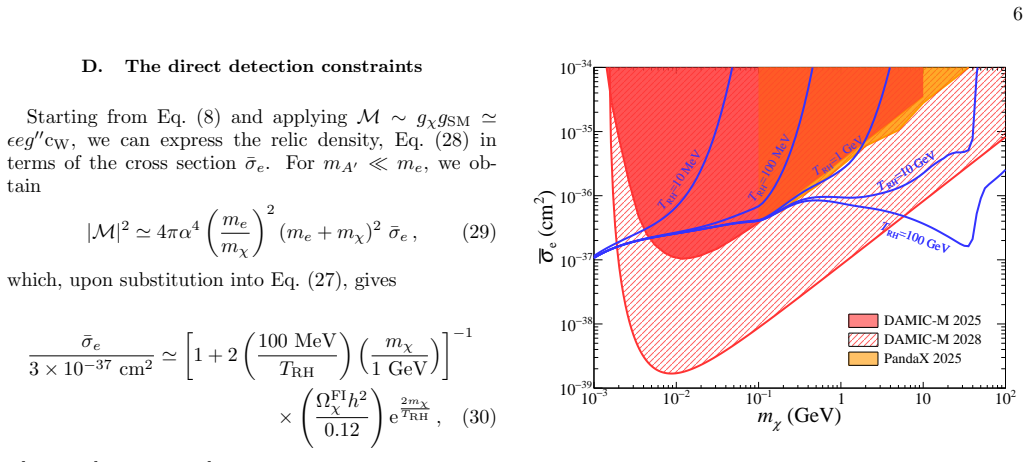
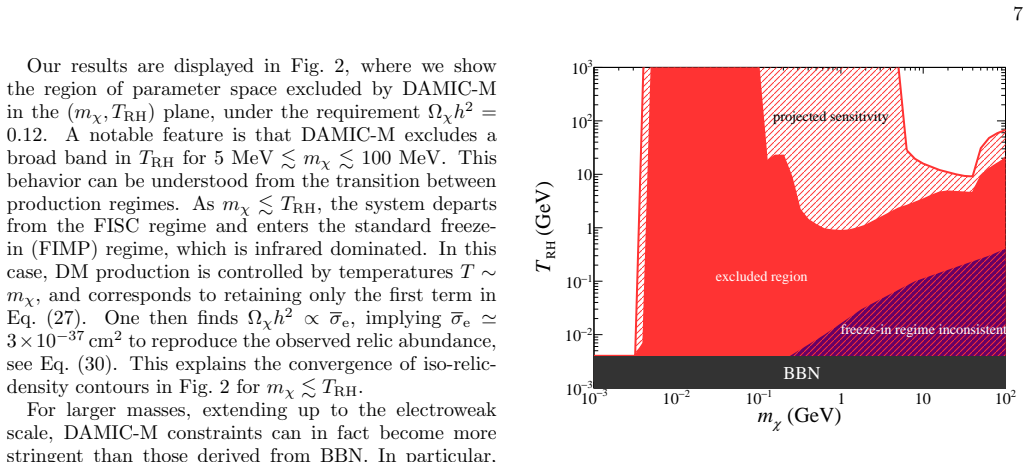
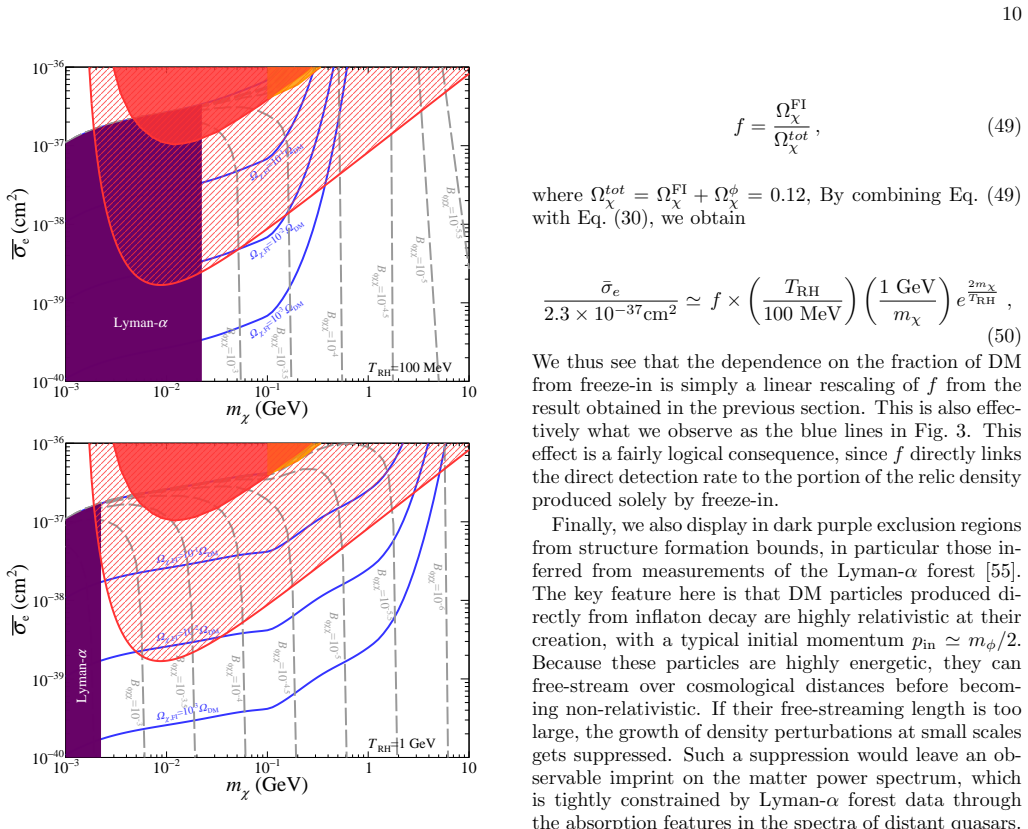
Recent results from the DAMIC-M and PandaX collaborations have excluded the standard freeze-in production of dark matter for masses in the range $3~\mathrm{MeV} \lesssim m_\chi \lesssim 1~\mathrm{GeV}$ in the context of extensions of the Standard Model featuring an additional ultra-light $U(1)_{\rm X}$ gauge boson. In this work, we analyze the constraints induced by DAMIC-M and PandaX results on the reheating temperature in freeze-in models at stronger coupling, or when a non-thermal source (such as inflaton decay) comes into play. We identify viable scenarios in which the DM relic abundance is correctly reproduced while evading current experimental bounds on the electron-scattering cross section, $\overline{\sigma}_\mathrm{e}$. In particular, we show that for reheating temperatures below the electroweak scale, Boltzmann suppressed production can be compensated by stronger couplings, bringing freeze-in scenarios within present experimental reach. Finally, we study a hybrid scenario in which a small branching ratio of inflaton decay seeds a nonzero initial dark-matter abundance. We show that such contributions can significantly modify freeze-in predictions across broad regions of parameter space, offering an additional pathway for probing extremely feeble interactions.
Editorial analysis
A structured set of objections, weighed in public.
Referee Report
Summary. The manuscript analyzes constraints from DAMIC-M and PandaX on freeze-in dark matter production in models with an ultra-light U(1)_X gauge boson. It considers stronger DM-mediator couplings to offset Boltzmann suppression at reheating temperatures T_RH below the electroweak scale, as well as hybrid scenarios with a small inflaton branching ratio seeding an initial DM abundance. The central claim is that viable parameter regions exist where the observed relic density is reproduced while the electron-scattering cross section remains below current experimental bounds, thereby linking direct detection results to constraints on T_RH and inflaton properties.
Significance. If the numerical results hold, the work demonstrates that direct detection experiments can probe reheating temperatures below ~100 GeV in freeze-in scenarios and can test the effects of non-thermal inflaton contributions on the DM yield. This provides a concrete link between cosmological parameters (T_RH, inflaton branching) and observable DM scattering rates, extending the phenomenological reach of freeze-in models without requiring new production channels.
major comments (2)
- [Sections discussing the Boltzmann integration and viable parameter regions (around the relic-density formula and numeric] The central claim that stronger couplings compensate Boltzmann suppression at low T_RH while remaining in the freeze-in regime (abstract and viable-scenarios paragraph) requires explicit verification that the interaction rate satisfies Γ_int(T) ≪ H(T) for all relevant temperatures, including near T ~ m_χ. The skeptic concern is load-bearing: if the required coupling increase pushes the system into partial thermalization, the standard freeze-in yield integral no longer applies and the quoted viable regions would need recalculation.
- [Hybrid scenario analysis and associated parameter-space plots] The hybrid inflaton-seeded scenario assumes the inflaton branching ratio contributes only a small initial abundance that is then augmented by freeze-in; however, the manuscript does not quantify how large this branching ratio can be before the total yield deviates from the pure freeze-in prediction or before late-time effects (e.g., entropy dilution) become relevant. This boundary condition is needed to support the statement that such contributions “significantly modify freeze-in predictions across broad regions.”
minor comments (2)
- [Introduction and experimental constraints paragraph] Notation for the electron-scattering cross section σ_e is introduced without an explicit definition or reference to the standard formula used in DAMIC-M/PandaX analyses; adding the precise expression would improve clarity.
- [Results section] The abstract states results for 3 MeV ≲ m_χ ≲ 1 GeV but the full parameter scan ranges and mass dependence of the viable T_RH regions are not summarized in a single table or figure caption; a compact summary table would aid readability.
Simulated Author's Rebuttal
We thank the referee for the careful reading and constructive comments on our manuscript. We address each major comment below and will incorporate clarifications and additional verifications in a revised version.
read point-by-point responses
-
Referee: [Sections discussing the Boltzmann integration and viable parameter regions (around the relic-density formula and numeric] The central claim that stronger couplings compensate Boltzmann suppression at low T_RH while remaining in the freeze-in regime (abstract and viable-scenarios paragraph) requires explicit verification that the interaction rate satisfies Γ_int(T) ≪ H(T) for all relevant temperatures, including near T ~ m_χ. The skeptic concern is load-bearing: if the required coupling increase pushes the system into partial thermalization, the standard freeze-in yield integral no longer applies and the quoted viable regions would need recalculation.
Authors: We agree that explicit verification of the freeze-in condition is necessary to support the central claim. Although the parameter choices in our analysis were selected to maintain out-of-equilibrium production, we acknowledge that the manuscript would benefit from direct confirmation. In the revised version we will add a dedicated subsection with plots of Γ_int(T)/H(T) versus temperature for the boundary points of the viable regions (including the strongest couplings at low T_RH). These checks confirm that the ratio remains ≪ 1 (peaking below ~0.05 near T ~ m_χ), validating continued use of the standard freeze-in yield integral. The viable regions therefore do not require recalculation. revision: yes
-
Referee: [Hybrid scenario analysis and associated parameter-space plots] The hybrid inflaton-seeded scenario assumes the inflaton branching ratio contributes only a small initial abundance that is then augmented by freeze-in; however, the manuscript does not quantify how large this branching ratio can be before the total yield deviates from the pure freeze-in prediction or before late-time effects (e.g., entropy dilution) become relevant. This boundary condition is needed to support the statement that such contributions “significantly modify freeze-in predictions across broad regions.”
Authors: We accept that a quantitative boundary on the inflaton branching ratio strengthens the hybrid-scenario discussion. In the revised manuscript we will include an additional paragraph and a supplementary plot showing the maximum branching ratio (typically BR_φ→χ ≲ 10^{-12}–10^{-10} depending on m_χ and T_RH) for which the total yield deviates by less than 10% from the pure freeze-in result. For the small values adopted in our examples, the inflaton decays well before BBN, rendering entropy-dilution effects negligible. This delineation supports the claim that modest inflaton contributions modify predictions over broad parameter space while remaining within the hybrid regime. revision: yes
Circularity Check
No significant circularity; standard freeze-in equations applied to extended parameter space.
full rationale
The paper's central claim rests on solving the standard freeze-in yield integral (with or without an inflaton branching term) for T_reh below the electroweak scale and stronger couplings, then comparing the resulting relic density and electron-scattering cross section against external experimental bounds. No step reduces by construction to a fitted input, self-definition, or load-bearing self-citation chain; the relic-density formula is the conventional one and remains independent of the target viable regions. The analysis is therefore self-contained against external benchmarks.
Axiom & Free-Parameter Ledger
free parameters (3)
- reheating temperature T_RH
- inflaton branching ratio to DM
- DM-mediator coupling strength
axioms (2)
- domain assumption The dark matter relic density is set entirely by the freeze-in mechanism (thermal or inflaton-seeded) with no late-time entropy injection or additional production channels.
- domain assumption The U(1)_X gauge boson remains ultra-light and does not thermalize with the Standard Model bath.
Forward citations
Cited by 2 Pith papers
-
Gravitational ultra-relativistic freeze-out during general reheating
Generalizes UFO to T ~ a^{-ξ} and introduces GUFO from gravitational production, extending DM mass reach to 10^7 GeV for n=2 in matter-like reheating.
-
Freeze-in at all couplings
In low-reheating-temperature charged-parent freeze-in dark matter models, stronger couplings are viable if both dark matter and mediator number densities are tracked, with updated LHC and lepton-flavor-violation constraints.
Reference graph
Works this paper leans on
-
[1]
McDonald, Thermally generated gauge singlet scalars as self-interacting dark matter, Phys
J. McDonald, Thermally generated gauge singlet scalars as self-interacting dark matter, Phys. Rev. Lett.88, 091304 (2002), arXiv:hep-ph/0106249. 15
Pith/arXiv arXiv 2002
-
[2]
K.-Y. Choi and L. Roszkowski, E-WIMPs, AIP Conf. Proc.805, 30 (2005), arXiv:hep-ph/0511003
Pith/arXiv arXiv 2005
-
[3]
M. Shaposhnikov and I. Tkachev, The nuMSM, infla- tion, and dark matter, Phys. Lett. B639, 414 (2006), arXiv:hep-ph/0604236
Pith/arXiv arXiv 2006
-
[4]
A. Kusenko, Sterile neutrinos, dark matter, and the pul- sar velocities in models with a Higgs singlet, Phys. Rev. Lett.97, 241301 (2006), arXiv:hep-ph/0609081
Pith/arXiv arXiv 2006
-
[5]
K. Petraki and A. Kusenko, Dark-matter sterile neutrinos in models with a gauge singlet in the Higgs sector, Phys. Rev. D77, 065014 (2008), arXiv:0711.4646 [hep-ph]
Pith/arXiv arXiv 2008
-
[6]
L. J. Hall, K. Jedamzik, J. March-Russell, and S. M. West, Freeze-In Production of FIMP Dark Matter, JHEP 03, 080, arXiv:0911.1120 [hep-ph]
-
[7]
N. Bernal, M. Heikinheimo, T. Tenkanen, K. Tuominen, and V. Vaskonen, The Dawn of FIMP Dark Matter: A Review of Models and Constraints, Int. J. Mod. Phys. A 32, 1730023 (2017), arXiv:1706.07442 [hep-ph]
Pith/arXiv arXiv 2017
-
[8]
Y. Mambrini, K. A. Olive, J. Quevillon, and B. Zaldivar, Gauge Coupling Unification and Nonequilibrium Ther- mal Dark Matter, Phys. Rev. Lett.110, 241306 (2013), arXiv:1302.4438 [hep-ph]
Pith/arXiv arXiv 2013
-
[9]
X. Chu, Y. Mambrini, J. Quevillon, and B. Zaldivar, Thermal and non-thermal production of dark matter via Z’-portal(s), JCAP01, 034, arXiv:1306.4677 [hep-ph]
-
[10]
D. Chowdhury, E. Dudas, M. Dutra, and Y. Mambrini, Moduli Portal Dark Matter, Phys. Rev. D99, 095028 (2019), arXiv:1811.01947 [hep-ph]
Pith/arXiv arXiv 2019
-
[11]
N. Bernal, M. Dutra, Y. Mambrini, K. Olive, M. Peloso, and M. Pierre, Spin-2 Portal Dark Matter, Phys. Rev. D 97, 115020 (2018), arXiv:1803.01866 [hep-ph]
Pith/arXiv arXiv 2018
-
[12]
Y. Mambrini, N. Nagata, K. A. Olive, and J. Zheng, Vacuum Stability and Radiative Electroweak Symmetry Breaking in an SO(10) Dark Matter Model, Phys. Rev. D93, 111703 (2016), arXiv:1602.05583 [hep-ph]
Pith/arXiv arXiv 2016
-
[13]
Y. Mambrini, N. Nagata, K. A. Olive, J. Quevillon, and J. Zheng, Dark matter and gauge coupling unification in nonsupersymmetric SO(10) grand unified models, Phys. Rev. D91, 095010 (2015), arXiv:1502.06929 [hep-ph]
Pith/arXiv arXiv 2015
-
[14]
E. Dudas, Y. Mambrini, and K. Olive, Case for an EeV Gravitino, Phys. Rev. Lett.119, 051801 (2017), arXiv:1704.03008 [hep-ph]
Pith/arXiv arXiv 2017
-
[15]
K. Benakli, Y. Chen, E. Dudas, and Y. Mambrini, Min- imal model of gravitino dark matter, Phys. Rev. D95, 095002 (2017), arXiv:1701.06574 [hep-ph]
Pith/arXiv arXiv 2017
-
[16]
E. Dudas, T. Gherghetta, Y. Mambrini, and K. A. Olive, Inflation and High-Scale Supersymmetry with an EeV Gravitino, Phys. Rev. D96, 115032 (2017), arXiv:1710.07341 [hep-ph]
Pith/arXiv arXiv 2017
-
[17]
M. Lindner, Y. Mambrini, T. B. de Melo, and F. S. Queiroz, XENON1T anomaly: A light Z’ from a Two Higgs Doublet Model, Phys. Lett. B811, 135972 (2020), arXiv:2006.14590 [hep-ph]
arXiv 2020
-
[18]
G. Bhattacharyya, M. Dutra, Y. Mambrini, and M. Pierre, Freezing-in dark matter through a heavy invisible Z’, Phys. Rev. D98, 035038 (2018), arXiv:1806.00016 [hep-ph]
Pith/arXiv arXiv 2018
-
[19]
E. Dudas, L. Heurtier, Y. Mambrini, and B. Zaldivar, Ex- tra U(1), effective operators, anomalies and dark matter, JHEP11, 083, arXiv:1307.0005 [hep-ph]
-
[20]
Aggarwalet al.(DAMIC-M), Probing Benchmark Models of Hidden-Sector Dark Matter with DAMIC-M, Phys
K. Aggarwalet al.(DAMIC-M), Probing Benchmark Models of Hidden-Sector Dark Matter with DAMIC-M, Phys. Rev. Lett.135, 071002 (2025), arXiv:2503.14617 [hep-ex]
arXiv 2025
-
[21]
Zhanget al.(PandaX), Search for Light Dark Mat- ter with 259 Days of Data in PandaX-4T, Phys
M. Zhanget al.(PandaX), Search for Light Dark Mat- ter with 259 Days of Data in PandaX-4T, Phys. Rev. Lett.135, 211001 (2025), [Erratum: Phys.Rev.Lett. 136, 069901 (2026)], arXiv:2507.11930 [hep-ex]
arXiv 2025
-
[22]
X. Chu, T. Hambye, and M. H. G. Tytgat, The Four Basic Ways of Creating Dark Matter Through a Portal, JCAP05, 034, arXiv:1112.0493 [hep-ph]
-
[23]
R. Essig, J. Mardon, and T. Volansky, Direct Detection of Sub-GeV Dark Matter, Phys. Rev. D85, 076007 (2012), arXiv:1108.5383 [hep-ph]
Pith/arXiv arXiv 2012
-
[24]
P. N. Bhattiprolu, R. McGehee, and A. Pierce, Dark sink enhances the direct detection of freeze-in dark mat- ter, Phys. Rev. D110, L031702 (2024), arXiv:2312.14152 [hep-ph]
arXiv 2024
- [25]
- [26]
-
[27]
Fayet, The Fifth Force Charge as a Linear Combi- nation of Baryonic, Leptonic (orB−L) and Electric Charges, Phys
P. Fayet, The Fifth Force Charge as a Linear Combi- nation of Baryonic, Leptonic (orB−L) and Electric Charges, Phys. Lett. B227, 127 (1989)
1989
-
[28]
Holdom, Two U(1)’s and Epsilon Charge Shifts, Phys
B. Holdom, Two U(1)’s and Epsilon Charge Shifts, Phys. Lett. B166, 196 (1986)
1986
-
[29]
Fayet, MICROSCOPE limits for new long-range forces and implications for unified theories, Phys
P. Fayet, MICROSCOPE limits for new long-range forces and implications for unified theories, Phys. Rev. D97, 055039 (2018), arXiv:1712.00856 [hep-ph]
Pith/arXiv arXiv 2018
-
[30]
P. Fayet, MICROSCOPE limits on the strength of a new force, with comparisons to gravity and electromagnetism, Phys. Rev. D99, 055043 (2019), arXiv:1809.04991 [hep- ph]
Pith/arXiv arXiv 2019
-
[31]
D. Alonso-Gonz´ alez, D. Cerde˜ no, P. Foldenauer, and J. M. No, GeV-scale thermal dark matter from dark pho- tons: tightly constrained, yet allowed, JHEP04, 083, arXiv:2507.11376 [hep-ph]
-
[32]
Mambrini,Particles in the Dark Universe
Y. Mambrini,Particles in the Dark Universe. A Student’s Guide to Particle Physics and Cosmology(Springer, 2021)
2021
-
[33]
Sarkar, Big bang nucleosynthesis and physics beyond the standard model, Rept
S. Sarkar, Big bang nucleosynthesis and physics beyond the standard model, Rept. Prog. Phys.59, 1493 (1996), arXiv:hep-ph/9602260
Pith/arXiv arXiv 1996
-
[34]
M. Kawasaki, K. Kohri, and N. Sugiyama, Cosmological constraints on late time entropy production, Phys. Rev. Lett.82, 4168 (1999), arXiv:astro-ph/9811437
Pith/arXiv arXiv 1999
-
[35]
Hannestad, What is the lowest possible reheating tem- perature?, Phys
S. Hannestad, What is the lowest possible reheating tem- perature?, Phys. Rev. D70, 043506 (2004), arXiv:astro- ph/0403291
arXiv 2004
-
[36]
P. F. de Salas, M. Lattanzi, G. Mangano, G. Miele, S. Pastor, and O. Pisanti, Bounds on very low reheating scenarios after Planck, Phys. Rev. D92, 123534 (2015), arXiv:1511.00672 [astro-ph.CO]
Pith/arXiv arXiv 2015
-
[37]
Y. Mambrini and K. A. Olive, Gravitational Production of Dark Matter during Reheating, Phys. Rev. D103, 115009 (2021), arXiv:2102.06214 [hep-ph]
arXiv 2021
- [38]
-
[39]
S. E. Henrich, Y. Mambrini, and K. A. Olive, Aspects of gravitational portals and freeze-in during reheating, Phys. Rev. D111, 083501 (2025), arXiv:2412.13288 [hep- ph]
arXiv 2025
-
[40]
Barman, S
B. Barman, S. Cl´ ery, R. T. Co, Y. Mambrini, and K. A. 16 Olive, Gravity as a Portal to Reheating, Leptogenesis and Dark Matter, PoSCORFU2023, 054 (2024)
2024
- [41]
-
[42]
D. H. Lyth and D. Roberts, Cosmological consequences of particle creation during inflation, Phys. Rev. D57, 7120 (1998), arXiv:hep-ph/9609441
Pith/arXiv arXiv 1998
-
[43]
D. J. H. Chung, E. W. Kolb, and A. Riotto, Superheavy dark matter, Phys. Rev. D59, 023501 (1998), arXiv:hep- ph/9802238
arXiv 1998
-
[44]
V. A. Kuzmin and I. I. Tkachev, Ultrahigh-energy cosmic rays and inflation relics, Phys. Rept.320, 199 (1999), arXiv:hep-ph/9903542
Pith/arXiv arXiv 1999
-
[45]
D. J. H. Chung, P. Crotty, E. W. Kolb, and A. Ri- otto, On the Gravitational Production of Superheavy Dark Matter, Phys. Rev. D64, 043503 (2001), arXiv:hep- ph/0104100
arXiv 2001
-
[46]
E. W. Kolb and A. J. Long, Cosmological gravita- tional particle production and its implications for cos- mological relics, Rev. Mod. Phys.96, 045005 (2024), arXiv:2312.09042 [astro-ph.CO]
arXiv 2024
-
[47]
G. Choi, M. A. G. Garcia, W. Ke, Y. Mambrini, K. A. Olive, and S. Verner, Inflaton production of scalar dark matter through fluctuations and scattering, Phys. Rev. D110, 083512 (2024), arXiv:2406.06696 [hep-ph]
arXiv 2024
-
[48]
M. A. G. Garcia, W. Ke, Y. Mambrini, K. A. Olive, and S. Verner, Scalar field fluctuations and the production of dark matter, JCAP08, 039, arXiv:2502.20471 [hep-ph]
-
[49]
S. E. Henrich, M. Gross, Y. Mambrini, and K. A. Olive, Ultrarelativistic freeze-out during reheating, Phys. Rev. D112, 103538 (2025), arXiv:2505.04703 [hep-ph]
arXiv 2025
-
[50]
S. E. Henrich, Y. Mambrini, and K. A. Olive, Ultrarel- ativistic Freeze-Out: A Bridge from WIMPs to FIMPs, Phys. Rev. Lett.135, 221002 (2025), arXiv:2511.02117 [hep-ph]
arXiv 2025
-
[51]
S. E. Henrich, Y. Mambrini, and K. A. Olive, Z’ portal dark matter from post-inflationary reheating: WIMPs, FIMPs, and UFOs, JCAP04, 068, arXiv:2512.04229 [hep-ph]
-
[52]
M. Garny, A. Palessandro, M. Sandora, and M. S. Sloth, Theory and Phenomenology of Planckian Inter- acting Massive Particles as Dark Matter, JCAP02, 027, arXiv:1709.09688 [hep-ph]
-
[53]
K. Kaneta, Y. Mambrini, and K. A. Olive, Radiative pro- duction of nonthermal dark matter, Phys. Rev. D99, 063508 (2019), arXiv:1901.04449 [hep-ph]
Pith/arXiv arXiv 2019
-
[54]
M. A. G. Garcia, K. Kaneta, Y. Mambrini, and K. A. Olive, Reheating and Post-inflationary Produc- tion of Dark Matter, Phys. Rev. D101, 123507 (2020), arXiv:2004.08404 [hep-ph]
arXiv 2020
-
[55]
N. Bernal and Y. Xu, Polynomial inflation and dark mat- ter, Eur. Phys. J. C81, 877 (2021), arXiv:2106.03950 [hep-ph]
arXiv 2021
-
[56]
P. S. Bhupal Dev, A. Mazumdar, and S. Qutub, Con- straining Non-thermal and Thermal properties of Dark Matter, Front. in Phys.2, 26 (2014), arXiv:1311.5297 [hep-ph]
Pith/arXiv arXiv 2014
-
[57]
M. A. G. Garcia, K. Kaneta, Y. Mambrini, and K. A. Olive, Inflaton Oscillations and Post-Inflationary Reheat- ing, JCAP04, 012, arXiv:2012.10756 [hep-ph]
arXiv 2012
-
[58]
M. A. G. Garcia, K. Kaneta, Y. Mambrini, K. A. Olive, and S. Verner, Freeze-in from preheating, JCAP03(03), 016, arXiv:2109.13280 [hep-ph]
-
[59]
J. Ellis, M. A. G. Garcia, D. V. Nanopoulos, K. A. Olive, and M. Peloso, Post-Inflationary Gravitino Pro- duction Revisited, JCAP03, 008, arXiv:1512.05701 [astro-ph.CO]
-
[60]
J. Pradler and F. D. Steffen, Constraints on the Reheat- ing Temperature in Gravitino Dark Matter Scenarios, Phys. Lett. B648, 224 (2007), arXiv:hep-ph/0612291
Pith/arXiv arXiv 2007
- [61]
-
[62]
Y. Cado, M. Gross, Y. Mambrini, and K. Olive, Phe- nomenological constraints on Higgs reheating, Phys. Rev. D112, 115027 (2025), arXiv:2508.13155 [hep-ph]
arXiv 2025
-
[63]
V. Irˇ siˇ cet al., New Constraints on the free-streaming of warm dark matter from intermediate and small scale Lyman-αforest data, Phys. Rev. D96, 023522 (2017), arXiv:1702.01764 [astro-ph.CO]
Pith/arXiv arXiv 2017
-
[64]
Masina, Dark matter and dark radiation from evap- orating primordial black holes, Eur
I. Masina, Dark matter and dark radiation from evap- orating primordial black holes, Eur. Phys. J. Plus135, 552 (2020), arXiv:2004.04740 [hep-ph]
arXiv 2020
-
[65]
G. F. Giudice, E. W. Kolb, and A. Riotto, Largest tem- perature of the radiation era and its cosmological im- plications, Phys. Rev. D64, 023508 (2001), arXiv:hep- ph/0005123
arXiv 2001
-
[66]
Gondolo and G
P. Gondolo and G. Gelmini, Cosmic abundances of sta- ble particles: Improved analysis, Nucl. Phys. B360, 145 (1991)
1991
-
[67]
A. D. Dolgov and K. Kainulainen, Fermi-Dirac correc- tions to the relic abundances, Nucl. Phys. B402, 349 (1993), arXiv:hep-ph/9211231
Pith/arXiv arXiv 1993
-
[68]
I. Arnquistet al.(DAMIC-M), First Constraints from DAMIC-M on Sub-GeV Dark-Matter Particles Interact- ing with Electrons, Phys. Rev. Lett.130, 171003 (2023), arXiv:2302.02372 [hep-ex]
arXiv 2023
-
[69]
R. Kallosh and A. Linde, Universality Class in Conformal Inflation, JCAP07, 002, arXiv:1306.5220 [hep-th]
-
[70]
A. S. Joshipura and W. Rodejohann, Scaling in the neutrino mass matrix, Phys. Lett. B678, 276 (2009), arXiv:0905.2096 [hep-ph]
Pith/arXiv arXiv 2009
-
[71]
X.-G. He, A. S. Joshipura, W. Rodejohann, and S.- F. Wu, New predictions for neutrino mixing and lep- tonic CP violation, Phys. Lett. B596, 221 (2004), hep- ph/0405085
arXiv 2004
-
[72]
R. N. Mohapatra and W. Rodejohann, Broken mu-tau symmetry and leptonic CP violation, Phys. Rev. D72, 053001 (2005), hep-ph/0507312
Pith/arXiv arXiv 2005
-
[73]
S. N. Gninenko and N. V. Krasnikov, The Muon anoma- lous magnetic moment and a new light gauge boson, Phys. Lett. B513, 119 (2001), hep-ph/0102222
Pith/arXiv arXiv 2001
-
[74]
W. Altmannshofer, S. Gori, M. Pospelov, and I. Yavin, Neutrino Trident Production: A Powerful Probe of New Physics with Neutrino Beams, Phys. Rev. Lett.113, 091801 (2014), arXiv:1406.2332 [hep-ph]
Pith/arXiv arXiv 2014
-
[75]
S. N. Gninenko and N. V. Krasnikov, Probing the muon gµ −2 anomaly,L µ −L τ gauge boson and Dark Matter in dark photon experiments, Phys. Lett. B783, 24 (2018), arXiv:1801.10448 [hep-ph]
Pith/arXiv arXiv 2018
-
[76]
Akramiet al.(Planck), Planck 2018 results
Y. Akramiet al.(Planck), Planck 2018 results. X. Con- straints on inflation, Astron. Astrophys.641, A10 (2020), arXiv:1807.06211 [astro-ph.CO]
Pith/arXiv arXiv 2018
-
[77]
P. Fayet, The lightUboson as the mediator of a new force, coupled to a combination ofQ, B, Land dark mat- ter, Eur. Phys. J. C77, 53 (2017), arXiv:1611.05357 [hep- 17 ph]
Pith/arXiv arXiv 2017
-
[78]
X.-G. He, G. C. Joshi, H. Lew, and R. R. Volkas, Simplest Z ′ model, Phys. Rev. D44, 2118 (1991)
1991
-
[79]
X. G. He, G. C. Joshi, H. Lew, and R. R. Volkas, New Z ′ phenomenology, Phys. Rev. D43, 22 (1991)
1991
-
[80]
S. Baek, N. G. Deshpande, X. G. He, and P. Ko, Muon anomalousg−2 and gaugedL µ −L τ models, Phys. Rev. D64, 055006 (2001), arXiv:hep-ph/0104141
Pith/arXiv arXiv 2001
discussion (0)
Sign in with ORCID, Apple, or X to comment. Anyone can read and Pith papers without signing in.