Planning on Paper: Problem Decomposition with Diagrams in Introductory Computing
Pith reviewed 2026-06-30 19:52 UTC · model grok-4.3
The pith
Novice programmers' decomposition diagrams reveal multiple underlying models of program behavior with tensions between structural hierarchy and execution sequencing.
A machine-rendered reading of the paper's core claim, the machinery that carries it, and where it could break.
Core claim
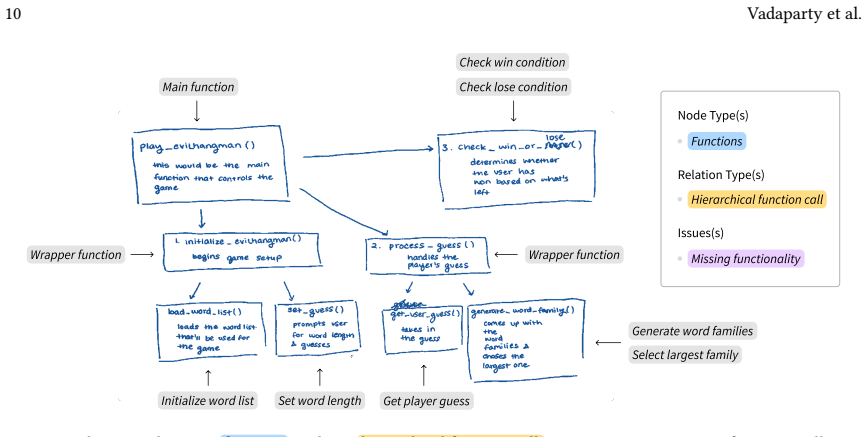
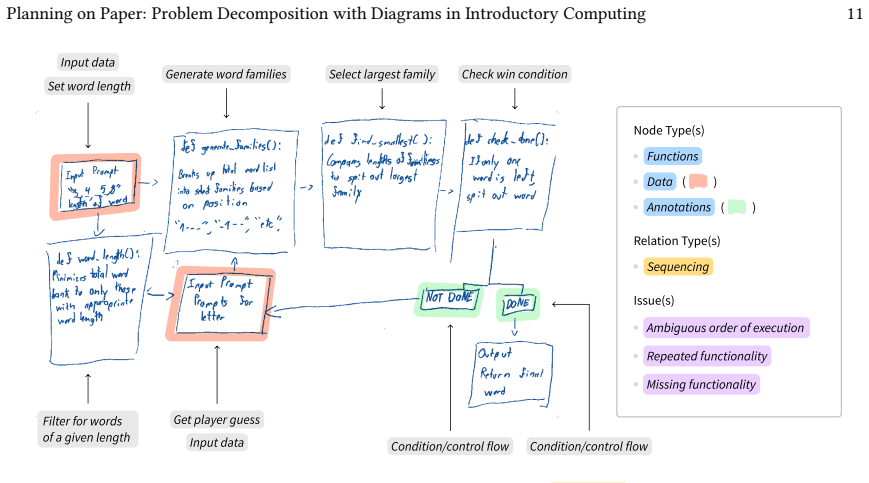
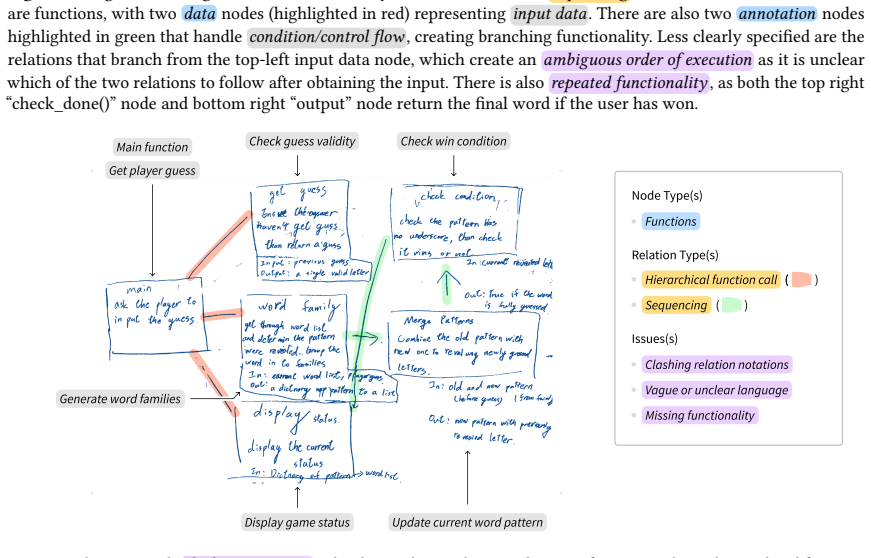
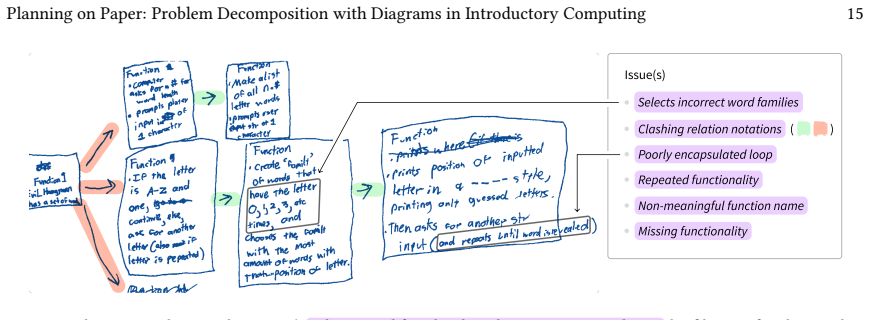
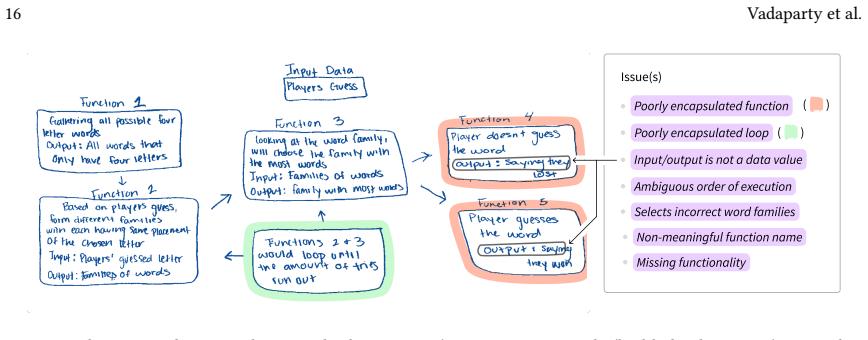
When CS1 students drew decomposition diagrams for a multifunction word-game program, they used both hierarchical function-call structures and sequencing of execution steps; diagrams frequently contained incompatible notations, unclear abstraction boundaries, missing reuse opportunities, and execution-order problems, indicating that novice decomposition is shaped by multiple models of program behavior with tensions between structural and sequence-focused reasoning.
What carries the argument
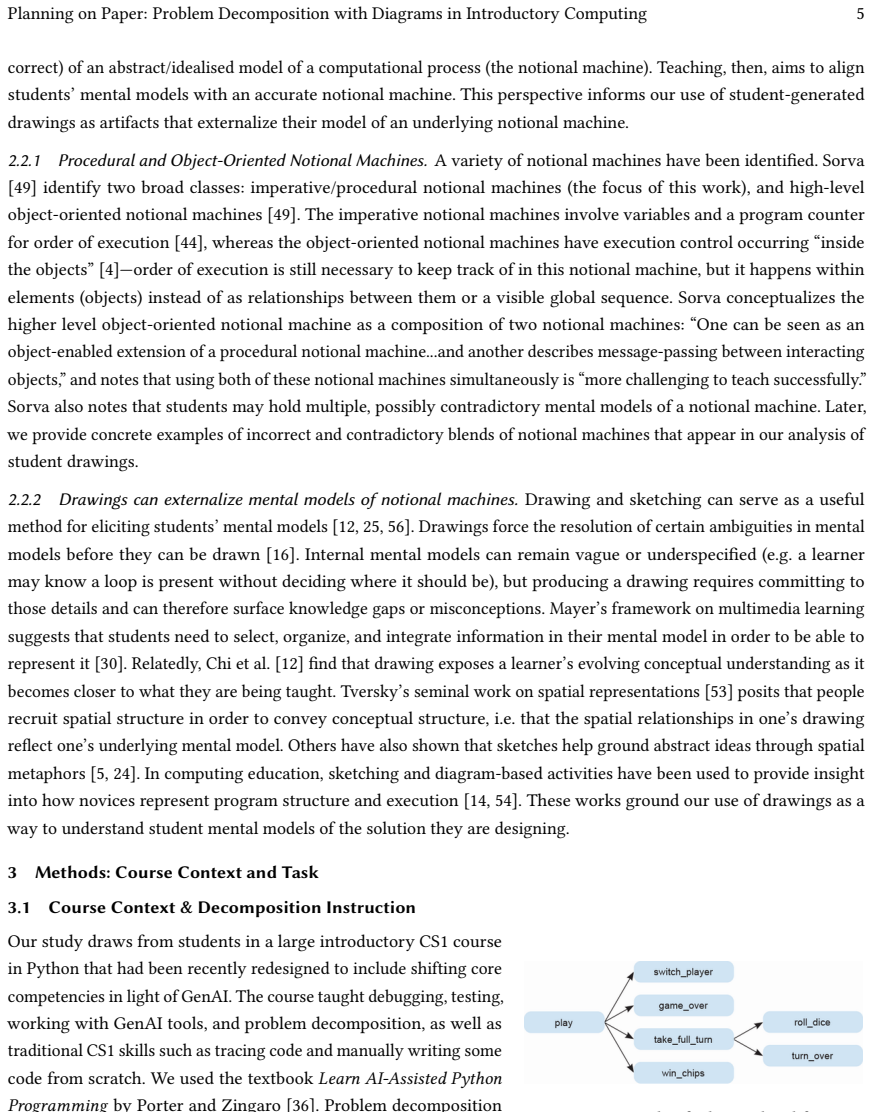
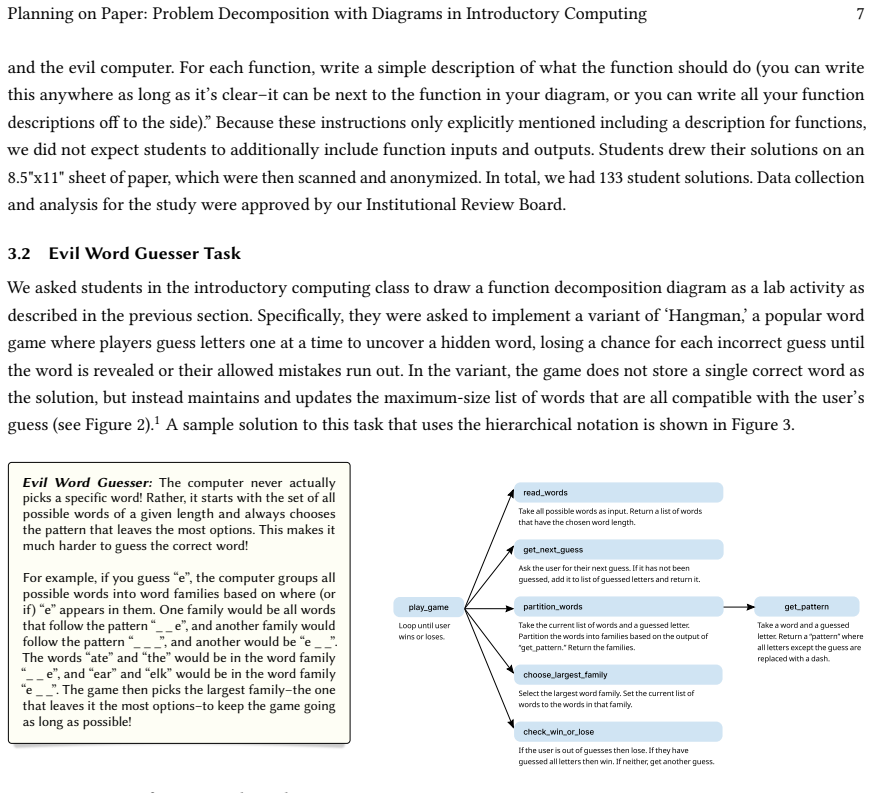
The pencil-and-paper decomposition diagram, which students used to externalize functions, their relationships, and execution order, serving as the primary data source for inductive thematic analysis.
If this is right
- Decomposition instruction should address both hierarchical structure and sequential execution to reduce conflicts between the two models.
- Explicit teaching of consistent notation conventions could reduce the incompatible-notation problems observed in student diagrams.
- Future work on plan tracing through simulation may help students test and refine their decompositions before coding.
- Instructional materials may need to target abstraction, reuse, and encapsulation skills separately from basic function identification.
Where Pith is reading between the lines
- The same diagram-drawing task could be used across different problem domains to test whether the structural-versus-sequential tension appears only in game-like specifications.
- Providing pre-drawn diagram templates might reveal whether the observed issues stem from lack of representational guidance or from deeper model conflicts.
- If the multiple-models pattern holds, AI-assisted planning tools may need to support both structural and sequential views rather than enforcing a single format.
Load-bearing premise
The diagrams students produced are accurate externalizations of their internal decomposition thinking and the thematic coding process surfaces the main issues without substantial bias from the drawing medium or researcher interpretation.
What would settle it
A controlled follow-up in which students receive explicit instruction on one consistent diagram notation and then produce diagrams showing no mixed notations or order-of-execution errors would indicate the multiple-models tension is not inherent.
Figures
read the original abstract
Background and Context. Problem decomposition is a core concern of computing education. It has also become increasingly relevant: in response to GenAI, many CS1 educators are advocating for shifting instructional emphasis away from code writing and towards decomposition and higher-level planning. Currently, there is a lack of knowledge in how novices do decomposition in large, multifunction tasks. Objectives. In this study, we describe how students represent solutions to a decomposition task, and characterize common issues that arise in those representations. Method. In a 50-minute lab, students were given a description of a word game and asked to draw (with pencil and paper) a decomposition diagram for a program that would implement this game. We performed an inductive thematic analysis with negotiated agreement on 55 of the diagrams, coding salient elements (e.g. functions and the relationships between them) and issues that arose. Findings. Students used multiple representational strategies, including hierarchical function calls and sequencing (order of execution). We identified issues in notation (including use of differing, incompatible notations within the same diagram), order of execution, abstraction and reuse, encapsulation, clarity, and problem-specific misunderstandings. Implications. These findings suggest that novice decomposition is shaped by multiple underlying models of program behavior, with tensions between structural and sequence-focused reasoning. We discuss implications for decomposition instruction and future work, including clarifying representational constraints and plan tracing as simulation.
Editorial analysis
A structured set of objections, weighed in public.
Referee Report
Summary. The paper reports an inductive thematic analysis with negotiated agreement of 55 pencil-and-paper decomposition diagrams produced by introductory computing students in a 50-minute lab task involving a word game. Students employed multiple representational strategies (hierarchical function calls and sequencing of execution order); the analysis identifies recurring issues in notation (including mixed incompatible notations), order of execution, abstraction/reuse, encapsulation, clarity, and problem-specific misunderstandings. The authors conclude that these patterns indicate novice decomposition is shaped by multiple underlying models of program behavior, with tensions between structural and sequence-focused reasoning, and discuss implications for decomposition instruction.
Significance. If the mapping from static diagrams to cognitive models is valid, the study supplies a concrete descriptive account of how novices externalize decomposition in a multifunction task, which is timely for CS1 instruction emphasizing planning over code writing. The negotiated-agreement thematic analysis on authentic student artifacts is a strength, though the absence of validation data limits the strength of the cognitive-model claims.
major comments (2)
- [Findings / Implications] Findings and Implications sections: The claim that observed strategies reflect 'tensions between structural and sequence-focused reasoning' and 'multiple underlying models of program behavior' rests on an unvalidated interpretive mapping from static diagrams to internal cognitive models. The reported procedure (inductive coding of salient elements and issues on 55 diagrams) does not include think-aloud protocols, interviews, or member-checking that would distinguish representational choices from pre-existing models of program behavior.
- [Method] Method section: The description of the inductive thematic analysis supplies only high-level information on coding of salient elements and issues. Specific coding criteria, decision rules for distinguishing problem-specific misunderstandings from general issues, and the precise process for negotiated agreement are not reported, which bears on the reliability of the thematic categories that support the central claim.
minor comments (2)
- [Abstract] Abstract: The method paragraph could state the exact task prompt and sample demographics to allow readers to assess generalizability without consulting the full text.
- The paper would benefit from one or two additional example diagrams (with annotations) that illustrate the distinction between hierarchical and sequencing strategies.
Simulated Author's Rebuttal
We thank the referee for their constructive comments, which highlight important limitations in the interpretive scope and methodological transparency of our work. We address each major comment below and outline revisions to strengthen the manuscript while remaining faithful to the data collected.
read point-by-point responses
-
Referee: [Findings / Implications] Findings and Implications sections: The claim that observed strategies reflect 'tensions between structural and sequence-focused reasoning' and 'multiple underlying models of program behavior' rests on an unvalidated interpretive mapping from static diagrams to internal cognitive models. The reported procedure (inductive coding of salient elements and issues on 55 diagrams) does not include think-aloud protocols, interviews, or member-checking that would distinguish representational choices from pre-existing models of program behavior.
Authors: We agree that the mapping from observed diagram features to claims about internal cognitive models is interpretive rather than directly validated. The study was designed as a descriptive analysis of external representations produced in a time-constrained lab task, and the patterns (e.g., mixed notations, sequencing vs. hierarchy) are grounded in the artifacts themselves. However, we acknowledge that stronger assertions about 'underlying models' would benefit from additional data sources. We will revise the Findings and Implications sections to present these as observed tensions in representational strategies and hypothesized links to program-behavior models, while adding an explicit limitations paragraph noting the absence of think-aloud or interview validation. This preserves the descriptive contribution without overstating the cognitive inferences. revision: partial
-
Referee: [Method] Method section: The description of the inductive thematic analysis supplies only high-level information on coding of salient elements and issues. Specific coding criteria, decision rules for distinguishing problem-specific misunderstandings from general issues, and the precise process for negotiated agreement are not reported, which bears on the reliability of the thematic categories that support the central claim.
Authors: We accept this critique. The current Method section provides only a high-level overview of the inductive process and negotiated agreement. We will expand it with concrete details: (1) the initial codebook development, (2) explicit decision rules and examples for distinguishing problem-specific misunderstandings (e.g., incorrect word-game logic) from general decomposition issues (e.g., notation conflicts), and (3) the exact negotiated-agreement protocol, including how the two coders resolved disagreements and the final agreement rate. These additions will be placed in the main text or a supplementary appendix to allow readers to assess category reliability. revision: yes
- The study did not collect think-aloud protocols, interviews, or member-checking data; therefore we cannot retroactively validate the mapping from diagrams to internal cognitive models without conducting new data collection.
Circularity Check
No circularity: empirical qualitative analysis of student artifacts
full rationale
This paper reports an inductive thematic analysis of 55 pencil-and-paper decomposition diagrams produced by novices in a single 50-minute task. The method codes salient elements and issues directly from the artifacts with negotiated agreement; no equations, fitted parameters, model predictions, or load-bearing self-citations appear. All claims (representational strategies, issues in notation/abstraction, tensions between structural and sequence-focused reasoning) are presented as observations from the coded data rather than derivations that reduce to inputs by construction. The study is therefore self-contained against external benchmarks with no circular steps.
Axiom & Free-Parameter Ledger
axioms (2)
- domain assumption Student pencil-and-paper diagrams are valid proxies for their internal decomposition models
- domain assumption Thematic analysis with negotiated agreement produces reliable characterizations of issues
Reference graph
Works this paper leans on
-
[1]
Shaaron Ainsworth. 1999. The functions of multiple representations.Computers & education33, 2-3 (1999), 131–152
1999
-
[2]
Shaaron Ainsworth. 2006. DeFT: A conceptual framework for considering learning with multiple representations.Learning and instruction16, 3 (2006), 183–198
2006
-
[3]
Valerie Barr and Chris Stephenson. 2011. Bringing computational thinking to K-12: What is involved and what is the role of the computer science education community?ACM inroads2, 1 (2011), 48–54
2011
-
[4]
Joseph Bergin. 2000. Why procedural is the wrong first paradigm if OOP is the goal.URL: http://csis. pace. edu/ bergin/papers/Whynotproceduralfirst. html(2000)
2000
-
[5]
Alan F Blackwell, Kirsten N Whitley, Judith Good, and Marian Petre. 2001. Cognitive factors in programming with diagrams.Artificial Intelligence Review15, 1 (2001), 95–114
2001
-
[6]
Virginia Braun and Victoria Clarke. 2006. Using thematic analysis in psychology.Qualitative research in psychology3, 2 (2006), 77–101
2006
-
[7]
Virginia Braun and Victoria Clarke. 2019. Reflecting on reflexive thematic analysis.Qualitative research in sport, exercise and health11, 4 (2019), 589–597
2019
-
[8]
Virginia Braun and Victoria Clarke. 2021. To saturate or not to saturate? Questioning data saturation as a useful concept for thematic analysis and sample-size rationales.Qualitative research in sport, exercise and health13, 2 (2021), 201–216
2021
-
[9]
John L Campbell, Charles Quincy, Jordan Osserman, and Ove K Pedersen. 2013. Coding in-depth semistructured interviews: Problems of unitization and intercoder reliability and agreement.Sociological methods & research42, 3 (2013), 294–320
2013
-
[10]
Richard Catrambone. 1998. The subgoal learning model: Creating better examples so that students can solve novel problems.Journal of experimental psychology: General127, 4 (1998), 355
1998
-
[11]
Mauro Cherubini, Gina Venolia, Rob DeLine, and Amy J Ko. 2007. Let’s go to the whiteboard: how and why software developers use drawings. In Proceedings of the SIGCHI conference on Human factors in computing systems. 557–566
2007
-
[12]
Michelene TH Chi, Stephanie A Siler, Heisawn Jeong, Takashi Yamauchi, and Robert G Hausmann. 2001. Learning from human tutoring.Cognitive science25, 4 (2001), 471–533
2001
-
[13]
Albert T Corbett and John R Anderson. 1995. Knowledge decomposition and subgoal reification in the ACT programming tutor. (1995)
1995
-
[14]
Kathryn Cunningham, Sarah Blanchard, Barbara Ericson, and Mark Guzdial. 2017. Using tracing and sketching to solve programming problems: Replicating and extending an analysis of what students draw. InProceedings of the 2017 ACM Conference on international computing education research. 164–172
2017
-
[15]
Michael De Raadt, Richard Watson, and Mark Toleman. 2009. Teaching and assessing programming strategies explicitly. InProceedings of the Eleventh Australasian Conference on Computing Education, Vol. 95. 45–54
2009
-
[16]
Alan Dix and Layda Gongora. 2011. Externalisation and design. InProcedings of the second conference on creativity and innovation in design. 31–42
2011
-
[17]
Benedict Du Boulay, Tim O’Shea, and John Monk. 1981. The black box inside the glass box: presenting computing concepts to novices.International Journal of man-machine studies14, 3 (1981), 237–249. Manuscript submitted to ACM Planning on Paper: Problem Decomposition with Diagrams in Introductory Computing 21
1981
-
[18]
2018.How to design programs: an introduction to programming and computing
Matthias Felleisen, Robert Bruce Findler, Matthew Flatt, and Shriram Krishnamurthi. 2018.How to design programs: an introduction to programming and computing. MIT Press
2018
-
[19]
Sally Fincher, Johan Jeuring, Craig S Miller, Peter Donaldson, Benedict Du Boulay, Matthias Hauswirth, Arto Hellas, Felienne Hermans, Colleen Lewis, Andreas Mühling, et al. 2020. Notional machines in computing education: The education of attention. InProceedings of the working group reports on innovation and technology in computer science education. 21–50
2020
-
[20]
Kathi Fisler, Shriram Krishnamurthi, and Janet Siegmund. 2016. Modernizing plan-composition studies. InProceedings of the 47th ACM Technical Symposium on Computing Science Education. 211–216
2016
-
[21]
David Grove, Greg DeFouw, Jeffrey Dean, and Craig Chambers. 1997. Call graph construction in object-oriented languages. InProceedings of the 12th ACM SIGPLAN conference on Object-oriented programming, systems, languages, and applications. 108–124
1997
-
[22]
Georgiana Haldeman, Peter Ohmann, and Paul Denny. 2026. Systematically Thinking about the Complexity of Code Structuring Exercises at Introductory Level. InProceedings of the 57th ACM Technical Symposium on Computer Science Education V. 1. 442–448
2026
-
[23]
David Hammer and Leema K Berland. 2014. Confusing claims for data: A critique of common practices for presenting qualitative research on learning.Journal of the Learning Sciences23, 1 (2014), 37–46
2014
-
[24]
David G Hendry. 2006. Sketching with Conceptual Metaphors to Explain Computational Processes. In2006 IEEE Symposium on Visual Languages and Human-Centric Computing (VL/HCC). 95–102
2006
-
[25]
Jones, Helen Ross, Timothy Lynam, Pascal Perez, and Anne Leitch
Natalie A. Jones, Helen Ross, Timothy Lynam, Pascal Perez, and Anne Leitch. 2011. Mental Models: An Interdisciplinary Synthesis of Theory and Methods.Ecology and Society16, 1 (2011)
2011
-
[26]
Thomas D LaToza and Brad A Myers. 2011. Visualizing call graphs. In2011 IEEE Symposium on Visual Languages and Human-Centric Computing (VL/HCC). 117–124
2011
-
[27]
Marcia C Linn and John Dalbey. 1985. Cognitive consequences of programming instruction: Instruction, access, and ability.Educational Psychologist 20, 4 (1985), 191–206
1985
-
[28]
Raymond Lister, Elizabeth S Adams, Sue Fitzgerald, William Fone, John Hamer, Morten Lindholm, Robert McCartney, Jan Erik Moström, Kate Sanders, Otto Seppälä, et al. 2004. A multi-national study of reading and tracing skills in novice programmers.ACM SIGCSE bulletin36, 4 (2004), 119–150
2004
-
[29]
Dastyni Loksa, Amy J Ko, Will Jernigan, Alannah Oleson, Christopher J Mendez, and Margaret M Burnett. 2016. Programming, problem solving, and self-awareness: Effects of explicit guidance. InProceedings of the 2016 CHI conference on human factors in computing systems. 1449–1461
2016
-
[30]
Richard E Mayer. 2002. Multimedia learning. InPsychology of learning and motivation. Vol. 41. Elsevier, 85–139
2002
-
[31]
Orna Muller, David Ginat, and Bruria Haberman. 2007. Pattern-oriented instruction and its influence on problem decomposition and solution construction. InProceedings of the 12th annual SIGCSE conference on Innovation and technology in computer science education. 151–155
2007
-
[32]
1972.Human problem solving
Allen Newell, Herbert Alexander Simon, et al. 1972.Human problem solving. Vol. 104. Prentice-hall Englewood Cliffs, NJ
1972
-
[33]
Aadarsh Padiyath and Tamara Nelson-Fromm. 2026. Reflecting on Thematic Analysis in Computer Science Education Research: A Field Guide for Researchers and Reviewers. InProceedings of the 57th ACM Technical Symposium on Computer Science Education V. 1. 790–796
2026
-
[34]
David Lorge Parnas. 1972. On the criteria to be used in decomposing systems into modules.Commun. ACM15, 12 (1972), 1053–1058
1972
-
[35]
Nancy Pennington. 1987. Stimulus structures and mental representations in expert comprehension of computer programs.Cognitive psychology19, 3 (1987), 295–341
1987
-
[36]
2024.Learn AI-assisted Python programming: with github copilot and ChatGPT
Leo Porter and Daniel Zingaro. 2024.Learn AI-assisted Python programming: with github copilot and ChatGPT. Manning
2024
-
[37]
James Prather, Juho Leinonen, Natalie Kiesler, Jamie Gorson Benario, Sam Lau, Stephen MacNeil, Narges Norouzi, Simone Opel, Vee Pettit, Leo Porter, Brent N. Reeves, Jaromir Savelka, David H. Smith IV, Sven Strickroth, and Daniel Zingaro. 2025. Beyond the Hype: A Comprehensive Review of Current Trends in Generative AI Research, Teaching Practices, and Tool...
-
[38]
Peter J Rich, Garrett Egan, and Jordan Ellsworth. 2019. A framework for decomposition in computational thinking. InProceedings of the 2019 ACM conference on innovation and technology in computer science education. 416–421
2019
-
[39]
Robert S Rist. 1989. Schema creation in programming.Cognitive science13, 3 (1989), 389–414
1989
-
[40]
Robert S Rist. 1991. Knowledge creation and retrieval in program design: A comparison of novice and intermediate student programmers. Human-Computer Interaction6, 1 (1991), 1–46
1991
-
[41]
Elijah Rivera, Kathi Fisler, and Shriram Krishnamurthi. 2024. Observations on the Design of Program Planning Notations for Students. InProceedings of the 55th ACM Technical Symposium on Computer Science Education V. 1. 1133–1139
2024
-
[42]
Elijah Rivera, Shriram Krishnamurthi, and Robert Goldstone. 2022. Plan composition using higher-order functions. InProceedings of the 2022 ACM Conference on International Computing Education Research-Volume 1. 84–104
2022
-
[43]
Anthony Robins, Janet Rountree, and Nathan Rountree. 2003. Learning and Teaching Programming: A Review and Discussion.Computer Science Education13, 2 (2003), 137–172
2003
-
[44]
Jorma Sajaniemi and Marja Kuittinen. 2008. From procedures to objects: A research agenda for the psychology of object-oriented programming education.Human technology4, 1 (2008), 75–91
2008
-
[45]
Mario Luis Small. 2009. How many cases do I need?’ On science and the logic of case selection in field-based research.Ethnography10, 1 (2009), 5–38
2009
-
[46]
Elliot Soloway. 1986. Learning to program = learning to construct mechanisms and explanations.Commun. ACM29, 9 (1986), 850–858. Manuscript submitted to ACM 22 Vadaparty et al
1986
-
[47]
Ting Song and Kurt Becker. 2014. Expert vs. novice: Problem decomposition/recomposition in engineering design. In2014 International Conference on interactive collaborative learning (ICL). IEEE, 181–190
2014
-
[48]
Ting Song, Kurt Becker, John Gero, Scott DeBerard, Oenardi DeBerard, and Edward Reeve. 2016. Problem Decomposition and Recomposition in Engineering Design: A Comparison of Design Behavior between Professional Engineers, Engineering Seniors, and Engineering Freshmen.Journal of Technology Education27, 2 (2016), 37–56
2016
-
[49]
Juha Sorva. 2013. Notional machines and introductory programming education.ACM Trans. Comput. Educ.13, 2, Article 8 (2013), 31 pages. https://doi.org/10.1145/2483710.2483713
-
[50]
James C Spohrer and Elliot Soloway. 1986. Novice mistakes: Are the folk wisdoms correct?Commun. ACM29, 7 (1986), 624–632
1986
-
[51]
Stevens, Glenford J
Wayne P. Stevens, Glenford J. Myers, and Larry L. Constantine. 1974. Structured design.IBM Syst. J.13, 2 (June 1974), 115–139
1974
-
[52]
Physics of Notations
Harald Störrle and Andrew Fish. 2013. Towards an Operationalization of the “Physics of Notations” for the Analysis of Visual Languages. In International Conference on Model Driven Engineering Languages and Systems. Springer, 104–120
2013
-
[53]
Barbara Tversky. 2011. Visualizing thought. Topics in Cognitive Science, 3 (3), 499–535
2011
-
[54]
Jacqueline Whalley, Christine Prasad, and PK Ajith Kumar. 2007. Decoding doodles: novice programmers and their annotations. InACM International Conference Proceeding Series, Vol. 239. 171–178
2007
-
[55]
Lee J White. 1987. Software testing and verification. InAdvances in computers. Vol. 26. Elsevier, 335–391
1987
-
[56]
Katy Williams, Alex Bigelow, and Katherine E. Isaacs. 2023. Data Abstraction Elephants: The Initial Diversity of Data Representations and Mental Models. InProceedings of the 2023 CHI Conference on Human Factors in Computing Systems(Hamburg, Germany)(CHI ’23). Association for Computing Machinery, New York, NY, USA, Article 803, 24 pages. doi:10.1145/354454...
-
[57]
Jeannette M Wing. 2006. Computational thinking.Commun. ACM49, 3 (2006), 33–35
2006
-
[58]
Titus Winters. 2026. CS and SE Education, Post-AI. InProceedings of the 57th ACM Technical Symposium on Computer Science Education V. 1. 2–2
2026
- [59]
-
[60]
Hong Zhu. 1995. Axiomatic assessment of control flow-based software test adequacy criteria.Software Engineering Journal10, 5 (1995), 194–204. Received 27 February 2026; revised 1 May 2026; accepted 12 May 2026 Manuscript submitted to ACM
1995
discussion (0)
Sign in with ORCID, Apple, or X to comment. Anyone can read and Pith papers without signing in.