New bounds on private simultaneous quantum message passing
Pith reviewed 2026-06-27 09:25 UTC · model grok-4.3
The pith
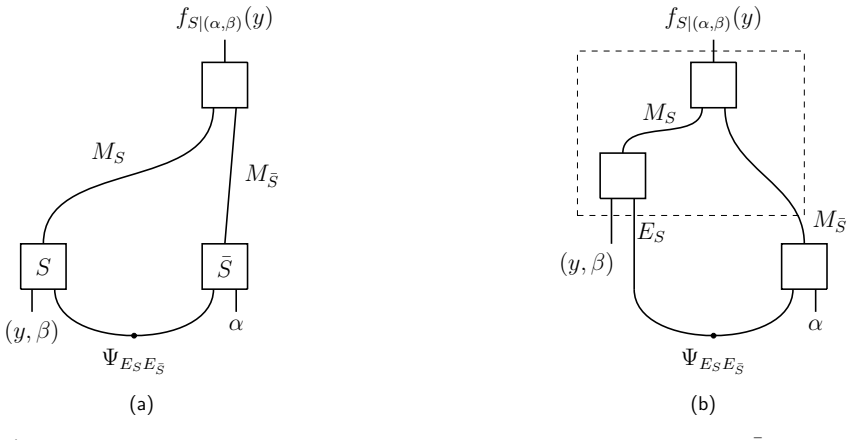
Nečiporuk's measure lower bounds entanglement for k-player quantum PSM with perfect correctness, while circuit size upper bounds the communication cost.
A machine-rendered reading of the paper's core claim, the machinery that carries it, and where it could break.
Core claim
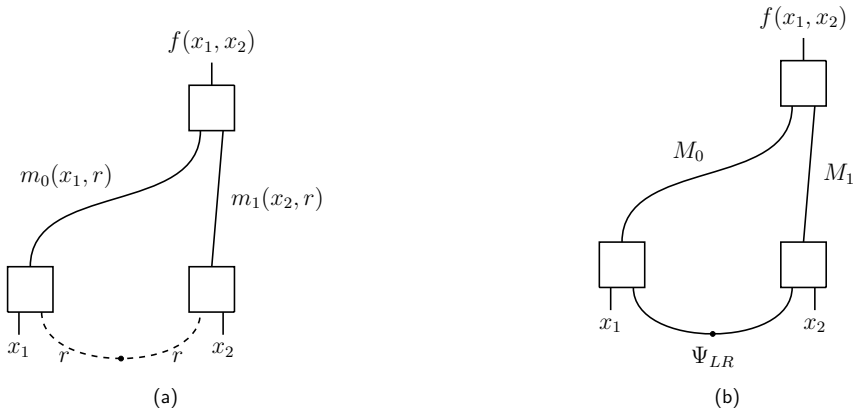
Nečiporuk's measure lower bounds the entanglement required for k-player quantum PSM with perfect correctness. This leads to quadratic lower bounds for explicit functions. The rank of the communication matrix of f(x1,x2) lower bounds 2-player quantum PSM with perfect privacy but imperfect correctness. Letting s be the size of a quantum circuit computing f, df its depth, k the number of players, n the input length per player, and ε a correctness parameter, PSM_k^*(f) ≤ (kn + s) · log^{O(df)}(s/ε). Also, PSM(f) ≤ O(∥f̂∥_1²).
What carries the argument
Nečiporuk's measure for entanglement lower bounds in perfect k-party quantum PSM, together with generalization of T-depth techniques from non-local quantum computation to k parties with restricted Clifford light cones for the circuit-size upper bound.
If this is right
- Quadratic lower bounds hold for explicit functions in k-player quantum PSM with perfect correctness.
- The communication-matrix rank yields the first lower bounds on quantum PSM that use the privacy condition.
- PSM complexity is at most linear in circuit size times a logarithmic factor in depth.
- Classical PSM complexity is bounded above by the square of the Fourier 1-norm of f.
- The matrix-rank bound implies a new lower bound for classical PSM with imperfect correctness.
Where Pith is reading between the lines
- The bounds may limit the quantum advantage possible in secure multiparty computation for functions with large Nečiporuk measure.
- The upper-bound construction suggests that depth-bounded quantum circuits can be turned into low-communication PSM protocols by controlling light cones in Clifford layers.
- Tightness could be tested by comparing the new bounds against known PSM costs for functions such as equality or disjointness.
Load-bearing premise
The T-depth based techniques for non-local quantum computation can be generalized from 2 to k parties while restricting Clifford layers to small light cones.
What would settle it
An explicit function f where the minimal shared entanglement for perfect-correctness k-player quantum PSM is strictly smaller than the Nečiporuk measure of f.
Figures
read the original abstract
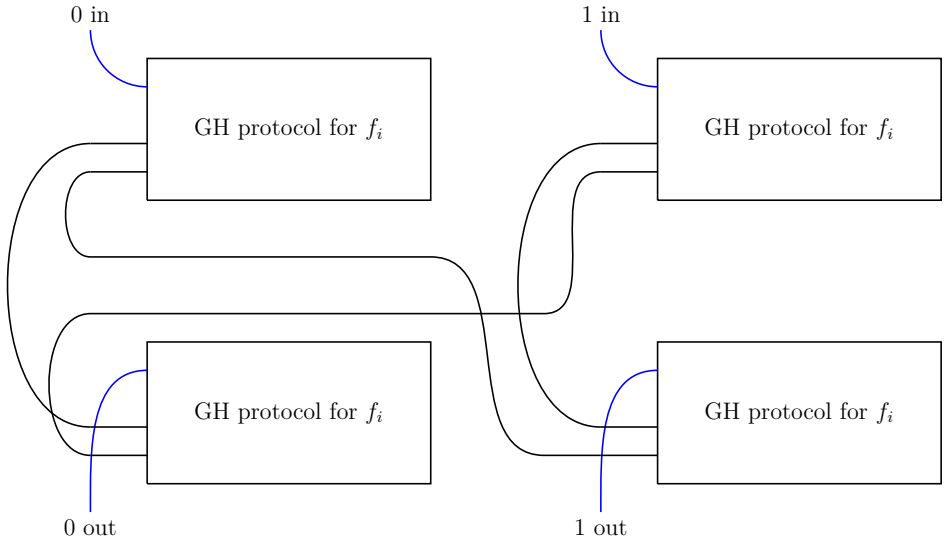
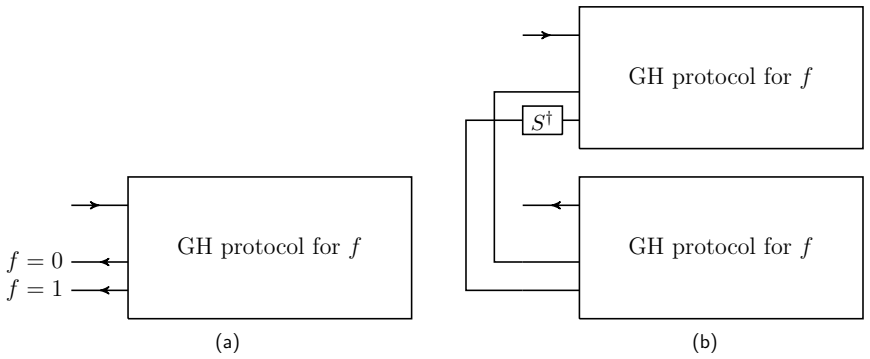
In the private simultaneous message (PSM) setting, $k$ players obtain inputs $x_i\in\{0,1\}^n$ and then each send messages to a referee, who should learn $f(x_1,...,x_k)$ but no other information about $(x_1,...,x_k)$. The PSM setting was introduced as a minimal model for secure multiparty computation and has connections to Boolean function complexity. In the quantum setting, PSM has been related to non-local quantum computation (NLQC). The communication and correlation cost of implementing PSM remains poorly understood. Here, we give new upper and lower bounds on the (quantum) PSM model. For lower bounds, we show: 1) Ne\v{c}iporuk's measure lower bounds the entanglement required for $k$-player quantum PSM with perfect correctness. This leads to quadratic lower bounds for explicit functions. 2) The rank of the communication matrix of $f(x_1,x_2)$ lower bounds 2-player quantum PSM with perfect privacy but imperfect correctness. This implies a previously unknown lower bound on classical PSM with imperfect correctness. When allowing quantum communication and shared entanglement, these are the first lower bounds on quantum PSM that make use of the privacy condition. For upper bounds, we show: 1) Letting $s$ be the size of a quantum circuit computing $f$, $d_f$ be the circuit depth, $k$ the number of players, $n$ the number of bits received by each player, and $\epsilon$ a correctness parameter, we obtain $\mathsf{PSM}_k^*(f) \leq (kn +s) \cdot \log^{O(d_f)}(s/\epsilon)$. 2) The square of the Fourier 1 norm of $f$, $\Vert \hat{f}\Vert_1^2$, upper bounds the classical PSM complexity, $\mathsf{PSM}(f)\leq O(\Vert \hat{f} \Vert^2_1)$. In proving the first upper bound, we generalize existing $T$-depth based techniques for NLQC from $2$ to $k\geq 2$ parties, and consider cases where the Clifford layers are restricted to having small light cones.
Editorial analysis
A structured set of objections, weighed in public.
Referee Report
Summary. The paper establishes new upper and lower bounds for quantum private simultaneous message passing (PSM). Lower bounds include: Nečiporuk's measure bounding entanglement in k-player quantum PSM with perfect correctness (yielding quadratic bounds for explicit functions), and the rank of the communication matrix of f(x1,x2) bounding 2-player quantum PSM with perfect privacy but imperfect correctness (implying a new classical PSM lower bound). Upper bounds are: PSM_k^*(f) ≤ (kn + s) · log^{O(d_f)}(s/ε) via a generalization of T-depth NLQC techniques to k parties with small-light-cone Clifford layers, and PSM(f) ≤ O(∥f̂∥_1²) from the Fourier 1-norm.
Significance. If the stated bounds and the NLQC generalization hold, the work supplies the first privacy-based lower bounds on quantum PSM and connects PSM complexity to standard Boolean-function measures (Nečiporuk, matrix rank, circuit size, Fourier norm). The upper-bound construction via circuit parameters and the classical Fourier-norm bound would be concrete, falsifiable contributions to the communication-complexity literature.
major comments (2)
- [Proof of the circuit-size upper bound (generalization of T-depth NLQC)] The claimed upper bound PSM_k^*(f) ≤ (kn + s) · log^{O(d_f)}(s/ε) rests on extending 2-party T-depth NLQC constructions to k ≥ 2 parties while enforcing small light cones on Clifford layers. The abstract asserts this generalization is performed, but any failure of the light-cone restriction to control entanglement or communication overhead for k > 2 would invalidate the stated polylog(d_f) factor and the overall multiplier; the proof of this step therefore requires explicit verification.
- [Lower-bound statements in the abstract] The lower-bound claims are expressed in terms of external complexity measures (Nečiporuk, matrix rank) rather than quantities internal to the PSM model; while this is not circular, the paper must show that the reductions preserve the privacy and correctness parameters exactly as stated.
minor comments (2)
- [Abstract] The abstract states the bounds but supplies no derivations, error analysis, or verification details; the full manuscript must include complete proofs and explicit parameter tracking for the ε-dependence.
- [Introduction / notation section] Notation for PSM_k^* versus PSM should be defined at first use and kept consistent throughout.
Simulated Author's Rebuttal
We thank the referee for the careful review and for recognizing the significance of connecting PSM to standard complexity measures. We respond to the major comments below.
read point-by-point responses
-
Referee: [Proof of the circuit-size upper bound (generalization of T-depth NLQC)] The claimed upper bound PSM_k^*(f) ≤ (kn + s) · log^{O(d_f)}(s/ε) rests on extending 2-party T-depth NLQC constructions to k ≥ 2 parties while enforcing small light cones on Clifford layers. The abstract asserts this generalization is performed, but any failure of the light-cone restriction to control entanglement or communication overhead for k > 2 would invalidate the stated polylog(d_f) factor and the overall multiplier; the proof of this step therefore requires explicit verification.
Authors: The full manuscript (Section 4) contains the explicit generalization: we reduce the k-party case to a sequence of 2-party NLQC instances by partitioning the circuit into layers and using the small-light-cone restriction on Clifford gates to ensure that each party's effective support remains O(1) per layer, yielding only a logarithmic overhead in depth rather than exponential in k. The communication multiplier remains linear in k because the referee's messages are assembled from the localized outputs. To make verification immediate, we will add a short self-contained lemma stating the k-party light-cone bound and its communication cost. revision: yes
-
Referee: [Lower-bound statements in the abstract] The lower-bound claims are expressed in terms of external complexity measures (Nečiporuk, matrix rank) rather than quantities internal to the PSM model; while this is not circular, the paper must show that the reductions preserve the privacy and correctness parameters exactly as stated.
Authors: Sections 3 and 5 derive the reductions directly from the PSM definitions. For Nečiporuk, the entanglement lower bound is obtained by embedding the function's variable-disjoint subfunctions into a perfect-correctness PSM protocol and showing that any such protocol induces a valid Nečiporuk covering; privacy is not required for this direction. For the matrix-rank bound, the 2-player reduction maps any PSM protocol with perfect privacy and (1-ε)-correctness to a low-rank communication matrix for the function, preserving both parameters exactly. We will insert a one-sentence clarification in the abstract and introduction that the stated parameters are preserved by these embeddings. revision: partial
Circularity Check
No significant circularity detected
full rationale
The derivation relies on external measures (Nečiporuk's measure for lower bounds on entanglement, communication matrix rank for 2-player privacy, circuit size s and depth d_f for the PSM_k^* upper bound, and Fourier 1-norm for classical PSM) that are standard and independent of the paper's own quantities. The stated generalization of T-depth NLQC techniques from 2 to k parties is described as an extension of existing methods without reducing the central claims to self-defined inputs or self-citation chains by construction. The paper is self-contained against these external benchmarks.
Axiom & Free-Parameter Ledger
axioms (2)
- standard math Properties of quantum circuits, entanglement, and non-local quantum computation hold as in prior literature.
- domain assumption Nečiporuk's measure and communication matrix rank behave as established complexity measures.
Forward citations
Cited by 1 Pith paper
-
Equivalence of non-local computation tasks beyond Clifford operations
Reductions link redirecting a quantum system to controlled measurements and Clifford-diagonal-Clifford unitaries, implying equivalent entanglement scaling for many position-verification protocols.
Reference graph
Works this paper leans on
-
[1]
A minimal model for secure computation
Uri Feige, Joe Killian, and Moni Naor. A minimal model for secure computation. InProceedings of the twenty-sixth annual ACM symposium on Theory of computing, pages 554–563, 1994. 28
1994
-
[2]
Private simultaneous messages protocols with applications
Yuval Ishai and Eyal Kushilevitz. Private simultaneous messages protocols with applications. InProceedings of the Fifth Israeli Symposium on Theory of Computing and Systems, pages 174–183. IEEE, 1997
1997
-
[3]
The communication complexity of private simultaneous messages, revisited.Journal of Cryptology, 33(3):917–953, 2020
Benny Applebaum, Thomas Holenstein, Manoj Mishra, and Ofer Shayevitz. The communication complexity of private simultaneous messages, revisited.Journal of Cryptology, 33(3):917–953, 2020
2020
-
[4]
Marshall Ball, Justin Holmgren, Yuval Ishai, Tianren Liu, and Tal Malkin. On the complexity of decomposable randomized encodings, or: How friendly can a garbling- friendly prf be? In11th Innovations in Theoretical Computer Science Conference (ITCS 2020), pages 86–1. Schloss Dagstuhl–Leibniz-Zentrum für Informatik, 2020
2020
-
[5]
A note on the complexity of private simultaneous messages with many parties
Marshall Ball and Tim Randolph. A note on the complexity of private simultaneous messages with many parties. In3rd Conference on Information-Theoretic Cryp- tography (ITC 2022), pages 7–1. Schloss Dagstuhl–Leibniz-Zentrum für Informatik, 2022
2022
-
[6]
Akinori Kawachi and Harumichi Nishimura. Communication complexity of private simultaneous quantum messages protocols.arXiv preprint arXiv:2105.07120, 2021
arXiv 2021
-
[7]
Relating non-local quantum computation to information theoretic cryptog- raphy.Quantum, 8:1387, 2024
Rene Allerstorfer, Harry Buhrman, Alex May, Florian Speelman, and Philip Verduyn Lunel. Relating non-local quantum computation to information theoretic cryptog- raphy.Quantum, 8:1387, 2024
2024
-
[8]
Uma Girish, Alex May, Leo Orshansky, and Chris Waddell. Comparing classical and quantum conditional disclosure of secrets.arXiv preprint arXiv:2505.02939, 2025
arXiv 2025
-
[9]
Magic and communication complexity.arXiv preprint arXiv:2510.07246, 2025
Uma Girish, Alex May, Natalie Parham, and Henry Yuen. Magic and communication complexity.arXiv preprint arXiv:2510.07246, 2025
arXiv 2025
-
[10]
Communication complexity lower bounds by polynomials
Harry Buhrman and Ronald de Wolf. Communication complexity lower bounds by polynomials. InProceedings 16th Annual IEEE Conference on Computational Complexity, pages 120–130. IEEE, 2001
2001
-
[11]
Florian Speelman. Instantaneous non-local computation of low T-depth quantum circuits.arXiv preprint arXiv:1511.02839, 2015
Pith/arXiv arXiv 2015
-
[12]
Quantum circuit complexity
A Chi-Chih Yao. Quantum circuit complexity. InProceedings of 1993 IEEE 34th Annual Foundations of Computer Science, pages 352–361. IEEE, 1993
1993
-
[13]
Bounded-width polynomial-size branching programs recognize exactly those languages in NC
David A Barrington. Bounded-width polynomial-size branching programs recognize exactly those languages in NC. InProceedings of the eighteenth annual ACM sym- posium on Theory of computing, pages 1–5, 1986
1986
-
[14]
Cambridge University Press, 2014
Ryan O’Donnell.Analysis of boolean functions. Cambridge University Press, 2014
2014
-
[15]
On the power of circuits with gates of low l1 norms.Theoretical computer science, 188(1-2):117–128, 1997
Vince Grolmusz. On the power of circuits with gates of low l1 norms.Theoretical computer science, 188(1-2):117–128, 1997
1997
-
[16]
Continuity of quantum conditional information
Robert Alicki and Mark Fannes. Continuity of quantum conditional information. Journal of Physics A: Mathematical and General, 37(5):L55–L57, 2004
2004
-
[17]
Andreas Winter. Tight uniform continuity bounds for quantum entropies: condi- tional entropy, relative entropy distance and energy constraints.Communications in Mathematical Physics, 347(1):291–313, 2016
2016
-
[18]
Rank lower bounds on non-local quantum computation.arXiv preprint arXiv:2402.18647, 2024
Vahid R Asadi, Eric Culf, and Alex May. Rank lower bounds on non-local quantum computation.arXiv preprint arXiv:2402.18647, 2024
arXiv 2024
-
[19]
Yael Gertner, Yuval Ishai, Eyal Kushilevitz, and Tal Malkin. Protect- ing data privacy in private information retrieval schemes.Journal of Computer and System Sciences, 60(3):592–629, 2000. ISSN 0022-0000. doi:https://doi.org/10.1006/jcss.1999.1689. URLhttps://www.sciencedirect. com/science/article/pii/S0022000099916896
-
[20]
Conditional disclosure of secrets with quantum resources.Quantum, 9:1885, 2025
Vahid R Asadi, Kohdai Kuroiwa, Debbie Leung, Alex May, Sabrina Pasterski, and Chris Waddell. Conditional disclosure of secrets with quantum resources.Quantum, 9:1885, 2025. 29
2025
-
[21]
Quantum computations: algorithms and error correction.Russian Mathematical Surveys, 52(6):1191–1249, 1997
A Yu Kitaev. Quantum computations: algorithms and error correction.Russian Mathematical Surveys, 52(6):1191–1249, 1997
1997
-
[22]
Cambridge university press, 2010
Michael A Nielsen and Isaac L Chuang.Quantum computation and quantum infor- mation. Cambridge university press, 2010
2010
-
[23]
Catalyticz-rotations in constantt-depth.arXiv preprint arXiv:2506.15147, 2025
Isaac H Kim. Catalyticz-rotations in constantt-depth.arXiv preprint arXiv:2506.15147, 2025
arXiv 2025
-
[24]
Isaac H Kim and Tuomas Laakkonen. Any Clifford+T circuit can be controlled with constant T-depth overhead.arXiv preprint arXiv:2512.24982, 2025
arXiv 2025
-
[25]
Post on X (Twitter).https://x.com/CraigGidney/status/ 1936285631359197210
Craig Gidney. Post on X (Twitter).https://x.com/CraigGidney/status/ 1936285631359197210. Accessed: 2026-02-12
2026
-
[26]
Quan- tum circuits for general multiqubit gates.Physical review letters, 93(13):130502, 2004
Mikko Möttönen, Juha J Vartiainen, Ville Bergholm, and Martti M Salomaa. Quan- tum circuits for general multiqubit gates.Physical review letters, 93(13):130502, 2004
2004
-
[27]
Thegarden- hose model
HarryBuhrman, SergeFehr, ChristianSchaffner, andFlorianSpeelman. Thegarden- hose model. InProceedings of the 4th conference on Innovations in Theoretical Computer Science, pages 145–158, 2013
2013
-
[28]
New bounds for the garden-hose model
Hartmut Klauck and Supartha Podder. New bounds for the garden-hose model. arXiv preprint arXiv:1412.4904, 2014
Pith/arXiv arXiv 2014
-
[29]
Private vs
Ilan Newman. Private vs. common random bits in communication complexity.In- formation processing letters, 39(2):67–71, 1991
1991
-
[30]
Placing conditional disclosure of secrets in the communication complexity universe.Journal of Cryptology, 34(2): 11, 2021
Benny Applebaum and Prashant Nalini Vasudevan. Placing conditional disclosure of secrets in the communication complexity universe.Journal of Cryptology, 34(2): 11, 2021. 30
2021
discussion (0)
Sign in with ORCID, Apple, or X to comment. Anyone can read and Pith papers without signing in.