The STRASSE liquid hydrogen target system
Pith reviewed 2026-06-27 07:27 UTC · model grok-4.3
The pith
A liquid hydrogen target with 125 mL volume and thin Mylar walls enables high-precision nuclear structure studies at RIBF.
A machine-rendered reading of the paper's core claim, the machinery that carries it, and where it could break.
Core claim
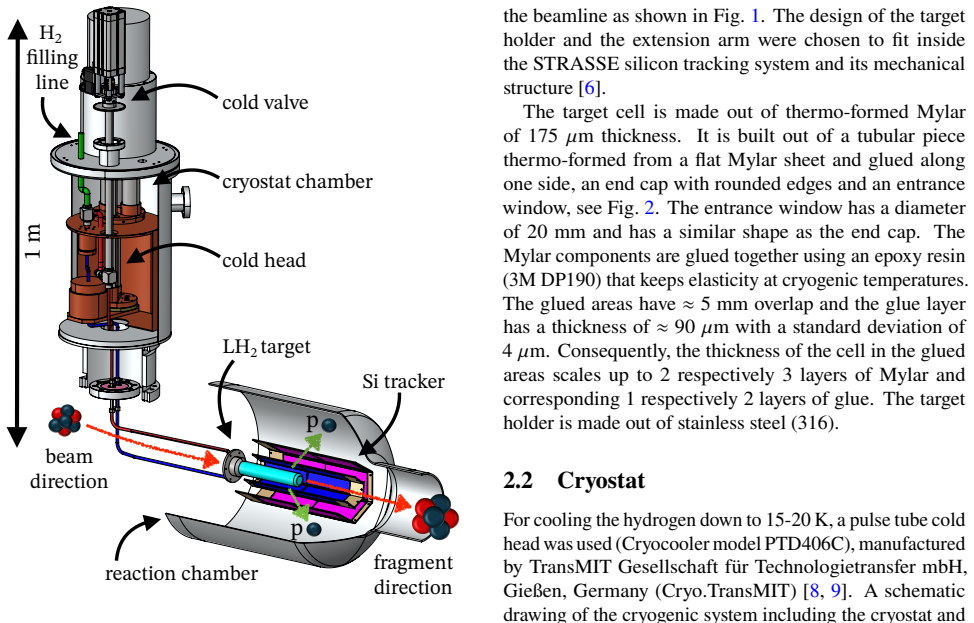
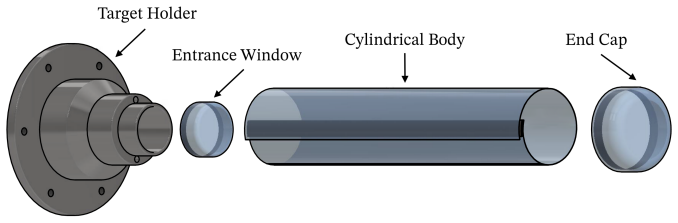
The STRASSE liquid hydrogen target system provides a customizable cylindrical cell of up to 125 mL with thin Mylar walls in a cryogenic setup at 20 K, delivering increased luminosity while reducing straggling for precise measurements at the RIBF facility.
What carries the argument
The thin-walled liquid hydrogen cell in the fast-cooling cryogenic system, which boosts reaction rates and reduces proton angular straggling.
Load-bearing premise
The thin Mylar walls and 125 mL cell volume will achieve the desired increase in reaction rate while keeping angular straggling low enough, without cryogenic or vacuum problems during beam operation.
What would settle it
If actual operation shows angular straggling significantly higher than minimized or the cool-down time exceeds 5 hours with beam present, the performance claims would not hold.
Figures
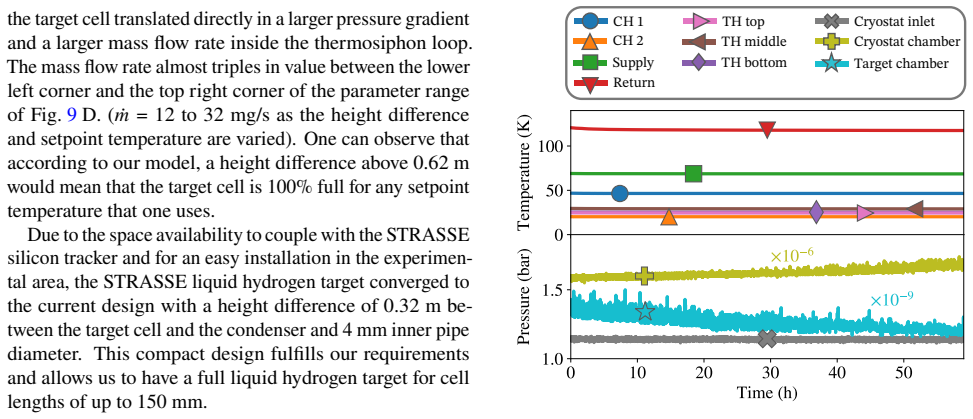
read the original abstract
A compact liquid hydrogen target system has been developed for the Silicon Tracker for RAdioactive nuclei Studies at SAMURAI Experiments (STRASSE) at the RIKEN Nishina Center. This target, designed for proton-induced quasi-free scattering measurements in inverse kinematics, features a customizable cylindrical cell with a volume up to 125~mL which increases the reaction rate/luminosity, and thin Mylar walls to minimize the protons' angular straggling. The cryogenic system, operated at 20~K, is optimized for rapid cool-down ($\leq$ 5~h) and empty-target measurements, avoiding long experimental dead time. This new setup will allow for high-precision studies of nuclear structure using both missing-mass and in-flight prompt $\gamma$-ray spectroscopy techniques at the RIBF facility.
Editorial analysis
A structured set of objections, weighed in public.
Referee Report
Summary. The manuscript describes the design and construction of a compact liquid hydrogen target system developed for the STRASSE setup at the RIKEN Nishina Center's RIBF facility. Intended for proton-induced quasi-free scattering in inverse kinematics, the system includes a customizable cylindrical cell with volume up to 125 mL and thin Mylar walls to increase reaction luminosity while minimizing proton angular straggling, along with a 20 K cryogenic system optimized for rapid cool-down (≤5 h) to enable efficient empty-target measurements. The authors state that this setup will enable high-precision nuclear structure studies via missing-mass and in-flight prompt γ-ray spectroscopy techniques.
Significance. If the design choices deliver the claimed balance of higher luminosity and acceptable straggling under actual beam conditions, the target would represent a practical advance for inverse-kinematics experiments at RIBF by improving statistics without compromising resolution. The focus on rapid cycling between filled and empty targets addresses a common operational bottleneck in such measurements. As an instrumentation paper, it provides a detailed technical description that could serve as a reference for similar cryogenic targets, though its impact depends on subsequent validation.
major comments (3)
- [Abstract] Abstract: The central claim that the system 'will allow for high-precision studies' is not supported by any presented measurements of achieved luminosity, angular straggling distributions, or direct comparisons to previous targets; the manuscript supplies only design specifications without error analysis or in-beam verification data.
- [Target cell] Target cell description: The assertion that the 125 mL cell with thin Mylar walls simultaneously raises reaction rate while keeping straggling low enough for missing-mass precision lacks quantitative support such as GEANT4 simulations, calculated straggling widths, or luminosity benchmarks, which are required to substantiate the luminosity-straggling tradeoff.
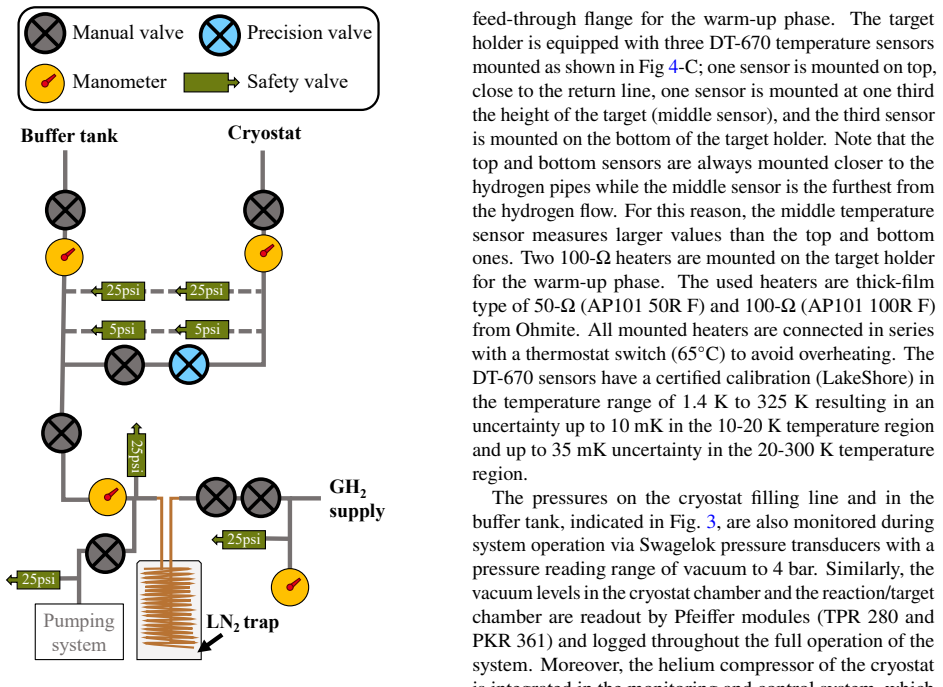
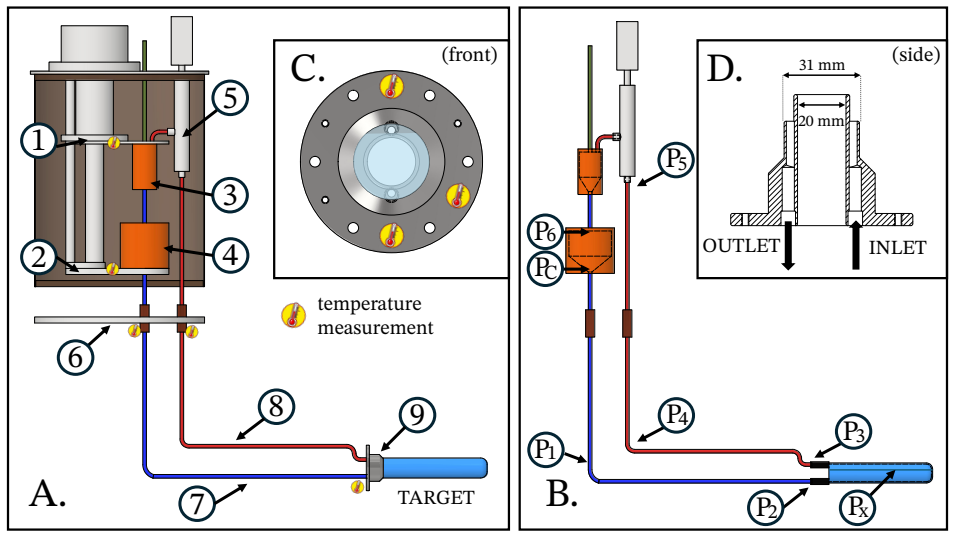
- [Cryogenic system] Cryogenic system section: Claims of ≤5 h cool-down and stable empty-target operation without vacuum or thermal issues are presented as design features but are not accompanied by test results or operational logs, leaving the assertion that long experimental dead time is avoided unverified.
minor comments (1)
- The manuscript would benefit from a summary table listing key parameters (cell volume, wall thickness, operating temperature, cool-down time) for quick reference.
Simulated Author's Rebuttal
We thank the referee for the thorough review and constructive comments on our manuscript describing the STRASSE liquid hydrogen target system. We address each major comment point by point below, proposing revisions to clarify the distinction between design specifications and experimental validation where needed.
read point-by-point responses
-
Referee: [Abstract] Abstract: The central claim that the system 'will allow for high-precision studies' is not supported by any presented measurements of achieved luminosity, angular straggling distributions, or direct comparisons to previous targets; the manuscript supplies only design specifications without error analysis or in-beam verification data.
Authors: We agree that the abstract makes a prospective claim without supporting in-beam data, as the manuscript is an instrumentation paper focused on design and construction details for a newly developed system. The statement is based on the intended performance from the cell volume, wall thickness, and cryogenic features. We will revise the abstract to state that the target is designed to enable high-precision studies, with performance to be validated in future experiments. revision: yes
-
Referee: [Target cell] Target cell description: The assertion that the 125 mL cell with thin Mylar walls simultaneously raises reaction rate while keeping straggling low enough for missing-mass precision lacks quantitative support such as GEANT4 simulations, calculated straggling widths, or luminosity benchmarks, which are required to substantiate the luminosity-straggling tradeoff.
Authors: The cell parameters were chosen based on engineering requirements and experience with similar targets to increase luminosity while limiting material in the beam path. We acknowledge that the manuscript does not include dedicated simulations or benchmarks. We will add a short discussion with analytical estimates of angular straggling and luminosity gain to better support the design rationale. revision: yes
-
Referee: [Cryogenic system] Cryogenic system section: Claims of ≤5 h cool-down and stable empty-target operation without vacuum or thermal issues are presented as design features but are not accompanied by test results or operational logs, leaving the assertion that long experimental dead time is avoided unverified.
Authors: The cool-down time specification derives from the cryogenic design and was confirmed during initial laboratory commissioning tests. We will revise the section to reference these off-beam test results explicitly and clarify that the rapid cycling capability has been demonstrated in controlled conditions prior to beam use. revision: yes
Circularity Check
No circularity in apparatus description
full rationale
The manuscript is a technical description of a liquid hydrogen target system. It contains no derivations, equations, fitted parameters presented as predictions, or self-citation chains that reduce claims to inputs by construction. The central claims concern design choices (125 mL cell, thin Mylar walls, 20 K cryogenic system) and their intended benefits for luminosity and straggling, but these are presented as engineering specifications without any mathematical reduction or circular logic. This is a self-contained description of hardware, consistent with a circularity score of 0.
Axiom & Free-Parameter Ledger
Reference graph
Works this paper leans on
-
[1]
T. Aumann, C. A. Bertulani, and J. Ryckebusch. Quasifree (p,2p) and (p,3p) reactions with unstable nuclei.Physical Review C, 88(6), 2013. ISSN 1089- 490X. doi:10.1103/physrevc.88.064610
-
[2]
A. Obertelli and T. Uesaka. Hydrogen targets for exotic-nuclei studies developed over the past 10 years. The European Physical Journal A, 47(9), 2011. ISSN 1434-601X. doi:10.1140/epja/i2011-11105-5
-
[3]
Cocotier project
Anna Corsi. Cocotier project. IRFU, France, 2017. URL https://anr.fr/Project-ANR-17-CE31-0005
2017
-
[4]
C. Louchart, J.M. Gheller, Ph. Chesny, G. Au- thelet, J.Y. Rousse, A. Obertelli, P. Boutachkov, S. Pietri, F. Ameil, L. Audirac, A. Corsi, Z. Dom- bradi, J. Gerl, A. Gillibert, W. Korten, C. Mailleret, E. Merchan, C. Nociforo, N. Pietralla, D. Ralet, M. Reese, and V. Stepanov. The PRESPEC liquid- hydrogen target for in-beam gamma spectroscopy of exotic nu...
-
[5]
A. Obertelli, A. Delbart, S. Anvar, L. Audirac, G. Authelet, H. Baba, B. Bruyneel, D. Calvet, F. Chˆateau, A. Corsi, P. Doornenbal, J.-M. Gheller, A. Giganon, C. Lahonde-Hamdoun, D. Leboeuf, D. Loiseau, A. Mohamed, J.-Ph. Mols, H. Otsu, C. P´eron, A. Peyaud, E. C. Pollacco, G. Prono, J.-Y. Rousse, C. Santamaria, and T. Uesaka. MINOS: A vertex tracker coup...
-
[6]
H. N. Liu, F. Flavigny, H. Baba, M. Boehmer, U. Bonnes, V. Borshchov, P. Doornenbal, N. Ebina, M. Enciu, A. Frotscher, R. Gernh ¨auser, V. Girard- Alcindor, D. Goupilli `ere, J. Heuser, R. Kapell, Y. Kondo, H. Lee, J. Lehnert, T. Matsui, A. Matta, T. Nakamura, A. Obertelli, T. Pohl, M. Protsenko, M. Sasano, Y. Satou, C. J. Schmidt, K. Sch¨ une- mann, C. S...
-
[7]
J. Tanaka, R. Tsuji, K. Higuchi, H. Baba, M. B¨ohmer, T. Furuno, R. Gernh ¨auser, Y. Hijikata, S. Ishi- moto, T. Kawabata, S. Kawase, Y. Kubota, S. Kuro- sawa, S. Takeshige, T. Uesaka, K. Yahiro, and J. Zenihiro. Designing TOGAXSI: Telescope for inverse-kinematics cluster-knockout reactions.Nu- clear Instruments and Methods in Physics Re- search Section B...
-
[8]
Cryogenic systems, 2025
TransMIT Center for Adaptive Cryotechnology and Sensors. Cryogenic systems, 2025. URL https://cryo .transmit.de/en/. Accessed: 2025-11-02
2025
-
[9]
Falter et al
J. Falter et al. Pulse Tube Cryocooler at 4 K: Cus- tomization for Sensitive Cryoelectronic Applications in “Dry” Low Noise Cryostats. InKRYO 2016, Frey- burg, Germany, 2016. URL https://snf.ieeecsc.org/fil es/ieeecsc/2023-05/revedhdrFalter%2C%20Jens T ransMIT-Poster.pdf
2016
-
[10]
Small scale 4He liquefaction using a two-stage 4K pulse tube cooler.Cryogenics, 38(3):337–342, 1998
G Thummes, C Wang, and C Heiden. Small scale 4He liquefaction using a two-stage 4K pulse tube cooler.Cryogenics, 38(3):337–342, 1998. ISSN 0011-2275. doi:https://doi.org/10.1016/S0011- 2275(97)00169-0
-
[11]
Bell, Jorrit Wronski, Sylvain Quoilin, and Vincent Lemort
Ian H. Bell, Jorrit Wronski, Sylvain Quoilin, and Vincent Lemort. Pure and Pseudo-pure Fluid Ther- mophysical Property Library CoolProp.Industrial & Engineering Chemistry Research, 53:2498–2508,
-
[12]
doi:10.1021/ie4033999
-
[13]
Blasius.Das Aehnlichkeitsgesetz bei Rei- bungsvorg¨angen in Fl ¨ussigkeiten, pages 1–41
H. Blasius.Das Aehnlichkeitsgesetz bei Rei- bungsvorg¨angen in Fl ¨ussigkeiten, pages 1–41. Springer Berlin Heidelberg, Berlin, Heidelberg, 1913. ISBN 978-3-662-02239-9. doi:10.1007/978-3-662- 02239-9 1
-
[14]
White.Fluid Mechanics
F. White.Fluid Mechanics. McGraw-Hill series in mechanical engineering. McGraw-Hill Education,
-
[15]
Crane Co., Stamford, CT, 1999
Crane Co.Flow of Fluids Through Valves, Fittings, and Pipe. Crane Co., Stamford, CT, 1999. Technical Paper No. 410
1999
-
[16]
Martinez, J
R. Martinez, J. E. Fesmire, and S. D. Augustynowicz. Experimental study of multilayer insulation (MLI) for cryogenic applications.Cryogenics, 64:151–157,
-
[17]
doi:10.1016/j.cryogenics.2014.02.006
-
[18]
Jacob W. Leachman, Richard T. Jacobsen, Steven G. Penoncello, and Eric W. Lemmon.Thermodynamic Properties of Cryogenic Fluids. Springer Cham, 2017. ISBN 978-3-319-57835-4. doi:10.1007/978-3-319- 57835-4
-
[19]
Yu. Ya. Milenko and R. M. Sibileva. Natural ortho- para conversion in liquid hydrogen.Ukrainskii Fizich- eskii Zhurnal, 19:2008, 1974
2008
-
[20]
Liujing Yang, Xinbao Li, Ying Chen, Xiaoling Zheng, and Kai Sun. Ortho to para hydrogen conversion over bimetallic iron and cobalt catalysts.Scientific Reports, 14(1):20925, Sep 2024. ISSN 2045-2322. doi:10.1038/s41598-024-71790-9
-
[21]
Julien Caner, Etienne Videcoq, Adel M. Benselama, and Manuel Girault. Simulation of a two-phase loop thermosyphon using a new interface-resolved phase change model.International Journal of Heat and Mass Transfer, 228:125607, 2024. ISSN 0017-9310. doi:https://doi.org/10.1016/j.ijheatmasstransfer.2024.125607. This is the author’s accepted manuscript. Accept...
discussion (0)
Sign in with ORCID, Apple, or X to comment. Anyone can read and Pith papers without signing in.