Physics-Informed Neural Networks for Chemotherapy Pharmacokinetics: Benchmarking the Clinical Estimator and Exposing Parameter Identifiability
Pith reviewed 2026-06-27 10:13 UTC · model grok-4.3
The pith
A physics-informed neural network shows the Michaelis-Menten two-compartment chemotherapy model is non-identifiable from plasma data alone.
A machine-rendered reading of the paper's core claim, the machinery that carries it, and where it could break.
Core claim
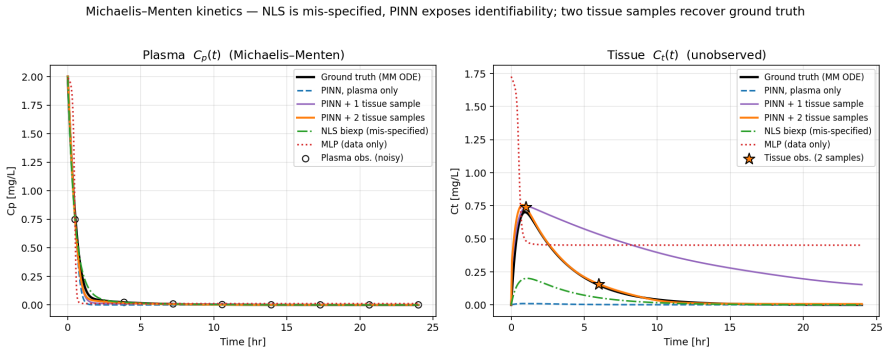
The Michaelis-Menten two-compartment model is non-identifiable from plasma alone, with the PINN converging to a basin where k12 approaches zero. Adding two sparse tissue observations largely resolves identifiability: across five seeds the PINN recovers k21 to within 1 percent of truth and Vmax, Km to within one standard-deviation bar, while k12 moves toward truth but remains roughly two standard deviations below it. The nonlinear least-squares estimator cannot attempt this recovery because its biexponential ansatz applies only to plasma.
What carries the argument
The physics-informed neural network loss that enforces the two-compartment differential equations (linear or Michaelis-Menten) while fitting observed plasma concentrations and any available tissue points.
If this is right
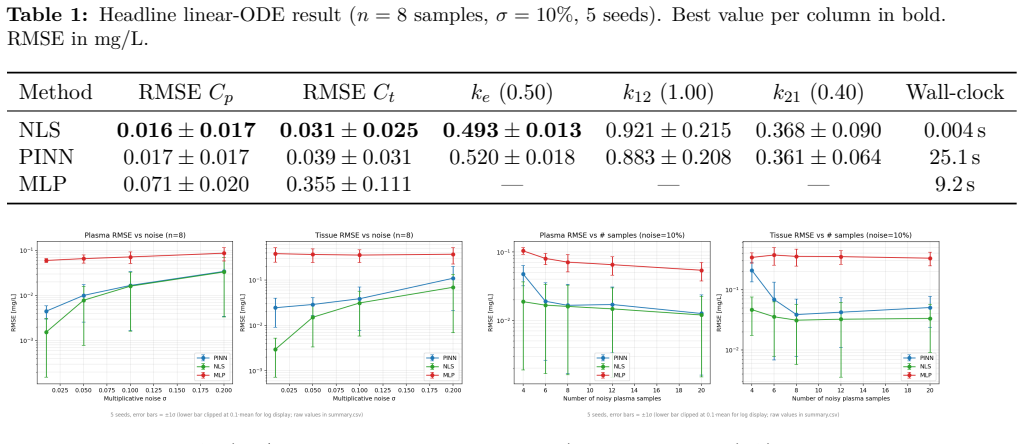
- On linear two-compartment problems the PINN matches the clinical nonlinear least-squares estimator to within a small factor while also producing the tissue concentration curve.
- On Michaelis-Menten problems the PINN reveals the non-identifiability that a mis-specified nonlinear least-squares estimator hides by returning meaningless constants.
- Two sparse tissue observations suffice to recover k21, Vmax and Km to high accuracy while k12 improves but stays partially biased.
- The single PINN training procedure handles both standard estimation and structural identifiability diagnosis without requiring a closed-form plasma solution.
Where Pith is reading between the lines
- The same loss structure could be applied to other pharmacokinetic models that lack closed-form solutions once some compartments are observed.
- Occasional invasive tissue sampling in early-phase trials might be justified if it resolves parameter uncertainty that plasma data alone cannot.
- Real clinical data with measurement noise and model mismatch would provide a direct test of whether the reported identifiability improvement survives outside simulation.
Load-bearing premise
The compartment model equations are assumed to be the exact governing dynamics with no mismatch to real biology and the simulated data are taken as representative of real clinical measurements.
What would settle it
Apply the same PINN training to real patient plasma and tissue concentration time series; if the recovered parameters remain non-unique or the tissue predictions fail to match independent clinical outcomes, the identifiability claim does not hold outside simulated data.
Figures
read the original abstract
Physics-Informed Neural Networks (PINNs) are an attractive tool for partial-observation problems in biology, where the governing dynamics are known but some compartments cannot be measured. Chemotherapy pharmacokinetics (PK) is a clean instance: drug concentration in plasma is routinely measured, but concentration in tissue -- which determines tumour kill and off-target toxicity -- is not. We benchmark a PINN against the standard clinical baseline (nonlinear least-squares on the analytical biexponential plasma solution, hereafter NLS) and a physics-agnostic neural baseline (a data-only MLP) on two PK problems. On the linear two-compartment problem, NLS is near-optimal; the PINN matches it to within a small constant factor while also producing the tissue curve in a single training pass, whereas the data-only MLP fails on tissue by roughly 10x. On a Michaelis-Menten extension (saturable elimination), the biexponential closed form no longer exists, so NLS is mis-specified and silently returns meaningless rate constants. The PINN instead exposes a deeper fact: the Michaelis-Menten two-compartment model is non-identifiable from plasma alone, and the PINN reports this honestly by converging to a basin with k12 -> 0. Adding two sparse tissue observations largely resolves identifiability: across five seeds the PINN recovers k21 to within 1% of truth and Vmax, Km to within one standard-deviation bar, while k12 moves in the correct direction (0.02 -> 0.82) but remains ~2 sigma below truth -- a recovery the closed-form NLS estimator cannot attempt at all, because its biexponential ansatz describes only plasma. Our claim is not that PINNs beat NLS. It is that PINNs offer a uniform recipe that ties the textbook estimator on the textbook problem, exposes structural identifiability that the textbook estimator hides, and absorbs heterogeneous measurements within a single loss.
Editorial analysis
A structured set of objections, weighed in public.
Referee Report
Summary. The manuscript claims that PINNs offer a uniform recipe for chemotherapy PK problems with partial observations. On the linear two-compartment model, the PINN matches the clinical NLS estimator to within a small factor while also recovering the unobserved tissue curve; on the Michaelis-Menten extension (where the biexponential closed form does not exist), the PINN exposes non-identifiability from plasma data alone by converging to a k12 → 0 basin, and shows that two sparse tissue observations largely resolve the issue, recovering k21 to 1 % of truth and Vmax, Km within 1 SD across five seeds while NLS cannot attempt the recovery at all.
Significance. If the identifiability results generalize, the work provides a concrete demonstration that PINNs can surface structural degeneracies hidden by closed-form estimators and absorb heterogeneous measurements (plasma + sparse tissue) in one loss. The use of forward simulation to generate ground truth, direct benchmarking against the external NLS clinical estimator, and reporting of recovery statistics across five independent seeds are explicit strengths that make the central demonstration falsifiable and reproducible within the idealized setting.
major comments (2)
- [Michaelis-Menten identifiability experiment] The Michaelis-Menten identifiability experiment (abstract and associated results): the claim that plasma observations alone drive the PINN to a k12 → 0 basin while two tissue points recover k21 to 1 % and Vmax/Km within 1 SD is demonstrated exclusively on noise-free trajectories obtained by exact integration of the assumed linear and Michaelis-Menten ODEs. This assumption is load-bearing for the headline conclusion that the PINN “exposes structural identifiability that the textbook estimator hides” in a clinically relevant way, because real plasma and tissue measurements contain assay noise and the true elimination kinetics may deviate from pure MM.
- [Abstract and methods] Abstract and methods description: the quantitative recovery results (1 % error, 2-sigma deviation) are reported from five seeds, yet the loss formulation (component weights), optimizer settings, and network architecture are not fully specified. Without these details it is impossible to verify that the observed convergence behavior is driven by the physics residual rather than by the particular choice of loss weights or initialization.
minor comments (1)
- [Abstract] Abstract: the verb “ties” in “ties the textbook estimator on the textbook problem” is ambiguous; replace with “matches” or “equals” for precision.
Simulated Author's Rebuttal
We thank the referee for the constructive feedback and for highlighting both the strengths of our benchmarking setup and the areas needing clarification. We address each major comment below and indicate where revisions will be made.
read point-by-point responses
-
Referee: [Michaelis-Menten identifiability experiment] The Michaelis-Menten identifiability experiment (abstract and associated results): the claim that plasma observations alone drive the PINN to a k12 → 0 basin while two tissue points recover k21 to 1 % and Vmax/Km within 1 SD is demonstrated exclusively on noise-free trajectories obtained by exact integration of the assumed linear and Michaelis-Menten ODEs. This assumption is load-bearing for the headline conclusion that the PINN “exposes structural identifiability that the textbook estimator hides” in a clinically relevant way, because real plasma and tissue measurements contain assay noise and the true elimination kinetics may deviate from pure MM.
Authors: We agree that the experiments use noise-free trajectories generated by exact ODE integration. This controlled setting was chosen deliberately to isolate the structural non-identifiability of the Michaelis-Menten two-compartment model from plasma data alone, without confounding by measurement noise or model mismatch. In this idealized case the PINN convergence to the k12 → 0 basin provides direct evidence of the degeneracy that the closed-form NLS estimator cannot even detect. We acknowledge that assay noise and possible deviations from pure MM kinetics are important for clinical translation. We will revise the discussion section to explicitly state this limitation, emphasize that the current results demonstrate the method's ability to surface identifiability issues in the assumed model, and outline planned extensions to noisy and misspecified data. revision: partial
-
Referee: [Abstract and methods] Abstract and methods description: the quantitative recovery results (1 % error, 2-sigma deviation) are reported from five seeds, yet the loss formulation (component weights), optimizer settings, and network architecture are not fully specified. Without these details it is impossible to verify that the observed convergence behavior is driven by the physics residual rather than by the particular choice of loss weights or initialization.
Authors: We thank the referee for this observation. While the manuscript provides the overall training procedure and reports results across five random seeds, we agree that the precise loss-component weights, optimizer hyperparameters, and network architecture details should be stated explicitly for full reproducibility. We will expand the methods section (and add a supplementary table if needed) to include the exact weighting factors for data, residual, and initial-condition losses, the Adam learning-rate schedule, and the network depth/width/activation choices. These additions will make it straightforward to confirm that the reported behavior arises from the physics-informed loss. revision: yes
Circularity Check
No significant circularity; derivation is self-contained
full rationale
The paper generates synthetic trajectories by direct integration of the stated linear and Michaelis-Menten ODEs, then trains PINNs and compares them to an external NLS baseline on those trajectories. The reported identifiability behavior (k12 collapse under plasma-only data, partial recovery with tissue points) is an observed outcome of the optimization, not a quantity defined by the method and then re-labeled as a prediction. No self-citations, uniqueness theorems, or ansatzes are invoked to justify the central claims; the comparison to NLS is performed against an independently implemented clinical estimator. The work therefore contains no load-bearing step that reduces to its own inputs by construction.
Axiom & Free-Parameter Ledger
free parameters (1)
- PINN loss component weights
axioms (1)
- domain assumption The linear and Michaelis-Menten two-compartment ODEs are the correct governing dynamics for the system.
Reference graph
Works this paper leans on
-
[1]
& Karniadakis, G.E
Raissi, M., Perdikaris, P. & Karniadakis, G.E. (2019) Physics-informed neural networks: a deep learning framework for solving forward and inverse problems involving nonlinear partial differential equations.Journal of Computational Physics378:686–707
2019
-
[2]
& Fotiadis, D.I
Lagaris, I.E., Likas, A. & Fotiadis, D.I. (1998) Artificial neural networks for solving ordinary and partial differential equations.IEEE Transactions on Neural Networks9(5):987–1000
1998
-
[3]
Cuomo, S. et al. (2022) Scientific machine learning through physics-informed neural networks: where we are and what’s next.Journal of Scientific Computing92:88
2022
-
[4]
Apotekarsocieteten
Gabrielsson, J.&Weiner, D.(2016)Pharmacokinetic and Pharmacodynamic Data Analysis: Concepts and Applications, 5th ed. Apotekarsocieteten
2016
-
[5]
& Haanen, C
Speth, P.A.J., van Hoesel, Q.G.C.M. & Haanen, C. (1988) Clinical pharmacokinetics of doxorubicin. Clinical Pharmacokinetics15(1):15–31
1988
-
[6]
& DiStefano, J.J
Cobelli, C. & DiStefano, J.J. (1980) Parameter and structural identifiability concepts and ambiguities: a critical review and analysis.American Journal of Physiology239(1):R7–R24
1980
-
[7]
& Pronzato, L
Walter, E. & Pronzato, L. (1997)Identification of Parametric Models from Experimental Data. Springer. 8
1997
-
[8]
& Yang, L
Karniadakis, G.E., Kevrekidis, I.G., Lu, L., Perdikaris, P., Wang, S. & Yang, L. (2021) Physics- informed machine learning.Nature Reviews Physics3:422–440
2021
-
[9]
& Karniadakis, G.E
Lu, L., Meng, X., Mao, Z. & Karniadakis, G.E. (2021) DeepXDE: a deep learning library for solving differential equations.SIAM Review63(1):208–228
2021
-
[10]
& Karniadakis, G.E
Raissi, M., Yazdani, A. & Karniadakis, G.E. (2020) Hidden fluid mechanics: learning velocity and pressure fields from flow visualizations.Science367(6481):1026–1030
2020
-
[11]
& Perdikaris, P
Wang, S., Yu, X. & Perdikaris, P. (2022) When and why PINNs fail to train: a neural tangent kernel perspective.Journal of Computational Physics449:110768
2022
-
[12]
Kingma, D.P. & Ba, J. (2015) Adam: a method for stochastic optimization. InInternational Conference on Learning Representations (ICLR)
2015
-
[13]
& Nocedal, J
Liu, D.C. & Nocedal, J. (1989) On the limited memory BFGS method for large scale optimization. Mathematical Programming45(1–3):503–528
1989
-
[14]
& Åström, K.J
Bellman, R. & Åström, K.J. (1970) On structural identifiability.Mathematical Biosciences7(3– 4):329–339
1970
-
[15]
Miao, H., Xia, X., Perelson, A.S. & Wu, H. (2011) On identifiability of nonlinear ODE models and applications in viral dynamics.SIAM Review53(1):3–39
2011
-
[16]
& Karniadakis, G.E
Yazdani, A., Lu, L., Raissi, M. & Karniadakis, G.E. (2020) Systems biology informed deep learning for inferring parameters and hidden dynamics.PLOS Computational Biology16(11):e1007575
2020
-
[17]
Daneker, M., Zhang, Z., Karniadakis, G.E. & Lu, L. (2023) Systems biology: identifiability analysis and parameter identification via systems-biology-informed neural networks.Methods in Molecular Biology2634:87–105
2023
-
[18]
& Timmer, J
Raue, A., Kreutz, C., Maiwald, T., Bachmann, J., Schilling, M., Klingmüller, U. & Timmer, J. (2009) Structural and practical identifiability analysis of partially observed dynamical models by exploiting the profile likelihood.Bioinformatics25(15):1923–1929
2009
-
[19]
Godfrey, K.R., Chapman, M.J. & Vajda, S. (1994) Identifiability and indistinguishability of nonlinear pharmacokinetic models.Journal of Pharmacokinetics and Biopharmaceutics22(3):229–251. Ahmadi Daryakenari, N., Wang, S. & Karniadakis, G.E. (2025) CMINNs: compartment model informed neural networks—unlocking drug dynamics.Computers in Biology and Medicine ...
arXiv 1994
-
[20]
Nasim, I. & Nasim, A. (2024) Discovering intrinsic multi-compartment pharmacometric models using physics-informed neural networks.arXiv preprintarXiv:2405.00166
arXiv 2024
-
[21]
& Kohandel, M
Podina, L., Ghodsi, A. & Kohandel, M. (2025) Learning chemotherapy drug action via universal physics-informed neural networks.Pharmaceutical Research42(4):593–612. 9
2025
-
[22]
& Sarimveis, H
Tsiros, P., Minadakis, V. & Sarimveis, H. (2026) A physics-informed neural network approach for estimating population-level pharmacokinetic parameters from aggregated concentration data. Journal of Pharmacokinetics and Pharmacodynamics53(2):11
2026
-
[23]
Wickramasinghe, C.D., Weerasinghe, K.C., Ranaweera, P.K. & Hapuhinna, N.S.S.M. (2025) PBPK- iPINNs: inverse physics-informed neural networks for physiologically based pharmacokinetic brain models.arXiv preprintarXiv:2509.12666
arXiv 2025
-
[24]
& Fröhlich, H
Valderrama, D., Teplytska, O., Koltermann, L.M., Trunz, E., Schmulenson, E., Fritsch, A., Jaehde, U. & Fröhlich, H. (2025) Comparing scientific machine learning with population pharmacokinetic and classicalmachinelearningapproachesforpredictionofdrugconcentrations.CPT: Pharmacometrics & Systems Pharmacology14(4):759–769. Ahmadi Daryakenari, N., De Florio,...
2025
-
[25]
& Karniadakis, G.E
Yang, L., Meng, X. & Karniadakis, G.E. (2021) B-PINNs: Bayesian physics-informed neural networks for forward and inverse PDE problems with noisy data.Journal of Computational Physics425:109913. A Full robustness tables Table 4:Tissue RMSE (mg/L) across multiplicative noise levels (n= 8, 5 seeds). Best per row in bold. σPINN NLS MLP 1%0.024±0.0150.003±0.00...
2021
discussion (0)
Sign in with ORCID, Apple, or X to comment. Anyone can read and Pith papers without signing in.