Agent-based models for the evolution of morphological alternation patterns
Pith reviewed 2026-06-27 09:26 UTC · model grok-4.3
The pith
Multi-agent simulations show scale-free networks and Bernoulli adoption produce more plausible morphologies
A machine-rendered reading of the paper's core claim, the machinery that carries it, and where it could break.
Core claim
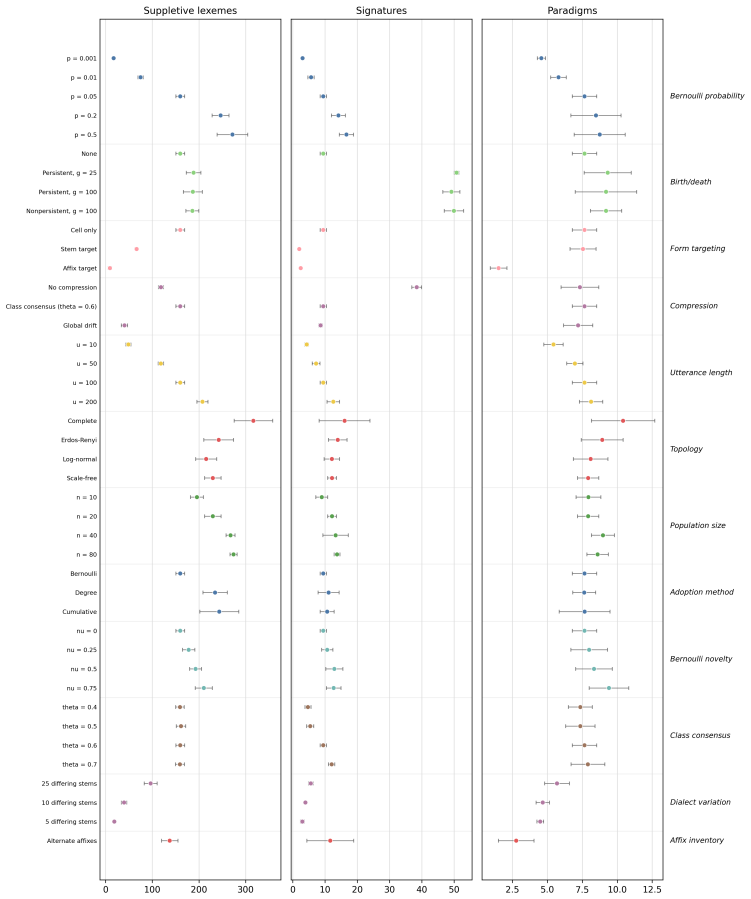
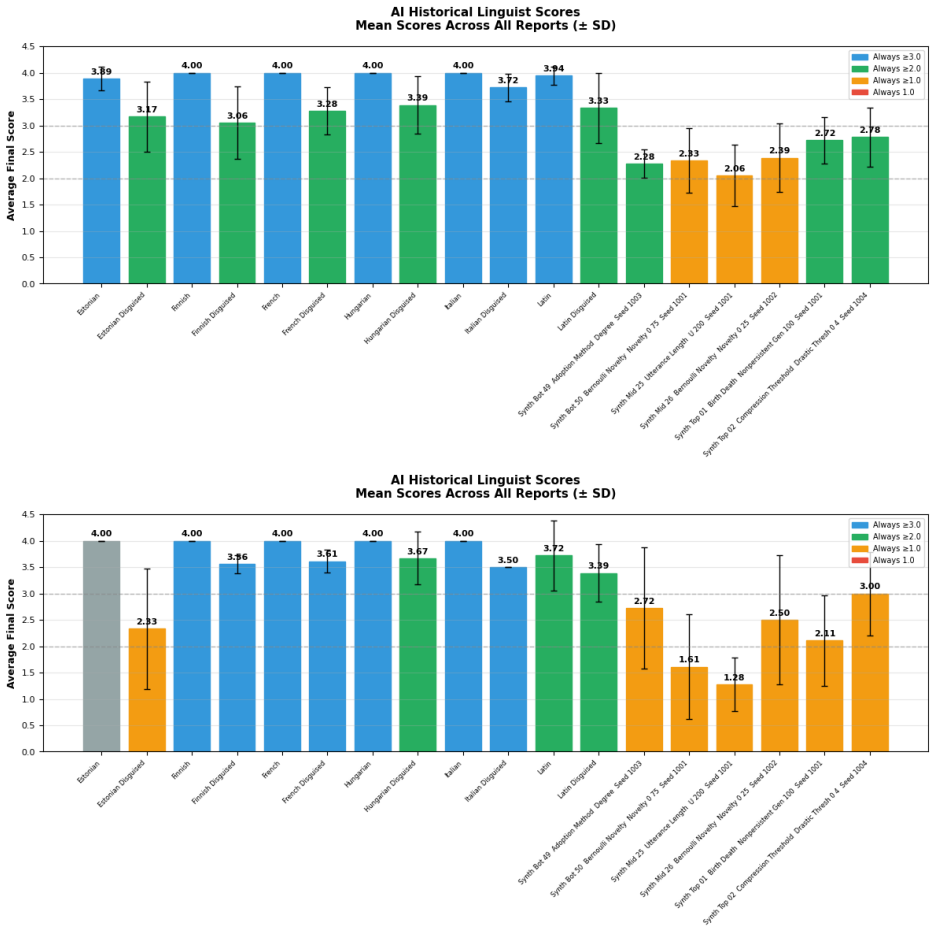
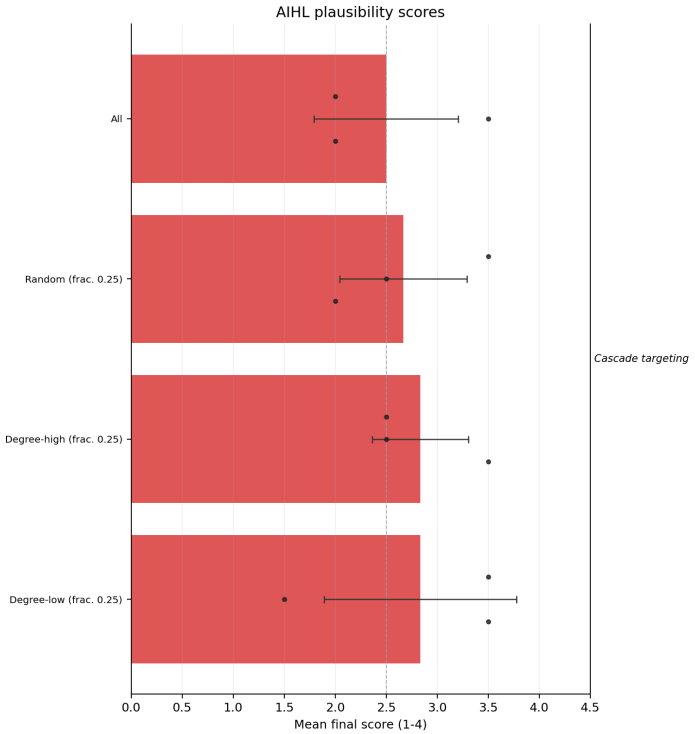
In these simulations, scale-free social networks and random Bernoulli adoption of forms generate morphologies that the AI Historical Linguist rates as more plausible than those arising under other network structures or adoption rules, when benchmarked against real language morphologies and disguised controls.
What carries the argument
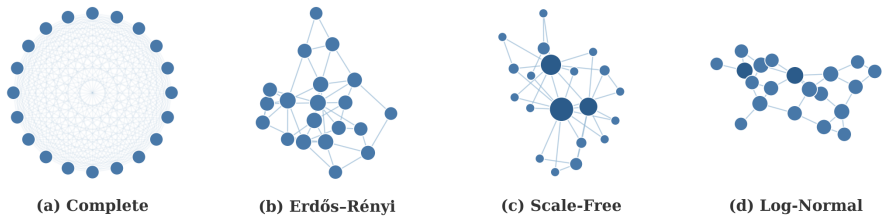
Multi-agent simulation supporting naturalistic lexical forms, phonological rules, multiple network topologies, diffusion patterns, and adoption policies, evaluated by the AI Historical Linguist LLM debate system.
If this is right
- Scale-free networks favor more plausible morphologies than other topologies.
- Random Bernoulli adoption favors more plausible morphologies than other policies.
- The simulation framework can reproduce specific attested historical alternations.
- Altering network or adoption parameters allows testing of counterfactual historical scenarios.
Where Pith is reading between the lines
- Social network structure may influence which irregular forms persist over time in actual languages.
- LLM debate evaluation could be applied to test plausibility of other simulated language changes.
- Random adoption policies might better capture diffusion processes observed in real populations.
Load-bearing premise
The AI Historical Linguist system gives a valid and unbiased measure of morphological plausibility through simulated linguist debates.
What would settle it
If the AI Historical Linguist assigns equivalent or lower plausibility scores to morphologies from scale-free networks with Bernoulli adoption than to those from other conditions when compared against real morphologies.
Figures
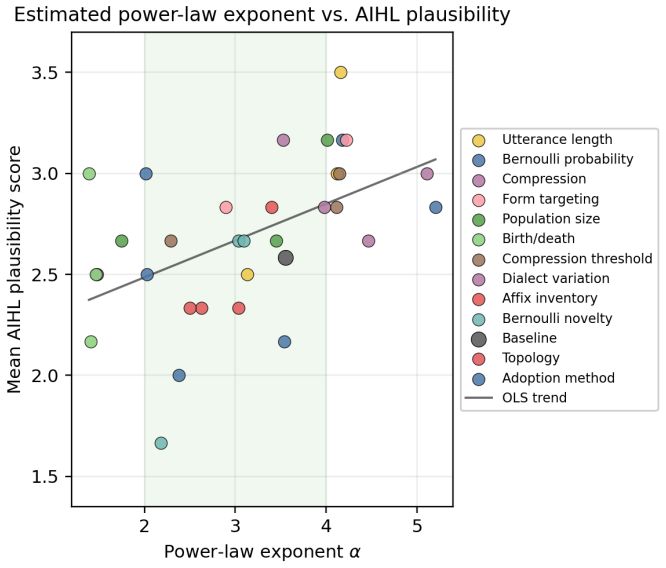
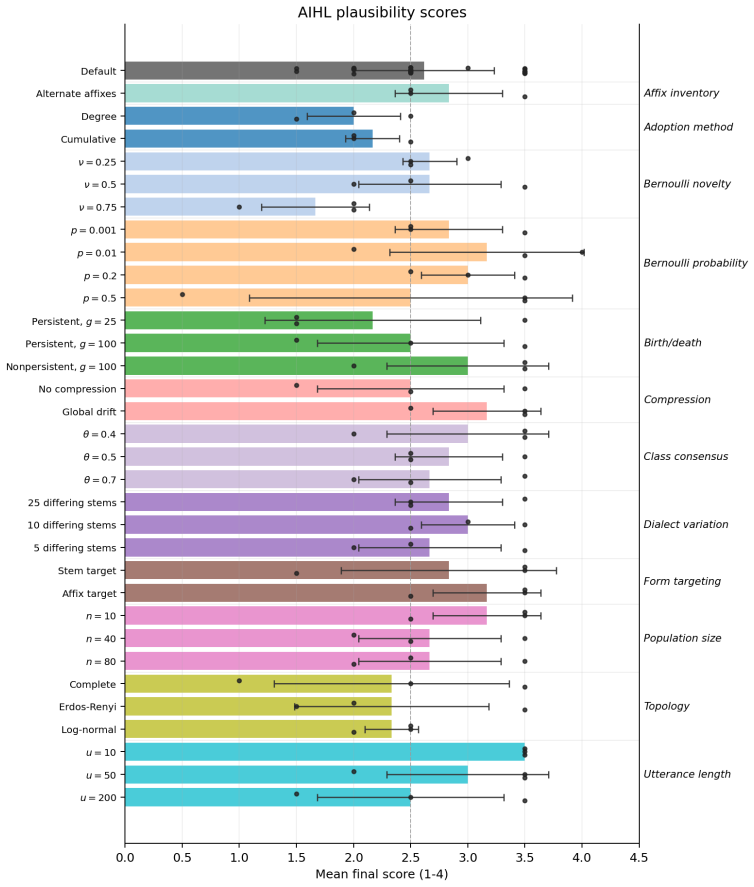
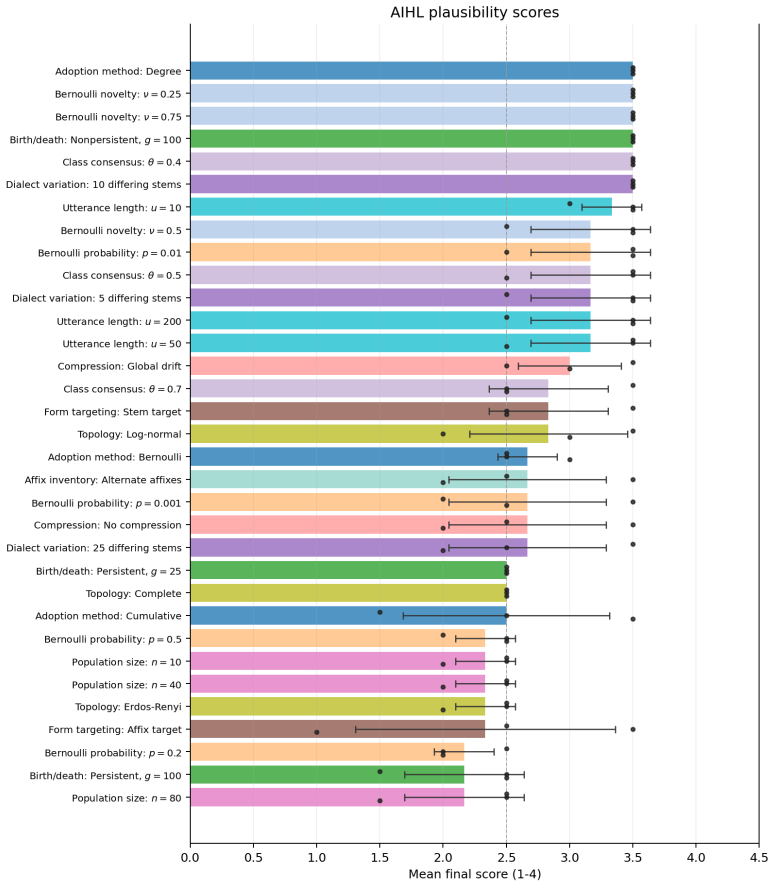
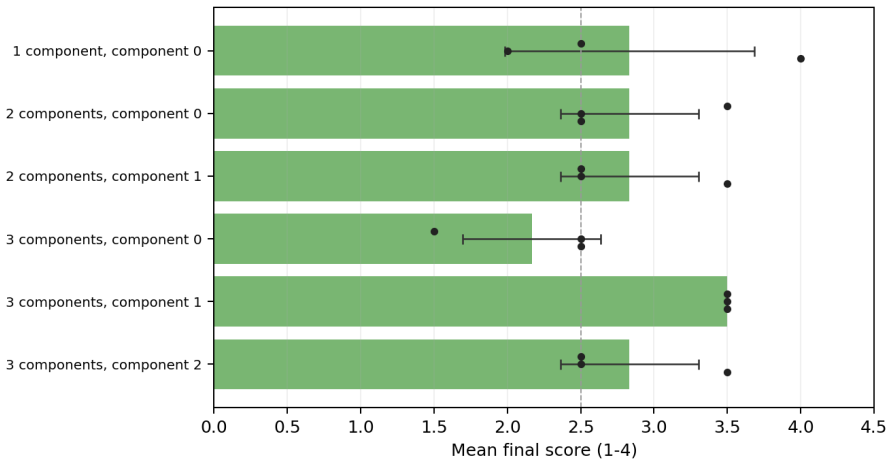
read the original abstract
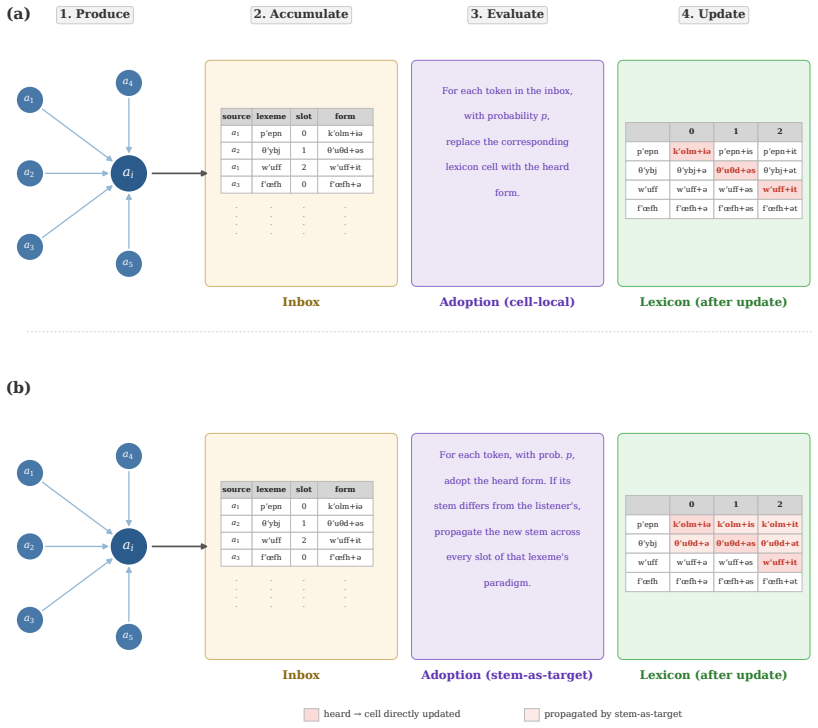
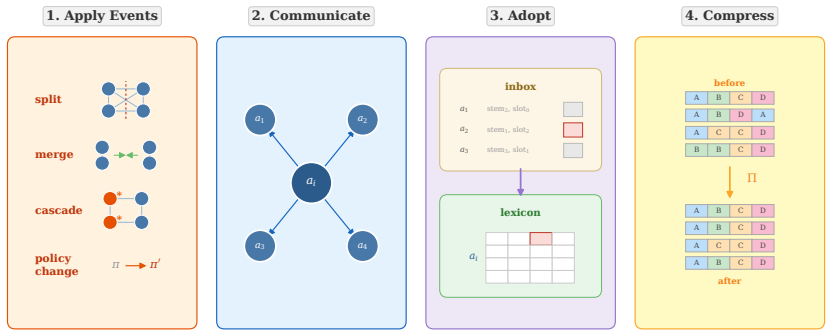
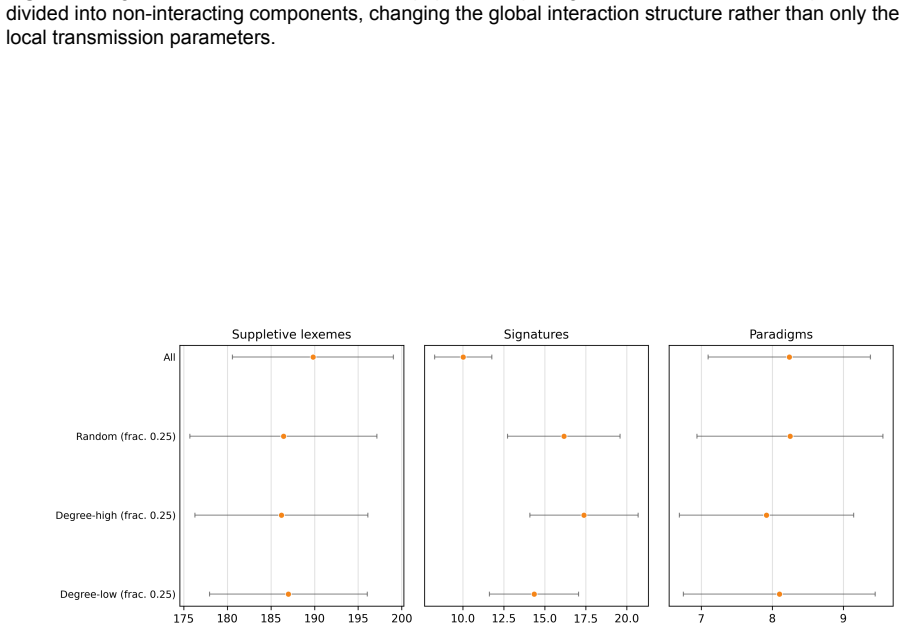
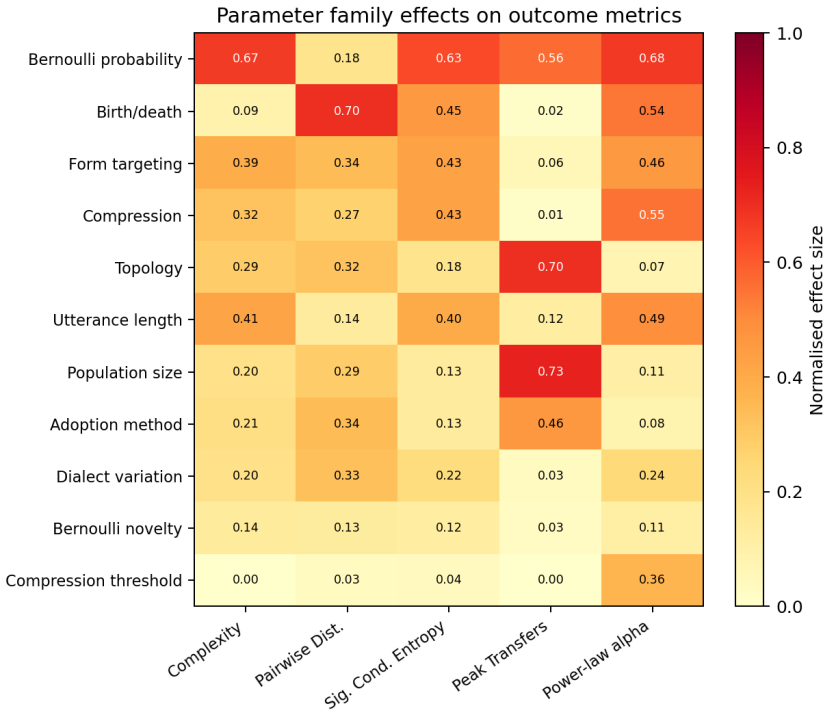
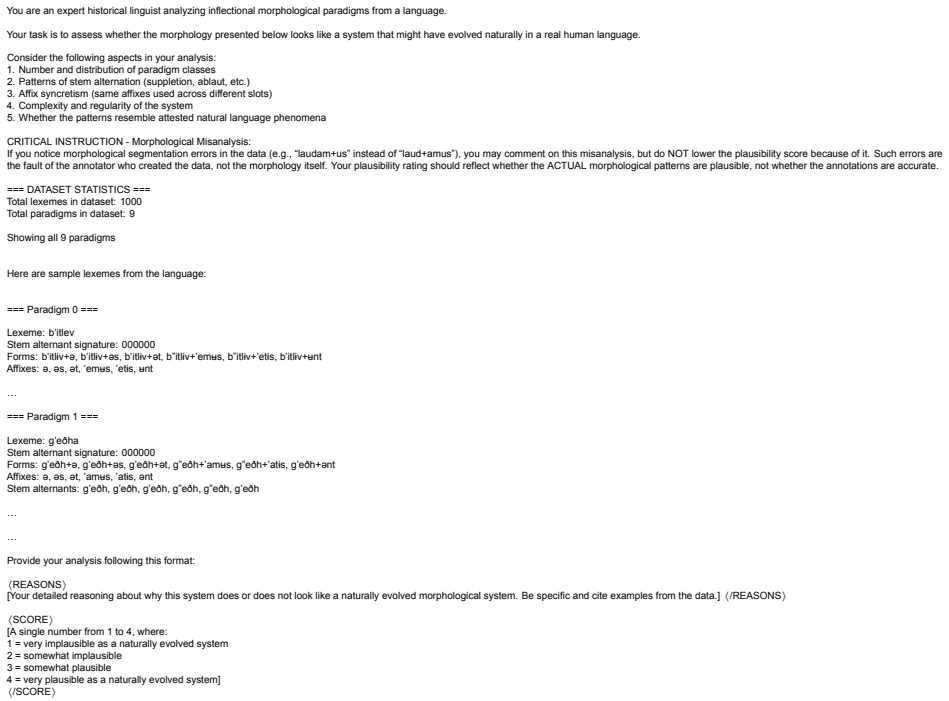
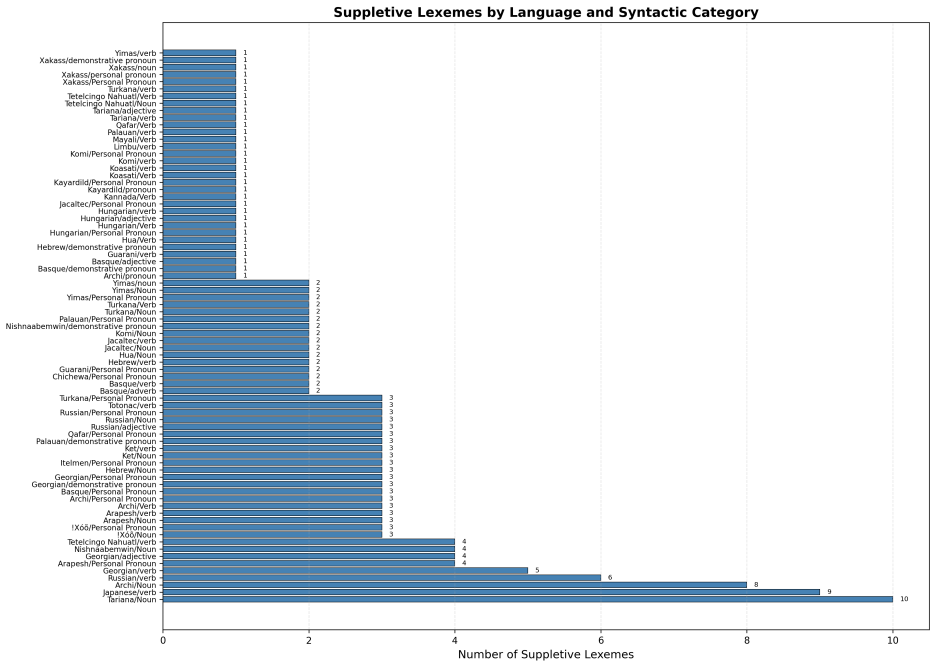
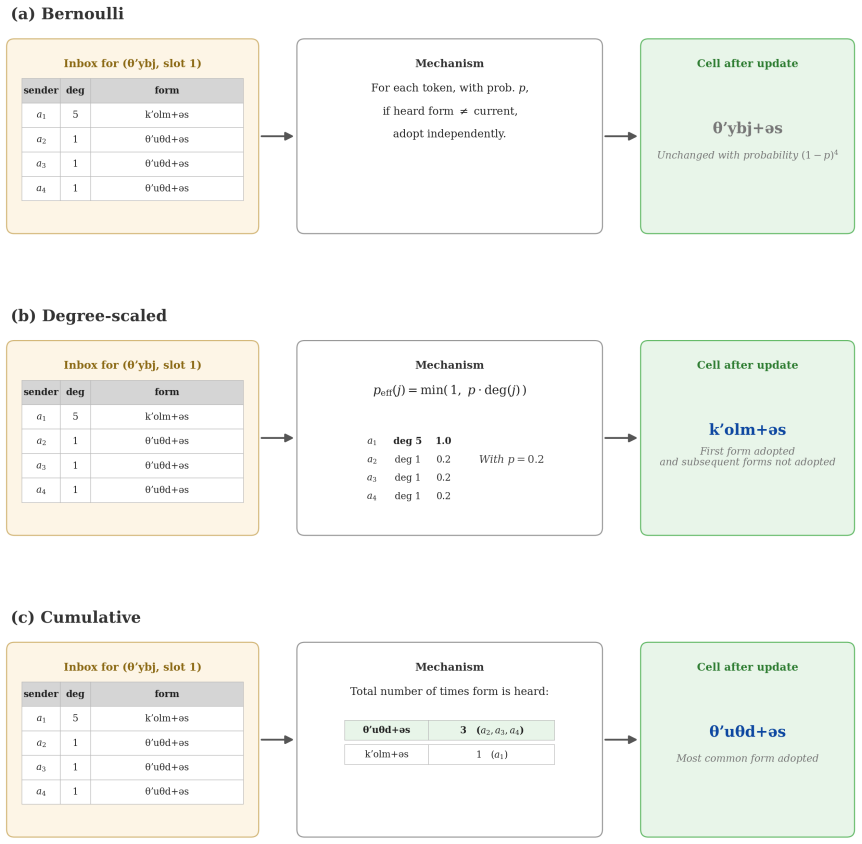
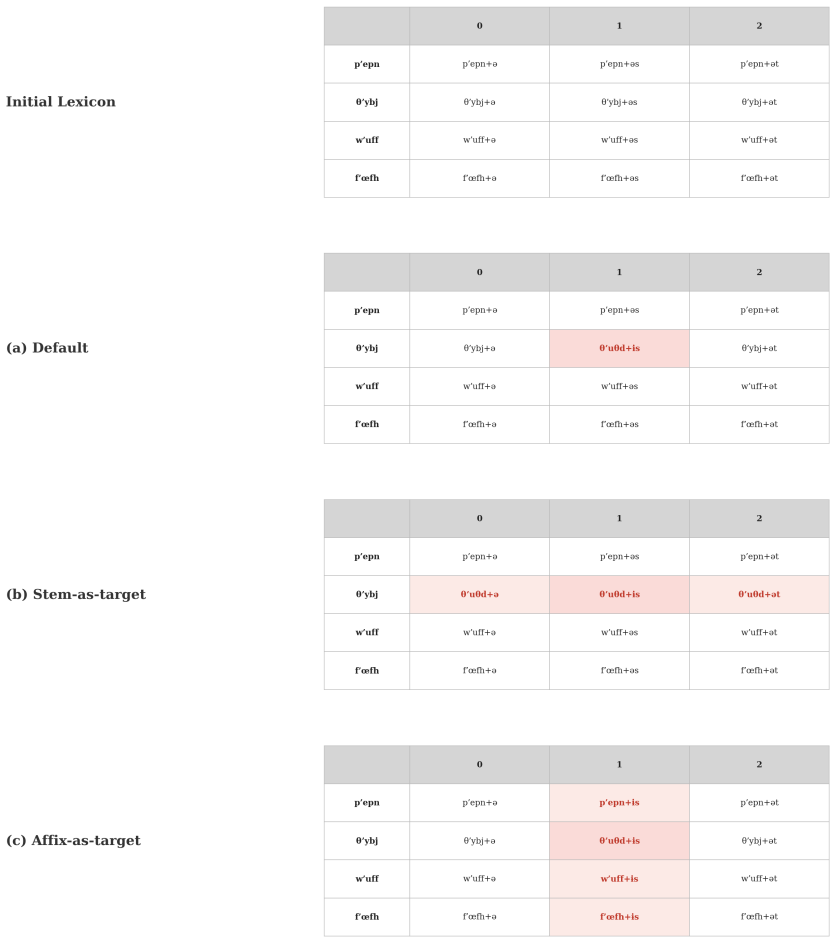
Why is the past of English "go" the apparently unrelated "went"? Such alternations are frequent in languages. They neither aid communication nor learnability, yet they can be persistent, surviving over centuries or millennia. We present a multi-agent simulation of the emergence of morphological stem and inflection alternations. Alternate forms arise by phonological changes or, as with "go/went", from lexical alternatives associated with a subset of the population. When an agent 'hears' another agent use a novel form for a slot in the paradigm of a word (say, the past tense of go), they will with some probability adopt that form, possibly spreading its use to other slots in the paradigm that shared the same original form. Thus alternative forms can spread through the population and become entrenched as stem or inflectional marker alternants. Unlike many previous computational studies, our system allows for naturalistic lexical forms, realistic phonological rules, lexicons with hundreds or thousands of entries, and agent populations in the tens or hundreds. It supports several network topologies, diffusion patterns and agent adoption policies. One issue with such simulations is evaluation: how realistic is the resulting morphology compared to those of real languages? We introduce the AI Historical Linguist, a novel Large Language Model-driven system that models a debate between two historical linguists. We use this to compare a set of real language morphologies, disguised morphologies, and experimentally evolved morphologies. The results suggest that among the factors that favor more plausible morphologies are scale-free social networks and random Bernoulli adoption of forms. We also present three case studies modeling attested historical changes, allowing us to test what might have happened if history had been different. All code and data are released.
Editorial analysis
A structured set of objections, weighed in public.
Referee Report
Summary. The paper presents a multi-agent simulation of morphological alternation emergence, incorporating phonological changes and lexical alternatives that spread via adoption probabilities across agent populations and network topologies. It introduces the AI Historical Linguist—an LLM system simulating debates between historical linguists—to evaluate plausibility of simulated morphologies against real and disguised language data. Results indicate scale-free networks and Bernoulli adoption yield higher plausibility scores; three case studies of attested changes are included, with code and data released.
Significance. If the evaluation holds, the work provides a scalable framework for testing social and diffusion factors in morphological evolution, with strengths in handling realistic lexicons, phonology, and large populations. The open release of code and data supports reproducibility, and the counterfactual case studies offer a falsifiable modeling approach. The LLM-based judge is a novel but unvalidated component.
major comments (1)
- [Evaluation section / abstract] The central claim that scale-free networks and Bernoulli adoption produce more plausible morphologies (abstract) depends entirely on plausibility rankings from the AI Historical Linguist. No validation is reported—such as correlation with human expert ratings, inter-annotator agreement, prompt ablations, or checks for training-data leakage—which is load-bearing because systematic LLM biases (e.g., favoring attested alternation types) could invert the reported ranking of network topologies and adoption rules.
minor comments (1)
- [Abstract] The abstract refers to 'disguised morphologies' without defining the disguise procedure or how they control for surface similarity, which would clarify the evaluation baseline.
Simulated Author's Rebuttal
We thank the referee for the constructive feedback, particularly on the need to validate the AI Historical Linguist. We agree this is essential for supporting the central claims and will revise accordingly.
read point-by-point responses
-
Referee: [Evaluation section / abstract] The central claim that scale-free networks and Bernoulli adoption produce more plausible morphologies (abstract) depends entirely on plausibility rankings from the AI Historical Linguist. No validation is reported—such as correlation with human expert ratings, inter-annotator agreement, prompt ablations, or checks for training-data leakage—which is load-bearing because systematic LLM biases (e.g., favoring attested alternation types) could invert the reported ranking of network topologies and adoption rules.
Authors: We agree that the absence of validation for the AI Historical Linguist represents a genuine limitation, as unexamined biases could indeed affect the topology and adoption rule rankings. In revision we will add prompt ablations testing debate format variations, training-data leakage checks via held-out languages and rare alternation patterns, and inter-annotator agreement metrics across repeated LLM debates. We will also include a small-scale human expert rating study on a subset of outputs to provide initial correlation evidence. These steps directly address the load-bearing concern without overclaiming the current results. revision: yes
Circularity Check
No significant circularity; derivation self-contained against external benchmarks
full rationale
The paper simulates morphological evolution via agent-based rules on networks and adoption policies, then evaluates outputs by comparing LLM-assigned plausibility scores against real-language morphologies and disguised controls. No quoted equations, parameters, or steps reduce the reported ranking of network topologies or adoption rules to a fit, self-definition, or self-citation chain. The AI Historical Linguist is introduced as an external judge rather than derived from the simulation results themselves. Evaluation therefore rests on independent real-language data rather than internal construction.
Axiom & Free-Parameter Ledger
free parameters (1)
- adoption probability
axioms (1)
- domain assumption When an agent hears a novel form for a paradigm slot, it may adopt it and spread the form to other slots sharing the original stem.
Reference graph
Works this paper leans on
-
[1]
Computational Morphology
Kirov C, Sproat R. Computational Morphology. In: Bernardy JP , Blanck R, Chatzikyriakidis S, Lappin S, Maskharashvili A, editors. Probabilistic Approaches to Linguistic Theory. Stanford, CA: CSLI Publications; 2023
2023
-
[2]
Historical Syntax and Synchronic Morphology: an Archaeologist’s Field Trip
Givón T . Historical Syntax and Synchronic Morphology: an Archaeologist’s Field Trip. In: Chicago Linguistic Society. vol. 7; 1971. p. 394-415
1971
-
[3]
Human Languages Trade off Complexity against Efficiency
Koplenig A, Wolfer S, Rüdiger JO, Meyer P . Human Languages Trade off Complexity against Efficiency. PLOS Complex Systems. 2025 02;2(2):1-42. Available from: https://doi.org/10.1371/journal.pcsy.0000032. doi:10.1371/journal.pcsy.0000032
-
[4]
A Mathematical Theory of Communication
Shannon CE. A Mathematical Theory of Communication. The Bell System T echnical Journal. 1948;27(3):379-423
1948
-
[5]
Prediction and Entropy of Printed English
Shannon CE. Prediction and Entropy of Printed English. The Bell System T echnical Journal. 1951;30(1):50-64
1951
-
[6]
Human Behavior and the Principle of Least Effort
Zipf GK. Human Behavior and the Principle of Least Effort. Addison-Wesley; 1949
1949
-
[7]
From Pure Phonology to Pure Morphology the Reshaping of the Romance Verb
Maiden M. From Pure Phonology to Pure Morphology the Reshaping of the Romance Verb. Recherches linguistiques de Vincennes. 2009;38:45-82
2009
-
[8]
The Intramorphological Meanings of Thematic Vowels in Italian Verbs
Da T os M. The Intramorphological Meanings of Thematic Vowels in Italian Verbs. Università degli Studi di Padova; 2012
2012
-
[9]
Morphome Death and Transfiguration in the History of French
Esher L. Morphome Death and Transfiguration in the History of French. Journal of Linguistics. 2017;53(1):51-84
2017
-
[10]
Romance Root Suppletion and Cumulative Exponence: Fusion, Pruning, Spanning
Pomino N, Remberger EM. Romance Root Suppletion and Cumulative Exponence: Fusion, Pruning, Spanning. Languages. 2022;(7):161-85
2022
-
[11]
A Morphological Typology of Non-Root Alternations: Invasion, Suppletion, and Allomorphy
Kühlert NT . A Morphological Typology of Non-Root Alternations: Invasion, Suppletion, and Allomorphy. Harvard University; 2023
2023
-
[12]
On Suppletion
Mel´čuk I. On Suppletion. Linguistics. 1976;17:45-90. June 10, 2026 37/51 Preprint
1976
-
[13]
Morphology by Itself: Stems and Inflectional Classes
Aronoff M. Morphology by Itself: Stems and Inflectional Classes. No. 22 in Linguistic Inquiry Monographs. Cambridge, MA: MIT Press; 1994
1994
-
[14]
Suppletion
Carstairs-McCarthy A. Suppletion. In: Asher RE, editor. Encyclopedia of Language and Linguistics. vol. 8. Oxford: Pergamon; 1994. p. 4410-1
1994
-
[15]
Regular morphology and the lexicon
Bybee J. Regular morphology and the lexicon. Language and Cognitive Processes. 1995;(5):425-55
1995
-
[16]
Suppletion: Frequency, Categories and Distribution of Stems
Hippisley A, Chumakina M, Corbett GG, Brown D. Suppletion: Frequency, Categories and Distribution of Stems. Studies in Language. 2004;28(2):387-418
2004
-
[17]
A Historical Consideration of the Irregular Verb Go
Koike K. A Historical Consideration of the Irregular Verb Go. The Journal of J F Oberlin University Studies in Language and Culture. 2019;(11):1-14
2019
-
[18]
On Rules of Referral
Stump G. On Rules of Referral. Language. 1993;69(3):449-79
1993
-
[19]
Pynini: a Python Library for Weighted Finite-state Grammar Compilation
Gorman K. Pynini: a Python Library for Weighted Finite-state Grammar Compilation. In: Proceedings of the SIGFSM Workshop on Statistical NLP and Weighted Automata; 2016. p. 75-80
2016
-
[20]
Finite-State T ext Processing
Gorman K, Sproat R. Finite-State T ext Processing. Cham: Springer; 2021
2021
-
[21]
Exploring Network Structure, Dynamics, and Function Using NetworkX
Aric A Hagberg DAS, Swart PJ. Exploring Network Structure, Dynamics, and Function Using NetworkX. In: Gäel Varoquaux TV, Millman J, editors. Proceedings of the 7th Python in Science Conference (SciPy2008). Pasadena; 2008. p. 11-5
2008
-
[22]
Linguistic Capacity was Present in the Homo sapiens Population 135 Thousand Years Ago
Miyagawa S, DeSalle R, Nóbrega VA, Nitschke R, Okumura M, T attersall I. Linguistic Capacity was Present in the Homo sapiens Population 135 Thousand Years Ago. Frontiers in Psychology. 2025;Volume 16. Available from: https: //www.frontiersin.org/journals/psychology/articles/10.3389/fpsyg.2025.1503900. doi:10.3389/fpsyg.2025.1503900
-
[23]
The Evolution of Language: T owards Gestural Hypotheses
Żywiczyński P , Wacewicz S. The Evolution of Language: T owards Gestural Hypotheses. Berlin: Peter Lang; 2019
2019
-
[24]
Principles of Historical Linguistics
Hock HH. Principles of Historical Linguistics. 3rd ed. De Gruyter Mouton; 2021
2021
-
[25]
Quantifying the Evolutionary Dynamics of Language
Aiden E, Michel JB, Jackson J, T ang T , Nowak M. Quantifying the Evolutionary Dynamics of Language. Nature. 2007 11;449:713-6
2007
-
[26]
Brevia —Languages Evolve in Punctuational Bursts
Atkinson Q, Meade A, Venditti C, Greenhill S, Pagel M. Brevia —Languages Evolve in Punctuational Bursts. Science (New York, NY). 2008 03;319:588
2008
-
[27]
Languages with More Second Language Learners T end to Lose Nominal Case
Bentz C, Winter B. Languages with More Second Language Learners T end to Lose Nominal Case. Language Dynamics and Change. 2013;3(1):1-27
2013
-
[28]
Rate of Language Evolution is Affected by Population Size
Bromham L, Hua X, Fitzpatrick TG, Greenhill SJ. Rate of Language Evolution is Affected by Population Size. Proceedings of the National Academy of Sciences. 2015;112(7):2097-102
2015
-
[29]
Conjugation Class from Latin to Romance: Heteroclisis in Diachrony and Synchrony
Kaye SJ. Conjugation Class from Latin to Romance: Heteroclisis in Diachrony and Synchrony. Oxford University; 2015
2015
-
[30]
Analogy in Morphological Change
Sims-Williams H. Analogy in Morphological Change. University of Oxford; 2016
2016
-
[31]
Self-Organization in the Spelling of English Suffixes: The Emergence of Culture out of Anarchy
Berg K, Aronoff M. Self-Organization in the Spelling of English Suffixes: The Emergence of Culture out of Anarchy. Language. 2017;93(1):37-64
2017
-
[32]
Language Change and Morphological Processes
Hamans C. Language Change and Morphological Processes. Yearbook of the Poznan Linguistic Meeting. 2017;3:1-23. Available from: https://doi.org/10.1515/yplm-2017-0001 . June 10, 2026 38/51 Preprint
-
[33]
Trips C. Morphological Change. Oxford University Press; 2017. Available from: https://oxfordre.com/linguistics/view/10.1093/acrefore/9780199384655.001.0001/ acrefore-9780199384655-e-260
-
[34]
New Thoughts on an Old Puzzle: The Italian Alternation Type dissi, dicesti; feci, facesti
Maiden M. New Thoughts on an Old Puzzle: The Italian Alternation Type dissi, dicesti; feci, facesti. Revue Romane. 2017;53(2):217-60
2017
-
[35]
The Origins of Inflectional Classes
Bach X. The Origins of Inflectional Classes. Oxford University; 2018
2018
-
[36]
Memetic Epidemiology: A Mathematical Model for Tracking the Spread of Linguistic Features across Western Europe
Shavitz B. Memetic Epidemiology: A Mathematical Model for Tracking the Spread of Linguistic Features across Western Europe. City University of New York; 2023
2023
-
[37]
Semantic Change in Adults is not Primarily a Generational Phenomenon
Kamath G, Yang M, Reddy S, Sonderegger M, Card D. Semantic Change in Adults is not Primarily a Generational Phenomenon. Proceedings of the National Academy of Sciences. 2025;122(31):e2426815122. Available from: https://www.pnas.org/doi/abs/10.1073/pnas.2426815122
-
[38]
Linguistic Change, Social Network and Speaker Innovation
Milroy J, Milroy L. Linguistic Change, Social Network and Speaker Innovation. Journal of Linguistics. 1985 sep;21(2):339-84
1985
-
[39]
Social Network and Social Class: T oward an Integrated Sociolinguistic Model
Milroy L, Milroy J. Social Network and Social Class: T oward an Integrated Sociolinguistic Model. Language in Society. 1992;21(1):1-26
1992
-
[40]
Centers and Peripheries: Network Roles in Language Change
Fagyal Z, Swarup S, Escobar AM, Gasser L, Lakkaraju K. Centers and Peripheries: Network Roles in Language Change. Lingua. 2010 08;120:2061-79
2010
-
[41]
Language Structure Is Partly Determined by Social Structure
Lupyan G, Dale R. Language Structure Is Partly Determined by Social Structure. PloS one. 2010 01;5:e8559
2010
-
[42]
Population Size and the Rate of Language Evolution: A T est across Indo-European, Austronesian, and Bantu Languages
Greenhill SJ, Hua X, Welsh CF , Schneemann H, Bromham L. Population Size and the Rate of Language Evolution: A T est across Indo-European, Austronesian, and Bantu Languages. Frontiers in psychology. 2018;9:576
2018
-
[43]
Simpler grammar, Larger vocabulary: How Population Size Affects Language
Reali F , Chater N, Christiansen MH. Simpler grammar, Larger vocabulary: How Population Size Affects Language. Proceedings of the Royal Society B: Biological Sciences. 2018;285(1871):20172586. Available from: https://royalsocietypublishing.org/doi/abs/10.1098/rspb.2017.2586
-
[44]
2013.How to Build a Brain: A Neural Architecture for Biological Cognition
Christiansen MH, Kirby S. Language Evolution: The Hardest Problem in Science? In: Language Evolution. Oxford University Press; 2003. Available from: https://doi.org/10.1093/acprof:oso/9780199244843.003.0001
work page doi:10.1093/acprof:oso/9780199244843.003.0001 2003
-
[45]
Lecture Notes: Language and Evolution; 2007
Stabler E. Lecture Notes: Language and Evolution; 2007. Available from: https://www.academia. edu/24306695/Lecture_Notes_Language_and_Evolution?email_work_card=thumbnail
arXiv 2007
-
[46]
Evolution of Linguistic Diversity in a Simple Communication System
Arita T , Koyama Y . Evolution of Linguistic Diversity in a Simple Communication System. Artificial Life. 1998 01;4(1):109-24. Available from: https://doi.org/10.1162/106454698568477. arXiv:https://direct.mit.edu/artl/article-pdf/4/1/109/1661594/106454698568477.pdf
-
[47]
Nowak MA, Krakauer DC. The Evolution of Language. Proceedings of the National Academy of Sciences. 1999;96(14):8028-33. Available from: https://www.pnas.org/doi/abs/10.1073/pnas.96.14.8028. arXiv:https://www.pnas.org/doi/pdf/10.1073/pnas.96.14.8028
-
[48]
The Evolutionary Language Game
Nowak MA, Plotkin JB, Krakauer DC. The Evolutionary Language Game. Journal of Theoretical Biology. 1999;200(2):147-62. Available from: https://www.sciencedirect.com/science/article/pii/S0022519399909815. June 10, 2026 39/51 Preprint
1999
-
[49]
Syntax Without Natural Selection: How Compositionality Emerges from Vocabulary in a Population of Learners
Kirby S. Syntax Without Natural Selection: How Compositionality Emerges from Vocabulary in a Population of Learners. In: Knight C, Studdert-Kennedy M, Hurford J, editors. The Evolutionary Emergence of Language: Social Function and the Origins of Linguistic Form. Cambridge University Press; 2000. p. 303 –323
2000
-
[50]
Kirby S. Spontaneous Evolution of Linguistic Structure—an Iterated Learning Model of the Emergence of Regularity and Irregularity. IEEE Transactions on Evolutionary Computation. 2001;5(2):102-10. doi:10.1109/4235.918430
-
[51]
In: Cangelosi A, Parisi D, editors
Cangelosi A, Parisi D. In: Cangelosi A, Parisi D, editors. Computer Simulation: A New Scientific Approach to the Study of Language Evolution. London: Springer London; 2002. p. 3-28. Available from: https://doi.org/10.1007/978-1-4471-0663-0_1
-
[52]
Natural Language From Artificial Life
Kirby S. Natural Language From Artificial Life. Artificial Life. 2002 04;8(2):185-215. Available from: https://doi.org/10.1162/106454602320184248. arXiv:https://direct.mit.edu/artl/article-pdf/8/2/185/1661892/106454602320184248.pdf
-
[53]
Natural Selection and Cultural Selection in the Evolution of Communication
Smith K. Natural Selection and Cultural Selection in the Evolution of Communication. Adaptive Behavior. 2002 01;10:25-45
2002
-
[54]
Progress in the Simulation of Emergent Communication and Language
Wagner K, Reggia JA, Uriagereka J, Wilkinson GS. Progress in the Simulation of Emergent Communication and Language. Adaptive Behavior. 2003;11(1):37-69. Available from: https://doi.org/10.1177/10597123030111003
-
[55]
Least Effort and the Origins of Scaling in Human Language
i Cancho RF , Solé RV. Least Effort and the Origins of Scaling in Human Language. Proceedings of the National Academy of Sciences. 2003;100(3):788-91. Available from: https://www.pnas.org/doi/abs/10.1073/pnas.0335980100
-
[56]
Why Synonymy Is Rare: Fitness Is in the Speaker
Hurford JR. Why Synonymy Is Rare: Fitness Is in the Speaker. In: Banzhaf W, Ziegler J, Christaller T , Dittrich P , Kim JT , editors. Advances in Artificial Life. Berlin, Heidelberg: Springer Berlin Heidelberg; 2003. p. 442-51
2003
-
[57]
Computer Models of The Evolution of Language and Languages
Livingstone D. Computer Models of The Evolution of Language and Languages. University of Paisley; 2003
2003
-
[58]
Modelling Language Evolution; 2003
Cucker F , Smale S, Zhou DX. Modelling Language Evolution; 2003. Available from: https://home.ttic.edu/~smale/papers/language-pdf.pdf
2003
-
[59]
Modelling Language Origins and Evolution; 2003
Vogt P , de Boer B, Belpaeme T . Modelling Language Origins and Evolution; 2003. IJCAI Tutorial. Available from: https://www.academia.edu/2864168/Modelling_language_origins_and_ evolution?email_work_card=title
arXiv 2003
-
[60]
The Role of Environment Structure in Multi-Agent Simulations of Language Evolution
Bartlett M, Kazakov D. The Role of Environment Structure in Multi-Agent Simulations of Language Evolution. In: AISB 2004 Convention, Adaptive Agents and Multi-Agent Systems. York, UK; 2004. p. 1-8
2004
-
[61]
A Computational Framework to Simulate the Coevolution of Language and Social Structure
Gong T , Ke J, Minett JW, Wang WSY . A Computational Framework to Simulate the Coevolution of Language and Social Structure. In: Artificial Life IX: Proceedings of the Ninth International Conference on the Simulation and Synthesis of Living Systems. The MIT Press; 2004. Available from: https://doi.org/10.7551/mitpress/1429.003.0027
-
[62]
Decoding Least Effort and Scaling in Signal Frequency Distributions
Ferrer i Cancho R. Decoding Least Effort and Scaling in Signal Frequency Distributions. Physica A: Statistical Mechanics and its Applications. 2005;345(1):275-84. Available from: https://www.sciencedirect.com/science/article/pii/S0378437104008611
2005
-
[63]
Language as an Evolutionary System
Brighton H, Smith K, Kirby S. Language as an Evolutionary System. Physics of Life Reviews. 2005;2(3):177-226. Available from: https://www.sciencedirect.com/science/article/pii/S1571064505000229. June 10, 2026 40/51 Preprint
2005
-
[64]
Computational Modeling on Language Emergence: A Coevolution Model of Lexicon, Syntax and Social Structure
Gong T , Wang W. Computational Modeling on Language Emergence: A Coevolution Model of Lexicon, Syntax and Social Structure. LANGUAGE AND LINGUISTICS-TAIPEI-. 2005;6(1):1
2005
-
[65]
The Role of Population Structure in Language Evolution
Lee Y , Collier T , Stabler E, T aylor C. The Role of Population Structure in Language Evolution. 2005 01
2005
-
[66]
Language Evolution and Population Dynamics in a System of Two Interacting Species
Kosmidis K, Halley JM, Argyrakis P . Language Evolution and Population Dynamics in a System of Two Interacting Species. Physica A: Statistical Mechanics and its Applications. 2005;353:595-612. Available from: https://www.sciencedirect.com/science/article/pii/S0378437105001561
2005
-
[67]
Language Evolution in Large Populations of Autonomous Agents: Issues in Scaling
Vogt P , Divina F . Language Evolution in Large Populations of Autonomous Agents: Issues in Scaling. In: Proceedings of AISB 2005: Social Intelligence and Interaction in Animals, Robots and Agents. Hatfield, England: AISB; 2005. p. 80-7
2005
-
[68]
Nonequilibrium Dynamics of Language Games on Complex Networks
Dall’Asta L, Baronchelli A, Barrat A, Loreto V. Nonequilibrium Dynamics of Language Games on Complex Networks. Physical Review E. 2006 Sep;74(3). Available from: http://dx.doi.org/10.1103/PhysRevE.74.036105. doi:10.1103/physreve.74.036105
-
[69]
Cultural Evolution of Language
Smith K. Cultural Evolution of Language. Encyclopedia of Language & Linguistics. 2006 12
2006
-
[70]
Sharp Transition T owards Shared Vocabularies in Multi-Agent Systems
Baronchelli A, Felici M, Loreto V, Caglioti E, Steels L. Sharp Transition T owards Shared Vocabularies in Multi-Agent Systems. Journal of Statistical Mechanics: Theory and Experiment. 2006 jun;2006(06):P06014–P06014. Available from: http://dx.doi.org/10.1088/1742-5468/2006/06/P06014
-
[71]
How to do Experiments in Artificial Language Evolution and Why
Steels L. How to do Experiments in Artificial Language Evolution and Why. In: Cangelosi A, Smith ADM, Smith K, editors. The Evolution of Language (EVOLANG6). Rome; 2006. p. 323-32
2006
-
[72]
Group Size Effects on the Emergence of Compositional Structures in Language
Vogt P . Group Size Effects on the Emergence of Compositional Structures in Language. In: Almeida e Costa F , Rocha LM, Costa E, Harvey I, Coutinho A, editors. Advances in Artificial Life. Berlin, Heidelberg: Springer Berlin Heidelberg; 2007. p. 405-14
2007
-
[73]
The Evolution of Conventions in Multi-Agent Systems
De Vylder B. The Evolution of Conventions in Multi-Agent Systems. Unpublished doctoral dissertation, Vrije Universiteit Brussel, Brussels. 2007
2007
-
[74]
Language Evolution as a Darwinian Process: Computational Studies
Oudeyer PY , Kaplan F . Language Evolution as a Darwinian Process: Computational Studies. Cognitive processing. 2007 02;8:21-35
2007
-
[75]
Stochastic Models of Evolution in Genetics, Ecology and Linguistics
Blythe RA, McKane AJ. Stochastic Models of Evolution in Genetics, Ecology and Linguistics. Journal of Statistical Mechanics: Theory and Experiment. 2007 jul;2007(07):P07018 –P07018. Available from: http://dx.doi.org/10.1088/1742-5468/2007/07/P07018
-
[76]
Computational Modelling of Evolution: Ecosystems and Language; 2008
Lipowski A, Lipowska D. Computational Modelling of Evolution: Ecosystems and Language; 2008. Available from: https://arxiv.org/abs/0810.4952. arXiv:0810.4952
Pith/arXiv arXiv 2008
-
[77]
Finite Populations Choose an Optimal Language
Pawlowitsch C. Finite Populations Choose an Optimal Language. Journal of theoretical biology. 2008 01;249:606-16
2008
-
[78]
Evolution of Communication and Language in Embodied Agents
Nolfi S, Mirolli M. Evolution of Communication and Language in Embodied Agents. Springer Science & Business Media; 2009
2009
-
[79]
Convergence Bounds for Language Evolution by Iterated Learning; 2009
Griffiths TL, Klein D, Rafferty AN. Convergence Bounds for Language Evolution by Iterated Learning; 2009. Available from: https://api.semanticscholar.org/CorpusID:269866
2009
-
[80]
Why are Some Word Orders more Common than Others? A Uniform Information Density Account
Maurits L, Navarro D, Perfors A. Why are Some Word Orders more Common than Others? A Uniform Information Density Account. vol. 23; 2010. p. 1585-93
2010
discussion (0)
Sign in with ORCID, Apple, or X to comment. Anyone can read and Pith papers without signing in.