Self-similar imploding solutions of the 1D compressible Euler equations with a far field cutoff
Pith reviewed 2026-06-27 08:42 UTC · model grok-4.3
The pith
A constant density cutoff in the far field of Kidder's 1D imploding solution produces an exact analytic form even though a rarefaction suppresses the implosion.
A machine-rendered reading of the paper's core claim, the machinery that carries it, and where it could break.
Core claim
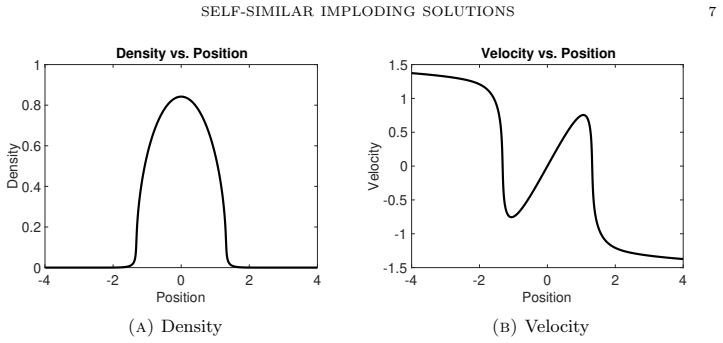
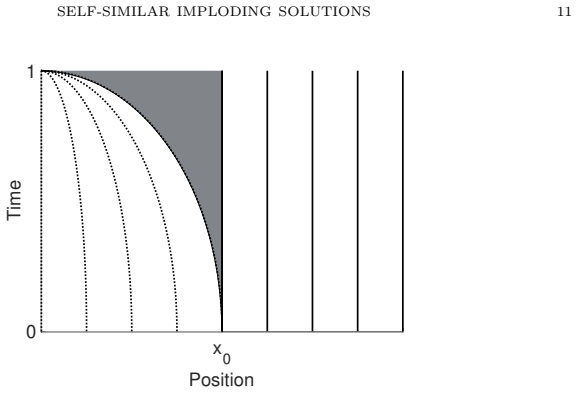
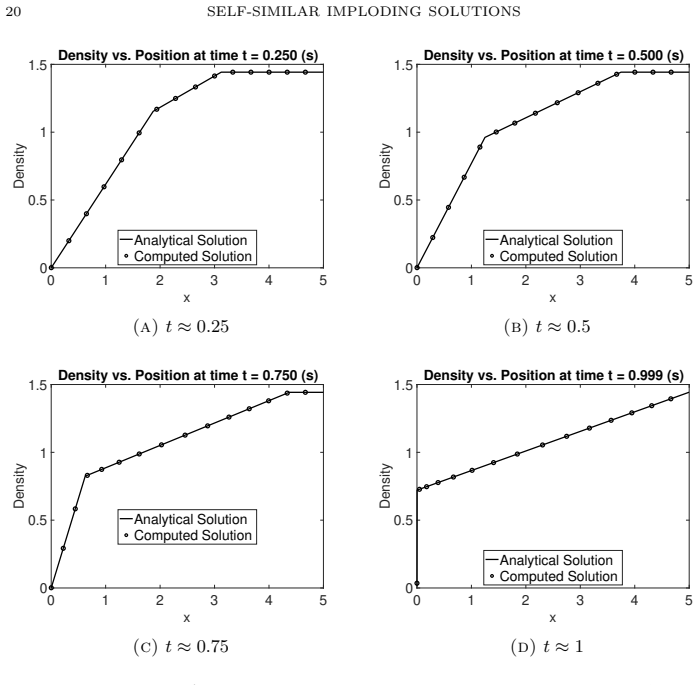
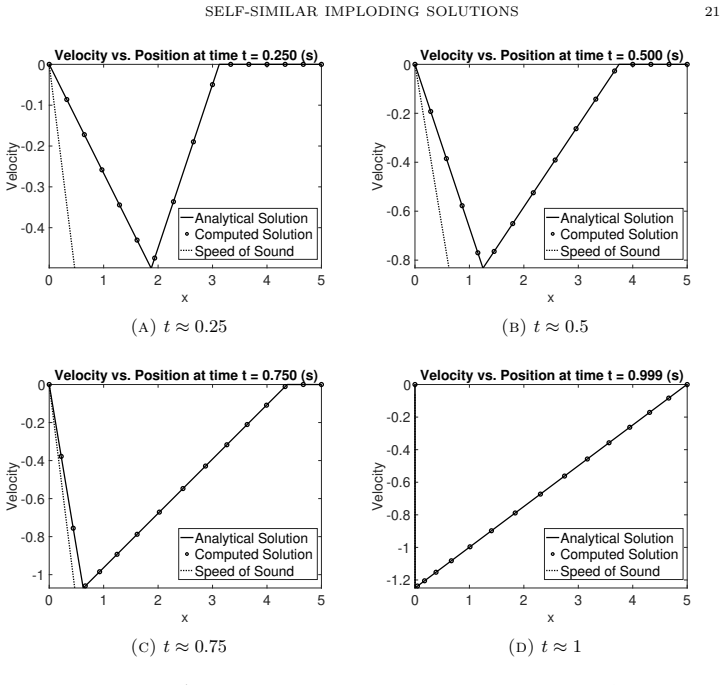
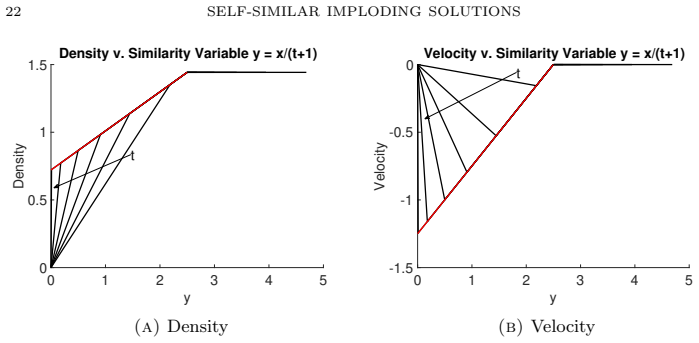
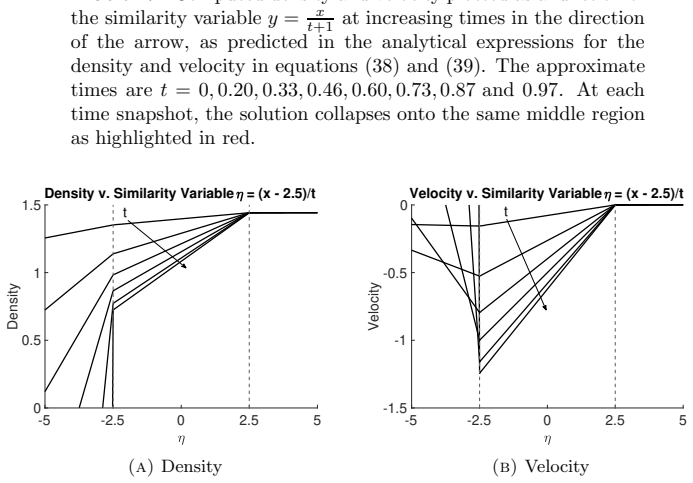
In Kidder's formulation of the radially symmetric isentropic compressible Euler equations in one dimension, the unbounded far-field condition is replaced by a constant density cutoff in the initial data. A non-centered rarefaction then emerges from the cutoff location and suppresses the implosion, yet an exact analytic self-similar solution for the entire flow field can still be constructed and matches numerical results.
What carries the argument
The non-centered rarefaction wave that originates at the far-field density cutoff and suppresses the implosion while preserving an exact self-similar solution.
If this is right
- The analytic solution remains numerically stable and directly computable.
- The emerging rarefaction damps the implosion strength at late times.
- An explicit closed-form expression is available for both density and velocity fields.
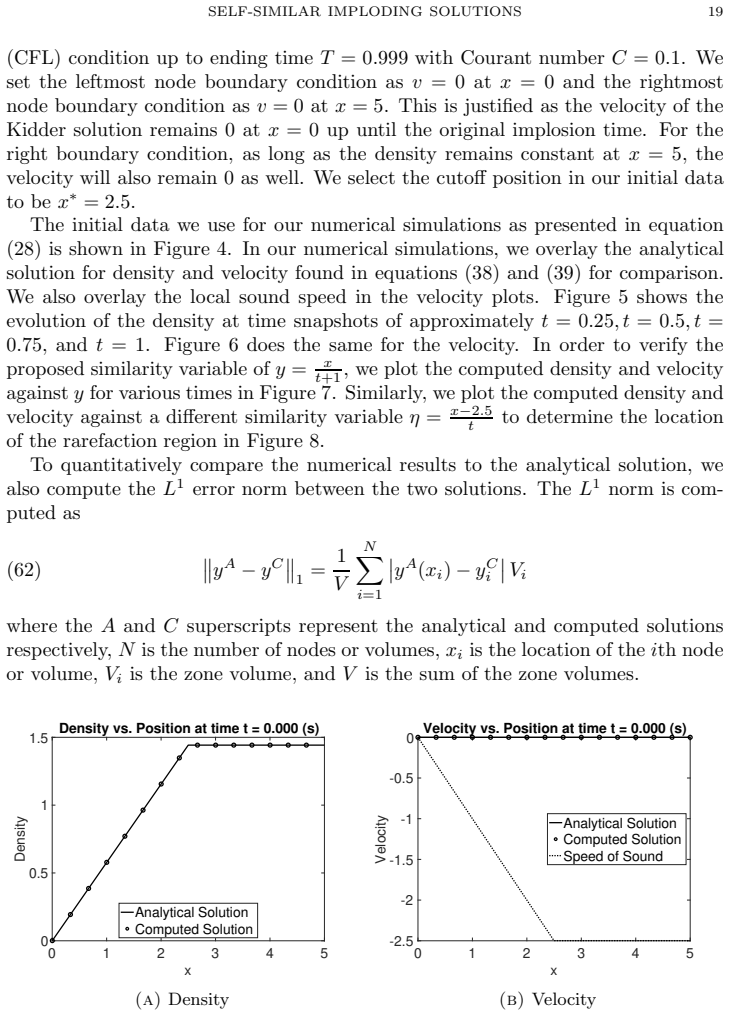
- Numerical simulations reproduce the analytic predictions to high accuracy.
Where Pith is reading between the lines
- The cutoff technique may supply a practical bounded test problem for codes that must handle interacting rarefactions and shocks.
- Analogous far-field modifications could be tested on other self-similar Euler flows whose unbounded versions are known.
- The suppression mechanism suggests that controlled far-field data can systematically alter global implosion behavior without destroying analytic tractability.
Load-bearing premise
The initial data with a constant density cutoff produces a non-centered rarefaction that suppresses the implosion while still permitting an exact analytic solution.
What would settle it
Numerical integration of the cutoff initial data that fails to generate the predicted non-centered rarefaction or deviates from the derived analytic profiles would falsify the existence of the exact solution.
Figures
read the original abstract
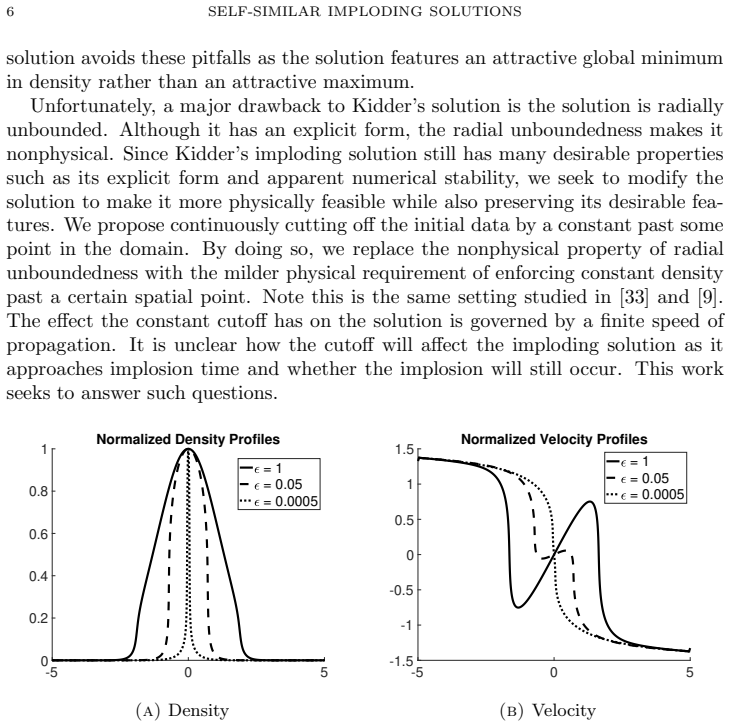
Imploding solutions to the radially symmetric, isentropic, compressible Euler equations have been well-studied, inspired by the work of Guderley. However, these smooth imploding solutions are shown to be numerically unstable and difficult to compute in practice. On the other hand, the imploding solution of Kidder has a closed form solution and is numerically computable. But, it is unbounded in the far field. We consider Kidder's formulation in one dimension in which the unbounded far field condition is replaced with a constant density cutoff of the initial data. Strikingly, a non-centered rarefaction emerges from the cutoff and suppresses the implosion. We present an exact analytic solution to the problem with the cutoff and support our theoretical predictions with numerical simulations.
Editorial analysis
A structured set of objections, weighed in public.
Referee Report
Summary. The paper modifies Kidder's closed-form imploding solution of the 1D isentropic compressible Euler equations by replacing the unbounded far-field condition with a constant-density cutoff at finite radius. It asserts that this generates a non-centered rarefaction wave that suppresses the implosion while preserving an exact analytic self-similar form, and supports the claim with numerical simulations.
Significance. If the central claim holds, the result supplies a rare closed-form example of how a far-field cutoff alters implosion dynamics via a simple-wave interaction, which could aid analysis of stability and numerical schemes for the Euler system. The reuse of Kidder's exact base solution and the combination of analytic construction with numerics are strengths.
major comments (3)
- [Abstract, §2] Abstract and §2: the assertion of a globally exact analytic self-similar solution after the non-centered rarefaction reaches the core is not accompanied by any derivation showing that the Riemann invariants remain constant across the interaction region while preserving the Guderley/Kidder scaling; the matching condition between the rarefaction fan and the imploding core is not exhibited.
- [§3] §3 (construction of the rarefaction): the claim that the cutoff produces a simple wave whose head and tail characteristics remain compatible with a single self-similar variable requires explicit verification that the invariants on the fan identically reproduce the core solution; without this step the solution cannot be guaranteed to stay self-similar once characteristics cross the implosion region.
- [Numerical results] Numerical section: the simulations are said to support the analytic prediction, yet no grid resolution, convergence study, or quantitative comparison (e.g., L2 error to the claimed closed-form profile) is reported, leaving open whether the observed suppression is due to the exact analytic mechanism or numerical dissipation.
minor comments (2)
- Notation for the cutoff radius and the rarefaction head/tail speeds should be introduced with a single consistent symbol and referenced in both the analytic and numerical sections.
- The manuscript would benefit from a brief statement of the isentropic exponent γ used throughout and confirmation that the same value appears in both the analytic construction and the simulations.
Simulated Author's Rebuttal
We thank the referee for the careful reading and constructive comments. The points raised correctly identify places where the manuscript would benefit from additional explicit derivations and numerical details. We address each major comment below and will revise the manuscript to incorporate the requested clarifications.
read point-by-point responses
-
Referee: [Abstract, §2] Abstract and §2: the assertion of a globally exact analytic self-similar solution after the non-centered rarefaction reaches the core is not accompanied by any derivation showing that the Riemann invariants remain constant across the interaction region while preserving the Guderley/Kidder scaling; the matching condition between the rarefaction fan and the imploding core is not exhibited.
Authors: We agree that an explicit derivation of the matching conditions and invariance of the Riemann invariants is missing from the current text. In the revised manuscript we will add a short subsection that computes the invariants J± across the rarefaction fan, verifies that one invariant remains constant while the other reproduces the Kidder core values at the interface, and confirms that the head and tail characteristics are compatible with the single self-similar variable ξ = r / t^α. The matching will be shown by direct substitution of the isentropic relations into the characteristic equations. revision: yes
-
Referee: [§3] §3 (construction of the rarefaction): the claim that the cutoff produces a simple wave whose head and tail characteristics remain compatible with a single self-similar variable requires explicit verification that the invariants on the fan identically reproduce the core solution; without this step the solution cannot be guaranteed to stay self-similar once characteristics cross the implosion region.
Authors: The construction in §3 proceeds from the observation that the cutoff generates a centered simple wave in the self-similar coordinate. To make this rigorous we will insert the explicit verification that the varying invariant along the fan equals the value required by the Kidder solution at the tail characteristic, using the standard integral expression for the Riemann invariant in the isentropic case. This calculation is algebraic once the cutoff density and the Kidder exponents are substituted and will be included in the revision. revision: yes
-
Referee: [Numerical results] Numerical section: the simulations are said to support the analytic prediction, yet no grid resolution, convergence study, or quantitative comparison (e.g., L2 error to the claimed closed-form profile) is reported, leaving open whether the observed suppression is due to the exact analytic mechanism or numerical dissipation.
Authors: We accept that the numerical section requires quantitative support. The revised version will state the spatial and temporal resolutions employed, present a mesh-refinement study with observed convergence rates, and report L2 errors between the computed profiles and the analytic self-similar solution at representative times. These additions will demonstrate that the suppression of the implosion is captured independently of numerical dissipation. revision: yes
Circularity Check
No circularity: analytic solution constructed independently from Kidder base plus cutoff rarefaction
full rationale
The paper begins from the standard 1D isentropic Euler system, adopts the known Kidder self-similar form only in the core region, imposes an explicit constant-density cutoff at finite radius as initial data, and derives the resulting non-centered rarefaction by matching Riemann invariants across the fan. No equation is shown to reduce to a fitted parameter renamed as a prediction, no uniqueness theorem is imported from the authors' prior work, and no ansatz is smuggled via self-citation. The claimed exact analytic solution is therefore self-contained against the external Kidder benchmark and the standard simple-wave theory; the derivation does not collapse to its inputs by construction.
Axiom & Free-Parameter Ledger
axioms (2)
- standard math The governing equations are the radially symmetric, isentropic, compressible Euler equations in one dimension.
- domain assumption Solutions admit a self-similar form as in Kidder's closed-form implosion.
Reference graph
Works this paper leans on
-
[1]
Inertial con finement by spherical implosion
Stefano Atzeni and J¨ urgen Meyer-ter Vehn. Inertial con finement by spherical implosion. In The Physics of Inertial Fusion: Beam Plasma Interaction, Hy drodynamics, Hot Dense Mat- ter, pages 47–74. Oxford University Press, 2004
2004
-
[2]
A second-order Godunov-type scheme for compress- ible fluid dynamics
Matania Ben-Artzi and Joseph Falcovitz. A second-order Godunov-type scheme for compress- ible fluid dynamics. Journal of Computational Physics , 55(1):1–32, 1984
1984
-
[3]
Self-similar solutions to the compressible Euler equations and their instabilities
Anxo Biasi. Self-similar solutions to the compressible Euler equations and their instabilities. Communications in Nonlinear Science and Numerical Simulat ion, 103:106014, 2021
2021
-
[4]
Bourgeade, Ph Le Floch, and P
A. Bourgeade, Ph Le Floch, and P. A. Raviart. An asymptoti c expansion for the solution of the generalized Riemann problem. part 2 : application to t he equations of gas dynamics. Annales de l’Institut Henri Poincar´ e C, Analyse non lin´ eaire, 6(6):437–480, 1989
1989
-
[5]
Brenner, Sascha Hilgenfeldt, and Detlef Lohs e
Michael P. Brenner, Sascha Hilgenfeldt, and Detlef Lohs e. Single-bubble sonoluminescence. Reviews of Modern Physics , 74(2):425–484, 2002
2002
-
[6]
Smooth imploding solutions for 3D compressible fluids
Tristan Buckmaster, Gonzalo Cao-Labora, and Javier G´ o mez-Serrano. Smooth imploding solutions for 3D compressible fluids. Forum of Mathematics, Pi , 13:e6, 2025
2025
-
[7]
Non-radial im- plosion for compressible Euler and Navier-Stokes in T3 and R3
Gonzalo Cao-Labora, Javier G´ omez-Serrano, Jia Shi, an d Gigliola Staffilani. Non-radial im- plosion for compressible Euler and Navier-Stokes in T3 and R3. Cambridge Journal of Math- ematics, 13(4):753–885, 2025
2025
-
[8]
Singularity fo rmation for the compressible Euler equations
Geng Chen, Ronghua Pan, and Shengguo Zhu. Singularity fo rmation for the compressible Euler equations. SIAM Journal on Mathematical Analysis , 49(4):2591–2614, 2017
2017
-
[9]
Compressible flow and Euler’s equations
Demetrios Christodoulou and Shuang Miao. Compressible flow and Euler’s equations . Surveys of Modern Mathematics. International Press of Boston; Beij ing, Somerville, Massachusetts, 2014
2014
-
[10]
C. M. Dafermos. The second law of thermodynamics and sta bility. Archive for Rational Mechanics and Analysis , 70(2):167–179, 1979
1979
-
[11]
Dafermos
Constantine M. Dafermos. Hyperbolic conservation laws in continuum physics . Grundlehren der mathematischen Wissenschaften. Springer, Berlin, Ger many, 4th edition, 2016
2016
-
[12]
Uniqueness of solutions to hyperbolic conservation laws
Ronald DiPerna. Uniqueness of solutions to hyperbolic conservation laws. Indiana Univ. Math. J. , 28(1):137–188, 1979. SELF-SIMILAR IMPLODING SOLUTIONS 25
1979
-
[13]
Lawrence C. Evans. Partial differential equations . Graduate Studies in Mathematics. Amer- ican Mathematical Society, Providence, Rhode Island, seco nd edition, 2022
2022
-
[14]
Giron, Scott D
Jesse F. Giron, Scott D. Ramsey, and Roy S. Baty. Nemchin ov–Dyson solutions of the two-dimensional axisymmetric inviscid compressible flow e quations. Physics of Fluids , 32(12):127116, 2020
2020
-
[15]
Guderley
K.G. Guderley. Starke kugelige und zylindrische verdi chtungsst¨ osse in der n¨ ahe des kugelmit- telpunktes bzw. der zylinderachse. Luftfahrtforschung, 19:302–312, 1942
1942
-
[16]
C. Hunter. On the collapse of an empty cavity in water. Journal of Fluid Mechanics , 8(2):241– 263, 1960
1960
-
[17]
Hunter, Jr
James H. Hunter, Jr. The collapse of interstellar gas cl ouds and the formation of stars. Monthly Notices of the Royal Astronomical Society , 142(4):473–498, 1969
1969
-
[18]
Amplitude b lowup in radial isentropic Euler flow
Helge Kristian Jenssen and Charis Tsikkou. Amplitude b lowup in radial isentropic Euler flow. SIAM Journal on Applied Mathematics , 80(6):2472–2495, 2020. doi: 10.1137/20M1340241
-
[19]
R. E. Kidder. Theory of homogeneous isentropic compres sion and its application to laser fusion. Nuclear Fusion, 14(1):53, 1974
1974
-
[20]
R. E. Kidder. Energy gain of laser-compressed pellets: a simple model calculation. Nuclear Fusion, 16(3):405, 1976
1976
-
[21]
Peter D. Lax. Development of singularities of solution s of nonlinear hyperbolic partial differ- ential equations. Journal of Mathematical Physics , 5(5):611–613, 1964
1964
-
[22]
Peter D. Lax. Hyperbolic Systems of Conservation Laws and the Mathematic al Theory of Shock Waves . CBMS-NSF Regional Conference Series in Applied Mathemati cs. Society for Industrial and Applied Mathematics, 1973
1973
-
[23]
Ph Le Floch and P. A. Raviart. An asymptotic expansion fo r the solution of the generalized Riemann problem part I: General theory. Annales de l’Institut Henri Poincar´ e C, Analyse non lin´ eaire, 5(2):179–207, 1988
1988
-
[24]
Description de la formation d’un choc dans le p-systeme
Marie-Pierre Lebaud. Description de la formation d’un choc dans le p-systeme. App roxima- tion de valeurs propres par des elements finis isoparametriq ues. Thesis, Universit´ e de Rennes I, 1992. Th` ese de doctorat Math´ ematiques et applications Rennes 1 1992 1992REN10094
1992
-
[25]
Numerical Methods for Conservation Laws
Randall Leveque. Numerical Methods for Conservation Laws . Springer Basel AG, Basel, 1990
1990
-
[26]
The generalized Riemann problem for quasi linear hyperbolic systems of conser- vation laws
Ta-tsien Li. The generalized Riemann problem for quasi linear hyperbolic systems of conser- vation laws. In Chaohao Gu, Xiaxi Ding, and Chung-Chun Yang, editors, Partial Differential Equations in China , pages 80–103. Springer Netherlands, Dordrecht, 1994
1994
-
[27]
On the implosion of a compressible fluid I: Smooth self-similar inviscid profiles
Frank Merle, Pierre Rapha¨ el, Igor Rodnianski, and Jer emie Szeftel. On the implosion of a compressible fluid I: Smooth self-similar inviscid profiles . Annals of Mathematics , 196(2):567– 778, 2022
2022
-
[28]
On the implosion of a compressible fluid II: Singularity formation
Frank Merle, Pierre Rapha¨ el, Igor Rodnianski, and Jer emie Szeftel. On the implosion of a compressible fluid II: Singularity formation. Annals of Mathematics , 196(2):779–889, 2022
2022
-
[29]
Meyer-ter Vehn and C
J. Meyer-ter Vehn and C. Schalk. Selfsimilar spherical compression waves in gas dynamics. Zeitschrift f¨ ur Naturforschung A, 37(8):954–970, 1982
1982
-
[30]
W. F. Noh. Errors for calculations of strong shocks usin g an artificial viscosity and an artificial heat flux. Journal of Computational Physics , 72(1):78–120, 1987
1987
-
[31]
Scott D. Ramsey. The linear velocity profile class of hyd rodynamics verification test problems. Full Paper LA-UR-11-02766, Los Alamos National Laboratory , 2011
2011
-
[32]
L. I. Sedov. Chapter IV - One-dimensional unsteady moti on of a gas. In L. I. Sedov, editor, Similarity and Dimensional Methods in Mechanics , pages 146–304. Academic Press, 1959
1959
-
[33]
Thomas C. Sideris. Formation of singularities in three -dimensional compressible fluids. Com- munications in Mathematical Physics , 101(4):475–485, 1985
1985
-
[34]
Eleuterio F. Toro. The generalized riemann problem. In Riemann Solvers and Numerical Methods for Fluid Dynamics: A Practical Introduction , pages 625–653. Springer Berlin Hei- delberg, Berlin, Heidelberg, 2009
2009
-
[35]
von Neumann and R
J. von Neumann and R. D. Richtmyer. A method for the numer ical calculation of hydrody- namic shocks. Journal of Applied Physics , 21(3):232–237, 1950
1950
-
[36]
P. R. W oodward. Shock-driven implosion of interstella r gas clouds and star formation. The Astrophysical Journal, 207:484, 1976
1976
-
[37]
Formation and construction of a shock wav e for 3-D compressible Euler equa- tions with the spherical initial data
Huicheng Yin. Formation and construction of a shock wav e for 3-D compressible Euler equa- tions with the spherical initial data. Nagoya Mathematical Journal , 175:125–164, 2004
2004
discussion (0)
Sign in with ORCID, Apple, or X to comment. Anyone can read and Pith papers without signing in.