REVIEW 2 major objections 1 minor 1 cited by
Reaching the thermodynamic limit of periodic CCSD cohesive energies and band gaps
T0 review · 2 major / 1 minor · reviewed 2026-06-27 · grok-4.3
Pith's one-line read A distributed-memory periodic CCSD implementation enables 216 k-point sampling to converge cohesive energies and band gaps to 0.1 eV.
desk verdict The distributed-memory periodic CCSD implementation that reaches 216 k-points is the actual advance, though the 0.1 eV thermodynamic limit claims need explicit checks against existing codes and raw data to be fully convincing. read the letter →
The pith
A machine-rendered reading of the paper's core claim, the machinery that carries it, and where it could break.
The reading
What carries the argument
Distributed-memory implementation of periodic coupled-cluster theory with single and double excitations (CCSD) that supports dense Brillouin zone sampling up to 216 k-points for thermodynamic limit extrapolation.
What would settle it
A calculation with substantially denser k-point sampling such as 8^3=512 points that deviates by more than 0.1 eV from the reported extrapolated values would falsify the convergence claim.
Extended reading notes
Core claim
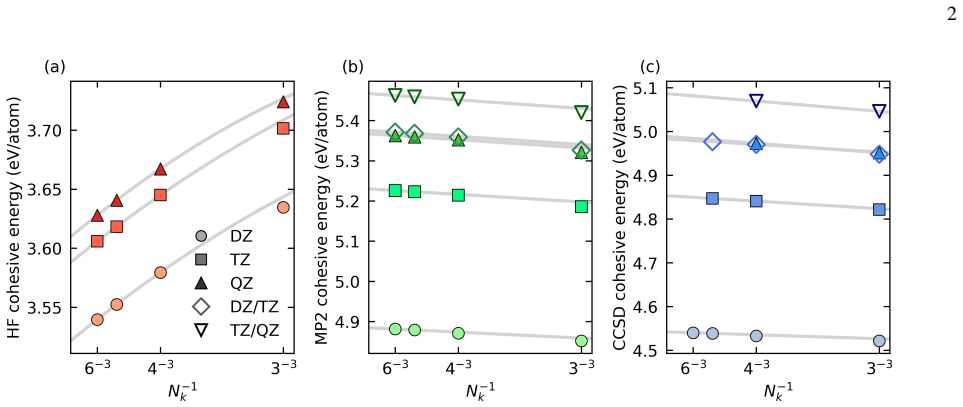
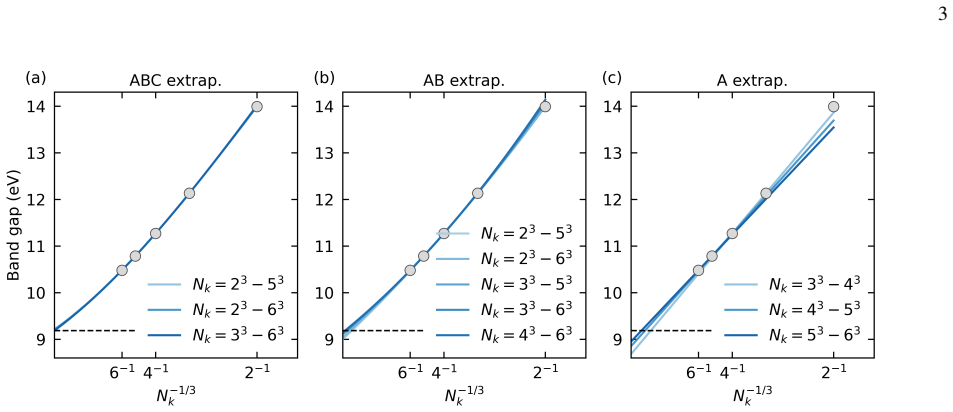
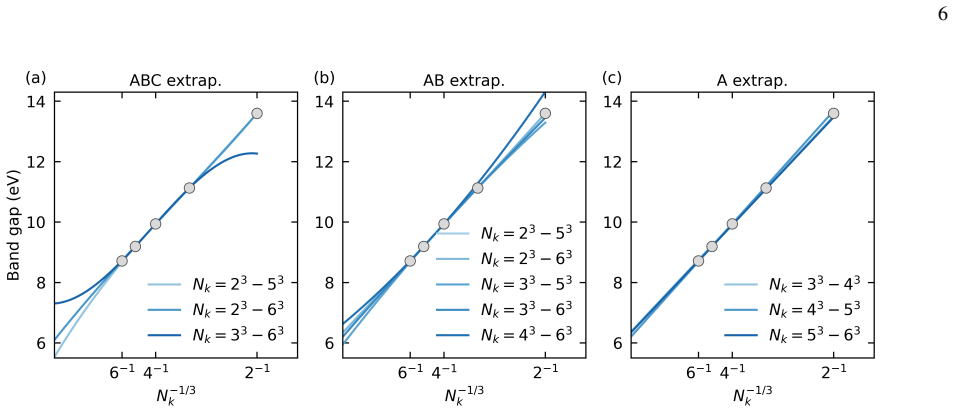
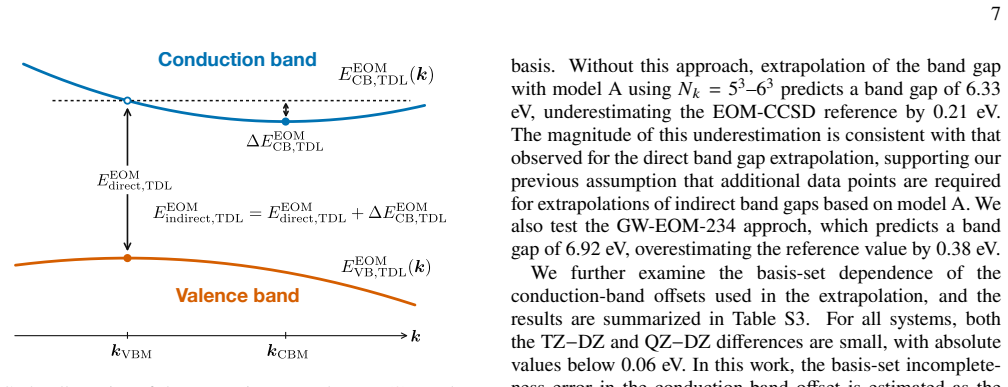
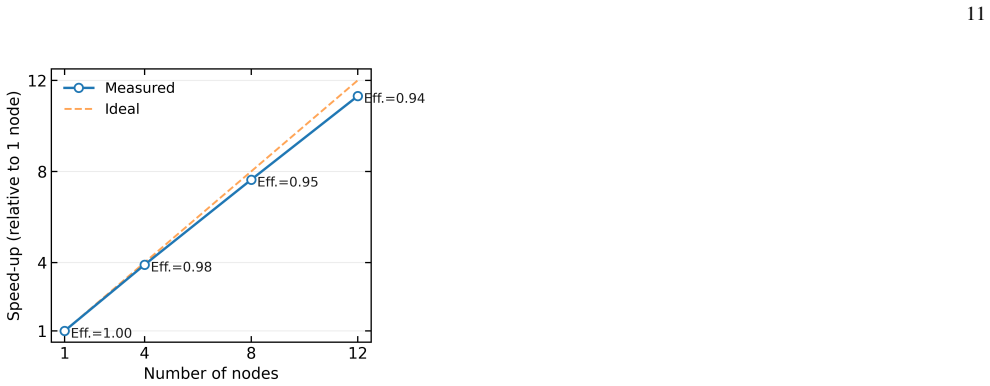
The central claim is that the new distributed-memory software implementation of periodic CCSD runs efficiently on up to 12 nodes, allowing calculations in which the Brillouin zone is sampled with up to 6^3=216 k-points. This enables reliable extrapolation to the thermodynamic limit. For eight simple semiconductors and insulators, the cohesive energy and band gap are reported converged to 0.1 eV, providing definitive benchmark numbers for the CCSD level of theory.
Load-bearing premise
The new distributed-memory implementation correctly computes the periodic CCSD energies without numerical errors, and the extrapolation procedure from finite k-point samplings accurately reaches the thermodynamic limit.
Editorial extensions
If this is right
- The reported values serve as benchmarks for assessing other electronic structure methods in periodic systems.
- Cohesive energies at the CCSD level typically underestimate experimental values by 0.1-0.2 eV on average.
- Band gaps at the CCSD level typically overestimate experimental values by about 0.4 eV on average.
- Ground-state and excited-state properties in solids can now be computed with higher k-point density before extrapolation.
Reading between the lines
- The benchmarks could be used to test and improve lower-cost methods such as density functional theory for solid-state properties.
- The distributed implementation approach may extend to higher-order coupled-cluster methods or larger unit cells as hardware improves.
- Similar dense sampling strategies could reduce finite-size errors in other many-body perturbation theories for solids.
Editorial analysis
A structured set of objections, weighed in public.
Referee Report
Summary. The manuscript reports the development of a distributed-memory implementation of periodic CCSD that enables Brillouin zone sampling with up to 6^3 k-points. For eight simple semiconductors and insulators, it provides cohesive energies and band gaps extrapolated to the thermodynamic limit, claimed to converge to 0.1 eV, serving as benchmarks, with average errors versus experiment of 0.1-0.2 eV (cohesive energies) and ~0.4 eV (band gaps).
Significance. If the implementation is numerically correct and the extrapolation reliable, the work would supply useful high-accuracy periodic CCSD benchmarks that address finite-size errors limiting prior studies; the technical advance in scaling to denser k-grids is a clear strength.
major comments (2)
- [Implementation section] Implementation section: no comparisons are provided between the new distributed-memory periodic CCSD results at small k-grids (e.g., 2^3 or 3^3) and existing periodic CCSD codes, leaving the numerical correctness of the energies unverified and directly undermining the 0.1 eV convergence claim.
- [Results/extrapolation section] Results/extrapolation section: the manuscript provides no explicit description of the extrapolation functional form, fitting procedure, or quantitative error analysis demonstrating that finite-size errors have been removed to the stated 0.1 eV precision for the reported cohesive energies and band gaps.
minor comments (1)
- [Abstract] Abstract: the phrasing 'definitive benchmark numbers' is not yet supported by the validation data shown.
Simulated Author's Rebuttal
We thank the referee for their constructive comments on our manuscript. We address each major comment below and will revise the manuscript accordingly to strengthen the presentation of our results.
read point-by-point responses
-
Referee: [Implementation section] Implementation section: no comparisons are provided between the new distributed-memory periodic CCSD results at small k-grids (e.g., 2^3 or 3^3) and existing periodic CCSD codes, leaving the numerical correctness of the energies unverified and directly undermining the 0.1 eV convergence claim.
Authors: We agree that explicit numerical verification against existing periodic CCSD implementations is important for establishing correctness. In the revised manuscript, we will add direct comparisons of our distributed-memory CCSD energies at 2^3 and 3^3 k-grids for representative systems against published results from other periodic CCSD codes. These comparisons will be included in the Implementation section to support the reliability of the implementation and the subsequent convergence claims. revision: yes
-
Referee: [Results/extrapolation section] Results/extrapolation section: the manuscript provides no explicit description of the extrapolation functional form, fitting procedure, or quantitative error analysis demonstrating that finite-size errors have been removed to the stated 0.1 eV precision for the reported cohesive energies and band gaps.
Authors: We acknowledge that the extrapolation details require clarification. The revised manuscript will explicitly describe the functional form employed for extrapolation to the thermodynamic limit (typically of the form a + b/N_k + c/N_k^{4/3} or similar, as appropriate for the quantity), the fitting procedure used, and quantitative error estimates (e.g., standard errors from the fit and sensitivity to the number of k-points included). This will demonstrate that residual finite-size errors are below the stated 0.1 eV threshold for the reported cohesive energies and band gaps. revision: yes
Circularity Check
No circularity; results from direct computation on new implementation with standard extrapolation
full rationale
The paper reports development of a distributed-memory periodic CCSD code and its application to compute cohesive energies and band gaps at up to 6^3 k-points for eight materials, followed by extrapolation to the thermodynamic limit. No load-bearing step reduces by construction to a fitted parameter, self-definition, or self-citation chain. The extrapolation is presented as a numerical procedure to remove finite-size errors, not as a prediction derived from the same data by definition. Claims rest on the correctness of the implementation and the validity of the extrapolation form, which are external to any circular reduction within the paper's equations. This is a standard computational reporting structure with independent content.
Assumptions & free parameters
Cite this review
Pith. "Pith review of Reaching the thermodynamic limit of periodic CCSD cohesive energies and band gaps." pith.science (2026). https://pith.science/paper/VRY7OEDS
@misc{pith2026260612782,
  author       = {Pith},
  title        = {Pith review of: Reaching the thermodynamic limit of periodic CCSD cohesive energies and band gaps},
  year         = {2026},
  howpublished = {\url{https://pith.science/paper/VRY7OEDS}},
  note         = {Machine review of arXiv:2606.12782}
}
abstract
The high computational cost of periodic coupled-cluster theory has limited the density of Brillouin zone sampling, yielding finite-size errors that need to be removed by extrapolation. Here we report the development and application of a distributed-memory software implementation of periodic coupled-cluster theory with single and double excitations (CCSD) that runs efficiently on up to 12 nodes with 96 cores each. This new implementation allows ground-state and excited-state calculations in which the Brillouin zone is sampled with up to $6^3=216$ $k$-points, allowing us to reliably extrapolate to the thermodynamic limit. For eight simple semiconductors and insulators, we report the cohesive energy and band gap, which are converged to 0.1 eV, providing definitive benchmark numbers for the CCSD level of theory. Compared to experimental values, average errors for the cohesive energy are 0.1-0.2 eV (typically an underestimate), and average errors for the band gap are about 0.4 eV (typically an overestimate).
Figures
Figures from the paper (2 more)
Forward citations
Cited by 1 Pith paper
-
Wavefunction-based periodic quantum chemistry
A comprehensive tutorial derives and organizes the standard machinery of periodic wavefunction quantum chemistry from Ewald Hamiltonians through HF, MP2, CC, finite-size corrections, and local/embedding methods.
Reviewed June 27, 2026 · model on record in the stance chip above.
Discussion (0). Sign in to comment.