To Share or Not to Share: Orchestrating Trustworthy Data in Global Value Chains
Pith reviewed 2026-06-27 05:32 UTC · model grok-4.3
The pith
A RegTech architecture based on the International Data Spaces framework orchestrates sovereign environmental data exchange for semiconductor value chains under CBAM.
A machine-rendered reading of the paper's core claim, the machinery that carries it, and where it could break.
Core claim
The central claim is that a RegTech reference architecture using the International Data Spaces framework orchestrates trustworthy environmental telemetry across the semiconductor-petrochemical nexus. This enables sovereign data exchange for Digital Product Passports that drive Global Business Services capability demands. The architecture distinguishes mandatory CBAM requirements from voluntary frameworks such as SBTi and SSbD. A prospective roadmapping methodology transforms upstream physical vulnerabilities into circular negative feedback loops focused on the Taipei and Penang technology corridor. Integration with Agentic AI for autonomous compliance and FinTech for green financing provides
What carries the argument
The RegTech reference architecture using the International Data Spaces (IDSA) framework, which orchestrates trustworthy environmental telemetry while preserving sovereignty and enabling distinction between mandatory and voluntary regulatory requirements.
Load-bearing premise
The International Data Spaces framework and the prospective roadmapping methodology can be practically adapted to the Taipei-Penang technology corridor to transform upstream physical vulnerabilities into circular negative feedback loops without insurmountable technical, governance, or adoption barriers.
What would settle it
Implementation attempts in the Taipei-Penang corridor that show either persistent data sovereignty conflicts blocking Digital Product Passport creation or failure to distinguish CBAM requirements from voluntary frameworks would falsify the claim.
Figures
read the original abstract
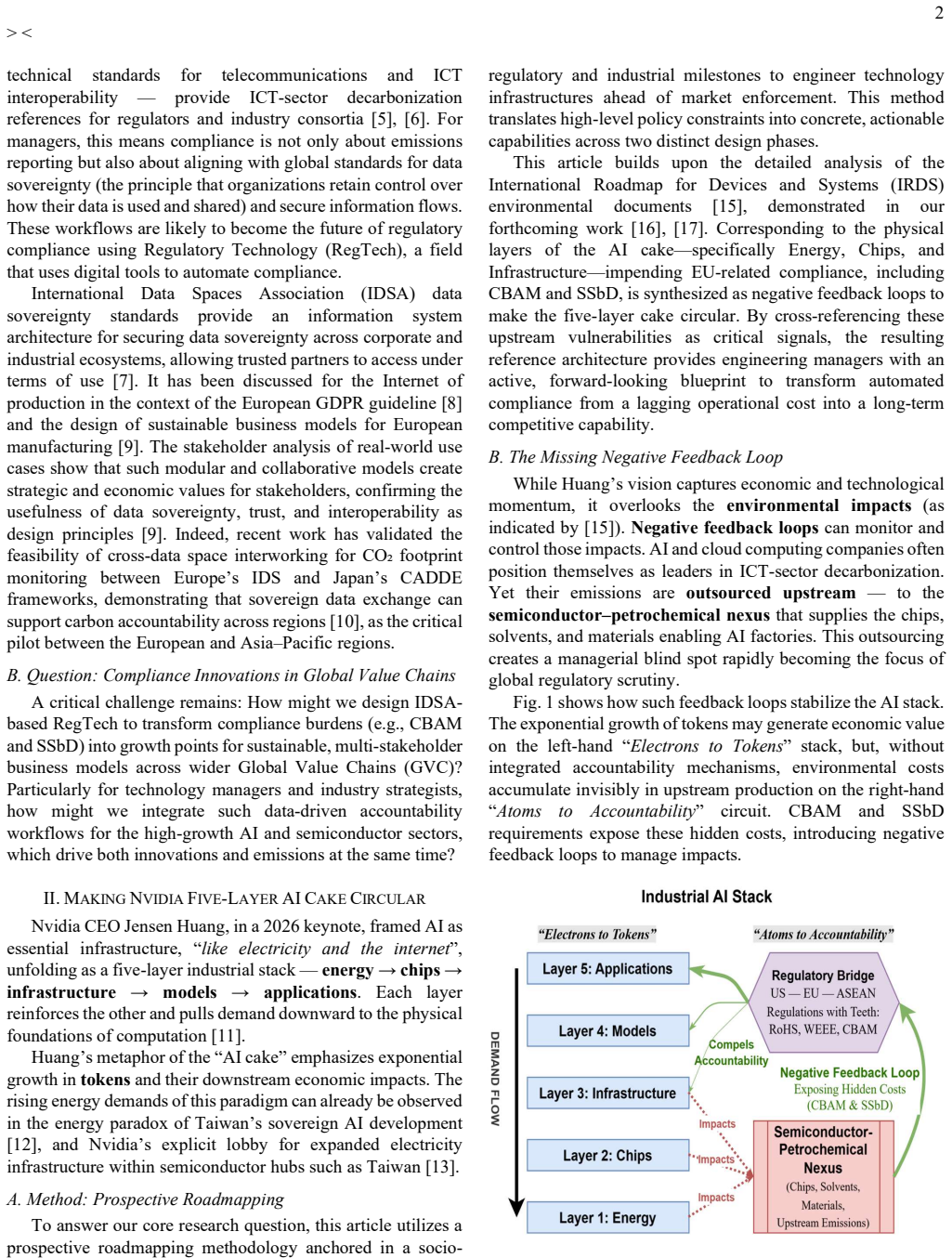
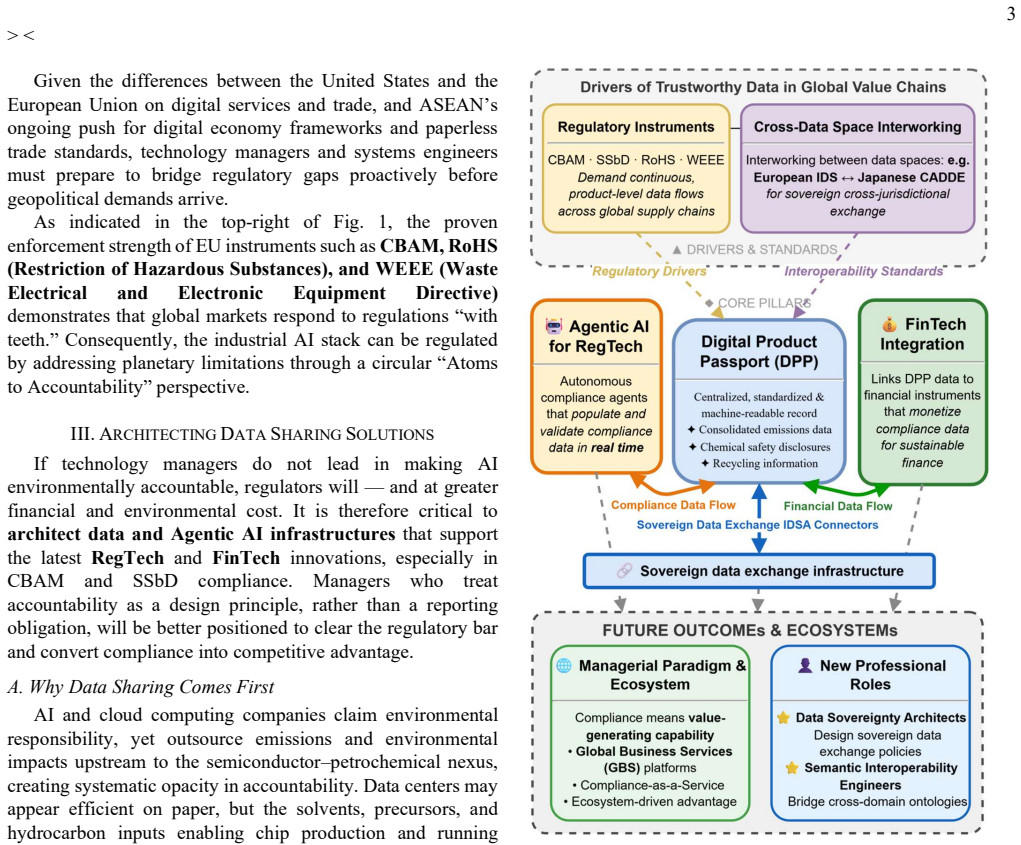
As the EU Carbon Border Adjustment Mechanism (CBAM) approaches, the global semiconductor value chain faces growing structural tensions between regulatory transparency and data sovereignty. This article proposes a RegTech reference architecture using the International Data Spaces (IDSA) framework to orchestrate trustworthy environmental telemetry across the semiconductor-petrochemical nexus. The framework distinguishes the mandatory CBAM requirements from voluntary Science Based Targets initiative (SBTi) frameworks, while addressing the additive complexities of the Safe-and-Sustainable-by-Design (SSbD) framework. Moving beyond standard linear technology stacks, we introduce a prospective roadmapping methodology that transforms upstream physical vulnerabilities into circular, negative feedback loops. Focusing on the Taipei and Penang technology corridor, the article details how sovereign data exchange enables Digital Product Passports (DPPs) to drive Global Business Services (GBSs) capability demands. Finally, we discuss the integration of Agentic AI for autonomous compliance and FinTech green financing, providing a scalable blueprint for global industrial clusters to achieve sovereign, sustainable, and transparent value chains.
Editorial analysis
A structured set of objections, weighed in public.
Referee Report
Summary. The manuscript proposes a RegTech reference architecture using the International Data Spaces (IDSA) framework to orchestrate trustworthy environmental telemetry across the semiconductor-petrochemical nexus. It distinguishes mandatory CBAM requirements from voluntary SBTi and SSbD frameworks, introduces a prospective roadmapping methodology to convert upstream vulnerabilities into circular negative feedback loops, and focuses on the Taipei-Penang corridor where sovereign data exchange via Digital Product Passports drives Global Business Services demands. The paper also discusses integration of Agentic AI for autonomous compliance and FinTech green financing as a scalable blueprint.
Significance. If the proposed architecture can be realized, it would supply a conceptual blueprint for reconciling data sovereignty with regulatory transparency demands in global value chains. The integration of IDSA with existing regulatory instruments and the roadmapping approach for feedback loops represents a coherent synthesis that could inform future work on DPP-enabled sustainability governance.
major comments (1)
- [Abstract] Abstract and overall manuscript: the central claim that the IDSA framework plus the introduced roadmapping methodology can be practically adapted to the semiconductor-petrochemical nexus and Taipei-Penang corridor without insurmountable barriers rests on untested assertions; no formal model, implementation details, or falsification criteria are supplied to ground the adaptation claim.
Simulated Author's Rebuttal
We thank the referee for the constructive feedback. We address the major comment below, clarifying the conceptual scope of the work.
read point-by-point responses
-
Referee: [Abstract] Abstract and overall manuscript: the central claim that the IDSA framework plus the introduced roadmapping methodology can be practically adapted to the semiconductor-petrochemical nexus and Taipei-Penang corridor without insurmountable barriers rests on untested assertions; no formal model, implementation details, or falsification criteria are supplied to ground the adaptation claim.
Authors: The manuscript presents a conceptual reference architecture and a prospective roadmapping methodology, explicitly described as such in the abstract and text. It does not assert that adaptation can occur without barriers or provide empirical validation; rather, it synthesizes IDSA principles with CBAM, DPP, and related frameworks to offer a blueprint for future development. No formal model or implementation is included because the contribution is architectural and prospective, not evaluative. We will revise the abstract and introduction to more explicitly emphasize the conceptual nature and avoid any phrasing that might imply practical realization. revision: partial
Circularity Check
No circularity in conceptual architecture proposal
full rationale
The paper is a prospective RegTech reference architecture proposal that integrates existing external frameworks (IDSA, CBAM, SBTi, SSbD, DPPs) and introduces a roadmapping methodology for the semiconductor-petrochemical nexus. No equations, fitted parameters, predictions of derived quantities, or self-citations appear in the provided text that would reduce any claim to its own inputs by construction. The central content is a high-level blueprint whose claims rest on the described integration rather than any self-referential derivation chain.
Axiom & Free-Parameter Ledger
Reference graph
Works this paper leans on
-
[1]
Taiwan collects nearly NT$5 billion in first carbon fee cycle,
Focus Taiwan, “Taiwan collects nearly NT$5 billion in first carbon fee cycle,” CNA English News, The Central News Agency (CNA), Jun. 03,
- [2]
-
[3]
K. Schwirn et al., “The European Commission’s safe and sustainable by design framework: bridging innovation and legislation,” Environ. Sci Eur., vol. 37, no. 1, p. 189, Nov. 2025, doi: 10.1186/s12302-025-01246-y
-
[4]
P. Fantke and P. Mankong, “Insights from life cycle assessment to inform chemical substitution, alternatives assessment and safe and sustainable-by- design,” Environ. Sci. Technol., vol. 60, no. 2, pp. 1596–1611, Jan. 2026, doi: 10.1021/acs.est.5c12521
-
[5]
C. Apel et al., “Safe and Sustainable by Design (SSbD) landscape: Mapping state of the art approaches along the innovation process and developing good practices,” Sustain. Chem. Pharm., vol. 50, p. 102355, Apr. 2026, doi: 10.1016/j.scp.2026.102355
-
[6]
A. Serpe et al., “2002-2022: 20 years of e-waste regulation in the European Union and the worldwide trends in legislation and innovation technologies for a circular economy,” RSC Sustain., vol. 3, no. 3, pp. 1039–1083, Mar. 2025, doi: 10.1039/d4su00548a
-
[7]
H.-T. Liao, C.-L. Pan, and Y. Zhang, “Smart digital platforms for carbon neutral management and services: Business models based on ITU standards for green digital transformation,” Front. Ecol. Evol., vol. 11, p. 1134381, Mar. 2023, doi: 10.3389/fevo.2023.1134381
-
[8]
B. Otto, M. ten Hompel, and S. Wrobel, “International Data Spaces,” in Digital Transformation, R. Neugebauer, Ed., Berlin, Heidelberg: Springer, 2019, pp. 109–128. doi: 10.1007/978-3-662-58134-6_8
-
[9]
Data Sovereignty and the Internet of Production,
M. Jarke, “Data Sovereignty and the Internet of Production,” in Advanced Information Systems Engineering, S. Dustdar, E. Yu, C. Salinesi, D. Rieu, and V. Pant, Eds., Cham: Springer International Publishing, 2020, pp. 549–
2020
-
[10]
doi: 10.1007/978-3-030-49435-3_34
-
[11]
Designing Sustainable Business Models for Data Spaces: Insights from the Industrial Sector,
E. Politi et al., “Designing Sustainable Business Models for Data Spaces: Insights from the Industrial Sector,” IEEE Access, pp. 1–1, 2026, doi: 10.1109/ACCESS.2026.3695646
-
[12]
On the Need of International Cross-Data Space Interworking: An EU–Japan Case Study,
J. R. Santana et al., “On the Need of International Cross-Data Space Interworking: An EU–Japan Case Study,” IT Prof., vol. 27, no. 5, pp. 59– 65, Sep. 2025, doi: 10.1109/MITP.2025.3545214
-
[13]
AI is a 5-layer cake,
J. Huang, “AI is a 5-layer cake,” NVIDIA Blog. Accessed: Apr. 18, 2026. [Online]. Available: https://blogs.nvidia.com/blog/ai-5-layer-cake/
2026
-
[14]
The energy paradox of Taiwan’s sovereign AI ambition,
S. Huang, “The energy paradox of Taiwan’s sovereign AI ambition,” Center for Asia-Pacific Resilience and Innovation (CAPRI) Analysis, Mar
-
[15]
Available: https://caprifoundation.org/the-energy- paradox-of-taiwans-sovereign-ai-ambition/
[Online]. Available: https://caprifoundation.org/the-energy- paradox-of-taiwans-sovereign-ai-ambition/
-
[16]
Nvidia CEO touts surge in spending in Taiwan,
L. Wang, “Nvidia CEO touts surge in spending in Taiwan,” The Taipei Times, Taipei, p. 1, May 28, 2026
2026
-
[17]
A. Tuominen and T. Ahlqvist, “Is the transport system becoming ubiquitous? Socio-technical roadmapping as a tool for integrating the development of transport policies and intelligent transport systems and services in Finland,” Technol. Forecast. Soc. Chang., vol. 77, no. 1, pp. 120–134, Jan. 2010, doi: 10.1016/j.techfore.2009.06.001
-
[18]
Environment, safety, health & sustainability (ESHS): environmental sustainability of the semiconductor facilities (ESSF),
IEEE, “Environment, safety, health & sustainability (ESHS): environmental sustainability of the semiconductor facilities (ESSF),” International Roadmap for Devices and Systems (IRDS), 2024. [Online]. Available: https://irds.ieee.org/images/files/pdf/2024/2024IRDS_ESHS- ESSF.pdf
2024
-
[19]
From stacks to circuits: a regenerative socio- technical roadmap for AI infrastructure within planetary boundaries,
H.-T. Liao and K. Ang, “From stacks to circuits: a regenerative socio- technical roadmap for AI infrastructure within planetary boundaries,” in 2026 IEEE International Conference on Engineering, Technology, and Innovation (ICE/ITMC), forthcoming 2026
2026
-
[20]
Scoping review of AI, metrology, and ESG in the semiconductor sector: implications for Safe and Sustainable by Design (SSbD),
K. Ang and H.-T. Liao, “Scoping review of AI, metrology, and ESG in the semiconductor sector: implications for Safe and Sustainable by Design (SSbD),” in 2026 IEEE International Conference on Engineering, Technology, and Innovation (ICE/ITMC), forthcoming 2026
2026
-
[21]
Orchestrating the twin transition in multinational corporations: technology roadmapping for green and digital global business services,
H.-T. Liao and K. Ang, “Orchestrating the twin transition in multinational corporations: technology roadmapping for green and digital global business services,” in 2026 IEEE International Conference on Engineering, Technology, and Innovation (ICE/ITMC), forthcoming 2026
2026
-
[22]
Global capability centres: emerging opportunities and challenges,
S. K. Jha and A. Seth, “Global capability centres: emerging opportunities and challenges,” IIMB Manag. Rev., vol. 37, no. 3, p. 100595, Sep. 2025, doi: 10.1016/j.iimb.2025.100595. 6 > <
-
[23]
H.-T. Liao, C.-L. Pan, and Z. Wu, “Digital transformation and innovation and business ecosystems: A bibliometric analysis for conceptual insights and collaborative practices for ecosystem innovation,” International Journal of Innovation Studies, vol. 8, no. 4, pp. 406–431, Dec. 2024, doi: 10.1016/j.ijis.2024.04.003. Han-Teng (Member, IEEE) was born in Tai...
discussion (0)
Sign in with ORCID, Apple, or X to comment. Anyone can read and Pith papers without signing in.