Embedding ISO 10218 Safety Compliance in Robots via Control Barrier Functions for Human-Robot Collaboration
Pith reviewed 2026-06-27 06:53 UTC · model grok-4.3
The pith
A predictive Control Barrier Function using human acceleration data ensures ISO 10218 speed-separation compliance while cutting trajectory error by 63 percent.
A machine-rendered reading of the paper's core claim, the machinery that carries it, and where it could break.
Core claim
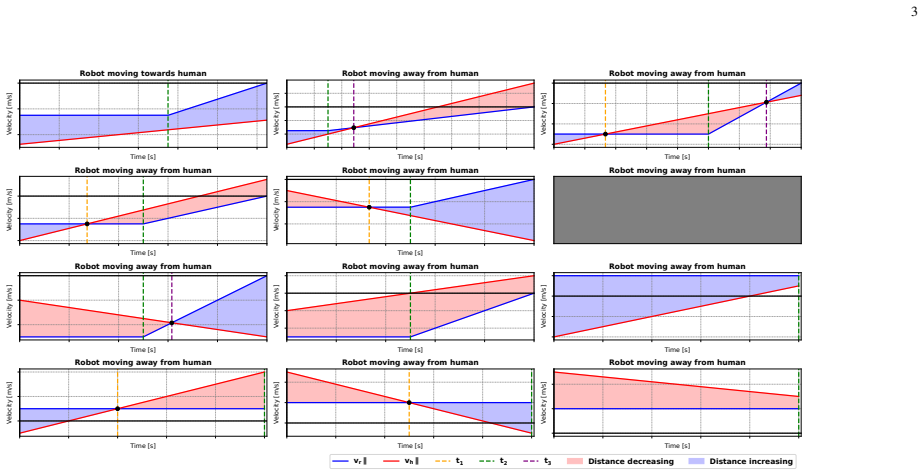
The central claim is that a Control Barrier Function can be formulated to forward-predict the exact minimum human-robot separation distance under a worst-case robot stopping trajectory by incorporating real-time human acceleration measurements, and that this CBF, when enforced as an SQP inequality constraint, guarantees ISO 10218 SSM compliance at the control level. Two methods are derived: Method I applies the CBF as a PD safety filter, while Method II uses the CBF inside a task-scaling SQP controller that also enforces a spatial tube. Experiments demonstrate that Method II reduces mean trajectory error by 63 percent relative to Method I, dynamically adjusts speed, avoids excessive evasive
What carries the argument
The predictive Control Barrier Function that analytically computes the minimum separation distance from human acceleration and the robot's worst-case stopping trajectory, imposed as an inequality constraint inside an SQP optimization.
If this is right
- Method II dynamically modulates robot execution speed while confining spatial deviations inside a prescribed tube.
- Method II achieves a 63 percent reduction in mean trajectory error relative to the CBF-constrained PD filter.
- The SQP formulation avoids excessive evasive maneuvers while preserving high task throughput.
- Both methods enforce ISO 10218 SSM compliance directly at the control level rather than through post-hoc speed filtering.
- The predictive CBF outperforms a standard industrial SSM module on the same UR10e hardware in both simulation and hardware trials.
Where Pith is reading between the lines
- If human acceleration cannot be sensed directly, the method would require an online estimator whose error bounds would have to be folded into the CBF margin.
- The same predictive-separation idea could be applied to multi-robot cells where each robot treats the others as dynamic obstacles whose accelerations are also measured.
- Replacing the analytic stopping-trajectory model with a learned dynamics model would allow the CBF to adapt to payload changes without retuning the safety constraint.
- The SQP formulation naturally supports additional task constraints, suggesting the safety layer can be stacked with force or vision objectives without reformulating the optimizer.
Load-bearing premise
The formulation assumes real-time human acceleration measurements are available and that an analytical worst-case robotic stopping trajectory can be forward-predicted to compute the exact minimum separation distance required by the CBF inequality.
What would settle it
A physical experiment in which measured human acceleration is withheld or corrupted and the robot's actual stopping distance exceeds the CBF-predicted value, producing a separation distance that falls below the ISO 10218 SSM threshold.
Figures


read the original abstract
Human-Robot Collaboration (HRC) requires strict adherence to safety standards, such as ISO 10218, to prevent harmful interactions. Standard Speed and Separation Monitoring (SSM) filters calculate safe robotic speeds based on conservative assumptions, such as constant human velocity, which prevents accurate predictions of minimum separation distances and causes unnecessary operational halts. This paper proposes a Control Barrier Function (CBF) that explicitly incorporates human acceleration data to analytically forward-predict the minimum human-robot separation distance during a worst-case robotic stopping trajectory. To guarantee safety at the control level, this predictive CBF is integrated as an inequality constraint within a Sequential Quadratic Programming (SQP) framework. Specifically, two methods are proposed: Method I, a CBF-constrained PD safety filter; and Method II, a task-scaling SQP controller that enforces a spatial tube constraint. Simulated and real-world experiments on a UR10e robot evaluate the two proposed methods against a standard industrial SSM module baseline. Results demonstrate that Method II dynamically modulates execution speed and confines spatial deviations. Compared to Method I, Method II achieves a 63\% reduction in mean trajectory error and avoids excessive evasive manoeuvres, ensuring high task throughput while complying with ISO 10218 SSM guidelines.
Editorial analysis
A structured set of objections, weighed in public.
Referee Report
Summary. The paper proposes a predictive Control Barrier Function (CBF) that incorporates real-time human acceleration data to analytically forward-predict the minimum human-robot separation distance under a worst-case robotic stopping trajectory. This CBF is enforced as an inequality constraint inside a Sequential Quadratic Programming (SQP) solver, yielding two controllers: Method I (CBF-constrained PD safety filter) and Method II (task-scaling SQP controller with spatial-tube constraint). Simulated and real UR10e experiments are reported to show that Method II reduces mean trajectory error by 63% relative to Method I, dynamically modulates speed, avoids excessive evasive maneuvers, and complies with ISO 10218 Speed and Separation Monitoring (SSM) guidelines while improving task throughput over a standard industrial SSM baseline.
Significance. If the safety guarantee holds, the approach would be significant for human-robot collaboration by replacing conservative constant-velocity human-motion assumptions with acceleration-aware forward prediction, thereby reducing unnecessary robot halts and increasing operational efficiency without sacrificing ISO 10218 compliance.
major comments (2)
- [Abstract] Abstract: the central compliance claim—that the predictive CBF inequality, when enforced via SQP, guarantees ISO 10218 SSM compliance—lacks any verification that the inequality is satisfied under all tested conditions; no error bars, dataset details, or explicit check that the minimum-separation prediction never drops below the required threshold are provided.
- [Abstract] Abstract and formulation: the safety argument rests on the assumptions that (1) human acceleration is available in real time with negligible measurement error and (2) the closed-form worst-case stopping trajectory exactly matches reality; the manuscript contains no robustness analysis, uncertainty propagation, or sensitivity study to sensor noise, unmodeled human jerk, or model mismatch that would falsify the CBF inequality.
Simulated Author's Rebuttal
We thank the referee for the constructive feedback. We address each major comment below.
read point-by-point responses
-
Referee: [Abstract] Abstract: the central compliance claim—that the predictive CBF inequality, when enforced via SQP, guarantees ISO 10218 SSM compliance—lacks any verification that the inequality is satisfied under all tested conditions; no error bars, dataset details, or explicit check that the minimum-separation prediction never drops below the required threshold are provided.
Authors: The experimental results section reports that both proposed methods completed all tasks while satisfying the separation requirements under the tested conditions. We agree that the abstract would be strengthened by an explicit statement of this verification. We will revise the abstract to note that the CBF inequality held in all trials and will add error bars to the separation-distance results in the revised manuscript. revision: yes
-
Referee: [Abstract] Abstract and formulation: the safety argument rests on the assumptions that (1) human acceleration is available in real time with negligible measurement error and (2) the closed-form worst-case stopping trajectory exactly matches reality; the manuscript contains no robustness analysis, uncertainty propagation, or sensitivity study to sensor noise, unmodeled human jerk, or model mismatch that would falsify the CBF inequality.
Authors: The formulation is derived under the stated assumptions of real-time acceleration availability and exact model match for the worst-case trajectory. The manuscript does not contain a robustness or sensitivity analysis to sensor noise, jerk, or mismatch. We will add a limitations subsection discussing these assumptions and their implications in the revised manuscript. revision: partial
Circularity Check
No significant circularity; derivation is self-contained
full rationale
The paper derives a predictive CBF by analytically incorporating real-time human acceleration into a forward-predicted minimum separation distance under worst-case robot stopping, then enforces it as an SQP inequality constraint. No provided equations, claims, or descriptions reduce this formulation to a fitted parameter renamed as prediction, a self-citation chain, or an ansatz smuggled from prior author work. The two methods (PD safety filter and task-scaling SQP) are presented as independent constructions whose safety properties follow from the CBF inequality itself rather than by construction from inputs. This matches the default case of a self-contained derivation with no load-bearing reductions.
Axiom & Free-Parameter Ledger
axioms (2)
- standard math Control Barrier Functions can be used to enforce safety constraints via inequality conditions in optimization-based controllers
- domain assumption Human acceleration data can be measured in real time and used to bound worst-case future positions
Reference graph
Works this paper leans on
-
[1]
ISO 10218:2025 - Robotics — Safety requirements,
International Organization for Standardization, “ISO 10218:2025 - Robotics — Safety requirements,” 2025
2025
-
[2]
ISO/TS 15066:2016 - Robots and robotic devices – Collaborative robots,
——, “ISO/TS 15066:2016 - Robots and robotic devices – Collaborative robots,” 2016
2016
-
[3]
Dynamic speed and separation monitoring for collaborative robot applications – concepts and perfor- mance,
C. Byner, B. Matthias, and H. Ding, “Dynamic speed and separation monitoring for collaborative robot applications – concepts and perfor- mance,” vol. 58, no. C, 2019
2019
-
[4]
Safety of machinery - electro-sensitive protective equipment - part 4-3: Particular requirements for equipment using vision based protective devices (vbpd),
IEC, “Safety of machinery - electro-sensitive protective equipment - part 4-3: Particular requirements for equipment using vision based protective devices (vbpd),” International Electrotechnical Commission, Technical Specification 61496-4-3, September 2022
2022
-
[5]
An MPC Framework for Online Motion Planning in Human-Robot Collaborative Tasks,
M. Faroni, M. Beschi, and N. Pedrocchi, “An MPC Framework for Online Motion Planning in Human-Robot Collaborative Tasks,” in2019 24th IEEE Int Conf on Emerging Technologies and Factory Automation (ETFA), 2019, pp. 1555–1558
2019
-
[6]
Safe motion planning for industrial manipulators in dynamic environments,
J. Jung, S. Sim, and S. Han, “Safe motion planning for industrial manipulators in dynamic environments,” in2024 24th Int Conf on Control, Automation and Systems (ICCAS), 2024, pp. 681–685
2024
-
[7]
Motion plan- ning analysis according to iso/ts 15066 in human–robot collaboration environment,
A. Vysock ´y, H. Wada, J. Kinugawa, and K. Kosuge, “Motion plan- ning analysis according to iso/ts 15066 in human–robot collaboration environment,” in2019 IEEE/ASME Int Conf on Advanced Intelligent Mechatronics (AIM), 2019, pp. 151–156
2019
-
[8]
Efficient ISO/TS 15066 Compliance through Model Predictive Control,
A. Pupa and C. Secchi, “Efficient ISO/TS 15066 Compliance through Model Predictive Control,” in2024 IEEE Int Conf on Robotics and Automation (ICRA), 2024, pp. 17 358–17 364
2024
-
[9]
Fast and Safe Trajectory Planning: Solving the Cobot Performance/Safety Trade-Off in Human-Robot Shared Environments,
A. Palleschi, M. Hamad, S. Abdolshah, M. Garabini, S. Haddadin, and L. Pallottino, “Fast and Safe Trajectory Planning: Solving the Cobot Performance/Safety Trade-Off in Human-Robot Shared Environments,” IEEE Robotics and Automation Letters, vol. 6, no. 3, pp. 5445–5452, 2021
2021
-
[10]
On making robots understand safety: Embedding injury knowledge into control,
S. Haddadin, S. Haddadin, A. Khoury, T. Rokahr, S. Parusel, R. Burgkart, A. Bicchi, and A. Albu-Sch ¨affer, “On making robots understand safety: Embedding injury knowledge into control,”The International Journal of Robotics Research, vol. 31, no. 13, pp. 1578– 1602, 2012
2012
-
[11]
Control Barrier Function Based Quadratic Programs for Safety Critical Systems,
A. D. Ames, X. Xu, J. W. Grizzle, and P. Tabuada, “Control Barrier Function Based Quadratic Programs for Safety Critical Systems,”IEEE Transactions on Automatic Control, vol. 62, no. 8, pp. 3861–3876, 2017
2017
-
[12]
Safety on the fly: Constructing robust safety filters via policy control barrier functions at runtime,
L. Knoedler, O. So, J. Yin, M. Black, Z. Serlin, P. Tsiotras, J. Alonso- Mora, and C. Fan, “Safety on the fly: Constructing robust safety filters via policy control barrier functions at runtime,”IEEE Robotics and Automation Letters, vol. 10, no. 10, pp. 10 058–10 065, 2025
2025
-
[13]
Constrained robot control us- ing control barrier functions,
M. Rauscher, M. Kimmel, and S. Hirche, “Constrained robot control us- ing control barrier functions,” in2016 IEEE/RSJ Int Conf on Intelligent Robots and Systems (IROS), 2016, pp. 279–285
2016
-
[14]
Dynamic control barrier function-based model predictive control to safety-critical obstacle-avoidance of mobile robot,
Z. Jian, Z. Yan, X. Lei, Z. Lu, B. Lan, X. Wang, and B. Liang, “Dynamic control barrier function-based model predictive control to safety-critical obstacle-avoidance of mobile robot,” in2023 IEEE Int Conf on Robotics and Automation (ICRA), 2023, pp. 3679–3685
2023
-
[15]
Designing control barrier function via probabilistic enumeration for safe reinforcement learning navigation,
L. Marzari, F. Trotti, E. Marchesini, and A. Farinelli, “Designing control barrier function via probabilistic enumeration for safe reinforcement learning navigation,”IEEE Robotics and Automation Letters, vol. 10, no. 10, pp. 9630–9637, 2025
2025
-
[16]
Robot cartesian compliance variation for safe kinesthetic teaching using safety control barrier functions,
J. M. S. Ducaju, B. Olofsson, A. Robertsson, and R. Johansson, “Robot cartesian compliance variation for safe kinesthetic teaching using safety control barrier functions,” in2022 IEEE 18th Int Conf on Automation Science and Engineering (CASE), 2022, pp. 2259–2266
2022
-
[17]
Model-based pre- dictive impedance variation for obstacle avoidance in safe human–robot collaboration,
J. M. Salt Ducaju, B. Olofsson, and R. Johansson, “Model-based pre- dictive impedance variation for obstacle avoidance in safe human–robot collaboration,”IEEE Transactions on Automation Science and Engineer- ing, vol. 22, pp. 9571–9583, 2025
2025
-
[18]
A Control Barrier Function Approach for Maximizing Performance While Fulfilling to ISO/TS 15066 Regulations,
F. Ferraguti, M. Bertuletti, C. T. Landi, M. Bonf `e, C. Fantuzzi, and C. Secchi, “A Control Barrier Function Approach for Maximizing Performance While Fulfilling to ISO/TS 15066 Regulations,”IEEE Robotics and Automation Letters, vol. 5, no. 4, pp. 5921–5928, 2020
2020
-
[19]
Control of redundant robots under hard joint constraints: Saturation in the null space,
F. Flacco, A. De Luca, and O. Khatib, “Control of redundant robots under hard joint constraints: Saturation in the null space,”IEEE Trans- actions on Robotics, vol. 31, no. 3, pp. 637–654, 2015
2015
-
[20]
Optuna: A next- generation hyperparameter optimization framework,
T. Akiba, S. Sano, T. Yanase, T. Ohta, and M. Koyama, “Optuna: A next- generation hyperparameter optimization framework,” inProceedings of the 25th ACM SIGKDD Int Conf on Knowledge Discovery and Data Mining, 2019
2019
-
[21]
A unified masked autoencoder with patchified skeletons for motion synthesis,
E. Valls Mascar ´o, H. Ahn, and D. Lee, “A unified masked autoencoder with patchified skeletons for motion synthesis,”Proceedings of the AAAI Conference on Artificial Intelligence, no. 6, p. 5261–5269, Mar. 2024
2024
discussion (0)
Sign in with ORCID, Apple, or X to comment. Anyone can read and Pith papers without signing in.