Selective stabilization of antiferromagnetic orders in FeTe films via local strain engineering
Pith reviewed 2026-06-27 05:47 UTC · model grok-4.3
The pith
Local uniaxial strain in FeTe films stabilizes either bicollinear or dimer antiferromagnetic order depending on the strain direction relative to Fe-Fe bonds.
A machine-rendered reading of the paper's core claim, the machinery that carries it, and where it could break.
Core claim
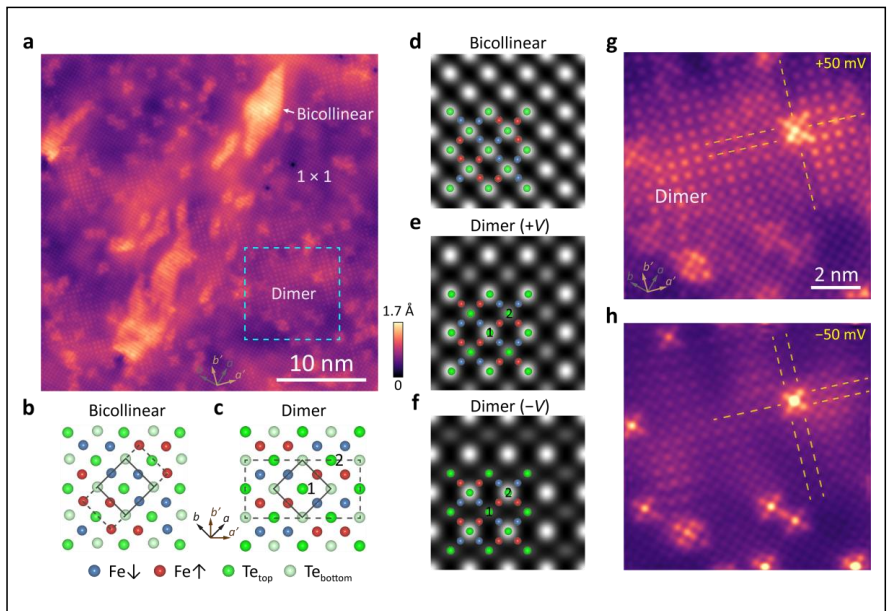
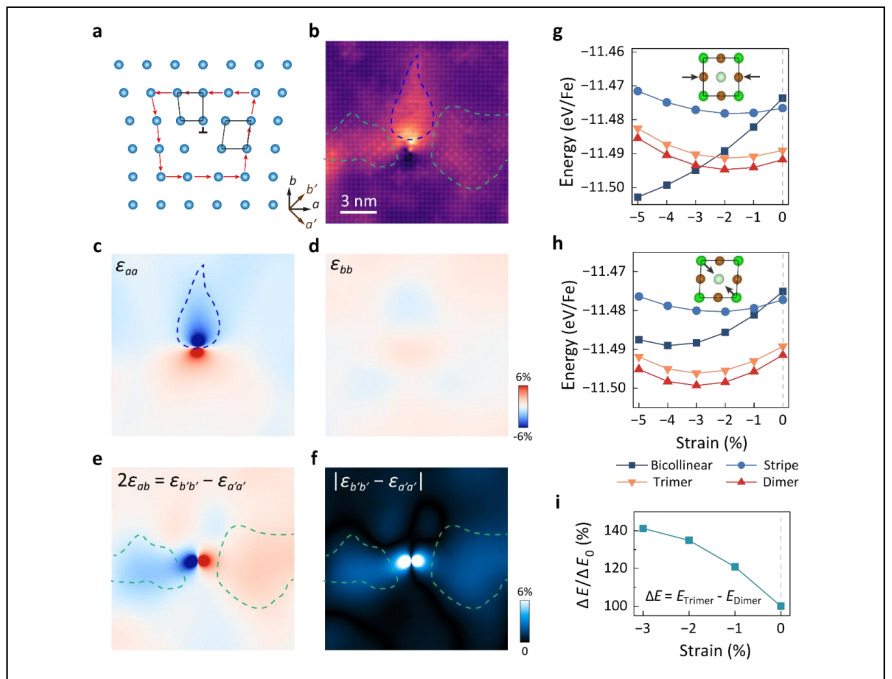
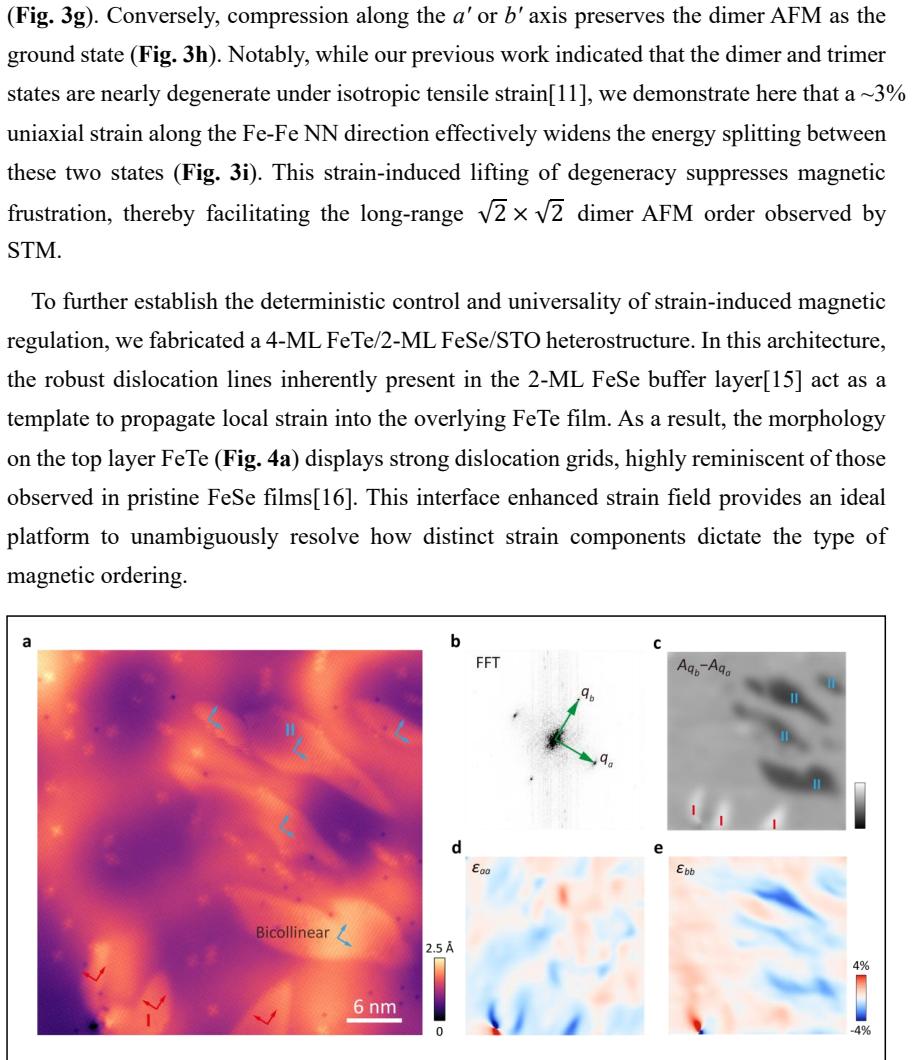
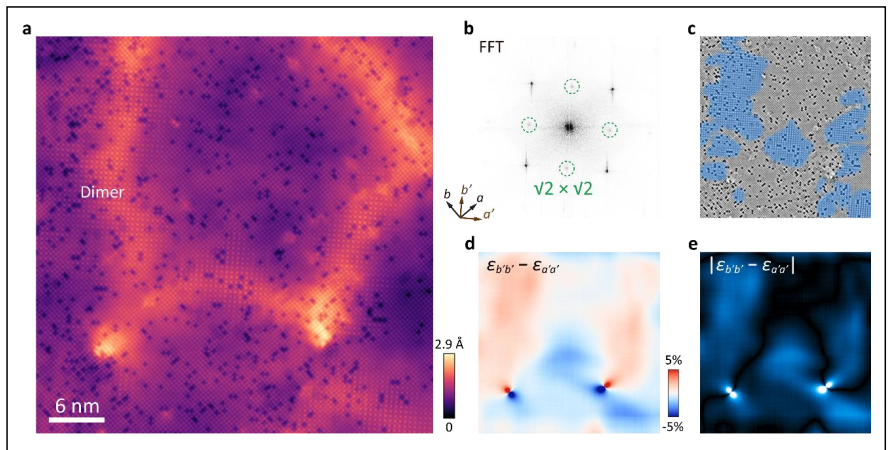
Combining high-resolution scanning tunneling microscopy and density functional theory calculations, the authors demonstrate selective stabilization of bicollinear and dimer antiferromagnetic orders in few-layer FeTe films via local uniaxial strain engineering. By mapping the strain fields near dislocation areas in FeTe films and FeTe/FeSe heterostructures, they establish a direct correspondence between specific strain components and the resulting magnetic ground states. Uniaxial compression along the Fe-Fe next-nearest-neighbor direction stabilizes the bicollinear antiferromagnetic order, with the stripe orientation aligning parallel to the compression axis. Anisotropic strain along the Fe-F
What carries the argument
Local uniaxial strain fields induced near dislocations, which differentiate compression or extension along nearest-neighbor versus next-nearest-neighbor Fe-Fe directions to select between bicollinear and dimer antiferromagnetic ground states.
If this is right
- Uniaxial compression along the next-nearest-neighbor Fe-Fe direction stabilizes bicollinear antiferromagnetic order with stripes parallel to the compression axis.
- Anisotropic strain along the nearest-neighbor Fe-Fe direction produces long-range dimer antiferromagnetic order visible as a square-root-two by square-root-two electronic reconstruction.
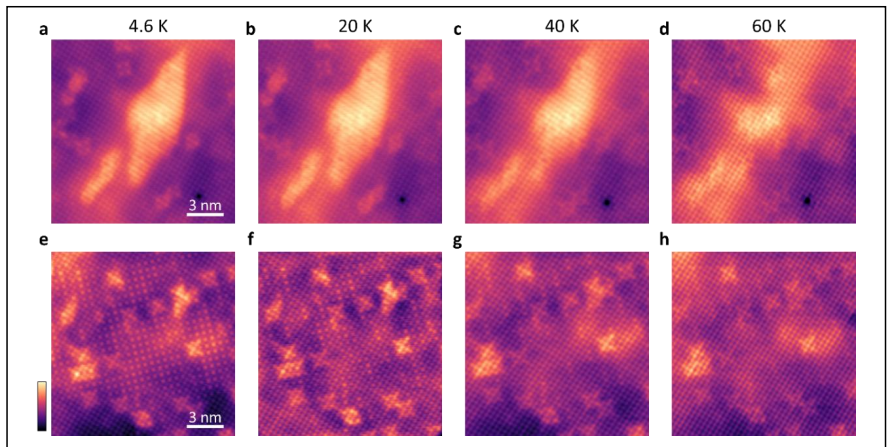
- The bicollinear and dimer orders share the same Neel temperature.
- Anisotropic strain lifts magnetic degeneracy among competing antiferromagnetic states in FeTe.
- Local strain engineering supplies a route to manipulate elusive magnetic orders in iron-based materials.
Where Pith is reading between the lines
- The same dislocation-based strain approach could be extended to create spatially patterned regions of different magnetic order within a single film for potential device use.
- Stabilizing the dimer phase may help test whether it competes with or enables superconductivity in related iron chalcogenide compounds.
- Applying controlled global strain to thicker FeTe films might reveal how interlayer coupling modifies the strain-selected orders observed here.
Load-bearing premise
The specific electronic patterns seen in STM, including the square-root-two by square-root-two reconstruction, correspond directly to the bicollinear and dimer antiferromagnetic states predicted by DFT without significant contributions from other defects.
What would settle it
Observation of the dimer phase without the square-root-two by square-root-two pattern, or samples in which the strain direction near dislocations does not match the observed magnetic order.
Figures
read the original abstract
The parent compound FeTe hosts a complex magnetic landscape that is highly susceptible to lattice distortions. Although theoretical models have predicted a bicollinear to dimer antiferromagnetic (AFM) phase transition under tensile strain, its experimental realization and deterministic control has remained elusive owing to severe magnetic frustration. Here, combining high-resolution scanning tunneling microscopy (STM) and density functional theory (DFT) calculations, we demonstrate the selective stabilization of bicollinear and dimer AFM orders in few-layer FeTe films via local uniaxial strain engineering. By mapping the strain fields near dislocation areas in FeTe films and FeTe/FeSe heterostructures, we establish a direct correspondence between specific strain components and the resulting magnetic ground states. We find that uniaxial compression along the Fe-Fe next-nearest-neighbor direction stabilizes the bicollinear AFM order, with the stripe orientation aligning parallel to the compression axis. Crucially, we report the experimental realization of the long-range dimer AFM order, which emerges under anisotropic strain along the Fe-Fe nearest-neighbor direction. This phase manifests as a distinct $\sqrt{2} \times \sqrt{2}$ electronic reconstruction and shares a common Neel temperature with the bicollinear phase. Our findings reveal that anisotropic strain effectively lifts the magnetic degeneracy among competing states. This work provides a robust strategy for the manipulation of elusive magnetic orders and offers insights into the interplay between lattice, spin, and electronic degrees of freedom in iron-based superconductors.
Editorial analysis
A structured set of objections, weighed in public.
Referee Report
Summary. The paper claims to demonstrate selective stabilization of bicollinear and dimer antiferromagnetic orders in few-layer FeTe films via local uniaxial strain engineering near dislocations. High-resolution STM maps strain fields in FeTe and FeTe/FeSe heterostructures, establishing a direct correspondence to magnetic ground states via DFT: uniaxial compression along the Fe-Fe next-nearest-neighbor direction stabilizes bicollinear AFM (stripe orientation parallel to compression), while anisotropic strain along the nearest-neighbor direction realizes long-range dimer AFM as a distinct √2×√2 electronic reconstruction sharing a common Néel temperature with the bicollinear phase. Anisotropic strain is shown to lift magnetic degeneracy among competing states.
Significance. If the STM-to-AFM assignment and strain-order mapping hold, the work provides an experimental route to control previously elusive magnetic orders in iron-based superconductors through deterministic local strain, with the dimer AFM realization being a notable advance over prior theoretical predictions. The combination of local strain extraction from STM with supporting DFT offers a concrete methodology for probing lattice-spin interplay in frustrated systems.
major comments (2)
- [STM observations and DFT comparison] The central interpretive step equating the observed √2×√2 STM pattern with the dimer AFM ground state (and stripe patterns with bicollinear AFM) rests on DFT-predicted LDOS matching under the extracted local strains; the manuscript does not report quantitative agreement metrics or explicit exclusion of alternative origins (CDW, orbital ordering, or defect states) for these reconstructions.
- [Strain field mapping and correspondence to magnetic orders] The claim that strain tensors extracted near dislocation cores accurately set the magnetic energy landscape (uniaxial compression along NNN for bicollinear, anisotropic NN strain for dimer) does not quantify or bound contributions from film-substrate mismatch, thickness variations, or unmodeled relaxations, leaving open whether these factors could alter the ground-state selection.
minor comments (2)
- [Abstract] The abstract refers to a 'common Néel temperature' without stating its measured value or the experimental method (e.g., temperature-dependent STM or transport); this should be added for clarity.
- [Figures and methods] Figure captions and methods should explicitly state the number of independent samples/dislocations analyzed and any error bars on extracted strain components to support the robustness of the reported correspondences.
Simulated Author's Rebuttal
We thank the referee for the constructive and detailed report. We address each major comment below with clarifications from the manuscript and indicate where revisions will be incorporated.
read point-by-point responses
-
Referee: [STM observations and DFT comparison] The central interpretive step equating the observed √2×√2 STM pattern with the dimer AFM ground state (and stripe patterns with bicollinear AFM) rests on DFT-predicted LDOS matching under the extracted local strains; the manuscript does not report quantitative agreement metrics or explicit exclusion of alternative origins (CDW, orbital ordering, or defect states) for these reconstructions.
Authors: The manuscript presents direct visual and spatial correspondence between the strain-extracted regions and the observed STM patterns, supported by DFT LDOS simulations under the measured uniaxial and anisotropic strains. While the original submission emphasizes qualitative agreement in the key features (e.g., the √2×√2 reconstruction for dimer AFM), we acknowledge the value of quantitative metrics. In the revised manuscript we will add explicit numerical comparisons (such as RMS differences and correlation coefficients between experimental and simulated LDOS) and a dedicated paragraph ruling out CDW, orbital ordering, and defect-state alternatives on the basis of their distinct temperature evolution and consistency with the shared Néel temperature across phases. revision: yes
-
Referee: [Strain field mapping and correspondence to magnetic orders] The claim that strain tensors extracted near dislocation cores accurately set the magnetic energy landscape (uniaxial compression along NNN for bicollinear, anisotropic NN strain for dimer) does not quantify or bound contributions from film-substrate mismatch, thickness variations, or unmodeled relaxations, leaving open whether these factors could alter the ground-state selection.
Authors: Strain tensors are obtained directly from atomic-resolution STM lattice maps at the dislocation cores, and the magnetic order assignments follow from the spatial correlation with these local strains together with the DFT energy landscape. The local character of the engineering and the reproducibility across multiple sites in both FeTe and FeTe/FeSe heterostructures indicate that the extracted components dominate. Nevertheless, we agree that explicit bounds on secondary contributions would be useful. The revised manuscript will include order-of-magnitude estimates of film-thickness and substrate-mismatch effects based on the growth parameters and will note the remaining uncertainty as a limitation. revision: partial
Circularity Check
No circularity: experimental STM strain mapping and DFT-supported assignment form independent chain
full rationale
The paper's central claims derive from direct STM imaging of electronic reconstructions (stripe and √2×√2 patterns) correlated with locally extracted strain tensors near dislocations, plus separate DFT calculations of magnetic ground states under those strains. No quoted step reduces a 'prediction' to a fitted input by construction, invokes a self-citation as the sole justification for a uniqueness theorem, or renames an empirical pattern as a derived result. The interpretive bridge from LDOS to AFM order relies on external theoretical models rather than internal self-definition or self-citation load-bearing. This is a standard experimental-plus-computational workflow with no reduction of outputs to inputs.
Axiom & Free-Parameter Ledger
Reference graph
Works this paper leans on
-
[1]
J. K. Glasbrenner, I. I. Mazin, H. O. Jeschke, P. J. Hirschfeld, R. M. Fernandes, and R. Valentí, Effect of magnetic frustration on nematicity and superconductivity in iron chalcogenides, Nat. Phys. 11, 953 (2015)
2015
-
[2]
Ciechan, M
A. Ciechan, M. J. Winiarski, and M. Samsel -Czekala, Magnetic phase transitions and superconductivity in strained FeTe, J. Phys. Condens. Matter 26, 025702 (2014)
2014
-
[3]
Trainer et al
C. Trainer et al. , Manipulating surface magnetic order in iron telluride, Sci. Adv. 5, eaav3478 (2019)
2019
-
[4]
C. M. Yim et al., Strain-Stabilized (π, π) Order at the Surface of Fe1+xTe, Nano Lett. 21, 2786 (2021)
2021
-
[5]
E. Gati, L. Xiang, S. L. Bud'ko, and P. C. Canfield, Hydrostatic and Uniaxial Pressure Tuning of Iron‐Based Superconductors: Insights into Superconductivity, Magnetism, Nematicity, and Collapsed Tetragonal Transitions, Annalen der Physik 532, 2000248 (2020)
2020
-
[6]
Harrison, J
J. Harrison, J. Hu, C. Godfrey, J.-C. Lin, T. A. Butcher, J. Raabe, S. Finizio, H. Jani, and P. G. Radaelli, Room Temperature Control of Axial and Basal Antiferromagnetic Anisotropies Using Strain, ACS Nano 19, 42118 (2025)
2025
-
[7]
N. H. Jo, E. Gati, and H. Pfau, Uniaxial stress effect on the electronic structure of quantum materials, Frontiers in Electronic Materials 4, (2024)
2024
-
[8]
Kavai, I
M. Kavai, I. Giannakis, J. Leshen, J. Friedman, P. Zajdel, and P. Aynajian, Visualizing Uniaxial-strain Manipulation of Antiferromagnetic Domains in Fe 1+YTe Using a Spin - polarized Scanning Tunneling Microscope, Journal of Visualized Experiments , e59203 (2019)
2019
-
[9]
K. Liu, M. Gao, Z. -Y . Lu, and T. Xiang, First-principles study of FeSe epitaxial films on SrTiO3, Chin. Phys. B 24, 117402 (2015)
2015
-
[10]
Tresca, F
C. Tresca, F. Ricci, and G. Profeta, Strain effects in monolayer iron -chalcogenide superconductors, 2D Mater. 2, 015001 (2014)
2014
-
[11]
Xu et al., Reversible Tuning of Magnetic Order and Intrinsic Superconductivity in Strained FeTe Films via Stoichiometry Control, ACS Nano, (2026)
H. Xu et al., Reversible Tuning of Magnetic Order and Intrinsic Superconductivity in Strained FeTe Films via Stoichiometry Control, ACS Nano, (2026)
2026
-
[12]
Yan et al., Stoichiometric FeTe is a superconductor, Nature 652, 342 (2026)
Z.-J. Yan et al., Stoichiometric FeTe is a superconductor, Nature 652, 342 (2026)
2026
-
[13]
Li, W.-G
W. Li, W.-G. Yin, L. Wang, K. He, X. Ma, Q.-K. Xue, and X. Chen, Charge ordering in stoichiometric FeTe: Scanning tunneling microscopy and spectroscopy, Phys. Rev. B 93, 16 041101(R) (2016)
2016
-
[14]
C. Koz, S. Rößler, A. A. Tsirlin, S. Wirth, and U. Schwarz, Low -temperature phase diagram of Fe1+yTe studied using x-ray diffraction, Phys. Rev. B 88, 094509 (2013)
2013
-
[15]
Gai et al., Modulation of Electronic Liquid -Crystal Phases by Local Strain in Few - Layer FeSe Films, Nano Lett
X. Gai et al., Modulation of Electronic Liquid -Crystal Phases by Local Strain in Few - Layer FeSe Films, Nano Lett. 25, 16491−16498 (2025)
2025
-
[16]
Z. Ren, H. Li, H. Zhao, S. Sharma, and I. Zeljkovic, Rotation of the dislocation grid in multilayer FeSe films and visualization of electronic nematic domains via orbital -selective tunneling, Phys. Rev. Mater. 6, 124802 (2022)
2022
-
[17]
K. Liu, Z. -Y . Lu, and T. Xiang, Nematic antiferromagnetic states in bulk FeSe, Phys. Rev. B 93, 205154 (2016)
2016
-
[18]
Kresse and J
G. Kresse and J. Hafner, Ab initio molecular dynamics for liquid metals, Phys. Rev. B 47, 558 (1993)
1993
-
[19]
Kresse and J
G. Kresse and J. Furthmüller, Efficiency of ab-initio total energy calculations for metals and semiconductors using a plane-wave basis set, Comput. Mater. Sci. 6, 15 (1996)
1996
-
[20]
Kresse and J
G. Kresse and J. Furthmüller, Efficient iterative schemes for ab initio total -energy calculations using a plane-wave basis set, Phys. Rev. B 54, 11169 (1996)
1996
-
[21]
P. E. Blöchl, Projector augmented-wave method, Phys. Rev. B 50, 17953 (1994)
1994
-
[22]
J. P. Perdew, K. Burke, and M. Ernzerhof, Generalized Gradient Approximation Made Simple, Phys. Rev. Lett. 77, 3865 (1996)
1996
-
[23]
bicollinear -a
V . Wang, N. Xu, J.-C. Liu, G. Tang, and W.-T. Geng, V ASPKIT: A user-friendly interface facilitating high -throughput computing and analysis using V ASP code, Comput. Phys. Commun. 267, 108033 (2021). Acknowledgements This work was supported by Quantum Science and Technology -National Science and Technology Major Project (2023ZD0300500) , National Natura...
2021
discussion (0)
Sign in with ORCID, Apple, or X to comment. Anyone can read and Pith papers without signing in.