An unidentified absorption feature at 5.11 μm on the surface of Titan and Pluto from JWST spectroscopy
Pith reviewed 2026-06-27 05:46 UTC · model grok-4.3
The pith
An unidentified absorption at 5.113 micrometers appears in JWST spectra of Titan and Pluto and most likely comes from their surfaces.
A machine-rendered reading of the paper's core claim, the machinery that carries it, and where it could break.
Core claim
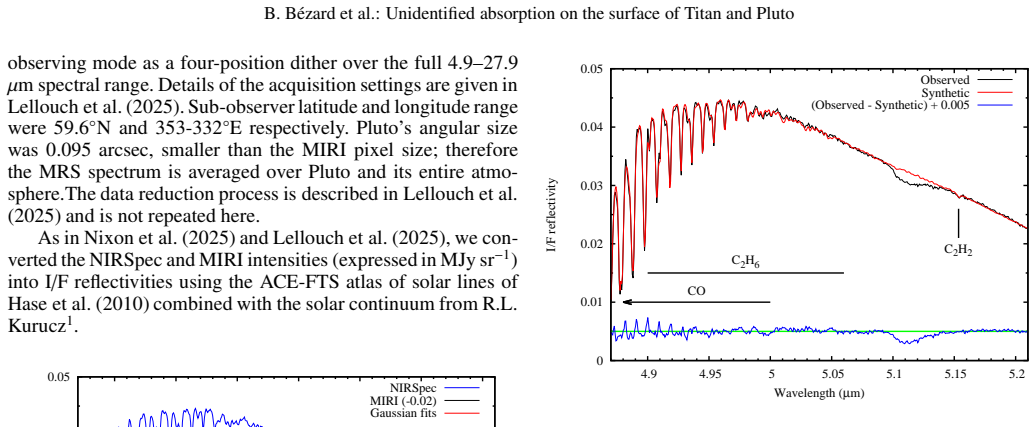
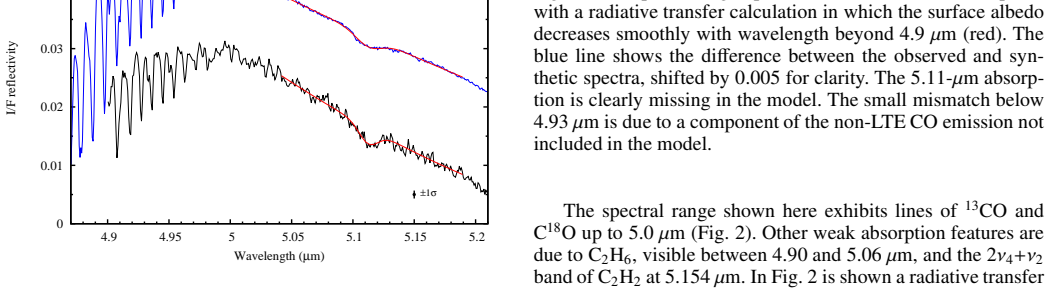
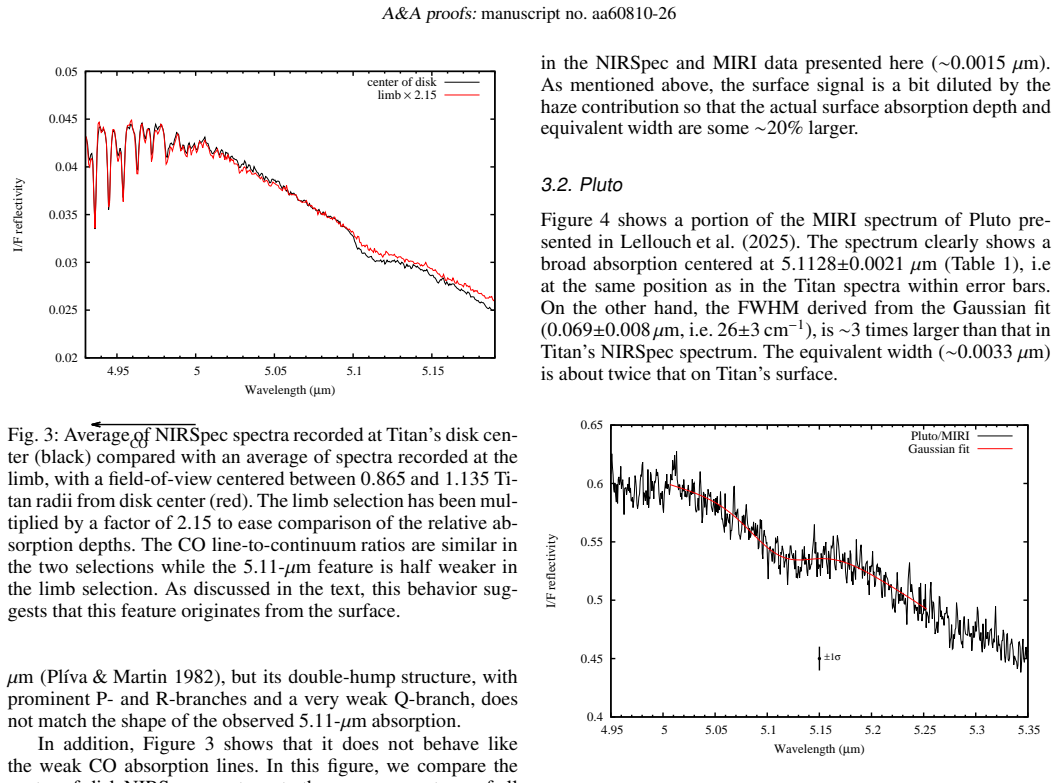
We detected an unidentified absorption in both NIRSpec and MIRI spectra of Titan centered at 5.113 μm (1956 cm^{-1}) and 6-7% deep. The width of the feature is 0.024±0.0008 μm in the NIRSpec spectrum recorded on the trailing side. This absorption most likely originates from the surface. A 4-5% deep absorption is also present in the MIRI spectrum of Pluto but is about 3 times broader.
What carries the argument
Radiative transfer model comparison that subtracts gas and haze contributions in the 5-μm atmospheric window to isolate a residual surface absorption.
If this is right
- Titan's surface contains at least one solid compound whose spectrum is not reproduced by published laboratory data on N2-CH4 photochemistry products.
- A related but not identical surface material exists on Pluto.
- Future JWST observations at other longitudes or seasons can test whether the absorber is uniformly distributed.
- Targeted laboratory synthesis of candidate ices must match both the 5.113 μm position and the observed width to confirm an identification.
Where Pith is reading between the lines
- If the absorber proves to be a photochemical product that condenses only on the surface, it would indicate a separation between atmospheric and surface chemistry not captured by current models.
- Detection of the same band on other icy bodies with thin N2-CH4 atmospheres would suggest a common formation pathway across the outer solar system.
Load-bearing premise
The residual absorption is produced by the solid surface rather than by incomplete removal of atmospheric or haze opacity.
What would settle it
A spectrum recorded at higher spectral resolution or with a different viewing geometry that removes the feature while leaving all other atmospheric lines intact would falsify the surface attribution.
Figures
read the original abstract
Titan possesses a thick N$_2$-CH$_4$ atmosphere that makes it difficult to study its surface spectroscopically. The chemical composition of the solid surface of Titan thus remains very uncertain. By leveraging JWST's high sensitivity and large spectral coverage, we searched for any signature from Titan's surface in the broad and less explored 5-$\mu$m atmospheric window. We also investigated the JWST spectrum of Pluto which has a thin Titan-like atmosphere. We made selections of JWST NIRSpec and MIRI spectra around Titan's disk center and compared the NIRSpec average spectrum with a radiative transfer model including gas and haze opacity. We detected an unidentified absorption in both NIRSpec and MIRI spectra of Titan centered at 5.113 $\mu$m (1956 cm$^{-1}$) and 6-7% deep. The width of the feature is 0.024$\pm$0.0008 $\mu$m (9.2$\pm$0.3 cm$^{-1}$) in the NIRSpec spectrum recorded on the trailing side and is possibly 25% narrower in the MIRI spectrum of the leading side. This absorption most likely originates from the surface. We could not identify this signature among published laboratory spectra of ices relevant to Titan's atmospheric compounds but present a few plausible candidates. A 4-5% deep absorption is also present in the MIRI spectrum of Pluto but is about 3 times broader than on Titan's trailing side.
Editorial analysis
A structured set of objections, weighed in public.
Referee Report
Summary. The paper reports the detection of an unidentified absorption feature centered at 5.113 μm (1956 cm^{-1}) with 6-7% depth in JWST NIRSpec (trailing side) and MIRI (leading side) spectra of Titan, after comparison to a radiative transfer model of gas and haze opacity. The feature's width is quantified as 0.024±0.0008 μm in NIRSpec, and a similar but ~3× broader 4-5% feature is reported in Pluto's MIRI spectrum. The authors conclude the Titan feature most likely originates from the surface and discuss possible ice candidates without identification.
Significance. If the surface attribution holds, the result would provide a new constraint on Titan's surface composition in the under-explored 5 μm window, where atmospheric interference has historically limited progress. The consistency of the feature across NIRSpec and MIRI instruments and both hemispheres is a strength, as is the direct observational approach with no free parameters fitted to the residual itself. The Pluto comparison adds context but is secondary.
major comments (1)
- [Radiative transfer modeling and residual analysis] The central claim that the 6-7% residual at 5.113 μm is surface-origin (rather than a model residual) rests on the single best-fit gas+haze RT model. No quantitative estimate is given for systematic uncertainty in the model's haze scattering or CH₄/N₂ continuum opacity at 5 μm; a 10-15% under-prediction of model opacity could reproduce the observed residual depth without invoking a surface absorber.
minor comments (2)
- [Results and discussion] The reported width difference (NIRSpec 0.024 μm vs. possibly 25% narrower in MIRI) and the factor-of-three broader Pluto feature are noted but not explored for possible instrumental or residual atmospheric contributions.
- [Methods] The manuscript would benefit from explicit tabulation of the RT model parameters (haze optical depth, gas mixing ratios) used for the subtraction at 5.113 μm.
Simulated Author's Rebuttal
We thank the referee for their constructive comments and for highlighting the importance of quantifying systematic uncertainties in our analysis. We respond to the major comment as follows.
read point-by-point responses
-
Referee: [Radiative transfer modeling and residual analysis] The central claim that the 6-7% residual at 5.113 μm is surface-origin (rather than a model residual) rests on the single best-fit gas+haze RT model. No quantitative estimate is given for systematic uncertainty in the model's haze scattering or CH₄/N₂ continuum opacity at 5 μm; a 10-15% under-prediction of model opacity could reproduce the observed residual depth without invoking a surface absorber.
Authors: We agree that providing a quantitative estimate of systematic uncertainties would strengthen the paper. The RT model used is based on established parameters from the literature for Titan's atmosphere, and the fit is performed across the 5 μm window without tuning to the specific feature. In the revised manuscript, we will include an assessment of how variations in haze scattering and gas continuum opacity affect the residual, showing that the observed feature's narrow width and depth are not consistent with plausible model errors. The consistency between NIRSpec and MIRI observations further supports the detection. We will revise the text to explicitly discuss these points. revision: yes
Circularity Check
No circularity: direct observational detection via residual after RT modeling
full rationale
The paper reports a spectroscopic detection of an absorption feature by averaging JWST NIRSpec/MIRI spectra and subtracting a radiative transfer model that includes known gas and haze opacities. The central claim (6-7% residual at 5.113 μm) is an empirical measurement of the difference between observed flux and the model prediction; it does not derive any quantity from prior fitted parameters or self-citations that would make the result tautological. The surface-origin inference rests on the feature's persistence across hemispheres and model residuals, which is an interpretive step but not a self-definitional or fitted-input reduction. No equations, ansatzes, or uniqueness theorems are invoked that collapse back to the input data by construction. This is a standard observational result whose validity can be checked against independent spectra or improved models.
Axiom & Free-Parameter Ledger
axioms (1)
- domain assumption Radiative transfer model including gas and haze opacity accurately represents the 5-μm atmospheric window on Titan.
Reference graph
Works this paper leans on
-
[1]
J., Frigge, R., & Kaiser, R
Abplanalp, M. J., Frigge, R., & Kaiser, R. I. 2019, Science Ad vances, 5, eaaw5841
2019
-
[2]
R., et al
Argyriou, I., Glasse, A., Law, D. R., et al. 2023, A&A, 675, A1 11
2023
-
[3]
Behringer, R. E. 1958, J. Chem. Phys., 29, 537 Bockelée-Morvan, D., Lellouch, E., Poch, O., et al. 2024, A& A, 681, A27 Böker, T., Beck, T. L., Birkmann, S. M., et al. 2023, PASP , 135, 038001
1958
-
[4]
2015, MNRAS, 451 , 2145 Brassé, C., Muñoz, O., Coll, P ., & Raulin, F
Bouilloud, M., Fray, N., Bénilan, Y ., et al. 2015, MNRAS, 451 , 2145 Brassé, C., Muñoz, O., Coll, P ., & Raulin, F. 2015, Planet. Sp ace Sci., 109, 159
2015
-
[5]
Brown, K. G. & Person, W. B. 1978, Spectrochimica Acta Part A: Molecular Spectroscopy, 34, 117
1978
-
[6]
2025, JWS T Calibration Pipeline
Bushouse, H., Eisenhamer, J., Dencheva, N., et al. 2025, JWS T Calibration Pipeline
2025
-
[7]
N., Curchin, J
Clark, R. N., Curchin, J. M., Barnes, J. W., et al. 2010, Journ al of Geophysical Research (Planets), 115, E10005 Dello Russo, N. & Khanna, R. K. 1996, Icarus, 123, 366
2010
-
[8]
R., Karkoschka, E., Tomasko, M
Doose, L. R., Karkoschka, E., Tomasko, M. G., & Anderson, C. M . 2016, Icarus, 270, 355
2016
-
[9]
2026, A&A, 706, A167
Drant, T., Sciamma-O’Brien, E., Jovanovic, L., et al. 2026, A&A, 706, A167
2026
-
[10]
2021, Icarus, 364, 1 14462 Griffith, C
Faure, M., Quirico, E., Faure, A., et al. 2021, Icarus, 364, 1 14462 Griffith, C. A., Owen, T., Geballe, T. R., Rayner, J., & Rannou, P . 2003, Science, 300, 628 Griffith, C. A., Penteado, P . F., Turner, J. D., et al. 2019, Nature A stronomy, 3, 642 Gronoff, G., Mertens, C., Lilensten, J., et al. 2011, A&A, 529, A143
2021
-
[11]
D., Harrison, J
Hase, F., Wallace, L., McLeod, S. D., Harrison, J. J., & Berna th, P . F. 2010, J. Quant. Spectr. Rad. Transf., 111, 521
2010
-
[12]
L., Gerakines, P
Hudson, R. L., Gerakines, P . A., Y arnall, Y . Y ., & Coones, R. T . 2021, Icarus, 354, 114033
2021
-
[13]
Hudson, R. L. & Y arnall, Y . Y . 2022, ACS Earth and Space Chemistry, 6, 1163 Article number, page 6 B. Bézard et al.: Unidentified absorption on the surface of Ti tan and Pluto
2022
-
[14]
2022, A&A, 661, A80
Jakobsen, P ., Ferruit, P ., Alves de Oliveira, C., et al. 2022, A&A, 661, A80
2022
-
[15]
2025, A&A, 696, A14 7
Lellouch, E., Wong, I., Lavvas, P ., et al. 2025, A&A, 696, A14 7
2025
-
[16]
B., Fateley, W
Lin-Vien, D., Colthup, N. B., Fateley, W. G., & Grasselli, J. G. 1991, in The Handbook of Infrared and Raman Characteristic Frequencies of Organic Molecules, ed. D. Lin-Vien, N. B. Colthup, W. G. Fateley, & J. G. Grasselli (San Diego: Academic Press), 277–306
1991
-
[17]
A., Nixon, C
Lombardo, N. A., Nixon, C. A., Greathouse, T. K., et al. 2019, ApJ, 881, L33 Mathé, C., Gautier, T., Trainer, M. G., & Carrasco, N. 2018, A pJ, 861, L25 Mejía, C., de Barros, A. L. F., Rothard, H., Boduch, P ., & da Silveira, E. F. 2020, ApJ, 894, 132
2019
-
[18]
Moore, C. B. & Pimentel, G. C. 1963, J. Chem. Phys., 38, 2816
1963
-
[19]
H., Ferrante, R
Moore, M. H., Ferrante, R. F., Moore, W. J., & Hudson, R. 2010, ApJS, 191, 96 Müller, B., Lutz, H. D., Hermeling, J., & Knözinger, E. 1993, Spectrochimica Acta Part A: Molecular Spectroscopy, 49, 191
2010
-
[20]
B., Atreya, S
Niemann, H. B., Atreya, S. K., Demick, J. E., et al. 2010, Jour nal of Geophysical Research (Planets), 115, E12006
2010
-
[21]
A., Bézard, B., Cornet, T., et al
Nixon, C. A., Bézard, B., Cornet, T., et al. 2025, Nature Astr onomy, 9, 969
2025
-
[22]
A., Birch, S., Chatain, A., et al
Nixon, C. A., Birch, S., Chatain, A., et al. 2026, Reviews of G eophysics, 64, e2025RG000909
2026
-
[23]
& Anderson, C
Nna-Mvondo, D. & Anderson, C. M. 2022, ApJ, 925, 123
2022
-
[24]
2024, ApJ, 972, L10 Plíva, J
Ozhiganov, M., Medvedev, M., Karteyeva, V ., et al. 2024, ApJ, 972, L10 Plíva, J. & Martin, C. A. 1982, Journal of Molecular Spectros copy, 91, 218
2024
-
[25]
2023, Icarus, 3 94, 115396
Quirico, E., Bacmann, A., Wolters, C., et al. 2023, Icarus, 3 94, 115396
2023
-
[26]
& Schmitt, B
Quirico, E. & Schmitt, B. 1997, Icarus, 127, 354
1997
-
[27]
V ., Bézard, B., et al
Rey, M., Nikitin, A. V ., Bézard, B., et al. 2018, Icarus, 303, 114
2018
-
[28]
2015, Mid-IR transmission and optical constants spectra of crystalline C 6H6 at 130 K
Schmitt, B., Vinatier, S., & Bernard, J.-M. 2015, Mid-IR transmission and optical constants spectra of crystalline C 6H6 at 130 K
2015
-
[29]
B., Combe, J.-P ., et al
Singh, S., McCord, T. B., Combe, J.-P ., et al. 2016, ApJ, 828, 55
2016
-
[30]
2001, Infrared and Raman Characteristic Group Frequencies: Table and Charts (Wiley & Sons)
Socrates, G. 2001, Infrared and Raman Characteristic Group Frequencies: Table and Charts (Wiley & Sons)
2001
-
[31]
2025 , in Titan Af- ter Cassini-Huygens, ed
Solomonidou, A., Le Gall, A., Hayne, P ., & Coustenis, A. 2025 , in Titan Af- ter Cassini-Huygens, ed. R. M. Lopes, C. Elachi, I. C. Müelle r-Wodarg, & A. Solomonidou, COSPAR Series (Elsevier), 325–375
2025
-
[32]
J., Lopes, R
Solomonidou, A., Malaska, M. J., Lopes, R. M. C., et al. 2024, Icarus, 421, 116215
2024
-
[33]
A., Moore, J
Stern, S. A., Moore, J. M., Grundy, W. M., Y oung, L. A., & Binze l, R. P . 2021, The Pluto System After New Horizons (University of Arizona P ress)
2021
-
[34]
E., Y oung, L
Summers, M. E., Y oung, L. A., Gladstone, G. R., & Person, M. J. 2021, in The Pluto System After New Horizons, ed. S. A. Stern, J. M. Moo re, W. M
2021
-
[35]
G., Archinal, B., Becker, T., et al
Tomasko, M. G., Archinal, B., Becker, T., et al. 2005, Nature , 438, 765
2005
-
[36]
A., & Teanby, N
Vuitton, V ., Lavvas, P ., Nixon, C. A., & Teanby, N. A. 2025, in Titan Af- ter Cassini-Huygens, ed. R. M. Lopes, C. Elachi, I. C. Müelle r-Wodarg, & A. Solomonidou, COSPAR Series (Elsevier), 157–200
2025
-
[37]
2015, PASP , 127, 646 Article number, page 7
Wells, M., Pel, J.-W., Glasse, A., et al. 2015, PASP , 127, 646 Article number, page 7
2015
discussion (0)
Sign in with ORCID, Apple, or X to comment. Anyone can read and Pith papers without signing in.