Japan's Possible Contributions for Coronagraph of the Habitable Worlds Observatory (HWO)
Pith reviewed 2026-06-27 05:38 UTC · model grok-4.3
The pith
Japan can contribute to the Habitable Worlds Observatory coronagraph with an infrared hardware layout and nearby-target science drawn from SPICA and Roman experience.
A machine-rendered reading of the paper's core claim, the machinery that carries it, and where it could break.
Core claim
Japan's prior coronagraph work enables contributions to HWO through both science planning and hardware, with a concrete optical-mechanical layout for the infrared coronagraph offered as an example; inner working angle and sensitivity drive the recommendation for focused observations of nearby targets, while visible and NIR systems must share limited resources and development roles must be allocated by international agreement.
What carries the argument
The optical and mechanical layout of the entire infrared coronagraph, which serves as the concrete example of a large-scale Japanese hardware contribution.
If this is right
- Dedicated observations of a small number of nearby targets can form a key science program when IWA and sensitivity are limiting.
- Pushing development of small-IWA coronagraphs remains essential even while preparing more robust designs in parallel.
- Visible and NIR coronagraphs must be made to coexist inside shared volume, mass, and budget constraints.
- International allocation of coronagraph development work must be settled by formal agreement.
Where Pith is reading between the lines
- Even partial or later-generation participation could still increase the total scientific return from HWO if the early hardware choices allow it.
- Prioritizing a handful of very nearby systems might enable higher signal-to-noise characterization than a broader but shallower survey.
- Japanese technology paths could supply fallback options if primary coronagraph approaches encounter performance shortfalls.
Load-bearing premise
The proposed hardware layouts, individual technologies, and focus on nearby targets will fit within HWO limits on volume, mass, budget, and international agreements.
What would settle it
Selection of an HWO coronagraph architecture that is incompatible with the described Japanese layouts and technologies would rule out these contributions.
Figures
read the original abstract
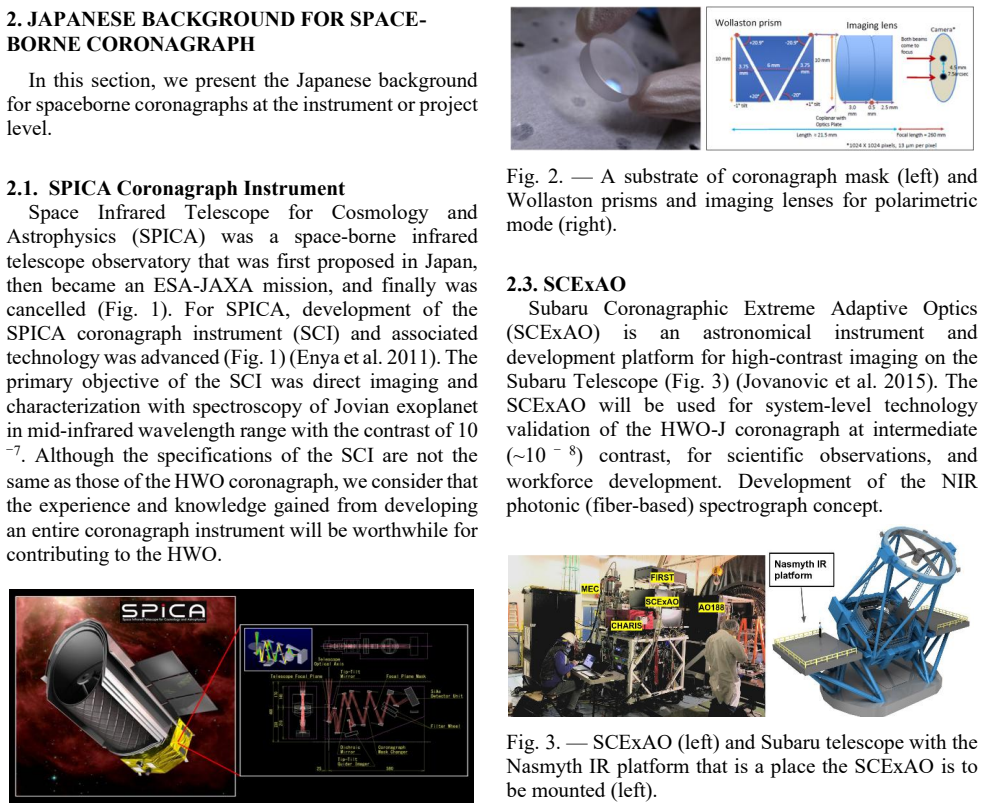
In this paper, we describe Japan's possible contributions for coronagraph of the Habitable Worlds Observatory (HWO) based on our independent study. We are considering to contribute to the HOW coronagraph by science and hardware, based on Japan's experience for the SPICA coronagraph instrument, contributions to the Nancy Grace Roman Space Telescope, and SCExAO for the Subaru telescope. Currently, hardware contributions of various scales, from large-scale to small components, are considered. As an example of the large-scale hardware case, the optical and mechanical layout of the entire infrared coronagraph is presented. Several individual high-contrast technologies are also briefly introduced, for which research is ongoing in Japan. In discussions, it is pointed out that both the inner working angle (IWA) and sensitivity are particularly critical for the NIR coronagraph. In this situation, dedicated observations of a small number of targets close to the solar system can be one of key science program in this situation, and designing consolidating science objectives, requirements, observation targets, and survey plans is important. It is essential to push the development of advanced coronagraphs that provide small IWAs. On the other hand, it is also necessary to prepare solutions that adopt more robust coronagraphs in parallel. How to coexist visible and NIR coronagraphs within constraints of volume, mass, budget etc. is an important issue. The international sharing for the coronagraph development should be carefully decided by international agreement. Although all of our studies may not be realized in contributions to the first generation of HWO instruments, we are considering Japan's multigenerational participation in the HWO to maximize outcomes of the HWO.
Editorial analysis
A structured set of objections, weighed in public.
Referee Report
Summary. The paper describes Japan's possible contributions to the coronagraph of the Habitable Worlds Observatory (HWO) based on experience with SPICA, Roman, and SCExAO. It considers hardware contributions of various scales, presents an example layout for the infrared coronagraph, introduces high-contrast technologies, and discusses the critical role of IWA and sensitivity for NIR, the importance of dedicated observations of nearby targets, and the need to address volume, mass, budget constraints and international agreements for development sharing, while considering multigenerational participation.
Significance. If realized, the contributions could strengthen the HWO coronagraph by incorporating Japanese expertise in coronagraph design and exoplanet science. The identification of IWA and sensitivity as key parameters is aligned with the mission's goals for habitable world detection. The paper's forward-looking approach to science planning and technology development is a positive step toward international collaboration, though it lacks specific quantitative assessments or new technical results.
minor comments (1)
- [Abstract] The term 'HOW coronagraph' is likely a typographical error and should be corrected to 'HWO coronagraph'.
Simulated Author's Rebuttal
We thank the referee for the positive assessment of our manuscript and the recommendation for minor revision. The alignment with mission goals for habitable world detection and the value of international collaboration are appreciated. We address the noted limitation regarding quantitative assessments below.
read point-by-point responses
-
Referee: The paper's forward-looking approach to science planning and technology development is a positive step toward international collaboration, though it lacks specific quantitative assessments or new technical results.
Authors: The manuscript is structured as a conceptual study outlining possible Japanese contributions based on existing experience with SPICA, Roman, and SCExAO, including an example optical/mechanical layout and brief introductions to ongoing high-contrast technologies. While it does not claim new technical results, we agree that additional quantitative context would strengthen the paper. In the revised version we will incorporate quantitative performance estimates and comparisons drawn from our prior instrument work to address this point. revision: yes
Circularity Check
No significant circularity
full rationale
The manuscript is a forward-looking discussion of possible Japanese contributions to the HWO coronagraph, drawing on prior instrument experience (SPICA, Roman, SCExAO) without any derivations, equations, fitted parameters, or predictions. No load-bearing step reduces to a self-definition, fitted input renamed as prediction, or self-citation chain; the text explicitly flags open issues (volume/mass/budget compatibility, international agreements) rather than asserting they are resolved. The central claim is descriptive and self-contained as a statement of ongoing study and intent.
Axiom & Free-Parameter Ledger
Reference graph
Works this paper leans on
-
[1]
Mennesson, B., Belikov, R., Por, E., Serabyn, E., Ruane, G., Riggs, A. E., ... & Zimmerman, N. (2024). Current laboratory performance of starlight suppression systems and potential pathways to desired Habitable Worlds Observatory exoplanet science capabilities. Journal of Astronomical Telescopes, Instruments, and Systems, 10(3), 035004-035004
2024
discussion (0)
Sign in with ORCID, Apple, or X to comment. Anyone can read and Pith papers without signing in.