REVIEW 3 major objections 45 references
City landscape in sight: A crowdsourced framework for unlocking urban-scale window view perceptions from real estate imagery
T0 review · 3 major / 0 minor · reviewed 2026-07-12 · grok-4.5
Pith's one-line read Real estate window photos, scored by thousands of human comparisons, map how Wuhan residents experience the city from inside their homes.
desk verdict Promising urban-perception pipeline on real listing window views, but the provided full text is the wrong paper, so we cannot verify methods or the planning claim. read the letter →
The pith
A machine-rendered reading of the paper's core claim, the machinery that carries it, and where it could break.
The reading
What carries the argument
Crowdsourced pairwise comparison of real window-view images (WVIs) feeding a hybrid neural network that scores every listing photo and maps the resulting perceptual fields across the city.
What would settle it
Collect new window-view photos taken by actual residents from the same addresses under ordinary daily conditions and re-run the perception model; if hot/cold spots and composition effects reverse or disappear, the listing-image assumption fails.
Extended reading notes
Core claim
A hybrid neural network trained on 27,477 pairwise human comparisons of real residential window-view images can predict six perceptual dimensions across 12,334 crowdsourced views citywide, revealing significant spatial autocorrelation and non-linear effects of floor level and view composition on preference, vividness, monotony, and oppression.
Load-bearing premise
That real-estate listing photographs of window views are close enough to residents’ everyday visual experience to stand in for city-scale perception mapping and planning decisions.
Editorial analysis
A structured set of objections, weighed in public.
Referee Report
Summary. The manuscript formulates user-centric continual spatial intelligence for egocentric video streams and introduces UCS-Bench: 532 videos (~170 hours) with 8,114 timestamped multiple-choice QA pairs spanning four skill families (position & orientation, trajectory & movement, proximity & reachability, category & quantity), with repeated queries at different times to test dynamic spatial memory. It further proposes DirectMe, a training-free streaming framework that fuses depth/pose (DepthAnything3), open-vocabulary detection and mask tracking (Grounding-DINO/YOLO-World + SAM2), and scene tags into a world-aligned metric-semantic map and an evolving pose-anchored scene graph; at query time a minimal subgraph and keyframes are retrieved for an MLLM. Experiments on 18 MLLMs show overall accuracies near ~50% versus human 91%, with DirectMe (Qwen3-VL-8B) reaching 50.5% and outperforming many spatial and streaming baselines, plus ablations and a root-cause error analysis attributing most DirectMe failures to tracking and ego-pose errors.
Significance. If the claims hold, the work supplies a missing evaluation axis—orientation-aware, user-relative spatial state under continuous ego-motion in long indoor/outdoor streams—that existing image, multi-view, and streaming spatial benchmarks largely omit. The multi-stage annotation and quality-control pipeline (evidence spans, re-asks, NLI distractor filtering, blind-choice bias tests) and the public data/code release are concrete community assets. DirectMe’s structured memory is a clear, falsifiable design hypothesis: pose-anchored scene graphs should reduce sensitivity to question–evidence distance relative to frame-only or caption-only baselines, which Table 5 and Figure 6 partially support. The large remaining gap to humans and the honest failure taxonomy make the benchmark useful beyond a leaderboard.
major comments (3)
- §4.1 asserts a causal streaming protocol (answers at t may use only observations and graph state ≤ t), but Appendix §D.3 states that a pose-aware scene graph G is “built offline from the memory buffer M and cached” so that “online reasoning never revisits raw video frames.” For hour-scale videos this wording is ambiguous: if G is constructed over the full sequence before any query, future observations can leak into earlier answers (e.g., object anchors refined after re-observation). The central claim of continual, online spatial intelligence requires an explicit statement and experimental check that graph updates and retrieval are strictly causal (no future frames, no global re-optimization after t). Without that check, SOTA numbers in Table 3 are not interpretable as streaming results.
- Table 3 and §5.2 compare DirectMe to frame-only MLLMs, spatial-centric models, and streaming models, but DirectMe is given continuous 1 fps access plus metric depth, camera extrinsics, instance tracks, and a constructed scene graph, while general baselines receive 50–64 RGB frames (or 1 fps streams without geometry). The ablation in Table 5 isolates Desc. vs Graph on top of Qwen3-VL, yet there is no control that feeds the same geometric signals (depth maps, poses, track boxes) as unstructured text or tokens without the scene-graph structure. Gains attributed to “evolving scene-graph memory” may partly reflect privileged 3D sensing rather than the memory architecture. A geometry-matched non-graph baseline is needed for the architectural claim to be load-bearing.
- §5.3 / Table 4 report that 40% of DirectMe failures are tracking failures and 23% ego-pose relation failures—i.e., upstream foundation models dominate error. The paper’s planning claim that DirectMe “significantly improves the spatial reasoning of leading multimodal LLMs” is still true in aggregate (Table 3), but the method’s ceiling and transferability then hinge on DepthAnything3 / SAM2 reliability under blur, outdoor lighting, and identity switches. The manuscript should quantify tracking/pose error rates on UCS-Bench streams (or a held-out subset) and show how perception noise propagates into QA accuracy; otherwise the SOTA margin is hard to attribute and hard to improve systematically.
Circularity Check
No definitional circularity: standard supervised perception mapping from human pairwise labels to city-scale predictions; residual risk is ordinary ML generalization, not a closed derivation.
full rationale
The paper’s chain is empirical, not a first-principles derivation that collapses into its inputs. Human perceptions are operationalized by 27,477 pairwise comparisons on 499 WVIs; a hybrid network is trained to generalize those labels to 12,334 listing images; spatial maps, floor-level associations, and a composition inference model are then reported as findings. That is ordinary supervised learning plus post-hoc association analysis: the target quantities (preference, vividness, monotony, oppression, etc.) are defined by the human judgments, and the model is evaluated as a predictor of those judgments—not as a quantity that is algebraically identical to a fitted parameter. There is no self-definitional identity (X defined as Y then “derived” as Y), no uniqueness theorem imported from the same authors, no ansatz smuggled via self-citation, and no renaming of a known closed-form result. The only mild circularity-adjacent concern is the usual one in this genre: composition effects are inferred on model-predicted perceptions of the same image domain used for training, so interpretation can partly reflect model biases rather than independent ground truth—but that is statistical dependence, not circularity by construction under the stated criteria. Representativeness of listing photos is a validity/assumption issue, not circularity. Score 1 reflects negligible residual self-referential risk only.
Assumptions & free parameters
free parameters (3)
- Hybrid NN architecture and training hyperparameters
- Composition ratio thresholds / non-linear response shapes
- Number and definition of six perceptual dimensions
assumptions (3)
- domain assumption Real-estate listing window photographs are adequate proxies for residents’ everyday window-view experience at urban scale.
- domain assumption Non-immersive VR pairwise comparisons from 304 participants on 499 images yield valid ground-truth for six perceptual dimensions.
- domain assumption A model trained on the labeled subset generalizes to the full crowdsourced WVI set and to spatial inference about composition and floor.
Cite this review
Pith. "Pith review of City landscape in sight: A crowdsourced framework for unlocking urban-scale window view perceptions from real estate imagery." pith.science (2026). https://pith.science/paper/FER6BRWN
@misc{pith2026260615198,
  author       = {Pith},
  title        = {Pith review of: City landscape in sight: A crowdsourced framework for unlocking urban-scale window view perceptions from real estate imagery},
  year         = {2026},
  howpublished = {\url{https://pith.science/paper/FER6BRWN}},
  note         = {Machine review of arXiv:2606.15198}
}
read the original abstract
City landscapes viewed through home windows influence quality of life, yet perceptions of actual window views at the urban scale remain understudied. This study presents an approach for large-scale mapping of perceptions using 12,334 window view images (WVIs) collected from actual residential properties listed on real estate platforms in Wuhan, China, representing a rarely explored form of urban view imagery that offers advantages over the rendered or simulated window views commonly examined in previous studies. Through a non-immersive virtual reality platform, we collected 27,477 pairwise comparisons across six perceptual dimensions (e.g. preference) from 304 participants based on 499 WVIs. A hybrid neural network model was trained to predict human perceptions of all crowdsourced WVIs and map their spatial distribution. Results reveal significant spatial autocorrelation with distinct hot and cold spots across the whole city. Floor level strongly influences human perceptions: while higher floors offer more preferred and extensive window views, lower-floor windows provide residents with quiet and vivid views. An inference model further shows that window view composition matters considerably: high ratios of sky, trees, and low-rise buildings enhance people's preferences and perceptions of vividness, whereas high ratios of high-rise buildings increase perceptions of monotony and oppression. Importantly, these effects are non-linear: the excessive presence of certain elements can alter their impact on human perception. This work advances urban-scale understanding of residents' visual experiences and offers a transferable, human-centric method to inform urban planning and design aimed at improving the visual quality of window views.
Figures


Figures from the paper (14 more)






Reference graph
Works this paper leans on
-
[1]
Spatial Intelligence Benchmark Comparison (§B) presents a high-level comparison of spatial intelligence evalua- tion along three dimensions:Static Spatial Relation,Dynamic Spatial Relation, andUser-Centric Spatial Relation (Figure. 8). Representative benchmarks for each dimension are respectively VSI-Bench (Yang et al., 2025b), MMSI- Video-Bench (Yang et ...
-
[2]
Additionally, the number of sampled frames K and image resolution are treated as hyperparameters to explore performance under various configurations
Implementation Details (§C) includes the implementation specifics for evaluation based on pre-extracted video frames at 1 fps, highlighting the comparison between Uniform Sampling (which captures global history) and Streaming Window Sampling (which focuses on recent context). Additionally, the number of sampled frames K and image resolution are treated as...
-
[3]
Processing methods (§D.1) extracts multi-modal signals from egocentric videos, including per-frame depth maps and ego poses using DepthAnything3 (Lin et al., 2025a), persistent object masks and trajectories via Grounding-DINO (Liu et al., 2024b) or YOLO-World (Cheng et al., 2024b) and SAM2 (Ravi et al., 2025), and coarse scene semantics using Qwen3-VL (Ba...
2025
-
[4]
Evaluation methods (§D.2-§D.3) describes a spatial reasoning evaluation method that integrates visual frames, camera poses, object tracking, and scene tags into a global map, supporting both offline and real-time reasoning
-
[5]
Implementation Parameters (§D.4) describes the experimental hardware setup, the model implementation framework, and the inference parameter settings
-
[6]
Prompt (§D.5) defines a set of prompt templates for egocentric video question answering (Video QA) tasks, used to guide the model in generating answers under different strategies (Uniform Sampling, Stream Sampling, Spatial Captions, Scene Graph, etc.)
-
[7]
Hyperparameter Comparisons (§E.1) provides a detailed analysis of the impact of key hyperparameters on model performance, including model size, spatial resolution, and temporal context length
-
[8]
These captions are concatenated with the corresponding frames and jointly fed into the model to provide additional explicit spatial information during inference
Spatial Captions (§E.2) augments visual inputs with frame-level spatial captions generated by a VLM, which explicitly describe object positions, orientations, and relative layouts. These captions are concatenated with the corresponding frames and jointly fed into the model to provide additional explicit spatial information during inference
Show all 45 references
-
[9]
Dataset Source (§F.1) collects data from several publicly available datasets, including EgoLife (Yang et al., 2025a), HourVideo (Chandrasegaran et al., 2024), ScanNet (Dai et al., 2017), EPIC-KITCHENS (Damen et al., 2020), EgoBlind (Xiao et al., 2025), and TeleEgo (Yan et al.,...
2024
-
[10]
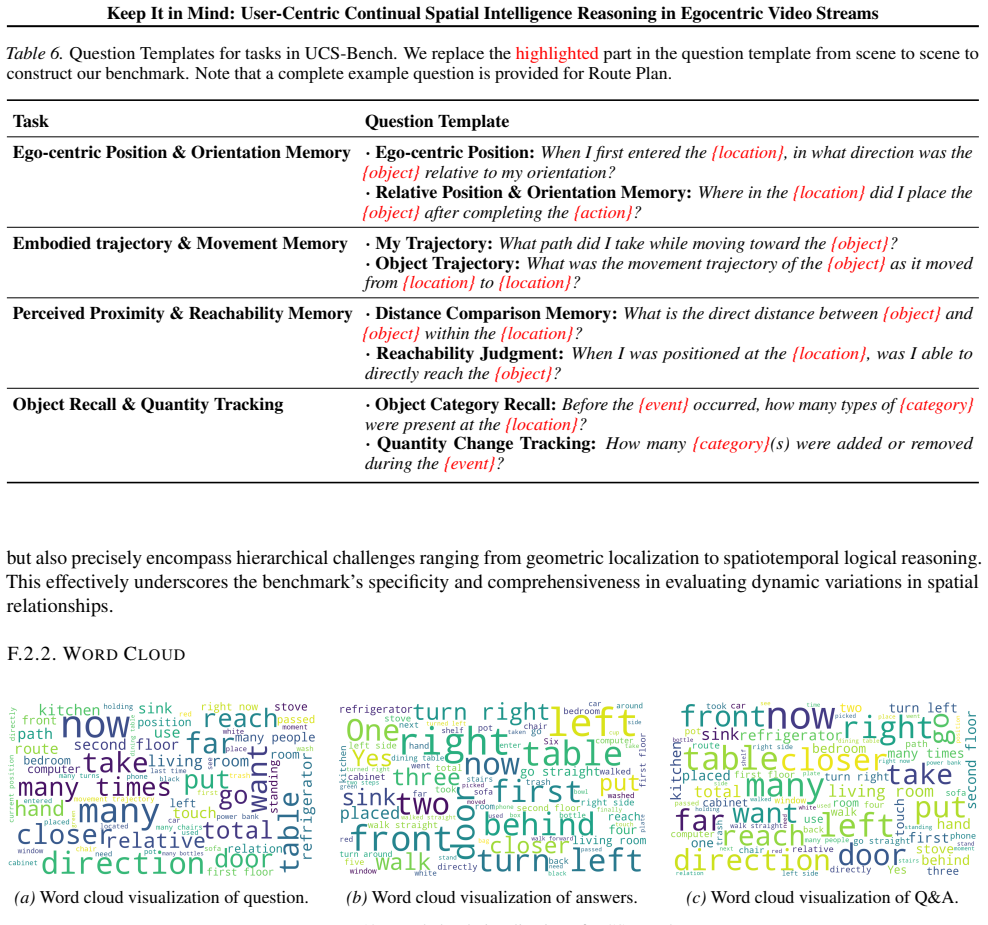
Dataset Statistics (§F.2) includes four categories of question templates—ego-centric spatial memory, trajectory & movement memory, proximity & reachability judgment, and object recall & quantity tracking—designed to evaluate models on dynamic spatial relationships and temporal...
-
[11]
Annotation System (§F.3) comprises the video QA annotation tool and the QA refinement & verification workflow. It enables annotators to create temporally and spatially grounded question-answer pairs, apply perspective correction, optimize answer options (including AI-assisted ...
-
[12]
Generation Distractor Pipeline (§F.4) includes question type categorization (binary, count, multi-choice) and a multi- stage distractor generation process. The pipeline combines retrieval-based candidate extraction, multi-criteria validation, diversity-aware selection, LLM-bas...
-
[13]
Quality-control Pipeline (§F.5) provides an overview of our procedure to ensure high-quality distractor options and reliable question-answer pairs. It covers automated evaluation using GPT-5 to identify and improve ineffective distractors, addresses semantic and information ba...
-
[14]
Human Performance and QA (§F.6) evaluates human upper-bound performance on the benchmark. The study aligns tasks with model questions, allows full-context video access, enforces independent answering by experts and reports average accuracy as a reference for model evaluation
-
[15]
Representative Failure Cases (§G.1) includes illustrative examples for Type I (Spatial Reasoning), Type II (Temporal State Tracking), and Type III (Visual Memory Amnesia) errors, highlighting typical failure patterns and underlying causes
-
[16]
Insights and Implications (§G.2) includes analysis of core capability gaps in current VLMs, covering lack of 3D spatial grounding, state memory bottleneck, and long-range visual forgetting, as well as potential directions for improvement
-
[17]
thinking
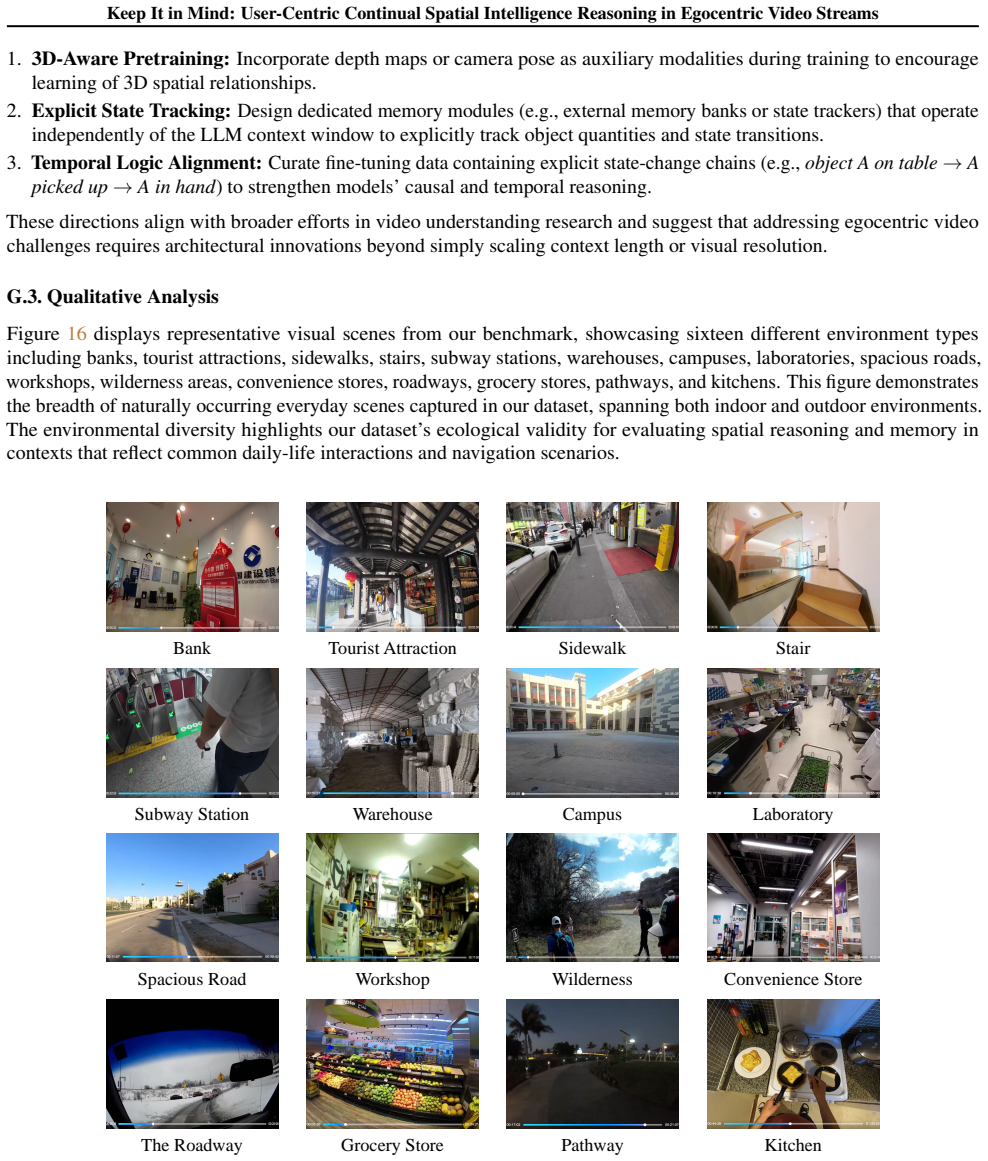
Qualitative Analysis (§G.3) includes representative visual scenes from diverse environments, demonstrating dataset breadth and ecological validity for evaluating spatial reasoning and memory in daily-life contexts. Together, these materials support reproducibility and provide ...
-
[18]
This strategy captures the global context of the video but may lose high-frequency details needed for short-term dynamics
Uniform Sampling:We uniformly sample K frames from the entire history range [0, tq]. This strategy captures the global context of the video but may lose high-frequency details needed for short-term dynamics. We employ prompt template 1 for this setting
-
[19]
If the number of available frames in the window is less thanK, all available frames are used
Streaming Window Sampling:We select the most recent K frames within a defined temporal window [tq −W, t q], whereWis the window size in seconds. If the number of available frames in the window is less thanK, all available frames are used. This strategy focuses on the immediate...
2025
-
[20]
These captions emphasize precise spatial information, including salient objects, their relative positions, inter-object relationships, and overall scene structure
Spatial Captioning:For each sampled frame in the buffer, the VLM generates a detailed spatial caption describing the scene layout. These captions emphasize precise spatial information, including salient objects, their relative positions, inter-object relationships, and overall...
-
[21]
type": "image
Visual-Textual Question Answering:The model receives an interleaved sequence of frames and their corresponding spatial captions as input. This design explicitly grounds the reasoning process in both visual evidence and structured spatial descriptions. We use prompt template 4 ...
-
[22]
English-only, concise (<= 18 words), ending with a period
-
[23]
Mutually exclusive with the true answer (not a paraphrase; not entailed)
-
[24]
Highly similar in structure/content (near-miss): change a concrete attribute like left/right, count, object name, container/surface, path step, floor level, or order
-
[25]
Avoid generic/hedging phrases (e.g., ’Insufficient information’, ’Probably’, ’Not sure’)
-
[26]
Avoid ’All/None of the above’
-
[27]
Keep the same answer TYPE/slot (location/quantity/trajectory etc.)
-
[28]
If seeds are few or absent, CREATE new high-quality distractors from scratch
If seeds are provided, use them as inspiration but improve and diversify them. If seeds are few or absent, CREATE new high-quality distractors from scratch
-
[29]
- If the question mentions a subject (e.g., ’apple’) and the true answer also includes it, ALL options must include that same subject to maintain consistency
MATCH THE STYLE AND STRUCTURE of the true answer closely: - Use similar sentence patterns, phrasing, and grammatical structure. - If the question mentions a subject (e.g., ’apple’) and the true answer also includes it, ALL options must include that same subject to maintain con...
-
[30]
Seed candidates (use as inspiration, but create variations): - seed_1 - seed_2
Generate diverse options covering different types of plausible errors (spatial, temporal, quantitative, categorical, etc.) while maintaining the near-miss quality. ] Role:user Content:[ “Question: {question} True Answer: {gold} seed_section IMPORTANT: Analyze the style of the ...
-
[31]
Change CORE attributes instead of adding/removing positional information: - Change colors - Change objects - Change quantities - Change states
-
[32]
Maintain identical sentence structure as the correct answer
-
[33]
Keep length consistent (±2 words from the correct answer length)
-
[34]
Ensure mutual exclusivity with every existing option
-
[35]
Problem: Some options are significantly longer or shorter than the correct answer, making it easy to guess
Keep it plausible but clearly wrong for the question Output Format (JSON only): {json_template} ] 28 Keep It in Mind: User-Centric Continual Spatial Intelligence Reasoning in Egocentric Video Streams Prompt 10: Fix Length Imbalance Prompt Role:user Content:[ You are helping to...
-
[36]
Match the length: each rewritten option should be {target_length} ± 2 words
-
[37]
Keep the same grammatical structure as the correct answer
-
[38]
Maintain content diversity (no meaningless padding)
-
[39]
You are a helpful assistant designed to output JSON
Preserve wrongness and avoid entailment with other options Output Format (JSON only): {json_template} ] 29 Keep It in Mind: User-Centric Continual Spatial Intelligence Reasoning in Egocentric Video Streams Prompt 11: Blind Test Prompt for Egocentric Video QA Role:system Conten...
2024
-
[40]
Lack of 3D Spatial Grounding.The high error rate on spatial reasoning tasks (57.4%) indicates that models primarily rely on 2D image feature matching rather than explicit 3D geometric understanding. The frequent confusion of relative positions (e.g.,leftvs.right,frontvs.back) ...
-
[41]
what I see now
State Memory Bottleneck.Despite improvements in context window length, models struggle to distinguish between instantaneous observations(“what I see now”) andaccumulated states(“what has changed over time”). The 61.2% error rate on temporal tracking questions—particularly thos...
-
[42]
This suggests that current KV-cache compression or token pruning strategies may inadvertently discard semantically critical information
Long-Range Visual Forgetting.Models exhibit significant forgetting of visual details from earlier frames, especially as video length increases. This suggests that current KV-cache compression or token pruning strategies may inadvertently discard semantically critical informati...
-
[43]
3D-Aware Pretraining:Incorporate depth maps or camera pose as auxiliary modalities during training to encourage learning of 3D spatial relationships
-
[44]
Explicit State Tracking:Design dedicated memory modules (e.g., external memory banks or state trackers) that operate independently of the LLM context window to explicitly track object quantities and state transitions
-
[45]
B" Distance Comparison Memory Which is closer to me, the mirror or the dining table? [’A. Mirror.’ ’B. Dining table.’]
Temporal Logic Alignment:Curate fine-tuning data containing explicit state-change chains (e.g.,object A on table → A picked up→A in hand) to strengthen models’ causal and temporal reasoning. These directions align with broader efforts in video understanding research and sugges...
Reviewed July 12, 2026 · model on record in the stance chip above.
Discussion (0). Sign in to comment.