Adaptive Epidemic Dynamics on Hypergraphs with Group-Level Immunization and Rewiring
Pith reviewed 2026-06-27 04:34 UTC · model grok-4.3
The pith
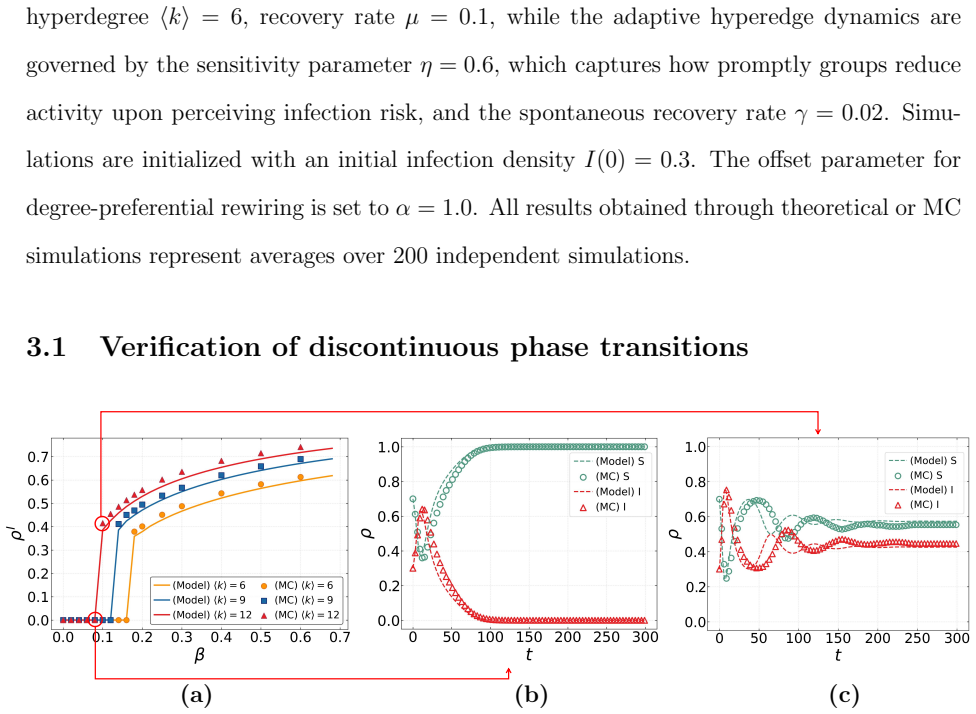
Adaptive hyperedge feedback on hypergraphs induces discontinuous epidemic transitions and bistable regimes where high initial prevalence drives eradication.
A machine-rendered reading of the paper's core claim, the machinery that carries it, and where it could break.
Core claim
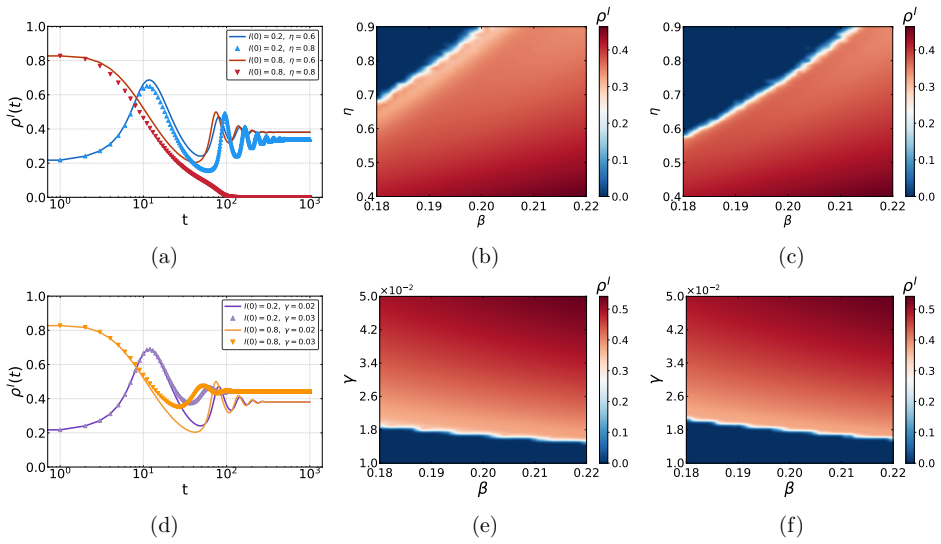
In the adaptive s-SIS model on d-uniform hypergraphs, hyperedge activity decreases in response to local infection pressure, inducing discontinuous phase transitions, nonlinear epidemic thresholds, and bistable regimes in which sufficiently high initial prevalence drives the system to the disease-free equilibrium. Risk-driven immunization, combining spontaneous isolation with targeted deactivation, and structural rewiring, either random or degree-preferential, are introduced as hyperedge-level interventions. Extending the microscopic Markov chain approximation yields analytical conditions for the existence and stability of endemic and disease-free states, while simulations confirm that target
What carries the argument
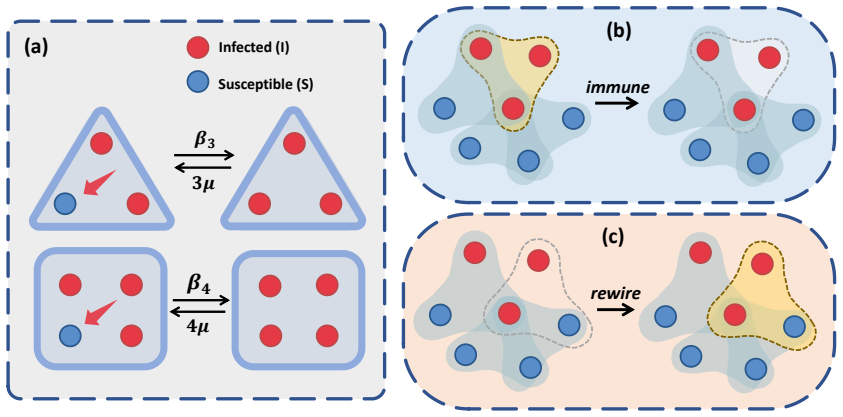
adaptive hyperedge feedback in the s-SIS model on d-uniform hypergraphs, where hyperedge activity co-evolves with node states according to local infection pressure and intervention rules.
If this is right
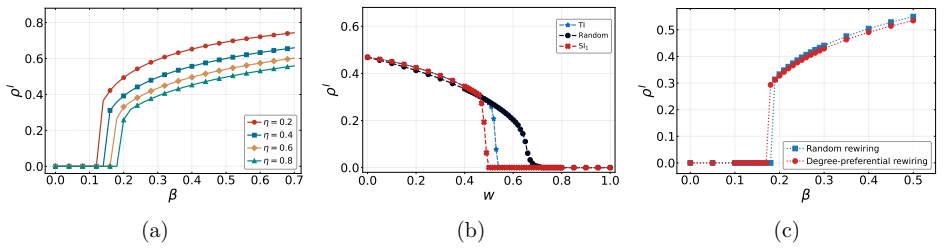
- Adaptive hyperedge feedback produces discontinuous phase transitions between disease-free and endemic states.
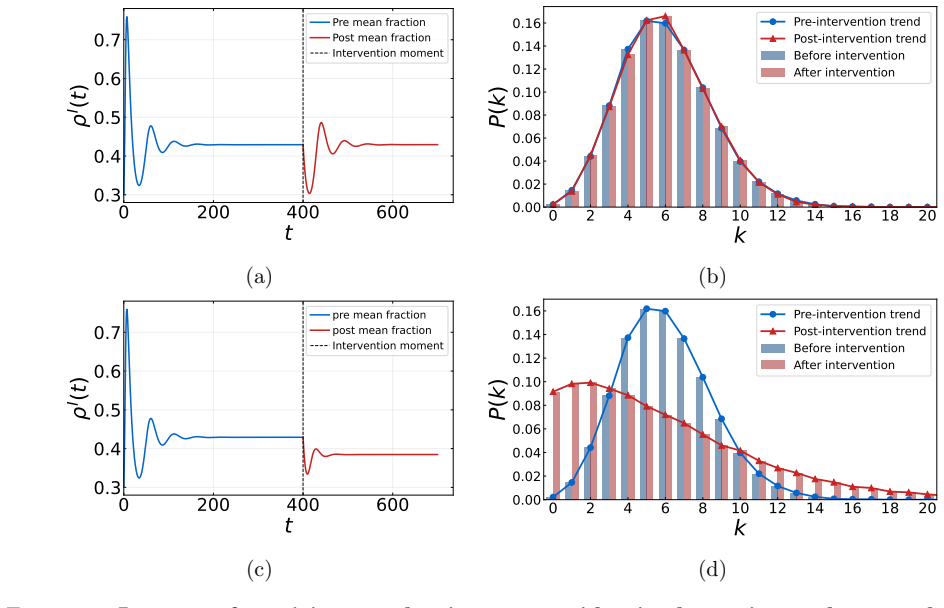
- Bistable regimes appear in which high enough initial prevalence drives the system to the disease-free equilibrium.
- Epidemic thresholds become nonlinear functions of transmission parameters because of the co-evolution between nodes and hyperedges.
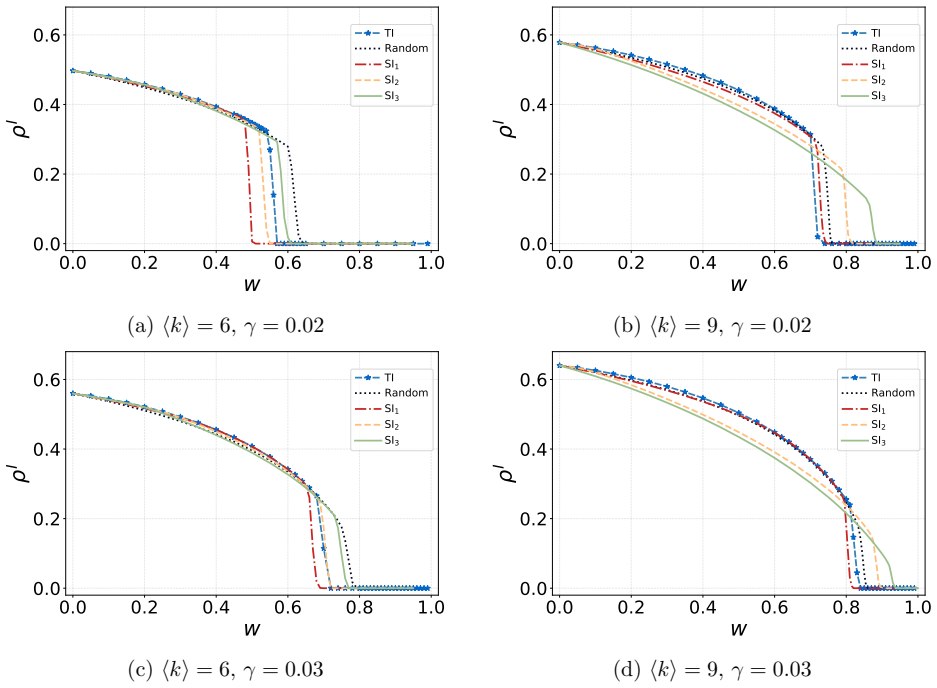
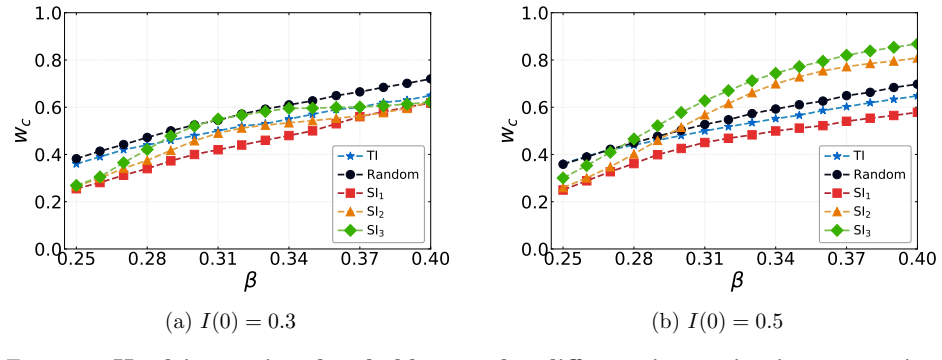
- Targeted immunization and degree-preferential rewiring suppress steady-state prevalence more than random counterparts.
Where Pith is reading between the lines
- Group-level self-isolation policies keyed to internal infection counts could create self-correcting outbreak dynamics in real clustered populations.
- The bistability suggests that temporary surges in reported cases might sometimes resolve without further intervention if feedback thresholds are met.
- Similar adaptive mechanisms might be tested on non-uniform hypergraphs to check whether the discontinuous and bistable features persist beyond fixed group size.
Load-bearing premise
The microscopic Markov chain approximation can be extended to accurately capture higher-order interactions and the co-evolution of node states with hyperedge activity on d-uniform hypergraphs.
What would settle it
Monte Carlo runs on the same d-uniform hypergraphs that fail to exhibit discontinuous jumps or bistability when initial prevalence is varied would falsify the claimed induction of those regimes by adaptive hyperedge feedback.
Figures
read the original abstract
Understanding how higher-order social structures shape epidemic spreading requires models that couple group interactions with adaptive behavior. We introduce an adaptive simplicial susceptible-infected-susceptible (s-SIS) model on d-uniform hypergraphs, where both node states and hyperedge activity co-evolve in response to local infection pressure. Hyperedges represent group interactions of fixed size and dynamically reduce their activity through a feedback mechanism in highly infected environments. Within this framework, we design two classes of hyperedge-level interventions: (i) risk-driven immunization, combining spontaneous, activity-based isolation with targeted deactivation guided by hyperedge infection pressure, and (ii) structural rewiring, which reconstructs group structures either randomly or via degree-preferential attachment. By extending the microscopic Markov chain approximation to higher-order interactions, we derive analytical conditions for the existence and stability of both endemic and disease-free stationary states. Our analysis shows that adaptive hyperedge feedback can induce discontinuous phase transitions, nonlinear epidemic thresholds, and bistable regimes in which sufficiently high initial prevalence drives the system to a disease-free equilibrium. Extensive Monte Carlo simulations support the theory and confirm that targeted immunization and degree-preferential rewiring substantially suppress epidemic prevalence, outperforming random strategies. These results demonstrate that higher-order interactions and adaptive group-level responses fundamentally reshape epidemic bifurcations and suggest principles for designing effective intervention policies in complex social systems.
Editorial analysis
A structured set of objections, weighed in public.
Referee Report
Summary. The paper introduces an adaptive s-SIS epidemic model on d-uniform hypergraphs in which node states and hyperedge activity co-evolve via infection-pressure feedback. Two intervention classes are defined: risk-driven immunization (spontaneous plus targeted deactivation) and structural rewiring (random or degree-preferential). An extension of the microscopic Markov chain approximation (MMCA) to higher-order interactions yields analytical conditions for the existence and stability of endemic and disease-free equilibria. The analysis predicts that adaptive hyperedge feedback produces discontinuous phase transitions, nonlinear thresholds, and bistable regimes in which high initial prevalence can drive the system to the disease-free state. Monte Carlo simulations are reported to support the theory and to show that targeted immunization and degree-preferential rewiring outperform random strategies in suppressing prevalence.
Significance. If the MMCA closure remains accurate under adaptive hyperedge dynamics, the work supplies a concrete mechanism by which group-level adaptation reshapes epidemic bifurcations and supplies testable intervention principles. The explicit derivation of stationary-state conditions together with direct simulation comparisons constitutes a strength; the absence of free parameters in the core model rules is also noted.
major comments (2)
- [Derivation of stationary-state conditions (MMCA extension)] The central claims of discontinuous transitions, nonlinear thresholds, and bistability rest on the stationary-state conditions obtained from the MMCA extension to d-uniform hypergraphs with adaptive hyperedge activity (abstract and the section deriving the stationary-state equations). This closure necessarily omits dynamical correlations between node states and the rewiring/immunization rules; on hypergraphs such correlations are expected to be stronger than in pairwise networks, especially under degree-preferential rewiring. If the neglected terms alter the bifurcation diagram, the reported qualitative phenomena could be artifacts of the approximation rather than properties of the underlying stochastic process. A direct comparison of the MMCA predictions against exact stochastic realizations on small hypergraphs, or an explicit error bound, is required to establish that the claimed regi
- [Monte Carlo simulation results section] Table or figure reporting the Monte Carlo validation of the bistable regime (high initial prevalence driving the system to disease-free equilibrium) should include the precise initial-condition sampling protocol and the number of independent runs per parameter point; without these details it is impossible to assess whether the observed bistability is robust to stochastic fluctuations that the MMCA neglects.
minor comments (2)
- [Model definition] Notation for the hyperedge activity variable and its feedback function should be introduced with an explicit equation number at first use to avoid ambiguity when the same symbols appear in both the immunization and rewiring sections.
- [Figure captions] The abstract states that 'extensive Monte Carlo simulations support the theory'; the corresponding figure captions should state the hypergraph size, the range of d values tested, and whether the same random seeds were used for the adaptive and non-adaptive cases.
Simulated Author's Rebuttal
We thank the referee for the careful reading and constructive comments on our manuscript. We address each major comment point by point below, indicating where revisions will be made.
read point-by-point responses
-
Referee: The central claims of discontinuous transitions, nonlinear thresholds, and bistability rest on the stationary-state conditions obtained from the MMCA extension to d-uniform hypergraphs with adaptive hyperedge activity (abstract and the section deriving the stationary-state equations). This closure necessarily omits dynamical correlations between node states and the rewiring/immunization rules; on hypergraphs such correlations are expected to be stronger than in pairwise networks, especially under degree-preferential rewiring. If the neglected terms alter the bifurcation diagram, the reported qualitative phenomena could be artifacts of the approximation rather than properties of the underlying stochastic process. A direct comparison of the MMCA predictions against exact stochastic realizations on small hypergraphs, or an explicit error bound, is required to establish that the claimed regi
Authors: We acknowledge that the MMCA constitutes a closure approximation that neglects dynamical correlations, which can indeed be stronger under adaptive hyperedge rules on hypergraphs. The manuscript validates the MMCA predictions through direct Monte Carlo simulations on finite hypergraphs of varying sizes, demonstrating quantitative agreement in threshold locations, transition types, and bistable regimes. This cross-validation across system sizes indicates that the qualitative phenomena are robust features of the model rather than pure artifacts. We will add an explicit discussion of the approximation's limitations and the supporting simulation evidence in the revised text, but a full exact enumeration on small instances for all regimes would require new computational work. Hence partial revision. revision: partial
-
Referee: Table or figure reporting the Monte Carlo validation of the bistable regime (high initial prevalence driving the system to disease-free equilibrium) should include the precise initial-condition sampling protocol and the number of independent runs per parameter point; without these details it is impossible to assess whether the observed bistability is robust to stochastic fluctuations that the MMCA neglects.
Authors: We agree that these methodological details are essential for assessing robustness to stochasticity. In the revised manuscript we will augment the Monte Carlo section and relevant figure captions with the exact initial-condition protocol (uniform random selection of an initial infected fraction) and the number of independent realizations per parameter point used for averaging. revision: yes
Circularity Check
No significant circularity; derivation grounded in model rules and external validation
full rationale
The paper extends the microscopic Markov chain approximation (MMCA) to derive stationary-state conditions for the adaptive s-SIS model on d-uniform hypergraphs. This is a standard closure applied to the stated transition probabilities for node states and hyperedge activity, not a self-definition or fitted-input renaming. Results are cross-checked against independent Monte Carlo simulations, and no load-bearing self-citations or uniqueness theorems from prior author work are invoked to force the outcomes. The discontinuous transitions and bistability arise from the adaptive feedback and intervention rules rather than reducing to inputs by construction.
Axiom & Free-Parameter Ledger
axioms (1)
- domain assumption The microscopic Markov chain approximation extends to higher-order interactions on d-uniform hypergraphs
Reference graph
Works this paper leans on
-
[1]
R. M. Anderson, R. M. May,Infectious Diseases of Hu- mans: Dynamics and Control, Oxford University Press, 1991. doi: https://doi.org/10.1093/oso/9780198545996.001.0001
-
[2]
Modelling dynamical processes in complex socio-technical systems,
A. Vespignani, “Modelling dynamical processes in complex socio-technical systems,”Na- ture Physics, vol. 8, no. 1, pp. 32–39, 2012. doi:https://doi.org/10.1038/nphys2160 30
-
[3]
J. Tang, Y. Yao, M. Xie, M. Feng, “SIS Epidemic Modelling on Homo- geneous Networked System: General Recovering Process and Mean-Field Per- spective,”Applied Mathematical Modelling, vol. 146, p. 116188, 2025. doi: https://doi.org/10.1016/j.apm.2025.116188
-
[4]
Network spreading among ar- eas: A dynamical complex network modeling approach,
Q. Li, H. Chen, Y. Li, M. Feng, J. Kurths, “Network spreading among ar- eas: A dynamical complex network modeling approach,”Chaos: An Interdis- ciplinary Journal of Nonlinear Science, vol. 32, no. 10, p. 103102, 2022. doi: https://doi.org/10.1063/5.0102390
-
[5]
M. Xie, Y. Li, M. Feng, J. Kurths, “Contact-dependent infection and mo- bility in the metapopulation SIR model from a birth–death process per- spective,”Chaos, Solitons & Fractals, vol. 177, p. 114299, 2023. doi: https://doi.org/10.1016/j.chaos.2023.114299
-
[6]
Planning for smallpox outbreaks,
N. M. Ferguson, M. J. Keeling, W. J. Edmunds, R. Gani, B. T. Grenfell, R. M. Anderson, S. Leach, “Planning for smallpox outbreaks,”Nature, vol. 425, no. 6959, pp. 681–685,
-
[7]
doi:https://doi.org/10.1038/nature02007
-
[8]
The SIRC model and influenza A,
R. Casagrandi, L. Bolzoni, S. A. Levin, V. Andreasen, “The SIRC model and influenza A,”Mathematical Biosciences, vol. 200, no. 2, pp. 152–169, 2006. doi: https://doi.org/10.1016/j.mbs.2005.12.029
-
[9]
Epidemic processes in complex networks,
R. Pastor-Satorras, C. Castellano, P. Van Mieghem, A. Vespignani, “Epidemic processes in complex networks,”Reviews of Modern Physics, vol. 87, no. 3, p. 925, 2015. doi: https://doi.org/10.1103/RevModPhys.87.925
-
[10]
Collective dynamics of ‘small-world’ networks,
D. J. Watts, S. H. Strogatz, “Collective dynamics of ‘small-world’ networks,”Nature, vol. 393, no. 6684, pp. 440–442, 1998. doi:https://doi.org/10.1038/30918
-
[11]
Emergence of scaling in random networks,
A.-L. Barab´ asi, R. Albert, “Emergence of scaling in random networks,”Science, vol. 286, no. 5439, pp. 509–512, 1999. doi:https://doi.org/10.1126/science.286.5439.509
-
[12]
Epidemic spreading in scale-free net- works,
R. Pastor-Satorras, A. Vespignani, “Epidemic spreading in scale-free net- works,”Physical Review Letters, vol. 86, no. 14, p. 3200, 2001. doi: https://doi.org/10.1515/9781400841356.493
-
[13]
The structure and dynam- ics of multilayer networks,
S. Boccaletti, G. Bianconi, R. Criado, C. I. Del Genio, J. G´ omez-Garde˜ nes, M. Romance, I. Sendina-Nadal, Z. Wang, M. Zanin, “The structure and dynam- ics of multilayer networks,”Physics Reports, vol. 544, no. 1, pp. 1–122, 2014. doi: https://doi.org/10.1016/j.physrep.2014.07.001
-
[14]
M. Feng, X. Li, Y. Li, Q. Li, “The impact of nodes of information dissemina- tion on epidemic spreading in dynamic multiplex networks,”Chaos: An Inter- disciplinary Journal of Nonlinear Science, vol. 33, no. 4, p. 043112, 2023. doi: https://doi.org/10.1063/5.0142386
-
[15]
V. Colizza, A. Barrat, M. Barthelemy, A.-J. Valleron, A. Vespignani, “Mod- eling the worldwide spread of pandemic influenza: baseline case and con- tainment interventions,”PLoS Medicine, vol. 4, no. 1, p. e13, 2007. doi: https://doi.org/10.1371/journal.pmed.0040013
-
[16]
Critical regimes driven by recurrent mobility patterns of reaction–diffusion processes in networks,
J. G´ omez-Garde˜ nes, D. Soriano-Pa˜ nos, A. Arenas, “Critical regimes driven by recurrent mobility patterns of reaction–diffusion processes in networks,”Nature Physics, vol. 14, no. 4, pp. 391–395, 2018. doi:https://doi.org/10.1038/s41567-017-0022-7
-
[17]
Spreading processes in multiplex metapopulations containing different mobility networks,
D. Soriano-Pa˜ nos, L. Lotero, A. Arenas, J. G´ omez-Garde˜ nes, “Spreading processes in multiplex metapopulations containing different mobility networks,”Physical Review X, 31 vol. 8, no. 3, p. 031039, 2018. doi:https://doi.org/10.1103/PhysRevX.8.031039
-
[18]
Adaptive coevolutionary networks: a review,
T. Gross, B. Blasius, “Adaptive coevolutionary networks: a review,”Jour- nal of the Royal Society Interface, vol. 5, no. 20, pp. 259–271, 2008. doi: https://doi.org/10.1098/rsif.2007.1229
-
[19]
M. Feng, Z. Zeng, Q. Li, M. Perc, J. Kurths, “Information Dynamics in Evolving Net- works Based on the Birth-Death Process: Random Drift and Natural Selection Perspec- tive,”IEEE Transactions on Systems, Man, and Cybernetics: Systems, vol. 54, no. 8, pp. 5123–5136, 2024. doi:https://doi.org/10.1109/TSMC.2024.3389095
-
[20]
Epidemic spreading on pre- ferred degree adaptive networks,
S. Jolad, W. Liu, B. Schmittmann, R. K. Zia, “Epidemic spreading on pre- ferred degree adaptive networks,”PLoS ONE, vol. 7, no. 11, p. e48686, 2012. doi: https://doi.org/10.1371/journal.pone.0048686
-
[21]
Epidemic dynamics on an adap- tive network,
T. Gross, C. J. D. D’Lima, B. Blasius, “Epidemic dynamics on an adap- tive network,”Physical Review Letters, vol. 96, no. 20, p. 208701, 2006. doi: https://doi.org/10.1103/PhysRevLett.96.208701
-
[22]
Adaptive dy- namical networks,
R. Berner, T. Gross, C. Kuehn, J. Kurths, S. Yanchuk, “Adaptive dy- namical networks,”Physics Reports, vol. 1031, pp. 1–59, 2023. doi: https://doi.org/10.48550/arXiv.2304.05652
-
[23]
Effects of rewiring strategies on information spreading in complex dynamic networks,
A. F. Ally, N. Zhang, “Effects of rewiring strategies on information spreading in complex dynamic networks,”Communications in Nonlinear Science and Numerical Simulation, vol. 57, pp. 97–110, 2018. doi:https://doi.org/10.1016/j.cnsns.2017.08.031
-
[24]
Epidemic processes with immu- nization,
A. Jim´ enez-Dalmaroni, H. Hinrichsen, “Epidemic processes with immu- nization,”Physical Review E, vol. 68, no. 3, p. 036103, 2003. doi: https://doi.org/10.1103/PhysRevE.68.036103
-
[25]
Epidemic dynamics in finite size scale- free networks,
R. Pastor-Satorras, A. Vespignani, “Epidemic dynamics in finite size scale- free networks,”Physical Review E, vol. 65, no. 3, p. 035108, 2002. doi: https://doi.org/10.1103/PhysRevE.65.035108
-
[27]
Herd immunity and herd effect: new insights and defini- tions,
T. J. John, R. Samuel, “Herd immunity and herd effect: new insights and defini- tions,”European Journal of Epidemiology, vol. 16, no. 7, pp. 601–606, 2000. doi: https://doi.org/10.1023/A:1007626510002
-
[28]
Attack vulnerability of complex networks,
P. Holme, B. J. Kim, C. N. Yoon, S. K. Han, “Attack vulnerability of complex networks,”Physical Review E, vol. 65, no. 5, p. 056109, 2002. doi: https://doi.org/10.1103/PhysRevE.65.056109
-
[29]
Efficient immunization strategies for computer networks and populations,
R. Cohen, S. Havlin, D. Ben-Avraham, “Efficient immunization strategies for computer networks and populations,”Physical Review Letters, vol. 91, no. 24, p. 247901, 2003. doi:https://doi.org/10.1103/PhysRevLett.91.247901
-
[30]
Finding a better immu- nization strategy,
Y. Chen, G. Paul, S. Havlin, F. Liljeros, H. E. Stanley, “Finding a better immu- nization strategy,”Physical Review Letters, vol. 101, no. 5, p. 058701, 2008. doi: https://doi.org/10.1103/PhysRevLett.101.058701
-
[31]
Diffusion Containment in Complex Networks Through Collective Influence of Connections,
Y. Liu, G. Liang, X. Wang, P. Zhu, Z. Wang, “Diffusion Containment in Complex Networks Through Collective Influence of Connections,”IEEE Transac- tions on Information Forensics and Security, vol. 19, pp. 1510–1524, 2024. doi: https://doi.org/10.1109/TIFS.2023.3338423 32
-
[32]
Efficient Edge Immunization Strategies for Diffusion Containment in Social Networks,
Y. Liu, X. Wang, Z. Su, Y. Xiao, Z. Wang, “Efficient Edge Immunization Strategies for Diffusion Containment in Social Networks,”IEEE Transactions on Dependable and Secure Computing, vol. 23, no. 2, pp. 2693–2709, 2026. doi: https://doi.org/10.1109/TDSC.2025.3629028
-
[33]
Effective epidemic containment strategy in hypergraphs,
B. Jhun, “Effective epidemic containment strategy in hypergraphs,” Physical Review Research, vol. 3, no. 3, p. 033282, 2021. doi: https://doi.org/10.1103/PhysRevResearch.3.033282
-
[34]
L. Zhu, Y. Ding, S. Shen, “Green behavior propagation analysis based on statistical the- ory and intelligent algorithm in data-driven environment,”Mathematical Biosciences, vol. 379, p. 109340, 2025. doi:https://doi.org/10.1016/j.mbs.2024.109340
-
[35]
Networks beyond pairwise interactions: struc- ture and dynamics,
F. Battiston, G. Cencetti, I. Iacopini, V. Latora, M. Lucas, A. Pata- nia, J.-G. Young, G. Petri, “Networks beyond pairwise interactions: struc- ture and dynamics,”Physics Reports, vol. 874, pp. 1–92, 2020. doi: https://doi.org/10.1016/j.physrep.2020.05.004
-
[36]
Epidemic spreading on higher-order networks,
W. Wang, Y. Nie, W. Li, T. Lin, M.-S. Shang, S. Su, Y. Tang, Y.-C. Zhang, G.-Q. Sun, “Epidemic spreading on higher-order networks,”Physics Reports, vol. 1056, pp. 1–70,
-
[37]
doi:https://doi.org/10.1016/j.physrep.2024.01.003
-
[38]
O. T. Courtney, G. Bianconi, “Generalized network structures: The configuration model and the canonical ensemble of simplicial complexes,”Physical Review E, vol. 93, no. 6, p. 062311, 2016. doi:https://doi.org/10.1103/PhysRevE.93.062311
-
[39]
Simplicial SIS model in scale-free uniform hypergraph,
B. Jhun, M. Jo, B. Kahng, “Simplicial SIS model in scale-free uniform hypergraph,” Journal of Statistical Mechanics: Theory and Experiment, vol. 2019, no. 12, p. 123207,
2019
-
[40]
doi:https://doi.org/10.1088/1742-5468/ab5367
-
[41]
Simplicial SIRS epidemic models with nonlinear incidence rates,
D. Wang, Y. Zhao, J. Luo, H. Leng, “Simplicial SIRS epidemic models with nonlinear incidence rates,”Chaos: An Interdisciplinary Journal of Nonlinear Science, vol. 31, no. 5, p. 053112, 2021. doi:https://doi.org/10.1063/5.0040518
-
[42]
Abrupt phase transition of epidemic spreading in simplicial complexes,
J. T. Matamalas, S. G´ omez, A. Arenas, “Abrupt phase transition of epidemic spreading in simplicial complexes,”Physical Review Research, vol. 2, no. 1, p. 012049, 2020. doi: https://doi.org/10.1103/PhysRevResearch.2.012049
-
[43]
Simplicial models of so- cial contagion,
I. Iacopini, G. Petri, A. Barrat, V. Latora, “Simplicial models of so- cial contagion,”Nature Communications, vol. 10, no. 1, p. 2485, 2019. doi: https://doi.org/10.1038/s41467-019-10431-6
-
[44]
Social contagion models on hy- pergraphs,
G. F. de Arruda, M. Tizzani, Y. Moreno, “Social contagion models on hy- pergraphs,”Physical Review Research, vol. 2, no. 2, p. 023032, 2020. doi: https://doi.org/10.1103/PhysRevResearch.2.023032
-
[45]
Impacts of Physical-Layer Information on Epi- demic Spreading in Cyber-Physical Networked Systems,
X. Yuan, Y. Yao, H. Wu, M. Feng, “Impacts of Physical-Layer Information on Epi- demic Spreading in Cyber-Physical Networked Systems,”IEEE Transactions on Cir- cuits and Systems I: Regular Papers, vol. 72, no. 10, pp. 5957–5969, 2025. doi: https://doi.org/10.1109/TCSI.2025.3550386
-
[46]
Dynamic propagation and control of a West Nile virus model based on higher-order temporal network structure,
L. Zhu, Y. Li, “Dynamic propagation and control of a West Nile virus model based on higher-order temporal network structure,”Physical Review E, vol. 112, no. 4, p. 044409,
-
[47]
doi:https://doi.org/10.1103/xwt2-f1d3
-
[48]
L. Zhu, T. Zheng, “Pattern dynamics analysis and application of West Nile virus spa- tiotemporal models based on higher-order network topology,”Bulletin of Mathematical Biology, vol. 87, 2025. doi:https://doi.org/10.1007/s11538-025-01501-6 33
-
[49]
T. Yang, L. Zhu, S. Shen, L. He, “Pattern dynamics analysis and pa- rameter identification of spatiotemporal infectious disease models on com- plex networks,”Mathematical Biosciences, vol. 387, p. 109502, 2025. doi: https://doi.org/10.1016/j.mbs.2025.109502
-
[50]
Discrete- time Markov chain approach to contact-based disease spreading in com- plex networks,
S. G´ omez, A. Arenas, J. Borge-Holthoefer, S. Meloni, Y. Moreno, “Discrete- time Markov chain approach to contact-based disease spreading in com- plex networks,”Europhysics Letters, vol. 89, no. 3, p. 38009, 2010. doi: https://doi.org/10.1209/0295-5075/89/38009
-
[51]
Effective approach to epidemic containment using link equations in complex networks,
J. T. Matamalas, A. Arenas, S. G´ omez, “Effective approach to epidemic containment using link equations in complex networks,”Science Advances, vol. 4, no. 12, p. eaau4212,
-
[52]
doi:https://doi.org/10.1126/sciadv.aau4212
-
[53]
Quasistationary analysis of the contact process on annealed scale-free networks,
S. C. Ferreira, R. S. Ferreira, R. Pastor-Satorras, “Quasistationary analysis of the contact process on annealed scale-free networks,”Physical Review E, vol. 83, no. 6, p. 066113, 2011. doi:https://doi.org/10.1103/PhysRevE.83.066113
-
[54]
Immunization of complex net- works,
R. Pastor-Satorras, A. Vespignani, “Immunization of complex net- works,”Physical Review E, vol. 65, no. 3, p. 036104, 2001. doi: https://doi.org/10.1103/PhysRevE.65.036104
-
[55]
Connecting the Congress: A Study of Cosponsorship Networks,
J. H. Fowler, “Connecting the Congress: A Study of Cosponsorship Networks,”Political Analysis, vol. 14, no. 4, pp. 456–487, 2006. doi: https://doi.org/10.1093/pan/mpl002 34
discussion (0)
Sign in with ORCID, Apple, or X to comment. Anyone can read and Pith papers without signing in.