Quantum-enhanced Markov chain Monte Carlo sampling to model Lagrangian tracer dispersion in turbulent boundary layer
Pith reviewed 2026-06-27 03:34 UTC · model grok-4.3
The pith
A quantum-enhanced MCMC samples height-dependent turbulent accelerations to generate Lagrangian tracer tracks whose pair dispersion matches classical methods.
A machine-rendered reading of the paper's core claim, the machinery that carries it, and where it could break.
Core claim
The QE-MCMC method generates synthetic tracer particle tracks in homogeneous shear flow and turbulent boundary layers. The resulting scaling laws for tracer-particle pair dispersion agree with a stochastic transport model of coupled Langevin equations and with classical MCMC. The effective height-weighted spectral gap between the first and second eigenvalue of the Markov-chain transition matrix significantly exceeds that of classical MCMC when sampling from multivariate distributions with cross-correlations at the highest qubit numbers.
What carries the argument
A parametric quantum circuit that constructs the proposal distribution for the first Metropolis-Hastings substep when sampling the joint target distribution over the three acceleration components that depends on height.
Load-bearing premise
The joint target distribution over the three acceleration components that depends on height can be usefully sampled via a tempered distribution whose proposal is generated by a parametric quantum circuit without introducing systematic biases that would alter the measured pair-dispersion statistics or the reported spectral-gap comparison.
What would settle it
Direct numerical comparison in which the pair-dispersion scaling laws from QE-MCMC tracks deviate from those of the coupled Langevin equations or classical MCMC, or in which the height-weighted spectral gap fails to exceed the classical value at high qubit numbers, would falsify the claims.
Figures







read the original abstract
We present a quantum-enhanced Markov chain Monte Carlo (QE-MCMC) method to sample turbulent acceleration vectors from a joint target distribution that depends on all three components and height to model the transport and dispersion of massless Lagrangian tracer particles in two turbulent shear flows. A homogeneous shear flow, characterized by a uniform shear rate S, is considered as the starting point. Secondly, a turbulent boundary layer, which forms in both halves of a plane turbulent channel flow at friction Reynolds number Re_tau = 1000, is considered, where the mean shear rate S(y) varies with distance from the wall y. In this hybrid quantum-classical method, the proposal distribution Q for the first of two Metropolis-Hastings sampling substeps is constructed by a parametric quantum circuit. The algorithm generates synthetic tracer particle tracks. The resulting scaling laws for tracer-particle pair dispersion, a central quantity to probe turbulent mixing from a Lagrangian perspective, agree with a stochastic transport model consisting of coupled Langevin equations and with the classical MCMC counterpart. Differently from the classical sampling method, QE-MCMC uses a tempered target distribution. Due to the height dependence of the tracer dynamics in turbulent channel flow, an effective height-weighted spectral gap between the first and second eigenvalue of the Markov-chain transition matrix is introduced. The latter is found to significantly exceed the one of classical MCMC when sampling from a multivariate distribution with cross-correlations at the highest qubit numbers and thus resolutions. Consequently, our results support the applicability of this one-shot algorithm as a generative Lagrangian quantum-computing module, possibly embedded in a complex fluid-flow problem. Our module is found to work reliably for a relatively small number of qubits per spatial dimension of Nq <= 6.
Editorial analysis
A structured set of objections, weighed in public.
Referee Report
Summary. The manuscript introduces a quantum-enhanced Markov chain Monte Carlo (QE-MCMC) method that uses a parametric quantum circuit to construct proposal distributions for sampling turbulent acceleration vectors from a joint, height-dependent target distribution. This generates synthetic Lagrangian tracer tracks in homogeneous shear flow and a turbulent boundary layer (Re_tau=1000 channel flow). The resulting tracer-pair dispersion scaling laws are reported to agree with those from coupled Langevin equations and from classical MCMC; QE-MCMC employs a tempered target and yields a larger effective height-weighted spectral gap (between the first and second eigenvalues of the transition matrix) than classical MCMC, especially at the highest qubit counts (Nq=6).
Significance. If the tempering step is shown not to bias the sampled statistics, the work would demonstrate a viable hybrid quantum-classical module for generating Lagrangian statistics in wall-bounded turbulence, with a concrete efficiency metric (spectral gap) that scales with problem dimensionality. The explicit comparison to both a stochastic model and classical MCMC provides a falsifiable benchmark that strengthens the applicability claim.
major comments (2)
- [Abstract/Methods] Abstract and Methods: QE-MCMC explicitly uses a tempered target distribution while the classical MCMC counterpart does not. No quantitative check is supplied that the tempering parameter (or schedule) leaves the joint acceleration statistics, cross-correlations, and height dependence unchanged; without this, the reported agreement in pair-dispersion exponents could be an artifact of the altered target rather than evidence that the quantum proposal faithfully samples the intended distribution.
- [Results] Results: The effective height-weighted spectral gap is computed on the tempered QE-MCMC transition matrix. Because the classical comparison chain is untempered, the claimed advantage at Nq=6 requires an explicit demonstration that the gap difference is not an artifact of the tempering choice or of the height-weighting procedure itself.
minor comments (2)
- [Abstract] Abstract: No error bars, circuit-ansatz specifications, or data-exclusion criteria are stated for the dispersion-law comparisons or the spectral-gap values.
- [Abstract] Abstract: The phrase 'significantly exceeds' for the spectral-gap advantage would be strengthened by reporting the actual numerical ratios or differences at each Nq.
Simulated Author's Rebuttal
We thank the referee for the constructive comments. We address each major comment below and will revise the manuscript accordingly.
read point-by-point responses
-
Referee: [Abstract/Methods] Abstract and Methods: QE-MCMC explicitly uses a tempered target distribution while the classical MCMC counterpart does not. No quantitative check is supplied that the tempering parameter (or schedule) leaves the joint acceleration statistics, cross-correlations, and height dependence unchanged; without this, the reported agreement in pair-dispersion exponents could be an artifact of the altered target rather than evidence that the quantum proposal faithfully samples the intended distribution.
Authors: We agree that an explicit verification is required. In the revised manuscript we will add classical MCMC runs that employ the identical tempered target used by QE-MCMC. These runs will be used to compare marginal distributions, cross-correlations and height dependence against the untempered classical results already presented, thereby quantifying any bias introduced by tempering. We will also report the sensitivity of the pair-dispersion exponents to the tempering schedule. This addition will confirm that the observed agreement is not an artifact. revision: yes
-
Referee: [Results] Results: The effective height-weighted spectral gap is computed on the tempered QE-MCMC transition matrix. Because the classical comparison chain is untempered, the claimed advantage at Nq=6 requires an explicit demonstration that the gap difference is not an artifact of the tempering choice or of the height-weighting procedure itself.
Authors: We acknowledge the need to isolate the effect of the quantum proposal from tempering. The revision will include the height-weighted spectral gap computed for the classical MCMC chain under the same tempered target as QE-MCMC. We will also present a short parametric study of the gap versus tempering strength to show that the reported advantage at Nq=6 is robust. These additions will remove the potential confounding factor while preserving the main conclusions. revision: yes
Circularity Check
No circularity: derivation relies on external benchmarks and direct computation
full rationale
The abstract and description present QE-MCMC as a hybrid sampler whose outputs (pair-dispersion scaling laws and height-weighted spectral gap) are compared to an independent stochastic Langevin model and to classical MCMC. The spectral gap is extracted directly from the transition matrix eigenvalues of each sampler; the tempering difference is explicitly noted rather than hidden. No equations, self-citations, or fitted parameters are shown reducing the central claims to their own inputs by construction. The method is evaluated against external references (Langevin model, classical MCMC) that are not derived from the QE-MCMC run itself.
Axiom & Free-Parameter Ledger
free parameters (2)
- parameters of the parametric quantum circuit
- tempering parameter
axioms (2)
- domain assumption Acceleration vectors are drawn from a joint target distribution that depends on all three components and on height above the wall.
- standard math An effective height-weighted spectral gap can be defined from the first two eigenvalues of the Markov-chain transition matrix and used to compare mixing efficiency.
Reference graph
Works this paper leans on
-
[1]
Flow configuration MCMC and QE-MCMC methods were first tested in a three-dimensional homogeneous turbulent shear flow, see also ref. [18]. Such a turbulent flow, which evolves far away from walls and boundaries, is commonly described by a decomposition of the velocity field into a streamwise mean flow and fluctuations which are given by u(x, t) =⟨u x⟩(y)e...
-
[2]
To assess this quantity, we compute the mean-squared relative displacementD(t) between pairs of Lagrangian particles, initialized with small differences in their initial conditions
Lagrangian particle pair dispersion A key quantity of interest in the Lagrangian frame- work is the particle dispersion, which characterizes the spreading of particle trajectories due to turbulent mixing. To assess this quantity, we compute the mean-squared relative displacementD(t) between pairs of Lagrangian particles, initialized with small differences...
-
[3]
(5) forQ(a ∗|a(n))
Optimal parameters of the MCMC method To ensure efficient sampling within the MCMC frame- work, a parameter study was conducted to determine the optimal proposal varianceσ prop for the acceleration fluc- tuations, see again Eq. (5) forQ(a ∗|a(n)). The proposal standard deviations are calibrated by matching the tem- poral correlation structure of the Marko...
-
[4]
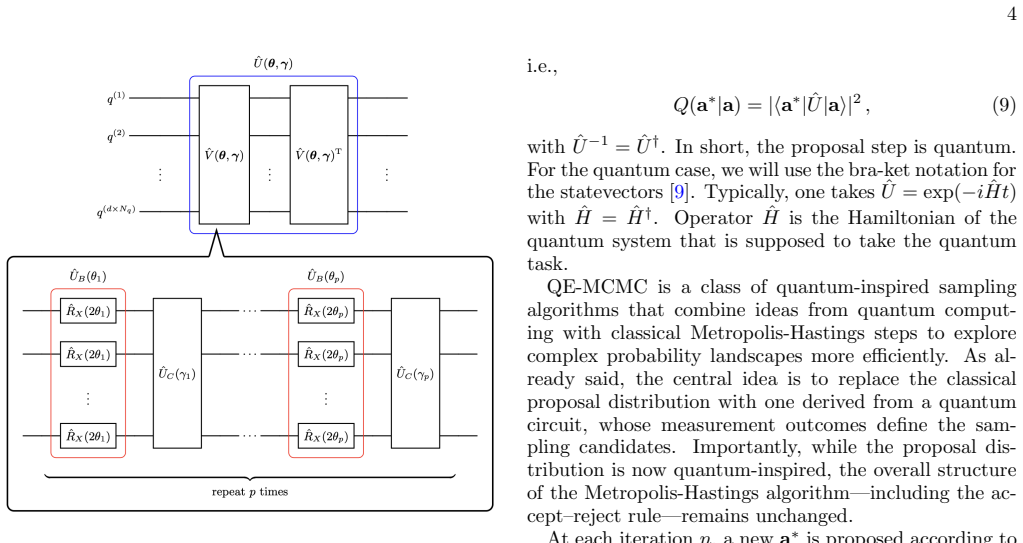
Optimal parameters of the QE-MCMC method The quantum-enhanced MCMC introduces additional parameters that influence the structure and efficiency of the sampling process. In the present setting, QE-MCMC was applied to the distribution of the acceleration fluc- tuations using separate quantum proposals for the joint (a1,a 2) and individual spanwise (a 3) com...
2048
-
[5]
Since the spectral gap governs the asymptotic convergence rate of a Markov chain in the classical sense (see Sec
Spectral gap analysis To quantitatively assess the potential quantum advan- tage, we compared the spectral gapsδof the Markov matrices of the classical MCMC and quantum-enhanced MCMC algorithms. Since the spectral gap governs the asymptotic convergence rate of a Markov chain in the classical sense (see Sec. I), larger values ofδare typi- cally associated ...
-
[6]
Flow configuration The second application case is a turbulent channel flow (TCF), a three-dimensional Navier-Stokes flow between 11 FIG. 4. Comparison of the spectral gapδbetween classical MCMC and QE-MCMC as a function of the number of qubits per dimensionN q for the HSF case. Here, the number of layers isp= 10 in the quantum algorithm. two parallel plat...
-
[7]
The accelera- tion statistics will be inferred from the velocity fluctua- tion statistics as discussed in subsection III.A
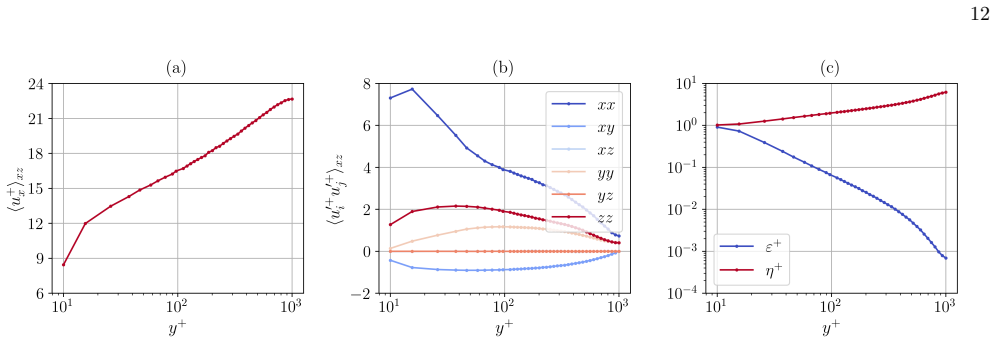
Height dependence of velocity fluctuation statistics We proceed similarly to the HSF case. The accelera- tion statistics will be inferred from the velocity fluctua- tion statistics as discussed in subsection III.A. Complex- ity is, however, significantly increased by the dependence of the turbulent fluctuations from the distance to the wall. Figure 6 show...
-
[8]
The definitions (40) 14 FIG
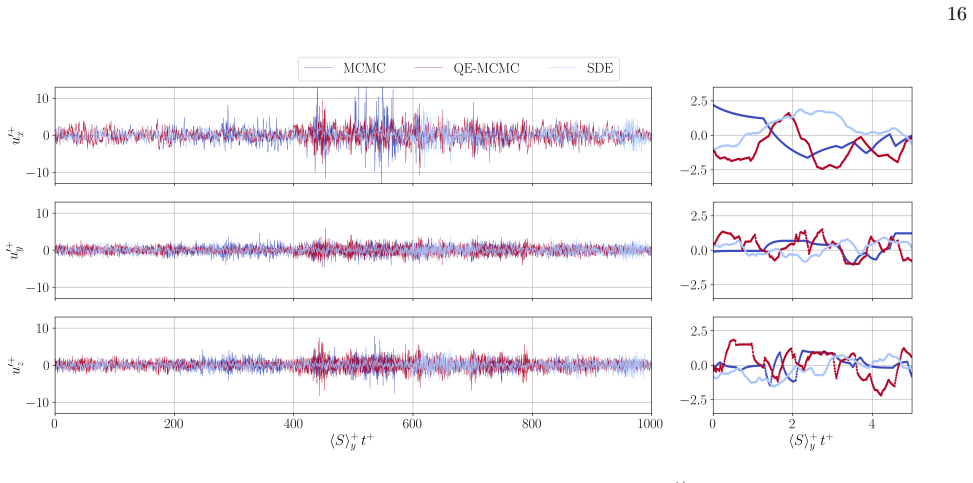
Lagrangian particle pair dispersion Similarly to subsection III.A.2, we analyze the La- grangian particle pair dispersion. The definitions (40) 14 FIG. 8. Temporal evolution of two Lagrangian particles within a tracer pair over 10 5 steps which were generated by the QE-MCMC algorithm. They were initialized atX +(0) = [0,500, L + z /2]T and ˜X+(0) = [0,500...
-
[9]
Optimal parameters of the MCMC and QE-MCMC method For the turbulent channel flow case, we employ the same calibration strategies as in the HSF benchmark to determine the sampling parameters of both MCMC and QE-MCMC. Due to the height-dependent flow statistics, the classical MCMC proposal scales must be adapted lo- cally iny +, i.e.σ 12,prop =σ 12,prop(y+)...
2048
-
[10]
Spectral gap analysis Due to the wall-normal inhomogeneity of the turbu- lent channel flow, the acceleration statistics and thus the Markov transition mechanism depend on the instanta- neous wall distance. Consequently, we consider a height- conditioned transition probability Π(y +) and define the local spectral gap asδ y(y+) = 1− |λ 2(Π(y+))|, where λ2 d...
-
[11]
Nevertheless, it is interesting to take a closer look at this free parameter in the present case, which does not stand for a real temperature as in the original canonical equilibrium ensemble in applications in condensed matter physics (cf. Eq. (2)). The role ofTcan be understood from two complementary perspectives. From an algorithmic point of view, the ...
-
[12]
Table I summarizes the run- times of the SDE, classical MCMC, and QE-MCMC al- gorithms for both caes, HSF and TCF flow
Runtime comparison To further assess the practical relevance of the pro- posed approach, we compare their computational cost in terms of wall-clock time. Table I summarizes the run- times of the SDE, classical MCMC, and QE-MCMC al- gorithms for both caes, HSF and TCF flow. The results show that, on current classical hardware, the QE-MCMC algorithm is comp...
-
[13]
C. M. Bishop,Pattern recognition and machine learning (Springer, New York, 2006)
2006
-
[14]
Metropolis, A
N. Metropolis, A. W. Rosenbluth, M. N. Rosenbluth, A. H. Teller, and E. Teller, Equation of state calcula- tions by fast computing machines, J. Chem. Phys.21, 1087 (1953)
1953
-
[15]
W. K. Hastings, Monte Carlo sampling methods using Markov chains and their applications, Biometrika57, 97 (1970)
1970
-
[16]
J. A. Vrugt, C. J. F. ter Braak, C. G. H. Diks, and G. Schoups, Hydrologic data assimilation using particle Markov chain Monte Carlo simulation: Theory, concepts and applications, Adv. Water Resour.51, 457 (2013)
2013
-
[17]
Zuccarello, G
F. Zuccarello, G. Bilotta, F. Cannav` o, A. Cappello, R. Guardo, and G. Ganci, A Markov Chain Monte Carlo approach for complex lava flow simulations driven by satellite-derived data, Environ. Model. Softw.188, 106426 (2025)
2025
-
[18]
Cerezo, A
M. Cerezo, A. Arrasmith, R. Babbush, S. C. Benjamin, S. Endo, K. Fujii, J. R. McClean, K. Mitarai, X. Yuan, L. Cincio, and P. J. Coles, Variational quantum algo- rithms, Nat. Rev. Phys.3, 625 (2021)
2021
-
[19]
T. L. Patti, O. Shehab, K. Najafi, and S. F. Yelin, Markov chain Monte Carlo enhanced variational quantum algo- rithms, Quantum Sci. Technol.8, 015019 (2023)
2023
-
[20]
Graham, K
J. Graham, K. Kanov, X. I. A. Yang, M. K. Lee, N. Malaya, C. C. Lalescu, R. Burns, G. Eyink, A. Szalay, R. D. Moser, and C. Meneveau, A Web Services - acces- sible database of turbulent channel flow and its use for testing a new integral wall model for LES, J. Turb.17, 181 (2016)
2016
-
[21]
Nielsen and I
M. Nielsen and I. Chuang,Quantum Computation and Quantum Information: 10th Anniversary Edition(Cam- bridge University Press, 2011). 21
2011
-
[22]
Arute, K
F. Arute, K. Arya, and R. Babbush et al., Quantum supremacy using a programmable superconducting pro- cessor, Nature574, 505 (2019)
2019
-
[23]
D. S. Wild, D. Sels, H. Pichler, C. Zanoci, and M. D. Lukin, Quantum sampling algorithms for near-term de- vices, Phys. Rev. Lett.127, 100504 (2021)
2021
-
[24]
Layden, G
D. Layden, G. Mazzola, R. V. Mishmash, M. Motta, P. Wocjan, J.-S. Kim, and S. Sheldon, Quantum- enhanced Markov-chain Monte Carlo, Nature619, 282 (2023)
2023
-
[25]
D. A. Levin and Y. Peres,Markov chains and mixing times: Second edition(American Mathematical Society, Providence, RI, 2017)
2017
-
[26]
Nakano, H
Y. Nakano, H. Hakoshima, K. Mitarai, and K. Fujii, Markov-chain Monte Carlo method enhanced by a quan- tum alternating operator ansatz, Phys. Rev. Res.6, 033105 (2024)
2024
-
[27]
Orfi and D
A. Orfi and D. Sels, Bounding speedup of quantum- enhanced Markov chain Monte Carlo, Phys. Rev. A110, 052414 (2024)
2024
-
[28]
Nakano, K
Y. Nakano, K. N. Okada, and K. Fujii, Neural-network- assisted Monte Carlo sampling trained by quantum ap- proximate optimization algorithm, PRX Quantum7, 010338 (2026)
2026
-
[29]
Ferguson and P
S. Ferguson and P. Wallden, Quantum-enhanced Markov chain Monte Carlo for systems larger than a quantum computer, Phys. Rev. Res.7, 013231 (2025)
2025
-
[30]
Ingelmann, F
J. Ingelmann, F. Schindler, and J. Schumacher, Quantum-assisted Lagrangian tracer dispersion in tur- bulent shear flow, Phys. Fluids37, 085251 (2025)
2025
-
[31]
J. Kim, P. Moin, and R. D. Moser, Turbulence statistics in fully developed channel flow at low Reynolds number, J. Fluid Mech.177, 133 (1987)
1987
-
[32]
P. K. Yeung, Lagrangian investigations of turbulence, Annu. Rev. Fluid Mech.34, 115 (2002)
2002
-
[33]
Toschi and E
F. Toschi and E. Bodenschatz, Lagrangian properties of particles in turbulence, Annu. Rev. Fluid Mech.41, 375 (2009)
2009
-
[34]
K. R. Sreenivasan and J. Schumacher, Lagrangian views on turbulent mixing of passive scalars, Phil. Trans. R. Soc. A368, 1561 (2010)
2010
-
[35]
I. M. Mazzitelli, F. Fornarelli, A. S. Lanotte, and P. Oresta, Pair and multi-particle dispersion in numeri- cal simulations of convective boundary layer turbulence, Phys. Fluids26, 055110 (2014)
2014
-
[36]
I. M. Mazzitelli, F. Toschi, and A. S. Lanotte, An accu- rate and efficient Lagrangian sub-grid model, Phys. Flu- ids26, 095101 (2014)
2014
-
[37]
B. L. Sawford, Reynolds number effects in Lagrangian stochastic models of turbulent dispersion, Phys. Fluids A3, 1577 (1991)
1991
-
[38]
Viggiano, J
B. Viggiano, J. Friedrich, R. Volk, M. Bourgoin, R. Bayo` an Cal, and L. Chevillard, Modelling Lagrangian velocity and acceleration in turbulent flows as infinitely differentiable stochastic processes, J. Fluid Mech.900, A27 (2020)
2020
-
[39]
F. T. M. Nieuwstadt, A large-eddy simulation of a line source in a convective atmospheric boundary layer – I. Dispersion characteristics, Atmos. Environ.26A, 485 (1992)
1992
-
[40]
Dosio and J
A. Dosio and J. Vil` a-Guerau de Arrelano, Statistics of absolute and relative dispersion in the atmospheric con- vective boundary layer: A large-eddy simulation study, J. Atmos. Sci.63, 1253 (2006)
2006
-
[41]
A. F. Stein, R. R. Draxler, G. D. Rolph, B. J. B. Stunder, M. D. Cohen, and F. Ngan, NOAA’s HYSPLIT atmo- spheric transport and dispersion modeling system, Bull. Am. Meteor. Soc.96, 2059 (2015)
2059
-
[42]
Hoffmann, G
L. Hoffmann, G. G¨ unther, D. Li, O. Stein, X. Wu, S. Griessbach, Y. Heng, P. Konopka, R. M¨ uller, B. Vogel, and J. S. Wright, From ERA-Interim to ERA5: the con- siderable impact of ECMWF’s next-generation reanaly- sis on Lagrangian transport simulations, Atmos. Chem. Phys.19, 3097 (2019)
2019
-
[43]
Hoffmann, T
L. Hoffmann, T. R¨ oßler, S. Griessbach, Y. Heng, and O. Stein, Lagrangian transport simulations of volcanic sulfur dioxide emissions: Impact of meteorological data products, J. Geophys. Res. Atmos.121, 4651 (2016)
2016
-
[44]
Lubasch, J
M. Lubasch, J. Joo, P. Moinier, M. Kiffner, and D. Jaksch, Variational quantum algorithms for nonlinear problems, Phys. Rev. A101, 010301 (2020)
2020
-
[45]
B. N. Todorova and R. de Steijl, Quantum algorithm for the collisionless Boltzmann equation, J. Comp. Phys. 409, 109347 (2020)
2020
-
[46]
Gaitan, Finding flows in a Navier-Stokes fluid through quantum computing, npj Quantum Inf.6, 61 (2021)
F. Gaitan, Finding flows in a Navier-Stokes fluid through quantum computing, npj Quantum Inf.6, 61 (2021)
2021
-
[47]
Budinski, Quantum algorithm for the advec- tion–diffusion equation simulated with the Lattice Boltz- mann method, Quantum Inf
L. Budinski, Quantum algorithm for the advec- tion–diffusion equation simulated with the Lattice Boltz- mann method, Quantum Inf. Process.20, 57 (2021)
2021
-
[48]
Pfeffer, F
P. Pfeffer, F. Heyder, and J. Schumacher, Hybrid quantum-classical reservoir computing of thermal con- vection flow, Phys. Rev. Res.4, 033176 (2022)
2022
-
[49]
Pfeffer, F
P. Pfeffer, F. Heyder, and J. Schumacher, Reduced-order modeling of two-dimensional turbulent Rayleigh-B´ enard flow by hybrid quantum-classical reservoir computing, Phys. Rev. Res.5, 043242 (2023)
2023
-
[50]
S. S. Bharadwaj and K. R. Sreenivasan, Hybrid quantum algorithms for flow problems, Proc. Natl. Acad. Sci. USA 120, e2311014120 (2023)
2023
-
[51]
Jaksch, P
D. Jaksch, P. Givi, A. J. Daley, and T. Rung, Variational quantum algorithms for computational fluid dynamics, AIAA J.61, 1885 (2023)
2023
-
[52]
Meng and Y
Z. Meng and Y. Yang, Quantum computing of fluid dy- namics using the hydrodynamic Schr¨ odinger equation, Phys. Rev. Res.5, 033182 (2023)
2023
-
[53]
Ingelmann, S
J. Ingelmann, S. S. Bharadwaj, P. Pfeffer, K. R. Sreeni- vasan, and J. Schumacher, Two quantum algorithms for solving the one-dimensional advection–diffusion equa- tion, Comput. Fluids281, 106369 (2024)
2024
-
[54]
Ahmed, F
O. Ahmed, F. Tennie, and L. Magri, Prediction of chaotic dynamics and extreme events: A recurrence-free quan- tum reservoir computing approach, Phys. Rev. Res.6, 043082 (2024)
2024
-
[55]
A. J. Pool, A. D. Somoza, C. Mc Keever, M. Lubasch, and B. Horstmann, Nonlinear dynamics as a ground-state so- lution on quantum computers, Phys. Rev. Res.6, 033257 (2024)
2024
-
[56]
Brearley and S
P. Brearley and S. Laizet, Quantum algorithm for solv- ing the advection equation using Hamiltonian simulation, Phys. Rev. A110, 012430 (2024)
2024
-
[57]
Z. Meng, J. Zhong, S. Xu et al., Simulating unsteady flows on a superconducting quantum processor, Com- mun. Phys.7, 349 (2024)
2024
-
[58]
K¨ ocher, H
N. K¨ ocher, H. Rose, S. S. Bharadwaj, J. Schumacher, and S. Schumacher, Numerical solution of nonlin- ear Schr¨ odinger equation by a hybrid pseudospectral- variational quantum algorithm, Sci. Rep.15, 23478 (2025). 22
2025
-
[59]
S. S. Bharadwaj and K. R. Sreenivasan, Compact quan- tum algorithms for time-dependent differential equations, Phys. Rev. Res.7, 023262 (2025)
2025
-
[60]
P. Over, S. Bengoechea, T. Rung, F. C. L. Scandurra, E. de Villiers, and D. Jaksch, Boundary treatment for variational quantum simulations of partial differential equations on quantum computers, Comput. Fluids288, 106508 (2025)
2025
-
[61]
Pfeffer, P
P. Pfeffer, P. Brearley, S. Laizet, and J. Schumacher, Spectral quantum algorithm for passive scalar transport in shear flows, Sci. Rep.15, 41172 (2025)
2025
-
[62]
S. S. Bharadwaj and K. R. Sreenivasan, Quantum com- putation of fluid dynamics, Indian Academy of Sciences Conference Series3, 77 (2020)
2020
-
[63]
Succi, W
S. Succi, W. Itani, K. R. Sreenivasan, and R. Steijl, Quantum computing for fluids: Where do we stand?, Eu- rophys. Lett.144, 10001 (2023)
2023
-
[64]
Tennie, S
F. Tennie, S. Laizet, S. Lloyd, and L. Magri, Quantum computing for nonlinear differential equations and tur- bulence, Nat. Rev. Phys.7, 1 (2025)
2025
-
[65]
Shen and P
P. Shen and P. K. Yeung, Fluid particle dispersion in homogeneous turbulent shear flow, Phys. Fluids9, 3472 (1997)
1997
-
[66]
S. B. Pope, Stochastic Lagrangian models of velocity in homogeneous turbulent shear flow, Phys. Fluids14, 1696 (2002)
2002
-
[67]
Schumacher and B
J. Schumacher and B. Eckhardt, Derivative moments in stationary homogeneous shear turbulence, J. Fluid Mech. 441, 109 (2001)
2001
-
[68]
Schumacher, Relation between shear parameter and Reynolds number in statistically stationary turbulent shear flows, Phys
J. Schumacher, Relation between shear parameter and Reynolds number in statistically stationary turbulent shear flows, Phys. Fluids16, 3094 (2004)
2004
-
[69]
S. B. Pope,Turbulent Flows(Cambridge University Press, Cambridge, UK, 2000)
2000
-
[70]
J. I. Polanco, I. Vinkovic, N. Stelzenmuller, N. Mordant, and M. Bourgoin, Relative dispersion of particle pairs in turbulent channel flow, Int. J. Heat Fluid Flow71, 231 (2018)
2018
-
[71]
Y. Li, E. Perlman, M. Wan, Y. Yang, C. Meneveau, R. Burns, S. Chen, A. Szalay, and G. Eyink, A public turbulence database cluster and applications to study La- grangian evolution of velocity increments in turbulence, J. Turb.9, N31 (2008)
2008
-
[72]
Schumacher and B
J. Schumacher and B. Eckhardt, On statistically station- ary homogeneous shear turbulence, Europhys. Lett.52, 627 (2000)
2000
-
[73]
Gualtieri, C
P. Gualtieri, C. M. Casciola, R. Benzi, G. Amati, and R. Piva, Scaling laws and intermittency in homogeneous shear flow, Phys. Fluids14, 583 (2002)
2002
-
[74]
S. C. C. Bailey and A. J. Smits, Experimental investi- gation of the structure of large- and very-large-scale mo- tions in turbulent pipe flow, J. Fluid Mech.651, 339 (2010)
2010
-
[75]
A. J. Smits and I. Marusic, Wall-bounded turbulence, Phys. Today66, 25 (2013)
2013
-
[76]
D. J. Higham and P. E. Kloeden,An Introduction to the Numerical Simulation of Stochastic Differential Equa- tions(SIAM, Philadelphia, 2021)
2021
-
[77]
A. M. Obukhov, Distribution of energy in the spectrum of turbulent flow, Izv. Akad. Nauk Ser. Geogr. i Geophys. 4-5(1941)
1941
-
[78]
Boffetta and I
G. Boffetta and I. M. Sokolov, Statistics of two-particle dispersion in two-dimensional turbulence, Phys. Fluids 14, 3224 (2002)
2002
-
[79]
Birnir and L
B. Birnir and L. Angheluta, Scaling of Lagrangian struc- ture functions, Phys. Rev. Res.7, 023225 (2025)
2025
-
[80]
Schumacher, Lagrangian dispersion and heat transport in convective turbulence, Phys
J. Schumacher, Lagrangian dispersion and heat transport in convective turbulence, Phys. Rev. Lett.100, 134502 (2008)
2008
discussion (0)
Sign in with ORCID, Apple, or X to comment. Anyone can read and Pith papers without signing in.