Attention-Based Prototype Calibration for Multi-Rater Few-Shot Medical Image Segmentation
Pith reviewed 2026-06-27 03:43 UTC · model grok-4.3
The pith
An attention operator calibrates rater prototypes to model annotation variability in few-shot medical segmentation.
A machine-rendered reading of the paper's core claim, the machinery that carries it, and where it could break.
Core claim
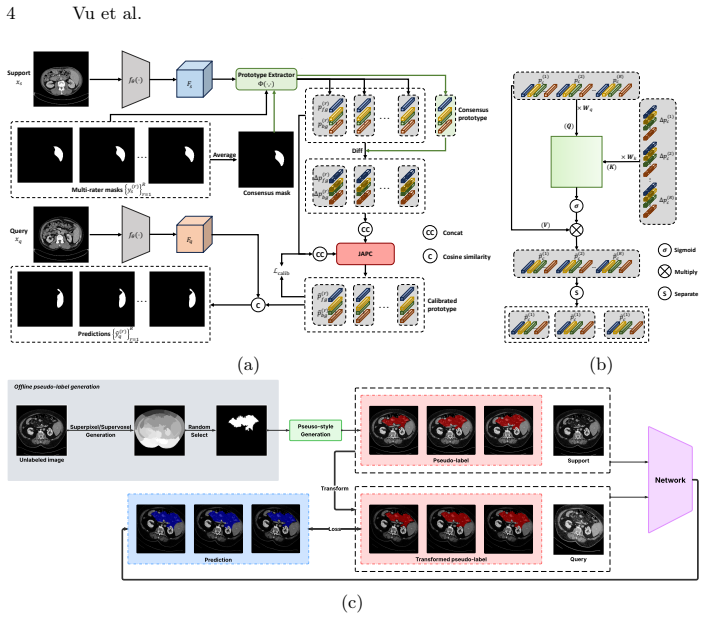
The central claim is that an attention-based prototype calibration framework models rater-specific deviations from a consensus representation in prototype space. A lightweight attention operator directly refines rater prototypes without modifying the backbone feature extractor. This design preserves semantic consistency while enabling personalized segmentation outputs with minimal computational overhead.
What carries the argument
lightweight attention operator that refines rater prototypes directly in prototype space
If this is right
- Existing prototype-based few-shot segmentation methods become compatible with multi-rater data through direct prototype refinement.
- Personalized segmentation maps can be produced for individual raters at low extra cost.
- Semantic consistency of the original feature representations remains unchanged.
- Annotation variability is captured as structured deviations within prototype space rather than in the feature extractor.
Where Pith is reading between the lines
- Prototype space offers a modular place to insert rater-specific adjustments that avoids retraining entire networks.
- The same calibration pattern could apply to other few-shot tasks where multiple human labels exist for the same input.
- If the operator succeeds, it suggests that inter-rater disagreement is better expressed as shifts among prototypes than as changes to shared features.
Load-bearing premise
A lightweight attention operator can directly refine rater prototypes without modifying the backbone feature extractor while preserving semantic consistency and enabling personalized outputs.
What would settle it
Running the calibrated prototypes on a multi-rater medical dataset and finding segmentation accuracy equal to or lower than uncalibrated prototype baselines would falsify the claim of effective variability modeling.
Figures
read the original abstract
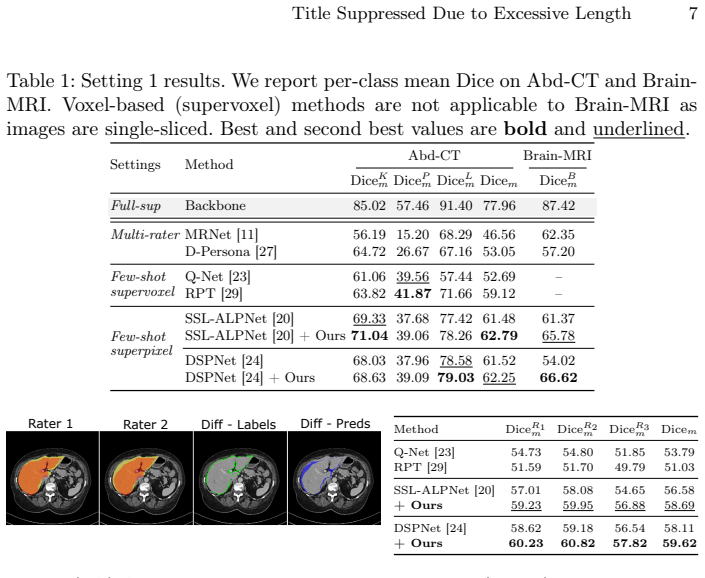
Few-shot medical image segmentation methods typically assume a single ground-truth annotation, overlooking systematic variability across expert raters commonly observed in clinical datasets. We propose an attention-based prototype calibration framework for few-shot multi-rater segmentation that models rater-specific deviations from a consensus representation in prototype space. A lightweight yet principled attention operator directly refines rater prototypes without modifying the backbone feature extractor, making the approach fully compatible with existing prototype-based few-shot segmentation methods. This design preserves semantic consistency while enabling personalized segmentation outputs with minimal computational overhead. Experiments on multi-rater medical imaging datasets demonstrate consistent improvements over baseline prototype approaches, highlighting the effectiveness of structured prototype calibration for modeling annotation variability.
Editorial analysis
A structured set of objections, weighed in public.
Referee Report
Summary. The paper proposes an attention-based prototype calibration framework for few-shot multi-rater medical image segmentation. It models rater-specific deviations from a consensus representation in prototype space using a lightweight attention operator that directly refines rater prototypes without modifying the backbone feature extractor. This design is claimed to be fully compatible with existing prototype-based few-shot segmentation methods, preserve semantic consistency, and enable personalized outputs with minimal overhead. Experiments on multi-rater medical imaging datasets are said to demonstrate consistent improvements over baseline prototype approaches.
Significance. If the experimental claims hold, the work addresses a practically relevant gap in few-shot medical segmentation by explicitly handling inter-rater variability, which is common in clinical data. The modular attention operator on prototypes (rather than the backbone) is a potentially useful design choice that could allow easy adoption of the method. The emphasis on minimal computational overhead and compatibility with prior prototype methods is a positive aspect if supported by results.
major comments (1)
- [Abstract] Abstract: the claim that experiments 'demonstrate consistent improvements over baseline prototype approaches' is presented without any quantitative results, metrics, error bars, dataset details, number of raters, or baseline descriptions. This is load-bearing for the central claim and prevents evaluation of whether the evidence supports the asserted effectiveness of the attention-based calibration.
Simulated Author's Rebuttal
We thank the referee for the detailed review and constructive comment on the abstract. We address the point below.
read point-by-point responses
-
Referee: [Abstract] Abstract: the claim that experiments 'demonstrate consistent improvements over baseline prototype approaches' is presented without any quantitative results, metrics, error bars, dataset details, number of raters, or baseline descriptions. This is load-bearing for the central claim and prevents evaluation of whether the evidence supports the asserted effectiveness of the attention-based calibration.
Authors: We agree that the abstract, in its current form, states the experimental outcome at a high level without supporting quantitative details. While the full manuscript (Sections 4 and 5) provides the requested information—including specific datasets, number of raters, baseline methods, Dice/IoU metrics with standard deviations, and comparisons—the abstract itself does not. To strengthen the central claim and improve evaluability, we will revise the abstract to incorporate concise quantitative highlights (e.g., average performance gains and key experimental settings) without exceeding typical length constraints. revision: yes
Circularity Check
No significant circularity detected
full rationale
The paper introduces an attention-based prototype calibration module for modeling rater variability in few-shot medical segmentation. This is presented as a modular architectural addition that operates on existing prototype representations without altering the backbone. The abstract and description contain no equations or steps that define a quantity in terms of itself, rename a fitted parameter as a prediction, or rely on self-citations for uniqueness or ansatz justification. The central claim is supported by reported experimental improvements over baselines, which constitute independent empirical content rather than a reduction to the method's own inputs. No load-bearing self-referential elements are present.
Axiom & Free-Parameter Ledger
axioms (1)
- domain assumption Rater annotations exhibit systematic deviations from a consensus that can be modeled in prototype space
invented entities (1)
-
lightweight attention operator for prototype calibration
no independent evidence
Reference graph
Works this paper leans on
-
[1]
The Lung Image Database Consortium (LIDC) and Image Database Resource Initiative (IDRI).Med Phys
Armato, S.G.I.e.a.: The Lung Image Database Consortium (LIDC) and Image Database Resource Initiative (IDRI): A Completed Reference Database of Lung Nodules on CT Scans. Medical Physics38(2), 915–931 (February 2011).https: //doi.org/10.1118/1.3528204
-
[2]
IEEE Transactions on Pattern Analysis and Machine Intelligence46(12), 10076–10095 (2024)
Azad,R.,Aghdam,E.K.,Rauland,A.,Jia,Y.,Avval,A.H.,Bozorgpour,A.,Karim- ijafarbigloo, S., Cohen, J.P., Adeli, E., Merhof, D.: Medical image segmentation review: The success of u-net. IEEE Transactions on Pattern Analysis and Machine Intelligence46(12), 10076–10095 (2024)
2024
-
[3]
Scientific Reports15(1), 29908 (2025)
Banerjee, T., Singh, D.P., Kour, P., Swain, D., Mahajan, S., Kadry, S., Kim, J.: A novel unified Inception-U-Net hybrid gravitational optimization model (UIGO) incorporatingautomatedmedicalimagesegmentationandfeatureselectionforliver tumor detection. Scientific Reports15(1), 29908 (2025)
2025
-
[4]
In: International conference on medical image computing and computer-assisted intervention
Baumgartner, C.F., Tezcan, K.C., Chaitanya, K., Hötker, A.M., Muehlematter, U.J., Schawkat, K., Becker, A.S., Donati, O., Konukoglu, E.: Phiseg: Capturing uncertainty in medical image segmentation. In: International conference on medical image computing and computer-assisted intervention. pp. 119–127. Springer (2019)
2019
-
[5]
arXiv preprint arXiv:1706.05587 (2017)
Chen, L.C., Papandreou, G., Schroff, F., Adam, H.: Rethinking atrous convolution for semantic image segmentation. arXiv preprint arXiv:1706.05587 (2017)
Pith/arXiv arXiv 2017
-
[6]
IEEE Transactions on Medical Imaging43(6), 2202–2214 (2024).https://doi.org/10
Cheng, Z., Wang, S., Xin, T., Zhou, T., Zhang, H., Shao, L.: Few-Shot Medical Image Segmentation via Generating Multiple Representative Descriptors. IEEE Transactions on Medical Imaging43(6), 2202–2214 (2024).https://doi.org/10. 1109/TMI.2024.3358295
arXiv 2024
-
[7]
IEEE Transactions on Radiation and Plasma Medical Sciences7(6), 545–569 (2023)
Conze, P.H., Andrade-Miranda, G., Singh, V.K., Jaouen, V., Visvikis, D.: Current and emerging trends in medical image segmentation with deep learning. IEEE Transactions on Radiation and Plasma Medical Sciences7(6), 545–569 (2023)
2023
-
[8]
In: Proceedings of the IEEE/CVF Winter Conference on Applications of Computer Vision (WACV)
Ding, H., Sun, C., Tang, H., Cai, D., Yan, Y.: Few-Shot Medical Image Segmenta- tion With Cycle-Resemblance Attention. In: Proceedings of the IEEE/CVF Winter Conference on Applications of Computer Vision (WACV). pp. 2488–2497 (January 2023)
2023
-
[9]
International Journal of Computer Vision59, 167–181 (09 2004).https://doi
Felzenszwalb, P., Huttenlocher, D.: Efficient Graph-Based Image Segmentation. International Journal of Computer Vision59, 167–181 (09 2004).https://doi. org/10.1023/B:VISI.0000022288.19776.77
-
[10]
Medical Image Analysis78, 102385 (2022)
Hansen, S., Gautam, S., Jenssen, R., Kampffmeyer, M.: Anomaly detection- inspired few-shot medical image segmentation through self-supervision with su- pervoxels. Medical Image Analysis78, 102385 (2022)
2022
-
[11]
In: Proceedings of the IEEE/CVF Conference on Computer Vision and Pattern Recognition (CVPR)
Ji, W., Yu, S., Wu, J., Ma, K., Bian, C., Bi, Q., Li, J., Liu, H., Cheng, L., Zheng, Y.: Learning Calibrated Medical Image Segmentation via Multi-Rater Agreement Modeling. In: Proceedings of the IEEE/CVF Conference on Computer Vision and Pattern Recognition (CVPR). pp. 12341–12351 (June 2021)
2021
-
[12]
In: Proceedings of the Thirty-Fourth International Joint Conference on Artificial Intelligence
Jiang, J., Zhang, H.: Concentrate on weakness: mining hard prototypes for few-shot medical image segmentation. In: Proceedings of the Thirty-Fourth International Joint Conference on Artificial Intelligence. IJCAI ’25 (2025).https://doi.org/ 10.24963/ijcai.2025/139
-
[13]
In: International Conference on Medical Image Comput- ing and Computer-Assisted Intervention
Kim, H., Hansen, S., Kampffmeyer, M.: Tied Prototype Model for Few-Shot Med- ical Image Segmentation. In: International Conference on Medical Image Comput- ing and Computer-Assisted Intervention. pp. 651–661. Springer (2025)
2025
-
[14]
segmentation of ambiguous images
Kohl, S., Romera-Paredes, B., Meyer, C., De Fauw, J., Ledsam, J.R., Maier-Hein, K., Eslami, S., Jimenez Rezende, D., Ronneberger, O.: A probabilistic u-net for 10 Vu et al. segmentation of ambiguous images. Advances in neural information processing sys- tems31(2018)
2018
-
[15]
Computers and Electrical Engineering123, 110099 (2025)
Kumar, S.: Advancements in medical image segmentation: A review of transformer models. Computers and Electrical Engineering123, 110099 (2025)
2025
-
[16]
arXiv preprint arXiv:2405.18435 (2024)
Li, H.B., Navarro, F., Ezhov, I., Bayat, A., Das, D., Kofler, F., Shit, S., Wald- mannstetter, D., Paetzold, J.C., Hu, X., et al.: QUBIQ: Uncertainty quantifica- tion for biomedical image segmentation challenge. arXiv preprint arXiv:2405.18435 (2024)
arXiv 2024
-
[17]
Medical Image Analysis92, 103028 (2024)
Liao, Z., Hu, S., Xie, Y., Xia, Y.: Modeling annotator preference and stochastic an- notation error for medical image segmentation. Medical Image Analysis92, 103028 (2024)
2024
-
[18]
In: International Conference on Medical Image Computing and Computer-Assisted Intervention
Lin, Y., Chen, Y., Cheng, K.T., Chen, H.: Few shot medical image segmentation with cross attention transformer. In: International Conference on Medical Image Computing and Computer-Assisted Intervention. pp. 233–243. Springer (2023)
2023
-
[19]
Pattern Recog- nition Letters191, 58–65 (2025)
Liu, Q., Liu, M., Zhu, Y., Liu, L., Zhang, Z., Wang, Y.: DAUNet: A deformable aggregation UNet for multi-organ 3D medical image segmentation. Pattern Recog- nition Letters191, 58–65 (2025)
2025
-
[20]
ResViT: residual vision transformers for multimodal medical image synthesis
Ouyang, C., Biffi, C., Chen, C., Kart, T., Qiu, H., Rueckert, D.: Self-Supervised Learning for Few-Shot Medical Image Segmentation. IEEE Transactions on Medical Imaging41(7), 1837–1848 (2022).https://doi.org/10.1109/TMI.2022. 3150682
-
[21]
Riera-Marín, M., Kleiß, J.M., Aubanell, A., Antolín, A.: CURVAS dataset (Sep 2024).https://doi.org/10.5281/zenodo.13767408,https://doi.org/10.5281/ zenodo.13767408
-
[22]
Medical image analysis 59, 101587 (2020)
Roy, A.G., Siddiqui, S., Pölsterl, S., Navab, N., Wachinger, C.: ‘Squeeze & ex- cite’guided few-shot segmentation of volumetric images. Medical image analysis 59, 101587 (2020)
2020
-
[23]
In: Proceedings of SAI Intelligent Systems Conference
Shen, Q., Li, Y., Jin, J., Liu, B.: Q-net: Query-informed few-shot medical image segmentation. In: Proceedings of SAI Intelligent Systems Conference. pp. 610–628. Springer (2023)
2023
-
[24]
Medical Image Analysis100, 103412 (2025)
Tang, S., Yan, S., Qi, X., Gao, J., Ye, M., Zhang, J., Zhu, X.: Few-shot medical image segmentation with high-fidelity prototypes. Medical Image Analysis100, 103412 (2025)
2025
-
[25]
In: proceedings of the IEEE/CVF inter- national conference on computer vision
Wang, K., Liew, J.H., Zou, Y., Zhou, D., Feng, J.: Panet: Few-shot image semantic segmentation with prototype alignment. In: proceedings of the IEEE/CVF inter- national conference on computer vision. pp. 9197–9206 (2019)
2019
-
[26]
IEEE Transactions on Medical Imaging23, 903–921 (2004)
Warfield, S., Zou, K.H., Wells, W.M.: Simultaneous truth and performance level es- timation (STAPLE): an algorithm for the validation of image segmentation. IEEE Transactions on Medical Imaging23, 903–921 (2004)
2004
-
[27]
In: Proceedings of the IEEE/CVF Conference on Computer Vision and Pattern Recognition (CVPR)
Wu, Y., Luo, X., Xu, Z., Guo, X., Ju, L., Ge, Z., Liao, W., Cai, J.: Diversified and Personalized Multi-rater Medical Image Segmentation. In: Proceedings of the IEEE/CVF Conference on Computer Vision and Pattern Recognition (CVPR). pp. 11470–11479 (June 2024)
2024
-
[28]
Neurocomputing613, 128740 (2025)
Xia, Q., Zheng, H., Zou, H., Luo, D., Tang, H., Li, L., Jiang, B.: A comprehensive review of deep learning for medical image segmentation. Neurocomputing613, 128740 (2025)
2025
-
[29]
In: International conference on medical image computing and computer-assisted intervention
Zhu, Y., Wang, S., Xin, T., Zhang, H.: Few-shot medical image segmentation via a region-enhanced prototypical transformer. In: International conference on medical image computing and computer-assisted intervention. pp. 271–280. Springer (2023)
2023
discussion (0)
Sign in with ORCID, Apple, or X to comment. Anyone can read and Pith papers without signing in.