Quantum Enchanced Multi-Scale CNN with Bi-directional Mamba for Crop Field Analysis
Pith reviewed 2026-06-27 04:01 UTC · model grok-4.3
The pith
A BiSpectral Mamba framework combines multi-scale CNN, spectral attention, bidirectional state-space modeling, and quantum-inspired learning to classify hyperspectral crop images at 84.83 percent accuracy.
A machine-rendered reading of the paper's core claim, the machinery that carries it, and where it could break.
Core claim
The central claim is that a BiSpectral Mamba-based framework, formed by fusing multi-scale convolutional feature extraction, spectral attention, bidirectional state-space modeling of hyperspectral tokens, and quantum-inspired learning, together with class-weighted optimization, enables effective spatial-spectral feature learning and achieves 84.83 percent overall accuracy on the UAVHSI-Crop dataset for crop classification.
What carries the argument
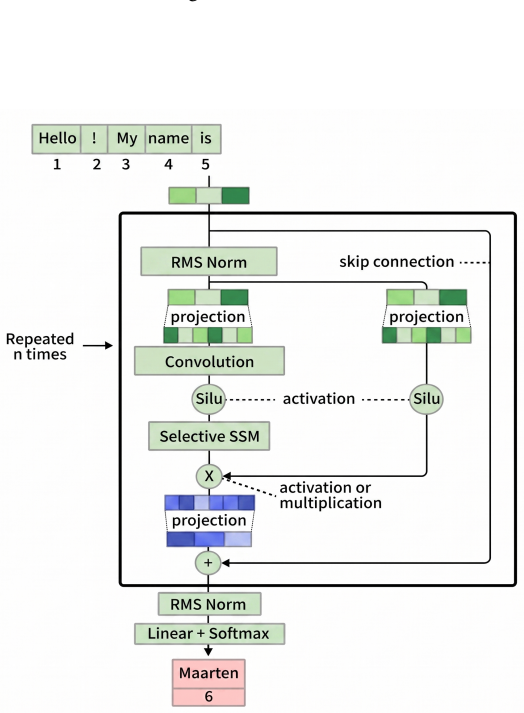
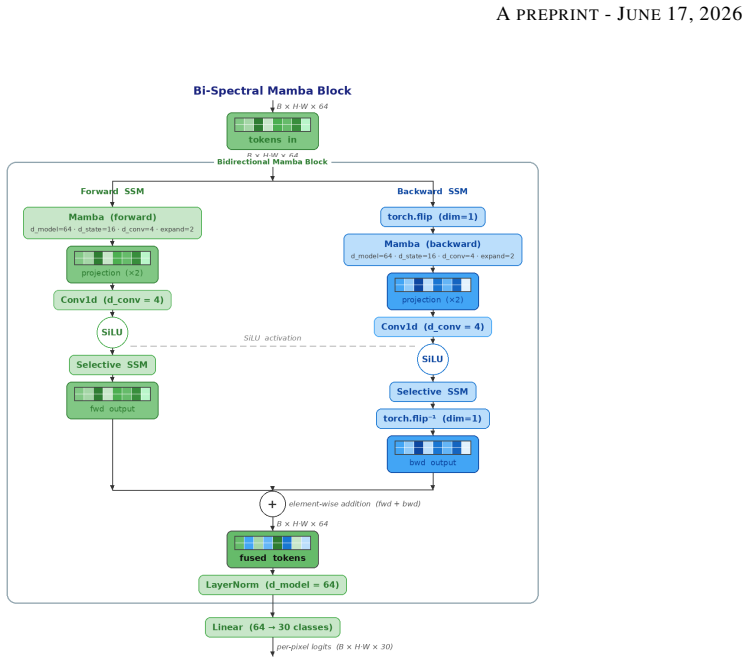
The BiSpectral Mamba module, which models hyperspectral feature maps as sequential tokens and processes them in both forward and backward directions to capture long-range dependencies.
If this is right
- The framework supports accurate crop classification from UAV hyperspectral data despite limited labels and imbalance.
- The same architecture can extend to related tasks including crop disease detection, yield prediction, and soil moisture estimation.
- Structured state-space models combined with convolutional and attention elements can serve as a general pattern for hyperspectral remote sensing analysis.
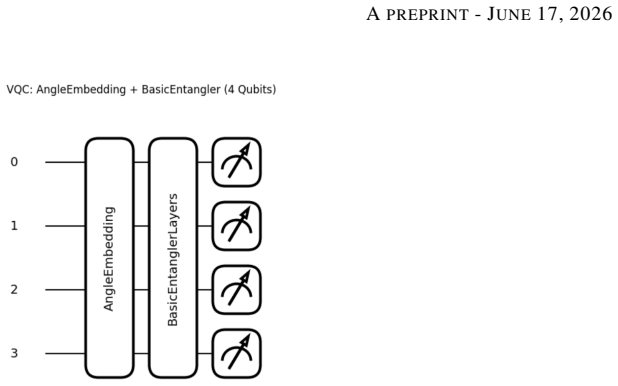
- Quantum-inspired learning adds a mechanism that may stabilize training on high-dimensional spectral inputs.
Where Pith is reading between the lines
- The bidirectional token modeling may transfer to other sequential high-dimensional data such as video or time-series imagery beyond agriculture.
- If the quantum-inspired component proves additive in further tests, it could motivate similar hybrids in other state-space architectures.
- Wider deployment would require checking performance on datasets with different sensor characteristics or crop types.
Load-bearing premise
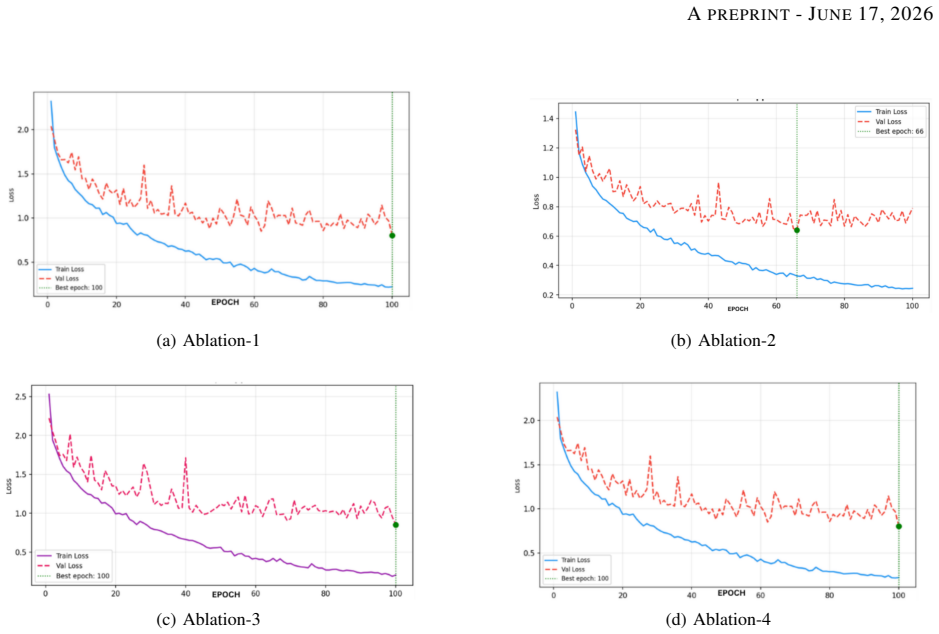
That fusing multi-scale CNN, spectral attention, bidirectional Mamba, and quantum-inspired components will reliably overcome high spectral dimensionality, spatial complexity, and class imbalance without detailed ablation or validation evidence supplied.
What would settle it
A controlled comparison on the UAVHSI-Crop dataset in which a standard multi-scale CNN or attention-only baseline reaches or exceeds 84.83 percent accuracy, or an ablation that removes the bidirectional Mamba component and shows no accuracy drop.
Figures
read the original abstract
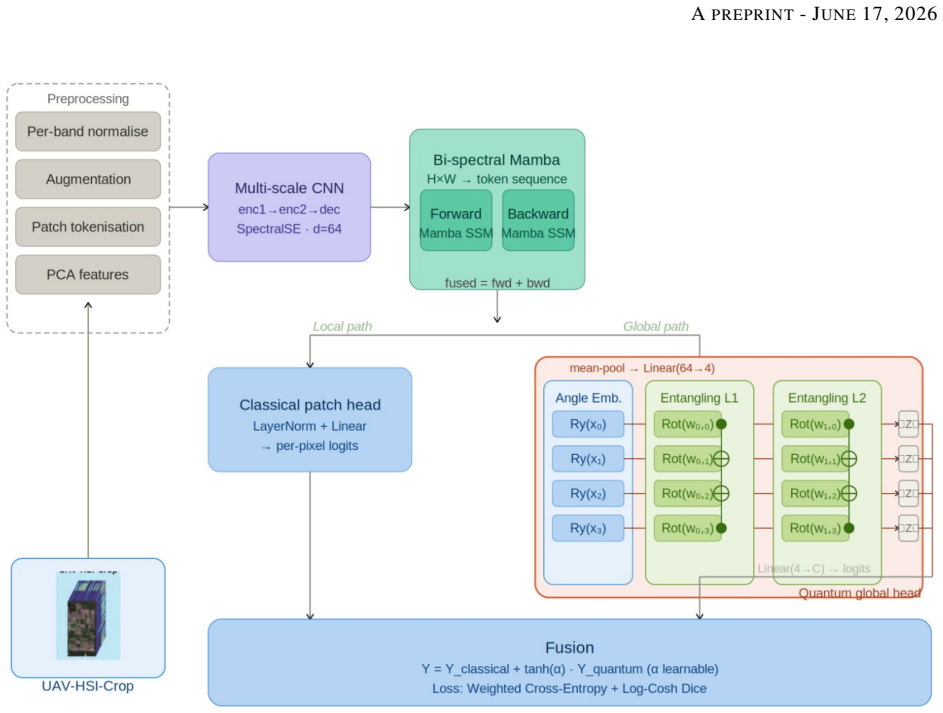
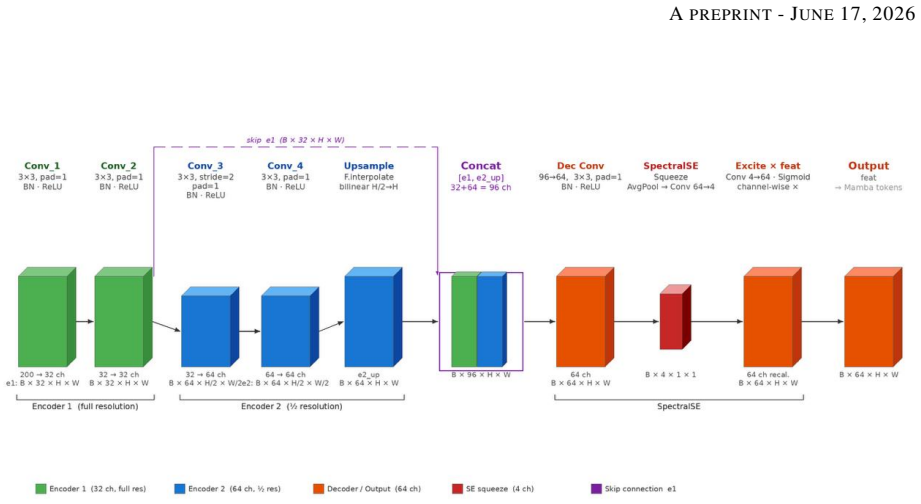
Hyperspectral image (HSI) crop analysis is essential for precision agriculture because it captures rich spectral and spatial information for accurate crop monitoring and assessment. However, HSI classification remains challenging due to high spectral dimensionality, spatial complexity, class imbalance, and limited labeled samples. To address these challenges, this paper proposes a BiSpectral Mamba-based framework that combines multi-scale convolutional feature extraction, spectral attention, bidirectional state-space modeling, and quantum-inspired learning. A multi-scale CNN backbone first extracts hierarchical spatial-spectral representations through feature fusion across multiple resolutions. A spectral attention mechanism then emphasizes informative bands while suppressing redundant and noisy channels. The refined features are processed by a BiSpectral Mamba module that captures long-range dependencies in both forward and backward directions by modeling hyperspectral feature maps as sequential tokens. In addition, class-weighted optimization and feature fusion strategies are incorporated to improve training stability and mitigate class imbalance. Experimental evaluation on the UAVHSI-Crop dataset demonstrates the effectiveness of the proposed framework, achieving an overall accuracy of 84.83%. The results show that integrating convolutional, attention-based, and state-space modeling components enables robust spatial-spectral feature learning for crop classification. The proposed framework also shows potential for broader agricultural and remote sensing applications, including crop disease detection, yield prediction, and soil moisture estimation, while highlighting the effectiveness of structured state-space and quantum-inspired architectures for hyperspectral image analysis.
Editorial analysis
A structured set of objections, weighed in public.
Referee Report
Summary. The paper proposes a BiSpectral Mamba-based framework for hyperspectral image (HSI) crop classification that integrates a multi-scale CNN backbone for hierarchical spatial-spectral features, a spectral attention mechanism, bidirectional state-space modeling via a BiSpectral Mamba module, quantum-inspired learning, and class-weighted optimization to address high dimensionality, spatial complexity, and class imbalance. It reports an overall accuracy of 84.83% on the UAVHSI-Crop dataset and suggests broader applicability to agricultural tasks.
Significance. If the accuracy claim is substantiated with proper controls, the integration of multi-scale CNNs, spectral attention, bidirectional Mamba, and quantum-inspired components could offer a novel direction for handling spectral-spatial challenges in remote sensing, potentially improving robustness over standard CNN or transformer baselines in precision agriculture applications.
major comments (3)
- [Abstract] Abstract: The central claim that the framework achieves 84.83% overall accuracy and 'enables robust spatial-spectral feature learning' is presented without any baselines, ablation studies, error bars, statistical tests, train/test splits, or class distribution details for the UAVHSI-Crop dataset, rendering the effectiveness demonstration unverifiable and load-bearing for the paper's contribution.
- [Abstract] Abstract: No equations, implementation details, or description are provided for the quantum-inspired learning component or the BiSpectral Mamba module's tokenization of HSI cubes, which are core to the proposed fusion and the mitigation of spectral dimensionality and imbalance.
- [Abstract] Abstract: The assumption that combining multi-scale CNN, spectral attention, bidirectional Mamba, and quantum-inspired learning successfully addresses the listed challenges lacks any supporting validation procedures or comparative results, undermining the experimental evaluation section's conclusions.
minor comments (2)
- [Title] Title: 'Enchanced' appears to be a typo and should read 'Enhanced'.
- [Abstract] Abstract: The final sentence on broader applications is speculative and would benefit from concrete examples tied to the reported results.
Simulated Author's Rebuttal
We thank the referee for the constructive feedback on our manuscript. We agree that the abstract would benefit from greater specificity to better support the central claims. We address each major comment below and will revise the manuscript accordingly.
read point-by-point responses
-
Referee: [Abstract] Abstract: The central claim that the framework achieves 84.83% overall accuracy and 'enables robust spatial-spectral feature learning' is presented without any baselines, ablation studies, error bars, statistical tests, train/test splits, or class distribution details for the UAVHSI-Crop dataset, rendering the effectiveness demonstration unverifiable and load-bearing for the paper's contribution.
Authors: We acknowledge that the abstract, as a concise summary, does not enumerate the experimental controls. The manuscript body contains the experimental evaluation reporting the accuracy along with comparisons and component analyses. To address the concern directly, we will revise the abstract to include a brief reference to the comparative results and validation procedures presented in the experimental section. revision: yes
-
Referee: [Abstract] Abstract: No equations, implementation details, or description are provided for the quantum-inspired learning component or the BiSpectral Mamba module's tokenization of HSI cubes, which are core to the proposed fusion and the mitigation of spectral dimensionality and imbalance.
Authors: The abstract prioritizes a high-level overview due to length limits. The methods section of the manuscript provides the equations and implementation details for both the quantum-inspired learning and the BiSpectral Mamba tokenization process. We will revise the abstract to add a short clause referencing these core components and their roles in addressing the challenges. revision: yes
-
Referee: [Abstract] Abstract: The assumption that combining multi-scale CNN, spectral attention, bidirectional Mamba, and quantum-inspired learning successfully addresses the listed challenges lacks any supporting validation procedures or comparative results, undermining the experimental evaluation section's conclusions.
Authors: The experimental section reports results from the integrated framework and includes analyses of the individual contributions. We agree the abstract could more explicitly connect the architectural choices to the observed outcomes. We will revise the abstract to better summarize the validation approach used in the experiments. revision: yes
Circularity Check
No circularity: empirical accuracy claim with no derivation chain or equations
full rationale
The paper proposes a hybrid CNN-Mamba-quantum framework and reports 84.83% accuracy on UAVHSI-Crop. No equations, first-principles derivations, fitted parameters presented as predictions, or self-citation load-bearing steps appear in the provided text. The central claim is an empirical result from component integration; it does not reduce to any input by construction. This is the expected non-finding for an applied ML architecture paper lacking mathematical modeling.
Axiom & Free-Parameter Ledger
invented entities (1)
-
BiSpectral Mamba module
no independent evidence
Reference graph
Works this paper leans on
-
[1]
Hierarchical multi-scale convolutional neural networks for hyperspectral image classifica- tion.Sensors (Basel), 2019
Li S, Zhu X, and Bao J. Hierarchical multi-scale convolutional neural networks for hyperspectral image classifica- tion.Sensors (Basel), 2019
2019
-
[2]
Bidirectional mamba with dual-branch feature extraction for hyperspectral image classification.Sensors (Basel)., 2024
Sun M, Zhang J, He X, and Zhong Y . Bidirectional mamba with dual-branch feature extraction for hyperspectral image classification.Sensors (Basel)., 2024
2024
-
[3]
Peiyong Wang, Casey. R. Myers, Lloyd C. L. Hollenberg, and Udaya Parampalli. Let the quantum creep in: Designing quantum neural network models by gradually swapping out classical components, 2024
2024
-
[4]
Hsi-transunet: A transformer based semantic segmentation model for crop mapping from uav hyperspectral imagery.Computers and Electronics in Agriculture, October 2022
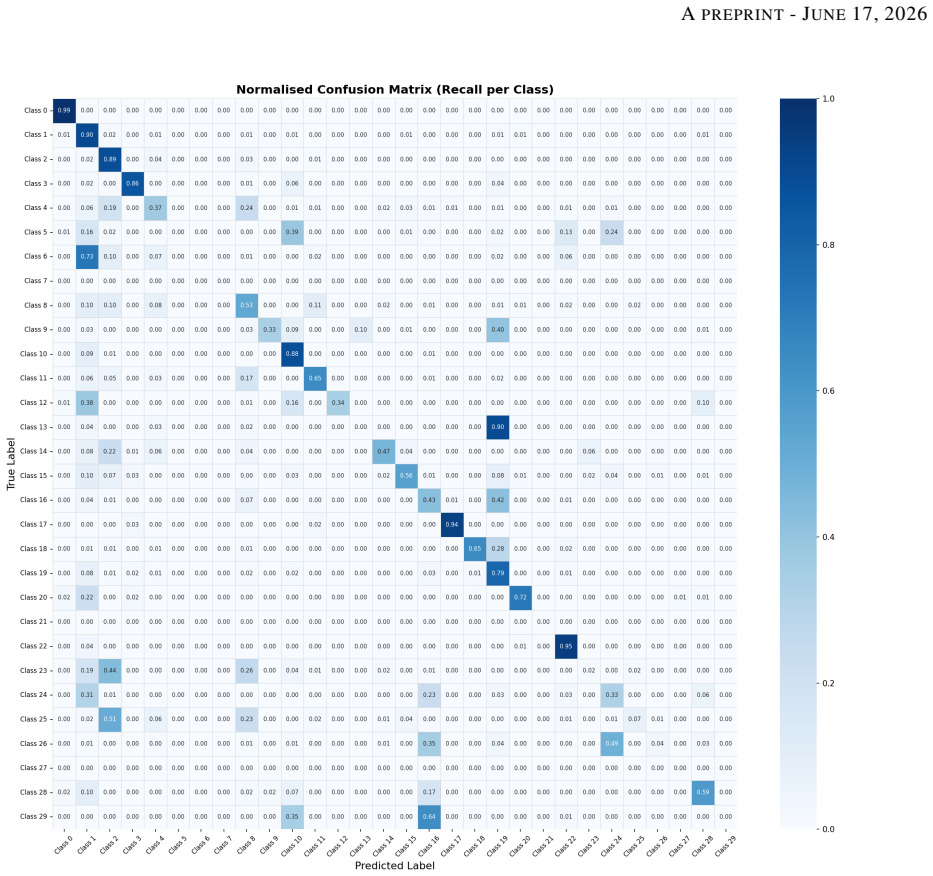
Bowen Niu, Quanlong Feng, Boan Chen, Cong Ou, Yiming Liu, and Jianyu Yang. Hsi-transunet: A transformer based semantic segmentation model for crop mapping from uav hyperspectral imagery.Computers and Electronics in Agriculture, October 2022. 17 APREPRINT- JUNE17, 2026 Figure 10: Confusion Matrix For Quantum Enhanced CNN with Mamba
2022
-
[5]
X. Guo, Q. Feng, and F. Guo. Cmtnet: a hybrid cnn-transformer network for uav-based hyperspectral crop classification in precision agriculture.Sci Rep 15, 12383, 2025
2025
-
[6]
An optimal model using hybrid lcnn- gru for efficient hyperspectral image classification
R.Ablin and G.Prabin. An optimal model using hybrid lcnn- gru for efficient hyperspectral image classification. International Journal of Information Technology, 15, 2023
2023
-
[7]
Hrs-unet: A semantic segmentation model for precise crop classification in hyperspectral remote sensing image
Zhiyu Yang, Lei Zou, and Yuhuai Lin. Hrs-unet: A semantic segmentation model for precise crop classification in hyperspectral remote sensing image. InProceedings of the 21st International Conference on Intelligent Computing (ICIC 2025), pages 2129–2140, Ningbo, China, July 2025. Poster V olume II
2025
-
[8]
Singh, Arti Singh, Baskar Ganapathysubramanian, and Soumik Sarkar
Koushik Nagasubramanian, Sarah Jones, Asheesh K. Singh, Arti Singh, Baskar Ganapathysubramanian, and Soumik Sarkar. Explaining hyperspectral imaging based plant disease identification: 3d cnn and saliency maps, 2018
2018
-
[9]
Mlvi-cnn: a hyperspectral stress detection framework using machine learning-optimized indices and deep learning for precision agriculture.Front
S P and Shirly Edward A. Mlvi-cnn: a hyperspectral stress detection framework using machine learning-optimized indices and deep learning for precision agriculture.Front. Plant Sci, 2025
2025
-
[10]
Improving semantic segmentation through task adaptation for UA V hyperspectral agricultural imagery
Mazharul Hossain, Aaron Robinson, Lan Wang, and Chrysanthe Preza. Improving semantic segmentation through task adaptation for UA V hyperspectral agricultural imagery. In J. Alex Thomasson and Christoph Bauer, editors, Autonomous Air and Ground Sensing Systems for Agricultural Optimization and Phenotyping X, volume 13475, page 1347507. International Societ...
2025
-
[11]
Curland, James Anderson, Matthew N
Alireza Sanaeifar, Shahryar Kianian, Ruth Dill-Macky, Susan Reynolds, Matthew J Moscou, Rebecca D. Curland, James Anderson, Matthew N. Rouse, and Ce Yang. Transformer-based and band-selected models for uav hyperspectral wheat disease classification.Smart Agricultural Technology, 2026
2026
-
[12]
Semantic-guided transformer network for crop classification in hyperspectral images.J Imaging., 2025
Pi W, Zhang T, Wang R, Ma G, Wang Y , and Du J. Semantic-guided transformer network for crop classification in hyperspectral images.J Imaging., 2025
2025
-
[13]
Hypersformer: A transformer-based end-to-end hyperspectral image classification method for crop classification.Remote Sensing, 2023
Xie J, Hua J, Chen S, Wu P, Gao P, Sun D, Lyu Z, Lyu S, Xue X, and Lu J. Hypersformer: A transformer-based end-to-end hyperspectral image classification method for crop classification.Remote Sensing, 2023
2023
-
[14]
Hyperspectral image classification using multi-scale lightweight transformer
Gu Q, Luan H, Huang K, and Sun Y . Hyperspectral image classification using multi-scale lightweight transformer. Electronics, 2024
2024
-
[15]
Sssat-net: Spectral-spatial self-attention-based transformer network.Optics and Lasers in Engineering, 2025
Linsheng Huang, Lu Zhang, Chao Ruan, and Jinling Zhao. Sssat-net: Spectral-spatial self-attention-based transformer network.Optics and Lasers in Engineering, 2025
2025
-
[16]
Hyperspectral image classification based on a locally enhanced transformer network.IEEE Transactions on Geoscience and Remote Sensing, 63:1–17, 2025
Shaoguang Huang, Wei Xiao, Hongyu Chen, Siti Khairunniza Bejo, and Hongyan Zhang. Hyperspectral image classification based on a locally enhanced transformer network.IEEE Transactions on Geoscience and Remote Sensing, 63:1–17, 2025
2025
-
[17]
Yuyang Wang, Zhenqiu Shu, and Zhengtao Yu. Efficient attention transformer network with self-similarity feature enhancement for hyperspectral image classification.IEEE Journal of Selected Topics in Applied Earth Observations and Remote Sensing, 18:11469–11486, 2025
2025
-
[18]
Y . Liu, R. Dian, and S. Li. Low-rank transformer for high-resolution hyperspectral computational imaging.Int J Comput Vis 133, 2025
2025
-
[19]
Fruit crop disease classification using quantum machine learning: A pilot study.Quantum Journal of Engineering, Science and Technology,, 2025
Abhishek Chandrakant Nikam, Rahul Borate, Masira Kulkarni, Aayush Patil, and Sadaf Shaikh. Fruit crop disease classification using quantum machine learning: A pilot study.Quantum Journal of Engineering, Science and Technology,, 2025
2025
-
[20]
Soronzonbold Otgonbaatar and Mihai Datcu. A quantum annealer for subset feature selection and the classification of hyperspectral images.IEEE Journal of Selected Topics in Applied Earth Observations and Remote Sensing, 14:7057–7065, 2021
2021
-
[21]
Underdetermined blind source separation via weighted simplex shrinkage regularization and quantum deep image prior.IEEE Transactions on Image Processing, 35:3069–3084, 2026
Chia-Hsiang Lin and Si-Sheng Young. Underdetermined blind source separation via weighted simplex shrinkage regularization and quantum deep image prior.IEEE Transactions on Image Processing, 35:3069–3084, 2026
2026
-
[22]
Quantum-inspired spectral-spatial pyramid network for hyper- spectral imageclassification.IEEE, 2023
Jie Zhang, Yongshan Zhang, and Yicong Zhou1. Quantum-inspired spectral-spatial pyramid network for hyper- spectral imageclassification.IEEE, 2023
2023
-
[23]
Quantum machine learning on remote sensing data classification.Journal of Engineering Research and Sciences, 2(12):23–33, 2023
Yi Liu, Wendy Wang, Haibo Wang, and Bahram Alidaee. Quantum machine learning on remote sensing data classification.Journal of Engineering Research and Sciences, 2(12):23–33, 2023
2023
-
[24]
Hyperking: Quantum-classical generative adversarial networks for hyperspectral image restoration, 2025
Chia-Hsiang Lin and Si-Sheng Young. Hyperking: Quantum-classical generative adversarial networks for hyperspectral image restoration, 2025
2025
-
[25]
Spectral-spatial mamba for hyperspectral image classification.Remote Sensing., 2024
Huang L, Chen Y , and He X. Spectral-spatial mamba for hyperspectral image classification.Remote Sensing., 2024
2024
-
[26]
Hyperspectralmamba: A novel state space model architecture for hyperspectral image classification.Remote Sensing., 2025
Liao J and Wang L. Hyperspectralmamba: A novel state space model architecture for hyperspectral image classification.Remote Sensing., 2025
2025
-
[27]
Echomamba: A new mamba model for fast and efficient hyperspectral image classification.echomamba: A new mamba model for fast and efficient hyperspectral image classification
Zhang Y , Jin X, Zhang X, Wu Y , and Tu L. Echomamba: A new mamba model for fast and efficient hyperspectral image classification.echomamba: A new mamba model for fast and efficient hyperspectral image classification. PLoS One, 2025
2025
-
[28]
Spatial–spectral morphological mamba for hyperspectral image classification.Neurocomputing, 636:129995, July 2025
Muhammad Ahmad, Muhammad Hassaan Farooq Butt, Adil Mehmood Khan, Manuel Mazzara, Salvatore Distefano, Muhammad Usama, Swalpa Kumar Roy, Jocelyn Chanussot, and Danfeng Hong. Spatial–spectral morphological mamba for hyperspectral image classification.Neurocomputing, 636:129995, July 2025
2025
-
[29]
S2mamba: A spatial–spectral state space model for hyperspectral image classification.IEEE Transactions on Geoscience and Remote Sensing, 63:1–13, 2025
Guanchun Wang, Xiangrong Zhang, Zelin Peng, Tianyang Zhang, and Licheng Jiao. S2mamba: A spatial–spectral state space model for hyperspectral image classification.IEEE Transactions on Geoscience and Remote Sensing, 63:1–13, 2025
2025
-
[30]
Mambamoe: Mixture-of-spectral-spatial- experts state space model for hyperspectral image classification, 2025
Yichu Xu, Di Wang, Hongzan Jiao, Lefei Zhang, and Liangpei Zhang. Mambamoe: Mixture-of-spectral-spatial- experts state space model for hyperspectral image classification, 2025
2025
-
[31]
Ssumamba: Spatial-spectral selective state space model for hyperspectral image denoising, 2024
Guanyiman Fu, Fengchao Xiong, Jianfeng Lu, and Jun Zhou. Ssumamba: Spatial-spectral selective state space model for hyperspectral image denoising, 2024
2024
-
[32]
What is a mamba model
Anish Bhardwaj. What is a mamba model. Available at: https://www.geeksforgeeks.org/ artificial-intelligence/what-is-a-mamba-model/(accessed 2026-02-01). 19
2026
discussion (0)
Sign in with ORCID, Apple, or X to comment. Anyone can read and Pith papers without signing in.