Distributed General-Purpose Agent Networks: Architecture, Key Mechanisms, and Prototypes
Pith reviewed 2026-06-27 02:55 UTC · model grok-4.3
The pith
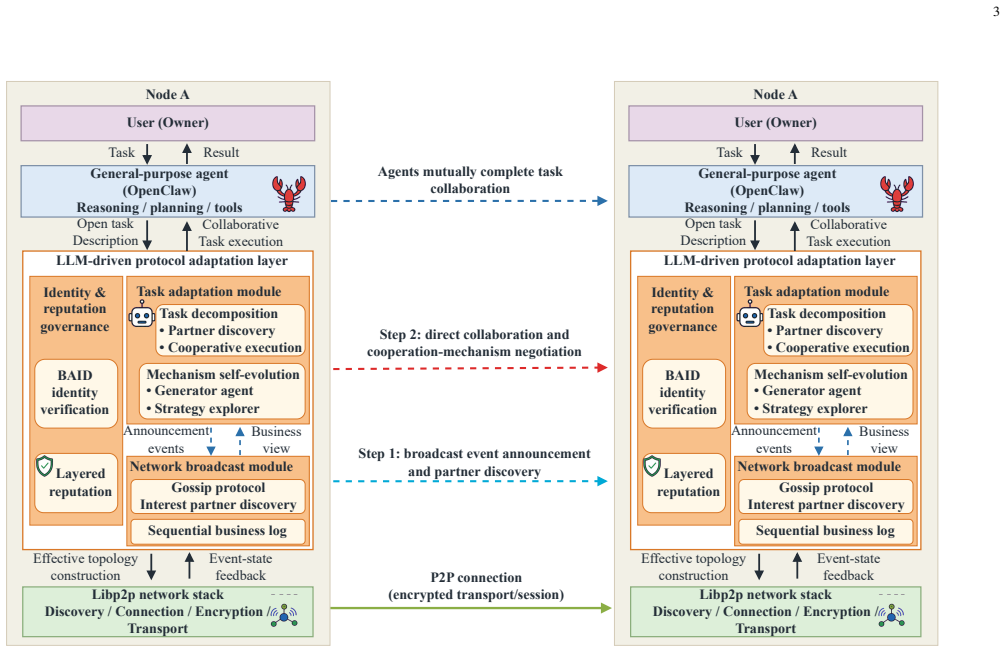
Distributed agent networks require a dedicated protocol adaptation layer to propagate semantic declarations about intentions and capabilities.
A machine-rendered reading of the paper's core claim, the machinery that carries it, and where it could break.
Core claim
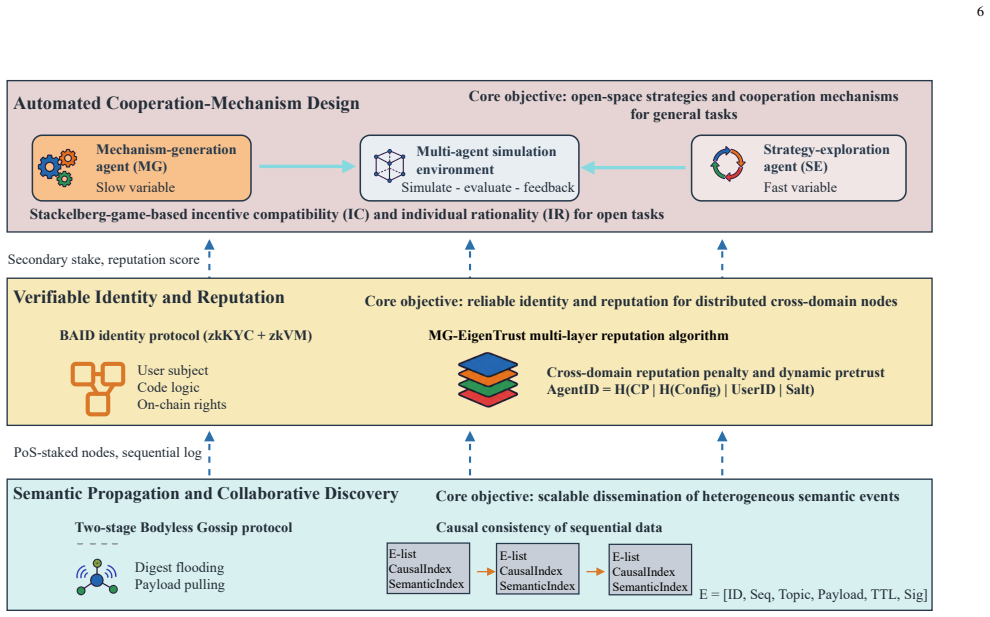
The paper claims that distributed general-purpose agent networks, in which heterogeneous agents on personal devices, edge nodes, or autonomous environments discover one another, establish trust, negotiate rules, and execute open-ended tasks, cannot arise from simple combinations of P2P overlays and multi-agent systems. A layered architecture centered on a protocol adaptation layer is required to propagate semantic declarations about intentions, capabilities, states, and cooperation constraints. The architecture supports three core mechanisms: bodyless gossip with sequential logs for semantic announcement propagation, BAID-based identity binding with MG-EigenTrust for verifiable identity and
What carries the argument
protocol adaptation layer that connects upper-level task semantics with lower-level network operations
If this is right
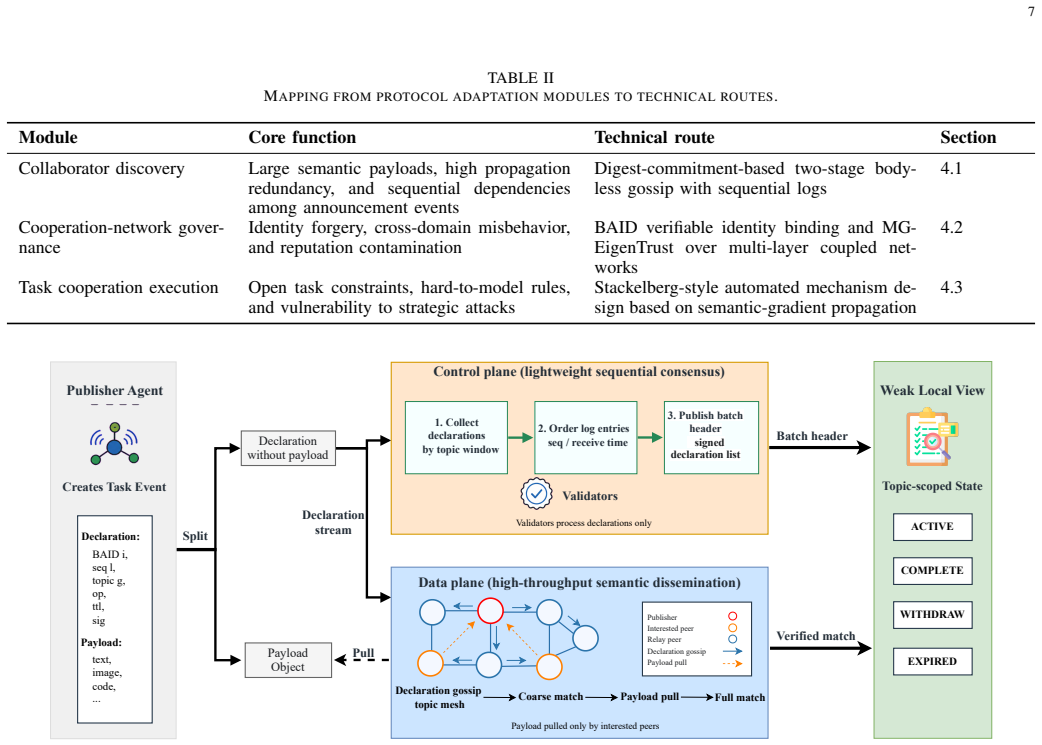
- Semantic announcement propagation via bodyless gossip enables collaborator discovery across open networks.
- BAID-based identity binding combined with MG-EigenTrust supports verifiable governance of cooperation.
- Semantic-gradient mechanism design allows open-ended task execution driven by attribution feedback.
- The resulting framework supplies a system-level foundation for open, trustworthy, and scalable agent collaboration.
Where Pith is reading between the lines
- If the architecture succeeds, agent collaboration could proceed without reliance on central servers, increasing resilience to single points of failure.
- The mechanisms could be extended by testing discovery success rates in real edge-device deployments with varying participant counts.
- This layered approach may change how LLM-based agents are orchestrated by requiring explicit semantic layers rather than direct overlay use.
Load-bearing premise
Heterogeneous agents on personal devices, edge nodes, or autonomous environments can and will discover one another, establish trust, and negotiate cooperation rules in an open peer-to-peer setting using the proposed mechanisms.
What would settle it
A deployment or simulation in which agents using the protocol adaptation layer and proposed mechanisms fail to discover collaborators or establish verifiable trust under realistic device heterogeneity, network churn, or adversarial conditions.
Figures
read the original abstract
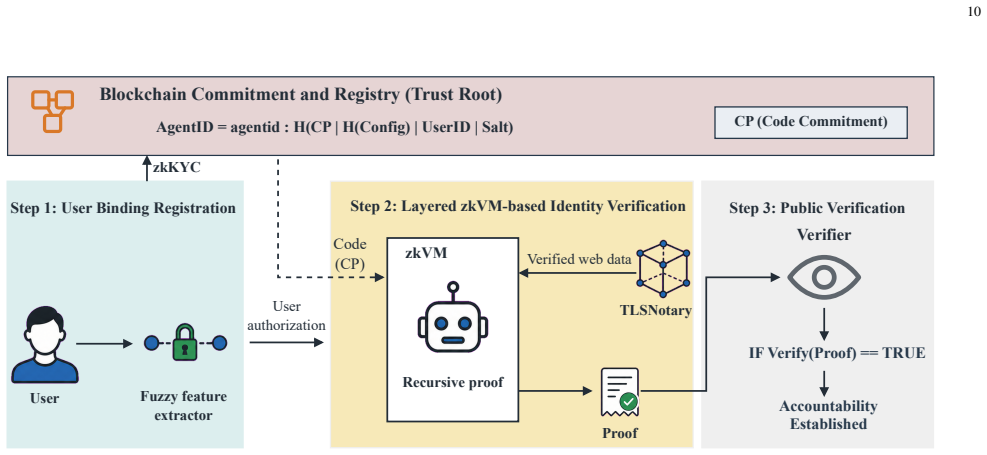
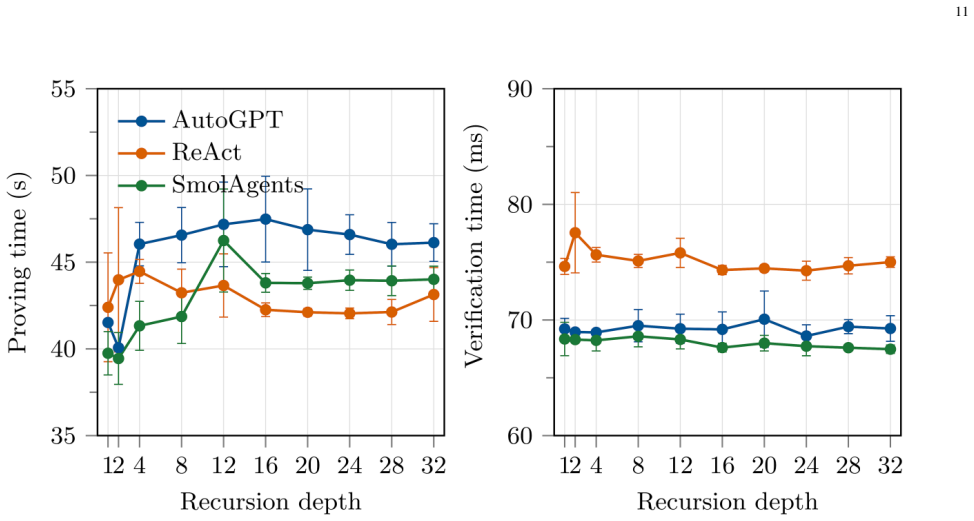
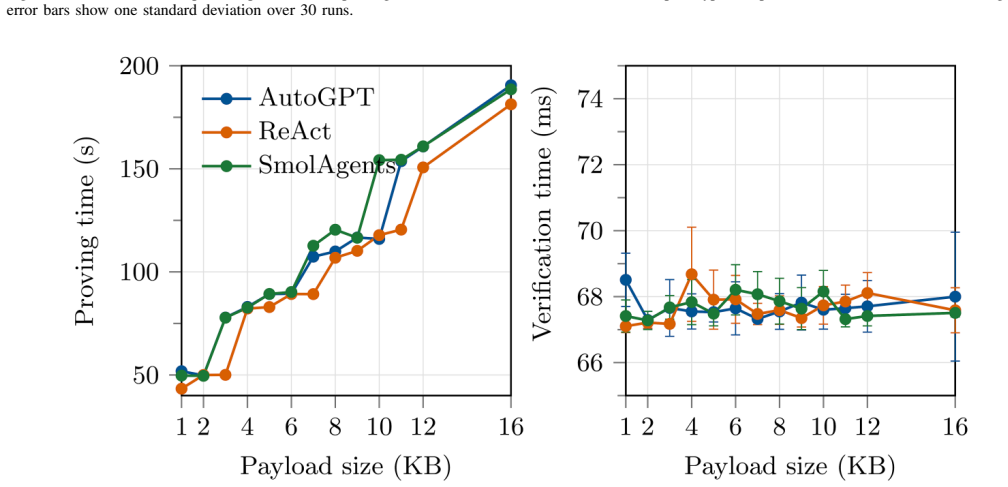
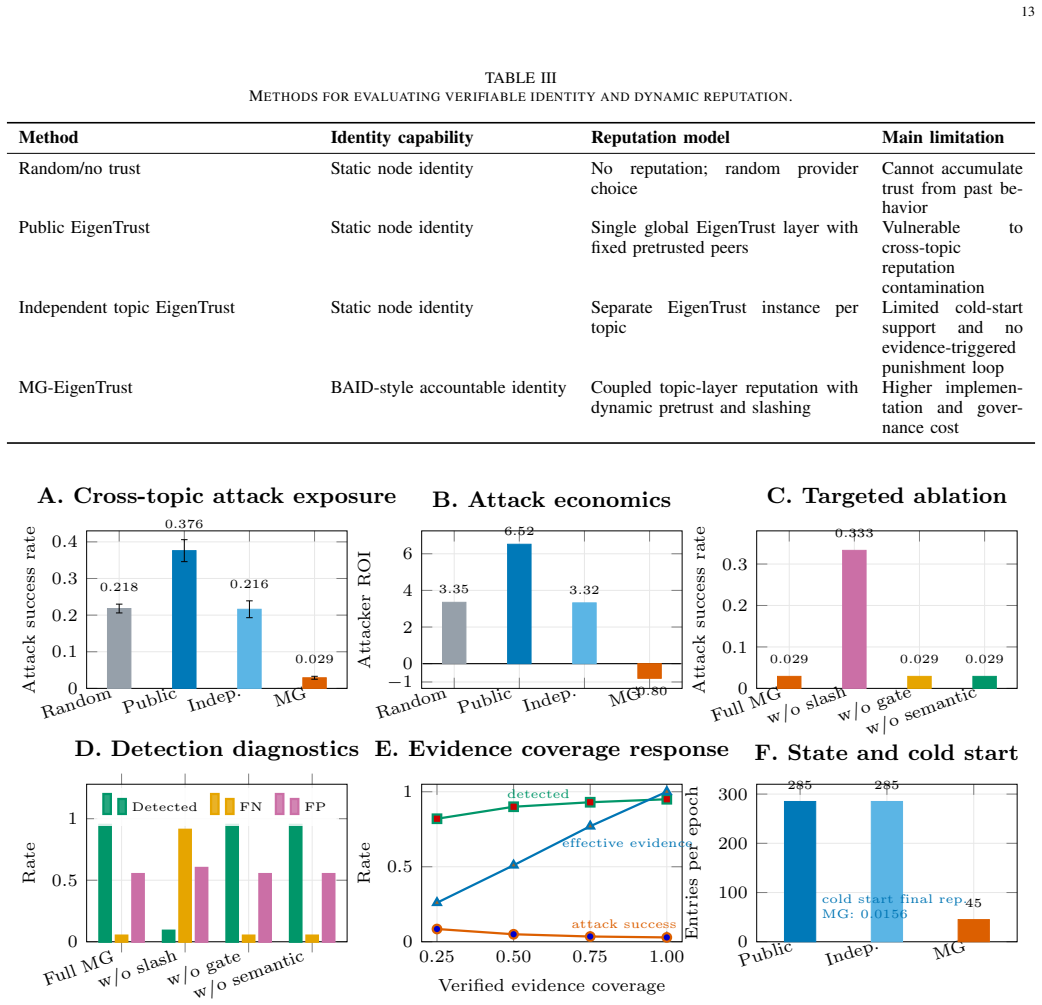
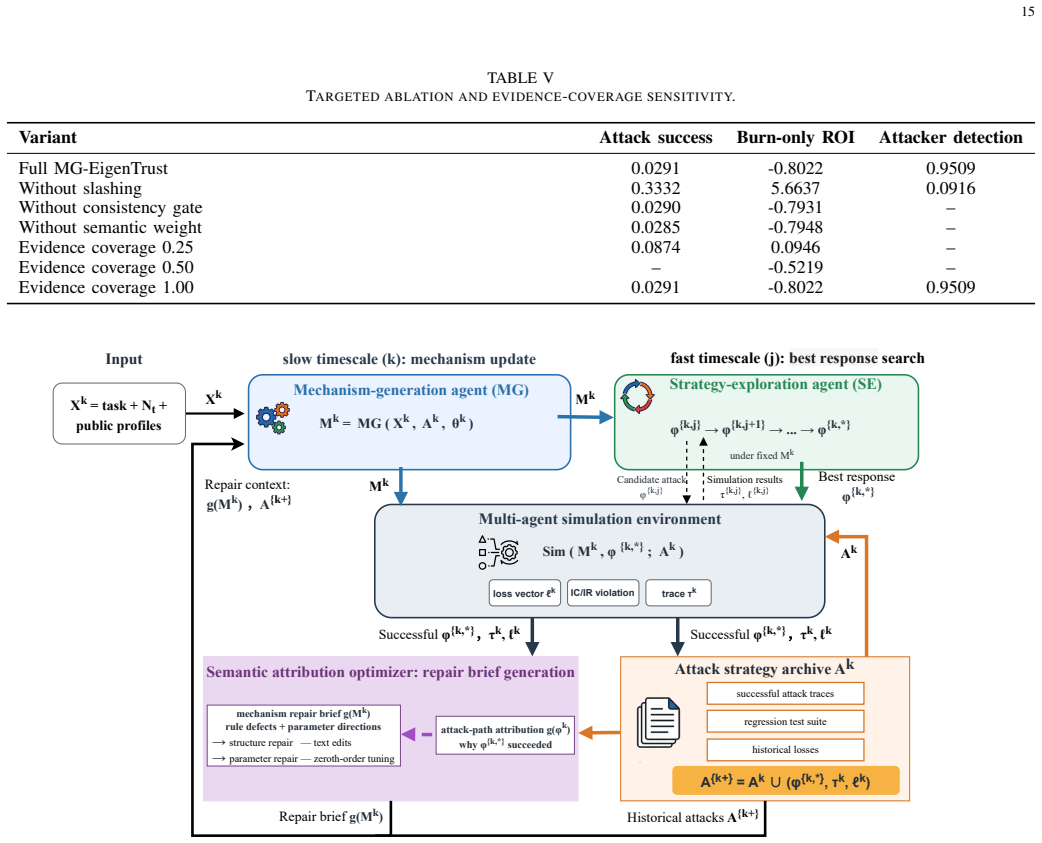
Large language models have accelerated the transition from passive conversational assistants to autonomous agents that can understand goals, plan actions, invoke tools, and execute multi-step tasks. Yet the capability of a single agent remains constrained by its local data, tool permissions, runtime environment, and governance boundary. This paper studies distributed general-purpose agent networks: open peer-to-peer networks in which heterogeneous agents deployed on personal devices, edge nodes, or autonomous computing environments can discover one another, establish trust, negotiate cooperation rules, and execute open-ended tasks. We argue that such networks cannot be obtained by simply combining existing peer-to-peer overlays with conventional multi-agent systems. Unlike traditional P2P networks, agent networks must propagate semantic declarations about intentions, capabilities, states, and cooperation constraints. We therefore propose a layered architecture centered on a protocol adaptation layer that connects upper-level task semantics with lower-level network operations. Based on this architecture, the paper identifies three core mechanism problems: semantic announcement propagation for collaborator discovery, verifiable identity and multi-topic reputation for cooperation governance, and semantic-gradient mechanism design for open task execution. For each problem, we present a technical route, including bodyless gossip with sequential logs, BAID-based identity binding with MG-EigenTrust reputation, and a Stackelberg-style mechanism-generation loop driven by semantic attribution feedback. We further report prototype overhead results for BAID-style tiered verification and mechanism-level simulations of MG-EigenTrust under cross-topic disguise-collusion attacks. The resulting framework provides a system-level foundation for open, trustworthy, and scalable agent collaboration.
Editorial analysis
A structured set of objections, weighed in public.
Referee Report
Summary. The paper proposes that open peer-to-peer networks of heterogeneous autonomous agents require a dedicated layered architecture with a protocol adaptation layer to propagate semantic declarations of intentions, capabilities, states, and constraints. It identifies three core mechanism problems—semantic announcement propagation, verifiable identity/reputation, and semantic-gradient mechanism design—and presents technical routes (bodyless gossip with sequential logs, BAID+MG-EigenTrust, Stackelberg-style loop) along with prototype overhead measurements for BAID and MG-EigenTrust simulations under cross-topic disguise-collusion attacks.
Significance. If the mechanisms prove effective, the work could supply a system-level foundation for scalable, trustworthy agent collaboration beyond single-agent limits. The inclusion of concrete prototype overhead data and targeted simulations provides a modest empirical anchor, though the absence of broader validation limits immediate impact.
major comments (2)
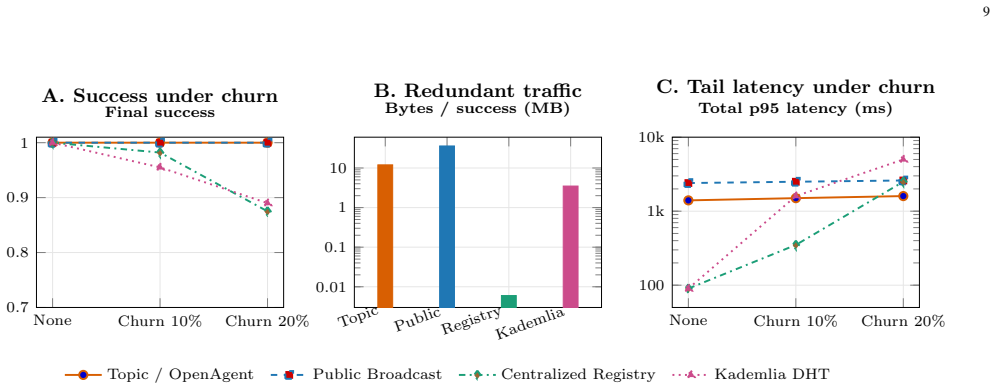
- [Abstract, §4] Abstract and mechanism sections: the central claim that the protocol adaptation layer plus the three mechanisms enable discovery, trust establishment, and negotiated cooperation among untrusted heterogeneous agents in open P2P settings is not load-bearing supported by evidence; only isolated BAID overhead on prototypes and MG-EigenTrust simulations under one attack model are reported, with no end-to-end results on announcement propagation, identity binding, or mechanism negotiation in topologies exhibiting churn, partial participation, or adversarial nodes.
- [§3] Architecture section: the assertion that agent networks cannot be obtained by combining existing P2P overlays with conventional multi-agent systems is presented without a concrete comparison, counter-example, or failure-mode analysis showing where standard approaches break on semantic propagation; this weakens the justification for introducing the protocol adaptation layer as a required component.
minor comments (2)
- [Introduction, §2] Notation for new constructs (bodyless gossip, BAID, MG-EigenTrust, semantic-gradient) is introduced without explicit cross-references to prior literature or precise formal definitions in the early sections.
- [Prototype evaluation] Prototype results for BAID tiered verification omit details on experimental configuration, number of runs, hardware, or baseline comparisons, making the overhead claims difficult to interpret.
Simulated Author's Rebuttal
We thank the referee for the constructive feedback on the strength of evidence and architectural justification. We address each major comment below.
read point-by-point responses
-
Referee: [Abstract, §4] Abstract and mechanism sections: the central claim that the protocol adaptation layer plus the three mechanisms enable discovery, trust establishment, and negotiated cooperation among untrusted heterogeneous agents in open P2P settings is not load-bearing supported by evidence; only isolated BAID overhead on prototypes and MG-EigenTrust simulations under one attack model are reported, with no end-to-end results on announcement propagation, identity binding, or mechanism negotiation in topologies exhibiting churn, partial participation, or adversarial nodes.
Authors: The reported results are limited to component-level overhead measurements for BAID and targeted MG-EigenTrust simulations under cross-topic disguise-collusion, as described in the manuscript. These provide initial feasibility evidence for the individual mechanisms but do not constitute end-to-end validation across dynamic topologies. We will revise the abstract and §4 to explicitly scope the current empirical contributions as mechanism-level validation and add a limitations subsection outlining the need for future end-to-end experiments under churn and partial participation. revision: yes
-
Referee: [§3] Architecture section: the assertion that agent networks cannot be obtained by combining existing P2P overlays with conventional multi-agent systems is presented without a concrete comparison, counter-example, or failure-mode analysis showing where standard approaches break on semantic propagation; this weakens the justification for introducing the protocol adaptation layer as a required component.
Authors: The manuscript's argument rests on the requirement for propagating semantic declarations of intentions, capabilities, states, and constraints, which differs from data-centric P2P or task-oriented MAS. To strengthen this, we will add a dedicated paragraph and table in §3 with concrete counter-examples (e.g., failure of standard gossip protocols to bind semantic constraints to identity without a dedicated layer, and limitations of FIPA-style ACL in open untrusted P2P settings) and failure-mode analysis for semantic propagation. revision: yes
Circularity Check
No circularity: architectural proposal with independent prototype measurements
full rationale
The paper advances an architectural argument and three mechanism proposals (bodyless gossip, BAID+MG-EigenTrust, Stackelberg loop) supported by overhead measurements on prototypes and targeted simulations. No equations, fitted parameters, or predictions appear that reduce by construction to the inputs. The central claim that a protocol adaptation layer is required is presented as a design rationale rather than a derived theorem; the reported results are direct measurements and attack-specific simulations, not self-referential fits. No load-bearing self-citations or uniqueness theorems are invoked in the provided text. The derivation chain is therefore self-contained against external benchmarks.
Axiom & Free-Parameter Ledger
Reference graph
Works this paper leans on
-
[1]
Large language model based multi-agents: A survey of progress and challenges,
T. Guoet al., “Large language model based multi-agents: A survey of progress and challenges,” arXiv preprint arXiv:2402.01680, 2024
Pith/arXiv arXiv 2024
-
[2]
Cognitive architectures for language agents,
T. R. Sumers, S. Yao, K. Narasimhan, and T. L. Griffiths, “Cognitive architectures for language agents,” arXiv preprint arXiv:2309.02427, 2023
Pith/arXiv arXiv 2023
-
[3]
Big ideas 2026,
ARK Investment Management LLC, “Big ideas 2026,” ARK Invest,
2026
-
[4]
Available: https://ark-invest.com/big-ideas-2026
[Online]. Available: https://ark-invest.com/big-ideas-2026
2026
-
[5]
Openclaw ai chatbots are running amok – these scientists are listening in,
M. Basu, “Openclaw ai chatbots are running amok – these scientists are listening in,”Nature, vol. 650, pp. 533–534, 2026
2026
-
[6]
Internet of agents: Weaving a web of heterogeneous agents for collaborative intelligence,
W. Chen, Z. You, R. Liet al., “Internet of agents: Weaving a web of heterogeneous agents for collaborative intelligence,”International Conference on Learning Representations, 2025
2025
-
[7]
Internet of agents: Fundamentals, applications, and challenges,
Y . Wang, S. Guo, Y . Panet al., “Internet of agents: Fundamentals, applications, and challenges,”IEEE Transactions on Cognitive Com- munications and Networking, 2025
2025
-
[8]
Agentnet: Decentralized evolutionary coordination for llm-based multi-agent systems,
Y . Yang, H. Chai, S. Shaoet al., “Agentnet: Decentralized evolutionary coordination for llm-based multi-agent systems,” inAdvances in Neural Information Processing Systems, 2025
2025
-
[9]
Guiding opinions on deeply implementing the “artificial intelligence plus
State Council of the People’s Republic of China, “Guiding opinions on deeply implementing the “artificial intelligence plus” action,” Guo Fa
-
[10]
11, Beijing, China, 2025
No. 11, Beijing, China, 2025
2025
-
[11]
Randomized rumor spreading,
R. Karp, C. Schindelhauer, S. Shenker, and B. V ocking, “Randomized rumor spreading,” inProceedings of the IEEE Symposium on Founda- tions of Computer Science, 2000, pp. 565–574
2000
-
[12]
Cyclon: Inexpensive membership management for unstructured p2p overlays,
S. V oulgaris, D. Gavidia, and M. van Steen, “Cyclon: Inexpensive membership management for unstructured p2p overlays,”Journal of Network and Systems Management, vol. 13, no. 2, pp. 197–217, 2005
2005
-
[13]
Gossip-based peer sampling,
M. Jelasity, S. V oulgaris, R. Guerraoui, A.-M. Kermarrec, and M. van Steen, “Gossip-based peer sampling,”ACM Transactions on Computer Systems, vol. 25, no. 3, 2007
2007
-
[14]
Gossipsub: Attack-resilient message propagation in the filecoin and eth2.0 networks,
D. Vyzovitis, Y . Napora, D. McCormicket al., “Gossipsub: Attack-resilient message propagation in the filecoin and eth2.0 networks,” arXiv preprint arXiv:2007.02754, 2020. [Online]. Available: https://arxiv.org/abs/2007.02754
arXiv 2007
-
[15]
Preamble and imreceiving for improved large message handling in libp2p gossipsub,
M. U. Farooq and D. Kaiser, “Preamble and imreceiving for improved large message handling in libp2p gossipsub,” arXiv preprint arXiv:2505.17337, 2025. [Online]. Available: https://arxiv.org/abs/2505. 17337
arXiv 2025
-
[16]
Bip152: Compact block relay,
M. Corallo, “Bip152: Compact block relay,” Bitcoin Improvement Proposal, 2016. [Online]. Available: https://bips.dev/152
2016
-
[17]
Bodyless block propagation: Tps fully scalable blockchain with pre-validation,
C. Zhao, S. Zhang, T. Wanget al., “Bodyless block propagation: Tps fully scalable blockchain with pre-validation,”Future Generation Computer Systems, vol. 163, p. 107516, 2025
2025
-
[18]
Certainsync: Rateless set reconciliation with certainty,
T. Keniagin, E. Yaakobi, and O. Rottenstreich, “Certainsync: Rateless set reconciliation with certainty,”Proceedings of the ACM on Measurement and Analysis of Computing Systems, vol. 9, no. 2, pp. 1–33, 2025
2025
-
[19]
Scaling blockchains with error correction codes: A survey on coded blockchains,
C. Yang, K. W. Chin, J. Wanget al., “Scaling blockchains with error correction codes: A survey on coded blockchains,”ACM Computing Surveys, vol. 56, no. 6, pp. 1–33, 2024
2024
-
[20]
Time, clocks, and the ordering of events in a distributed system,
L. Lamport, “Time, clocks, and the ordering of events in a distributed system,”Communications of the ACM, vol. 21, no. 7, pp. 558–565, 1978
1978
-
[21]
Timestamps in message-passing systems that preserve the partial ordering,
C. J. Fidge, “Timestamps in message-passing systems that preserve the partial ordering,” inProceedings of the 11th Australian Computer Science Conference, 1988, pp. 56–66
1988
-
[22]
Conflict-free replicated data types,
M. Shapiro, N. Preguica, C. Baquero, and M. Zawirski, “Conflict-free replicated data types,”Stabilization, Safety, and Security of Distributed Systems, pp. 386–400, 2011. 17 TABLE VI BASELINES FOR EVALUATING AUTOMATED COOPERATION-MECHANISM DESIGN. Method Rule source Optimization mode Main limitation Manual mechanism Human-written rules Static design Diffi...
2011
-
[23]
Practical byzantine fault tolerance,
M. Castro and B. Liskov, “Practical byzantine fault tolerance,” in Proceedings of the Symposium on Operating Systems Design and Implementation, 1999, pp. 173–186
1999
-
[24]
Hotstuff: Bft consensus with linearity and responsiveness,
M. Yin, D. Malkhi, M. K. Reiteret al., “Hotstuff: Bft consensus with linearity and responsiveness,” inProceedings of the ACM Symposium on Principles of Distributed Computing, 2019, pp. 347–356
2019
-
[25]
Announcing the agent2agent protocol (a2a),
Google Developers Blog, “Announcing the agent2agent protocol (a2a),” 2025. [Online]. Available: https://developers.googleblog.com/en/ a2a-a-new-era-of-agent-interoperability
2025
-
[26]
Agent name service (ans): A universal directory for secure ai agent discovery and interoperability,
K. Huang and V . S. Narajala, “Agent name service (ans): A universal directory for secure ai agent discovery and interoperability,” arXiv preprint arXiv:2505.10609, 2025. [Online]. Available: https: //arxiv.org/abs/2505.10609
arXiv 2025
-
[27]
The coral protocol: Open infrastructure connecting the internet of agents,
R. J. Georgio, C. Forder, S. Debet al., “The coral protocol: Open infrastructure connecting the internet of agents,” arXiv preprint arXiv:2505.00749, 2025. [Online]. Available: https://arxiv.org/abs/2505. 00749
arXiv 2025
-
[28]
The sybil attack,
J. R. Douceur, “The sybil attack,” inProceedings of the International Workshop on Peer-to-Peer Systems, 2002, pp. 251–260
2002
-
[29]
A survey of trust and reputation systems for online service provision,
A. Jøsang, R. Ismail, and C. Boyd, “A survey of trust and reputation systems for online service provision,”Decision Support Systems, vol. 43, no. 2, pp. 618–644, 2007
2007
-
[30]
Review on computational trust and reputation models,
J. Sabater and C. Sierra, “Review on computational trust and reputation models,”Artificial Intelligence Review, vol. 24, no. 1, pp. 33–60, 2005
2005
-
[31]
The eigentrust algorithm for reputation management in p2p networks,
S. D. Kamvar, M. T. Schlosser, and H. Garcia-Molina, “The eigentrust algorithm for reputation management in p2p networks,” inProceedings of the International Conference on World Wide Web, 2003, pp. 640–651
2003
-
[32]
Powertrust: A robust and scalable reputation system for trusted peer-to-peer computing,
R. Zhou and K. Hwang, “Powertrust: A robust and scalable reputation system for trusted peer-to-peer computing,”IEEE Transactions on Parallel and Distributed Systems, vol. 18, no. 4, pp. 460–473, 2007
2007
-
[33]
T. South, S. Nagabhushanaradhya, A. Dissanayakaet al., “Identity management for agentic ai: The new frontier of authorization, authentication, and security for an ai agent world,” arXiv preprint arXiv:2510.25819, 2025. [Online]. Available: https://arxiv.org/abs/2510. 25819
arXiv 2025
-
[34]
A. Chan, N. Kolt, P. Willset al., “Ids for ai systems,” arXiv preprint arXiv:2406.12137, 2024. [Online]. Available: https://arxiv.org/abs/2406. 12137
arXiv 2024
-
[35]
Beyond dns: Unlocking the internet of ai agents via the nanda index and verified agentfacts,
R. Raskar, P. Chari, J. Zinkyet al., “Beyond dns: Unlocking the internet of ai agents via the nanda index and verified agentfacts,” arXiv preprint arXiv:2507.14263, 2025. [Online]. Available: https://arxiv.org/abs/2507.14263
arXiv 2025
-
[36]
Loka protocol: A decentralized framework for trustworthy and ethical ai agent ecosystems,
R. Ranjan, S. Gupta, and S. N. Singh, “Loka protocol: A decentralized framework for trustworthy and ethical ai agent ecosystems,” arXiv preprint arXiv:2504.10915, 2025. [Online]. Available: https://arxiv.org/ abs/2504.10915
arXiv 2025
-
[37]
Erc-8004: Trustless agents,
M. De Rossi, D. Crapis, J. Elliset al., “Erc-8004: Trustless agents,” Ethereum Improvement Proposal, 2025. [Online]. Available: https://eips.ethereum.org/EIPS/eip-8004
2025
-
[38]
Reputation as a solution to cooperation collapse in llm-based mass,
S. Ren, W. Fu, X. Zouet al., “Reputation as a solution to cooperation collapse in llm-based mass,” arXiv preprint arXiv:2505.05029, 2025. [Online]. Available: https://arxiv.org/abs/2505.05029
arXiv 2025
-
[39]
Bottom-up reputation promotes cooperation with multi-agent reinforcement learning,
T. Ren, X. Yao, Y . Liet al., “Bottom-up reputation promotes cooperation with multi-agent reinforcement learning,” inProceedings of the Interna- tional Conference on Autonomous Agents and Multiagent Systems, 2025, pp. 1745–1753
2025
-
[40]
Talk, judge, cooperate: Gossip-driven indirect reciprocity in self-interested llm agents,
S. Zhu, Y . Lin, S. Kaisthaet al., “Talk, judge, cooperate: Gossip-driven indirect reciprocity in self-interested llm agents,” arXiv preprint arXiv:2602.07777, 2026. [Online]. Available: https: //arxiv.org/abs/2602.07777
Pith/arXiv arXiv 2026
-
[41]
Drf: Llm-agent dynamic reputation filtering framework,
Y . Lou, H. Hu, S. Maet al., “Drf: Llm-agent dynamic reputation filtering framework,” inProceedings of the International Conference on Neural Information Processing, 2025, pp. 127–141
2025
-
[42]
Complexity of mechanism design,
V . Conitzer and T. Sandholm, “Complexity of mechanism design,” Proceedings of the Conference on Uncertainty in Artificial Intelligence, pp. 103–110, 2002
2002
-
[43]
Automated mechanism design: A new application area for search algorithms,
T. Sandholm, “Automated mechanism design: A new application area for search algorithms,” inProceedings of the International Joint Conference on Artificial Intelligence, 2003, pp. 90–97
2003
-
[44]
Automated mechanism design: A survey,
M. J. Curry, Z. Fan, Y . Jianget al., “Automated mechanism design: A survey,”ACM SIGecom Exchanges, vol. 22, no. 2, pp. 102–120, 2025
2025
-
[45]
Optimal auctions through deep learning,
P. Duetting, Z. Feng, H. Narasimhan, D. C. Parkes, and S. S. Ravin- dranath, “Optimal auctions through deep learning,” inProceedings of the International Conference on Machine Learning, 2019, pp. 1706–1715
2019
-
[46]
Deep automated mechanism design for integrating ad auction and allocation in feed,
X. Li, Z. Wang, B. Zhuet al., “Deep automated mechanism design for integrating ad auction and allocation in feed,” inProceedings of the International ACM SIGIR Conference on Research and Development in Information Retrieval, 2024, pp. 1211–1220
2024
-
[47]
Edge-awarenet: A graph neural approach for efficient multi-item auction mechanism design,
X. Cao, Y . Yang, J. Liet al., “Edge-awarenet: A graph neural approach for efficient multi-item auction mechanism design,”Knowledge-Based Systems, vol. 313, p. 115097, 2025
2025
-
[48]
Research and applications of game intelligence,
J. Hao, K. Shao, K. Liet al., “Research and applications of game intelligence,”Scientia Sinica Informationis, vol. 53, no. 10, pp. 1892– 1923, 2023, in Chinese
1923
-
[49]
Robust reinforcement learning as a stackelberg game via adaptively-regularized adversarial training,
P. Huang, M. Xu, F. Fanget al., “Robust reinforcement learning as a stackelberg game via adaptively-regularized adversarial training,” inPro- ceedings of the International Joint Conference on Artificial Intelligence, 2022, pp. 3099–3106
2022
-
[50]
Game theory meets large language models: A systematic survey,
H. Sun, Y . Wu, Y . Chenget al., “Game theory meets large language models: A systematic survey,” inProceedings of the International Joint Conference on Artificial Intelligence, 2025, pp. 10 669–10 677
2025
-
[51]
Optimizing generative ai by backpropagating language model feedback,
M. Yuksekgonul, F. Bianchi, J. Boenet al., “Optimizing generative ai by backpropagating language model feedback,”Nature, vol. 639, pp. 609–616, 2025
2025
-
[52]
Generative agents: Interactive simulacra of human behavior,
J. S. Park, J. O’Brien, C. J. Cai, M. R. Morris, P. Liang, and M. S. Bernstein, “Generative agents: Interactive simulacra of human behavior,” inProceedings of the ACM Symposium on User Interface Software and Technology, 2023, pp. 1–22
2023
discussion (0)
Sign in with ORCID, Apple, or X to comment. Anyone can read and Pith papers without signing in.