Feynman Kac Reweighted Schr\"odinger Bridge Matching for Surface-Based Tau PET Harmonization
Pith reviewed 2026-06-26 23:03 UTC · model grok-4.3
The pith
FKRSBM aligns tau PET images across sites by reweighting Schrödinger bridges to separate scanner effects from biological subgroups.
A machine-rendered reading of the paper's core claim, the machinery that carries it, and where it could break.
Core claim
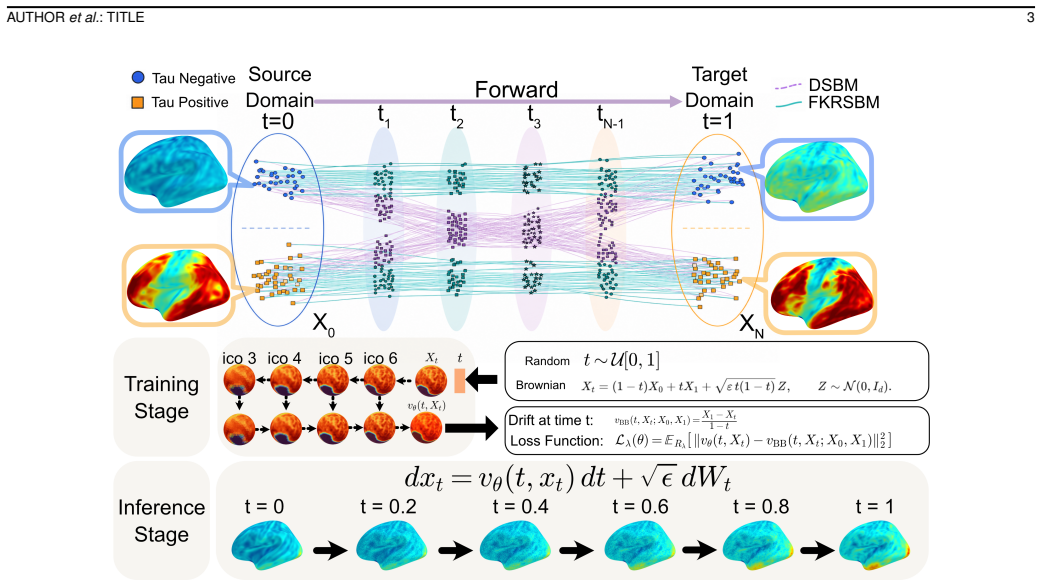
FKRSBM learns a direct stochastic transport process between source and target distributions via entropy-regularized optimal transport. It incorporates a subgroup-aware endpoint proposal derived from a Feynman Kac reweighting of the reference bridge measure, implemented through stratified importance sampling at the data level and requiring no changes to the underlying bridge-matching solver or network architecture. For surface-based neuroimaging, FKRSBM employs a spherical convolutional backbone operating on cortical meshes to perform vertex-level harmonization of tau PET SUVR maps.
What carries the argument
subgroup-aware endpoint proposal derived from Feynman Kac reweighting of the reference bridge measure, implemented through stratified importance sampling
If this is right
- achieves superior distributional alignment compared with ComBat, CycleGAN, a diffusion method, and unregularized DSBM
- reduces tau-positivity sign mismatch
- strengthens APOE subgroup alignment
- improves downstream disease classification performance
Where Pith is reading between the lines
- The approach may generalize to harmonizing other surface-based modalities such as cortical thickness or functional connectivity maps.
- If the reweighting truly isolates biology, the same sampling procedure could be applied to longitudinal within-subject data to reduce scanner drift.
- Clinical trials using tau PET endpoints across centers could adopt the method to increase statistical power without requiring matched subgroup compositions.
Load-bearing premise
The subgroup-aware endpoint proposal derived from Feynman Kac reweighting of the reference bridge measure successfully separates site-induced shifts from biological variation such as tau-positivity status without introducing new biases.
What would settle it
A new multi-site tau PET dataset in which FKRSBM-harmonized maps still exhibit site-specific differences in tau-positivity rates or yield no gain in disease classification accuracy relative to the unharmonized data.
Figures
read the original abstract
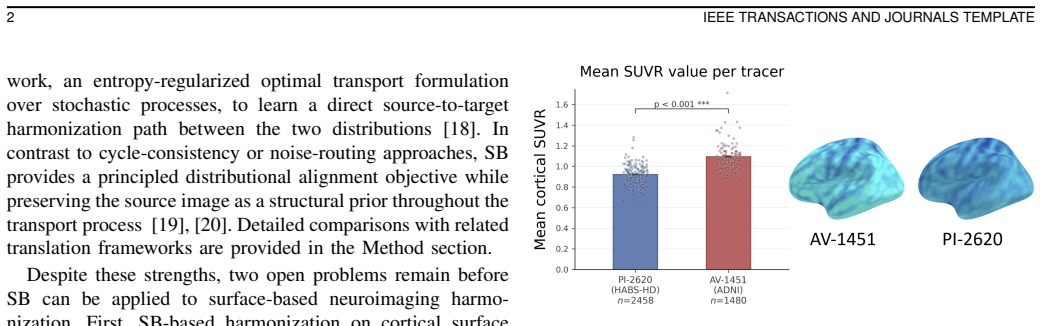
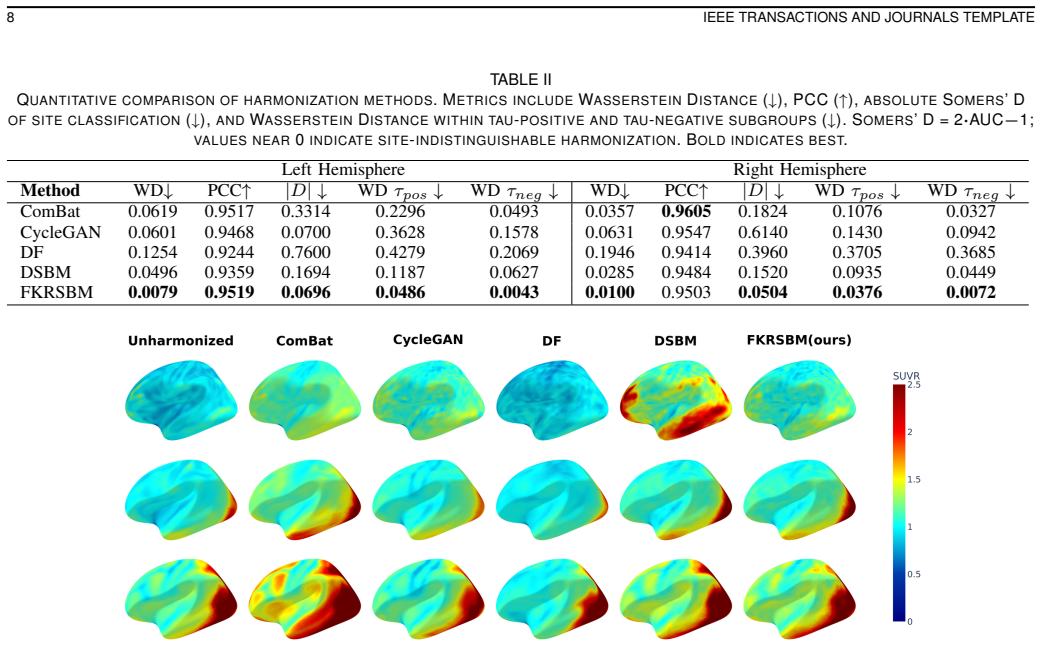
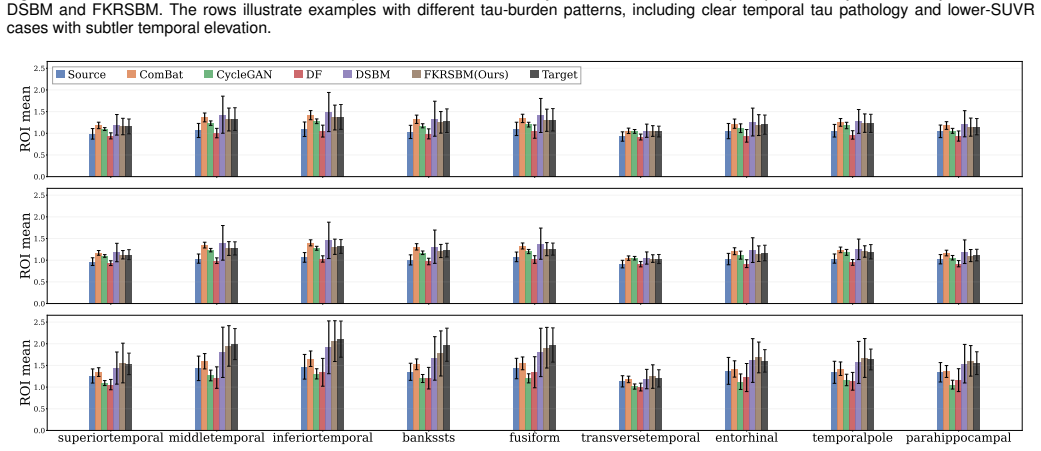
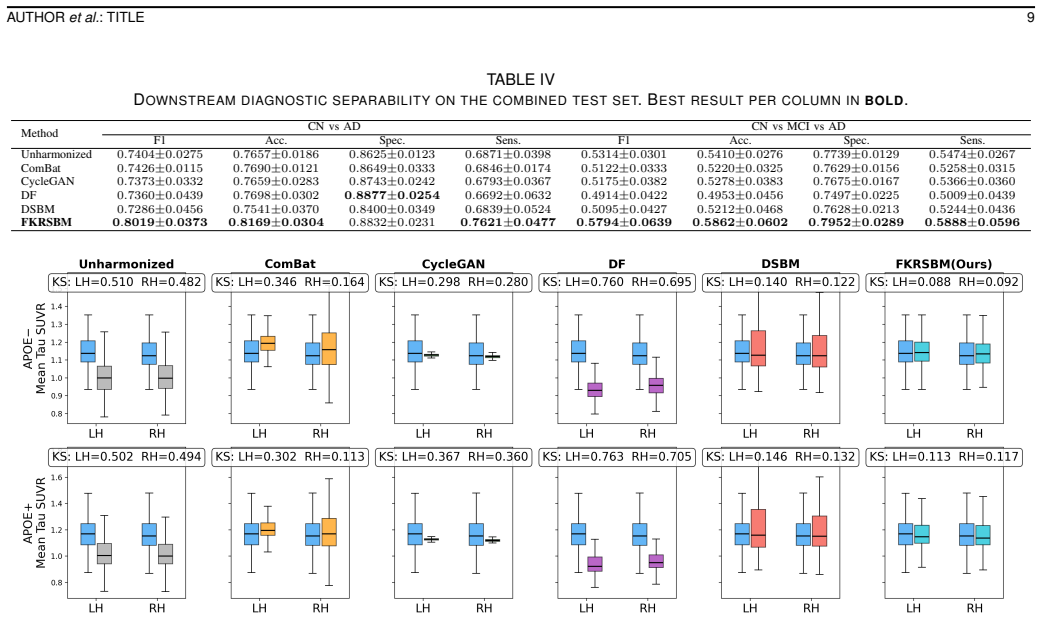
Tau PET imaging is central to tracking Alzheimer's disease progression, but systematic differences between scanners, protocols, and radiotracers across sites introduce nonbiological variability that inflates biomarker variance, reduces sensitivity to disease effects, and can bias downstream clinical assessments. Harmonization methods aim to remove these site-induced shifts while preserving biologically meaningful signal, yet existing approaches struggle when source and target cohorts differ in subgroup composition, risking conflation of site effects with biological variation such as tau-positivity status. We propose the Feynman Kac Reweighted Schr\"oodinger Bridge Matching (FKRSBM) model to address this problem. Rather than routing data through a Gaussian noise prior as in diffusion-based methods, FKRSBM learns a direct stochastic transport process between source and target distributions via entropy-regularized optimal transport. To enforce biologically consistent transport, FKRSBM incorporates a subgroup-aware endpoint proposal derived from a Feynman Kac reweighting of the reference bridge measure, implemented entirely through stratified importance sampling at the data level and requiring no changes to the underlying bridge-matching solver or network architecture. For surface-based neuroimaging, FKRSBM employs a spherical convolutional backbone operating on cortical meshes to perform vertex-level harmonization. We evaluate the method on tau PET SUVR maps, harmonizing PI-2620 data from the HABS-HD cohort into the AV-1451 domain of ADNI. Compared against ComBat, CycleGAN, a diffusion-based method (DF), and unregularized Diffusion Schr\"oodinger Bridge Matching (DSBM), FKRSBM achieves superior distributional alignment, reduced tau-positivity sign mismatch, stronger APOE subgroup alignment, and improved downstream disease classification performance.
Editorial analysis
A structured set of objections, weighed in public.
Referee Report
Summary. The manuscript proposes the Feynman Kac Reweighted Schrödinger Bridge Matching (FKRSBM) model for surface-based tau PET harmonization. It learns a direct entropy-regularized stochastic transport between source (HABS-HD PI-2620) and target (ADNI AV-1451) distributions via Schrödinger Bridge Matching, augmented by a subgroup-aware endpoint proposal obtained from Feynman Kac reweighting of the reference bridge measure and realized through stratified importance sampling at the data level. The approach uses a spherical convolutional network on cortical meshes for vertex-level mapping and is reported to outperform ComBat, CycleGAN, a diffusion baseline (DF), and unregularized DSBM on distributional alignment, tau-positivity sign consistency, APOE subgroup preservation, and downstream disease classification.
Significance. If the central performance claims are supported by the data, the work would offer a practical, architecture-preserving extension of bridge-matching methods that explicitly incorporates subgroup structure to mitigate conflation of site and biological effects in multi-tracer tau PET studies. The data-level implementation of the reweighting is a design choice that could facilitate adoption.
major comments (2)
- [Abstract] Abstract: the claim that the subgroup-aware endpoint proposal 'separates site-induced shifts from biological variation such as tau-positivity status' is load-bearing for the entire contribution. The description states that this is achieved 'entirely through stratified importance sampling at the data level' with 'no changes to the underlying bridge-matching solver or network architecture.' It is therefore unclear whether the reweighting modifies the full path measure of the learned bridge or only the endpoint marginals; if the latter, the stochastic transport may still mix site and subgroup effects, undermining the separation guarantee.
- [Abstract] Abstract (evaluation paragraph): the reported superiority on 'distributional alignment, reduced tau-positivity sign mismatch, stronger APOE subgroup alignment, and improved downstream disease classification' is presented without reference to specific quantitative tables, statistical tests, or error bars. Because these metrics directly support the claim that FKRSBM avoids new biases, the absence of the supporting numerical evidence in the provided manuscript text prevents verification that the improvements are not driven by post-hoc choices or subgroup imbalance.
minor comments (1)
- [Abstract] The abstract refers to 'Feynman Kac Reweighted Schrödinger Bridge Matching' and 'Diffusion Schrödinger Bridge Matching (DSBM)' without an explicit equation or pseudocode block defining the reweighting operator or the importance-sampling weights; a short methods subsection with these definitions would improve reproducibility.
Simulated Author's Rebuttal
We thank the referee for their insightful comments. We address each major comment below with clarifications and indicate where revisions will strengthen the manuscript.
read point-by-point responses
-
Referee: [Abstract] Abstract: the claim that the subgroup-aware endpoint proposal 'separates site-induced shifts from biological variation such as tau-positivity status' is load-bearing for the entire contribution. The description states that this is achieved 'entirely through stratified importance sampling at the data level' with 'no changes to the underlying bridge-matching solver or network architecture.' It is therefore unclear whether the reweighting modifies the full path measure of the learned bridge or only the endpoint marginals; if the latter, the stochastic transport may still mix site and subgroup effects, undermining the separation guarantee.
Authors: The Feynman Kac reweighting adjusts the reference bridge measure to produce subgroup-aware endpoint marginals. The Schrödinger Bridge is then matched directly between these reweighted marginals, so the learned path measure incorporates the subgroup structure throughout the transport rather than only at the endpoints. The data-level stratified importance sampling realizes this reweighting without altering the solver or network. We will revise the abstract to state explicitly that the reweighting influences the full bridge measure via the adjusted marginals. revision: yes
-
Referee: [Abstract] Abstract (evaluation paragraph): the reported superiority on 'distributional alignment, reduced tau-positivity sign mismatch, stronger APOE subgroup alignment, and improved downstream disease classification' is presented without reference to specific quantitative tables, statistical tests, or error bars. Because these metrics directly support the claim that FKRSBM avoids new biases, the absence of the supporting numerical evidence in the provided manuscript text prevents verification that the improvements are not driven by post-hoc choices or subgroup imbalance.
Authors: The abstract summarizes key findings at a high level. Full quantitative results with error bars, statistical tests, and tables appear in the Results section. We will add brief parenthetical references (e.g., 'Table 2') in the abstract to direct readers to the supporting evidence. revision: yes
Circularity Check
No circularity: method introduces independent reweighting via stratified sampling; claims rest on external comparisons
full rationale
The derivation introduces FKRSBM as a direct stochastic transport with a subgroup-aware endpoint proposal implemented through stratified importance sampling at the data level, without altering the bridge-matching solver. Performance claims (distributional alignment, tau-positivity sign mismatch, APOE alignment, downstream classification) are evaluated against external baselines (ComBat, CycleGAN, DF, DSBM) on held-out HABS-HD to ADNI data. No equation or step reduces a claimed prediction to a fitted parameter or self-citation by construction; the reweighting is presented as an additive procedure whose correctness is assessed empirically rather than defined into the result. This is the common case of an independent methodological contribution.
Axiom & Free-Parameter Ledger
axioms (1)
- standard math Entropy-regularized optimal transport yields a valid stochastic transport process between source and target distributions.
Reference graph
Works this paper leans on
-
[1]
Harmonization of multi-site diffusion tensor imaging data,
J.-P. Fortin, D. Parker, B. Tunc ¸, T. Watanabe, M. A. Elliott, K. Ruparel, D. R. Roalf, T. D. Satterthwaite, R. C. Gur, R. E. Gur, R. T. Schultz, R. Verma, and R. T. Shinohara, “Harmonization of multi-site diffusion tensor imaging data,”NeuroImage, vol. 161, pp. 149–170, 2017
2017
-
[2]
Harmonization of cortical thickness measurements across scanners and sites,
J.-P. Fortin, N. Cullen, Y . I. Sheline, W. D. Taylor, I. Aselcioglu, P. A. Cook, P. Adams, C. Cooper, M. Fava, P. J. McGrathet al., “Harmonization of cortical thickness measurements across scanners and sites,”Neuroimage, vol. 167, pp. 104–120, 2018
2018
-
[3]
Adjusting batch effects in mi- croarray expression data using empirical Bayes methods,
W. E. Johnson, C. Li, and A. Rabinovic, “Adjusting batch effects in mi- croarray expression data using empirical Bayes methods,”Biostatistics, vol. 8, no. 1, pp. 118–127, 2007
2007
-
[4]
Machine learning for medical imag- ing: methodological failures and recommendations for the future,
G. Varoquaux and V . Cheplygina, “Machine learning for medical imag- ing: methodological failures and recommendations for the future,”NPJ digital medicine, vol. 5, no. 1, p. 48, 2022
2022
-
[5]
Domain-adversarial training of neural networks,
Y . Ganin, E. Ustinova, H. Ajakan, P. Germain, H. Larochelle, F. Lavi- olette, M. Marchand, and V . Lempitsky, “Domain-adversarial training of neural networks,” inJournal of Machine Learning Research, vol. 17, no. 59, 2016, pp. 1–35
2016
-
[6]
Un- derstanding heterogeneity in clinical cohorts using normative models: Beyond case-control studies,
A. F. Marquand, I. Rezek, J. Buitelaar, and C. F. Beckmann, “Un- derstanding heterogeneity in clinical cohorts using normative models: Beyond case-control studies,”Biological Psychiatry, vol. 80, no. 7, pp. 552–561, 2016
2016
-
[7]
Disentan- gling brain atrophy heterogeneity in Alzheimer’s disease: A deep self- supervised approach with interpretable latent space,
S. Kang, S.-W. Kim, J.-K. Seong, and A. D. N. Initiative, “Disentan- gling brain atrophy heterogeneity in Alzheimer’s disease: A deep self- supervised approach with interpretable latent space,”NeuroImage, vol. 297, p. 120737, 2024
2024
-
[8]
Unpaired image-to-image translation using cycle-consistent adversarial networks,
J.-Y . Zhu, T. Park, P. Isola, and A. A. Efros, “Unpaired image-to-image translation using cycle-consistent adversarial networks,” inProceedings of the IEEE International Conference on Computer Vision (ICCV), 2017
2017
-
[9]
Deepharmony: A deep learning approach to contrast harmonization across scanner changes,
B. E. Dewey, C. Zhao, J. C. Reinhold, A. Carass, K. C. Fitzgerald, E. S. Sotirchos, S. Saidha, J. Oh, D. L. Pham, P. A. Calabresiet al., “Deepharmony: A deep learning approach to contrast harmonization across scanner changes,”Magnetic resonance imaging, vol. 64, pp. 160– 170, 2019
2019
-
[10]
Harmonization of multi-site diffusion mri data via a cycle-consistent adversarial net- work,
C. Zhao, A. Carass, J. Lee, Y . He, and J. L. Prince, “Harmonization of multi-site diffusion mri data via a cycle-consistent adversarial net- work,” inInternational Conference on Medical Image Computing and Computer-Assisted Intervention. Springer, 2019, pp. 159–167
2019
-
[11]
Disentangling factors of variation with cycle-consistent variational auto-encoders,
A. H. Jha, S. Anand, M. Singh, and V . Veeravasarapu, “Disentangling factors of variation with cycle-consistent variational auto-encoders,” arXiv preprint arXiv:1804.10469, 2018
Pith/arXiv arXiv 2018
-
[12]
Scanner invariant representations for weakly supervised domain adaptation with adversarial learning,
D. Moyer, G. Ver Steeg, C. M. Tax, and P. M. Thompson, “Scanner invariant representations for weakly supervised domain adaptation with adversarial learning,” inInternational Conference on Medical Image Computing and Computer-Assisted Intervention. Springer, 2020, pp. 3–13
2020
-
[13]
Information-based disentan- gled representation learning for unsupervised mr harmonization,
L. Zuo, B. E. Dewey, Y . Liu, Y . He, S. D. Newsome, E. M. Mowry, S. M. Resnick, J. L. Prince, and A. Carass, “Information-based disentan- gled representation learning for unsupervised mr harmonization,”IEEE Transactions on Medical Imaging, vol. 40, no. 11, pp. 3095–3107, 2021
2021
-
[14]
Deep learning- based unlearning of dataset bias for mri harmonisation and confound removal,
N. K. Dinsdale, M. Jenkinson, and A. I. Namburete, “Deep learning- based unlearning of dataset bias for mri harmonisation and confound removal,”NeuroImage, vol. 228, p. 117689, 2021
2021
-
[15]
Challenging common assumptions in the unsupervised learning of disentangled representations,
F. Locatello, S. Bauer, M. Lucic, G. Raetsch, S. Gelly, B. Sch ¨olkopf, and O. Bachem, “Challenging common assumptions in the unsupervised learning of disentangled representations,” inInternational Conference on Machine Learning. PMLR, 2019, pp. 4114–4124
2019
-
[16]
Understanding disentangling inβ-vae,
C. P. Burgess, I. Higgins, A. Pal, L. Matthey, N. Watters, G. Desjardins, and A. Lerchner, “Understanding disentangling inβ-vae,”arXiv preprint arXiv:1804.03599, 2018
Pith/arXiv arXiv 2018
-
[17]
Sdedit: Guided image synthesis and editing with stochastic differential equations,
C. Meng, Y . He, Y . Song, J. Song, J. Wu, J.-Y . Zhu, and S. Ermon, “Sdedit: Guided image synthesis and editing with stochastic differential equations,” inInternational Conference on Learning Representations, 2021
2021
-
[18]
Diffusion schr¨odinger bridge with applications to score-based generative model- ing,
V . De Bortoli, J. Thornton, J. Heng, and A. Doucet, “Diffusion schr¨odinger bridge with applications to score-based generative model- ing,” inAdvances in Neural Information Processing Systems (NeurIPS), 2021
2021
-
[19]
I 2sb: Image-to-image schr ¨odinger bridge,
G.-H. Liu, A. Vahdat, D.-A. Huang, E. A. Theodorou, W. Nie, and A. Anandkumar, “I 2sb: Image-to-image schr ¨odinger bridge,” inInter- national Conference on Machine Learning. PMLR, 2023, pp. 21 228– 21 248
2023
-
[20]
Schr ¨odinger bridge flow for unpaired data translation,
V . De Bortoli, I. Korshunova, A. Mnih, and A. Doucet, “Schr ¨odinger bridge flow for unpaired data translation,”arXiv preprint arXiv:2409.09347, 2024
arXiv 2024
-
[21]
Schr ¨odinger bridge for generative AI: Soft-constrained formulation and convergence analysis,
J. Ma, Y . Tan, and R. Xu, “Schr ¨odinger bridge for generative AI: Soft-constrained formulation and convergence analysis,”arXiv preprint arXiv:2510.11829, 2025
arXiv 2025
-
[22]
Spherical deformable u-net: Application to cortical surface parcellation and development prediction,
F. Zhao, Z. Wu, L. Wang, W. Lin, J. H. Gilmore, S. Xia, D. Shen, and G. Li, “Spherical deformable u-net: Application to cortical surface parcellation and development prediction,”IEEE Transactions on Medical Imaging, vol. 40, no. 4, pp. 1217–1228, 2021
2021
-
[23]
Harmonization of cortical thickness measurements across scanners and sites,
J.-P. Fortin, N. Cullen, Y . I. Sheline, W. D. Taylor, I. Aselcioglu, P. A. Cook, P. Adams, C. Cooper, M. Fava, P. J. McGrath, M. McInnis, M. L. Phillips, M. H. Trivedi, M. M. Weissman, and R. T. Shinohara, “Harmonization of cortical thickness measurements across scanners and sites,”NeuroImage, vol. 167, pp. 104–120, 2018. [Online]. Available: https://www...
2018
-
[24]
Tau pet harmonization via surface-based diffusion model,
J. Yue, J. Zhang, L. Zhong, Y . Shi, A. D. N. Initiativeet al., “Tau pet harmonization via surface-based diffusion model,” in2025 IEEE 22nd International Symposium on Biomedical Imaging (ISBI). IEEE, 2025, pp. 1–5
2025
-
[25]
Diffusion schr¨odinger bridge matching,
Y . Shi, V . De Bortoli, A. Campbell, and A. Doucet, “Diffusion schr¨odinger bridge matching,”Advances in Neural Information Process- ing Systems, vol. 36, pp. 62 183–62 223, 2023
2023
-
[26]
Moral,Feynman-Kac formulae: genealogical and interacting particle systems with applications
P. Moral,Feynman-Kac formulae: genealogical and interacting particle systems with applications. Springer, 2004
2004
-
[27]
Billingsley,Probability and Measure, 3rd ed., ser
P. Billingsley,Probability and Measure, 3rd ed., ser. Wiley Series in Probability and Mathematical Statistics. New York: John Wiley & Sons, 1995
1995
-
[28]
The health & aging brain among latino elders (HABLE) study methods and participant characteristics,
S. E. O’Bryantet al., “The health & aging brain among latino elders (HABLE) study methods and participant characteristics,”Alzheimer’s & Dementia: Diagnosis, Assessment & Disease Monitoring, vol. 13, no. 1, p. e12202, 2021
2021
-
[29]
The Alzheimer’s disease neuroimaging initiative,
S. Muelleret al., “The Alzheimer’s disease neuroimaging initiative,” Neuroimaging Clinics of North America, vol. 15, no. 4, pp. 869–877, 11 2005
2005
-
[30]
Cortical surface-based analysis reduces bias and variance in kinetic modeling of brain pet data,
D. N. Greve, C. Svarer, P. M. Fisher, L. Feng, A. E. Hansen, W. Baare, B. Rosen, B. Fischl, and G. M. Knudsen, “Cortical surface-based analysis reduces bias and variance in kinetic modeling of brain pet data,” Neuroimage, vol. 92, pp. 225–236, 2014
2014
-
[31]
Freesurfer,
B. Fischl, “Freesurfer,”Neuroimage, vol. 62, no. 2, pp. 774–781, 2012
2012
-
[32]
Nia- aa research framework: Toward a biological definition of alzheimer’s disease,
C. R. Jack, D. A. Bennett, K. Blennow, M. C. Carrillo, B. Dunn, S. B. Haeberlein, D. M. Holtzman, W. Jagust, F. Jessen, J. Karlawish, E. Liu, J. L. Molinuevo, T. Montine, C. Phelps, K. P. Rankin, C. C. Rowe, P. Scheltens, E. Siemers, H. M. Snyder, and R. Sperling, “Nia- aa research framework: Toward a biological definition of alzheimer’s disease,”Alzheime...
2018
discussion (0)
Sign in with ORCID, Apple, or X to comment. Anyone can read and Pith papers without signing in.