Domain-Validity-Gated Metamorphic Testing of Scientific ML Surrogates
Pith reviewed 2026-06-26 22:21 UTC · model grok-4.3
The pith
A domain-validity rubric screens candidate metamorphic relations to produce auditable, oracle-free test assets for scientific machine-learning surrogates.
A machine-rendered reading of the paper's core claim, the machinery that carries it, and where it could break.
Core claim
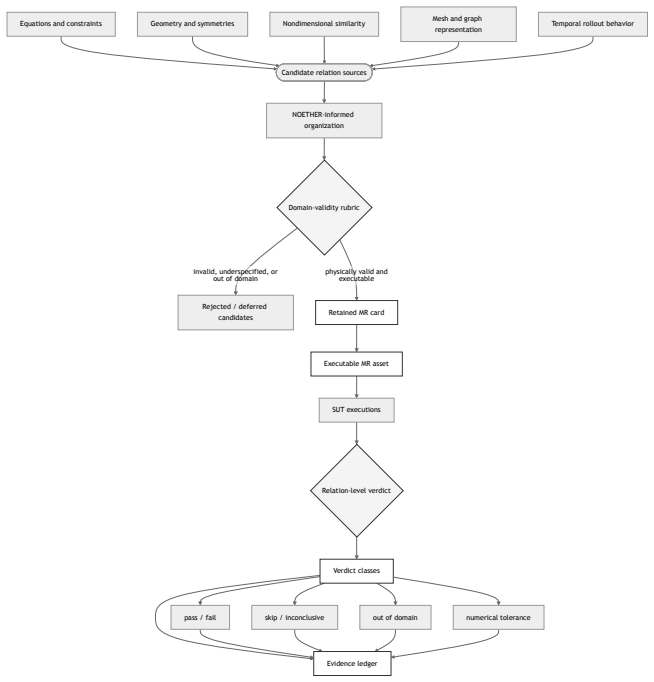
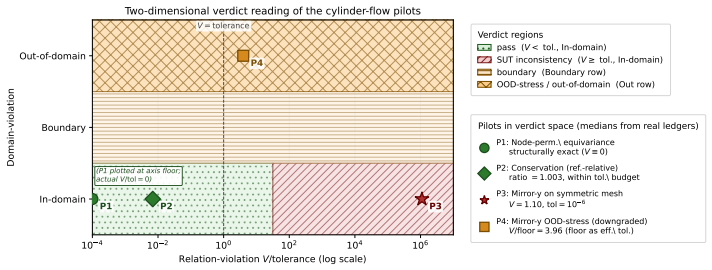
By applying a domain-validity rubric that requires a candidate metamorphic relation's tolerance to dominate the operator's numerical floor and its preconditions to hold, candidate relations can be screened and packaged as executable MR-card assets that yield auditable verdicts distinguishing model violations from out-of-domain applications. On MeshGraphNets cylinder-flow surrogates the rubric admits node permutation to machine precision, classifies mirror-y as a bounded out-of-distribution stress rather than an exact symmetry, and defers absolute conservation while accepting a reference-relative guard. The same pattern holds across trajectories, checkpoints, three further architectures, and
What carries the argument
The domain-validity rubric, which admits a candidate metamorphic relation only when its tolerance dominates the operator's numerical floor and its preconditions hold.
If this is right
- Node-permutation relations pass to machine precision and can be used as stable regression checks on any mesh-based surrogate.
- Mirror symmetry relations are reclassified as out-of-distribution stress tests rather than exact invariants, changing how symmetry violations are interpreted.
- Conservation relations remain deferred until a reference-relative guard is added, showing that the rubric forces explicit handling of numerical floors.
- The same admit/reject decisions transfer across architectures and libraries, indicating the rubric is not tied to one surrogate implementation.
Where Pith is reading between the lines
- The rubric could be extended to automatically compute numerical floors from ensemble runs rather than requiring a separate calibration set.
- MR-cards could serve as portable test suites that travel with published surrogate checkpoints, enabling third-party audit without access to training data.
- If the rubric rejects a relation on physical grounds, the same logic might flag input regions where the surrogate itself should refuse to predict.
Load-bearing premise
The rubric correctly decides when a relation's tolerance exceeds numerical noise and its preconditions are satisfied, so that detected violations reflect model behavior rather than domain mismatch.
What would settle it
Apply the rubric to a relation whose tolerance is just above the measured numerical floor on a held-out trajectory; if the rubric admits it yet the relation still flags violations that disappear when the same inputs are run with a higher-fidelity reference solver, the screening step is not isolating meaningful model errors.
Figures
read the original abstract
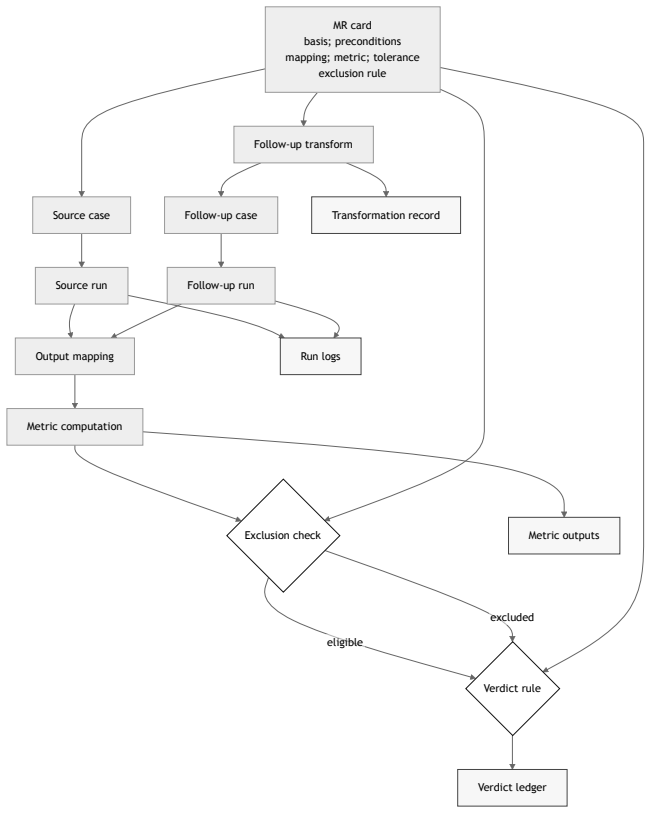
Scientific machine-learning (SciML) surrogates approximate expensive simulations, but exact expected outputs for arbitrary inputs are unavailable (the oracle problem). Metamorphic testing checks relations across executions, yet a candidate relation is not automatically valid: its preconditions, output mapping, and the numerical floor of the scoring operator determine whether a violation is meaningful. We study how candidate metamorphic relations (MRs) can be screened for domain validity and turned into executable, oracle-free test assets for SciML surrogates. We propose (i) a domain-validity rubric that admits a candidate only when its tolerance dominates the operator's numerical floor and its preconditions hold; (ii) an MR-card executable-asset format recording source cases, transformations, metrics, tolerances, and typed relation-level verdicts; and (iii) a case-study protocol on MeshGraphNets cylinder-flow surrogates, with a claim ledger binding every result to a tracked artifact. On a MeshGraphNets checkpoint, node permutation holds to machine precision, mirror-y is a bounded out-of-distribution stress finding rather than an exact symmetry, and absolute conservation stays deferred while a reference-relative guard passes. The same readings hold across held-out trajectories, a checkpoint roster, three further architectures, and PhysicsNeMo. On a second CFD task (compressible airfoil) the predicate instead rejects incompressible continuity on physical grounds, showing it reasons about domain validity rather than running a fixed checklist. On a second PDE family, FNO Burgers and heat surrogates run full admit/reject/execute verdicts. The evidence spans two CFD tasks and a second PDE family, supporting a validity-aware bridge from candidate MRs to auditable SciML test assets that separates model-level violations from out-of-domain applications.
Editorial analysis
A structured set of objections, weighed in public.
Referee Report
Summary. The paper proposes a domain-validity rubric to screen candidate metamorphic relations (MRs) for SciML surrogates so that only those whose tolerance exceeds the numerical floor of the scoring operator and whose preconditions hold are admitted as executable test assets. It introduces an MR-card format recording source cases, transformations, metrics, tolerances and verdicts, together with a claim-ledger protocol for traceability. Case studies on MeshGraphNets cylinder-flow surrogates, a compressible-airfoil task, and FNO Burgers/heat surrogates show the rubric admitting node-permutation and mirror-y relations while rejecting incompressible continuity on physical grounds for the compressible case, with consistent readings across checkpoints and architectures.
Significance. If the rubric can be shown to operate as a reproducible, executable predicate rather than author-mediated judgment, the work supplies a practical, oracle-free route to auditable test assets that distinguishes model-level violations from domain mismatch. The claim ledger and multi-architecture, multi-task validation are concrete strengths that support reproducibility claims.
major comments (2)
- [Abstract] Abstract: the central claim that the rubric 'reasons about domain validity rather than running a fixed checklist' rests on the rejection of incompressible continuity for the compressible airfoil 'on physical grounds.' No derivation of the rubric criteria, no quantitative false-positive-rate validation, and no error analysis are supplied; without these the separation of violation types cannot be shown to be mechanical rather than expert-mediated.
- [Methods / rubric definition] The weakest assumption identified in the stress-test note is load-bearing: if precondition evaluation remains an author-mediated step rather than an executable predicate on the MR-card, then the screening process does not fully achieve the claimed auditability and the reported separation of model violations from domain mismatch is not reproducible from the artifacts alone.
minor comments (2)
- The MR-card format is described at a high level; an explicit schema or example JSON would improve executability.
- Figure captions should explicitly link each plotted quantity to the corresponding claim-ledger entry.
Simulated Author's Rebuttal
We thank the referee for the constructive report. The comments correctly identify areas where the manuscript must demonstrate that the rubric operates as a mechanical predicate. We respond point-by-point and commit to revisions that strengthen reproducibility without overstating current evidence.
read point-by-point responses
-
Referee: [Abstract] Abstract: the central claim that the rubric 'reasons about domain validity rather than running a fixed checklist' rests on the rejection of incompressible continuity for the compressible airfoil 'on physical grounds.' No derivation of the rubric criteria, no quantitative false-positive-rate validation, and no error analysis are supplied; without these the separation of violation types cannot be shown to be mechanical rather than expert-mediated.
Authors: We agree the abstract claim is insufficiently supported. Section 3.2 defines the rubric as the conjunction of two executable checks: (tolerance > numerical_floor of the scoring operator) AND (all listed preconditions evaluate true on the MR-card metadata). The compressible-airfoil rejection occurs because the precondition 'flow_regime == incompressible' is false for the compressible task; this is a direct evaluation of a card field, not runtime expert judgment. However, the manuscript supplies neither an explicit derivation of the predicate nor quantitative false-positive-rate or error analysis. We will revise the abstract to remove the overstated phrasing, add a formal predicate definition with pseudocode in Methods, and note the absence of FPR validation as a limitation. Full quantitative validation would require new experiments outside the present scope. revision: partial
-
Referee: [Methods / rubric definition] The weakest assumption identified in the stress-test note is load-bearing: if precondition evaluation remains an author-mediated step rather than an executable predicate on the MR-card, then the screening process does not fully achieve the claimed auditability and the reported separation of model violations from domain mismatch is not reproducible from the artifacts alone.
Authors: The MR-card schema (Section 4) records preconditions as typed, machine-readable predicates (boolean metadata checks or input-property tests). The screening function is therefore intended to be an executable predicate over card fields. The case-study rejections (including the compressible-airfoil example) are produced by applying this predicate to the stored cards. The stress-test note flags the risk of author mediation; the current artifacts do not yet include runnable code for the predicate itself. We will add explicit pseudocode and a reference implementation of the screening function to the revised Methods, together with the claim-ledger entries that bind each verdict to a specific card evaluation. This change makes the process reproducible from the artifacts alone. revision: yes
Circularity Check
No circularity: framework applies independent screening to existing surrogates
full rationale
The paper introduces a domain-validity rubric and MR-card format as new executable assets for screening candidate metamorphic relations on SciML surrogates. The abstract and case-study descriptions present these as external layers applied to pre-existing checkpoints (MeshGraphNets, FNO, PhysicsNeMo) without any equations, fitted parameters, or claims that reduce by construction to the inputs. No self-citations are invoked as load-bearing uniqueness theorems, no ansatzes are smuggled, and no predictions are statistically forced from subsets of the same data. The separation of model violations from domain mismatch is achieved by explicit precondition checks and tolerance comparisons that are defined independently of the test outcomes themselves. This is the normal case of a methodological proposal that remains self-contained against external benchmarks.
Axiom & Free-Parameter Ledger
axioms (1)
- domain assumption Candidate metamorphic relations possess definable preconditions, output mappings, and a numerical floor for the scoring operator that can be compared against tolerance.
Reference graph
Works this paper leans on
-
[1]
author Baral, S. , author Lee, Y. , author Khanal, S. , author Jeon, J. , year 2026 . title Xrepit: A deep learning-computational fluid dynamics hybrid framework implemented in openfoam for fast, robust, and scalable unsteady simulations . journal Computers & Fluids volume 314 , pages 107075 . :10.1016/j.compfluid.2026.107075
-
[2]
Yann Dubois, Balázs Galambosi, Percy Liang, and Tatsunori B
author Barr, E.T. , author Harman, M. , author McMinn, P. , author Shahbaz, M. , author Yoo, S. , year 2015 . title The oracle problem in software testing: A survey . journal IEEE Transactions on Software Engineering volume 41 , pages 507--525 . :10.1109/TSE.2014.2372785
-
[3]
, author Cheung, S.C
author Chen, T.Y. , author Cheung, S.C. , author Yiu, S.M. , year 1998 . title Metamorphic Testing: A New Approach for Generating Next Test Cases . type Technical Report number HKUST-CS98-01 . The Hong Kong University of Science and Technology
1998
-
[4]
author Chen, T.Y. , author Kuo, F.C. , author Liu, H. , author Poon, P.L. , author Towey, D. , author Tse, T.H. , author Zhou, Z.Q. , year 2018 . title Metamorphic testing: A review of challenges and opportunities . journal ACM Computing Surveys volume 51 , pages 4:1--4:27 . :10.1145/3143561
-
[5]
author Duque-Torres, A. , author Pfahl, D. , author Klammer, C. , author Fischer, S. , year 2023 a. title Bug or not bug? analysing the reasons behind metamorphic relation violations , in: booktitle Proceedings of the 2023 IEEE International Conference on Software Analysis, Evolution and Reengineering (SANER) . :10.1109/SANER56733.2023.00080
-
[6]
author Duque-Torres, A. , author Pfahl, D. , author Klammer, C. , author Fischer, S. , year 2023 b. title Exploring a test data-driven method for selecting and constraining metamorphic relations . :10.48550/arXiv.2307.15522, http://arxiv.org/abs/2307.15522 arXiv:2307.15522
-
[7]
author Duque-Torres, A. , author Pfahl, D. , author Klammer, C. , author Fischer, S. , year 2023 c. title Towards a complete metamorphic testing pipeline . :10.48550/arXiv.2310.00338, http://arxiv.org/abs/2310.00338 arXiv:2310.00338
-
[8]
author Eniser, H.F. , author Gros, T.P. , author W\"ustholz, V. , author Hoffmann, J. , author Christakis, M. , year 2022 . title Metamorphic relations via relaxations: An approach to obtain oracles for action-policy testing , in: booktitle Proceedings of the 31st ACM SIGSOFT International Symposium on Software Testing and Analysis (ISSTA) , pp. pages 52-...
-
[9]
author Gopakumar, V. , author Gray, A. , author Zanisi, L. , author Nunn, T. , author Pamela, S. , author Giles, D. , author Kusner, M.J. , author Deisenroth, M.P. , year 2025 . title Calibrated physics-informed uncertainty quantification , in: booktitle Proceedings of the 42nd International Conference on Machine Learning (ICML) . :10.48550/arXiv.2502.044...
-
[10]
author Hiremath, D.J. , author Claus, M. , author Hasselbring, W. , author Rath, W. , year 2021 . title Towards automated metamorphic test identification for ocean system models , in: booktitle 2021 IEEE/ACM 6th International Workshop on Metamorphic Testing , pp. pages 31--35 . :10.1109/MET52542.2021.00014, http://arxiv.org/abs/2103.09782 arXiv:2103.09782
-
[11]
author Kanewala, U. , author Bieman, J.M. , year 2019 . title Metamorphic testing of scientific software: A machine learning approach . journal Journal of Software: Evolution and Process volume 31 , pages e1894 . :10.1002/smr.1894
-
[12]
author Kanewala, U. , author Bieman, J.M. , author Ben-Hur, A. , year 2016 . title Predicting metamorphic relations for testing scientific software: A machine learning approach using graph kernels . journal Software Testing, Verification and Reliability volume 26 , pages 245--269 . :10.1002/stvr.1594
-
[13]
Kevrekidis, Lu Lu, Paris Perdikaris, Sifan Wang, and Liu Yang
author Karniadakis, G.E. , author Kevrekidis, I.G. , author Lu, L. , author Perdikaris, P. , author Wang, S. , author Yang, L. , year 2021 . title Physics-informed machine learning . journal Nature Reviews Physics volume 3 , pages 422--440 . :10.1038/s42254-021-00314-5
-
[14]
, author Gholami, A
author Krishnapriyan, A.S. , author Gholami, A. , author Zhe, S. , author Kirby, R.M. , author Mahoney, M.W. , year 2021 . title Characterizing possible failure modes in physics-informed neural networks , in: booktitle Advances in Neural Information Processing Systems , pp. pages 26548--26560
2021
-
[15]
author Li, M. , author Yang, X. , author Liu, J. , author Yan, S. , year 2026 . title Noether: A constructive framework for metamorphic pattern discovery from operator algebras . :10.48550/arXiv.2605.17390, http://arxiv.org/abs/2605.17390 arXiv:2605.17390
-
[16]
, author Kovachki, N
author Li, Z. , author Kovachki, N. , author Azizzadenesheli, K. , author Liu, B. , author Bhattacharya, K. , author Stuart, A. , author Anandkumar, A. , year 2021 . title Fourier neural operator for parametric partial differential equations , in: booktitle International Conference on Learning Representations
2021
-
[17]
author Lin, Q. , author Kuo, F.C. , author Liu, H. , author Poon, P.L. , author Chen, T.Y. , author Tse, T.H. , year 2020 . title Exploratory metamorphic testing for scientific software . journal Computing in Science and Engineering volume 22 , pages 78--89 . :10.1109/MCSE.2018.2880577
-
[18]
author Mandrioli, C. , author Shin, S.Y. , author Bianculli, D. , author Briand, L. , year 2025 . title Testing cps with design assumptions-based metamorphic relations and genetic programming . journal IEEE Transactions on Software Engineering volume 51 , pages 1666--1684 . :10.1109/TSE.2025.3563121
-
[19]
author Olsen, P.C. , author Raunak, M.S. , author Rothermel, G. , year 2019 . title Increasing validity and reliability in simulation-based testing . journal IEEE Transactions on Reliability volume 68 , pages 1322--1337 . :10.1109/TR.2019.2906504
-
[20]
author Pfaff, T. , author Fortunato, M. , author Sanchez-Gonzalez, A. , author Battaglia, P.W. , year 2021 . title Learning mesh-based simulation with graph networks , in: booktitle International Conference on Learning Representations . :10.48550/arXiv.2010.03409, http://arxiv.org/abs/2010.03409 arXiv:2010.03409
-
[21]
author Raissi, M. , author Perdikaris, P. , author Karniadakis, G.E. , year 2019 . title Physics-informed neural networks: A deep learning framework for solving forward and inverse problems involving nonlinear partial differential equations . journal Journal of Computational Physics volume 378 , pages 686--707 . :10.1016/j.jcp.2018.10.045
-
[22]
, et al., year 2021
author Ralph, P. , et al., year 2021 . title Empirical standards for software engineering research . howpublished ACM SIGSOFT . note https://github.com/acmsigsoft/EmpiricalStandards
2021
-
[23]
author Raunak, M.S. , author Olsen, P.C. , author Simko, G. , author Kuhn, D.R. , year 2021 . title A continuum of oracles for testing scientific software , in: booktitle 2021 IEEE/ACM 6th International Workshop on Metamorphic Testing , pp. pages 18--25 . :10.1109/MET52542.2021.00015
-
[24]
author Reichert, M. , author Bouaziz, L. , author Verbeke, B. , author Eberle, C. , author Kratzert, F. , author Klotz, D. , author Gauch, M. , author Schulz, K. , author Hofmann, T. , author Holzleitner, M. , author Klambauer, G. , author Hochreiter, S. , author Nearing, G. , author Gnann, S. , year 2024 . title Metamorphic testing of machine learning an...
-
[25]
author Segura, S. , author Fraser, G. , author Sanchez, A.B. , author Ruiz-Cortes, A. , year 2016 . title A survey on metamorphic testing . journal IEEE Transactions on Software Engineering volume 42 , pages 805--824 . :10.1109/TSE.2016.2532875
-
[26]
author Verdecchia, R. , author Engstr \"o m, E. , author Lago, P. , author Runeson, P. , author Song, Q. , year 2023 . title Threats to validity in software engineering research: A critical reflection . journal Information and Software Technology volume 164 , pages 107329 . :10.1016/j.infsof.2023.107329
-
[27]
SIAM Journal on Scientific Computing 43, A3055–A3081
author Wang, S. , author Teng, Y. , author Perdikaris, P. , year 2021 . title Understanding and mitigating gradient flow pathologies in physics-informed neural networks . journal SIAM Journal on Scientific Computing volume 43 , pages A3055--A3081 . :10.1137/20M1318043
-
[28]
author Wang, W. , author Hakimzadeh, M. , author Ruan, H. , author Goswami, S. , year 2025 . title Time-marching neural operator-finite element coupling: Ai-accelerated physics modeling . journal Computer Methods in Applied Mechanics and Engineering volume 446 , pages 118319 . :10.1016/j.cma.2025.118319
-
[29]
author Xie, X. , author Ho, J.W.K. , author Murphy, C. , author Kaiser, G. , author Xu, B. , author Chen, T.Y. , year 2011 . title Testing and validating machine learning classifiers by metamorphic testing . journal Journal of Systems and Software volume 84 , pages 544--558 . :10.1016/j.jss.2010.11.920
-
[30]
author Yang, X.h. , author Yan, S.y. , author Liu, J. , author Li, M. , year 2020 . title Hierarchical classification model for metamorphic relations of scientific computing programs . journal Computer Science volume 47 , pages 557--561 . :10.11896/jsjkx.200200015
discussion (0)
Sign in with ORCID, Apple, or X to comment. Anyone can read and Pith papers without signing in.