Asymptotically Optimal Circuit Depth for Diagonal Unitary Synthesis and Compilation on Two-Dimensional Grids
Pith reviewed 2026-06-27 00:55 UTC · model grok-4.3
The pith
Gray-Path Framework synthesizes and compiles any diagonal unitary to optimal O(2^n/n) depth on 2D grids.
A machine-rendered reading of the paper's core claim, the machinery that carries it, and where it could break.
Core claim
Any n-qubit diagonal unitary can be realized in asymptotically optimal Rz and CNOT depth O(2^n/n) by the Gray-Path Framework. When this framework is compiled to a two-dimensional nearest-neighbor grid, the routing cost is also Θ(2^n/n) depth and Θ(2^n) gate count because the interaction structure is predetermined, allowing exact scheduling without search. The result holds with or without ancillas and on linear chains as well.
What carries the argument
The Gray-Path Framework, a construction that encodes the diagonal unitary into a fixed sequence of phase and entangling gates whose interaction graph can be routed deterministically on grid hardware.
Load-bearing premise
The Gray-Path Framework can fix the complete sequence of gates and interactions for synthesizing any given diagonal unitary in advance.
What would settle it
Finding an n-qubit diagonal unitary for which no circuit of depth o(2^n/n) exists on a 2D grid, or showing that GPF routing on the grid requires more than Θ(2^n/n) depth for some unitaries.
Figures






read the original abstract
Diagonal unitaries are a fundamental but resource-intensive class of quantum operations, arising as the phase separators of QAOA and the time-evolution blocks of Hamiltonian simulation. Under all-to-all connectivity their optimal depth is established, but on nearest-neighbor hardware general-purpose compilers fall back on heuristic search, which yields no analyzable cost bound and becomes intractable at the very sizes where depth is the bottleneck. We address synthesis and compilation jointly. On the synthesis side, we develop a Gray-Path Framework (GPF) that realizes any $n$-qubit diagonal unitary in asymptotically optimal $R_z$ and CNOT depth $O(2^n/n)$ without ancillas. Our main result is that compiling GPF onto a two-dimensional nearest-neighbor grid preserves this optimality: routing adds depth $\Theta(2^n/n)$ and gate count $\Theta(2^n)$. Because GPF fixes its entire interaction structure in advance, routing reduces to scheduling a known sequence, with no heuristic search. We give the construction both with and without ancillas: the ancilla-free, cost-optimized layout is a two-row grid, and a $2k$-row layout introduces a space--time tradeoff that cuts depth by $1/k$ while remaining asymptotically optimal for the enlarged register; both are deterministic and analyzed in closed form. The same complexity is also attained on a linear nearest-neighbor chain, so the preservation is topology-independent, holding on any architecture that contains such a chain. All routing bounds are closed-form, giving the concrete resource estimates that heuristic compilers cannot provide at scale.
Editorial analysis
A structured set of objections, weighed in public.
Referee Report
Summary. The paper introduces the Gray-Path Framework (GPF) for synthesizing arbitrary n-qubit diagonal unitaries in asymptotically optimal O(2^n/n) depth using Rz and CNOT gates without ancillas under all-to-all connectivity. Its central result is that the fixed, predetermined interaction sequence of GPF permits deterministic routing onto a 2D nearest-neighbor grid (or linear chain) whose overhead remains heta(2^n/n) in depth and heta(2^n) in gate count, thereby preserving optimality; closed-form analyses are given for both an ancilla-free two-row layout and a 2k-row space-time tradeoff.
Significance. If the constructions and closed-form bounds hold, the work supplies the first rigorous, analyzable compilation strategy for diagonal unitaries on nearest-neighbor hardware that matches the known all-to-all optimum up to constants. The topology independence within any architecture containing a chain, together with the elimination of heuristic search, constitutes a concrete advance over existing compilers.
minor comments (2)
- [Abstract] Abstract: the phrase 'all routing bounds are closed-form' would be strengthened by an explicit forward reference to the theorem or proposition that states the leading-term expressions for the 2D and chain cases.
- The manuscript would benefit from one additional sentence in the introduction clarifying how the GPF interaction sequence is generated from the target diagonal phases, to make the 'fixed in advance' property immediately verifiable.
Simulated Author's Rebuttal
We thank the referee for the positive summary, significance assessment, and recommendation of minor revision. No major comments appear in the provided report, so we have no specific points requiring rebuttal or revision at this stage.
Circularity Check
No significant circularity identified
full rationale
The derivation relies on explicit constructions of the Gray-Path Framework (GPF) for O(2^n/n) depth synthesis of diagonal unitaries under all-to-all connectivity, followed by closed-form deterministic scheduling arguments that bound routing overhead on 2D grids or chains by the same leading term. No equations reduce a claimed prediction to a fitted parameter by construction, no load-bearing premises depend on self-citations, and the fixed-sequence property converts routing to a scheduling task whose cost is analyzed independently of the target asymptotic result. The paper is self-contained against external benchmarks with no self-referential definitions or ansatzes smuggled via prior work.
Axiom & Free-Parameter Ledger
axioms (2)
- standard math Quantum circuit depth is measured in Rz and CNOT gates under the standard gate set
- domain assumption Hardware supports only nearest-neighbor interactions on a 2D grid or linear chain
Reference graph
Works this paper leans on
-
[1]
A quantum approximate optimization algorithm,
E. Farhi, J. Goldstone, and S. Gutmann, “A quantum approximate optimization algorithm,” 2014
2014
-
[2]
Classical simulation of commuting quantum computations implies collapse of the polynomial hierarchy,
M. J. Bremner, R. Jozsa, and D. J. Shepherd, “Classical simulation of commuting quantum computations implies collapse of the polynomial hierarchy,”Proceedings of the Royal Society A: Mathematical, Physical and Engineering Sciences, vol. 467, no. 2126, pp. 459–472, 2011
2011
-
[3]
Efficient quantum circuits for diagonal unitaries without ancillas,
J. Welch, D. Greenbaum, S. Mostame, and A. Aspuru-Guzik, “Efficient quantum circuits for diagonal unitaries without ancillas,”New Journal of Physics, vol. 16, no. 3, p. 033040, 2014
2014
-
[4]
Asymptotically optimal circuit depth for quantum state preparation and general unitary synthesis,
X. Sun, G. Tian, S. Yang, P. Yuan, and S. Zhang, “Asymptotically optimal circuit depth for quantum state preparation and general unitary synthesis,”IEEE Transactions on Computer-Aided Design of Integrated Circuits and Systems, vol. 42, no. 10, pp. 3301–3314, 2023
2023
-
[5]
Depth-optimized quantum circuit synthesis for diagonal unitary operators with asymptotically optimal gate count,
S. Zhang, K. Huang, and L. Li, “Depth-optimized quantum circuit synthesis for diagonal unitary operators with asymptotically optimal gate count,”Physical Review A, vol. 109, no. 4, p. 042601, 2024
2024
-
[6]
Quantum circuit synthesis and compilation optimization: Overview and prospects,
G. Yan, W. Wu, Y . Chen, K. Pan, X. Lu, Z. Zhou, Y . Wang, R. Wang, and J. Yan, “Quantum circuit synthesis and compilation optimization: Overview and prospects,” 2024
2024
-
[7]
Tackling the qubit mapping problem for NISQ-era quantum devices,
G. Li, Y . Ding, and Y . Xie, “Tackling the qubit mapping problem for NISQ-era quantum devices,” inProceedings of the 24th International Conference on Architectural Support for Programming Languages and Operating Systems (ASPLOS ’19), 2019, pp. 1001–1014
2019
-
[8]
Synthesis of quantum- logic circuits,
V . V . Shende, S. S. Bullock, and I. L. Markov, “Synthesis of quantum- logic circuits,”IEEE Transactions on Computer-Aided Design of Inte- grated Circuits and Systems, vol. 25, no. 6, pp. 1000–1010, 2006
2006
-
[9]
Asymptotically optimal circuits for arbitrary n-qubit diagonal computations,
S. S. Bullock and I. L. Markov, “Asymptotically optimal circuits for arbitrary n-qubit diagonal computations,”Quantum Information & Computation, vol. 4, no. 1, pp. 27–47, 2004
2004
-
[10]
On the controlled-NOT complexity of controlled-NOT-phase circuits,
M. Amy, P. Azimzadeh, and M. Mosca, “On the controlled-NOT complexity of controlled-NOT-phase circuits,”Quantum Science and Technology, vol. 4, no. 1, p. 015002, 2018
2018
-
[11]
Phase polynomi- als synthesis algorithms for NISQ architectures and beyond,
V . Vandaele, S. Martiel, and T. Goubault de Brugi `ere, “Phase polynomi- als synthesis algorithms for NISQ architectures and beyond,”Quantum Science and Technology, vol. 7, no. 4, p. 045027, 2022
2022
-
[12]
Quantum simulation of electronic structure with linear depth and connectivity,
I. D. Kivlichan, J. McClean, N. Wiebe, C. Gidney, A. Aspuru-Guzik, G. K.-L. Chan, and R. Babbush, “Quantum simulation of electronic structure with linear depth and connectivity,”Physical Review Letters, vol. 120, no. 11, p. 110501, 2018
2018
-
[13]
Generalized swap networks for near-term quantum computing,
B. O’Gorman, W. J. Huggins, E. G. Rieffel, and K. B. Whaley, “Generalized swap networks for near-term quantum computing,” 2019
2019
-
[14]
Improved qubit routing for QAOA circuits,
A. Kotil, F. ˇSimkovic, and M. Leib, “Improved qubit routing for QAOA circuits,” 2023
2023
-
[15]
Compiler optimizations for QAOA,
Y . Zhu, Y . Zhou, J. Cheng, Y . Jin, B. Li, S. Niu, and Z. Liang, “Compiler optimizations for QAOA,” inProceedings of the 43rd IEEE/ACM Inter- national Conference on Computer-Aided Design (ICCAD ’24), 2024, pp. 1–7
2024
-
[16]
Optimized SW AP networks with equivalent circuit averaging for QAOA,
A. Hashim, R. Rines, V . Omole, R. K. Naik, J. M. Kreikebaum, D. I. Santiago, F. T. Chong, I. Siddiqi, and P. Gokhale, “Optimized SW AP networks with equivalent circuit averaging for QAOA,”Physical Review Research, vol. 4, p. 033028, 2022
2022
-
[17]
Optimizing QAOA circuit transpilation with parity twine and SW AP network encodings,
J. A. Monta ˜nez-Barrera, Y . Ji, M. R. von Spakovsky, D. E. Bernal Neira, and K. Michielsen, “Optimizing QAOA circuit transpilation with parity twine and SW AP network encodings,” 2025
2025
-
[18]
A structured method for compilation of QAOA circuits in quantum computing,
Y . Jin, J. Luo, L. Fong, Y . Chen, A. B. Hayes, C. Zhang, F. Hua, and E. Z. Zhang, “A structured method for compilation of QAOA circuits in quantum computing,” 2021
2021
-
[19]
CNOT circuit extraction for topologically-constrained quantum memories,
A. Kissinger and A. Meijer-van de Griend, “CNOT circuit extraction for topologically-constrained quantum memories,”Quantum Information & Computation, vol. 20, no. 7&8, pp. 581–596, 2020
2020
-
[20]
Quantum circuit optimizations for NISQ architectures,
B. Nash, V . Gheorghiu, and M. Mosca, “Quantum circuit optimizations for NISQ architectures,”Quantum Science and Technology, vol. 5, no. 2, p. 025010, 2020
2020
-
[21]
Dynamic qubit routing with CNOT circuit synthesis for quantum compilation,
A. Meijer-van de Griend and S. M. Li, “Dynamic qubit routing with CNOT circuit synthesis for quantum compilation,” inProceedings of the 19th International Conference on Quantum Physics and Logic (QPL 2022), ser. Electronic Proceedings in Theoretical Computer Science, vol. 394, 2023
2022
-
[22]
Reducing the depth of linear reversible quantum circuits,
T. Goubault de Brugi `ere, M. Baboulin, B. Valiron, S. Martiel, and C. Allouche, “Reducing the depth of linear reversible quantum circuits,” IEEE Transactions on Quantum Engineering, vol. 2, pp. 1–22, 2021
2021
-
[23]
Does qubit connectivity impact quantum circuit complexity?
P. Yuan, J. Allcock, and S. Zhang, “Does qubit connectivity impact quantum circuit complexity?”IEEE Transactions on Computer-Aided Design of Integrated Circuits and Systems, vol. 43, no. 2, pp. 520–533, 2024
2024
-
[24]
Optimization of CNOT circuits on limited-connectivity architecture,
B. Wu, X. He, S. Yang, L. Shou, G. Tian, J. Zhang, and X. Sun, “Optimization of CNOT circuits on limited-connectivity architecture,” Physical Review Research, vol. 5, no. 1, p. 013065, 2023
2023
-
[25]
Optimal space-depth trade-off of CNOT circuits in quantum logic synthesis,
J. Jiang, X. Sun, S.-H. Teng, B. Wu, K. Wu, and J. Zhang, “Optimal space-depth trade-off of CNOT circuits in quantum logic synthesis,” in Proceedings of the 2020 ACM-SIAM Symposium on Discrete Algorithms (SODA), 2020, pp. 213–229
2020
-
[26]
ZAP: Zoned architecture and performant compiler for field programmable atom array,
C.-H. Huang, X. Zhao, H.-Z. Xu, W. Zhuang, M.-J. Hu, D. E. Liu, and J. Wang, “ZAP: Zoned architecture and performant compiler for field programmable atom array,”IEEE Transactions on Quantum Engineer- ing, 2026, early access
2026
-
[27]
Efficient quantum circuits for non-unitary and unitary diagonal operators with space-time-accuracy trade-offs,
J. Zylberman, U. Nzongani, A. Simonetto, and F. Debbasch, “Efficient quantum circuits for non-unitary and unitary diagonal operators with space-time-accuracy trade-offs,”ACM Transactions on Quantum Com- puting, vol. 6, no. 2, pp. 1–43, 2025
2025
-
[28]
Optimal synthesis of linear reversible circuits,
K. N. Patel, I. L. Markov, and J. P. Hayes, “Optimal synthesis of linear reversible circuits,”Quantum Information & Computation, vol. 8, no. 3–4, pp. 282–294, 2008
2008
-
[29]
Quan- tum circuits for general multiqubit gates,
M. M ¨ott¨onen, J. J. Vartiainen, V . Bergholm, and M. M. Salomaa, “Quan- tum circuits for general multiqubit gates,”Physical Review Letters, vol. 93, no. 13, p. 130502, 2004
2004
-
[30]
A game of surface codes: Large-scale quantum computing with lattice surgery,
D. Litinski, “A game of surface codes: Large-scale quantum computing with lattice surgery,”Quantum, vol. 3, p. 128, 2019
2019
-
[31]
t|ket⟩: a retargetable compiler for NISQ devices,
S. Sivarajah, S. Dilkes, A. Cowtan, W. Simmons, A. Edgington, and R. Duncan, “t|ket⟩: a retargetable compiler for NISQ devices,”Quantum Science and Technology, vol. 6, no. 1, p. 014003, 2021
2021
-
[32]
Berkeley quantum synthesis toolkit (BQSKit),
E. Younis, C. Iancu, W. Lavrijsen, M. Davis, and E. Smith, “Berkeley quantum synthesis toolkit (BQSKit),” Lawrence Berkeley National Laboratory, 2021. [Online]. Available: https://github.com/BQSKit/bqskit
2021
-
[33]
Improved constructions of skew- tolerant gray codes,
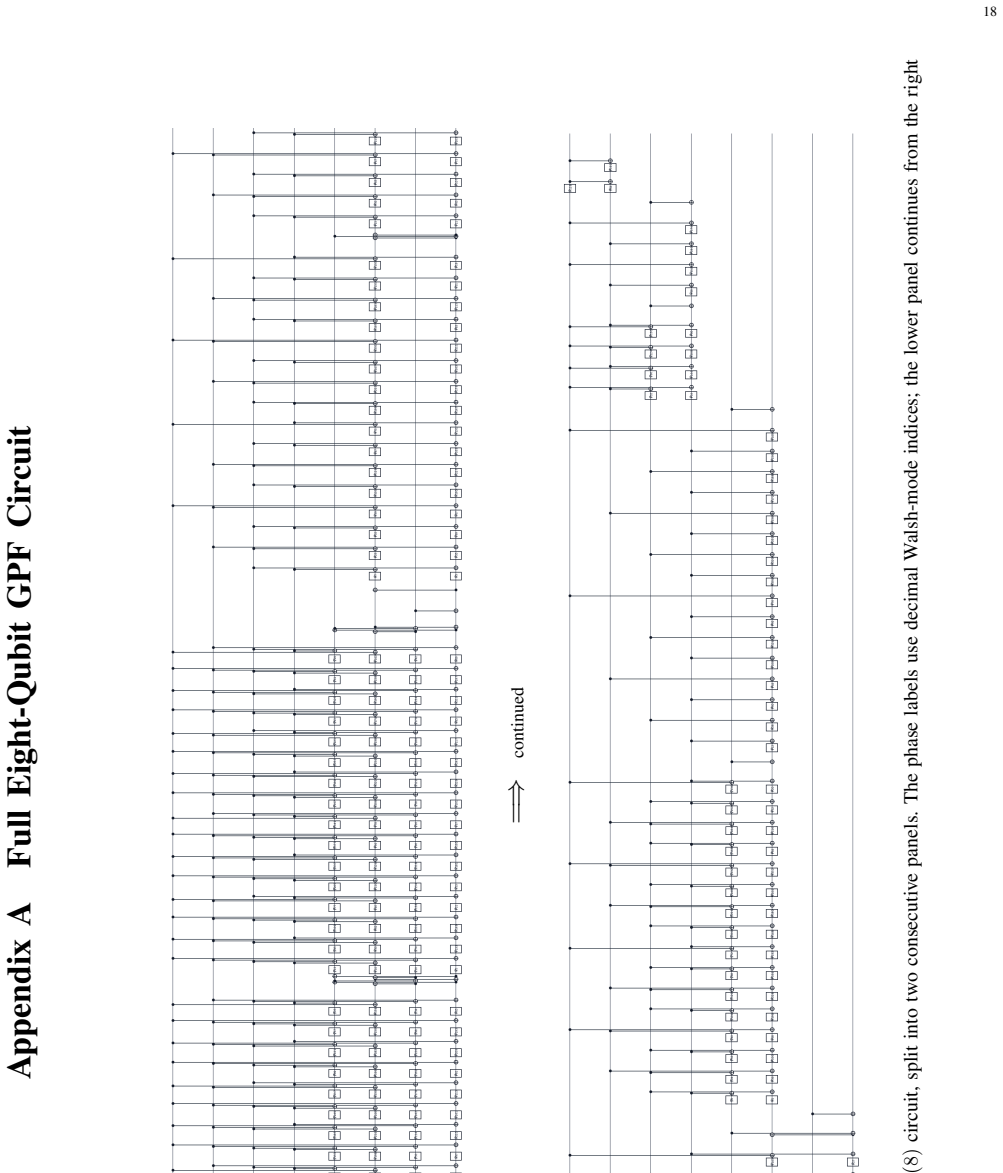
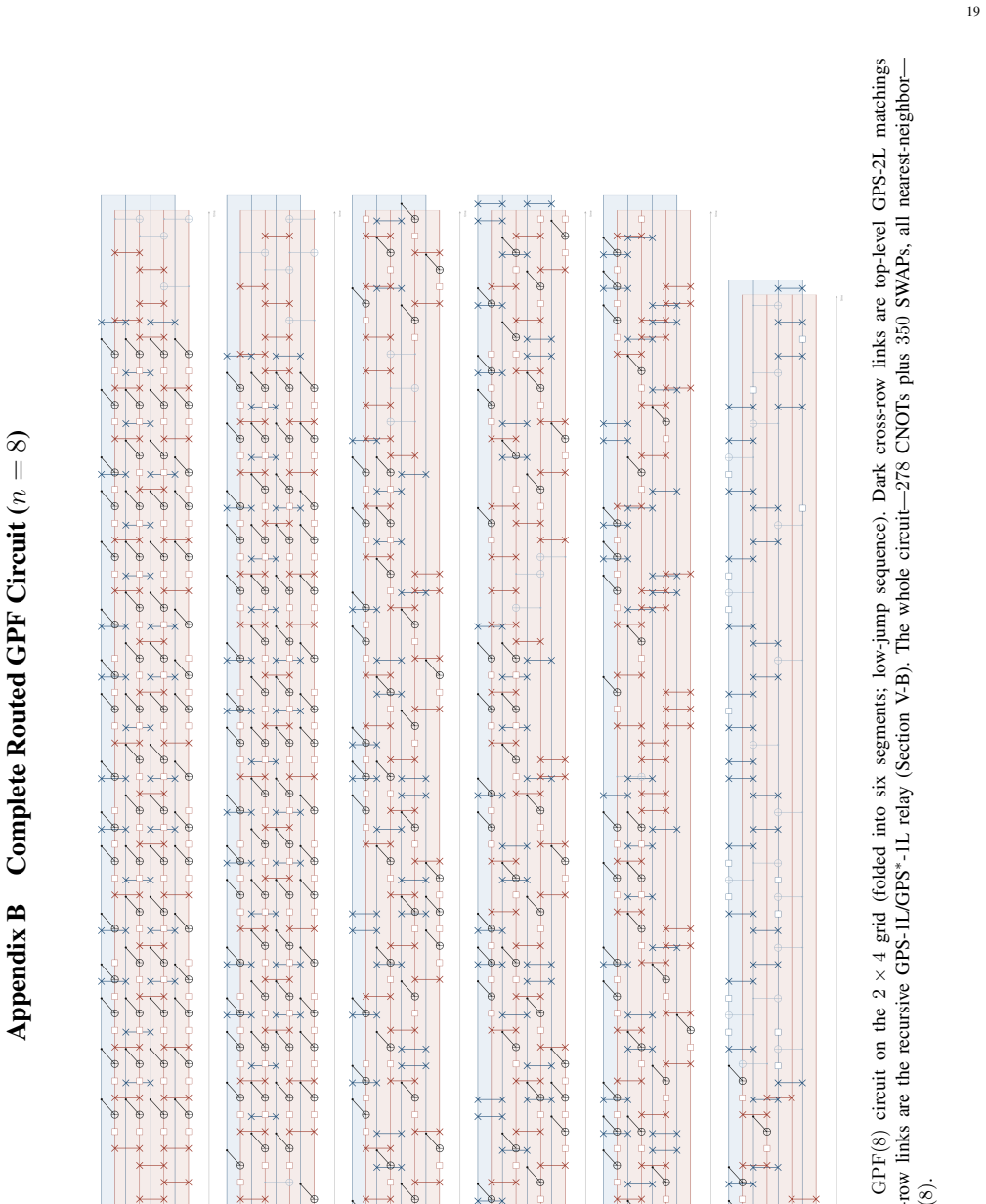
G. Sac Himelfarb and M. Schwartz, “Improved constructions of skew- tolerant gray codes,”IEEE Transactions on Information Theory, vol. 71, no. 10, pp. 8017–8028, 2025. 18 Appendix A Full Eight-Qubit GPF Circuit =⇒continued Fig. 19: Complete expanded GPF(8)circuit, split into two consecutive panels. The phase labels use decimal Walsh-mode indices; the lower...
2025
discussion (0)
Sign in with ORCID, Apple, or X to comment. Anyone can read and Pith papers without signing in.