Improving the efficiency of Hartree--Fock--Bogoliubov solvers in 3D space
Pith reviewed 2026-06-26 22:30 UTC · model grok-4.3
The pith
A generalized conjugate gradient method solves three-dimensional Hartree-Fock-Bogoliubov equations without problem-specific preconditioners.
A machine-rendered reading of the paper's core claim, the machinery that carries it, and where it could break.
Core claim
The paper claims that the generalized conjugate gradient method applied to the self-consistent solution of the Hartree-Fock-Bogoliubov equations in three dimensions eliminates the need for problem-dependent preconditioning and improves convergence speed compared to standard approaches, as tested on representative nuclear systems. This ultimately supports systematic studies of superheavy, strongly deformed, and drip-line nuclei.
What carries the argument
Generalized conjugate gradient method applied to the iterative self-consistent Hartree-Fock-Bogoliubov equations.
If this is right
- Calculations of strongly deformed nuclei become feasible without symmetry assumptions.
- Systematic studies of superheavy and drip-line nuclei gain a more robust numerical tool.
- Dependence on specific choices of spatial discretization is reduced.
- Convergence behavior improves across a range of representative nuclear systems.
Where Pith is reading between the lines
- The same method could be tested on related self-consistent problems that appear in atomic or molecular calculations.
- Efficiency gains might allow exploration of larger system sizes in nuclear simulations.
- Direct comparisons on additional test cases with varying grid resolutions would clarify the range of applicability.
Load-bearing premise
That the generalized conjugate gradient method will converge reliably and faster than preconditioned methods for HFB equations in full 3D without any preconditioning across different nuclear systems and spatial discretizations.
What would settle it
A 3D HFB calculation on a standard nuclear system where the generalized conjugate gradient method either fails to converge or converges more slowly than a well-tuned preconditioned conjugate gradient method.
Figures
read the original abstract
The solution of the three-dimensional Schr\"odinger-like single-particle equations that appear in Kohn Sham density functional theory, as well as in other contexts, for large systems and without any symmetry, requires efficient and robust numerical algorithms. Conventional methods suffer from slow convergence and require careful tuning, depending on the spatial discretization. Conjugate gradient methods combined with preconditioning have been proposed to accelerate the convergence of symmetry-unrestricted Skyrme energy density functionals; however, their effectiveness may depend on the design of a preconditioner. In this work, we introduce the generalized conjugate gradient method for the self-consistent solution of the Hartree--Fock--Bogoliubov equations, which eliminates the need for problem-dependent preconditioning and improves the convergence speed of currently available methods. The performance of the proposed algorithm is demonstrated on representative nuclear systems, showing improved convergence behavior compared to standard approaches. The proposed method ultimately provides a promising tool for systematic studies of superheavy, strongly deformed, and drip-line nuclei.
Editorial analysis
A structured set of objections, weighed in public.
Referee Report
Summary. The paper introduces a generalized conjugate gradient method for the self-consistent solution of the three-dimensional Hartree-Fock-Bogoliubov equations without symmetry assumptions. It claims that this approach eliminates the need for problem-dependent preconditioning required by conventional conjugate gradient methods and demonstrates improved convergence behavior on representative nuclear systems, ultimately providing a tool for studies of superheavy, deformed, and drip-line nuclei.
Significance. If the performance claims hold with quantitative support, the method could reduce the tuning overhead in large-scale symmetry-unrestricted Skyrme-DFT calculations and enable more systematic explorations of exotic nuclear systems.
major comments (1)
- [Abstract] Abstract: the central claim of improved convergence speed and elimination of problem-dependent preconditioning is asserted without any quantitative metrics, error analysis, iteration counts, or explicit comparison to preconditioned CG baselines on the representative systems; this leaves the evidence for the performance advantage at a low level and requires additional demonstration to support the load-bearing assertion.
minor comments (1)
- [Abstract] The abstract would benefit from a brief statement of the spatial discretization used and the specific nuclear systems (e.g., mass numbers or deformation parameters) on which the method was tested.
Simulated Author's Rebuttal
We thank the referee for the detailed review and constructive suggestion regarding the abstract. We address the point below and will revise the manuscript to incorporate quantitative evidence supporting the performance claims.
read point-by-point responses
-
Referee: [Abstract] Abstract: the central claim of improved convergence speed and elimination of problem-dependent preconditioning is asserted without any quantitative metrics, error analysis, iteration counts, or explicit comparison to preconditioned CG baselines on the representative systems; this leaves the evidence for the performance advantage at a low level and requires additional demonstration to support the load-bearing assertion.
Authors: We agree that the abstract would be strengthened by including quantitative metrics. In the revised version, we will augment the abstract with specific results from the numerical experiments, such as iteration counts required for convergence, convergence rates, and direct comparisons to standard preconditioned CG methods on the representative nuclear systems (e.g., superheavy and drip-line nuclei). These metrics are already present in the results section of the manuscript and can be concisely summarized in the abstract without exceeding length limits. This will provide explicit evidence for the claimed improvements in convergence speed and preconditioner independence. revision: yes
Circularity Check
No significant circularity; algorithmic proposal is self-contained
full rationale
The paper introduces a generalized conjugate gradient method for self-consistent HFB equations in 3D, claiming it eliminates problem-dependent preconditioning and improves convergence. This is positioned as a direct algorithmic replacement demonstrated on representative nuclear systems. No derivation chain reduces to self-definition, fitted inputs renamed as predictions, or load-bearing self-citations. The central claim rests on external performance demonstration rather than internal equivalence to inputs. No uniqueness theorems, ansatzes smuggled via citation, or renamed known results are invoked in a circular manner. The derivation is independent of the target result.
Axiom & Free-Parameter Ledger
Reference graph
Works this paper leans on
-
[1]
From this point onward we will restrict ourselves to the case of conserved time- reversal symmetry
Skyrme energy functional The Skyrme part of the EDF models the strong in- teraction between the nucleons. From this point onward we will restrict ourselves to the case of conserved time- reversal symmetry. In such case, time-odd densities van- ish, and the Skyrme energy reduces to [25–27] ESk = X t=0,1 C ρ t [ρ0]ρ2 t +C ρt t τt +C ∆ρ t ρt∇2ρt + +C ∇·J t ρ...
-
[2]
Kinetic energy and center of mass correction The kinetic energy term reads Ekin = ℏ2τ 2m .(12) As translational symmetry is broken when using a Slater determinant, this breaking is approximately accounted for by subtracting the one-body center of mass correction correction term, which reads Ecm =− 1 2mA X i p2 i .(13) This equates to a renormalization of ...
-
[3]
Coulomb energy The Coulomb energy is treated within the Local Density Approximation. The resulting energy density reads [28] ECoul =E Coul, D +E Coul, E (15) = e2 2 Z Uc,D(r)ρp(r)dr− 3 2 3 π 1 3 ρ4/3 p (r) , where the Coulomb field is the one generated by the pro- tons. The details on how the field is computed are given in App. B
-
[4]
The pairing interaction when using a Skyrme func- tional is often taken to be zero-range
Pairing energy The pairing interaction is assumed to be different from the particle-hole one, as done extensively in the litera- ture. The pairing interaction when using a Skyrme func- tional is often taken to be zero-range. Discussion on the differences provided by a zero- or a finite-range force can be found in the literature. Here, we carry on with a s...
-
[5]
(20) in coordinate space can be obtained in different ways
Mean-field Hamiltonian The variation of the energy functional with respect to the density matrixρ ij leads to the single-particle Hamil- tonian, which projected on the coordinate basis reads h=∇ · ℏ2 2m∗(r) ∇+U q(r) +B q(r)·(∇ ׈σ),(21) where the different fields in the equation are computed from the variation of the energy functional with respect to the ...
-
[6]
Algorithm The method starts with an ansatz ofN b single-particle wavefunctions{ϕ (0) k }and iteratively updates them at each mean-field iteration, until some convergence crite- rion is met. At iteration (i) of the calculation, a matrix of column vectorsWis constructed by an application of the inverse single-particle hamiltonianh (i), solving the linear sy...
-
[7]
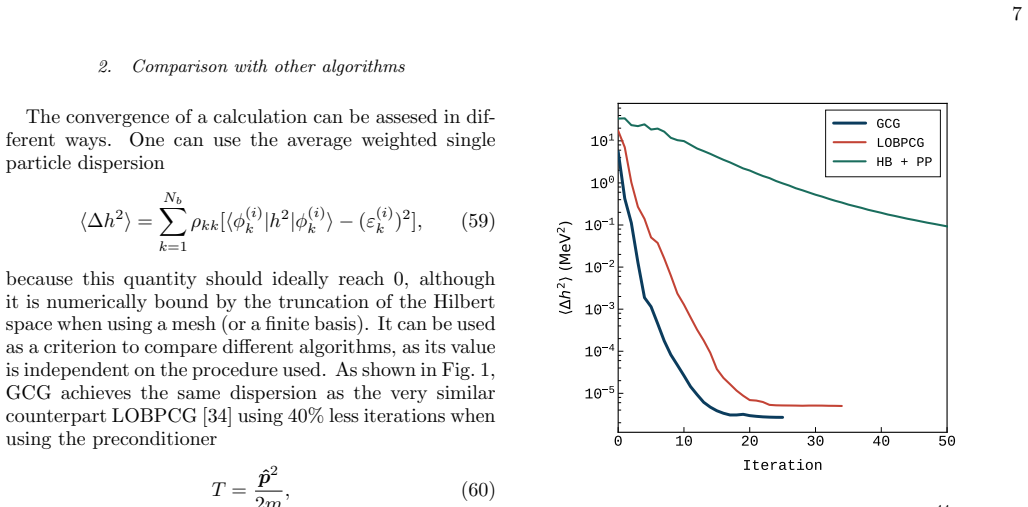
Comparison with other algorithms The convergence of a calculation can be assesed in dif- ferent ways. One can use the average weighted single particle dispersion ⟨∆h2⟩= NbX k=1 ρkk[⟨ϕ(i) k |h2|ϕ(i) k ⟩ −(ε (i) k )2],(59) because this quantity should ideally reach 0, although it is numerically bound by the truncation of the Hilbert space when using a mesh ...
-
[8]
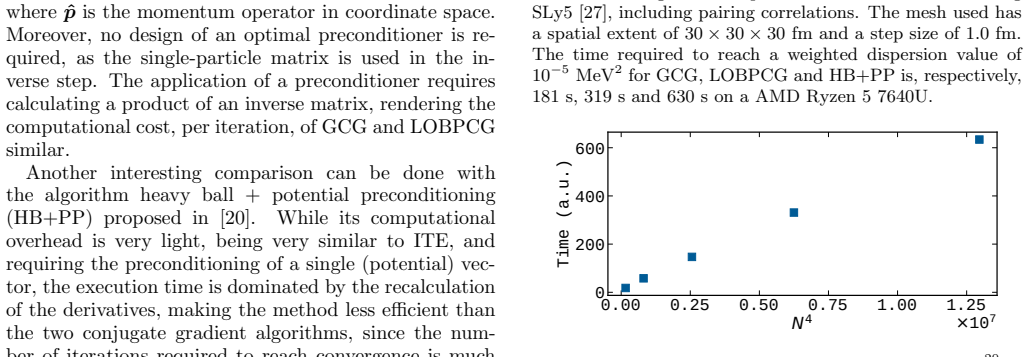
Mesh step size and computational scaling An interesting feature of the GCG method, and of pre- conditioning in general, is that the number of iterations needed to reach convergence is independent of the mesh size, as the condition number of the problem approaches
-
[9]
2, and not the step sizeδ
This implies that the computational cost of the lat- tice only scales with number of points, as highlighted in Fig. 2, and not the step sizeδ. The cost for a generic self- consistent calculation is dominated by the computation of the derivatives and the inverse Hamiltonian step. The scaling for computing a given derivative on a Lagrange mesh along a given...
-
[10]
Diagonalize the HFB matrix h−λ (j) ∆ −∆∗ −(h∗ −λ (j)) Uµ Vµ (j) =E µ Uµ Vµ (j) ; (65)
-
[11]
determine the particle number⟨N⟩ (j)
-
[12]
if⟨N⟩ (j) < A, setλ min =λ (j); otherwise setλ max = λ(j)
-
[13]
Repeat until conver- gence
setλ (j+1) = (λmin +λ max)/2. Repeat until conver- gence. The superscript (j) is used to avoid confusion between the outer mean-field iterations (i) and the inner bisection iterations (j). During the bisection algorithm, only the λ(j) value is updated, for which a new quasiparticle basis is obtained. All other quantities are kept fixed as to prevent ill-d...
-
[14]
The pairing window is set to ∆ε= 5 MeV and the diffusenessµ= 0.5 MeV for both proton and neutron
Numerical details To compare our results for 240Pu with MOCCa [20], for all the calculations from here onwards, we used a surface pairing interaction (η= 1) and a pairing strength V=V n =V p = 1250 MeV·fm 3. The pairing window is set to ∆ε= 5 MeV and the diffusenessµ= 0.5 MeV for both proton and neutron. The Skyrme functional employed is SLy4 [27]. All pa...
-
[15]
Schunck, ed.,Energy Density Functional Methods for Atomic Nuclei, 2053-2563 (IOP Publishing, 2019)
N. Schunck, ed.,Energy Density Functional Methods for Atomic Nuclei, 2053-2563 (IOP Publishing, 2019)
2053
-
[16]
Col` o, Nuclear density functional theory (dft), inHand- book of Nuclear Physics, edited by I
G. Col` o, Nuclear density functional theory (dft), inHand- book of Nuclear Physics, edited by I. Tanihata, H. Toki, and T. Kajino (Springer Nature Singapore, Singapore,
-
[17]
Stevenson, Y
Abhishek, P. Stevenson, Y. Shi, E. Y¨ uksel, and A. Umar, The tdhf code sky3d version 1.2, Computer Physics Com- munications301, 109239 (2024)
2024
-
[18]
Ring and P
P. Ring and P. Schuck,The Nuclear Many-Body Prob- lems, Vol. 103 (1980)
1980
-
[19]
J. L. Egido, State-of-the-art of beyond mean field theo- ries with nuclear density functionals, Physica Scripta91, 073003 (2016)
2016
-
[20]
Hohenberg and W
P. Hohenberg and W. Kohn, Inhomogeneous electron gas, Phys. Rev.136, B864 (1964)
1964
-
[21]
Kohn and L
W. Kohn and L. J. Sham, Self-consistent equations in- cluding exchange and correlation effects, Phys. Rev.140, A1133 (1965)
1965
-
[22]
L. N. Oliveira, E. K. U. Gross, and W. Kohn, Density- functional theory for superconductors, Phys. Rev. Lett. 60, 2430 (1988)
1988
-
[23]
Dobaczewski and J
J. Dobaczewski and J. Dudek, Solution of the skyrme—hartree—fock equations in the cartesian de- formed harmonic oscillator basis ii. the program hfodd, Computer Physics Communications102, 183 (1997)
1997
-
[24]
M. V. Stoitsov, J. Dobaczewski, W. Nazarewicz, and P. Ring, Axially deformed solution of the Skyrme- Hartree-Fock-Bogolyubov equations using the trans- formed harmonic oscillator basis: The Program HF- BTHO (v1.66p), Comput. Phys. Commun.167, 43 (2005), arXiv:nucl-th/0406075
Pith/arXiv arXiv 2005
-
[25]
Beiner, H
M. Beiner, H. Flocard, N. Van Giai, and P. Quentin, Nuclear ground-state properties and self-consistent cal- culations with the skyrme interaction: (i). spherical de- scription, Nuclear Physics A238, 29 (1975)
1975
-
[26]
J. C. Pei, M. V. Stoitsov, G. I. Fann, W. Nazarewicz, N. Schunck, and F. R. Xu, Deformed coordinate-space hartree-fock-bogoliubov approach to weakly bound nu- clei and large deformations, Physical Review C78, 10.1103/physrevc.78.064306 (2008)
-
[27]
Ryssens, V
W. Ryssens, V. Hellemans, M. Bender, and P.-H. Heenen, Solution of the skyrme hf+bcs equation on a 3d mesh. ii. a new version of the ev8 code, Computer Physics Com- munications187, 175 (2015)
2015
-
[28]
B. Gall, P. Bonche, J. Dobaczewski, H. Flocard, and P. H. Heenen, Superdeformed rotational bands in the mercury region. a cranked skyrme-hartree-fock-bogoliubov study, Zeitschrift f¨ ur Physik A Hadrons and Nuclei348, 183 (1994)
1994
-
[29]
Hellemans, P.-H
V. Hellemans, P.-H. Heenen, and M. Bender, Tensor part of the skyrme energy density functional. iii. time-odd terms at high spin, Phys. Rev. C85, 014326 (2012)
2012
-
[30]
L. Lin, S. Shao, and W. E, Efficient iterative method for solving the dirac-kohn–sham density functional theory, Journal of Computational Physics245, 205 (2013)
2013
-
[31]
M. Chen, T. Li, B. Schuetrumpf, P.-G. Reinhard, and W. Nazarewicz, Three-dimensional skyrme hartree-fock- bogoliubov solver in coordinate-space representation, Computer Physics Communications276, 108344 (2022)
2022
- [32]
-
[33]
Davies, H
K. Davies, H. Flocard, S. Krieger, and M. Weiss, Applica- tion of the imaginary time step method to the solution of the static hartree-fock problem, Nuclear Physics A342, 111 (1980)
1980
-
[34]
W. Ryssens, M. Bender, and P. H. Heenen, Iterative approaches to the self-consistent nuclear energy density functional problem: Heavy ball dynamics and potential preconditioning, The European Physical Journal A55, 10.1140/epja/i2019-12766-6 (2019)
-
[35]
F. F. Xu, B. Li, Z. X. Ren, and P. W. Zhao, Tetrahedral shape of 110Zr from covariant density functional theory in 3d lattice space, Phys. Rev. C109, 014311 (2024)
2024
-
[36]
Y. Li, H. Xie, R. Xu, C. You, and N. Zhang, A paral- lel generalised conjugate gradient method for large scale eigenvalue problems, CCF Transactions on High Perfor- mance Computing2, 111 (2020), the corresponding com- puting package can be downloaded from the web site: https://github.com/pase2017/GCGE-1.0
2020
-
[37]
Y. Li, Z. Wang, and H. Xie, Gcge: a package for solving large scale eigenvalue problems by parallel block damp- ing inverse power method, CCF Transactions on High Performance Computing5, 171 (2023)
2023
-
[38]
Ryssens, P.-H
W. Ryssens, P.-H. Heenen, and M. Bender, Numerical accuracy of mean-field calculations in coordinate space, Phys. Rev. C92, 064318 (2015)
2015
-
[39]
Kortelainen, T
M. Kortelainen, T. Lesinski, J. Mor´ e, W. Nazarewicz, J. Sarich, N. Schunck, M. V. Stoitsov, and S. Wild, Nuclear energy density optimization, Phys. Rev. C82, 024313 (2010)
2010
-
[40]
Chabanat, P
E. Chabanat, P. Bonche, P. Haensel, J. Meyer, and R. Schaeffer, A skyrme parametrisation from subnuclear to neutron star densities, Nuclear Physics A627, 710 (1997)
1997
-
[41]
Chabanat, P
E. Chabanat, P. Bonche, P. Haensel, J. Meyer, and R. Schaeffer, A skyrme parametrisation from subnuclear to neutron star densities part ii. nuclei far from stabili- ties, Nuclear Physics A635, 231 (1998)
1998
-
[42]
H.-Q. Gu, H. Liang, W. H. Long, N. Van Giai, and J. Meng, Slater approximation for coulomb exchange ef- fects in nuclear covariant density functional theory, Phys. Rev. C87, 041301 (2013)
2013
-
[43]
Bender, P.-H
M. Bender, P.-H. Heenen, and P.-G. Reinhard, Self- consistent mean-field models for nuclear structure, Rev. Mod. Phys.75, 121 (2003)
2003
-
[44]
Terasaki, P.-H
J. Terasaki, P.-H. Heenen, P. Bonche, J. Dobaczewski, and H. Flocard, Superdeformed rotational bands with density dependent pairing interactions, Nuclear Physics A593, 1 (1995)
1995
-
[45]
Krieger, P
S. Krieger, P. Bonche, H. Flocard, P. Quentin, and M. Weiss, An improved pairing interaction for mean field calculations using skyrme potentials*, Nuclear Physics A 517, 275 (1990)
1990
-
[46]
Zhou, Finite difference method, inNumerical Anal- ysis of Electromagnetic Fields(Springer Berlin Heidel- berg, Berlin, Heidelberg, 1993) pp
P.-b. Zhou, Finite difference method, inNumerical Anal- ysis of Electromagnetic Fields(Springer Berlin Heidel- berg, Berlin, Heidelberg, 1993) pp. 63–94
1993
-
[47]
Levit, Imaginary time step method for thomas-fermi equations, Phys
S. Levit, Imaginary time step method for thomas-fermi equations, Phys. Lett. B139, 147 (1984)
1984
-
[48]
J. A. Duersch, M. Shao, C. Yang, and M. Gu, A 13 robust and efficient implementation of lobpcg, SIAM Journal on Scientific Computing40, C655 (2018), https://doi.org/10.1137/17M1129830
-
[49]
Saad,Iterative Methods for Sparse Linear Systems (Society for Industrial and Applied Mathematics, 2003)
Y. Saad,Iterative Methods for Sparse Linear Systems (Society for Industrial and Applied Mathematics, 2003)
2003
-
[50]
J. R. Shewchuk, An introduction to the conjugate gradi- ent method without the agonizing pain (1994)
1994
-
[51]
Y. Tanimura, K. Hagino, and P. Ring, Application of the inverse hamiltonian method to hartree-fock-bogoliubov calculations, Physical Review C88, 10.1103/phys- revc.88.017301 (2013)
-
[52]
Jia and G
Z. Jia and G. Stewart, An analysis of the rayleigh-ritz method for approximating eigenspaces, Mathematics of Computation70, 637–647 (2000)
2000
-
[53]
Flocard, P
H. Flocard, P. Quentin, A. Kerman, and D. Vautherin, Nuclear deformation energy curves with the constrained hartree-fock method, Nuclear Physics A203, 433–472 (1973)
1973
-
[54]
Staszczak, M
A. Staszczak, M. Stoitsov, A. Baran, and W. Nazarewicz, Augmented lagrangian method for constrained nuclear density functional theory, The European Physical Jour- nal A46, 85 (2010)
2010
-
[55]
Dobaczewski, H
J. Dobaczewski, H. Flocard, and J. Treiner, Hartree-fock- bogolyubov description of nuclei near the neutron-drip line, Nuclear Physics A422, 103 (1984)
1984
-
[56]
Bulgac, S
A. Bulgac, S. Jin, K. J. Roche, N. Schunck, and I. Stetcu, Fission dynamics of 240Pu from saddle to scission and beyond, Phys. Rev. C100, 034615 (2019)
2019
-
[57]
Sadhukhan, W
J. Sadhukhan, W. Nazarewicz, and N. Schunck, Micro- scopic modeling of mass and charge distributions in the spontaneous fission of 240Pu, Phys. Rev. C93, 011304(R) (2016)
2016
-
[58]
Sadhukhan, C
J. Sadhukhan, C. Zhang, W. Nazarewicz, and N. Schunck, Formation and distribution of fragments in the spontaneous fission of 240Pu, Phys. Rev. C96, 061301(R) (2017)
2017
-
[59]
Bulgac, P
A. Bulgac, P. Magierski, K. J. Roche, and I. Stetcu, Induced fission of 240Pu within a real-time microscopic framework, Phys. Rev. Lett.116, 122504 (2016)
2016
-
[60]
S. A. Johansson, Nuclear octupole deformation and the mechanism of fission, Nuclear Physics22, 529 (1961)
1961
-
[61]
P. A. Butler, Pear-shaped atomic nuclei, Proceedings of the Royal Society A: Mathematical, Physical and Engi- neering Sciences476, 20200202 (2020)
2020
-
[62]
P. A. Butler, L. P. Gaffney, P. Spagnoletti, K. Abrahams, M. Bowry, J. Cederk¨ all, G. de Angelis, H. De Witte, P. E. Garrett, A. Goldkuhle, C. Henrich, A. Illana, K. Johnston, D. T. Joss, J. M. Keatings, N. A. Kelly, M. Komorowska, J. Konki, T. Kr¨ oll, M. Lozano, B. S. Nara Singh, D. O’Donnell, J. Ojala, R. D. Page, L. G. Pedersen, C. Raison, P. Reiter,...
2020
-
[63]
Auerbach, V
N. Auerbach, V. V. Flambaum, and V. Spevak, Collec- tive t- and p-odd electromagnetic moments in nuclei with octupole deformations, Phys. Rev. Lett.76, 4316 (1996)
1996
-
[64]
Perli´ nska, S
E. Perli´ nska, S. G. Rohozi´ nski, J. Dobaczewski, and W. Nazarewicz, Local density approximation for proton- neutron pairing correlations: Formalism, Phys. Rev. C 69, 014316 (2004)
2004
-
[65]
A. Ekstr¨ om, C. Forss´ en, G. Hagen, G. R. Jansen, W. Jiang, and T. Papenbrock, What is ab initio in nu- clear theory?, Frontiers in PhysicsVolume 11 - 2023, 10.3389/fphy.2023.1129094 (2023)
-
[66]
H. J. Lipkin, Collective motion in many-particle systems, Annals of Physics9, 272 (1960)
1960
-
[67]
M. V. Stoitsov, J. Dobaczewski, R. Kirchner, W. Nazarewicz, and J. Terasaki, Variation after particle- number projection for the hartree-fock-bogoliubov method with the skyrme energy density functional, Physical Review C76, 10.1103/physrevc.76.014308 (2007)
-
[68]
M. V. Stoitsov, J. Dobaczewski, W. Nazarewicz, S. Pit- tel, and D. J. Dean, Systematic study of deformed nu- clei at the drip lines and beyond, Physical Review C68, 10.1103/physrevc.68.054312 (2003)
-
[69]
Hamamoto, Xi zhen Zhang, and Hong-xing Xie, Parametrization of octupole deformation, Physics Letters B257, 1 (1991)
I. Hamamoto, Xi zhen Zhang, and Hong-xing Xie, Parametrization of octupole deformation, Physics Letters B257, 1 (1991)
1991
-
[70]
Dudek, A
J. Dudek, A. Go´ zd´ z, N. Schunck, and M. Mi´ skiewicz, Nu- clear tetrahedral symmetry: Possibly present throughout the periodic table, Phys. Rev. Lett.88, 252502 (2002)
2002
-
[71]
Dudek, D
J. Dudek, D. Curien, N. Dubray, J. Dobaczewski, V. Pan- gon, P. Olbratowski, and N. Schunck, Island of rare earth nuclei with tetrahedral and octahedral symmetries: Pos- sible experimental evidence, Phys. Rev. Lett.97, 072501 (2006)
2006
-
[72]
Basak, D
S. Basak, D. Kumar, T. Bhattacharjee, I. Dedes, J. Dudek, A. Pal, S. S. Alam, A. Saha, A. K. Sikdar, J. Nandi, S. Dar, A. Baran, A. Gaamouci, D. Rouvel, S. Samanta, S. Chatterjee, R. Raut, S. S. Ghugre, A. Ad- hikari, Y. Sapkota, R. Rahaman, A. Das, A. Gupta, A. Bisoi, S. Sharma, S. Das, A. Bhattacharyya, P. Das, U. Datta, I. Ray, J. Yang, D. Curien, and ...
2025
discussion (0)
Sign in with ORCID, Apple, or X to comment. Anyone can read and Pith papers without signing in.