Ground-state properties of the S=3/2 anisotropic triangular lattice antiferromagnet Na₃Cr(PO₄)₂
Pith reviewed 2026-06-27 00:15 UTC · model grok-4.3
The pith
Na3Cr(PO4)2 develops antiferromagnetic order at 2.6 K on a deformed triangular lattice with two strong and one weak exchange path.
A machine-rendered reading of the paper's core claim, the machinery that carries it, and where it could break.
Core claim
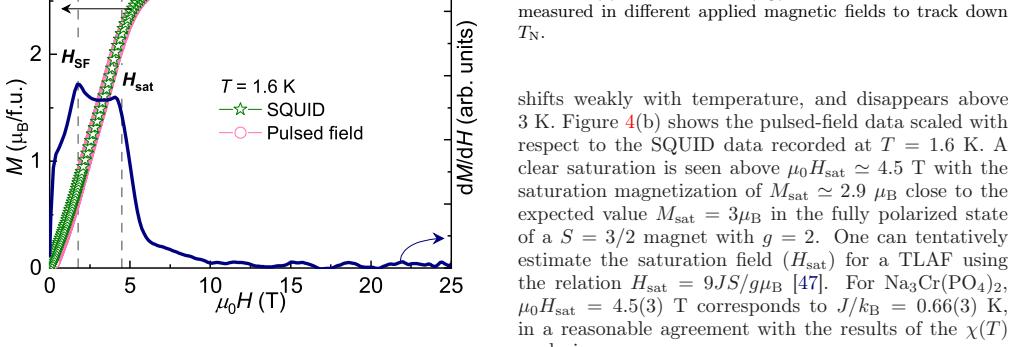
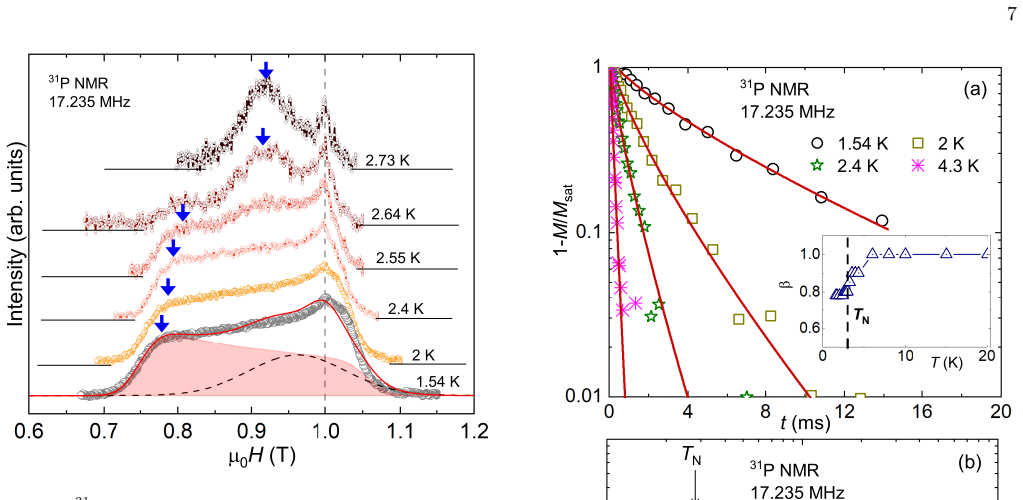
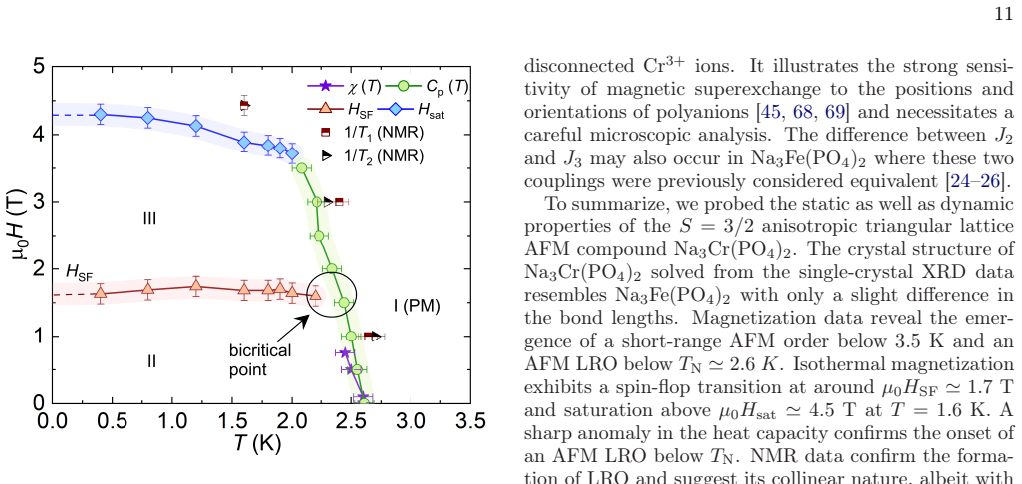
The compound exhibits antiferromagnetic long-range ordering at TN ≃ 2.6 K confirmed by magnetization, heat capacity and NMR, with a field-induced spin-flop at μ0HSF ≃ 1.7 T and saturation above 4.5 T; ab initio calculations reveal significant deformation of the triangular spin lattice resulting in two antiferromagnetic couplings of similar strength and a much weaker third coupling. The 31P NMR spectral shape confirms the commensurate antiferromagnetic nature of the ordering below TN.
What carries the argument
The deformed triangular spin lattice identified through ab initio calculations, which produces two strong antiferromagnetic couplings and one weak coupling.
If this is right
- The system behaves as an anisotropic two-dimensional antiferromagnet with a spin-flop transition.
- The observed saturation field of 4.5 T is consistent with the calculated exchange strengths.
- The ordering is commensurate with the underlying crystal lattice according to the NMR line shape.
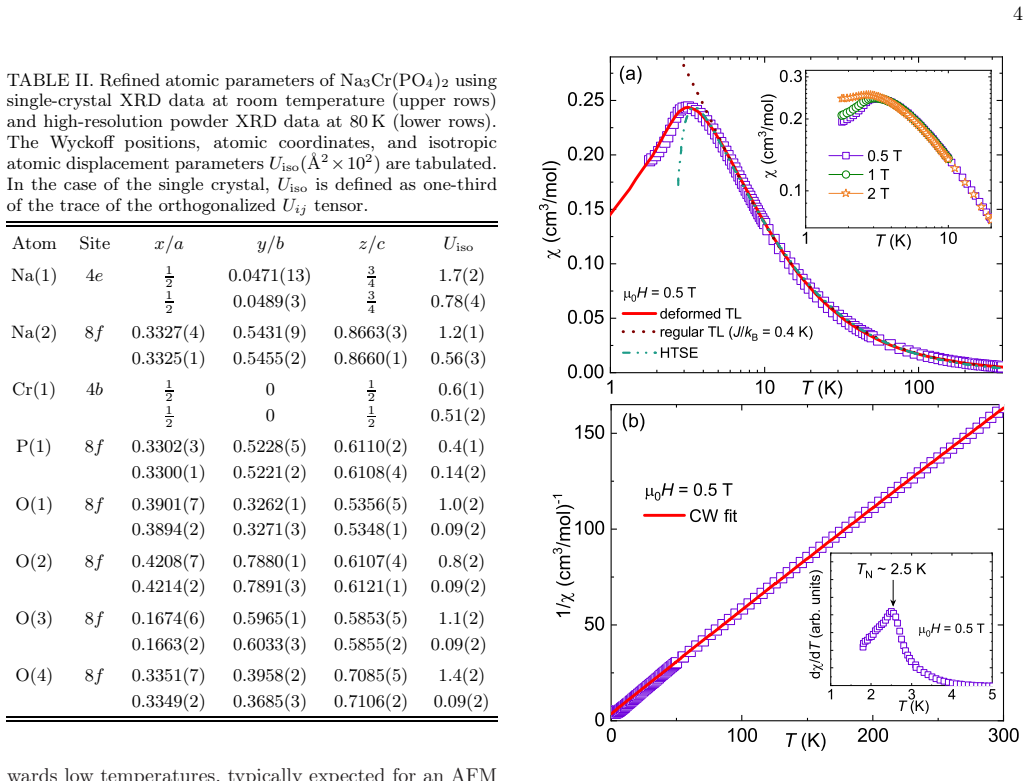
- Short-range antiferromagnetic correlations develop above TN, visible as the susceptibility maximum near 3.5 K.
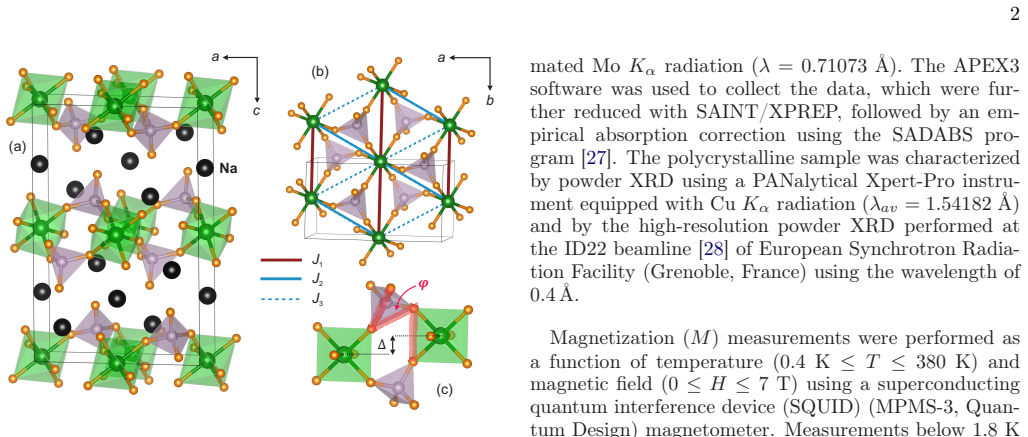
Where Pith is reading between the lines
- Hydrostatic pressure could modify the lattice deformation and thereby tune the relative strengths of the three exchange paths.
- Other chromium phosphates with comparable layer structures may display similar deformation-driven ordering.
- The direction of the weakest coupling could be exploited to realize quasi-one-dimensional behavior in applied fields or under strain.
Load-bearing premise
The broad maximum in susceptibility, the heat-capacity anomaly, and the NMR line broadening and relaxation peaks establish long-range commensurate antiferromagnetic order rather than short-range correlations or impurity effects.
What would settle it
Neutron diffraction that detects no magnetic Bragg peaks below 2.6 K would falsify the long-range ordering claim.
Figures

read the original abstract
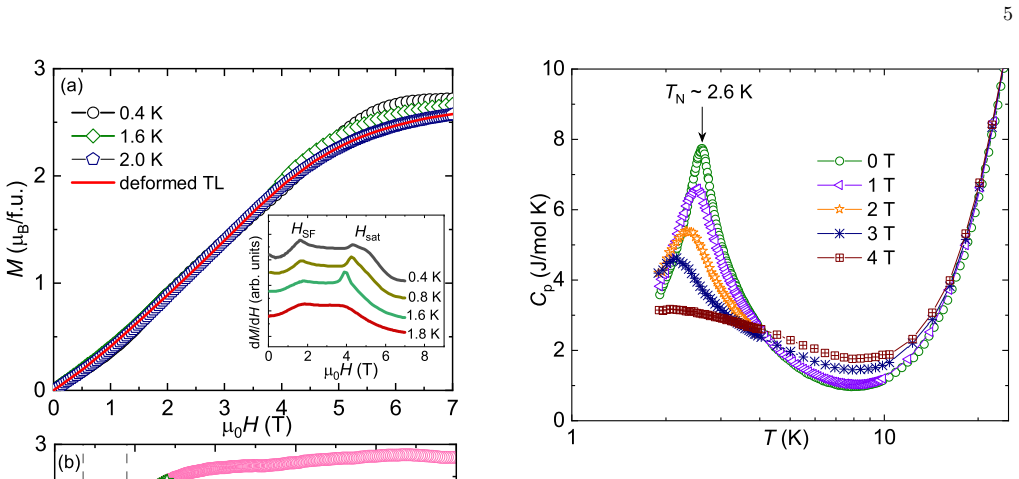
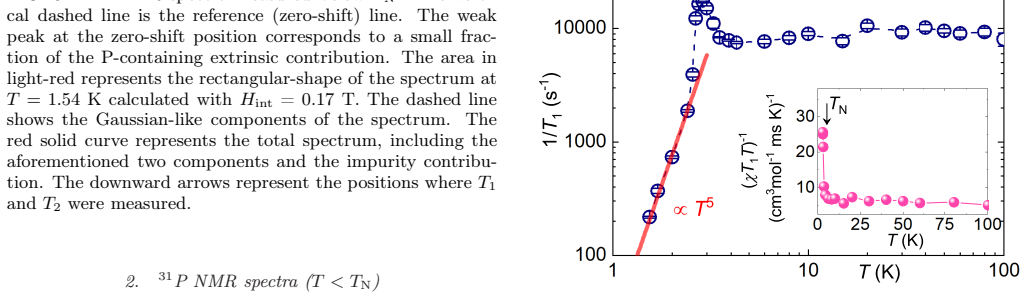
We report the crystal structure and magnetic properties of a $S=3/2$ anisotropic triangular lattice compound Na$_3$Cr(PO$_4$)$_2$ employing single-crystal and powder x-ray diffraction, magnetization, heat capacity, and $^{31}$P nuclear magnetic resonance (NMR) experiments, supported by the band structure calculations. Magnetic susceptibility exhibits a broad maximum around 3.5 K, indicating the presence of a short-range antiferromagnetic order, typical of a low-dimensional spin system. Magnetization and heat capacity manifest an antiferromagnetic long-range ordering at around $T_{\rm N} \simeq 2.6$ K. This was further confirmed by the drastic NMR line broadening and a peak in the nuclear spin-lattice and spin-spin relaxation rates. The isothermal magnetization data exhibit a field-induced spin-flop transition at around $\mu_0H_{\rm SF} \simeq 1.7$ T reminiscent of an anisotropic two-dimensional magnet, before saturating above $\mu_0H_{\rm sat} \simeq 4.5$ T. The saturation field was further upheld by the field-dependent NMR relaxation measurements at low temperatures. The $^{31}$P NMR spectral shape confirms the commensurate antiferromagnetic nature of the ordering below $T_{\rm N}$. \textit{Ab initio} calculations reveal a significant deformation of the triangular spin lattice, resulting in triangles with two antiferromagnetic couplings of similar strength and a much weaker coupling along the third side of the triangle.
Editorial analysis
A structured set of objections, weighed in public.
Referee Report
Summary. The manuscript reports the crystal structure and magnetic properties of Na₃Cr(PO₄)₂ as an S=3/2 anisotropic triangular lattice antiferromagnet. Single-crystal and powder x-ray diffraction, magnetization, heat capacity, and ³¹P NMR experiments, supported by ab initio band structure calculations, identify a broad susceptibility maximum near 3.5 K (short-range AFM correlations), long-range AFM ordering at T_N ≃ 2.6 K, a field-induced spin-flop transition at μ₀H_SF ≃ 1.7 T, and saturation above μ₀H_sat ≃ 4.5 T. NMR line broadening, relaxation-rate peaks, and spectral shape are used to confirm commensurate AFM order below T_N. The calculations indicate significant triangular-lattice deformation yielding two comparable AFM exchanges and one much weaker coupling.
Significance. If the central claims hold, the work supplies a new, experimentally well-probed S=3/2 triangular-lattice antiferromagnet whose anisotropy arises from lattice deformation rather than from a perfectly symmetric lattice. The convergence of magnetization, heat-capacity, and NMR data on the same T_N and field scales, together with the ab initio microscopic rationale, makes the compound a useful benchmark for theories of anisotropic frustrated magnets. The experimental signatures are standard and mutually reinforcing; the calculations are not required to establish the ordering itself.
major comments (2)
- [Abstract and experimental sections] Abstract and experimental sections: the reported values T_N ≃ 2.6 K, μ₀H_SF ≃ 1.7 T and μ₀H_sat ≃ 4.5 K are given without error bars or uncertainty estimates, and no details on sample purity, stoichiometry, or impurity phases are provided. These omissions weaken that the observed anomalies are intrinsic rather than impurity- or defect-driven.
- [NMR section] NMR section: the statement that the ³¹P spectral shape “confirms the commensurate antiferromagnetic nature” is presented without a quantitative lineshape simulation or comparison to the expected local fields from the proposed spin structure. A lineshape calculation or explicit modeling would be needed to rule out short-range or incommensurate scenarios at the level claimed.
minor comments (2)
- The broad susceptibility maximum at 3.5 K is attributed to short-range order, but no quantitative comparison (e.g., to high-temperature series or quantum Monte Carlo results for the anisotropic triangular lattice) is shown.
- Figure captions and axis labels should explicitly state whether data are for single-crystal or powder samples and include the applied-field direction where relevant.
Simulated Author's Rebuttal
We thank the referee for the positive assessment of our work and the recommendation for minor revision. We address each major comment below and will update the manuscript accordingly.
read point-by-point responses
-
Referee: [Abstract and experimental sections] Abstract and experimental sections: the reported values T_N ≃ 2.6 K, μ₀H_SF ≃ 1.7 T and μ₀H_sat ≃ 4.5 K are given without error bars or uncertainty estimates, and no details on sample purity, stoichiometry, or impurity phases are provided. These omissions weaken that the observed anomalies are intrinsic rather than impurity- or defect-driven.
Authors: We agree that explicit uncertainty estimates and sample characterization details would improve the manuscript. In the revised version we will add estimated uncertainties for T_N, μ₀H_SF and μ₀H_sat derived from the resolution and reproducibility of the magnetization, heat-capacity and NMR data. We will also include a brief description of sample stoichiometry (from ICP or refinement), phase purity (from powder and single-crystal XRD), and any detected impurity phases or their absence. revision: yes
-
Referee: [NMR section] NMR section: the statement that the ³¹P spectral shape “confirms the commensurate antiferromagnetic nature” is presented without a quantitative lineshape simulation or comparison to the expected local fields from the proposed spin structure. A lineshape calculation or explicit modeling would be needed to rule out short-range or incommensurate scenarios at the level claimed.
Authors: The referee correctly notes that our claim rests on the observed symmetric line broadening and the coincidence of the NMR anomalies with the thermodynamic transitions rather than on a quantitative simulation. While the combination of magnetization, heat capacity and NMR data already supports long-range commensurate order, we accept that a lineshape calculation would strengthen the argument. In the revision we will either add a simple estimate of the expected local fields from the proposed spin structure or qualify the statement to reflect the current level of evidence. revision: partial
Circularity Check
No significant circularity in derivation chain
full rationale
The paper reports experimental identification of AFM LRO at TN ≃ 2.6 K via direct observables (magnetization, heat capacity anomaly, NMR line broadening, relaxation peaks) that are mutually reinforcing and independent of any model fitting. Ab initio band-structure calculations supply a microscopic rationale for lattice deformation and exchange values but are not required to establish the ordering itself, nor are any parameters fitted to the transition data and then relabeled as predictions. No self-citations, self-definitional loops, or ansatz smuggling appear in the load-bearing steps.
Axiom & Free-Parameter Ledger
axioms (1)
- domain assumption Localized S=3/2 moments on Cr3+ ions interact via superexchange on the triangular lattice
Reference graph
Works this paper leans on
-
[1]
375x + 56
25 − 9. 375x + 56. 25x2 − 293. 20x3 + 1390. 9x4 − 6180. 33x5 + 26172. 66x6 − 106600. 27x7 + 41952. 64x8 − 1600661. 67x9 + 5938171. 24x10 ] . (3) Here, x = J/k BT , J is the (average) nearest-neighbor exchange coupling, and the expression is valid for T ≥ 8J/k B. The dash-dotted line in Fig. 3(a) represents the fit by Eq. ( 3) above T > 4 K. The resulting v...
-
[2]
31P NMR spectra ( T > T N) Field-swept NMR spectra measured at ν =
-
[3]
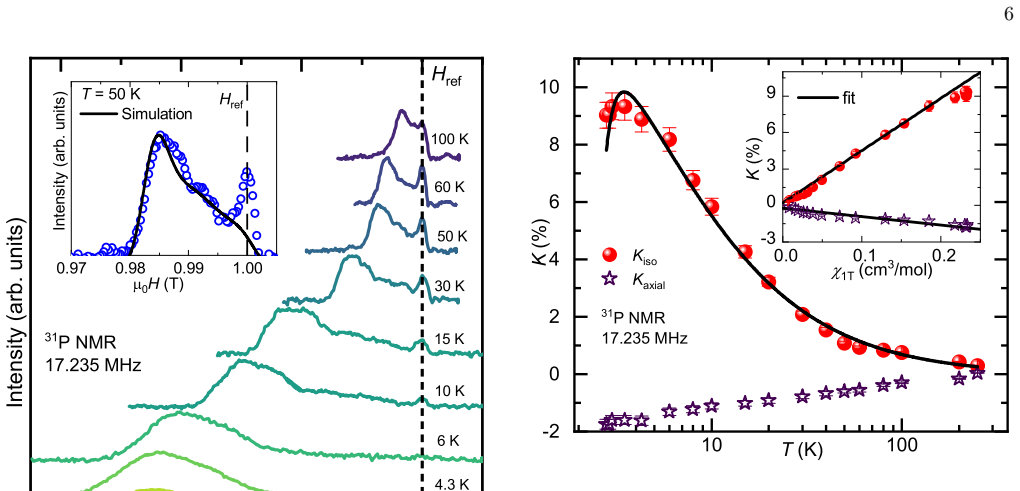
235 MHz ( µ 0H ≃ 1 T) above TN are shown in Fig. 6. For a better visualization, the spectra at individual tem- peratures are normalized with the peak amplitude and then vertically translated. The spectra exhibit a single line, as expected for an I = 1 / 2 nucleus. With lower- ing temperature, the line broadens, and the line broad- ening becomes drastic as...
-
[4]
08% and Kaxial ≃ − 0
gives Kiso ≃ 1. 08% and Kaxial ≃ − 0. 6%. Both the components of K (Kiso and Kaxial) as a function of T are presented in Fig. 7. Kiso(T ) shows a broad maximum around 3 K, similar to the χ (T ) data. K(T ) is a direct measure of the intrinsic spin suscepti- bility (χ spin) and is free from any extrinsic contributions. It is expressed in terms of the spin ...
-
[5]
( 5) yields K iso 0 ≃ 0
As expected, K and χ are linearly related, and a fit to the isotropic component using Eq. ( 5) yields K iso 0 ≃ 0. 214% and Aiso hf ≃ 0. 24 T/µ B. Similarly, the fit to the axial component gives K axial 0 ≃ − 0. 20% and Aaxial hf ≃ − 0. 04 T/µ B, indicating a small anisotropic hyperfine field at the 31P site. The value of Aiso hf is com- parable to that in ot...
-
[6]
9(6) and J/k B = 0
The fitted parameters are g = 1. 9(6) and J/k B = 0 . 47(3) K. This value of J/k B is in good agree- ment with the one obtained from the χ (T ) analysis. 7 /s50/s46/s55/s51/s32/s75 /s50/s46/s54/s52/s32/s75 /s50/s46/s53/s53/s32/s75 /s50/s46/s52/s32/s75 /s49/s46/s53/s52/s32/s75 /s73/s110/s116/s101/s110/s115/s105/s116/s121/s32/s40/s97/s114/s98/s46/s32/s117/s1...
-
[7]
31P NMR spectra ( T < T N) The 31P NMR spectra measured below TN are pre- sented in Fig. 8. At T = 2 . 73 K (close to TN), the line is nearly symmetric but with a sharp peak at the zero- shift position. As one decreases temperature below TN, a clear spectral broadening is observed due to the devel- opment of the static internal field ( Hint) in the ordered...
-
[8]
While the rectangular line shape is a clear sig- nature of the commensurate AFM ordering, the remain- ing Gaussian-like line suggests a paramagnetic-like phase fraction existing below TN . Such a paramagnetic-like line could be either due to partial disorder (i.e., staggered component) or spin canting, leading to this inhomoge- neous distribution of inter...
-
[9]
On the other hand, in the AFM state, 1/T1 was measured at the low-field-edge position of the spectra marked by the arrows in Fig
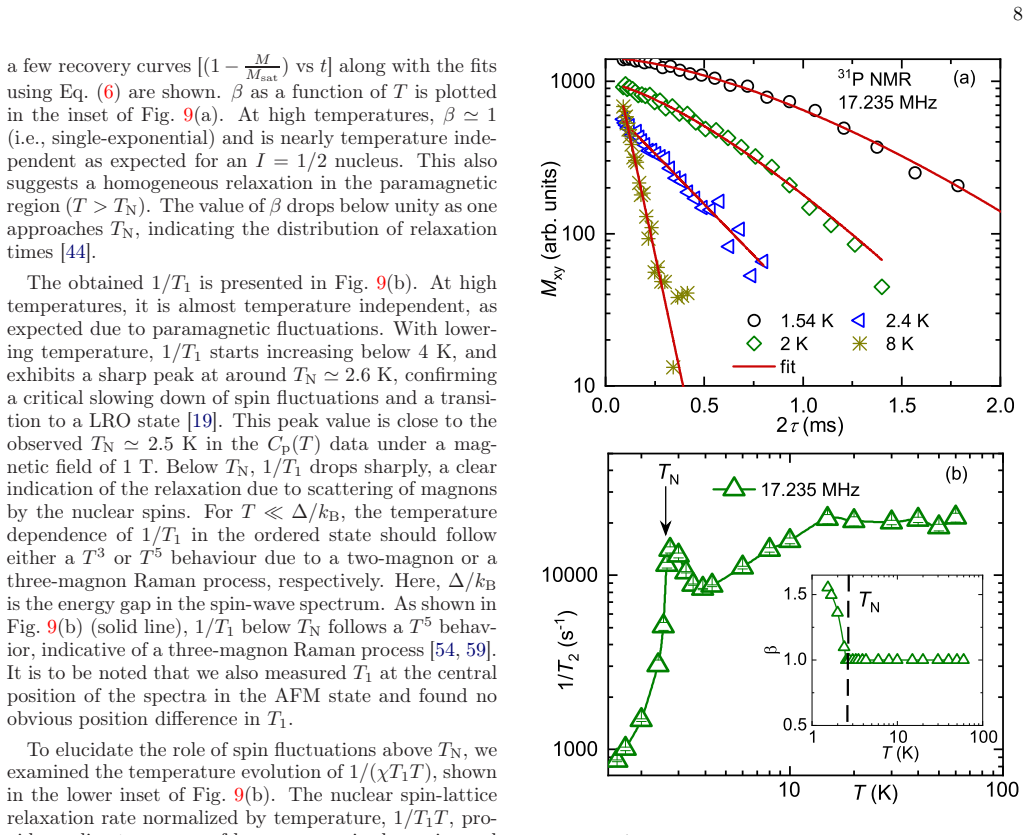
31P spin-lattice relaxation rate ( 1/T 1) The 31P spin-lattice relaxation rate ( 1/T 1) was mea- sured at the peak position of the spectra in the para- magnetic state. On the other hand, in the AFM state, 1/T1 was measured at the low-field-edge position of the spectra marked by the arrows in Fig
-
[10]
The longitudinal nuclear magnetization recovery curves were fitted by a stretched exponential form [ 58], 1 − M (t) Msat = A e− (t/T 1)β . (6) Here, M (t) is the nuclear magnetization at a time t af- ter the saturation pulse, Msat is the equilibrium nuclear magnetization, and β is the stretched exponent that ac- counts for a distribution of relaxation time...
-
[11]
The decay curves were then fitted by Mxy = M0e(− 2τ /T 2)β
31P spin-spin relaxation rate ( 1/T 2) The measurement of the nuclear spin-spin relaxation rate 1/T 2 was done by monitoring the decay of the trans- verse magnetization ( Mxy) after a π/ 2 − τ − π pulse se- quence as a function of the pulse separation time τ. The decay curves were then fitted by Mxy = M0e(− 2τ /T 2)β . (8) Figure 10(a) shows the fits for a ...
-
[12]
6 K (T < T N) at different frequencies well above and below Hsat
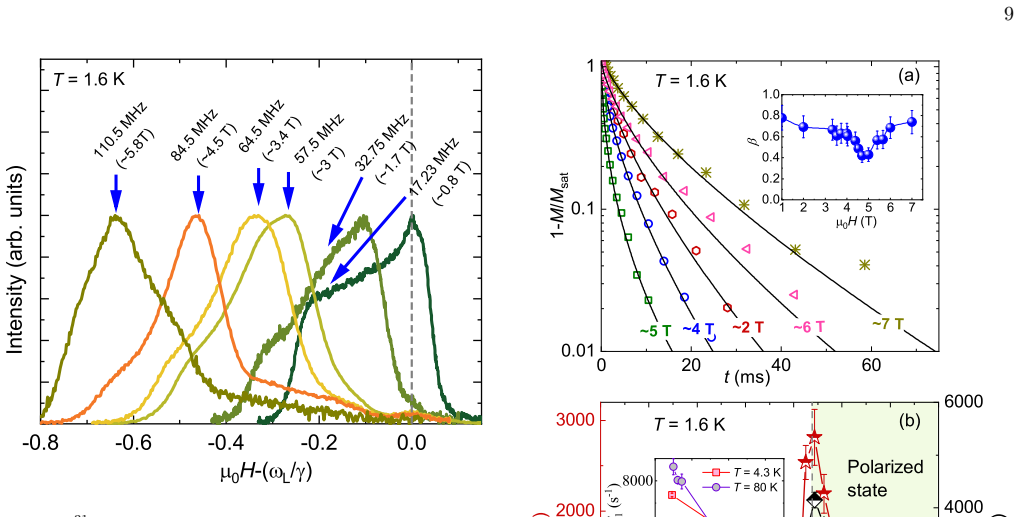
Field dependence of the 31P NMR spectra, 1/T 1, and 1/T 2 To detect the field-induced transition as well as the sat- uration field, we recorded the NMR spectra, 1/T 1, and 1/T 2 at T = 1 . 6 K (T < T N) at different frequencies well above and below Hsat. As evident from Fig. 11, for the low frequency of ∼ 17. 235 MHz, the spectrum roughly exhibits rectangula...
-
[13]
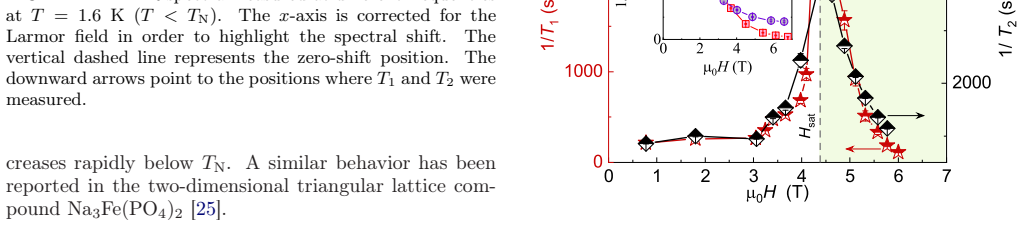
The corresponding recovery curves are pre- sented in Fig. 12(a). The recovery curves follow Eq. ( 6) and the obtained 1/T 1 as a function of magnetic field is shown in Fig. 12(b). The magnetic field dependence of β is shown in the inset of Fig. 12(a). While 1/T 1 exhibits a smooth decay with magnetic field in the paramagnetic state ( T > T N) as shown in the...
-
[14]
J1 J2 J3 J (K) 1.3 1.6 − 0
Room- temperature structural data are used. J1 J2 J3 J (K) 1.3 1.6 − 0. 4 d (Å) 4.991 5.139 5.139 ∆ (Å) 1.09 0.74 1.10 ϕ (deg) 141.0 153.4 124.5 spond to the maximum in the dM/dH vs H curve [inset of Fig. 4(a)]. At low magnetic fields below Hsat, how- ever, the relaxation is dominated by magnon scattering in the AFM ordered state rather than the paramagnet...
-
[15]
and also reproduce the field-dependent magneti- zation (Fig. 4). The fitted J values are generally consis- tent with the DFT results, although J1 and J2 are some- what smaller in magnitude, probably due to inaccuracies of DFT in the evaluation of weak exchange couplings. The 2D model given by J1 − J3 lacks LRO at a fi- nite temperature as per Mermin-Wagner t...
-
[16]
05 K, such that J⊥ /J 2 ≃ 0. 03. This weak coupling could nevertheless stabilize LRO. Alternatively, a small single-ion anisotropy of the same magnitude results in TN = 2 . 4 K within the 2D model, in an excellent agree- ment with the experimental value of 2.5 K. We thus con- clude that Na 3Cr(PO4)2 is a quasi-2D antiferromagnet where individual triangula...
2022
-
[17]
Anderson, Resonating valence bonds: A new kind of insulator?, Mater
P. Anderson, Resonating valence bonds: A new kind of insulator?, Mater. Res. Bull. 8, 153 (1973)
1973
-
[18]
Bernu and G
B. Bernu and G. Misguich, Specific heat and high- temperature series of lattice models: Interpolation scheme and examples on quantum spin systems in one and two dimensions, Phys. Rev. B 63, 134409 (2001)
2001
-
[19]
M. F. Collins and O. A. Petrenko, Review/Synthèse: Tri- angular antiferromagnets, Can. J. Phys. 75, 605 (1997) . 12
1997
-
[20]
Capriotti, A
L. Capriotti, A. E. Trumper, and S. Sorella, Long- Range Néel Order in the Triangular Heisenberg Model, Phys. Rev. Lett. 82, 3899 (1999)
1999
-
[21]
Y. A. Sakhratov, O. Prokhnenko, A. Y. Shapiro, H. D. Zhou, L. E. Svistov, A. P. Reyes, and O. A. Petrenko, High-field magnetic structure of the triangular antiferromagnet RbFe(MoO4)2, Phys. Rev. B 105, 014431 (2022)
2022
-
[22]
M. Lee, E. S. Choi, X. Huang, J. Ma, C. R. Dela Cruz, M. Matsuda, W. Tian, Z. L. Dun, S. Dong, and H. D. Zhou, Magnetic phase diagram and multifer- roicity of Ba3MnNb2O9: A spin- 5 2 triangular lat- tice antiferromagnet with weak easy-axis anisotropy, Phys. Rev. B 90, 224402 (2014)
2014
-
[23]
A. L. Chernyshev and M. E. Zhitomirsky, Spin waves in a triangular lattice antiferromagnet: De- cays, spectrum renormalization, and singularities, Phys. Rev. B 79, 144416 (2009)
2009
-
[24]
Verresen, R
R. Verresen, R. Moessner, and F. Pollmann, A voided quasiparticle decay from strong quantum interactions, Nature Phys. 15, 750 (2019)
2019
-
[25]
Yunoki and S
S. Yunoki and S. Sorella, Two spin liquid phases in the spatially anisotropic triangular heisenberg model, Phys. Rev. B 74, 014408 (2006)
2006
-
[26]
M. Q. Weng, D. N. Sheng, Z. Y. Weng, and R. J. Bursill, Spin-liquid phase in an anisotropic triangular-lattice heisenberg model: Exact diagonaliza- tion and density-matrix renormalization group calcula- tions, Phys. Rev. B 74, 012407 (2006)
2006
-
[27]
A. V. Chubukov and D. I. Golosov, Quantum theory of an antiferromagnet on a triangular lattice in a magnetic field, J. Phys. Condens. Matter. 3, 69 (1991)
1991
-
[28]
Sheng and C
Q. Sheng and C. L. Henley, Ordering due to disorder in a triangular Heisenberg antiferromagnet with exchange anisotropy, J. Phys.: Condens. Matter 4, 2937 (1992)
1992
-
[29]
Kawamura and S
H. Kawamura and S. Miyashita, Phase transition of the heisenberg antiferromagnet on the triangular lattice in a magnetic field, J. Phys. Soc. Jpn. 54, 4530 (1985)
1985
-
[30]
Seabra, T
L. Seabra, T. Momoi, P. Sindzingre, and N. Shannon, Phase diagram of the classical Heisenberg antiferromag- net on a triangular lattice in an applied magnetic field, Phys. Rev. B 84, 214418 (2011)
2011
-
[31]
O. A. Starykh, W. Jin, and A. V. Chubukov, Phases of a triangular-lattice antiferromagnet near saturation, Phys. Rev. Lett. 113, 087204 (2014)
2014
-
[32]
Yamamoto, G
D. Yamamoto, G. Marmorini, and I. Danshita, Quantum phase diagram of the triangular-lattice XXZ model in a magnetic field, Phys. Rev. Lett. 112, 127203 (2014)
2014
-
[33]
F. Wang, F. Pollmann, and A. Vishwanath, Extended supersolid phase of frustrated hard-core bosons on a tri- angular lattice, Phys. Rev. Lett. 102, 017203 (2009)
2009
-
[34]
Heidarian and A
D. Heidarian and A. Paramekanti, Supersolidity in the triangular lattice spin-1/2 XXZ model: A variational perspective, Phys. Rev. Lett. 104, 015301 (2010)
2010
-
[35]
S. J. Sebastian, K. Somesh, M. Nandi, N. Ahmed, P. Bag, M. Baenitz, B. Koo, J. Sichelschmidt, A. A. Tsirlin, Y. Furukawa, and R. Nath, Quasi-one-dimensional mag- netism in the spin- 1 2 antiferromagnet BaNa2Cu(VO4)2, Phys. Rev. B 103, 064413 (2021)
2021
-
[36]
N. E. Amuneke, D. E. Gheorghe, B. Lorenz, and A. Möller, Synthesis, Crystal Structure, and Physical Properties of BaAg 2Cu[VO4]2: A New Member of the S = 1/ 2 Triangular Lattice, Inorg. Chem. 50, 2207 (2011)
2011
-
[37]
A. A. Tsirlin, A. Möller, B. Lorenz, Y. Skourski, and H. Rosner, Superposition of ferromagnetic and an- tiferromagnetic spin chains in the quantum magnet BaAg2Cu[VO4]2, Phys. Rev. B 85, 014401 (2012)
2012
-
[38]
Xiang, C
J. Xiang, C. Zhang, Y. Gao, W. Schmidt, K. Schmalzl, C.-W. Wang, B. Li, N. Xi, X.-Y. Liu, H. Jin, G. Li, J. Shen, Z. Chen, Y. Qi, Y. Wan, W. Jin, W. Li, P. Sun, and G. Su, Giant magnetocaloric effect in spin supersolid candidate Na 2BaCo(PO4)2, Nature 625, 270 (2024)
2024
-
[39]
Sheng, J.-W
J. Sheng, J.-W. Mei, L. Wang, X. Xu, W. Jiang, L. Xu, H. Ge, N. Zhao, T. Li, A. Candini, B. Xi, J. Zhao, Y. Fu, J. Yang, Y. Zhang, G. Biasiol, S. Wang, J. Zhu, P. Miao, X. Tong, D. Yu, R. Mole, Y. Cui, L. Ma, Z. Zhang, Z. Ouyang, W. Tong, A. Podlesnyak, L. Wang, F. Ye, D. Yu, W. Yu, L. Wu, and Z. Wang, Bose-einstein con- densation of a two-magnon bound st...
2025
-
[40]
S. J. Sebastian, S. S. Islam, A. Jain, S. M. Yusuf, M. Uhlarz, and R. Nath, Collinear order in the spin- 5 2 triangular-lattice antiferromagnet Na3Fe(PO4)2, Phys. Rev. B 105, 104425 (2022)
2022
-
[41]
D. V. Ambika, Q.-P. Ding, S. J. Sebastian, R. Nath, and Y. Furukawa, Static and dynamic magnetic properties of the spin-5/2 triangle lattice anti- ferromagnet Na 3Fe(PO4)2 studied by 31P NMR, J. Phys.: Condens. Matter 35, 015803 (2022)
2022
-
[42]
B. Saha, A. K. Bera, S. M. Yusuf, R. Roy, S. Ka- nungo, D. Le, and A. Krajewska, Magnetic exci- tations and spin-Hamiltonian of the spin-5/2 dis- torted triangular lattice antiferromagnet Na3Fe(PO4)2, Phys. Rev. B 110, 094421 (2024)
2024
-
[43]
G. M. Sheldrick, Siemens area correction absorption cor- rection program, University of Göttingen, Göttingen, Germany (1994)
1994
-
[44]
Fitch, C
A. Fitch, C. Dejoie, E. Covacci, G. Confalonieri, O. Gren- dal, L. Claustre, P. Guillou, J. Kieffer, W. de Nolf, S. Petitdemange, M. Ruat, and Y. Watier, ID22 – the high-resolution powder-diffraction beamline at ESRF, J. Synch. Rad. 30, 1003 (2023)
2023
-
[45]
A. A. Tsirlin, B. Schmidt, Y. Skourski, R. Nath, C. Geibel, and H. Rosner, Exploring the spin- 1 2 frus- trated square lattice model with high-field magnetization studies, Phys. Rev. B 80, 132407 (2009)
2009
-
[46]
Kresse and J
G. Kresse and J. Furthmüller, Efficiency of ab- initio total energy calculations for metals and semiconductors using a plane-wave basis set, Computational Materials Science 6, 15 (1996)
1996
-
[47]
Kresse and J
G. Kresse and J. Furthmüller, Efficient iterative schemes for ab initio total-energy calculations using a plane-wave basis set, Phys. Rev. B 54, 11169 (1996)
1996
-
[48]
J. P. Perdew, K. Burke, and M. Ernzerhof, Gen- eralized gradient approximation made simple, Phys. Rev. Lett. 77, 3865 (1996)
1996
-
[49]
Kolay, Q.-P
R. Kolay, Q.-P. Ding, Y. Furukawa, A. A. Tsir- lin, and R. Nath, Magnetic properties of the dou- ble trillium lattice antiferromagnet KBaCr2(PO4)3, Phys. Rev. B 110, 224405 (2024)
2024
-
[50]
H. J. Xiang, E. J. Kan, S.-H. Wei, M.-H. Whangbo, and X. G. Gong, Predicting the spin-lattice or- der of frustrated systems from first principles, Phys. Rev. B 84, 224429 (2011)
2011
-
[51]
A. A. Tsirlin, Spin-chain magnetism and uni- form Dzyaloshinsky-Moriya anisotropy in BaV 3O8, Phys. Rev. B 89, 014405 (2014) . 13
2014
-
[52]
Todo and K
S. Todo and K. Kato, Cluster algo- rithms for general- S quantum spin systems, Phys. Rev. Lett. 87, 047203 (2001)
2001
-
[53]
F. Alet, S. Wessel, and M. Troyer, Generalized di- rected loop method for quantum Monte Carlo simula- tions, Phys. Rev. E 71, 036706 (2005)
2005
-
[54]
Albuquerque, F
A. Albuquerque, F. Alet, P. Corboz, P. Dayal, A. Feiguin, S. Fuchs, L. Gamper, E. Gull, S. Gürtler, A. Ho- necker, R. Igarashi, M. Körner, A. Kozhevnikov, A. Läuchli, S. Manmana, M. Matsumoto, I. McCulloch, F. Michel, R. Noack, G. Pawłowski, L. Pollet, T. Pr- uschke, U. Schollwöck, S. Todo, S. Trebst, M. Troyer, P. Werner, and S. Wessel, The ALPS project ...
2007
-
[55]
G. M. Sheldrick, Shelxt–integrated space-group and crystal-structure determination, Acta Crystallogr. A: Foundations and Advances 71, 3 (2015)
2015
-
[56]
G. M. Sheldrick, Shelxl-2018/3 software package, Univer- sity of Göttingen, Germany (2018)
2018
-
[57]
Pet˘ rí˘ cek, M
V. Pet˘ rí˘ cek, M. Du˘ sek, and L. Palatinus, Crystallo- graphic computing system JANA2006: General features, Z. Krist. 229, 345 (2014)
2014
-
[58]
M. S. Belkhiria, S. Laaribi, A. Ben Hadj Amara, and M. Ben Amara, Structure of Na 3Fe(PO4)2 from powder x-ray data, Ann. Chim. 23, 117 (1998)
1998
-
[59]
V. A. Morozov, B. I. Lazoryak, A. P. Malakho, K. V. Pokholok, S. N. Polyakov, and T. P. Terekhina, The glaserite-like structure of dou- ble sodium and iron phosphate Na 3Fe(PO4)2, J. Solid State Chem. 160, 377 (2001)
2001
-
[60]
Mohanty, K
S. Mohanty, K. M. Ranjith, C. S. Saramgi, Y. Sk- ourski, B. Büchner, H.-J. Grafe, and R. Nath, Ground-state properties of the spin- 5 2 frustrated triangular lattice antiferromagnet NH4Fe(PO3F)2, Phys. Rev. B 111, 184435 (2025)
2025
-
[61]
P. K. Mukharjee, K. Somesh, K. M. Ranjith, M. Baenitz, Y. Skourski, D. T. Adroja, D. Khalyavin, A. A. Tsirlin, and R. Nath, Quantum magnetism of ferromagnetic spin dimers in α − KVOPO4, Phys. Rev. B 104, 224409 (2021)
2021
-
[62]
Somesh, Y
K. Somesh, Y. Furukawa, G. Simutis, F. Bert, M. Prinz-Zwick, N. Büttgen, A. Zorko, A. A. Tsir- lin, P. Mendels, and R. Nath, Universal fluctuat- ing regime in triangular chromate antiferromagnets, Phys. Rev. B 104, 104422 (2021)
2021
-
[63]
S. Lal, S. J. Sebastian, S. S. Islam, M. P. Saravanan, M. Uhlarz, Y. Skourski, and R. Nath, Double mag- netic transitions and exotic field-induced phase in the triangular lattice antiferromagnets Sr3Co(Nb, Ta)2O9, Phys. Rev. B 108, 014429 (2023)
2023
-
[64]
S. J. Sebastian, R. Kolay, A. B, Q.-P. Ding, Y. Fu- rukawa, and R. Nath, Spin fluctuations, absence of mag- netic order, and crystal electric field studies in the Yb3+- based triangular lattice antiferromagnet Rb3Yb(VO4)2, Phys. Rev. B 112, 104428 (2025)
2025
-
[65]
C. P. Slichter, Principle of Nuclear Magnetic Resonance , 3rd ed. (Springer, New York, 1992)
1992
- [66]
-
[67]
K. M. Ranjith, M. Majumder, M. Baenitz, A. A. Tsirlin, and R. Nath, Frustrated three-dimensional antiferromag- net Li2CuW2O8: 7Li NMR and the effect of nonmagnetic dilution, Phys. Rev. B 92, 024422 (2015)
2015
-
[68]
S. S. Islam, K. M. Ranjith, M. Baenitz, Y. Skourski, A. A. Tsirlin, and R. Nath, Frustration of square cupola in Sr(TiO) Cu4(PO4)4, Phys. Rev. B 97, 174432 (2018)
2018
-
[69]
Yamada and A
Y. Yamada and A. Sakata, An Analysis Method of Anti- ferromagnetic Powder Patterns in Spin-Echo NMR under External Fields, J. Phys. Soc. Jpn. 55, 1751 (1986)
1986
-
[70]
Ranjith, K. M. and Nath, R. and Majumder, M. and Kasinathan, D. and Skoulatos, M. and Keller, L. and Skourski, Y. and Baenitz, M. and Tsirlin, A. A., Com- mensurate and incommensurate magnetic order in spin-1 chains stacked on the triangular lattice in Li2NiW2O8, Phys. Rev. B 94, 014415 (2016)
2016
-
[71]
Kikuchi, K
J. Kikuchi, K. Ishiguchi, K. Motoya, M. Itoh, K. Inari, N. Eguchi, and J. Akimitsu, NMR and Neutron Scatter- ing Studies of Quasi One-Dimensional Magnet CuV 2O6, J. Phys. Soc. Jpn. 69, 2660 (2000)
2000
-
[72]
F. Bert, D. Bono, P. Mendels, F. Ladieu, F. Duc, J.-C. Trombe, and P. Millet, Ground State of the Kagomé-Like S = 1 / 2 Antiferromagnet Volborthite Cu3V2O7(OH)2 · 2H2O, Phys. Rev. Lett. 95, 087203 (2005)
2005
-
[73]
R. Nath, K. M. Ranjith, B. Roy, D. C. Johnston, Y. Fu- rukawa, and A. A. Tsirlin, Magnetic transitions in the spin- 5 2 frustrated magnet BiMn2PO6 and strong lattice softening in BiMn2PO6 and BiZn2PO6 below 200 K, Phys. Rev. B 90, 024431 (2014)
2014
-
[74]
Mohanty, J
S. Mohanty, J. Babu, Y. Furukawa, and R. Nath, Structural and double magnetic transitions in the frustrated spin- 1 2 capped-kagome antiferromagnet (RbCl)Cu5P2O10, Phys. Rev. B 108, 104424 (2023)
2023
-
[75]
A. Yogi, N. Ahmed, R. Nath, A. A. Tsirlin, S. Kundu, A. V. Mahajan, J. Sichelschmidt, B. Roy, and Y. Fu- rukawa, Antiferromagnetism of Zn2VO(PO4)2 and the dilution with Ti4+, Phys. Rev. B 91, 024413 (2015)
2015
-
[76]
Moriya, Nuclear Magnetic Relaxation in Antiferro- magnetics, Prog
T. Moriya, Nuclear Magnetic Relaxation in Antiferro- magnetics, Prog. Theor. Exp. Phys. 16, 23 (1956)
1956
-
[77]
Moriya, The Effect of Electron-Electron Inter- action on the Nuclear Spin Relaxation in Metals, J
T. Moriya, The Effect of Electron-Electron Inter- action on the Nuclear Spin Relaxation in Metals, J. Phys. Soc. Jpn. 18, 516 (1963)
1963
-
[78]
R. Nath, Y. Furukawa, F. Borsa, E. E. Kaul, M. Baenitz, C. Geibel, and D. C. Johnston, Single-crystal 31P NMR studies of the frustrated square-lattice compound Pb2(VO)(PO4)2, Phys. Rev. B 80, 214430 (2009)
2009
-
[79]
Koutroulakis, T
G. Koutroulakis, T. Zhou, Y. Kamiya, J. D. Thompson, H. D. Zhou, C. D. Batista, and S. E. Brown, Quantum phase diagram of the S = 1 2 triangular-lattice antiferro- magnet Ba3CoSb2O9, Phys. Rev. B 91, 024410 (2015)
2015
-
[80]
M. Roca, P. Amorós, J. Cano, M. Dolores Marcos, J. Alamo, A. Beltrán-Porter, and D. Beltrán-Porter, Prediction of magnetic properties in oxovanadium(IV) phosphates: The role of the bridging PO 4 anions, Inorg. Chem. 37, 3167 (1998)
1998
discussion (0)
Sign in with ORCID, Apple, or X to comment. Anyone can read and Pith papers without signing in.