Demultiplexing Generalized Information via Quantum Transmission Lines
Pith reviewed 2026-06-27 00:38 UTC · model grok-4.3
The pith
Quantum demultiplexers can perfectly separate classical and quantum information from one system when their strength matches the incompatibility of the quantum instruments involved.
A machine-rendered reading of the paper's core claim, the machinery that carries it, and where it could break.
Core claim
The central claim is that a quantum-to-quantum-classical device called the Q-DEMUX exists and can be characterized by the condition that perfect classical-quantum routing is possible precisely when the incompatibility of the associated quantum instruments reaches a sufficient level; simple circuit realizations are given for all members of this class, and the notion extends to an oblivious-sender variant in which the transmitter does not know the nature of the data.
What carries the argument
The Q-DEMUX, a quantum instrument pair that routes the classical and quantum components of an input state to separate output ports, whose perfect operation is controlled by the incompatibility of the instruments.
If this is right
- Any Q-DEMUX whose instruments meet the incompatibility threshold routes both information types without error.
- Simple quantum circuits realize every member of the characterized class.
- The oblivious-sender variant works without the transmitter knowing the data type in advance.
- The routing power scales directly with the incompatibility measure of the instruments.
Where Pith is reading between the lines
- Network protocols could use these devices to multiplex classical control signals with quantum data on the same physical line.
- The incompatibility link suggests a way to quantify how much classical-quantum separation a given set of measurements can support.
- Implementation in linear optics or superconducting circuits would test whether the required instrument incompatibility is achievable in practice.
Load-bearing premise
That quantum instruments exist whose incompatibility can be tuned exactly to the level needed for lossless separation of classical and quantum parts.
What would settle it
A concrete calculation or experiment showing that the incompatibility of any realizable pair of quantum instruments falls short of the threshold required by the circuit constructions for a given input dimension.
Figures
read the original abstract
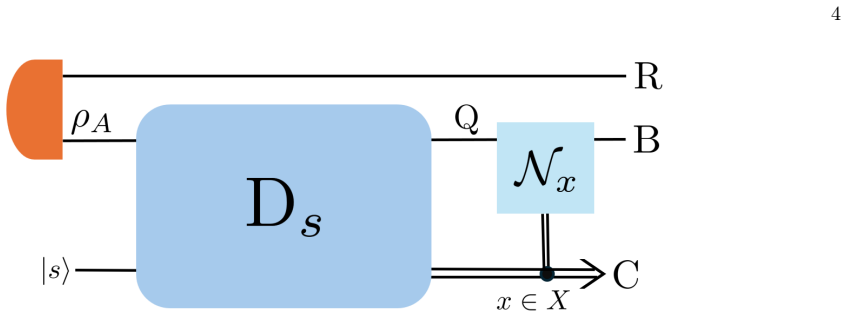
Demultiplexers are the fundamental primitives of network architecture, enabling perfect routing of an input classical signal to a designated one, among multiple output ports. Quantum transmission lines, having access to the quantum systems directly, are able to transmit both the classical and quantum information encoded in quantum systems. A natural question therefore emerges that whether the scrambled classical and quantum information in a quantum system can be perfectly demultiplexed in the designated classical and quantum output ports? Here we answer this question by introducing a quantum to quantum-classical device, namely the quantum demultiplexer (Q-DEMUX). We characterize the class of Q-DEMUXs enabling perfect routing of both the classical and the quantum information along with their simple circuit realizations. Our results highlight an explicit connection between the strength of a Q-DEMUX with the incompatibility of quantum instruments. Finally, we extend the notion in a stronger variant where the sender is oblivious regarding the nature of the data to be transmitted through the Q-DEMUX.
Editorial analysis
A structured set of objections, weighed in public.
Referee Report
Summary. The manuscript introduces the quantum demultiplexer (Q-DEMUX) as a quantum-to-quantum-classical device that routes both classical and quantum information encoded in a quantum system to designated output ports. It claims to fully characterize the class of Q-DEMUXs permitting perfect routing, supply simple circuit realizations, establish an explicit connection between Q-DEMUX strength and the incompatibility of quantum instruments, and extend the construction to an oblivious-sender variant in which the sender need not know the classical/quantum nature of the input.
Significance. If the claimed characterization and circuits are correct, the work would supply a new primitive for quantum network architectures that handles mixed classical-quantum payloads on a single transmission line. The explicit link to instrument incompatibility would also furnish a concrete operational interpretation of incompatibility measures, which is a strength of the manuscript.
major comments (1)
- [Abstract] Abstract: the central claim that the class of Q-DEMUXs is characterized and that this characterization rests on an explicit connection to instrument incompatibility is not accompanied by any stated mathematical condition (e.g., a necessary-and-sufficient bound on an incompatibility measure) or derivation showing how that condition produces the routing maps. Without this, it is impossible to verify whether the asserted circuit realizations achieve perfect routing for arbitrary input states or only under additional, unstated restrictions.
Simulated Author's Rebuttal
We thank the referee for the careful reading and for recognizing the potential significance of the Q-DEMUX primitive and its link to instrument incompatibility. We address the single major comment below.
read point-by-point responses
-
Referee: [Abstract] Abstract: the central claim that the class of Q-DEMUXs is characterized and that this characterization rests on an explicit connection to instrument incompatibility is not accompanied by any stated mathematical condition (e.g., a necessary-and-sufficient bound on an incompatibility measure) or derivation showing how that condition produces the routing maps. Without this, it is impossible to verify whether the asserted circuit realizations achieve perfect routing for arbitrary input states or only under additional, unstated restrictions.
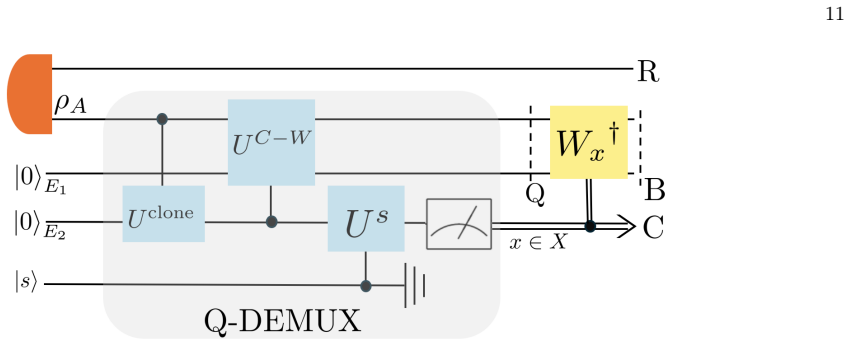
Authors: The full characterization appears in the body of the manuscript (Theorem 1 and the surrounding derivations in Section III). There we establish the necessary-and-sufficient condition that a Q-DEMUX realizes perfect classical-quantum routing if and only if the incompatibility measure of the two associated instruments satisfies I(Φ1,Φ2) ≤ 1/2, with the routing maps obtained explicitly by the Stinespring dilation of the instruments followed by the controlled unitary circuit of Figure 2. The proof proceeds by direct verification on arbitrary input states ho and uses only complete positivity and trace preservation, without further restrictions. We agree, however, that the abstract itself does not quote this bound or the derivation step. We will therefore revise the abstract to read: "We characterize the class of Q-DEMUXs by the necessary-and-sufficient condition that the incompatibility of the associated instruments is at most 1/2; this bound directly determines the routing maps via the circuit construction, which achieves perfect demultiplexing for arbitrary inputs." revision: yes
Circularity Check
No circularity in derivation chain
full rationale
The provided abstract and text contain no equations, derivations, or explicit mathematical steps that reduce a claimed result to its own inputs by construction. The central characterization of Q-DEMUXs and the stated connection to instrument incompatibility are asserted as outcomes without visible self-definitional loops, fitted-input predictions, or load-bearing self-citations that collapse the argument. The derivation therefore stands as self-contained against external benchmarks; no load-bearing step can be exhibited as circular.
Axiom & Free-Parameter Ledger
Forward citations
Cited by 1 Pith paper
-
Genuine certification of incompatible quantum instruments through sequential communication tasks
Three-party sequential communication tasks certify incompatibility of quantum instruments via violation of a tight classical bound, providing genuine semi-device-independent certification independent of component inco...
Reference graph
Works this paper leans on
-
[1]
The channel then admits an isometric extension of the following form: V(d,k) Λ |ψ⟩A = k−1X i=0 ci |i⟩Q ⊗ |i⟩E + d−1X j=k cj |j⟩Q ⊗ |k⟩E ,where, d−1X i=0 ci |i⟩=|ψ⟩ ∈ H d
In particular, to make it simpler, here we have replaced thek-dimensional C-Q channel with a classical-classical one and the RI with the identity channel on the(d−k )-dimensional subspace. The channel then admits an isometric extension of the following form: V(d,k) Λ |ψ⟩A = k−1X i=0 ci |i⟩Q ⊗ |i⟩E + d−1X j=k cj |j⟩Q ⊗ |k⟩E ,where, d−1X i=0 ci |i⟩=|ψ⟩ ∈ H ...
2025
-
[2]
M. M. Mano,Computer logic design, Vol. 80 (Prentice-Hall Englewood Cliffs, 1972)
1972
-
[3]
Komar, E
P. Komar, E. M. Kessler, M. Bishof, L. Jiang, A. S. Sørensen, J. Ye, and M. D. Lukin, A quantum network of clocks, Nature Physics10, 582 (2014)
2014
-
[4]
Wehner, D
S. Wehner, D. Elkouss, and R. Hanson, Quantum internet: A vision for the road ahead, Science362, eaam9288 (2018)
2018
-
[5]
M. Pant, H. Krovi, D. Towsley, L. Tassiulas, L. Jiang, P. Basu, D. Englund, and S. Guha, Routing entanglement in the quantum internet, npj Quantum Information5, 25 (2019)
2019
-
[6]
J. C. Garcia-Escartin and P. Chamorro-Posada, Quantum multiplexing with optical coherent states, Quantum Information and Computation9(2009)
2009
-
[7]
Y. Xie, Y. Huang, Y. Wu, and X. Hao, Quantum demultiplexer of quantum parameter-estimation information in quantum networks, Quantum Information Processing17, 108 (2018)
2018
-
[8]
S. S. Bhattacharya, A. G. Maity, T. Guha, G. Chiribella, and M. Banik, Random-receiver quantum communication, PRX Quantum2, 020350 (2021)
2021
-
[9]
T. Guha, S. Roy, and G. Chiribella, Quantum networks boosted by entanglement with a control system, Physical Review Research5, 033214 (2023)
2023
-
[10]
Heinosaari and M
T. Heinosaari and M. Ziman,The mathematical language of quantum theory: from uncertainty to entanglement(Cambridge University Press, 2011)
2011
-
[11]
Busch, P
P. Busch, P. Lahti, J.-P. Pellonpää, and K. Ylinen,Quantum measurement, Vol. 23 (Springer, 2016)
2016
-
[12]
E. B. Davies and J. T. Lewis, An operational approach to quantum probability, Communications in Mathematical Physics 17, 239 (1970)
1970
-
[13]
Horodecki, P
M. Horodecki, P. W. Shor, and M. B. Ruskai, Entanglement breaking channels, Reviews in Mathematical Physics15, 629 (2003)
2003
-
[14]
M. E. Shirokov, Conditions for coincidence of the classical capacity and entanglement-assisted capacity of a quantum channel, Problems of Information Transmission48, 85 (2012)
2012
-
[15]
Chiribella, S
G. Chiribella, S. Roy, T. Guha, and S. Saha, Communication power of a noisy qubit, Physical Review Letters134, 080803 (2025)
2025
-
[16]
L. B. Vieira, H.-Y. Ku, and C. Budroni, Entanglement-breaking channels are a quantum memory resource, Physical Review Research7, 043281 (2025)
2025
-
[17]
A. M. Childs, Secure assisted quantum computation, Quantum Information and computation5(2005)
2005
-
[18]
Arrighi and L
P. Arrighi and L. Salvail, Blind quantum computation, International Journal of Quantum Information4, 883 (2006)
2006
-
[19]
J. F. Fitzsimons, Private quantum computation: an introduction to blind quantum computing and related protocols, npj Quantum Information3, 23 (2017)
2017
-
[20]
Gregoratti and R
M. Gregoratti and R. Werner, On quantum error-correction by classical feedback in discrete time, Journal of Mathematical Physics45, 2600 (2004)
2004
-
[21]
Nayak and P
A. Nayak and P. Sen, Invertible quantum operations and perfect encryption of quantum states, Quantum Information and Computation7(2006)
2006
-
[22]
Plávala, O
M. Plávala, O. Gühne, and M. T. Quintino, All incompatible measurements on qubits lead to multiparticle bell nonlocality, Physical Review Letters134, 200201 (2025)
2025
-
[23]
Cavalcanti and P
D. Cavalcanti and P. Skrzypczyk, Quantitative relations between measurement incompatibility, quantum steering, and nonlocality, Physical Review A93, 052112 (2016). 21
2016
-
[24]
Skrzypczyk, I
P. Skrzypczyk, I. Šupić, and D. Cavalcanti, All sets of incompatible measurements give an advantage in quantum state discrimination, Physical Review Letters122, 130403 (2019)
2019
-
[25]
Heinosaari and T
T. Heinosaari and T. Miyadera, Incompatibility of quantum channels, Journal of Physics A: Mathematical and Theoretical 50, 135302 (2017)
2017
-
[26]
Leppäjärvi and M
L. Leppäjärvi and M. Sedlák, Incompatibility of quantum instruments, Quantum8, 1246 (2024)
2024
-
[27]
Mitra and M
A. Mitra and M. Farkas, Compatibility of quantum instruments, Physical Review A105, 052202 (2022)
2022
-
[28]
Mitra and M
A. Mitra and M. Farkas, Characterizing and quantifying the incompatibility of quantum instruments, Physical Review A 107, 032217 (2023)
2023
-
[29]
Bužek, M
V. Bužek, M. Hillery, M. Ziman, and M. Roško, Programmable quantum processors., Quantum Information Processing5, 313–420 (2006)
2006
-
[30]
Ji and E
K. Ji and E. Chitambar, Incompatibility as a resource for programmable quantum instruments, PRX Quantum5, 010340 (2024)
2024
- [31]
-
[32]
Leppäjärvi and M
L. Leppäjärvi and M. Sedlák, Postprocessing of quantum instruments, Physical Review A103, 022615 (2021)
2021
-
[33]
On environment-assisted capacities of quantum channels
A. Winter, On environment-assisted capacities of quantum channels, arXiv preprint quant-ph/0507045 10.48550/arxiv.quant- ph/0507045 (2005)
work page internal anchor Pith review Pith/arXiv arXiv doi:10.48550/arxiv.quant- 2005
-
[34]
Hayden and C
P. Hayden and C. King, Correcting quantum channels by measuring the environment, Quantum Info. Comput.5, 156–160 (2005)
2005
-
[35]
Karumanchi, S
S. Karumanchi, S. Mancini, A. Winter, and D. Yang, Classical capacities of quantum channels with environment assistance, Problems of Information Transmission52, 214 (2016)
2016
- [36]
- [37]
-
[38]
Pirandola, C
S. Pirandola, C. Ottaviani, C. S. Jacobsen, G. Spedalieri, S. L. Braunstein, T. Gehring, and U. L. Andersen, Environment- assisted bosonic quantum communications, npj Quantum Information7, 77 (2021)
2021
discussion (0)
Sign in with ORCID, Apple, or X to comment. Anyone can read and Pith papers without signing in.