Discovery of a quasi-periodic oscillation non-harmonically related to the Type-C QPO in the hard intermedidate state of MAXI J1820+070
Pith reviewed 2026-06-26 23:23 UTC · model grok-4.3
The pith
A QPO at 3.5-5.9 Hz appears in the hard-intermediate state of MAXI J1820+070 and evolves into the Type-B QPO after the transition.
A machine-rendered reading of the paper's core claim, the machinery that carries it, and where it could break.
Core claim
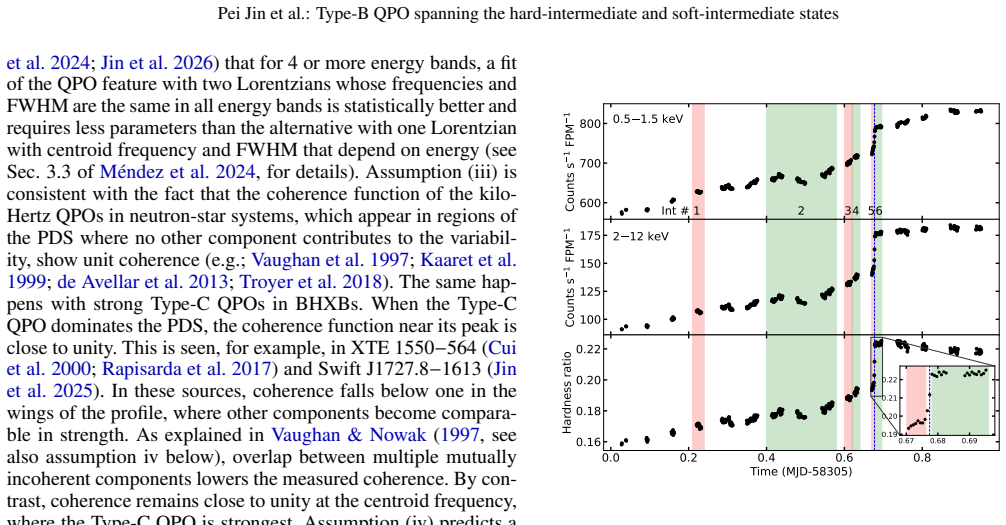
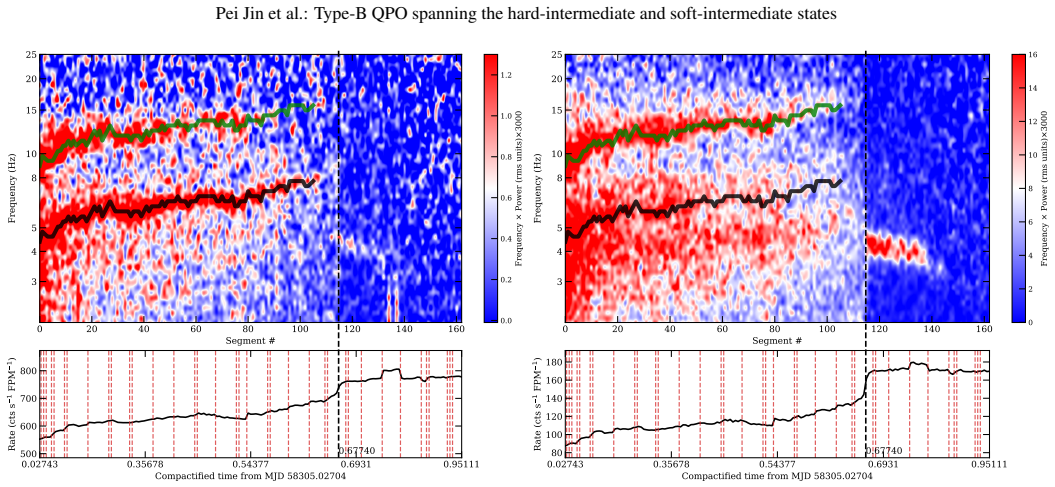
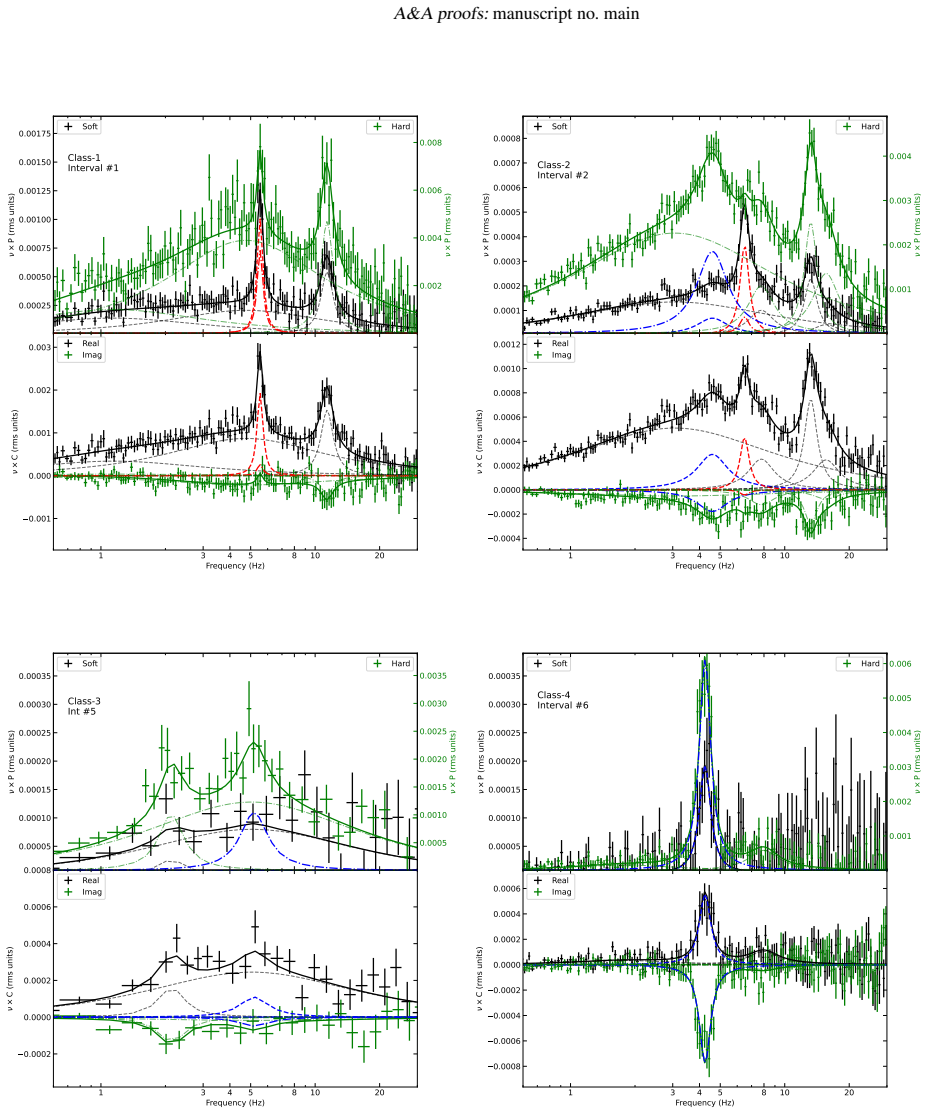
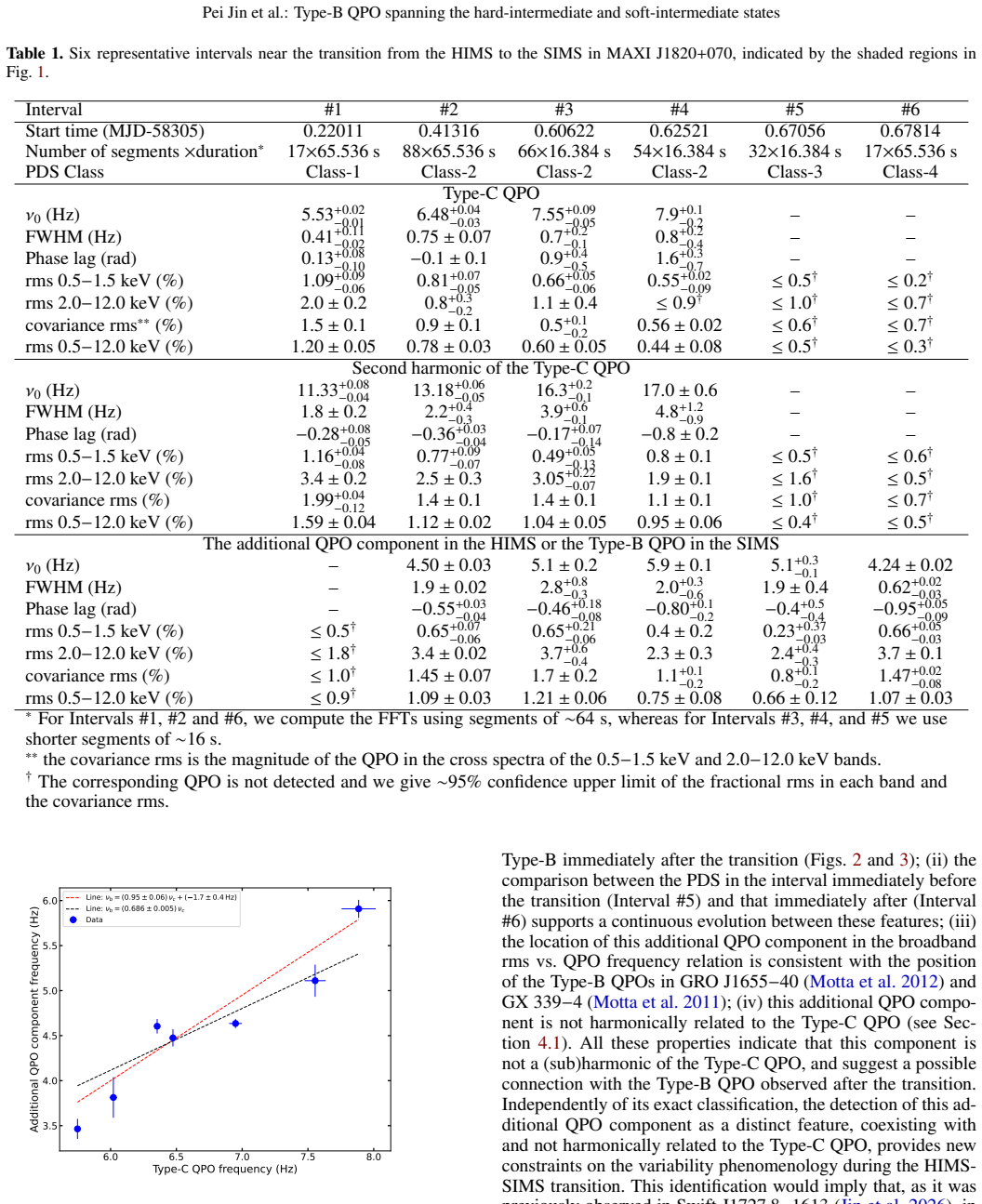
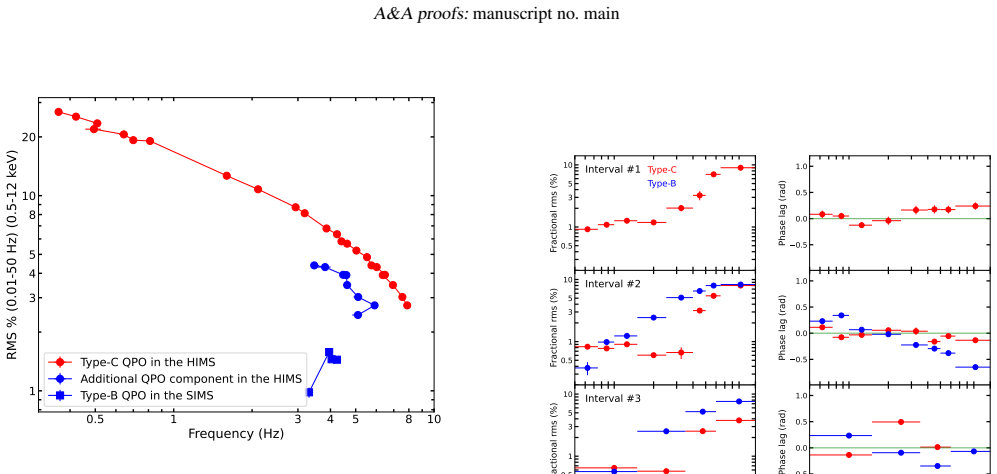
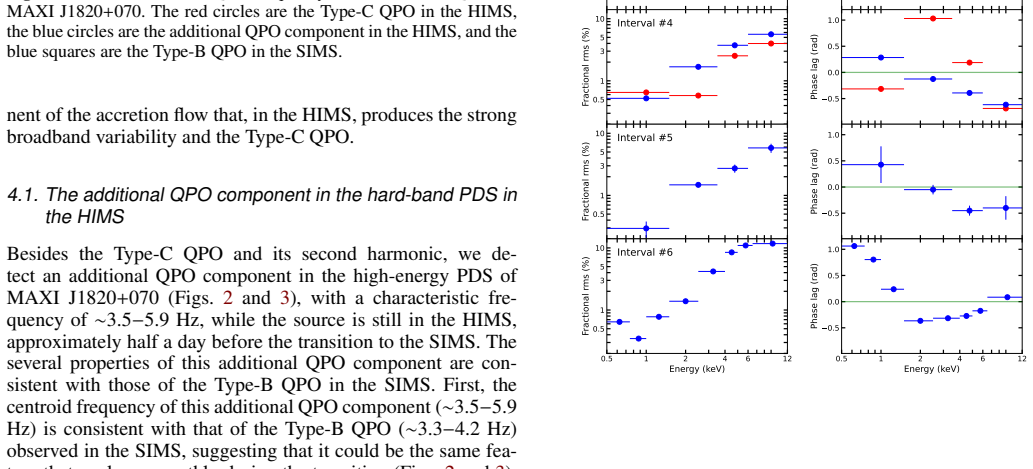
We detect a QPO at 3.5-5.9 Hz in the 2-12 keV power density spectrum of MAXI J1820+070 roughly half a day before the HIMS-to-SIMS transition. This QPO appears to evolve smoothly into the Type-B QPO observed immediately after the transition, and its location in the broadband rms versus QPO frequency plot matches Type-B QPOs in GX 339-4 and GRO J1655-40. The result indicates that QPOs with these characteristics can emerge prior to the transition and are not confined exclusively to the SIMS, implying no direct physical connection to the discrete radio ejections that occur at the transition.
What carries the argument
The additional QPO component at 3.5-5.9 Hz identified in the power density spectrum before the transition, distinguished by its frequency evolution, rms properties, and non-harmonic relation to the Type-C QPO.
If this is right
- QPOs with Type-B characteristics can emerge prior to the HIMS-to-SIMS transition.
- There may be no direct physical connection between the Type-B QPO and the discrete radio ejections.
- The disappearance of the Type-C QPO, the drop in broadband noise, and the emergence of discrete radio ejections are linked at the transition.
- The simultaneous presence of a non-harmonically related QPO in the HIMS could be compatible with a spine-sheath outflow structure.
Where Pith is reading between the lines
- Similar pre-transition QPOs may be found by re-examining archival data from other sources that show Type-B QPOs after their transitions.
- The mechanism producing this QPO likely operates independently of the processes that quench the compact jet at the transition.
- Multi-source comparisons could test whether the non-harmonic relation to the Type-C QPO is a general signature of the late HIMS.
Load-bearing premise
That the smooth frequency evolution and position in the rms-frequency diagram establish the pre-transition QPO as the direct precursor of the Type-B QPO.
What would settle it
If the 3.5-5.9 Hz feature does not continue evolving into the observed post-transition Type-B frequencies, or if no similar pre-transition QPO appears in other black hole binaries with comparable state transitions.
Figures
read the original abstract
We present a detailed timing analysis of the transition from the hard-intermediate state (HIMS) to the soft-intermediate state (SIMS) in MAXI J1820+070 using NICER observations. This transition is marked by a sharp drop of the broadband noise across both the soft and hard X-ray bands, the disappearance of the Type-C quasi-periodic oscillation (QPO), the quenching of the steady, optically thick, compact jet, the appearance of a Type-B QPO, and the detection of discrete, optically thin, radio ejections. For the first time, we detect a QPO at 3.5-5.9 Hz in the 2-12 keV power density spectrum of MAXI J1820+070 roughly half a day before the transition, which appears to evolve smoothly into the Type-B QPO observed immediately after the transition. The location of this additional QPO component in the broadband rms vs. QPO frequency plot is consistent with that of the Type-B QPOs in GX 339-4 and GRO J1655-40, suggesting a possible connection between this additional QPO in the HIMS and the Type-B QPO in the SIMS. This result, together with recent findings in Swift J1727.8-1613, suggests that QPOs with these characteristics can emerge prior to the HIMS-to-SIMS transition and are not confined exclusively to the SIMS. If this additional QPO feature is the precursor of the Type-B QPO in the SIMS, its presence before the transition, whereas the bright discrete, optically thin, radio ejections appear at the transition, would imply that there may be no direct physical connection between the Type-B QPO and the discrete radio ejections. Our results further suggest a link between the disappearance of the Type-C QPO, the drop of the broadband noise, and the emergence of discrete radio ejections at the HIMS-to-SIMS transition. We speculate that the simultaneous presence of such a QPO, non-harmonically related to the Type-C QPO in the HIMS, could be compatible with a spine-sheath outflow structure.
Editorial analysis
A structured set of objections, weighed in public.
Referee Report
Summary. The manuscript reports a timing analysis of NICER data on MAXI J1820+070 during the HIMS-to-SIMS transition. It claims detection of a new QPO at 3.5-5.9 Hz in the 2-12 keV PDS roughly half a day before the transition, which appears to evolve smoothly into the post-transition Type-B QPO. The feature's location in the rms-frequency diagram matches Type-B QPOs in GX 339-4 and GRO J1655-40, leading the authors to interpret it as a possible precursor to Type-B QPOs (not exclusive to the SIMS) and to suggest no direct physical link to the discrete radio ejections that appear at the transition. The work also links the Type-C QPO disappearance and broadband noise drop to the transition and speculates on compatibility with a spine-sheath outflow structure.
Significance. If the detection is robust and the evolutionary continuity holds, the result would be significant for black-hole X-ray binary timing studies. It would show that QPOs with Type-B characteristics can appear in the HIMS, extending the known phenomenology beyond the conventional SIMS association and providing a potential observational test for multi-component outflow models. The decoupling from radio ejections would also bear on jet-disk coupling at state transitions. The analysis draws on high-cadence NICER observations, which is a methodological strength for resolving rapid changes across the transition.
major comments (2)
- [Abstract] Abstract (detection paragraph): the claim that the 3.5-5.9 Hz QPO 'appears to evolve smoothly' into the Type-B QPO is load-bearing for the precursor interpretation, yet the text supplies neither the measured frequencies with uncertainties, the number of independent observations spanning the transition, nor any quantitative continuity test (e.g., a joint fit or χ^{2} comparison of a continuous vs. discontinuous track).
- [Abstract] Abstract (rms-frequency comparison): the statement that the new QPO's location in the broadband rms vs. QPO frequency plot is 'consistent' with Type-B QPOs in GX 339-4 and GRO J1655-40 is central to the suggested connection, but no rms value, uncertainty, or data point for MAXI J1820+070 is reported, preventing verification of the match or assessment against alternative placements.
minor comments (1)
- [Abstract] The frequency range 3.5-5.9 Hz is given without specifying whether these are the observed range across multiple observations or the 1-σ bounds on a single detection; clarifying this would aid reproducibility.
Simulated Author's Rebuttal
We thank the referee for their constructive comments, which help clarify the presentation of our results. We address each major comment below and have revised the abstract to incorporate the requested quantitative details.
read point-by-point responses
-
Referee: [Abstract] Abstract (detection paragraph): the claim that the 3.5-5.9 Hz QPO 'appears to evolve smoothly' into the Type-B QPO is load-bearing for the precursor interpretation, yet the text supplies neither the measured frequencies with uncertainties, the number of independent observations spanning the transition, nor any quantitative continuity test (e.g., a joint fit or χ^{2} comparison of a continuous vs. discontinuous track).
Authors: We agree that the abstract would benefit from these quantitative elements to support the evolutionary continuity claim. The main text already presents the frequency measurements from the NICER observations and the observed track across the transition; we have revised the abstract to explicitly include the measured frequencies with uncertainties, the number of independent observations, and a reference to the continuity assessment (including model comparison) detailed in the results section. This strengthens the precursor interpretation without changing the underlying analysis. revision: yes
-
Referee: [Abstract] Abstract (rms-frequency comparison): the statement that the new QPO's location in the broadband rms vs. QPO frequency plot is 'consistent' with Type-B QPOs in GX 339-4 and GRO J1655-40 is central to the suggested connection, but no rms value, uncertainty, or data point for MAXI J1820+070 is reported, preventing verification of the match or assessment against alternative placements.
Authors: We agree that reporting the specific rms value is necessary for independent verification. We have revised the abstract to include the measured broadband rms value with its uncertainty for the QPO in MAXI J1820+070, allowing direct comparison to the Type-B QPOs in the other sources and assessment of the consistency claim. revision: yes
Circularity Check
No circularity: purely observational timing detection with no derivation chain
full rationale
This is an observational X-ray timing study reporting detection of a 3.5-5.9 Hz QPO feature in NICER PDS data of MAXI J1820+070 and noting its location in the rms-frequency plane plus apparent frequency evolution. The central claims rest on direct measurements of frequencies, rms amplitudes, and comparisons to published data from other sources (GX 339-4, GRO J1655-40). No equations, model fits, or derivations are presented that reduce to inputs by construction; no self-citation load-bearing uniqueness theorems or ansatzes appear. The precursor interpretation is a qualitative inference from data properties, not a mathematical reduction, so the paper is self-contained against external benchmarks.
Axiom & Free-Parameter Ledger
Reference graph
Works this paper leans on
-
[1]
A two-component Comptonization model for the type-B QPO in MAXI J1348-630. , keywords =. doi:10.1093/mnras/staa3944 , archivePrefix =. 2012.10354 , primaryClass =
-
[2]
Long term variability of Cygnus X-1. VIII. A spectral-timing look at low energies with NICER. , keywords =. doi:10.1051/0004-6361/202449333 , archivePrefix =. 2405.07754 , primaryClass =
-
[3]
A Hidden Pulse: Uncovering a New Timing Signal in Cygnus X-1 with AstroSat. , keywords =. doi:10.3847/1538-4357/adf1a5 , archivePrefix =. 2507.13884 , primaryClass =
-
[4]
Probing the origin of quasi-periodic oscillations: the short-time-scale evolution of phase lags in GRS 1915+105. , keywords =. doi:10.1093/mnras/stw610 , archivePrefix =. 1603.03392 , primaryClass =
work page internal anchor Pith review Pith/arXiv arXiv doi:10.1093/mnras/stw610 1915
-
[5]
Discovery of Microsecond Soft Lags in the X-Ray Emission of the Atoll Source 4U1636-536
Discovery of Microsecond Soft Lags in the X-Ray Emission of the Atoll Source 4U 1636-536. , keywords =. doi:10.1086/311941 , archivePrefix =. astro-ph/9901349 , primaryClass =
work page internal anchor Pith review Pith/arXiv arXiv doi:10.1086/311941
-
[6]
Discovery of microsecond time lags in kilohertz QPO
Discovery of Microsecond Time Lags in Kilohertz QPOs. , keywords =. doi:10.1086/310740 , archivePrefix =. astro-ph/9704245 , primaryClass =
work page internal anchor Pith review Pith/arXiv arXiv doi:10.1086/310740
-
[7]
Disc-corona interaction in the heartbeat state of GRS 1915+105
Disc-corona interaction in the heartbeat state of GRS 1915+105. , keywords =. doi:10.1093/mnras/stx2885 , archivePrefix =. 1711.03005 , primaryClass =
work page internal anchor Pith review Pith/arXiv arXiv doi:10.1093/mnras/stx2885 1915
-
[8]
The energy dependence of the three types of low-frequency quasi-periodic oscillations in the black hole candidate H1743-322. , keywords =. doi:10.1093/mnras/stt737 , adsurl =
-
[9]
The energy dependence of the centroid frequency of the low-frequency quasi-periodic oscillations in XTE J1550-564. , keywords =. doi:10.1093/mnras/sts149 , adsurl =
-
[10]
The energy dependence of the centroid frequency and phase lag of the QPOs in GRS 1915+105
The Energy Dependence of the Centroid Frequency and Phase Lag of the Quasi-periodic Oscillations in GRS 1915+105. , keywords =. doi:10.1088/0004-637X/710/1/836 , archivePrefix =. 0912.4769 , primaryClass =
work page internal anchor Pith review Pith/arXiv arXiv doi:10.1088/0004-637x/710/1/836 1915
-
[11]
Black-hole X-ray binary Swift J1727.8─1613 shows simultaneous Type-B and Type-C quasiperiodic oscillations across the hard-intermediate and soft-intermediate states. , keywords =. doi:10.1051/0004-6361/202555907 , archivePrefix =. 2510.10353 , primaryClass =
-
[12]
A Detailed View of Low-frequency Quasi-periodic Oscillation in the Broadband 0.2-200 keV with Insight-HXMT and NICER. , keywords =. doi:10.3847/1538-4357/acc4c3 , archivePrefix =. 2303.00481 , primaryClass =
-
[13]
Cross-spectral modelling of the black hole X-ray binary XTE J1550-564: challenges to the propagating fluctuations paradigm. , keywords =. doi:10.1093/mnras/stx991 , archivePrefix =. 1704.07705 , primaryClass =
work page internal anchor Pith review Pith/arXiv arXiv doi:10.1093/mnras/stx991
-
[14]
A Systematic Spectral-timing Analysis of Kilohertz Quasi-periodic Oscillations in the Rossi X-Ray Timing Explorer Archive. , keywords =. doi:10.3847/1538-4357/aac4a4 , archivePrefix =. 1805.05234 , primaryClass =
work page internal anchor Pith review Pith/arXiv arXiv doi:10.3847/1538-4357/aac4a4
-
[15]
Time lags of the kilohertz quasi-periodic oscillations in the low-mass X-ray binaries 4U 1608-52 and 4U 1636-53. , keywords =. doi:10.1093/mnras/stt1001 , archivePrefix =. 1302.6464 , primaryClass =
work page internal anchor Pith review Pith/arXiv arXiv doi:10.1093/mnras/stt1001
-
[16]
Timing Analysis of Black Hole X-Ray Binaries with Insight-HXMT. Galaxies , keywords =. doi:10.3390/galaxies13050111 , adsurl =
-
[17]
Energy Spectra of Low-Mass Binary X-Ray Sources Observed from Tenma. , keywords =. doi:10.1093/pasj/36.4.741 , adsurl =
-
[18]
The limb-brightened jet of M87 down to 7 Schwarzschild radii scale
The limb-brightened jet of M87 down to the 7 Schwarzschild radii scale. , keywords =. doi:10.1051/0004-6361/201832921 , archivePrefix =. 1805.02478 , primaryClass =
work page internal anchor Pith review Pith/arXiv arXiv doi:10.1051/0004-6361/201832921
-
[19]
A unified accretion-ejection paradigm for black hole X-ray binaries. I. The dynamical constituents. , keywords =. doi:10.1051/0004-6361:20052689 , archivePrefix =. astro-ph/0511123 , primaryClass =
work page internal anchor Pith review Pith/arXiv arXiv doi:10.1051/0004-6361:20052689
-
[20]
Error formulae for the energy-dependent cross-spectrum. , keywords =. doi:10.1093/mnras/stz2409 , archivePrefix =. 1909.01385 , primaryClass =
-
[21]
Space Telescopes and Instrumentation 2016: Ultraviolet to Gamma Ray , year = 2016, editor =
The Neutron star Interior Composition Explorer (NICER): design and development. Space Telescopes and Instrumentation 2016: Ultraviolet to Gamma Ray , year = 2016, editor =. doi:10.1117/12.2231304 , adsurl =
-
[22]
X-Ray Properties of Black-Hole Binaries. , keywords =. doi:10.1146/annurev.astro.44.051905.092532 , archivePrefix =. astro-ph/0606352 , primaryClass =
work page internal anchor Pith review Pith/arXiv arXiv doi:10.1146/annurev.astro.44.051905.092532
-
[23]
The Astronomer's Telegram , keywords =
MAXI/GSC detection of a probable new X-ray transient MAXI J1820+070. The Astronomer's Telegram , keywords =
-
[24]
The Binary Mass Ratio in the Black Hole Transient MAXI J1820+070. , keywords =. doi:10.3847/2041-8213/ab863a , archivePrefix =. 2003.02360 , primaryClass =
-
[25]
Efficient generation of jets from magnetically arrested accretion on a rapidly spinning black hole. , keywords =. doi:10.1111/j.1745-3933.2011.01147.x , archivePrefix =. 1108.0412 , primaryClass =
-
[26]
A unified accretion-ejection paradigm for black hole X-ray binaries. V. Low-frequency quasi-periodic oscillations. , keywords =. doi:10.1051/0004-6361/202037539 , archivePrefix =. 2005.10359 , primaryClass =
-
[27]
Measuring fundamental jet properties with multiwavelength fast timing of the black hole X-ray binary MAXI J1820+070. , keywords =. doi:10.1093/mnras/stab820 , archivePrefix =. 2103.09318 , primaryClass =
-
[28]
The inner flow geometry in MAXI J1820+070 during hard and hard-intermediate states. , keywords =. doi:10.1051/0004-6361/202140567 , archivePrefix =. 2102.07811 , primaryClass =
-
[29]
Black-hole X-ray binary Swift J1727.8 - 1613 shows Type-B quasi-periodic oscillations across the hard-intermediate and soft-intermediate states. arXiv e-prints , keywords =. doi:10.48550/arXiv.2510.10353 , archivePrefix =. 2510.10353 , primaryClass =
-
[30]
X-ray and Optical Monitoring of State Transitions in MAXI J1820+070
X-Ray and Optical Monitoring of State Transitions in MAXI J1820+070. , keywords =. doi:10.3847/1538-4357/ab09ff , archivePrefix =. 1903.01686 , primaryClass =
work page internal anchor Pith review Pith/arXiv arXiv doi:10.3847/1538-4357/ab09ff 1903
-
[31]
The Ejection of Transient Jets in Swift J1727.8‑1613 Revealed by Time-dependent Visibility Modeling. , keywords =. doi:10.3847/2041-8213/adc9b3 , archivePrefix =. 2503.03073 , primaryClass =
-
[32]
A global study of Type B quasi-periodic oscillation in black hole X-ray binaries
A global study of type B quasi-periodic oscillation in black hole X-ray binaries. , keywords =. doi:10.1093/mnras/stw3146 , archivePrefix =. 1701.04994 , primaryClass =
work page internal anchor Pith review Pith/arXiv arXiv doi:10.1093/mnras/stw3146
-
[33]
Fluorescent iron lines as a probe of astrophysical black hole systems
Fluorescent iron lines as a probe of astrophysical black hole systems. , keywords =. doi:10.1016/S0370-1573(02)00584-7 , archivePrefix =. astro-ph/0212065 , primaryClass =
work page internal anchor Pith review Pith/arXiv arXiv doi:10.1016/s0370-1573(02)00584-7
-
[34]
Geometry of the Comptonization Region of MAXI J1348‑630 through Type-C Quasiperiodic Oscillations with NICER. , keywords =. doi:10.3847/1538-4357/ada7f9 , archivePrefix =. 2409.14883 , primaryClass =
-
[35]
Disk-Jet Coupling in the 2017/2018 Outburst of the Galactic Black Hole Candidate X-Ray Binary MAXI J1535-571. , keywords =. doi:10.3847/1538-4357/ab3d36 , archivePrefix =. 1906.00998 , primaryClass =
-
[36]
Disc-jet coupling in the 2009 outburst of the black hole candidate H1743-322. , keywords =. doi:10.1111/j.1365-2966.2011.20326.x , archivePrefix =. 1201.1678 , primaryClass =
-
[37]
Tracking the X-Ray Polarization of the Black Hole Transient Swift J1727.8 1613 during a State Transition. , keywords =. doi:10.3847/1538-4357/ad3faf , archivePrefix =. 2311.05497 , primaryClass =
-
[38]
Dynamical confirmation of a black hole in the X-ray transient Swift J1727.8‑1613. , keywords =. doi:10.1051/0004-6361/202451960 , archivePrefix =. 2408.13310 , primaryClass =
-
[39]
, keywords =
Energy dependence in the quasi-periodic oscillations and noise of black hole candidates in the very high state. , keywords =
-
[40]
Type-A quasi-periodic oscillation in the black hole transient MAXI J1348-630. , keywords =. doi:10.1093/mnras/stad3062 , archivePrefix =. 2310.04208 , primaryClass =
-
[41]
A clear state transition from super-Eddington to sub-Eddington accretion revealed by Insight-HXMT
The bright black hole X-ray binary 4U 1543-47 during 2021 outburst. A clear state transition from super-Eddington to sub-Eddington accretion revealed by Insight-HXMT. , keywords =. doi:10.1093/mnras/stae686 , archivePrefix =. 2403.02874 , primaryClass =
-
[42]
Fast variability as a tracer of accretion regimes in black hole transients. , keywords =. doi:10.1111/j.1365-2966.2010.17476.x , archivePrefix =. 1008.0558 , primaryClass =
-
[43]
The ABC of Low-Frequency Quasi-periodic Oscillations in Black Hole Candidates: Analogies with Z Sources. , keywords =. doi:10.1086/431174 , archivePrefix =. astro-ph/0504318 , primaryClass =
work page internal anchor Pith review Pith/arXiv arXiv doi:10.1086/431174
-
[44]
Characterizing the QPO Behavior of the X-ray Nova XTE J1550--564
Characterizing the Quasi-periodic Oscillation Behavior of the X-Ray Nova XTE J1550-564. , keywords =. doi:10.1086/324276 , archivePrefix =. astro-ph/0105508 , primaryClass =
work page internal anchor Pith review Pith/arXiv arXiv doi:10.1086/324276
-
[45]
The Complex Phase-Lag Behavior of the 3-12 HZ Quasi-Periodic Oscillations during the Very High State of XTE J1550-564. , keywords =. doi:10.1086/312365 , archivePrefix =. astro-ph/9909515 , primaryClass =
work page internal anchor Pith review Pith/arXiv arXiv doi:10.1086/312365
-
[46]
, keywords =
Comptonization of X-Rays in Plasma Clouds - Typical Radiation Spectra. , keywords =
-
[47]
A systematic study of the high-frequency bump in the black-hole low-mass X-ray binary GX 339 - 4. , keywords =. doi:10.1093/mnras/stad3623 , archivePrefix =. 2311.12661 , primaryClass =
-
[48]
Observational appearance
Black holes in binary systems. Observational appearance. , year = 1973, volume =
1973
-
[49]
The evolution of black hole states
The Evolution of Black Hole States. , keywords =. doi:10.1007/s10509-005-1197-4 , archivePrefix =. astro-ph/0412597 , primaryClass =
work page internal anchor Pith review Pith/arXiv arXiv doi:10.1007/s10509-005-1197-4
-
[50]
Towards a unified model for black hole X-ray binary jets. , keywords =. doi:10.1111/j.1365-2966.2004.08384.x , archivePrefix =. astro-ph/0409360 , primaryClass =
-
[51]
Fast-varying time lags in the quasi-periodic oscillation in GRS 1915 + 105. , keywords =. doi:10.1093/mnras/stad3639 , archivePrefix =. 2311.13467 , primaryClass =
-
[52]
The evolution of the high-frequency variability in the black hole candidate GRS 1915+105 as seen by RXTE. , keywords =. doi:10.1093/mnras/stac1050 , archivePrefix =. 2204.05273 , primaryClass =
-
[53]
NICER uncovers the transient nature of the type-B quasi-periodic oscillation in the black hole candidate MAXI J1348-630. , keywords =. doi:10.1093/mnras/stab1553 , archivePrefix =. 2105.12338 , primaryClass =
-
[54]
The evolving properties of the corona of GRS 1915+105: a spectral-timing perspective through variable-Comptonization modelling. , keywords =. doi:10.1093/mnras/stac1202 , archivePrefix =. 2204.13279 , primaryClass =
-
[55]
Lecture Notes in Physics, Berlin Springer Verlag , year = 2010, editor =
States and Transitions in Black Hole Binaries. Lecture Notes in Physics, Berlin Springer Verlag , year = 2010, editor =. doi:10.1007/978-3-540-76937-8_3 , adsurl =
-
[56]
Black hole binaries. Compact stellar X-ray sources , year = 2006, editor =. doi:10.48550/arXiv.astro-ph/0306213 , adsurl =
work page internal anchor Pith review Pith/arXiv arXiv doi:10.48550/arxiv.astro-ph/0306213 2006
-
[57]
, year = 1996, month = jan, volume =
X-ray Novae. , year = 1996, month = jan, volume =. doi:10.1146/annurev.astro.34.1.607 , adsurl =
-
[58]
Soviet Journal of Experimental and Theoretical Physics , year = 1957, month = may, volume =
The Establishment of Thermal Equilibrium between Quanta and Electrons. Soviet Journal of Experimental and Theoretical Physics , year = 1957, month = may, volume =
1957
-
[59]
A Timing View of the Additional High-energy Spectral Component Discovered in the Black Hole Candidate Swift J1727.8-1613. , keywords =. doi:10.3847/2041-8213/ad60bd , archivePrefix =. 2407.05236 , primaryClass =
-
[60]
Swift J1727.8 1613 Has the Largest Resolved Continuous Jet Ever Seen in an X-Ray Binary. , keywords =. doi:10.3847/2041-8213/ad6572 , archivePrefix =. 2405.12370 , primaryClass =
-
[61]
Correlations in Quasi-periodic Oscillation and Noise Frequencies among Neutron Star and Black Hole X-Ray Binaries. , keywords =. doi:10.1086/307436 , archivePrefix =. astro-ph/9902130 , primaryClass =
work page internal anchor Pith review Pith/arXiv arXiv doi:10.1086/307436
-
[62]
Centroid frequency ratios of simultaneous low-frequency QPOs in black hole low-mass X-ray binaries. , keywords =. doi:10.1093/mnras/staa1867 , adsurl =
-
[63]
On the modulation of low frequency Quasi-Periodic Oscillations in black-hole transients
On the modulation of low-frequency quasi-periodic oscillations in black hole transients. , keywords =. doi:10.1093/mnras/stv024 , archivePrefix =. 1501.01823 , primaryClass =
work page internal anchor Pith review Pith/arXiv arXiv doi:10.1093/mnras/stv024
-
[64]
A systematic analysis of the phase lags associated with the type-C quasi-periodic oscillation in GRS 1915+105. , keywords =. doi:10.1093/mnras/staa797 , archivePrefix =. 2003.08928 , primaryClass =
-
[65]
On the harmonics of the low-frequency quasi-periodic oscillation in GRS 1915+105. , keywords =. doi:10.1111/j.1365-2966.2012.20906.x , archivePrefix =. 1203.3582 , primaryClass =
-
[66]
Advances in Space Research , keywords =
Properties of 2017-18 'failed' outburst of GX 339-4. Advances in Space Research , keywords =. doi:10.1016/j.asr.2022.12.011 , archivePrefix =. 2111.13403 , primaryClass =
-
[67]
A timing view of the additional high-energy spectral component discovered in the black hole candidate Swift J1727.8-1613. arXiv e-prints , keywords =. doi:10.48550/arXiv.2407.05236 , archivePrefix =. 2407.05236 , primaryClass =
-
[68]
Phase Lag and Coherence Function of X-ray emission from Black Hole Candidate XTE J1550-564
Phase Lag and Coherence Function of X-Ray Emission from Black Hole Candidate XTE J1550-564. , keywords =. doi:10.1086/312520 , archivePrefix =. astro-ph/0001095 , primaryClass =
work page internal anchor Pith review Pith/arXiv arXiv doi:10.1086/312520
-
[69]
Coupling between the accreting corona and the relativistic jet in the microquasar GRS 1915+105. Nature Astronomy , keywords =. doi:10.1038/s41550-022-01617-y , archivePrefix =. 2203.02963 , primaryClass =
-
[70]
Low-frequency oscillations in black holes: a spectral-timing approach to the case of GX 339-4. , keywords =. doi:10.1111/j.1365-2966.2011.19566.x , archivePrefix =. 1108.0540 , primaryClass =
-
[71]
Are there three peaks in the power spectra of GX 339-4 and Cyg X-1?. , keywords =. doi:10.1046/j.1365-8711.2000.03668.x , archivePrefix =. astro-ph/0005232 , primaryClass =
-
[72]
and Piersol, Allan G
Bendat, Julius S. and Piersol, Allan G. , title =. 2010 , address =
2010
-
[73]
Phase Lags and Coherence of X-Ray Variability in Black Hole Candidates
Phase lags and coherence of X-ray variability in black hole candidates. , keywords =. doi:10.1093/mnras/280.1.227 , archivePrefix =. astro-ph/9512019 , primaryClass =
work page internal anchor Pith review Pith/arXiv arXiv doi:10.1093/mnras/280.1.227
-
[74]
Measurement Science and Technology , year = 2000, month = dec, volume =
BOOK REVIEW: Random Data Analysis and Measurement Procedures. Measurement Science and Technology , year = 2000, month = dec, volume =. doi:10.1088/0957-0233/11/12/702 , adsurl =
-
[75]
Canonical Time Variations of X-Rays from Black Hole Candidates in the Low-Intensity State. , keywords =. doi:10.1086/186389 , adsurl =
-
[76]
On searches for pulsed emission with application to four globular cluster X-ray sources : NGC 1851, 6441, 6624 and 6712. , keywords =. doi:10.1086/160766 , adsurl =
-
[77]
Black hole transients. Bulletin of the Astronomical Society of India , keywords =. doi:10.48550/arXiv.1109.3388 , archivePrefix =. 1109.3388 , primaryClass =
work page internal anchor Pith review Pith/arXiv arXiv doi:10.48550/arxiv.1109.3388
-
[78]
X-Ray Variability Coherence: How to Compute It, What It Means, and How It Constrains Models of GX 339-4 and Cygnus X-1. , keywords =. doi:10.1086/310430 , archivePrefix =. astro-ph/9610257 , primaryClass =
work page internal anchor Pith review Pith/arXiv arXiv doi:10.1086/310430
-
[79]
Investigating a fluctuating-accretion model for the spectral-timing properties of accreting black hole systems. , keywords =. doi:10.1111/j.1365-2966.2006.09989.x , archivePrefix =. astro-ph/0512394 , primaryClass =
-
[80]
Discovery of oscillations above 200 keV in a black hole X-ray binary with Insight-HXMT. Nature Astronomy , keywords =. doi:10.1038/s41550-020-1192-2 , archivePrefix =. 2009.10607 , primaryClass =
discussion (0)
Sign in with ORCID, Apple, or X to comment. Anyone can read and Pith papers without signing in.