Full-state information-disturbance tradeoff for direction estimation with antiparallel spin-coherent pairs
Pith reviewed 2026-06-27 00:12 UTC · model grok-4.3
The pith
For two antiparallel spin-1/2 particles the optimal direction estimator is a covariant filter with scalar-vector coherence, recovering the maximum information score while producing smaller disturbance than the parallel benchmark.
A machine-rendered reading of the paper's core claim, the machinery that carries it, and where it could break.
Core claim
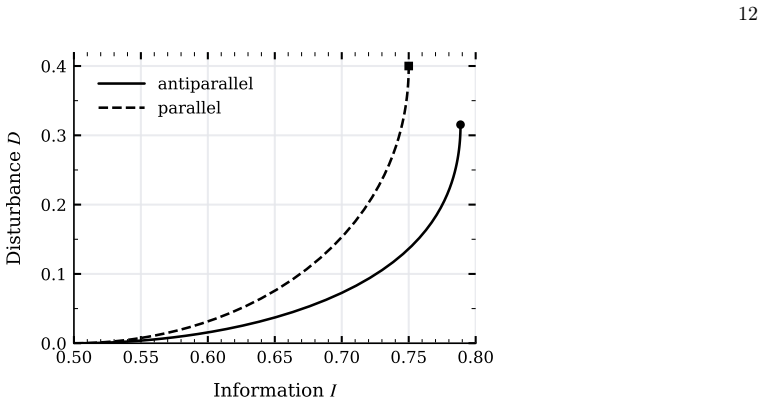
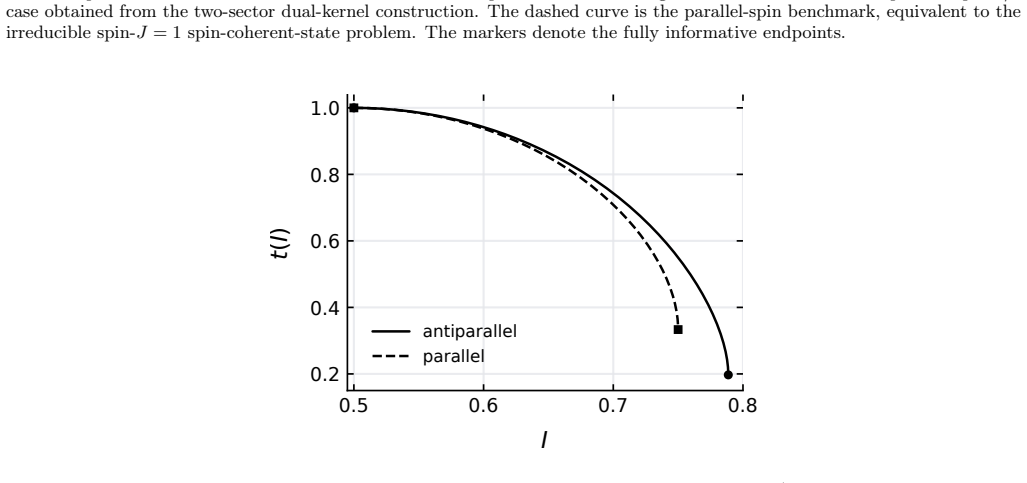
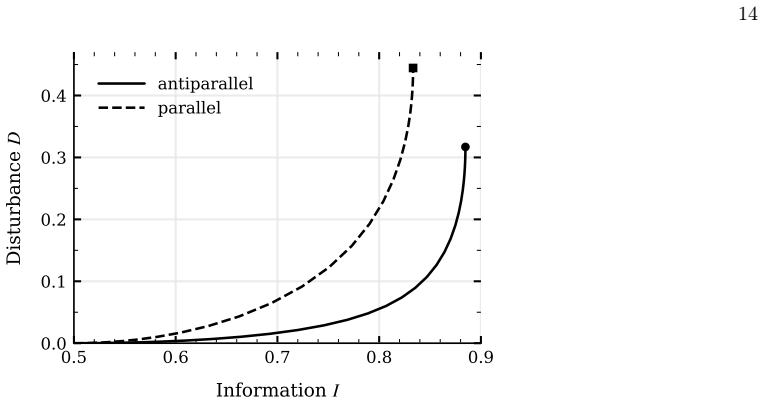
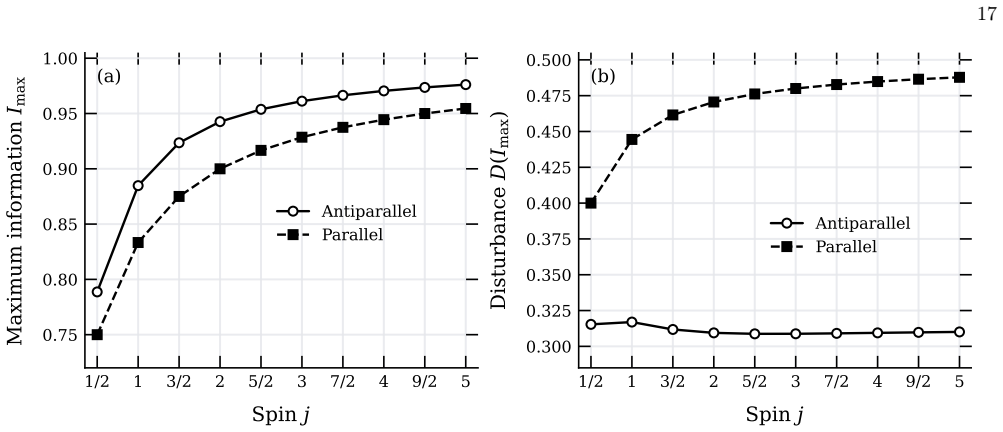
For two antiparallel spin-1/2 particles the optimal operation is a covariant filter with scalar-vector coherence. This operation is generally not a convex interpolation between the identity channel and a measure-and-reprepare strategy. At maximum information the known score is recovered, but the least disturbing output state is optimized independently, giving smaller disturbance than both the parallel-spin benchmark and antiparallel measure-and-reprepare. For arbitrary spin j the signal occupies sectors from 0 to 2j, endpoint information depends on nearest-neighbor coherences, and endpoint disturbance is obtained from an explicit finite block-diagonal eigenvalue problem.
What carries the argument
A positive seed operator in the finite-dimensional Choi representation that obeys one trace constraint for each irreducible sector of the input representation, with directional score and operation fidelity expressed as linear functionals of the seed.
If this is right
- The optimal instrument recovers the maximum information score while independently optimizing the least disturbing output state.
- For antiparallel spin-coherent states of arbitrary spin j the endpoint information is governed by nearest-neighbor sector coherences.
- The endpoint disturbance follows from solving an explicit finite block-diagonal eigenvalue problem.
Where Pith is reading between the lines
- The sector-constrained seed-operator method may extend to other symmetric estimation tasks on composite systems where the representation decomposes into multiple irreducible sectors.
- Reading the optimal instrument from the kernel vectors of the dual slack operator offers a practical route for solving similar semidefinite programs that arise in covariant quantum channels.
- The pattern of coherence between adjacent angular-momentum sectors for higher j suggests that the tradeoff may exhibit a simple recursive structure across spin values.
Load-bearing premise
Rotational covariance reduces the optimization over all instruments to a finite-dimensional Choi problem in which a positive seed operator obeys one trace constraint for each irreducible sector of the input representation.
What would settle it
An explicit non-covariant instrument whose information-disturbance curve lies strictly above the derived covariant optimum would show that the symmetry reduction misses superior operations.
Figures
read the original abstract
We determine the optimal information--disturbance tradeoff for estimating an unknown spatial direction encoded in two antiparallel spins. Rotational covariance reduces the optimization over all instruments to a finite-dimensional Choi problem: a positive seed operator obeys one trace constraint for each irreducible sector of the input representation, while both the directional score and the operation fidelity are linear functionals of this seed. For two antiparallel spin-$1/2$ particles, whose physical representation decomposes as $0\oplus1$, we derive the two-multiplier dual problem and characterize the optimal instrument from the kernel vectors of the dual slack operator. The optimal operation is a covariant filter with scalar--vector coherence and is generally not a convex interpolation between the identity channel and a measure-and-reprepare strategy. At maximum information we recover the Gisin--Popescu score, but the least disturbing output state is optimized independently, giving a smaller disturbance than both the parallel-spin benchmark and antiparallel measure-and-reprepare. We also formulate the parallel benchmark and, as a central extension of the method, treat antiparallel spin-coherent states of arbitrary spin $j$. In this case the signal coherently occupies all sectors $\ell=0,\ldots,2j$ of $j\otimes j$, the endpoint information is governed by nearest-neighbor sector coherences, and the endpoint disturbance is obtained from an explicit finite block-diagonal eigenvalue problem.
Editorial analysis
A structured set of objections, weighed in public.
Referee Report
Summary. The paper claims to derive the optimal information-disturbance tradeoff for estimating an unknown spatial direction encoded in two antiparallel spin-1/2 particles (and its extension to arbitrary spin j). Rotational covariance reduces the optimization over instruments to a finite-dimensional problem over a positive seed operator in the Choi representation, subject to one trace constraint per irreducible sector of the input representation (0 ⊕ 1 for spin-1/2). The dual SDP with two multipliers is solved, and the optimal instrument is characterized from the kernel vectors of the dual slack operator. The resulting operation is a covariant filter with scalar-vector coherence, shown to be generally not a convex interpolation between the identity channel and measure-and-reprepare. At maximum information the Gisin-Popescu score is recovered, but with independently optimized (smaller) disturbance than both the parallel benchmark and antiparallel measure-and-reprepare. For general j the signal occupies sectors ℓ=0 to 2j, with endpoint information governed by nearest-neighbor coherences and disturbance from an explicit finite block-diagonal eigenvalue problem.
Significance. If the derivation holds, the work supplies an exact analytical characterization of the full tradeoff curve for this setup, extending the Gisin-Popescu and parallel-spin benchmarks with an explicit method applicable to arbitrary j. Strengths include the parameter-free reduction via Schur's lemma to a finite Choi seed, the standard SDP duality yielding the kernel-vector characterization, and the finite block-diagonal eigenvalue problem for the general-j disturbance; these are reproducible analytical results without fitted parameters.
minor comments (2)
- [Abstract] Abstract: the term 'scalar--vector coherence' is used without a preceding definition or equation reference; a one-sentence gloss in the introduction (e.g., linking it to off-diagonal blocks between ℓ=0 and ℓ=1 sectors) would aid readability.
- The extension to arbitrary j is presented as a central contribution, yet the manuscript does not include an explicit small-j example (e.g., j=1) showing the block-diagonal matrix and its eigenvalues; adding one would make the finite-block claim more concrete without lengthening the text.
Simulated Author's Rebuttal
We thank the referee for the positive review, detailed summary of our results, and the recommendation to accept. There are no major comments requiring a point-by-point response.
Circularity Check
No significant circularity identified
full rationale
The derivation applies Schur's lemma to the SU(2) action on the two-particle space (0 ⊕ 1 for antiparallel spin-1/2), reducing the instrument optimization to a finite-dimensional Choi seed with one trace constraint per irrep sector; both the directional score and operation fidelity are linear in this seed. The dual SDP with two multipliers and kernel-vector characterization of the optimum follows directly from standard covariant-instrument duality. The claim that the optimum is a coherent scalar-vector filter (rather than a convex combination of identity and measure-reprepare) is an explicit output of solving this SDP, not an input assumption. Recovery of the Gisin-Popescu score at maximum information is a consistency check against an external benchmark, while the independently optimized disturbance is smaller than both the parallel benchmark and antiparallel measure-reprepare; the parallel benchmark itself is formulated inside the same framework. No load-bearing step reduces by construction to a fitted parameter, self-citation, or ansatz smuggled from prior work by the same author. The method is self-contained against external benchmarks.
Axiom & Free-Parameter Ledger
Reference graph
Works this paper leans on
-
[1]
General fixed-POVM construction Let the fixed endpoint POVM be rank one and covariant, with seed|ηz⟩⟨ηz|. For the outcome⃗ n=g⃗ zwe write |η⃗ n⟩=V g|ηz⟩.(B1) At the endpoint, a covariant choice of pure output states is similarly generated from a single fiducial vector|φz⟩, |φ⃗ n⟩=V g|φz⟩.(B2) For a true input|ψz⟩, define ρz =|ψ z⟩⟨ψz|, p(g|z) =p(⃗ n|z) =|...
-
[2]
Antiparallel spin-jrepresentation We now derive the block formula used in Eq. (114). We use the coupled basis|ℓ, m⟩ and the Wigner-matrix convention [61] U (ℓ) g |ℓ, m′⟩= X m D(ℓ) mm′(g)|ℓ, m⟩.(B7) The endpoint likelihood is the functionTj(nz)2 defined in Eqs. (103) and (104). Its dependence only onnz = cosθ follows from the identity D(ℓ) 00 (g) =d ℓ 00(θ...
-
[3]
VIII: the two-spin signal is equivalent to the spin-J coherent state withJ= 2jand fiducial vector|J, J⟩
Parallel spin-jrepresentation For the parallel endpoint we use the notation of Sec. VIII: the two-spin signal is equivalent to the spin-J coherent state withJ= 2jand fiducial vector|J, J⟩. Starting from Eq. (117), theJ z-basis matrix elements are ⟨J, m|Q∥ J |J, m′⟩= Z d⃗ n pJ(nz)D(J) mJ(g−1)D(J) Jm ′(g).(B12) Since the likelihoodpJ(nz)in Eq. (115) depends...
-
[4]
Heisenberg, Über den anschaulichen Inhalt der quantentheoretischen Kinematik und Mechanik, Z
W. Heisenberg, Über den anschaulichen Inhalt der quantentheoretischen Kinematik und Mechanik, Z. Phys.43, 172 (1927)
1927
-
[5]
C. W. Helstrom,Quantum Detection and Estimation Theory(Academic Press, New York, 1976)
1976
-
[6]
C. A. Fuchs and A. Peres, Quantum-state disturbance versus information gain: Uncertainty relations for quantum information, Phys. Rev. A53, 2038 (1996)
2038
-
[7]
Banaszek, Fidelity balance in quantum operations, Phys
K. Banaszek, Fidelity balance in quantum operations, Phys. Rev. Lett.86, 1366 (2001)
2001
-
[8]
Banaszek and I
K. Banaszek and I. Devetak, Fidelity trade-off for finite ensembles of identically prepared qubits, Phys. Rev. A64, 052307 (2001)
2001
-
[9]
C. A. Fuchs and K. Jacobs, Information-tradeoff relations for finite-strength quantum measurements, Phys. Rev. A63, 062305 (2001)
2001
-
[10]
Ozawa, Uncertainty relations for noise and disturbance in generalized quantum measurements, Ann
M. Ozawa, Uncertainty relations for noise and disturbance in generalized quantum measurements, Ann. Phys.311, 350 (2004)
2004
-
[11]
Mišta Jr., J
L. Mišta Jr., J. Fiurášek, and R. Filip, Optimal partial estimation of multiple phases, Phys. Rev. A72, 012311 (2005)
2005
-
[12]
U. L. Andersen, M. Sabuncu, R. Filip, and G. Leuchs, Experimental demonstration of coherent state estimation with minimal disturbance, Phys. Rev. Lett.96, 020409 (2006)
2006
-
[13]
M. F. Sacchi, Information-disturbance tradeoff in estimating a maximally entangled state, Phys. Rev. Lett.96, 220502 (2006)
2006
-
[14]
Buscemi and M
F. Buscemi and M. F. Sacchi, Information-disturbance trade-off in quantum-state discrimination, Phys. Rev. A74, 052320 (2006)
2006
-
[15]
M. F. Sacchi, Information-disturbance tradeoff for spin coherent state estimation, Phys. Rev. A75, 012306 (2007)
2007
-
[16]
S.-W. Lee, J. Kim, and H. Nha, Complete information balance in quantum measurement, Quantum5, 414 (2021)
2021
-
[17]
Hong, Y.-S
S. Hong, Y.-S. Kim, Y.-W. Cho, J. Kim, S.-W. Lee, and H.-T. Lim, Demonstration of complete information trade-off in quantum measurement, Phys. Rev. Lett.128, 050401 (2022)
2022
-
[18]
Saberian, S
N. Saberian, S. J. Akhtarshenas, and F. Shahbeigi, Measurement sharpness and disturbance tradeoff, Phys. Rev. A109, 012201 (2024)
2024
-
[19]
Asadian, F
A. Asadian, F. Gams, and S. Sponar, Covariant correlation-disturbance relation and its experimental realization with spin-1/2particles, Phys. Rev. Research8, L012011 (2026)
2026
-
[20]
A. S. Holevo,Probabilistic and Statistical Aspects of Quantum Theory(North-Holland, Amsterdam, 1982; Edizioni della Normale, Pisa, 2011)
1982
-
[21]
Massar and S
S. Massar and S. Popescu, Optimal extraction of information from finite quantum ensembles, Phys. Rev. Lett.74, 1259 (1995)
1995
-
[22]
Derka, V
R. Derka, V. Bužek, and A. K. Ekert, Universal algorithm for optimal estimation of quantum states from finite ensembles via realizable generalized measurement, Phys. Rev. Lett.80, 1571 (1998)
1998
-
[23]
J. I. Latorre, P. Pascual, and R. Tarrach, Minimal optimal generalized quantum measurements, Phys. Rev. Lett.81, 1351 (1998)
1998
-
[24]
Gisin and S
N. Gisin and S. Popescu, Spin flips and quantum information for antiparallel spins, Phys. Rev. Lett.83, 432 (1999)
1999
-
[25]
Peres and P
A. Peres and P. F. Scudo, Entangled quantum states as direction indicators, Phys. Rev. Lett.86, 4160 (2001)
2001
-
[26]
Bagan, M
E. Bagan, M. Baig, and R. Muñoz-Tapia, Aligning reference frames with quantum states, Phys. Rev. Lett.87, 257903 (2001)
2001
-
[27]
Zhang, X
S. Zhang, X. Zou, C. Li, C. Jin, and G. Guo, Information–disturbance tradeoff in sending direction information via antiparallel quantum spin, J. Phys. A: Math. Theor.43, 235301 (2010)
2010
-
[28]
Peres and W
A. Peres and W. K. Wootters, Optimal detection of quantum information, Phys. Rev. Lett.66, 1119 (1991)
1991
-
[29]
S. D. Bartlett, T. Rudolph, and R. W. Spekkens, Decoherence-full subsystems and the cryptographic power of a private shared reference frame, Phys. Rev. A70, 032307 (2004)
2004
-
[30]
Chiribella, G
G. Chiribella, G. M. D’Ariano, P. Perinotti, and M. F. Sacchi, Efficient use of quantum resources for the transmission of a reference frame, Phys. Rev. Lett.93, 180503 (2004)
2004
-
[32]
Chiribella, G
G. Chiribella, G. M. D’Ariano, P. Perinotti, and M. F. Sacchi, Covariant quantum measurements that maximize the likelihood, Phys. Rev. A70, 062105 (2004)
2004
-
[33]
Chiribella, L
G. Chiribella, L. Maccone, and P. Perinotti, Secret quantum communication of a reference frame, Phys. Rev. Lett.98, 120501 (2007)
2007
-
[34]
J.-F. Tang, Z. Hou, J. Shang, H. Zhu, G.-Y. Xiang, C.-F. Li, and G.-C. Guo, Experimental optimal orienteering via parallel and antiparallel spins, Phys. Rev. Lett.124, 060502 (2020)
2020
-
[35]
R. K. Patra, K. Agarwal, B. Paul, S. Roy Chowdhury, S. G. Naik, and M. Banik, Quantum incompatibility in parallel versus antiparallel spins, Phys. Rev. Lett.136, 110402 (2026)
2026
-
[36]
Boyd and L
S. Boyd and L. Vandenberghe,Convex Optimization(Cambridge University Press, Cambridge, 2004). 25
2004
-
[37]
Watrous,The Theory of Quantum Information(Cambridge University Press, Cambridge, 2018)
J. Watrous,The Theory of Quantum Information(Cambridge University Press, Cambridge, 2018)
2018
-
[38]
Hayashi,Group Representation for Quantum Theory(Springer, Cham, 2017)
M. Hayashi,Group Representation for Quantum Theory(Springer, Cham, 2017)
2017
-
[39]
E. B. Davies and J. T. Lewis, An operational approach to quantum probability, Commun. Math. Phys.17, 239 (1970)
1970
-
[40]
E. B. Davies,Quantum Theory of Open Systems(Academic Press, London, 1976)
1976
-
[41]
Ozawa, Quantum measuring processes of continuous observables, J
M. Ozawa, Quantum measuring processes of continuous observables, J. Math. Phys.25, 79 (1984)
1984
-
[42]
A. S. Holevo, Covariant measurements and imprimitivity systems, inQuantum Probability and Applications to the Quantum Theory of Irreversible Processes, Lecture Notes in Mathematics Vol. 1055, edited by L. Accardi, A. Frigerio, and V. Gorini (Springer, Berlin, 1984), pp. 153–172
1984
-
[43]
A. S. Holevo, Covariant measurements and uncertainty relations, inQuantum Communication, Computing, and Measurement, edited by O. Hirota, A. S. Holevo, and C. M. Caves (Plenum, New York, 1997), pp. 223–232
1997
-
[44]
Kraus,States, Effects, and Operations(Springer-Verlag, Berlin, 1983)
K. Kraus,States, Effects, and Operations(Springer-Verlag, Berlin, 1983)
1983
-
[45]
Jamiołkowski, Linear transformations which preserve trace and positive semidefiniteness of operators, Rep
A. Jamiołkowski, Linear transformations which preserve trace and positive semidefiniteness of operators, Rep. Math. Phys. 3, 275 (1972)
1972
-
[46]
Choi, Completely positive linear maps on complex matrices, Linear Algebra Appl.10, 285 (1975)
M.-D. Choi, Completely positive linear maps on complex matrices, Linear Algebra Appl.10, 285 (1975)
1975
-
[47]
Carmeli, T
C. Carmeli, T. Heinosaari, and A. Toigo, Covariant quantum instruments, J. Funct. Anal.257, 3353 (2009)
2009
-
[48]
G. M. D’Ariano, P. Lo Presti, and M. F. Sacchi, Bell measurements and observables, Phys. Lett. A272, 32 (2000)
2000
-
[49]
Buscemi, G
F. Buscemi, G. M. D’Ariano, P. Perinotti, and M. F. Sacchi, Optimal realization of the transposition maps, Phys. Lett. A 314, 374 (2003)
2003
-
[50]
Bagan, M
E. Bagan, M. Baig, A. Brey, R. Muñoz-Tapia, and R. Tarrach, Optimal encoding and decoding of a spin direction, Phys. Rev. A63, 052309 (2001)
2001
-
[51]
Popescu, A
S. Popescu, A. B. Sainz, A. J. Short, and A. Winter, Quantum reference frames and their applications to thermodynamics, Philos. Trans. R. Soc. A376, 20180111 (2018)
2018
-
[52]
Popescu, A
S. Popescu, A. B. Sainz, A. J. Short, and A. Winter, Reference frames which separately store noncommuting conserved quantities, Phys. Rev. Lett.125, 090601 (2020)
2020
-
[53]
Hayden, S
P. Hayden, S. Nezami, S. Popescu, and G. Salton, Error correction of quantum reference frame information, PRX Quantum 2, 010326 (2021)
2021
-
[54]
Zhou, Z.-W
S. Zhou, Z.-W. Liu, and L. Jiang, New perspectives on covariant quantum error correction, Quantum5, 521 (2021)
2021
-
[55]
Y. Yang, Y. Mo, J. M. Renes, G. Chiribella, and M. P. Woods, Optimal universal quantum error correction via bounded reference frames, Phys. Rev. Research4, 023107 (2022)
2022
-
[56]
Kong and Z.-W
L. Kong and Z.-W. Liu, Near-optimal covariant quantum error-correcting codes from random unitaries with symmetries, PRX Quantum3, 020314 (2022)
2022
-
[57]
Marvian, Restrictions on realizable unitary operations imposed by symmetry and locality, Nat
I. Marvian, Restrictions on realizable unitary operations imposed by symmetry and locality, Nat. Phys.18, 283 (2022)
2022
-
[58]
Liu and S
Z.-W. Liu and S. Zhou, Approximate symmetries and quantum error correction, npj Quantum Inf.9, 119 (2023)
2023
-
[59]
Marvian, H
I. Marvian, H. Liu, and A. Hulse, Rotationally invariant circuits: Universality with the exchange interaction and two ancilla qubits, Phys. Rev. Lett.132, 130201 (2024)
2024
-
[60]
They can be relevant for ultimate optimizations, for example in reference-frame transmission [27] or squeezing estimation [58]
Although this issue does not arise in the present analysis, equivalent irreducible components cannot in general be ignored. They can be relevant for ultimate optimizations, for example in reference-frame transmission [27] or squeezing estimation [58]
-
[61]
Chiribella, G
G. Chiribella, G. M. D’Ariano, and M. F. Sacchi, Optimal estimation of squeezing, Phys. Rev. A73, 062103 (2006)
2006
-
[62]
Perelomov,Generalized Coherent States and Their Applications(Springer-Verlag, Berlin, 1986)
A. Perelomov,Generalized Coherent States and Their Applications(Springer-Verlag, Berlin, 1986)
1986
-
[63]
F. T. Arecchi, E. Courtens, R. Gilmore, and H. Thomas, Atomic coherent states in quantum optics, Phys. Rev. A6, 2211 (1972)
1972
-
[64]
A. R. Edmonds,Angular Momentum in Quantum Mechanics(Princeton University Press, Princeton, 1957)
1957
-
[65]
Szegő,Orthogonal Polynomials, 4th ed
G. Szegő,Orthogonal Polynomials, 4th ed. (American Mathematical Society, Providence, RI, 1975)
1975
-
[66]
Kato,Perturbation Theory for Linear Operators(Springer, Berlin, 1995)
T. Kato,Perturbation Theory for Linear Operators(Springer, Berlin, 1995)
1995
-
[67]
Chiribella, G
G. Chiribella, G. M. D’Ariano, and M. F. Sacchi, Optimal estimation of group transformations using entanglement, Phys. Rev. A72, 042338 (2005)
2005
-
[68]
G. N. Watson,A Treatise on the Theory of Bessel Functions, 2nd ed. (Cambridge University Press, Cambridge, 1944)
1944
-
[69]
F. W. J. Olver, D. W. Lozier, R. F. Boisvert, and C. W. Clark, eds.,NIST Handbook of Mathematical Functions(Cambridge University Press, Cambridge, 2010)
2010
-
[70]
I. S. Gradshteyn and I. M. Ryzhik,Table of Integrals, Series, and Products, 8th ed., edited by D. Zwillinger and V. Moll (Academic Press, Amsterdam, 2014)
2014
discussion (0)
Sign in with ORCID, Apple, or X to comment. Anyone can read and Pith papers without signing in.