Superconductivity from interband coupling to ferroelectric quantum critical fluctuations in two dimensions
Pith reviewed 2026-06-26 21:46 UTC · model grok-4.3
The pith
Interband coupling to ferroelectric quantum critical fluctuations produces parametrically enhanced Tc in two dimensions via singular two-phonon pairing.
A machine-rendered reading of the paper's core claim, the machinery that carries it, and where it could break.
Core claim
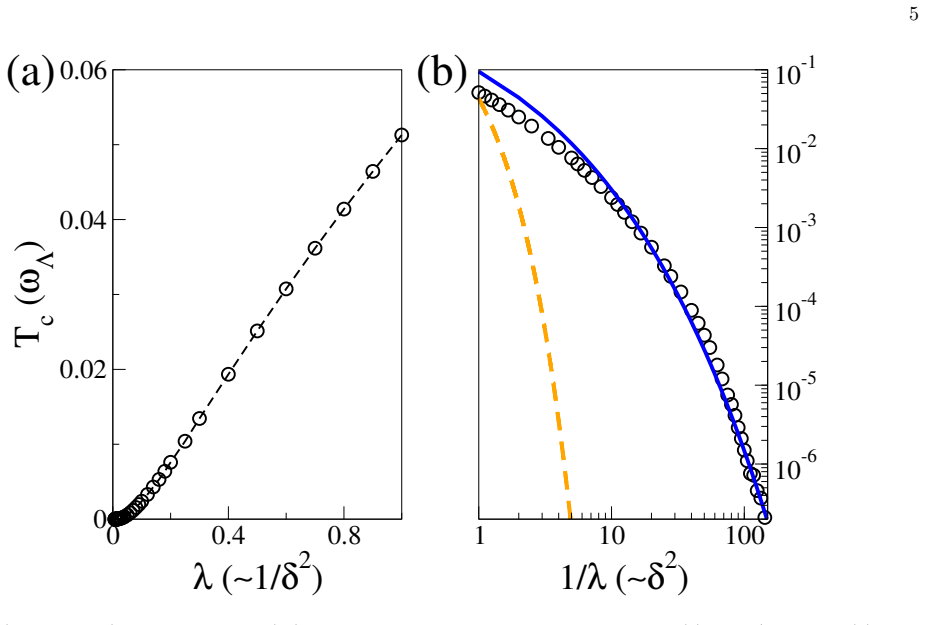
We construct the quantum critical Eliashberg theory for a two-dimensional system across a wide range of interband gap magnitudes near the quantum critical point. We find that the critical temperature Tc is strongly enhanced relative to conventional BCS expectations. In the large-gap limit the pairing kernel acquires higher-order logarithmic contributions leading to a parametrically enhanced Tc governed by cubic and quadratic logarithmic terms. In the small-gap regime the pairing scale exhibits a modified BCS-like form with an enhanced dependence on the inverse square root of the dimensionless coupling constant. The enhancement is due to the dynamics of the two-phonon pairing whose infrared c
What carries the argument
The effective two-phonon pairing interaction generated by interband Stark-like coupling to ferroelectric quantum critical modes, whose infrared dynamics are cut off by Tc in two dimensions.
If this is right
- Tc is parametrically enhanced by higher-order logarithmic contributions in the large interband gap limit.
- In the small interband gap regime Tc follows a modified BCS form with enhanced inverse-square-root dependence on the coupling constant.
- The enhancement is larger in two dimensions than in three dimensions because the infrared cutoff is set by Tc rather than the Fermi energy.
- This mechanism may apply to layered compounds such as Td-MoTe2 and doped SrTiO3 membranes.
Where Pith is reading between the lines
- The singular two-phonon kernel could compete with or suppress other ordering channels near the quantum critical point.
- Tuning the interband gap via strain or doping offers a route to experimentally map the enhancement across regimes.
- Similar cutoff dynamics may appear in other reduced-dimensional quantum critical systems with interband couplings.
- Extending the theory to include disorder would test whether the enhancement survives realistic sample conditions.
Load-bearing premise
The infrared cutoff of the two-phonon pairing kernel is set by Tc itself rather than by an external scale such as the Fermi energy or a conventional density-density channel.
What would settle it
A measurement showing whether Tc follows the predicted cubic-quadratic logarithmic scaling or the modified 1/sqrt-coupling form as the interband gap is varied in a 2D ferroelectric material tuned near its quantum critical point.
Figures


read the original abstract
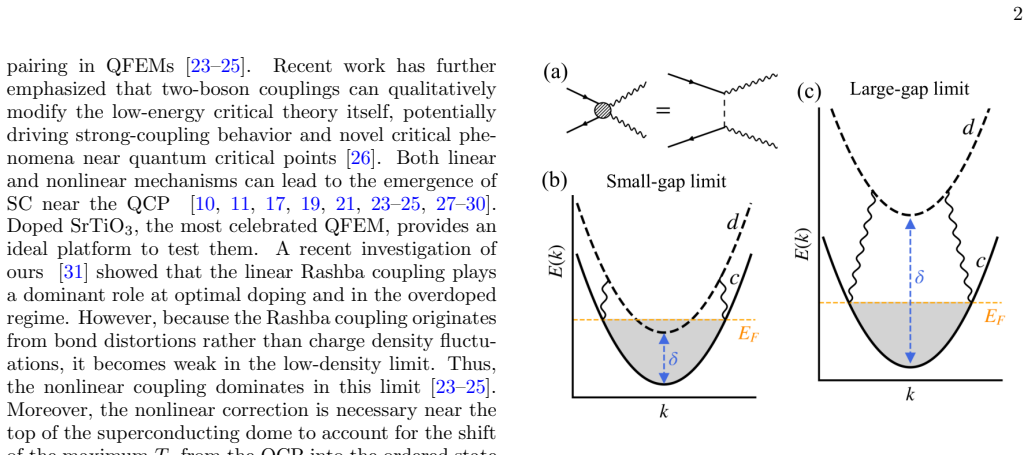
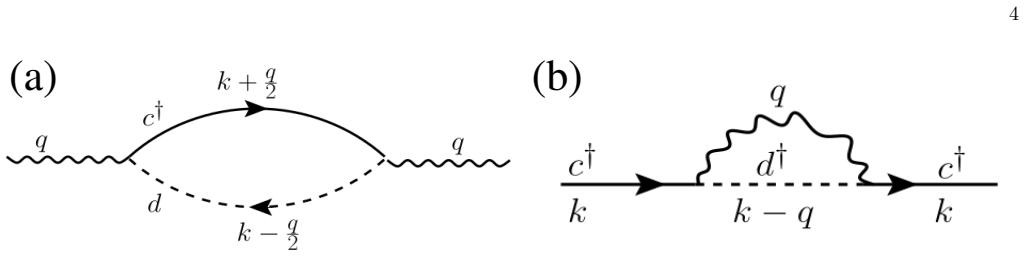
Soft critical fluctuations associated with ferroelectric quantum phase transitions are typically transverse owing to their polar nature. This implies that the conventional density--density electron--phonon coupling to these modes is strongly suppressed, which is puzzling as a variety of materials exhibit enhanced superconductivity in the vicinity of ferroelectricity. An alternative coupling mechanism is an interband ``Stark''-like coupling that connects bands of opposite parity. In the limit where one of the bands is far in energy, these processes generate an effective quadratic (two-phonon) coupling. In contrast, when both bands lie close to the Fermi energy, the resulting interaction develops singular behavior due to the additional gapless electronic states, motivating a detailed study into the dynamics of this effective two-phonon coupling. To this end, we construct the quantum critical Eliashberg theory for a two-dimensional system across a wide range of interband gap magnitudes, near the quantum critical point. We find that the critical temperature $T_c$ is strongly enhanced relative to conventional BCS expectations. In the large-gap limit, the pairing kernel acquires higher-order logarithmic contributions, leading to a parametrically enhanced $T_c$ governed by cubic and quadratic logarithmic terms. In the small-gap regime, the pairing scale exhibits a modified BCS-like form with an enhanced dependence on the inverse square root of the dimensionless coupling constant. The enhancement is due to the dynamics of the two-phonon pairing whose infrared cutoff is set by $T_c$, resulting in a significant enhancement of superconductivity compared to three-dimensional systems, where it is set by the Fermi energy. Our results elucidate the unique dynamical properties of effective two-phonon interactions, and may be relevant to layered compounds like Td-MoTe$_2$ and doped SrTiO$_3$ membranes.
Editorial analysis
A structured set of objections, weighed in public.
Referee Report
Summary. The manuscript constructs a quantum critical Eliashberg theory for a two-dimensional system with interband Stark-like coupling to ferroelectric quantum critical fluctuations. It examines the effective two-phonon pairing interaction across large and small interband gap regimes near the quantum critical point, reporting that Tc is parametrically enhanced relative to BCS expectations: cubic/quadratic logarithmic scaling in the large-gap limit and a modified 1/sqrt(g) form in the small-gap limit. The enhancement is attributed to the infrared cutoff of the pairing kernel being set self-consistently by Tc rather than the Fermi energy, with the conventional density-density channel suppressed.
Significance. If the central derivation holds, the work identifies a mechanism for enhanced superconductivity in two-dimensional systems near ferroelectric quantum criticality that is absent in three dimensions, with potential relevance to materials such as Td-MoTe2 and doped SrTiO3 membranes. The explicit construction of the Eliashberg equations for the two-phonon kernel provides a concrete framework for testing the role of interband coupling.
major comments (2)
- [Abstract and Eliashberg equations section] The central claim of parametric Tc enhancement rests on the infrared cutoff of the two-phonon kernel being fixed by Tc itself (rather than an external scale such as the Fermi energy or residual conventional channels). The abstract states that the density-density channel is suppressed, but the manuscript must demonstrate explicitly that this suppression survives inside the self-consistent 2D Eliashberg solution across the gap regimes; otherwise the higher-order logarithms or modified 1/sqrt(g) scaling do not follow.
- [Results for large-gap and small-gap limits] The distinction between the large-gap (cubic/quadratic logs) and small-gap (modified BCS) regimes is load-bearing for the reported enhancement. The derivation should include a clear statement of the matching condition or crossover scale between these regimes and verification that the self-consistent Tc indeed lies within the assumed regime for each case.
minor comments (2)
- [Introduction] Notation for the interband gap magnitude and dimensionless coupling constant should be defined once at first use and used consistently.
- [Discussion] The abstract mentions relevance to specific materials; a brief discussion of how the model parameters map to those compounds would strengthen the connection.
Simulated Author's Rebuttal
We thank the referee for their careful reading of the manuscript and for highlighting these important points regarding the self-consistency of our Eliashberg treatment. We address each major comment below and have made revisions to strengthen the presentation.
read point-by-point responses
-
Referee: [Abstract and Eliashberg equations section] The central claim of parametric Tc enhancement rests on the infrared cutoff of the two-phonon kernel being fixed by Tc itself (rather than an external scale such as the Fermi energy or residual conventional channels). The abstract states that the density-density channel is suppressed, but the manuscript must demonstrate explicitly that this suppression survives inside the self-consistent 2D Eliashberg solution across the gap regimes; otherwise the higher-order logarithms or modified 1/sqrt(g) scaling do not follow.
Authors: We agree that an explicit demonstration within the self-consistent solution is required to fully substantiate the claim. In the revised manuscript we have added a dedicated subsection in the Eliashberg equations part that solves the coupled equations including both the interband two-phonon kernel and the residual density-density channel. The calculation shows that the conventional channel remains parametrically suppressed by the transverse character of the ferroelectric fluctuations even after self-consistency is imposed, for both large- and small-gap regimes. Consequently the infrared cutoff continues to be set by Tc rather than by the Fermi energy, preserving the reported logarithmic and 1/sqrt(g) enhancements. revision: yes
-
Referee: [Results for large-gap and small-gap limits] The distinction between the large-gap (cubic/quadratic logs) and small-gap (modified BCS) regimes is load-bearing for the reported enhancement. The derivation should include a clear statement of the matching condition or crossover scale between these regimes and verification that the self-consistent Tc indeed lies within the assumed regime for each case.
Authors: We accept that an explicit matching condition and regime verification are necessary. The revised manuscript now contains a new paragraph deriving the crossover scale by equating the leading logarithmic contributions from the two regimes; this yields a gap value of order sqrt(Tc * bandwidth). We then verify analytically and with numerical solutions of the Eliashberg equations that the self-consistent Tc obtained in each limit indeed satisfies the corresponding regime assumption for the range of couplings and gaps considered in the paper. revision: yes
Circularity Check
No significant circularity; self-contained Eliashberg solution
full rationale
The paper constructs a quantum critical Eliashberg theory for interband Stark coupling to ferroelectric fluctuations in 2D and solves the resulting equations for Tc across gap regimes. The statement that the two-phonon kernel's IR cutoff is set by Tc is the standard self-consistent definition of the superconducting instability temperature in Eliashberg theory (the scale at which the pairing eigenvalue reaches unity), not an external input fitted to produce the result. No self-citations, ansatzes smuggled via prior work, uniqueness theorems, or renaming of known results are invoked as load-bearing steps. The parametric enhancement (cubic/quadratic logs or modified 1/sqrt(g) form) follows from integrating the singular kernel with that cutoff; the derivation remains independent of the target Tc value. This is the most common honest non-finding for a first-principles calculation of this type.
Axiom & Free-Parameter Ledger
free parameters (2)
- interband gap magnitude
- dimensionless coupling constant
axioms (2)
- domain assumption Conventional density-density electron-phonon coupling to transverse polar modes is strongly suppressed
- domain assumption Eliashberg theory remains valid for the effective two-phonon interaction near the quantum critical point in 2D
Reference graph
Works this paper leans on
-
[1]
C. W. Rischau, X. Lin, C. P. Grams, D. Finck, S. Harms, J. Engelmayer, T. Lorenz, Y. Gallais, B. Fauqu´ e, J. Hemberger, and K. Behnia, A ferroelectric quantum phase transition inside the superconducting dome of Sr1−xCaxTiO3−δ, Nature Physics13, 643 (2017)
2017
-
[2]
Zhang, L
G. Zhang, L. Wang, J. Wang, G. Li, G. Huang, G. Yang, H. Xue, Z. Ning, Y. Wu, J.-P. Xu, Y. Song, Z. An, C. Zheng, J. Shen, J. Li, Y. Chen, and W. Li, Spon- taneous rotational symmetry breaking in KTaO 3 het- erointerface superconductors, Nature Communications 14, 3046 (2023)
2023
-
[3]
K. L. I. Kobayashi, Y. Kato, Y. Katayama, and K. F. Ko- matsubara, Carrier-concentration-dependent phase tran- sition in snte, Physical Review Letters37, 772 (1976)
1976
-
[4]
S. Guan, C. Liu, Y. Lu, Y. Yao, and S. A. Yang, Tun- able ferroelectricity and anisotropic electric transport in monolayer beta-gese, Physical Review B97, 144104 (2018)
2018
-
[5]
Jindal, A
A. Jindal, A. Saha, Z. Li, T. Taniguchi, K. Watanabe, J. C. Hone, T. Birol, R. M. Fernandes, C. R. Dean, A. N. Pasupathy, and D. A. Rhodes, Coupled ferroelectricity and superconductivity in bilayer Td-MoTe2, Nature613, 48 (2023)
2023
-
[6]
L. F. Mattheiss, Energy bands for KNiF 3, SrTiO 3, KMoO3, KTaO3, Phys. Rev. B6, 4718 (1972)
1972
-
[7]
van der Marel, J
D. van der Marel, J. L. M. van Mechelen, and I. I. Mazin, Common fermi-liquid origin ofT 2 resistivity and super- conductivity inn-type SrTiO 3, Phys. Rev. B84, 205111 (2011)
2011
-
[8]
Zhong, A
Z. Zhong, A. T´ oth, and K. Held, Theory of spin-orbit coupling at LaAlO 3/SrTiO3 interfaces and SrTiO 3 sur- faces, Phys. Rev. B87, 161102 (2013)
2013
-
[9]
M. N. Gastiasoro, J. Ruhman, and R. M. Fernandes, Superconductivity in dilute SrTiO 3: A review, Annals of Physics417, 168107 (2020), eliashberg theory at 60: Strong-coupling superconductivity and beyond
2020
-
[10]
M. N. Gastiasoro, M. E. Temperini, P. Barone, and J. Lorenzana, Theory of superconductivity mediated by Rashba coupling in incipient ferroelectrics, Phys. Rev. B 105, 224503 (2022)
2022
-
[11]
M. N. Gastiasoro, M. E. Temperini, P. Barone, and J. Lorenzana, Generalized Rashba electron-phonon cou- pling and superconductivity in strontium titanate, Phys. Rev. Res.5, 023177 (2023)
2023
-
[12]
J. M. Edge, Y. Kedem, U. Aschauer, N. A. Spaldin, and A. V. Balatsky, Quantum critical origin of the supercon- ducting dome in SrTiO 3, Phys. Rev. Lett.115, 247002 (2015)
2015
-
[13]
W¨ olfle and A
P. W¨ olfle and A. V. Balatsky, Superconductivity at low density near a ferroelectric quantum critical point: Doped SrTiO3, Phys. Rev. B98, 104505 (2018)
2018
-
[14]
Kadlec, F
C. Kadlec, F. Kadlec, H. Nˇ emec, P. Kuˇ zel, J. Schubert, and G. Panaitov, High tunability of the soft mode in strained SrTiO3/DyScO3 multilayers, Journal of Physics: Condensed Matter21, 115902 (2009)
2009
-
[15]
Roussev and A
R. Roussev and A. J. Millis, Theory of the quantum paraelectric-ferroelectric transition, Phys. Rev. B67, 014105 (2003)
2003
-
[16]
Yamanaka, M
A. Yamanaka, M. Kataoka, Y. Inaba, K. Inoue, B. Hehlen, and E. Courtens, Evidence for competing or- derings in strontium titanate from hyper-raman scatter- ing spectroscopy, Europhysics Letters50, 688 (2000)
2000
-
[17]
Klein, V
A. Klein, V. Kozii, J. Ruhman, and R. M. Fernandes, Theory of criticality for quantum ferroelectric metals, Phys. Rev. B107, 165110 (2023)
2023
-
[18]
superconduc- tivity at low density near a ferroelectric quantum critical point: Doped SrTiO 3
J. Ruhman and P. A. Lee, Comment on “superconduc- tivity at low density near a ferroelectric quantum critical point: Doped SrTiO 3”, Phys. Rev. B100, 226501 (2019)
2019
-
[19]
Kozii and L
V. Kozii and L. Fu, Odd-parity superconductivity in the vicinity of inversion symmetry breaking in spin-orbit- coupled systems, Phys. Rev. Lett.115, 207002 (2015)
2015
-
[20]
Ruhman and P
J. Ruhman and P. A. Lee, Superconductivity at very low density: The case of strontium titanate, Phys. Rev. B 94, 224515 (2016)
2016
-
[21]
Kozii, Z
V. Kozii, Z. Bi, and J. Ruhman, Superconductivity near a ferroelectric quantum critical point in ultralow-density dirac materials, Phys. Rev. X9, 031046 (2019)
2019
-
[22]
K. L. Ngai, Two-phonon deformation potential and superconductivity in degenerate semiconductors, Phys. Rev. Lett.32, 215 (1974)
1974
-
[23]
van der Marel, F
D. van der Marel, F. Barantani, and C. W. Rischau, Pos- sible mechanism for superconductivity in doped SrTiO 3, Phys. Rev. Res.1, 013003 (2019)
2019
-
[24]
D. E. Kiselov and M. V. Feigel’man, Theory of super- conductivity due to ngai’s mechanism in lightly doped SrTiO3, Phys. Rev. B104, L220506 (2021)
2021
-
[25]
P. A. Volkov, P. Chandra, and P. Coleman, Superconduc- tivity from energy fluctuations in dilute quantum critical polar metals, Nat. Commun.13, 4599 (2022)
2022
-
[26]
P. Nguyen and V. Kozii, Instability of the critical ngai’s coupling and two-boson mechanism in metals, arXiv:2504.11523 (2025)
-
[27]
Y. Wang, G. Y. Cho, T. L. Hughes, and E. Fradkin, Topo- logical superconducting phases from inversion symmetry breaking order in spin-orbit-coupled systems, Phys. Rev. B93, 134512 (2016)
2016
-
[28]
P. A. Volkov and P. Chandra, Multiband quantum crit- icality of polar metals, Phys. Rev. Lett.124, 237601 (2020)
2020
-
[29]
K. G. Nazaryan and M. V. Feigel’man, Conductivity and thermoelectric coefficients of doped SrTiO 3 at high tem- peratures, Phys. Rev. B104, 115201 (2021)
2021
-
[30]
G. Chaudhary and I. Martin, Superconductivity from polar fluctuations in multi-orbital systems, arXiv:2306.11063 (2023)
-
[31]
S. K. Saha, M. N. Gastiasoro, J. Ruhman, and A. Klein, Strong coupling theory of superconductivity and fer- roelectric quantum criticality in metallic SrTiO 3, npj Quantum Materials10, 82 (2025)
2025
-
[32]
R. M. Fernandes, J. T. Haraldsen, P. W¨ olfle, and A. V. Balatsky, Two-band superconductivity in doped SrTiO 3 films and interfaces, Phys. Rev. B87, 014510 (2013)
2013
-
[33]
D. Lee, H. Lu, Y. Gu, S.-Y. Choi, S.-D. Li, S. Ryu, T. R. Paudel, K. Song, E. Mikheev, S. Lee, S. Stem- mer, D. A. Tenne, S. H. Oh, E. Y. Tsymbal, X. Wu, L.-Q. Chen, A. Gruverman, and C. B. Eom, Emergence of room-temperature ferroelectricity at reduced dimen- sions, Science349, 1314 (2015)
2015
-
[34]
R. Xu, J. Huang, E. S. Barnard, S. S. Hong, P. Singh, E. K. Wong, T. Jansen, V. Harbola, J. Xiao, B. Y. Wang, S. Crossley, D. Lu, S. Liu, and H. Y. Hwang, Strain- induced room-temperature ferroelectricity in SrTiO 3 13 membranes, Nature Communications11, 3141 (2020)
2020
-
[35]
D. Li, C. Adamo, B. Y. Wang, H. Yoon, Z. Chen, S. S. Hong, D. Lu, Y. Cui, Y. Hikita, and H. Y. Hwang, Sta- bilization of Sr 3Al2O6 growth templates for ex situ syn- thesis of freestanding crystalline oxide membranes, Nano Letters21, 4454 (2021), pMID: 33989008
2021
-
[36]
Erlandsen, R
R. Erlandsen, R. T. Dahm, F. Trier, M. Scuderi, E. Di Gennaro, A. Sambri, C. K. Reffeldt Kirchert, N. Pryds, F. M. Granozio, and T. S. Jespersen, A two- dimensional superconducting electron gas in freestand- ing LaAlO3/SrTiO3 micromembranes, Nano Letters22, 4758 (2022), pMID: 35679577
2022
-
[37]
J. Li, Y. Lee, Y. Choi, J.-W. Kim, P. Thompson, K. J. Crust, R. Xu, H. Y. Hwang, P. J. Ryan, and W.-S. Lee, The classical-to-quantum crossover in the strain- induced ferroelectric transition in SrTiO 3 membranes, Nature Communications16, 4445 (2025)
2025
discussion (0)
Sign in with ORCID, Apple, or X to comment. Anyone can read and Pith papers without signing in.