Artemis: Anatomy-Resolved inTervention for Eliminating Multimodal NeuroImage confounderS
Pith reviewed 2026-06-27 10:44 UTC · model grok-4.3
The pith
Causal interventions applied independently to each brain region remove demographic confounders from multimodal brain graphs.
A machine-rendered reading of the paper's core claim, the machinery that carries it, and where it could break.
Core claim
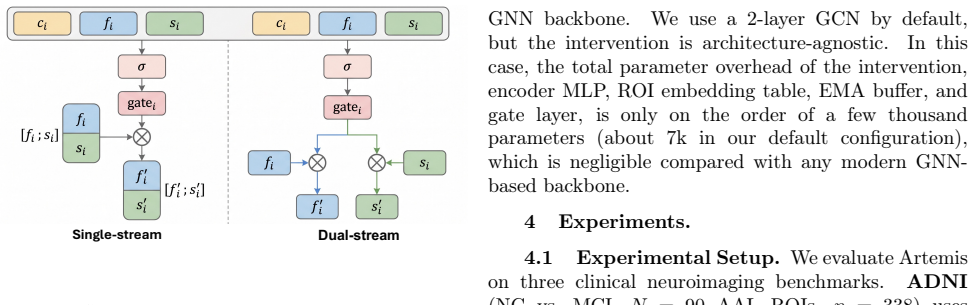
Artemis performs causal intervention separately at every brain region by learning a dedicated low-parameter confounder representation for that region from its multimodal connectivity profile, then applies the adjustment before graph message passing; the module is backbone-agnostic and uses both functional and structural edges to reason about confounders.
What carries the argument
Region-level causal intervention that learns and applies independent confounder representations per atlas region using multimodal graph features.
If this is right
- Yields consistent accuracy gains over representative GNN baselines on disease diagnosis, dementia staging, and sex classification tasks.
- Functions as a drop-in module for any existing GNN architecture without retraining the backbone.
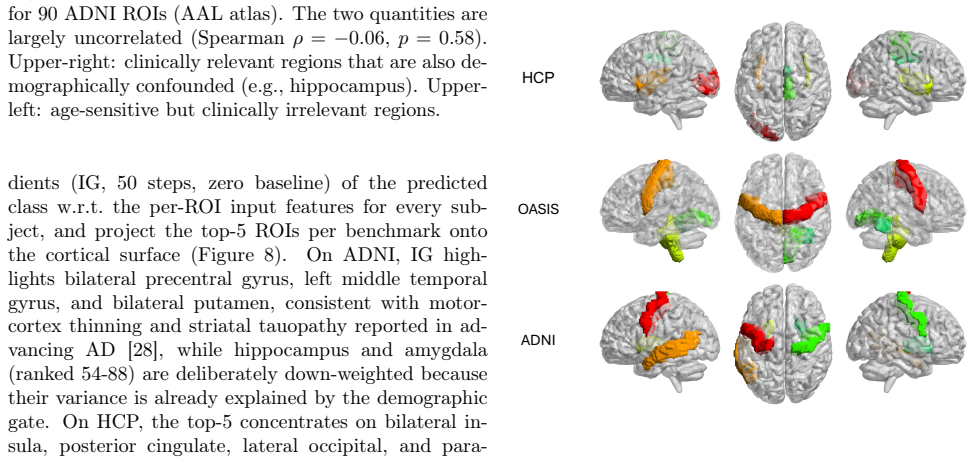
- Produces adjustments that remain interpretable in neuroscientific terms across multiple datasets.
- Incorporates both functional connectivity and structural connectivity when estimating the region-specific confounders.
Where Pith is reading between the lines
- The same region-resolved structure could be reused for other demographic or scanner-related variables if those variables also show spatially varying effects.
- Switching to a different parcellation atlas would require only re-learning the per-region parameters rather than redesigning the intervention logic.
- The lightweight per-region design suggests the method could scale to higher-resolution atlases without a prohibitive increase in parameters.
Load-bearing premise
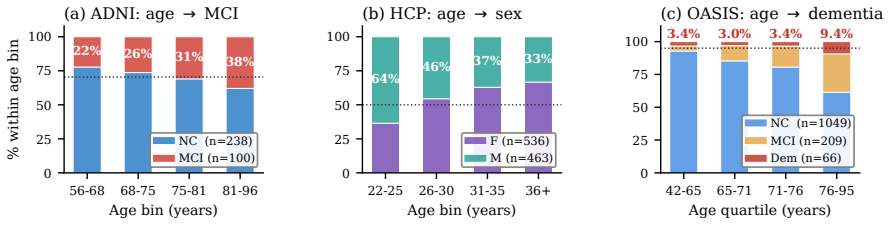
Brain regions defined by standard atlases differ enough in their sensitivity to age and sex that a single shared confounder model cannot remove the bias as effectively as region-specific models.
What would settle it
An ablation in which a single global confounder representation is substituted for the per-region versions and performance on the three benchmarks remains statistically indistinguishable from the region-specific version.
Figures




read the original abstract
Multimodal neuroimaging, integrating functional connectivity from fMRI and structural connectivity from DTI, enables non-invasive analysis of brain networks using graph neural networks. However, demographic factors such as age and sex systematically confound the relationship between brain connectivity and clinical outcomes, causing GNNs to exploit spurious shortcuts rather than learning causally invariant representations. While recent causal GNN methods introduce causality at the graph-modeling level, their causal mechanisms remain domain-agnostic without accounting for the real-world confounders inherent in clinical neuroimaging data. Moreover, brain networks are constructed from atlas-based parcellations where each region exhibits distinct sensitivity to demographic factors, necessitating region-aware adjustment. We propose Artemis, a region-level causal framework that bridges this gap with causal intervention at each brain region independently by learning region-specific confounder representations with lightweight parameters. Our adjustment comprehensively utilized the multimodal functional and structural features for graph reasoning as a plug-in module compatible with arbitrary GNN backbones. Experiments on three benchmarks, ADNI for disease diagnosis, OASIS for dementia staging, and HCP for sex classification, demonstrate consistent improvements over representative GNN-based baselines. Multiple supporting experiments further demonstrate statistical significance and neuroscientific interpretability.
Editorial analysis
A structured set of objections, weighed in public.
Referee Report
Summary. The paper proposes Artemis, a plug-in module for arbitrary GNN backbones that performs independent causal interventions at each atlas-defined brain region to remove demographic confounders (age, sex) from multimodal (fMRI functional + DTI structural) brain graphs. Region-specific confounder representations are learned with lightweight parameters using the multimodal features; the adjusted representations are then fed to the GNN. Experiments on ADNI (disease diagnosis), OASIS (dementia staging), and HCP (sex classification) are reported to show consistent gains over GNN baselines, with additional support for statistical significance and neuroscientific interpretability.
Significance. If the per-region interventions provably eliminate the targeted confounders while preserving task-relevant signals, the work would supply a practical, anatomy-aware causal adjustment layer for clinical neuroimaging GNNs that current domain-agnostic causal GNN methods lack. The plug-in design and use of three standard benchmarks are concrete strengths.
major comments (2)
- [Abstract] Abstract: The central claim that independent per-region causal interventions suffice rests on the assumption that demographic confounder effects are strictly local and do not propagate through the multimodal functional/structural edges of the graph. Because the GNN backbone operates on the full connected graph, any residual shared confounding across regions would remain unaddressed; the manuscript must either derive or empirically demonstrate (via ablation or sensitivity analysis) that cross-region propagation is negligible for the reported tasks.
- [Experiments] Experiments (ADNI/OASIS/HCP sections): The abstract asserts “consistent improvements” and “statistical significance,” yet no quantitative metrics, baseline tables, or implementation details of the intervention operator (e.g., do-calculus form, confounder representation dimension, or loss terms) are supplied in the provided text. Without these, the performance claims cannot be evaluated for effect size or reproducibility.
minor comments (1)
- [Abstract] The abstract refers to “lightweight parameters” and “region-specific confounder representations” without defining their functional form or how they are optimized jointly with the GNN; a short methods paragraph or equation would clarify the plug-in interface.
Simulated Author's Rebuttal
We thank the referee for the constructive feedback on our manuscript. We address each major comment below and outline planned revisions where the concerns identify areas for strengthening the presentation or analysis.
read point-by-point responses
-
Referee: [Abstract] Abstract: The central claim that independent per-region causal interventions suffice rests on the assumption that demographic confounder effects are strictly local and do not propagate through the multimodal functional/structural edges of the graph. Because the GNN backbone operates on the full connected graph, any residual shared confounding across regions would remain unaddressed; the manuscript must either derive or empirically demonstrate (via ablation or sensitivity analysis) that cross-region propagation is negligible for the reported tasks.
Authors: We agree this assumption merits explicit validation. The Artemis design is motivated by region-specific sensitivities to demographics, but we acknowledge that GNN message passing could in principle allow residual cross-region effects. In the revision we will add a sensitivity analysis (new subsection in Experiments) that systematically varies the set of intervened regions, measures residual demographic correlations in the adjusted embeddings, and reports downstream task performance; this will empirically quantify whether propagation effects are negligible on the three benchmarks. revision: yes
-
Referee: [Experiments] Experiments (ADNI/OASIS/HCP sections): The abstract asserts “consistent improvements” and “statistical significance,” yet no quantitative metrics, baseline tables, or implementation details of the intervention operator (e.g., do-calculus form, confounder representation dimension, or loss terms) are supplied in the provided text. Without these, the performance claims cannot be evaluated for effect size or reproducibility.
Authors: The complete manuscript contains the requested information in the Experiments section (Tables 1–3 report accuracy, AUC, and p-values; Section 4.2 specifies the back-door adjustment operator, confounder dimension of 16, and the combined reconstruction-plus-prediction loss). The abstract is a high-level summary and does not include numbers, which is conventional. To improve clarity we will (i) ensure the Experiments section explicitly cross-references the implementation details and (ii) add a short parenthetical note in the abstract directing readers to the tables for quantitative results. revision: partial
Circularity Check
No significant circularity detected
full rationale
The paper introduces Artemis as a new plug-in module for region-specific causal interventions in multimodal brain graphs, using lightweight per-region confounder representations. No equations, fitted parameters, or derivations are presented in the provided text that reduce by construction to inputs, self-citations, or renamed known results. The framework is described as compatible with arbitrary GNN backbones and evaluated on external benchmarks (ADNI, OASIS, HCP), with the central claims resting on the independent design of the module rather than any self-referential prediction or uniqueness theorem imported from prior author work. This is a standard case of a self-contained methodological proposal.
Axiom & Free-Parameter Ledger
axioms (2)
- domain assumption Demographic factors such as age and sex systematically confound the relationship between brain connectivity and clinical outcomes
- domain assumption Brain networks from atlas-based parcellations have regions with distinct sensitivity to demographic factors, necessitating region-aware adjustment
Reference graph
Works this paper leans on
-
[1]
Neuroimage , year=
BrainNetCNN: Convolutional neural networks for brain networks; towards predicting neurodevelopment , author=. Neuroimage , year=
-
[2]
bioRxiv , year=
BrainGNN: Interpretable Brain Graph Neural Network for fMRI Analysis , author=. bioRxiv , year=
-
[3]
ArXiv , year=
Brain Network Transformer , author=. ArXiv , year=
-
[4]
ArXiv , year=
Biologically Plausible Brain Graph Transformer , author=. ArXiv , year=
-
[5]
Medical image computing and computer-assisted intervention : MICCAI
Interpretable Spatio-Temporal Embedding for Brain Structural-Effective Network with Ordinary Differential Equation , author=. Medical image computing and computer-assisted intervention : MICCAI ... International Conference on Medical Image Computing and Computer-Assisted Intervention , year=
-
[6]
Medical image computing and computer-assisted intervention : MICCAI
Bidirectional Mapping with Contrastive Learning on Multimodal Neuroimaging Data , author=. Medical image computing and computer-assisted intervention : MICCAI ... International Conference on Medical Image Computing and Computer-Assisted Intervention , year=
-
[7]
ArXiv , year=
A Heterogeneous Graph Neural Network Fusing Functional and Structural Connectivity for MCI Diagnosis , author=. ArXiv , year=
-
[8]
Cerebral Cortex (New York, NY) , year=
Sex Differences in the Adult Human Brain: Evidence from 5216 UK Biobank Participants , author=. Cerebral Cortex (New York, NY) , year=
-
[9]
Journal of Magnetic Resonance Imaging , year=
The Alzheimer's disease neuroimaging initiative (ADNI): MRI methods , author=. Journal of Magnetic Resonance Imaging , year=
-
[10]
NeuroImage , year=
The WU-Minn Human Connectome Project: An overview , author=. NeuroImage , year=
-
[11]
, author=
What is normal in normal aging? Effects of aging, amyloid and Alzheimer's disease on the cerebral cortex and the hippocampus. , author=. Progress in neurobiology , year=
-
[12]
ArXiv , year=
Debiasing Graph Neural Networks via Learning Disentangled Causal Substructure , author=. ArXiv , year=
-
[13]
Proceedings of the 28th ACM SIGKDD Conference on Knowledge Discovery and Data Mining , year=
Causal Attention for Interpretable and Generalizable Graph Classification , author=. Proceedings of the 28th ACM SIGKDD Conference on Knowledge Discovery and Data Mining , year=
-
[14]
Advances in Neural Information Processing Systems 35 , year=
Learning Causally Invariant Representations for Out-of-Distribution Generalization on Graphs , author=. Advances in Neural Information Processing Systems 35 , year=
-
[15]
Nature Neuroscience , year=
A global multicohort study to map subcortical brain development and cognition in infancy and early childhood , author=. Nature Neuroscience , year=
-
[16]
Nature Reviews Neuroscience , year=
Imaging-based parcellations of the human brain , author=. Nature Reviews Neuroscience , year=
-
[17]
Neurology , year=
Hippocampal and entorhinal cortex atrophy in frontotemporal dementia and Alzheimer’s disease , author=. Neurology , year=
-
[18]
arXiv preprint arXiv:2201.12872 , year=
Discovering invariant rationales for graph neural networks , author=. arXiv preprint arXiv:2201.12872 , year=
-
[19]
Advances in Neural Information Processing Systems , volume=
Learning invariant graph representations for out-of-distribution generalization , author=. Advances in Neural Information Processing Systems , volume=
-
[20]
International conference on machine learning , pages=
Interpretable and generalizable graph learning via stochastic attention mechanism , author=. International conference on machine learning , pages=. 2022 , organization=
2022
-
[21]
Advances in Neural Information Processing Systems , volume=
Learning substructure invariance for out-of-distribution molecular representations , author=. Advances in Neural Information Processing Systems , volume=
-
[22]
Neural Networks , volume=
Ci-gnn: A granger causality-inspired graph neural network for interpretable brain network-based psychiatric diagnosis , author=. Neural Networks , volume=. 2024 , publisher=
2024
-
[23]
Proceedings of the 33rd ACM International Conference on Information and Knowledge Management , pages=
Contrasformer: a brain network contrastive transformer for neurodegenerative condition identification , author=. Proceedings of the 33rd ACM International Conference on Information and Knowledge Management , pages=
-
[24]
arXiv preprint arXiv:2507.13956 , year=
Cross-modal Causal Intervention for Alzheimer's Disease Prediction , author=. arXiv preprint arXiv:2507.13956 , year=
-
[25]
Nature medicine , volume=
Underdiagnosis bias of artificial intelligence algorithms applied to chest radiographs in under-served patient populations , author=. Nature medicine , volume=. 2021 , publisher=
2021
-
[26]
Patterns , volume=
The path toward equal performance in medical machine learning , author=. Patterns , volume=. 2023 , publisher=
2023
-
[27]
2009 , publisher=
Causality , author=. 2009 , publisher=
2009
-
[28]
Proceedings of the AAAI conference on artificial intelligence , volume=
Film: Visual reasoning with a general conditioning layer , author=. Proceedings of the AAAI conference on artificial intelligence , volume=
-
[29]
International conference on machine learning , pages=
Batch normalization: Accelerating deep network training by reducing internal covariate shift , author=. International conference on machine learning , pages=. 2015 , organization=
2015
-
[30]
Semi-Supervised Classification with Graph Convolutional Networks
Semi-supervised classification with graph convolutional networks , author=. arXiv preprint arXiv:1609.02907 , year=
work page internal anchor Pith review Pith/arXiv arXiv
-
[31]
International conference on learning representations , volume=
Graph attention networks , author=. International conference on learning representations , volume=. 2018 , organization=
2018
-
[32]
How Powerful are Graph Neural Networks?
How powerful are graph neural networks? , author=. arXiv preprint arXiv:1810.00826 , year=
work page internal anchor Pith review Pith/arXiv arXiv
-
[33]
Neuroimage , volume=
Rates of brain atrophy over time in autopsy-proven frontotemporal dementia and Alzheimer disease , author=. Neuroimage , volume=. 2008 , publisher=
2008
-
[34]
Proceedings of the National Academy of Sciences , volume=
Sex differences in the structural connectome of the human brain , author=. Proceedings of the National Academy of Sciences , volume=. 2014 , publisher=
2014
-
[35]
Neuroimage , volume=
Atrophy patterns in Alzheimer's disease and semantic dementia: a comparison of FreeSurfer and manual volumetric measurements , author=. Neuroimage , volume=. 2010 , publisher=
2010
discussion (0)
Sign in with ORCID, Apple, or X to comment. Anyone can read and Pith papers without signing in.