Deep-Learning-Based Pixelated Microwave Filter Design and Characterization using Electro-Optical Electric-Field Measurements
Pith reviewed 2026-06-26 22:32 UTC · model grok-4.3
The pith
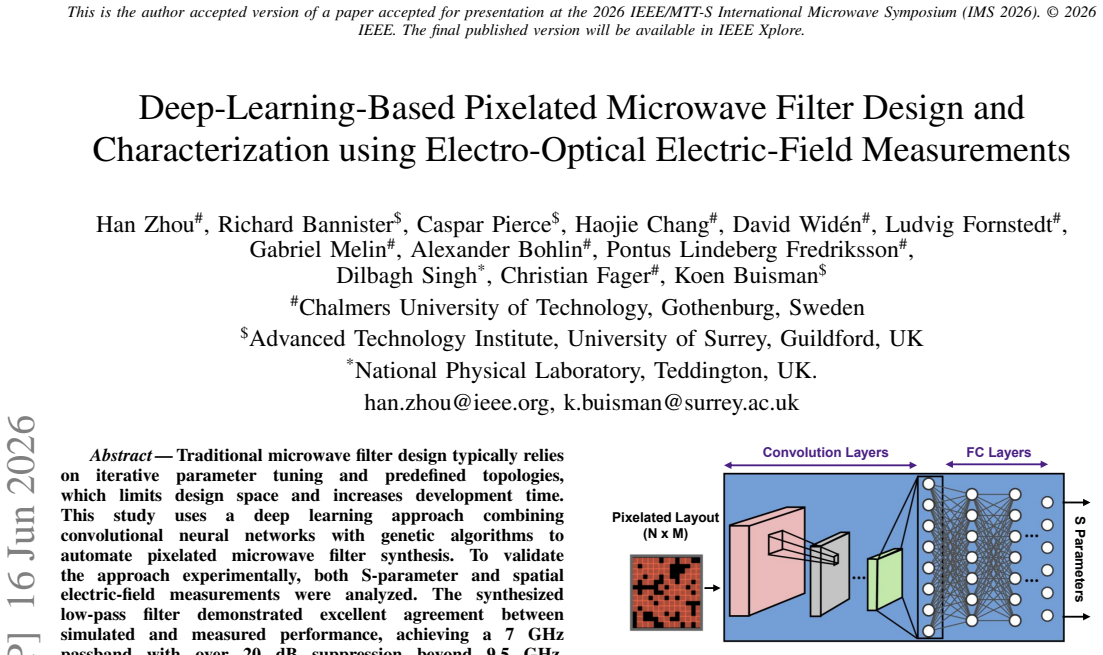
Deep learning with CNNs and genetic algorithms synthesizes pixelated microwave filters whose fabricated performance matches simulation at 7 GHz passband and over 20 dB suppression.
A machine-rendered reading of the paper's core claim, the machinery that carries it, and where it could break.
Core claim
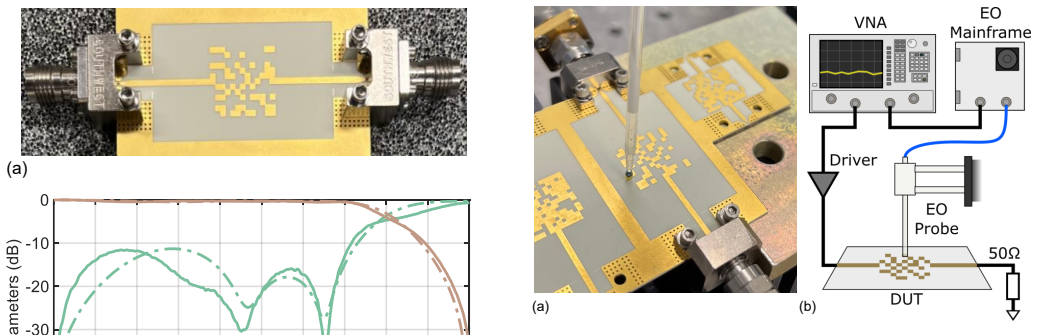
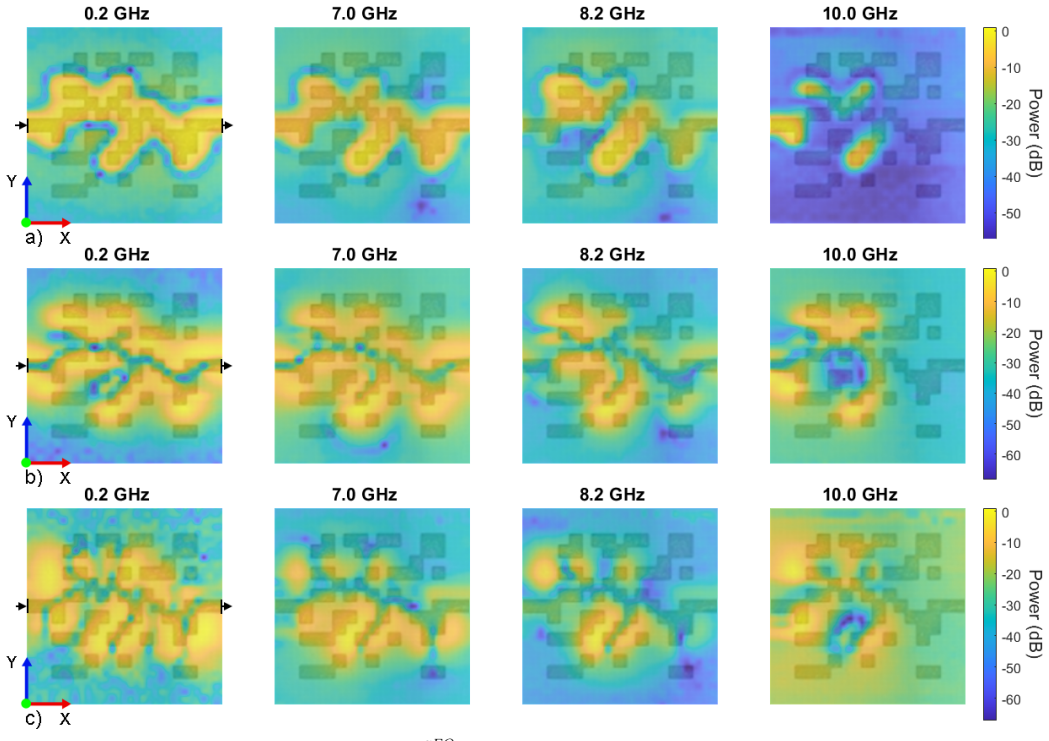
The synthesized low-pass filter demonstrates excellent agreement between simulated and measured performance, achieving a 7 GHz passband with over 20 dB suppression beyond 9.5 GHz. Electro-optical measurements reveal electric field patterns that resemble coupled transmission-lines or stub structures, providing insight into the emergent characteristics of AI-generated designs.
What carries the argument
Convolutional neural network plus genetic algorithm search over pixelated layouts, with electro-optical electric-field mapping used to characterize the resulting physical device.
If this is right
- Filter development time decreases because the algorithm explores topologies without predefined starting shapes or iterative manual tuning.
- Electro-optical field mapping can be applied to any AI-generated microwave circuit to reveal internal current or voltage distributions.
- Pixelated designs allow the algorithm to discover structures that resemble but are not identical to conventional stubs or coupled lines.
- The same synthesis pipeline can be rerun with different target specifications to produce families of filters for the same substrate.
Where Pith is reading between the lines
- The resemblance of the measured fields to known transmission-line features suggests the optimizer is converging on physically realizable current paths even though it starts from random pixels.
- Adding the electric-field measurement as an additional loss term in future training loops could steer the search toward layouts whose internal behavior is easier to interpret.
- The method might extend to other planar components such as power dividers or matching networks where topology constraints have historically limited performance.
- If the pixel grid resolution is increased, the same framework could produce filters with sharper transitions or multi-band responses without changing the algorithm.
Load-bearing premise
The simulated behavior of the pixelated layout will appear in the fabricated device without large discrepancies or the need for manual post-design adjustments.
What would settle it
Fabricate the AI-generated pixelated filter and measure its S-parameters; if the stopband suppression falls well below 20 dB above 9.5 GHz or the passband edge shifts significantly from the simulated 7 GHz, the transfer claim is falsified.
Figures
read the original abstract
Traditional microwave filter design typically relies on iterative parameter tuning and predefined topologies, which limits design space and increases development time. This study uses a deep learning approach combining convolutional neural networks with genetic algorithms to automate pixelated microwave filter synthesis. To validate the approach experimentally, both S-parameter and spatial electric-field measurements were analyzed. The synthesized low-pass filter demonstrated excellent agreement between simulated and measured performance, achieving a 7 GHz passband with over 20 dB suppression beyond 9.5 GHz. Electro-optical measurements, for the first time, revealed electric field patterns that resemble coupled transmission-lines or stub structures, providing insight into the emergent characteristics of AI-generated designs.
Editorial analysis
A structured set of objections, weighed in public.
Referee Report
Summary. The manuscript presents a deep-learning approach that combines convolutional neural networks with genetic algorithms to automate the synthesis of pixelated microwave filters, bypassing traditional iterative tuning and predefined topologies. Experimental validation is performed on a single low-pass filter using both S-parameter measurements and electro-optical electric-field mapping; the abstract reports excellent agreement between simulation and measurement, with a 7 GHz passband and >20 dB suppression beyond 9.5 GHz, and notes that the EO measurements reveal field patterns resembling coupled transmission lines or stubs.
Significance. If the automated pipeline reliably produces layouts whose simulated behavior transfers to fabricated devices without post-design tuning, the work would enable exploration of larger, non-intuitive design spaces for microwave filters and shorten development time. The use of electro-optical measurements to visualize emergent field distributions in AI-generated structures is a distinctive contribution that could yield new design insights.
major comments (2)
- [Abstract and Experimental Validation] Abstract and Experimental Validation section: the central claim that the CNN+GA pixelated low-pass filter transfers from simulation to measurement with excellent agreement rests on a single fabricated device. No error bars, dataset sizes for the measurements, multiple realizations, or explicit tolerance analysis to fabrication variations or pixel discretization are reported, which directly undermines the robustness of the sim-to-fabricated transfer assertion.
- [Methods and Results] Methods and Results: the manuscript does not state whether post-design tuning was performed or provide quantitative metrics (e.g., RMS error between simulated and measured S-parameters across the band) that would allow independent assessment of the "excellent agreement" claim.
minor comments (2)
- [Abstract] Abstract: the frequency range of the suppression specification could be stated more precisely (e.g., the exact stopband edges) and the number of filters synthesized during the study should be indicated.
- [Figures] Figure captions and text: the electro-optical field maps would benefit from explicit scale bars and a statement of the measurement calibration procedure to allow readers to judge the spatial resolution relative to the operating wavelength.
Simulated Author's Rebuttal
We thank the referee for the detailed and constructive feedback. We address the two major comments below, clarifying the scope of our experimental validation while committing to revisions that improve transparency and quantitative rigor without overstating the current results.
read point-by-point responses
-
Referee: [Abstract and Experimental Validation] Abstract and Experimental Validation section: the central claim that the CNN+GA pixelated low-pass filter transfers from simulation to measurement with excellent agreement rests on a single fabricated device. No error bars, dataset sizes for the measurements, multiple realizations, or explicit tolerance analysis to fabrication variations or pixel discretization are reported, which directly undermines the robustness of the sim-to-fabricated transfer assertion.
Authors: We agree that the validation is limited to a single fabricated device, presented as a proof-of-concept for the automated pipeline and the novel EO field mapping. The manuscript does not claim statistical robustness across multiple realizations. In revision we will (i) explicitly note the single-device scope in the abstract and experimental section, (ii) report any available measurement uncertainties or error bars from the VNA and EO setups, and (iii) add a short discussion of fabrication tolerances and pixel discretization effects based on the 0.5 mm grid used. Multiple independent fabrications cannot be added without new experiments. revision: partial
-
Referee: [Methods and Results] Methods and Results: the manuscript does not state whether post-design tuning was performed or provide quantitative metrics (e.g., RMS error between simulated and measured S-parameters across the band) that would allow independent assessment of the "excellent agreement" claim.
Authors: No post-fabrication tuning or parameter adjustment was performed; the CNN+GA output layout was sent directly to fabrication. We will revise the Methods and Results sections to state this explicitly and to include quantitative agreement metrics, specifically the RMS error between simulated and measured |S21| and |S11| over the 0–15 GHz band, together with the frequency ranges used for the comparison. revision: yes
Circularity Check
No circularity: experimental validation of DL-synthesized filter is independent of inputs
full rationale
The paper presents a CNN+GA pipeline for generating pixelated microwave filter layouts, followed by physical fabrication and measurement (S-parameters plus electro-optical E-field mapping). The reported agreement (7 GHz passband, >20 dB stopband) is an empirical outcome of fabrication and test, not a quantity obtained by fitting parameters to the same data or by re-expressing the input layout as a prediction. No equations, self-citations, or ansatzes are shown that would reduce the central claim to a tautology. The derivation chain is therefore self-contained against external benchmarks.
Axiom & Free-Parameter Ledger
Reference graph
Works this paper leans on
-
[1]
Deep learning for the design of photonic structures,
W. Ma, Z. Liu, Z. A. Kudyshev, A. Boltasseva, W. Cai, and Y . Liu, “Deep learning for the design of photonic structures,”Nat. Photonics, vol. 15, pp. 77 – 90, 2020
2020
-
[2]
Prior-knowledge-guided deep-learning-enabled synthesis for broadband and large phase shift range metacells in metalens antenna,
P. Liu, L. Chen, and Z. N. Chen, “Prior-knowledge-guided deep-learning-enabled synthesis for broadband and large phase shift range metacells in metalens antenna,”IEEE Trans. Antennas Propag., vol. 70, no. 7, pp. 5024–5034, 2022
2022
-
[3]
Deep-learning enabled generalized inverse design of multi-port radio-frequency and sub-terahertz passives and integrated circuits,
E. A. Karahan, Z. Liu, A. Gupta, Z. Shao, J. Zhou, U. Khankhoje, and K. Sengupta, “Deep-learning enabled generalized inverse design of multi-port radio-frequency and sub-terahertz passives and integrated circuits,”Nat. Commun., vol. 15, no. 1, pp. 1–13, 2024
2024
-
[4]
Deep-learning-based inverse-designed millimeter-wave passives and power amplifiers,
E. A. Karahan, Z. Liu, and K. Sengupta, “Deep-learning-based inverse-designed millimeter-wave passives and power amplifiers,”IEEE J. Solid-State Circuits, vol. 58, no. 11, pp. 3074–3088, 2023
2023
-
[5]
AI-assisted deep-learning-based design of high-efficiency class F power amplifiers,
H. Zhou, H. Chang, D. Widén, L. Fornstedt, G. Melin, and C. Fager, “AI-assisted deep-learning-based design of high-efficiency class F power amplifiers,”IEEE Microw. Wireless Technol. Lett., vol. 35, no. 6, pp. 690–693, 2025
2025
-
[6]
Deep learning driven design of highly efficient harmonic-tuned class F-1 power amplifiers,
H. Zhou, H. Chang, and C. Fager, “Deep learning driven design of highly efficient harmonic-tuned class F-1 power amplifiers,” inProc. 55th Eur. Microw. Conf. (EuMC), 2025, pp. 208–211
2025
-
[7]
AI-assisted template-seeded pixelated design for multi-metal-layer high-coupling em structures: A Ku-band 6G FR3 PA in 22nm FDX+,
C. Chu, J. Xu, Y . Liu, J. Zeng, A. Wang, T. Torii, S. Shinjo, K. Yamanaka, and H. Wang, “AI-assisted template-seeded pixelated design for multi-metal-layer high-coupling em structures: A Ku-band 6G FR3 PA in 22nm FDX+,” inProc. IEEE MTT-S Int. Microw. Symp. Dig, 2025, pp. 922–925
2025
-
[8]
Deep learning-driven inverse design of doherty power amplifiers using pixelated combiners and dual-state impedance synthesis,
H. Zhou, H. Chang, D. Widén, and C. Fager, “Deep learning-driven inverse design of doherty power amplifiers using pixelated combiners and dual-state impedance synthesis,” inProc. IEEE MTT-S Int. Microw. Symp. Dig, 2026
2026
-
[9]
Pattern and gain characterization using nonintrusive very-near-field electro-optical measurements over arbitrary closed surfaces,
K. Sarabandi, J. Choi, A. Sabet, and K. Sabet, “Pattern and gain characterization using nonintrusive very-near-field electro-optical measurements over arbitrary closed surfaces,”IEEE Trans. Antennas Propag., vol. 65, no. 2, pp. 489–497, 2017
2017
-
[10]
Electrooptic measurements to assess the quality of calibration kit design,
H. V otsi, J. Urbonas, S. Iezekiel, and P. H. Aaen, “Electrooptic measurements to assess the quality of calibration kit design,”IEEE Microw. Wirel. Compon. Lett., vol. 31, no. 1, pp. 80–83, 2021
2021
-
[11]
A low-profile dual-band dual-polarized quasi-endfire phased array for mmwave 5G smartphones,
M. Rao and K. Sarabandi, “A low-profile dual-band dual-polarized quasi-endfire phased array for mmwave 5G smartphones,”IEEE Access., vol. 10, pp. 38 523–38 533, 2022
2022
-
[12]
An electro-optic pulsed NVNA load–pull system for distributed E-field measurements,
J. Urbonas, K. Kim, F. Vanaverbeke, and P. H. Aaen, “An electro-optic pulsed NVNA load–pull system for distributed E-field measurements,” IEEE Trans. Microw. Theory Techn., vol. 66, no. 6, pp. 2896–2903, 2018
2018
-
[13]
Genetic algorithm optimization applied to electromagnetics: a review,
D. Weile and E. Michielssen, “Genetic algorithm optimization applied to electromagnetics: a review,”IEEE Trans. Antennas Propag., vol. 45, no. 3, pp. 343–353, 1997
1997
-
[14]
Deep residual learning for image recognition,
K. He, X. Zhang, S. Ren, and J. Sun, “Deep residual learning for image recognition,” inProc. IEEE Conf. Comput. Vis. Pattern Recognit. (CVPR), Las Vegas, NV , USA, Jun. 2016, pp. 770–778
2016
-
[15]
Rectified linear units improve restricted boltzmann machines,
V . Nair and G. E. Hinton, “Rectified linear units improve restricted boltzmann machines,” inProc. of the 27th Int. Conf. on Machine Learning (ICML), 2010, pp. 807–814
2010
-
[16]
Dropout: a simple way to prevent neural networks from overfitting,
N. Srivastava, G. Hinton, A. Krizhevsky, I. Sutskever, and R. Salakhutdinov, “Dropout: a simple way to prevent neural networks from overfitting,”J. Mach. Learn. Res., vol. 15, no. 1, pp. 1929–1958, Jan. 2014
1929
-
[17]
Dynamic range of an electro-optic field sensor and its imaging applications,
Q. Wu, F. G. Sun, P. Campbell, and X. C. Zhang, “Dynamic range of an electro-optic field sensor and its imaging applications,”Applied Physics Letters, vol. 68, pp. 3224–3226, 1996
1996
-
[18]
Ultracompact planar filter design based on pixelated configurations,
X. Zou, K. Song, and Y . Fan, “Ultracompact planar filter design based on pixelated configurations,”IEEE Trans. Microw. Theory Techn., vol. 73, no. 3, pp. 1725–1740, 2025
2025
discussion (0)
Sign in with ORCID, Apple, or X to comment. Anyone can read and Pith papers without signing in.