Polarization analysis of chi_(cJ) decay into octet baryonic pairs
Pith reviewed 2026-06-26 20:45 UTC · model grok-4.3
The pith
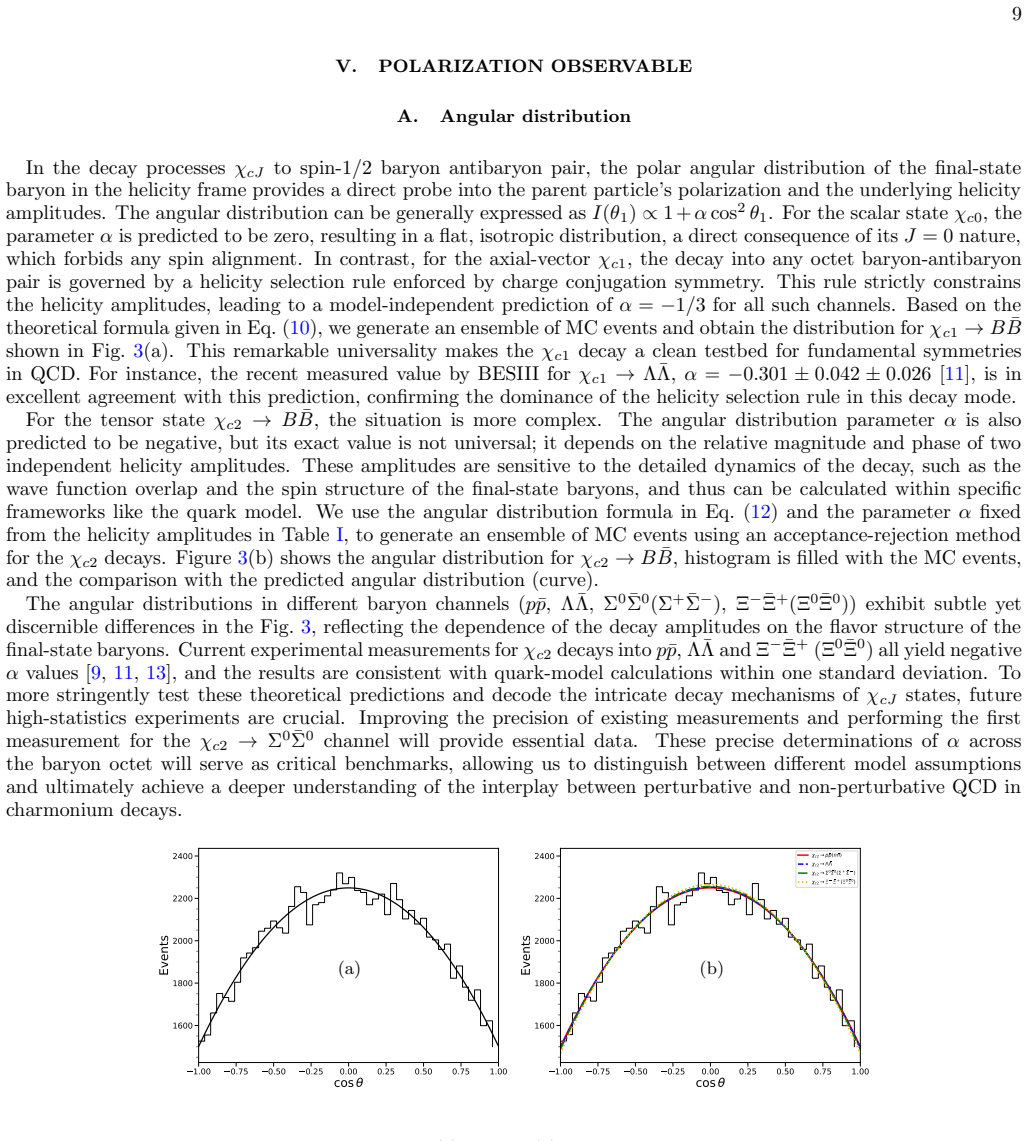
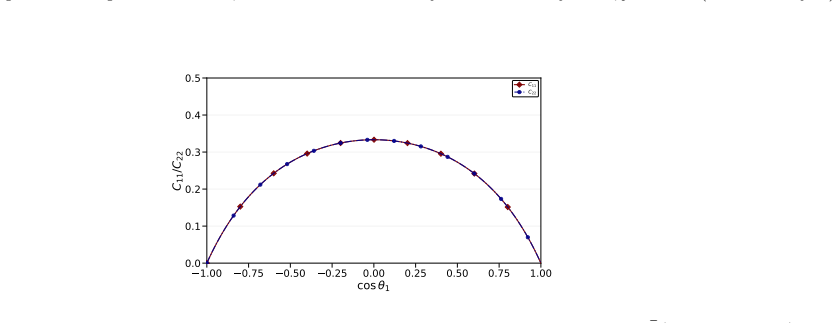
Helicity analysis confirms χ_c1 decays to baryon pairs follow a fixed angular distribution α = -1/3 set by charge conjugation.
A machine-rendered reading of the paper's core claim, the machinery that carries it, and where it could break.
Core claim
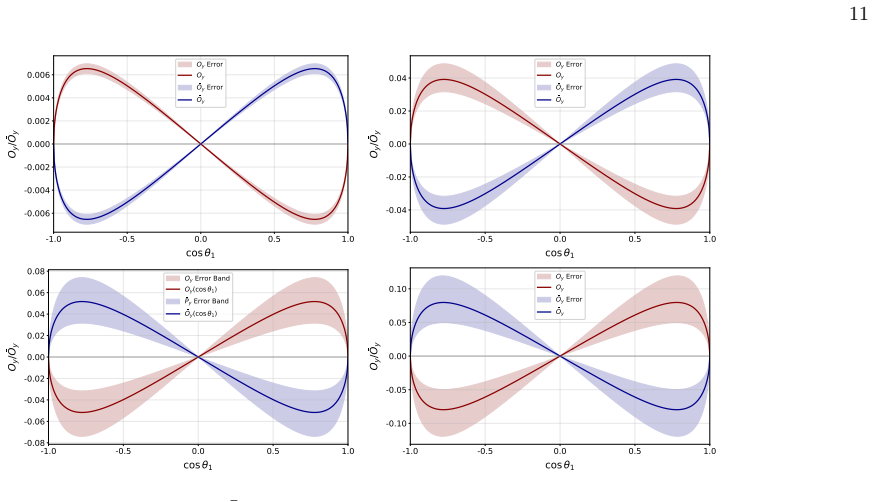
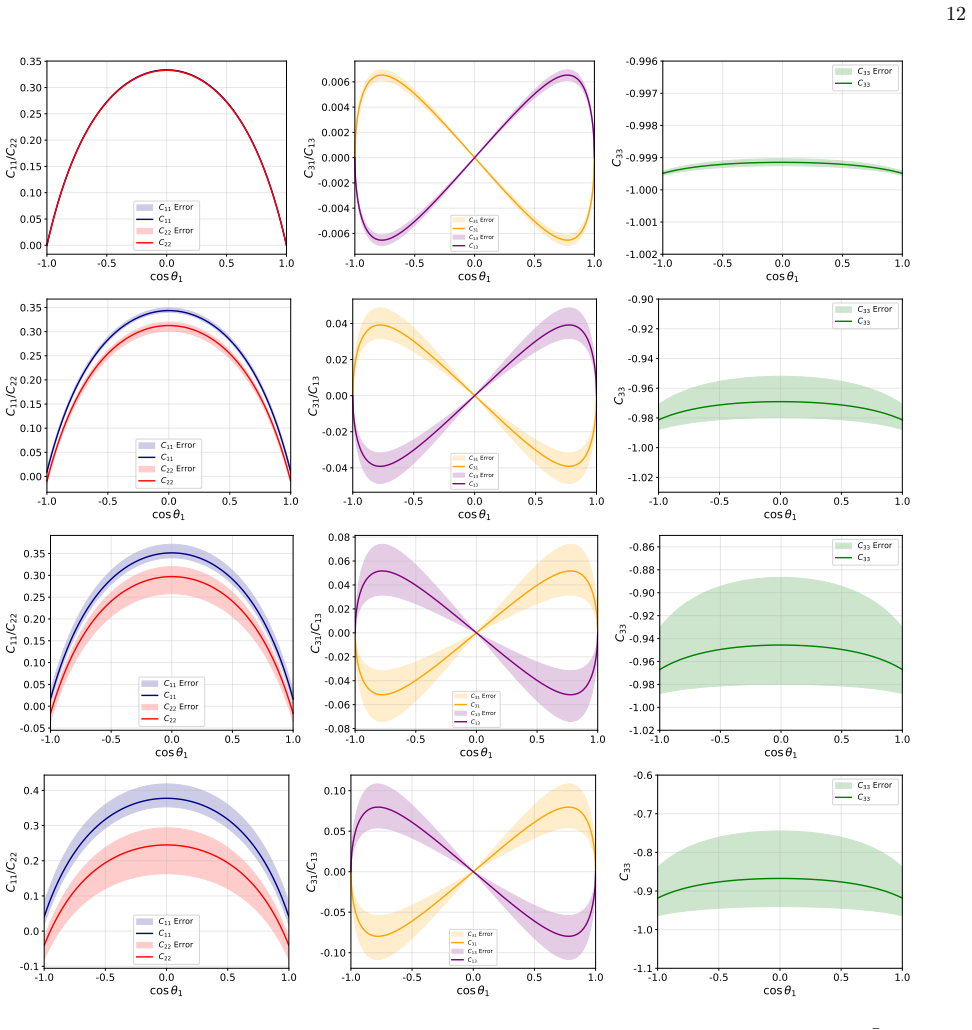
The helicity amplitude analysis for χ_c1 → B B-bar confirms the universal angular distribution parameter α = -1/3, as dictated by the charge-conjugation helicity selection rule. For χ_c2 decays, α and the transverse polarization depend on two independent amplitudes, and our quark-model calculations agree with existing data. Longitudinal beam polarization P_z modifies the spin observables for χ_c1 and χ_c2.
What carries the argument
Spin density matrix formalism that traces polarization through the full production-decay chain, together with helicity amplitudes constrained by charge-conjugation selection rules.
If this is right
- The angular distribution for χ_c1 decays remains fixed at α = -1/3 independent of other dynamical details.
- For χ_c2 decays, α and transverse polarization are determined by two amplitudes whose values can be extracted from data.
- Quark-model predictions for χ_c2 observables are consistent with existing measurements.
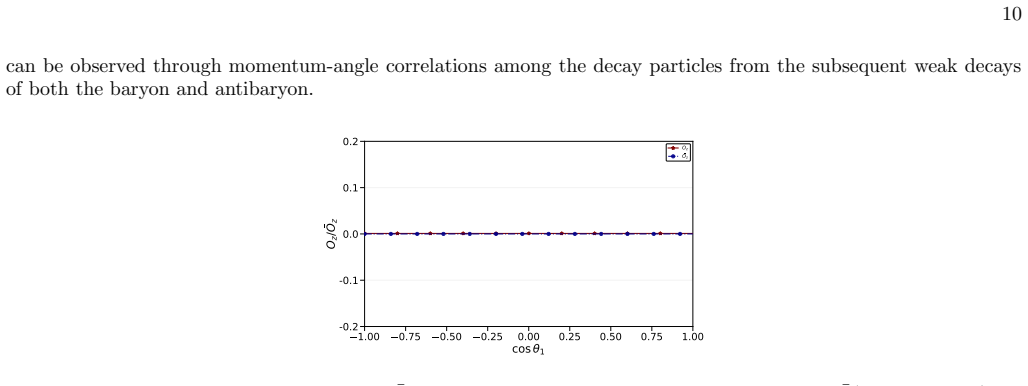
- Longitudinal beam polarization P_z provides new experimental control over the measured spin observables.
- The framework supplies handles for testing decay mechanisms at polarized tau-charm facilities.
Where Pith is reading between the lines
- If the fixed α holds, polarized beams could be used to isolate specific helicity contributions in related charmonium decays.
- Deviations from the predicted α in high-statistics samples would indicate the presence of higher-order corrections beyond the spin-density-matrix treatment.
- The same tracing technique could be applied to other vector-pseudoscalar or baryon-pair final states to map polarization transfer patterns.
- Observation of the modified observables at a polarized collider would allow quantitative tests of baryon spin correlations as a quantum resource.
Load-bearing premise
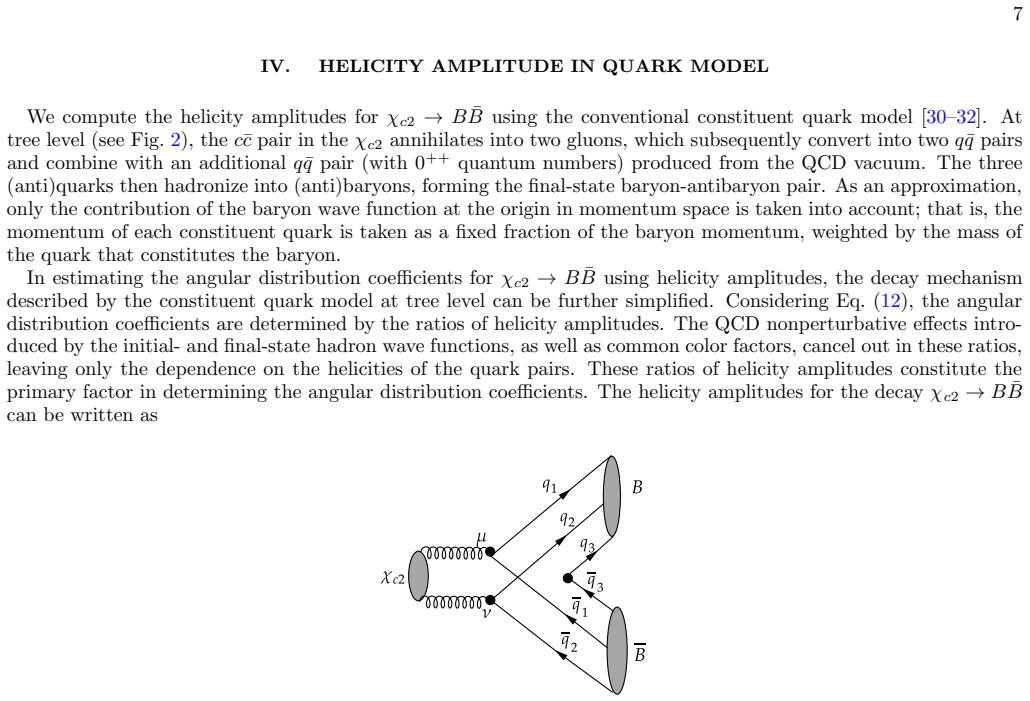
The production chain e+e- → ψ(2S) → γ χ_cJ followed by χ_cJ → B B-bar can be fully described by the spin density matrix formalism without additional dynamical effects or higher-order corrections that would alter the traced polarization observables.
What would settle it
A precision measurement showing the angular parameter α for χ_c1 → B B-bar differing from -1/3 would falsify the helicity selection rule claim.
Figures
read the original abstract
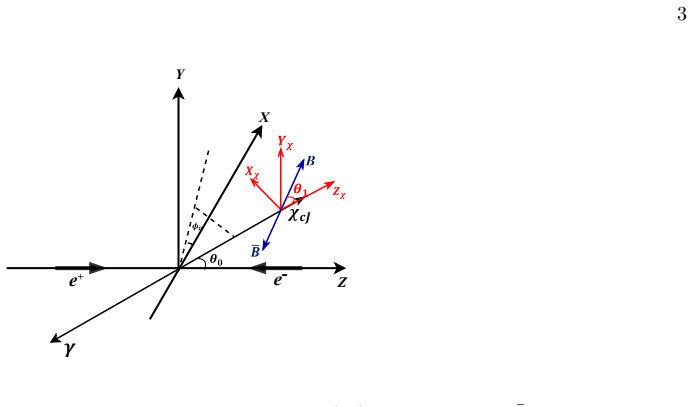
This work presents a comprehensive analysis of polarization transfer in the decays \(\chi_{cJ}\) (\(J=0,1,2\)) to octet baryon-antibaryon pairs within a polarized electron-positron collision environment. Using the spin density matrix formalism, we trace the polarization from the initial beams through the production chain \(e^+e^- \to \psi(2S) \to \gamma \chi_{cJ}\) to the final-state baryon-antibaryon system. The helicity amplitude analysis for \(\chi_{c1} \to B\bar{B}\) confirms the universal angular distribution parameter \(\alpha = -1/3\), as dictated by the charge-conjugation helicity selection rule. For \(\chi_{c2}\) decays, \(\alpha\) and the transverse polarization depend on two independent amplitudes, and our quark-model calculations agree with existing data. We demonstrate that the longitudinal beam polarization \(P_z\) modifies the spin observables for \(\chi_{c1}\) and \(\chi_{c2}\), offering new experimental handles at future polarized facilities like the Super \(\tau\)-Charm Facility(STCF) to test decay mechanisms and explore baryonic spin entanglement as a quantum information resource.
Editorial analysis
A structured set of objections, weighed in public.
Referee Report
Summary. The manuscript analyzes polarization transfer in χ_cJ (J=0,1,2) decays to octet baryon-antibaryon pairs in e⁺e⁻ collisions via the chain e⁺e⁻ → ψ(2S) → γ χ_cJ → B B-bar. It employs the spin density matrix formalism to trace polarization observables, claims that charge-conjugation invariance imposes a helicity selection rule forcing the universal angular distribution parameter α = -1/3 for χ_c1 decays, shows that α and transverse polarization for χ_c2 depend on two independent amplitudes with quark-model results agreeing with data, and demonstrates that longitudinal beam polarization P_z modifies the observables, providing new experimental handles at facilities like STCF.
Significance. If the central symmetry argument holds, the result supplies a clean, parameter-free prediction (α = -1/3) that can be tested directly against data, independent of specific dynamics. The standard spin-density-matrix treatment of the production chain and the explicit discussion of P_z effects at polarized e⁺e⁻ machines constitute useful additions for testing decay mechanisms. The exploration of baryonic spin entanglement as a quantum-information resource is noted but remains exploratory.
minor comments (4)
- The abstract and introduction state that the helicity selection rule 'dictates' α = -1/3 but do not cite the explicit helicity-amplitude relations or the trace over the density matrix that produces this value; adding a short derivation (perhaps in §3) would improve verifiability without altering the claim.
- Quark-model results for χ_c2 are said to 'agree with existing data,' yet no table or figure quantifies the level of agreement (e.g., χ²/dof or specific observable values); a brief comparison table would strengthen the statement.
- Notation for the two independent amplitudes in the χ_c2 case is introduced without an explicit definition of their relation to the helicity amplitudes or to the measured α; a one-line relation to the standard helicity basis would clarify the dependence.
- The discussion of P_z modifications for χ_c1 and χ_c2 is presented qualitatively; a single plot or set of expressions showing the linear dependence on P_z would make the 'new experimental handles' claim more concrete.
Simulated Author's Rebuttal
We thank the referee for the positive assessment of our work on polarization transfer in χ_cJ decays and for recommending minor revision. No specific major comments were raised in the report.
Circularity Check
No significant circularity; derivation rests on external symmetry and standard formalism
full rationale
The paper's central result α = -1/3 for χ_c1 → B B-bar follows from the charge-conjugation helicity selection rule, an independent symmetry constraint. The spin-density-matrix treatment of the e+e- → ψ(2S) → γ χ_cJ chain is the standard formalism with no reduction to the paper's own fitted inputs or self-citations. Quark-model calculations for χ_c2 are compared to external data rather than derived from the target observables. No load-bearing step reduces by construction to the paper's definitions or prior self-citations; the chain is self-contained.
Axiom & Free-Parameter Ledger
axioms (1)
- domain assumption Charge-conjugation helicity selection rule forces α = -1/3 for χ_c1 → B B-bar
Reference graph
Works this paper leans on
-
[1]
J. Bolz, P. Kroll and G. A. Schuler, Eur. Phys. J. C2, 705–719 (1998)
1998
-
[2]
B. Q. Ma, I. Schmidt, J. Soffer and J. J. Yang, Phys. Rev. D65, 034004 (2002)
2002
-
[3]
X. H. Liu and Q. Zhao, J. Phys. G38, 035007 (2011)
2011
-
[4]
Ablikimet al.(BESIII Collaboration), Nature Phys.15, 631–634 (2019)
M. Ablikimet al.(BESIII Collaboration), Nature Phys.15, 631–634 (2019)
2019
-
[5]
Elisabetta Perotti, G¨ oran F¨ aldt, Andrzej Kupsc, Stefan Leupold and Jiao Jiao Song, Phys. Rev. D99, 5, 056008 (2019)
2019
-
[6]
Moortgat Pick, T
G. Moortgat Pick, T. Abeet al., Phys. Rept.460, 131–243 (2008)
2008
-
[7]
Zhe Zhang, Tianbo Liu, Rong Gang Ping, Jiao Jiao Song and Weihua Yang, Phys. Rev. D112, 9, 096012 (2025)
2025
-
[8]
Ablikimet al.(BESIII Collaboration), Phys
M. Ablikimet al.(BESIII Collaboration), Phys. Rev. D87, 3, 032007 (2013)
2013
-
[9]
Ablikimet al.(BESIII Collaboration), Phys
M. Ablikimet al.(BESIII Collaboration), Phys. Rev. D88, 11, 112001 (2013)
2013
-
[10]
J. Z. Baiet al.(BES Collaboration), Phys. Rev. D67, 112001 (2003)
2003
-
[11]
Medina Ablikimet al.(BESIII Collaboration), [arXiv:2509.00289 [hep-ex]] (2025)
arXiv 2025
-
[12]
Ablikimet al.(BESIII Collaboration), Phys
M. Ablikimet al.(BESIII Collaboration), Phys. Rev. D101, 092002 (2020)
2020
-
[13]
Ablikimet al.(BESIII Collaboration), JHEP06, 74 (2022) 14
M. Ablikimet al.(BESIII Collaboration), JHEP06, 74 (2022) 14
2022
-
[14]
Ryszard Horodecki, Pawel Horodecki, Michal Horodecki and Karol Horodecki, Rev. Mod. Phys.81, 865–942 (2009)
2009
-
[15]
Gerardo Adesso and Fabrizio Illuminati, J. Phys. A40, 7821–7880 (2007)
2007
-
[16]
Rep.15, 1, 23410 (2025)
Alexander Bernal, Pawe l Caban and Jakub Rembieli´ nski, Sci. Rep.15, 1, 23410 (2025)
2025
-
[17]
P. C. Hong, R. G. Ping and W. M. Song, Phys. Rev. D113, no.7, 076009 (2026)
2026
-
[18]
C. Li, X. Cao, A. Q. Guo, C. X. Yu, H. W. Zhang and Z. Zhang, arXiv:2602.10398 2026
Pith/arXiv arXiv 2026
-
[19]
Georges Aadet al.(ATLAS Collaboration), Nature633, 8030, 542–547 (2024)
2024
-
[20]
Barr, Marco Fabbrichesi, Roberto Floreanini et.all, Prog
Alan J. Barr, Marco Fabbrichesi, Roberto Floreanini et.all, Prog. Part. Nucl. Phys.139, 104134 (2024)
2024
-
[21]
Zhongtian Dong, Dorival Gon¸ calves, Kyoungchul Kong and Alberto Navarro, Phys. Rev. D109, 11, 115023 (2024)
2024
-
[22]
Achasovet al., Front
M. Achasovet al., Front. Phys. (Beijing)19, 1, 14701 (2024)
2024
-
[23]
John David Jackson, Rev. Mod. Phys.48, 417–433 (1976)
1976
-
[24]
X. Cao, Y. T. Liang and R. G. Ping, Phys. Rev. D110,1, 014035 (2024)
2024
-
[25]
Frank Tabakin and R. A. Eisenstein, Phys. Rev. C31, 1857 (1985)
1985
-
[26]
Ablikimet al.(BESIII Collaboration), Phys
M. Ablikimet al.(BESIII Collaboration), Phys. Rev. D84, 092006 (2011)
2011
-
[27]
Rosner, Phys
Gabriel Karl, Sydney Meshkov and Jonathan L. Rosner, Phys. Rev. D13, 1203 (1976)
1976
-
[28]
Hong Chen and Rong-Gang Ping, Phys. Rev. D102, 016021 (2020)
2020
-
[29]
W. K. Wootters, Phys. Rev. Lett.80, 2245–2248 (1998)
1998
-
[30]
R. G. Ping, B. S. Zou and H. C. Chiang, Eur. Phys. J. A23, 129–133 (2004)
2004
-
[31]
R. G. Ping, H. C. Chiang and B. S. Zou, Phys. Rev. D66, 054020 (2002)
2002
-
[32]
E. S. Ackleh, Ted Barnes and E. S. Swanson, Phys. Rev. D54, 6811–6829 (1996)
1996
-
[33]
Roberts, Prog
Simon Capstick and W. Roberts, Prog. Part. Nucl. Phys.45, S241–S331 (2000)
2000
discussion (0)
Sign in with ORCID, Apple, or X to comment. Anyone can read and Pith papers without signing in.