Learning to Distort: Weakly-Supervised Image Quality Transfer for Prostate DWI Correction
Pith reviewed 2026-06-26 21:32 UTC · model grok-4.3
The pith
Weakly-supervised prototype flow matching turns image quality labels into realistic prostate DWI distortion pairs that train stronger correction models.
A machine-rendered reading of the paper's core claim, the machinery that carries it, and where it could break.
Core claim
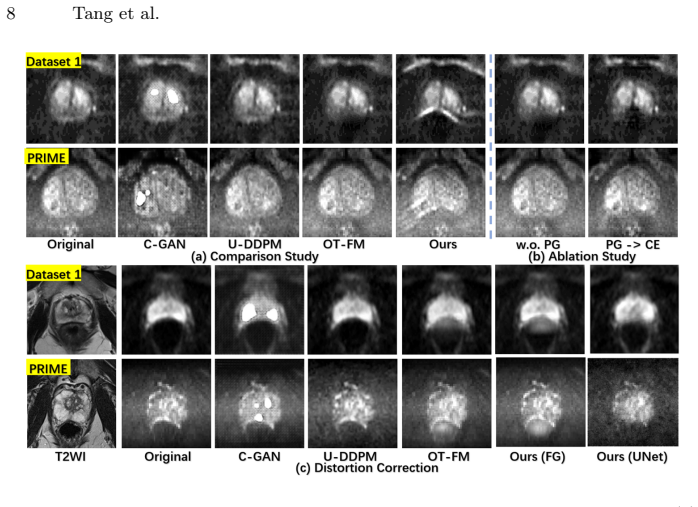
The central discovery is that a weakly-supervised prototype flow matching algorithm, driven solely by image-level quality labels, can synthesize susceptibility artifacts that match the diagnostic interference of real clinical distortions. These synthetic pairs then serve as training data for a downstream image quality transfer model that corrects distortions more effectively than models trained with existing unpaired baselines such as CycleGAN, UNIT-DDPM, or OT-FM.
What carries the argument
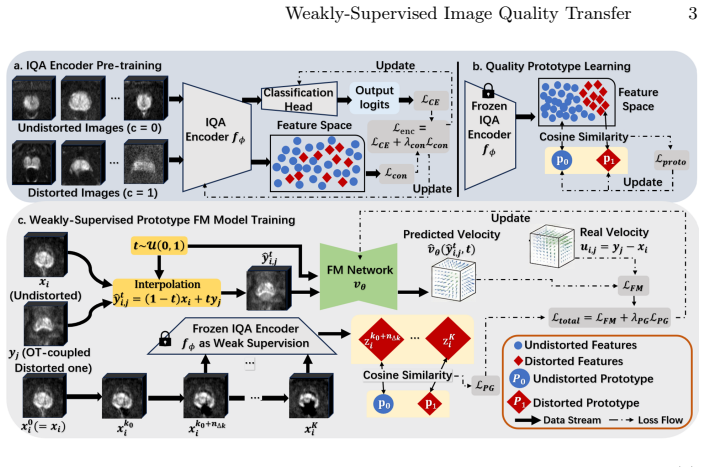
The prototype flow matching algorithm, which regularizes generative trajectories in a pre-trained feature space toward latent distorted prototypes identified from image-level quality labels.
If this is right
- Correction models can be trained without any voxel-wise paired clinical scans.
- The same framework can be run in reverse to produce undistorted images from distorted inputs.
- Downstream clinical classification performance improves on both internal and external test sets when using the synthetic pairs.
- Qualitative and quantitative comparisons show the generated artifacts interfere with diagnosis in the same way as real artifacts.
Where Pith is reading between the lines
- The approach could be tested on other MRI sequences that suffer from geometric distortion, such as abdominal or cardiac DWI.
- If the pre-trained feature space is replaced by a domain-specific encoder, the method might require fewer quality labels to locate prototypes.
- The generated pairs could serve as data augmentation for any downstream segmentation or detection task that uses DWI.
Load-bearing premise
Image-level quality labels alone are sufficient to locate latent quality prototypes whose flow-matching trajectories produce distortions that are diagnostically equivalent to real susceptibility artifacts.
What would settle it
If the generated images fail to improve PI-RADS or Gleason classification accuracy on an external dataset relative to the listed unpaired baselines, the claim that the synthetic pairs enable more capable correction models would not hold.
Figures
read the original abstract
Single-shot echo-planar prostate diffusion-weighted imaging (DWI) is frequently complicated by geometric distortions, which impact the ability to derive reliable diagnoses from such images. Developing automated correction methods is challenged by the absence of paired distorted and undistorted clinical scans. In this paper, we first propose a novel weakly-supervised image quality transfer (IQT) framework from undistorted to distorted images that utilizes image quality assessment (IQA) signals to supervise the transfer process. Unlike traditional methods that require expensive, voxel-wise paired data or resort to developing unpaired algorithms, our approach utilizes image-level quality labels (here, distorted vs. undistorted) to establish latent quality prototypes within a pre-trained feature space. Recognizing that simulating realistic distortions is more reliable than direct unpaired correction, we describe a weakly-supervised prototype flow matching algorithm to explicitly regularize generative trajectories towards distorted prototypes, producing realistic susceptibility artifacts that mimic clinical degradations. By synthesizing these realistic pairs, we enable a second IQT model to be trained in the forward direction for distortion correction. Experimental results demonstrate that our generated images successfully mimic the diagnostic interference of real-world artifacts, which leads to more capable distortion correction IQT models. In addition to qualitative comparisons, we also conduct exhaustive quantitative evaluations that compare our approach with existing unpaired approaches (e.g., CycleGAN, UNIT-DDPM, and OT-FM) - as either forward or reverse alternatives - by assessing clinical downstream task performance in PI-RADS and Gleason score classification, using both in-distribution and external data sets.
Editorial analysis
A structured set of objections, weighed in public.
Referee Report
Summary. The paper proposes a weakly-supervised image quality transfer (IQT) method for prostate diffusion-weighted imaging (DWI) that uses image-level distorted/undistorted labels to define latent quality prototypes in a pre-trained feature space. A prototype flow matching algorithm regularizes generative trajectories toward these prototypes to synthesize realistic susceptibility artifacts, enabling training of a forward distortion-correction IQT model without voxel-wise paired data. The generated pairs are evaluated against CycleGAN, UNIT-DDPM, and OT-FM baselines via downstream PI-RADS and Gleason score classification accuracy on both in-distribution and external datasets.
Significance. If the central claim holds, the work offers a practical route to realistic unpaired-to-paired data synthesis for medical image correction tasks where paired clinical scans are unavailable. Credit is due for evaluating via independent clinical tasks (PI-RADS/Gleason) rather than self-referential image metrics and for comparing against multiple unpaired baselines. The significance is tempered by the need to confirm that improvements stem from diagnostically faithful artifact simulation rather than generic augmentation.
major comments (2)
- [Abstract] Abstract: the claim that 'generated images successfully mimic the diagnostic interference of real-world artifacts' is load-bearing for interpreting downstream PI-RADS/Gleason gains as evidence of method superiority, yet the manuscript provides no direct validation (radiologist scoring of artifact location/severity, voxel-wise comparison on paired clinical cases, or geometric warping metrics) that prototype flow matching reproduces the specific signal dropout and distortion patterns of clinical susceptibility artifacts.
- [Method (prototype flow matching algorithm)] Prototype flow matching description: the assumption that image-level quality labels alone suffice to establish latent prototypes whose flow trajectories yield diagnostically equivalent artifacts is not accompanied by an ablation isolating the contribution of prototype regularization versus generic flow matching; without this, downstream gains could arise from non-specific data augmentation rather than artifact fidelity.
minor comments (2)
- [Experimental results] Ensure all quantitative tables report error bars, statistical significance tests, and full ablation details on prototype selection and flow regularization weights, as these are listed as free parameters.
- [Method] Clarify notation for the pre-trained feature space and how prototypes are selected to avoid ambiguity in the weakly-supervised setup.
Simulated Author's Rebuttal
We thank the referee for their constructive feedback. We address each major comment below, indicating revisions where appropriate.
read point-by-point responses
-
Referee: [Abstract] Abstract: the claim that 'generated images successfully mimic the diagnostic interference of real-world artifacts' is load-bearing for interpreting downstream PI-RADS/Gleason gains as evidence of method superiority, yet the manuscript provides no direct validation (radiologist scoring of artifact location/severity, voxel-wise comparison on paired clinical cases, or geometric warping metrics) that prototype flow matching reproduces the specific signal dropout and distortion patterns of clinical susceptibility artifacts.
Authors: We acknowledge the value of direct validation metrics. However, such validations (radiologist scoring or voxel-wise comparisons) require paired clinical scans, which are unavailable and form the central motivation for our weakly-supervised method. Our primary evidence instead comes from downstream clinical task performance (PI-RADS and Gleason classification) on both in-distribution and external datasets, which serves as a proxy for whether the synthesized artifacts produce diagnostically relevant interference. We will revise the abstract and discussion to more explicitly frame the claim around this indirect but clinically meaningful validation. revision: partial
-
Referee: [Method (prototype flow matching algorithm)] Prototype flow matching description: the assumption that image-level quality labels alone suffice to establish latent prototypes whose flow trajectories yield diagnostically equivalent artifacts is not accompanied by an ablation isolating the contribution of prototype regularization versus generic flow matching; without this, downstream gains could arise from non-specific data augmentation rather than artifact fidelity.
Authors: We agree that an ablation isolating the prototype regularization term would strengthen the manuscript. In the revised version we will add this ablation, comparing the full prototype flow matching model against a generic flow matching baseline without prototype guidance, to demonstrate the specific contribution to artifact fidelity. revision: yes
Circularity Check
No circularity: derivation uses external clinical tasks for validation
full rationale
The paper establishes latent prototypes from image-level distorted/undistorted labels, applies prototype flow matching to synthesize pairs, trains a forward correction IQT model, and validates via independent downstream PI-RADS and Gleason classification on in-distribution and external datasets. No equation reduces any reported gain to a parameter fitted from the same outputs, no self-citation chain supports a uniqueness claim, and the evaluation metrics are not defined by the generative process itself. The chain therefore remains self-contained against external benchmarks.
Axiom & Free-Parameter Ledger
free parameters (1)
- prototype selection and flow regularization weights
axioms (1)
- domain assumption Image-level quality labels (distorted vs. undistorted) suffice to define meaningful latent quality prototypes in a pre-trained feature space.
invented entities (1)
-
latent quality prototypes
no independent evidence
Reference graph
Works this paper leans on
-
[1]
Neuroim- age20(2), 870–888 (2003)
Andersson, J.L., Skare, S., Ashburner, J.: How to correct susceptibility distortions in spin-echo echo-planar images: application to diffusion tensor imaging. Neuroim- age20(2), 870–888 (2003)
2003
-
[2]
BMJ open13(4), e070280 (2023)
Asif, A., Nathan, A., Ng, A., Khetrapal, P., Chan, V.W.S., Giganti, F., Allen, C., Freeman, A., Punwani, S., Lorgelly, P., et al.: Comparing biparametric to multiparametric mri in the diagnosis of clinically significant prostate cancer in biopsy-naive men (prime): a prospective, international, multicentre, non-inferiority within-patient, diagnostic yield ...
2023
-
[3]
In: Medical Imaging 2023: Image Processing
Bian, Z., Shao, M., Carass, A., Prince, J.L.: Drdisco: Deep registration for distor- tion correction of diffusion mri with single phase-encoding. In: Medical Imaging 2023: Image Processing. vol. 12464, pp. 300–304. SPIE (2023)
2023
-
[4]
European Journal of Radiology p
Chien, N., Cho, Y.H., Wang, M.Y., Tsai, L.W., Yeh, C.Y., Li, C.W., Lan, P., Wang, X., Liu, K.L., Chang, Y.C.: Deep learning based multi-shot breast diffusion mri: Improving imaging quality and reduced distortion. European Journal of Radiology p. 112419 (2025)
2025
-
[5]
In: International conference on medical image computing and computer-assisted intervention
Çiçek, Ö., Abdulkadir, A., Lienkamp, S.S., Brox, T., Ronneberger, O.: 3d u-net: learning dense volumetric segmentation from sparse annotation. In: International conference on medical image computing and computer-assisted intervention. pp. 424–432. Springer (2016)
2016
-
[6]
Academic radiol- ogy21(6), 817–823 (2014)
Donato Jr, F., Costa, D.N., Yuan, Q., Rofsky, N.M., Lenkinski, R.E., Pe- drosa, I.: Geometric distortion in diffusion-weighted mr imaging of the prostate—contributing factors and strategies for improvement. Academic radiol- ogy21(6), 817–823 (2014)
2014
-
[7]
The Journal of urology 183(2), 433–440 (2010)
Epstein, J.I.: An update of the gleason grading system. The Journal of urology 183(2), 433–440 (2010)
2010
-
[8]
Hara, K., Kataoka, H., Satoh, Y.: Can spatiotemporal 3d cnns retrace the history of 2d cnns and imagenet? In: Proceedings of the IEEE conference on Computer Vision and Pattern Recognition. pp. 6546–6555 (2018)
2018
-
[9]
Neuroimage221, 117170 (2020) 10 Tang et al
Hu, Z., Wang, Y., Zhang, Z., Zhang, J., Zhang, H., Guo, C., Sun, Y., Guo, H.: Distortion correction of single-shot epi enabled by deep-learning. Neuroimage221, 117170 (2020) 10 Tang et al
2020
-
[10]
In: State of the Art in Neural Networks and their Applications, pp
Johnson, J.W.: Generative adversarial networks in medical imaging. In: State of the Art in Neural Networks and their Applications, pp. 271–278. Elsevier (2021)
2021
-
[11]
Magnetic resonance imaging93, 108–114 (2022)
Lawrence, E.M., Zhang, Y., Starekova, J., Wang, Z., Pirasteh, A., Wells, S.A., Hernando, D.: Reduced field-of-view and multi-shot dwi acquisition techniques: Prospective evaluation of image quality and distortion reduction in prostate cancer imaging. Magnetic resonance imaging93, 108–114 (2022)
2022
-
[12]
Liao, P., Zhang, J., Zeng, K., Yang, Y., Cai, S., Guo, G., Cai, C.: Referenceless distortion correction of gradient-echo echo-planar imaging under inhomogeneous magneticfieldsbasedonadeepconvolutionalneuralnetwork.Computersinbiology and medicine100, 230–238 (2018)
2018
-
[13]
arXiv preprint arXiv:2210.02747 (2022)
Lipman, Y., Chen, R.T., Ben-Hamu, H., Nickel, M., Le, M.: Flow matching for generative modeling. arXiv preprint arXiv:2210.02747 (2022)
Pith/arXiv arXiv 2022
-
[14]
Frontiers in neuroinformatics7, 45 (2013)
Lowekamp, B.C., Chen, D.T., Ibáñez, L., Blezek, D.: The design of simpleitk. Frontiers in neuroinformatics7, 45 (2013)
2013
-
[15]
arXiv preprint arXiv:2108.01073 (2021)
Meng, C., He, Y., Song, Y., Song, J., Wu, J., Zhu, J.Y., Ermon, S.: Sdedit: Guided image synthesis and editing with stochastic differential equations. arXiv preprint arXiv:2108.01073 (2021)
Pith/arXiv arXiv 2021
-
[16]
Magnetic resonance imaging 33(9), 1178–1181 (2015)
Rakow-Penner, R.A., White, N.S., Margolis, D.J., Parsons, J.K., Schenker-Ahmed, N., Kuperman, J.M., Bartsch, H., Choi, H.W., Bradley, W.G., Shabaik, A., et al.: Prostate diffusion imaging with distortion correction. Magnetic resonance imaging 33(9), 1178–1181 (2015)
2015
-
[17]
Scientific reports9(1), 16884 (2019)
Sandfort, V., Yan, K., Pickhardt, P.J., Summers, R.M.: Data augmentation us- ing generative adversarial networks (cyclegan) to improve generalizability in ct segmentation tasks. Scientific reports9(1), 16884 (2019)
2019
-
[18]
arXiv preprint arXiv:2104.05358 (2021)
Sasaki, H., Willcocks, C.G., Breckon, T.P.: Unit-ddpm: Unpaired image transla- tion with denoising diffusion probabilistic models. arXiv preprint arXiv:2104.05358 (2021)
arXiv 2021
-
[19]
arXiv preprint arXiv:2010.02502 (2020)
Song, J., Meng, C., Ermon, S.: Denoising diffusion implicit models. arXiv preprint arXiv:2010.02502 (2020)
Pith/arXiv arXiv 2010
-
[20]
In: International Con- ference on Medical Image Computing and Computer-Assisted Intervention
Tivnan, M., Yoon, S., Chen, Z., Li, X., Wu, D., Li, Q.: Hallucination index: An image quality metric for generative reconstruction models. In: International Con- ference on Medical Image Computing and Computer-Assisted Intervention. pp. 449–458. Springer (2024)
2024
-
[21]
arXiv preprint arXiv:2302.00482 (2023)
Tong, A., Fatras, K., Malkin, N., Huguet, G., Zhang, Y., Rector-Brooks, J., Wolf, G.,Bengio,Y.:Improvingandgeneralizingflow-basedgenerativemodelswithmini- batch optimal transport. arXiv preprint arXiv:2302.00482 (2023)
Pith/arXiv arXiv 2023
-
[22]
European urology76(3), 340–351 (2019)
Turkbey, B., Rosenkrantz, A.B., Haider, M.A., Padhani, A.R., Villeirs, G., Macura, K.J., Tempany, C.M., Choyke, P.L., Cornud, F., Margolis, D.J., et al.: Prostate imaging reporting and data system version 2.1: 2019 update of prostate imaging reporting and data system version 2. European urology76(3), 340–351 (2019)
2019
-
[23]
Yan, W., Chiu, B., Shen, Z., Yang, Q., Syer, T., Min, Z., Punwani, S., Emberton, M., Atkinson, D., Barratt, D.C., et al.: Combiner and hypercombiner networks: Rulestocombinemultimodalitymrimagesforprostatecancerlocalisation.Medical Image Analysis91, 103030 (2024)
2024
-
[24]
In: International Conference on Medical Image Computing and Computer-Assisted Intervention
Yazdani, M., Medghalchi, Y., Ashrafian, P., Hacihaliloglu, I., Shahriari, D.: Flow matching for medical image synthesis: Bridging the gap between speed and quality. In: International Conference on Medical Image Computing and Computer-Assisted Intervention. pp. 216–226. Springer (2025)
2025
-
[25]
arXiv preprint arXiv:2508.06625 (2025)
Zou, S., Huang, Y., Yi, R., Zhu, C., Xu, K.: Cyclediff: Cycle diffusion models for unpaired image-to-image translation. arXiv preprint arXiv:2508.06625 (2025)
arXiv 2025
discussion (0)
Sign in with ORCID, Apple, or X to comment. Anyone can read and Pith papers without signing in.