Theory of In-Plane Orbital Magnetization with Layer Hybridization
Pith reviewed 2026-06-26 20:03 UTC · model grok-4.3
The pith
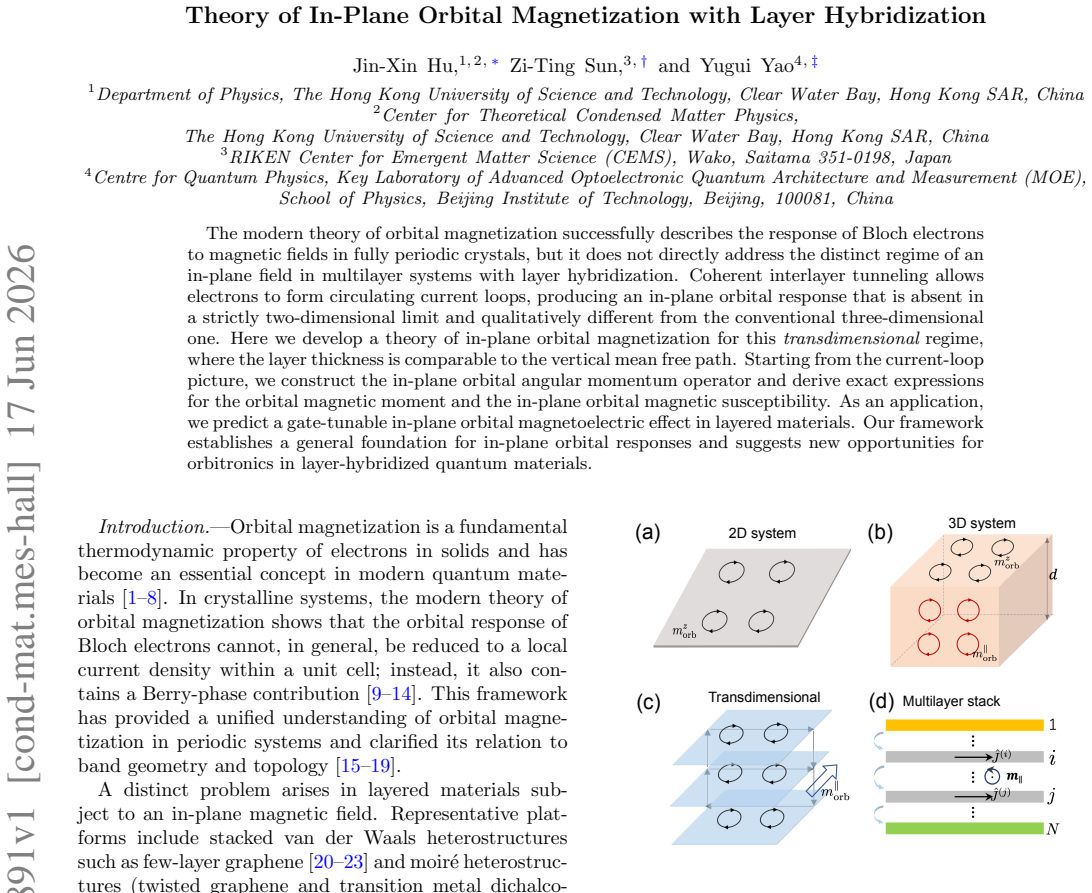
Coherent interlayer tunneling in multilayer systems produces an in-plane orbital magnetization via circulating current loops.
A machine-rendered reading of the paper's core claim, the machinery that carries it, and where it could break.
Core claim
In the transdimensional regime of multilayer systems with layer hybridization, coherent interlayer tunneling allows formation of circulating current loops that generate an in-plane orbital response. The theory constructs the in-plane orbital angular momentum operator and derives exact expressions for the orbital magnetic moment and the in-plane orbital magnetic susceptibility. Application to layered materials predicts a gate-tunable in-plane orbital magnetoelectric effect.
What carries the argument
The in-plane orbital angular momentum operator constructed from the current-loop picture of interlayer tunneling.
If this is right
- Exact closed-form expressions exist for the orbital magnetic moment in the transdimensional regime.
- Exact closed-form expressions exist for the in-plane orbital magnetic susceptibility.
- A gate-tunable in-plane orbital magnetoelectric effect appears in layered materials.
- The framework supplies a general foundation for all in-plane orbital responses in layer-hybridized systems.
Where Pith is reading between the lines
- The same current-loop construction could be used to compute orbital responses in other geometries where interlayer coherence is tunable, such as twisted bilayer systems.
- Device designs that exploit the predicted gate dependence may allow electrical control of orbital magnetism without requiring out-of-plane fields.
- The approach suggests that transport or spectroscopic signatures of the in-plane orbital moment should appear in multilayer samples once the vertical mean free path condition is met.
- Strictly two-dimensional models will systematically underestimate or miss in-plane orbital effects whenever finite interlayer tunneling is present.
Load-bearing premise
Coherent interlayer tunneling in the regime where layer thickness is comparable to the vertical mean free path produces circulating current loops that generate an in-plane orbital response.
What would settle it
Measurement of a gate-dependent in-plane orbital magnetoelectric response (or its absence) in a specific multilayer sample such as bilayer graphene under controlled in-plane magnetic field and gate voltage.
Figures


read the original abstract
The modern theory of orbital magnetization successfully describes the response of Bloch electrons to magnetic fields in fully periodic crystals, but it does not directly address the distinct regime of an in-plane field in multilayer systems with layer hybridization. Coherent interlayer tunneling allows electrons to form circulating current loops, producing an in-plane orbital response that is absent in a strictly two-dimensional limit and qualitatively different from the conventional three-dimensional one. Here we develop a theory of in-plane orbital magnetization for this {\it transdimensional} regime, where the layer thickness is comparable to the vertical mean free path. Starting from the current-loop picture, we construct the in-plane orbital angular momentum operator and derive exact expressions for the orbital magnetic moment and the in-plane orbital magnetic susceptibility. As an application, we predict a gate-tunable in-plane orbital magnetoelectric effect in layered materials. Our framework establishes a general foundation for in-plane orbital responses and suggests new opportunities for orbitronics in layer-hybridized quantum materials.
Editorial analysis
A structured set of objections, weighed in public.
Referee Report
Summary. The paper develops a theory of in-plane orbital magnetization in multilayer systems in the transdimensional regime (layer thickness comparable to vertical mean free path), where coherent interlayer tunneling produces circulating current loops. Starting from a semiclassical current-loop picture, the authors construct an in-plane orbital angular momentum operator and derive exact expressions for the orbital magnetic moment and in-plane orbital magnetic susceptibility. As an application, they predict a gate-tunable in-plane orbital magnetoelectric effect in layered materials.
Significance. If the central derivation holds without omitted contributions, the work would establish a useful framework for orbital responses in layer-hybridized systems that bridges 2D and 3D limits, with the gate-tunable magnetoelectric prediction offering a concrete, testable implication for orbitronics. The emphasis on exact expressions (rather than perturbative or fitted forms) is a methodological strength that could facilitate future comparisons.
major comments (2)
- [§2] §2 (operator construction): The in-plane orbital angular momentum operator is defined via the semiclassical current-loop picture arising from interlayer tunneling. This construction omits explicit treatment of Berry-curvature or interband matrix-element contributions that appear in the modern orbital magnetization formula (local circulation plus Berry term). The mean-free-path condition is invoked to justify the regime but is not shown to suppress the additional terms; this is load-bearing for the subsequent exact expressions.
- [§4] §4 (susceptibility derivation): The exact expression for the in-plane orbital magnetic susceptibility is obtained directly from the loop-based operator. No cross-check against a full Kubo linear-response calculation (including vector-potential coupling) is provided to confirm that interband or gauge contributions remain negligible under the stated coherence condition.
minor comments (2)
- The introduction would benefit from a brief statement of how the transdimensional regime differs quantitatively from both the strict 2D limit and bulk 3D orbital magnetism.
- Notation for the vertical mean free path and layer hybridization strength should be introduced with symbols at first use rather than only in the abstract.
Simulated Author's Rebuttal
We thank the referee for the careful reading and constructive comments on our manuscript. We address the major comments point by point below.
read point-by-point responses
-
Referee: [§2] §2 (operator construction): The in-plane orbital angular momentum operator is defined via the semiclassical current-loop picture arising from interlayer tunneling. This construction omits explicit treatment of Berry-curvature or interband matrix-element contributions that appear in the modern orbital magnetization formula (local circulation plus Berry term). The mean-free-path condition is invoked to justify the regime but is not shown to suppress the additional terms; this is load-bearing for the subsequent exact expressions.
Authors: We thank the referee for this observation. In the transdimensional regime, the layer thickness comparable to the vertical mean free path implies that coherent interlayer tunneling produces the dominant circulating current loops for the in-plane response; the semiclassical operator is constructed precisely to capture this leading contribution. Berry-curvature terms, which arise in the out-of-plane magnetization of periodic crystals, do not enter the in-plane orbital angular momentum at the same order because the hybridization is vertical and the field is in-plane. The mean-free-path condition limits the coherence length such that longer-range interband processes are suppressed by scattering. To make the argument explicit, we will add a clarifying paragraph in the revised §2 that derives the suppression of the additional terms from the stated coherence condition. revision: partial
-
Referee: [§4] §4 (susceptibility derivation): The exact expression for the in-plane orbital magnetic susceptibility is obtained directly from the loop-based operator. No cross-check against a full Kubo linear-response calculation (including vector-potential coupling) is provided to confirm that interband or gauge contributions remain negligible under the stated coherence condition.
Authors: We acknowledge that an explicit comparison with the Kubo formalism would provide an independent verification. Our expressions are exact within the loop-operator framework and the semiclassical regime defined by the mean-free-path condition. A complete Kubo calculation including all gauge and interband channels is a substantial separate calculation that lies outside the present scope. In the revised manuscript we will add a brief discussion (or short appendix) showing how the loop operator corresponds to the leading term of the linear-response susceptibility under the coherence condition, thereby addressing the concern without performing the full numerical cross-check. revision: partial
Circularity Check
No significant circularity; derivation is self-contained from stated current-loop premise
full rationale
The abstract and description indicate the paper starts from an explicit current-loop picture to construct the in-plane orbital angular momentum operator, then derives exact expressions for moment and susceptibility as applications of that construction. No quoted equations or steps reduce a claimed prediction back to a fitted parameter, self-citation chain, or definitional equivalence (e.g., no 'predict X' where X is the input fit). The gate-tunable magnetoelectric effect is presented as an application rather than a forced output. This matches the default case of a model-based derivation without circular reduction; external benchmarks or full-text equations would be needed to raise the score, but none are exhibited here.
Axiom & Free-Parameter Ledger
Forward citations
Cited by 1 Pith paper
-
Interlayer electric multipole Hall effect in twisted multilayers
Twisted multilayers show interlayer electric multipole Hall effects from layer pseudospin textures, with tunable currents in trilayers via interlayer translation and additive interface contributions at large angles.
Reference graph
Works this paper leans on
-
[1]
Getzlaff,Fundamentals of magnetism(Springer Sci- ence & Business Media, 2007)
M. Getzlaff,Fundamentals of magnetism(Springer Sci- ence & Business Media, 2007)
2007
-
[2]
Hirst, Reviews of Modern Physics69, 607 (1997)
L. Hirst, Reviews of Modern Physics69, 607 (1997)
1997
-
[3]
Vanderbilt,Berry phases in electronic structure the- ory: electric polarization, orbital magnetization and topo- logical insulators(Cambridge University Press, 2018)
D. Vanderbilt,Berry phases in electronic structure the- ory: electric polarization, orbital magnetization and topo- logical insulators(Cambridge University Press, 2018)
2018
-
[4]
B. A. Bernevig, C. Felser, and H. Beidenkopf, Nature 603, 41 (2022)
2022
-
[5]
Mei, Y.-F
R. Mei, Y.-F. Zhao, C. Wang, Y. Ren, D. Xiao, C.- Z. Chang, and C.-X. Liu, Physical review letters132, 066604 (2024)
2024
-
[6]
Grytsiuk, J.-P
S. Grytsiuk, J.-P. Hanke, M. Hoffmann, J. Bouaziz, O. Gomonay, G. Bihlmayer, S. Lounis, Y. Mokrousov, and S. Bl¨ ugel, Nature communications11, 511 (2020)
2020
-
[7]
Q. L. He, T. L. Hughes, N. P. Armitage, Y. Tokura, and K. L. Wang, Nature materials21, 15 (2022)
2022
-
[8]
Zhong, J
S. Zhong, J. E. Moore, and I. Souza, Physical review letters116, 077201 (2016)
2016
-
[9]
Thonhauser, D
T. Thonhauser, D. Ceresoli, D. Vanderbilt, and R. Resta, Physical review letters95, 137205 (2005)
2005
-
[10]
Ceresoli, T
D. Ceresoli, T. Thonhauser, D. Vanderbilt, and R. Resta, Physical Review B—Condensed Matter and Materials Physics74, 024408 (2006)
2006
-
[11]
Resta, Journal of Physics: Condensed Matter22, 123201 (2010)
R. Resta, Journal of Physics: Condensed Matter22, 123201 (2010)
2010
-
[12]
Bianco and R
R. Bianco and R. Resta, Physical review letters110, 087202 (2013)
2013
-
[13]
G. E. Topp, P. T¨ orm¨ a, D. M. Kennes, and A. Mitra, Physical Review B105, 195426 (2022)
2022
-
[14]
Hanke, F
J.-P. Hanke, F. Freimuth, A. K. Nandy, H. Zhang, S. Bl¨ ugel, and Y. Mokrousov, Physical Review B94, 121114 (2016)
2016
-
[15]
D. Xiao, Y. Yao, Z. Fang, and Q. Niu, Physical review letters97, 026603 (2006)
2006
-
[16]
Chang and Q
M.-C. Chang and Q. Niu, Physical Review B53, 7010 (1996)
1996
-
[17]
Chang and Q
M.-C. Chang and Q. Niu, Journal of Physics: Condensed Matter20, 193202 (2008)
2008
-
[18]
Xiao and Q
C. Xiao and Q. Niu, Physical Review B101, 235430 (2020)
2020
-
[19]
J. Shi, G. Vignale, D. Xiao, and Q. Niu, Physical review letters99, 197202 (2007)
2007
-
[20]
T. Han, Z. Lu, G. Scuri, J. Sung, J. Wang, T. Han, K. Watanabe, T. Taniguchi, L. Fu, H. Park,et al., Nature 623, 41 (2023)
2023
-
[21]
Hu and J
J.-X. Hu and J. C. Song, Proceedings of the National Academy of Sciences123, e2506751123 (2026)
2026
-
[22]
Ghorai, S
K. Ghorai, S. Das, H. Varshney, and A. Agarwal, Phys- ical Review Letters134, 026301 (2025)
2025
-
[23]
Q. Li, H. Fan, M. Li, Y. Xu, J. Song, A. Wang, K. Watan- abe, T. Taniguchi, J.-J. Chen, Z. Tan,et al., Nature , 1 (2026)
2026
-
[24]
Bistritzer and A
R. Bistritzer and A. H. MacDonald, Proceedings of the National Academy of Sciences108, 12233 (2011)
2011
-
[25]
Y. Cao, V. Fatemi, S. Fang, K. Watanabe, T. Taniguchi, E. Kaxiras, and P. Jarillo-Herrero, Nature556, 43 (2018)
2018
-
[26]
Y. Cao, V. Fatemi, A. Demir, S. Fang, S. L. Tomarken, 6 J. Y. Luo, J. D. Sanchez-Yamagishi, K. Watanabe, T. Taniguchi, E. Kaxiras,et al., Nature556, 80 (2018)
2018
-
[27]
J. Y. Lee, E. Khalaf, S. Liu, X. Liu, Z. Hao, P. Kim, and A. Vishwanath, Nature communications10, 5333 (2019)
2019
-
[28]
J.-X. Hu, C. Zeng, and Y. Yao, Physical Review B109, L201403 (2024)
2024
-
[29]
D. Zhai, C. Chen, C. Xiao, and W. Yao, Nature com- munications14, 1961 (2023)
1961
-
[30]
F. Wu, T. Lovorn, E. Tutuc, I. Martin, and A. MacDon- ald, Physical review letters122, 086402 (2019)
2019
-
[31]
Devakul, V
T. Devakul, V. Cr´ epel, Y. Zhang, and L. Fu, Nature communications12, 6730 (2021)
2021
-
[32]
Zheng, D
H. Zheng, D. Zhai, C. Xiao, and W. Yao, Nano Letters 25, 10096 (2025)
2025
-
[33]
D. L. Duong, S. J. Yun, and Y. H. Lee, ACS nano11, 11803 (2017)
2017
-
[34]
A. R.-P. Montblanch, M. Barbone, I. Aharonovich, M. Atat¨ ure, and A. C. Ferrari, Nature Nanotechnology 18, 555 (2023)
2023
-
[35]
Turunen, M
M. Turunen, M. Brotons-Gisbert, Y. Dai, Y. Wang, E. Scerri, C. Bonato, K. D. J¨ ons, Z. Sun, and B. D. Gerardot, Nature Reviews Physics4, 219 (2022)
2022
-
[36]
D. Zhai, H. Yu, and W. Yao, Reports on Progress in Physics88, 084501 (2025)
2025
-
[37]
Xiong, M
Y. Xiong, M. S. Rudner, and J. C. Song, Physical Review Letters133, 136901 (2024)
2024
-
[38]
Freimuth, S
F. Freimuth, S. Bl¨ ugel, and Y. Mokrousov, Physical Re- view B95, 184428 (2017)
2017
-
[39]
Pi´ echon, A
F. Pi´ echon, A. Raoux, J.-N. Fuchs, and G. Montambaux, Physical Review B94, 134423 (2016)
2016
-
[40]
Y. Gao, S. A. Yang, and Q. Niu, Physical Review B91, 214405 (2015)
2015
-
[41]
J. C. Song and G. Vignale, Physical Review B99, 235405 (2019)
2019
-
[42]
Bhowal and G
S. Bhowal and G. Vignale, Physical Review B103, 195309 (2021)
2021
-
[43]
Xiao, M.-C
D. Xiao, M.-C. Chang, and Q. Niu, Reviews of modern physics82, 1959 (2010)
1959
-
[44]
H. Zhou, R.-C. Xiao, S.-H. Zhang, W. Gan, H. Han, H.- M. Zhao, W. Lu, C. Zhang, Y. Sun, H. Li,et al., arXiv preprint arXiv:2407.08420 (2024)
-
[45]
E. Wang, H. Zeng, W. Duan, and H. Huang, Physical Review Letters132, 266802 (2024)
2024
-
[46]
Y. Gao, S. A. Yang, and Q. Niu, Physical review letters 112, 166601 (2014)
2014
-
[47]
H. Liu, J. Zhao, Y.-X. Huang, W. Wu, X.-L. Sheng, C. Xiao, and S. A. Yang, Physical Review Letters127, 277202 (2021)
2021
-
[48]
H. Liu, J. Zhao, Y.-X. Huang, X. Feng, C. Xiao, W. Wu, S. Lai, W.-b. Gao, and S. A. Yang, Physical Review B 105, 045118 (2022)
2022
-
[49]
Wang, Y.-X
H. Wang, Y.-X. Huang, H. Liu, X. Feng, J. Zhu, W. Wu, C. Xiao, and S. A. Yang, Physical review letters132, 056301 (2024)
2024
-
[50]
Huang, X
Y.-X. Huang, X. Feng, H. Wang, C. Xiao, and S. A. Yang, Physical Review Letters130, 126303 (2023)
2023
-
[51]
Y. Fang, J. Cano, and S. A. A. Ghorashi, Physical Re- view Letters133, 106701 (2024)
2024
-
[52]
Kaplan, T
D. Kaplan, T. Holder, and B. Yan, Physical review let- ters132, 026301 (2024)
2024
-
[53]
Xiang, C
L. Xiang, C. Zhang, L. Wang, and J. Wang, Physical Review B107, 075411 (2023)
2023
-
[54]
Theory of In-Plane Orbital Magnetization with Layer Hybridization
S. Lai, H. Liu, Z. Zhang, J. Zhao, X. Feng, N. Wang, C. Tang, Y. Liu, K. Novoselov, S. A. Yang,et al., Nature Nanotechnology16, 869 (2021). 1 Supplementary Material for “Theory of In-Plane Orbital Magnetization with Layer Hybridization” ORBIT AL MAGNETIC MOMENT IN TWO-BAND MODEL In the main text, we have shown the proper construction of the in-plane orbit...
2021
discussion (0)
Sign in with ORCID, Apple, or X to comment. Anyone can read and Pith papers without signing in.