Anomaly Detection for Sparse and Irregular Multivariate Time Series with Latent SDEs
Pith reviewed 2026-06-26 21:15 UTC · model grok-4.3
The pith
Latent SDEs model sparse irregular time series as continuous stochastic processes to detect anomalies more robustly than prior methods.
A machine-rendered reading of the paper's core claim, the machinery that carries it, and where it could break.
Core claim
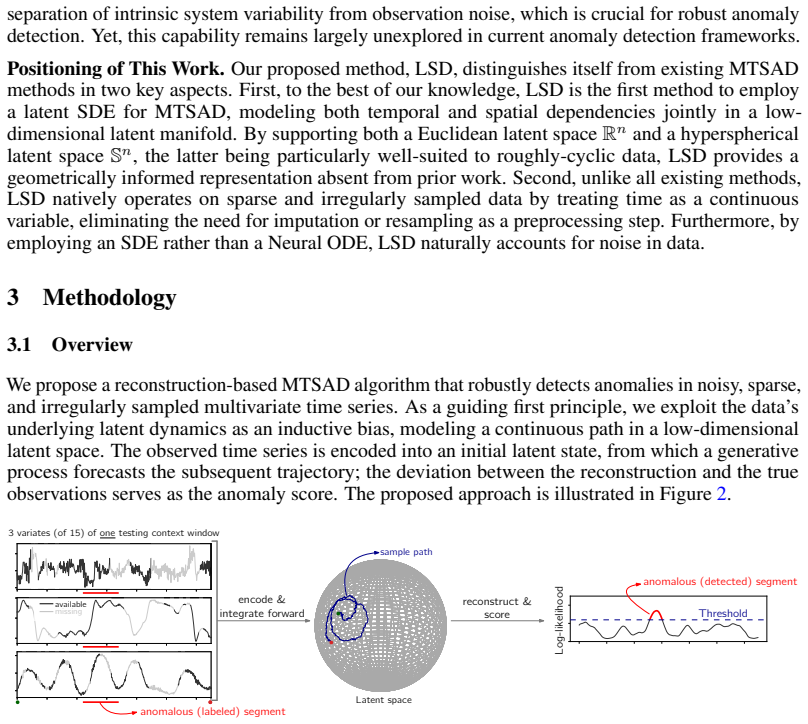
By embedding the observed time series in a latent stochastic differential equation, anomalies are identified through the mismatch between the data and the continuous-time generative process; the same mechanism automatically handles arbitrary missingness patterns and irregular timestamps while also capturing cyclic structure common in applications.
What carries the argument
Latent SDEs: stochastic differential equations defined in a latent space whose solutions are mapped to the observed multivariate time series, enabling continuous-time modeling without fixed sampling assumptions.
If this is right
- Anomaly detection no longer requires resampling or imputation steps that distort irregular data.
- Cyclic or periodic patterns in the underlying dynamics are captured automatically by the SDE formulation.
- Performance remains stable under increasing fractions of missing observations where discrete-time models fail.
- The generative likelihood provides a direct, calibrated anomaly score without auxiliary classifiers.
Where Pith is reading between the lines
- The same continuous-time prior could be reused for forecasting or imputation on the same irregular streams.
- Domains with naturally continuous dynamics, such as physiological signals, become direct application targets.
- Hybrid models that combine latent SDEs with known physical constraints could further reduce the need for labeled anomalies.
Load-bearing premise
Projecting the observed series onto a continuous-time stochastic dynamical system is enough to capture the anomalies without further assumptions about the sampling process or data distribution.
What would settle it
Run the method and the strongest baselines on a synthetic dataset engineered so that the anomalies lie outside any continuous stochastic trajectory; if detection performance no longer exceeds the baselines, the claim is falsified.
Figures

read the original abstract
Multivariate time series anomaly detection (MTSAD) is critical for a wide range of application areas, such as industrial monitoring, cybersecurity, or healthcare. Real-world data is often sparse, irregularly sampled or partially observed, yet existing methods assume uniformly sampled time series. We propose a generative approach based on Latent SDEs that projects the observed time series on a continuous-time stochastic dynamical system, directly being able to handle missing observations and irregular sampling, while also naturally capturing possible cyclic behavior that many real-world use cases inherently possess. Experiments on six anomaly benchmark datasets show that our proposed method ranks first among state-of-the-art baselines. We further demonstrate that our method remains robust under severe data sparsity, while performance significantly degrades for the tested baseline methods. These results highlight latent SDEs as a natural inductive bias for anomaly detection in multivariate time series, especially in presence of real-world irregularities.
Editorial analysis
A structured set of objections, weighed in public.
Referee Report
Summary. The paper proposes a generative anomaly detection method for multivariate time series based on Latent SDEs. It projects observed (possibly sparse and irregularly sampled) data onto a continuous-time stochastic dynamical system, which is claimed to naturally accommodate missing observations, irregular sampling, and cyclic behavior. Experiments on six anomaly benchmark datasets are reported to show that the method ranks first among state-of-the-art baselines and remains robust under severe data sparsity while baseline performance degrades.
Significance. If the experimental comparisons hold after proper adaptation of baselines, the work would demonstrate a useful inductive bias for handling real-world irregularities in MTS anomaly detection. The continuous-time generative formulation is a clear strength relative to discrete uniform-sampling assumptions common in prior art.
major comments (2)
- [Experiments] Experiments (abstract and §4): The central claim that the method 'ranks first among state-of-the-art baselines' and 'remains robust under severe data sparsity, while performance significantly degrades for the tested baseline methods' is load-bearing for the paper's contribution. The abstract states that existing methods assume uniformly sampled time series, yet it is not shown whether the reported baselines were adapted for irregular/sparse regimes (e.g., via masking, imputation, or continuous-time reformulation). Without such adaptation, baseline degradation is expected and does not isolate the benefit of the latent-SDE inductive bias.
- [§3] §3 (model description): The claim that the latent SDE 'directly [is] able to handle missing observations and irregular sampling' requires an explicit statement of the observation model and how the likelihood is computed under arbitrary observation times; the current high-level description leaves open whether additional assumptions on the sampling process are still needed.
minor comments (1)
- [Abstract] Abstract: The phrase 'projects the observed time series on a continuous-time stochastic dynamical system' is slightly imprecise; clarify whether the projection is via variational inference or another mechanism.
Simulated Author's Rebuttal
We thank the referee for the constructive feedback. We address each major comment below and indicate the corresponding revisions.
read point-by-point responses
-
Referee: [Experiments] Experiments (abstract and §4): The central claim that the method 'ranks first among state-of-the-art baselines' and 'remains robust under severe data sparsity, while performance significantly degrades for the tested baseline methods' is load-bearing for the paper's contribution. The abstract states that existing methods assume uniformly sampled time series, yet it is not shown whether the reported baselines were adapted for irregular/sparse regimes (e.g., via masking, imputation, or continuous-time reformulation). Without such adaptation, baseline degradation is expected and does not isolate the benefit of the latent-SDE inductive bias.
Authors: We agree that explicit documentation of baseline adaptations is necessary to substantiate the central claims and isolate the contribution of the latent SDE. In the revised manuscript we will add a subsection to §4 that details the precise adaptations applied to each baseline (masking for missing values, linear interpolation or nearest-neighbor imputation for irregular times, and any continuous-time reformulations used). We will also report the performance of the unadapted baselines for transparency. These changes will make the experimental protocol fully reproducible and strengthen the evidence for the claimed inductive bias. revision: yes
-
Referee: [§3] §3 (model description): The claim that the latent SDE 'directly [is] able to handle missing observations and irregular sampling' requires an explicit statement of the observation model and how the likelihood is computed under arbitrary observation times; the current high-level description leaves open whether additional assumptions on the sampling process are still needed.
Authors: We accept that the current description in §3 is insufficiently precise. We will revise the section to state the observation model explicitly: given latent trajectory z(t) generated by the SDE, each observation x_{t_i} at an arbitrary time t_i is drawn from p(x | z(t_i)) (typically a Gaussian emission), and the marginal likelihood is the product of these terms over the observed times only. No uniform-grid or fixed-interval assumptions are imposed. The revised text will include the corresponding equations and a short paragraph confirming that the formulation accommodates arbitrary observation times by construction. revision: yes
Circularity Check
No significant circularity detected
full rationale
The paper presents a generative Latent SDE method for MTS anomaly detection and reports empirical rankings on benchmarks. No derivation chain, equations, or self-citations are shown that reduce predictions to fitted inputs by construction, import uniqueness from prior author work, or smuggle ansatzes. The central claims rest on external benchmark comparisons that remain falsifiable outside any internal fit, satisfying the criteria for a self-contained result with no load-bearing circular steps.
Axiom & Free-Parameter Ledger
Reference graph
Works this paper leans on
-
[1]
Henriques, Yang Liu, Andrew Zisserman, and Samuel Albanie
Ahmed Abdulaal and Tomer Lancewicki. Real-time synchronization in neural networks for multivariate time series anomaly detection. In ICASSP 2021 - 2021 IEEE International Conference on Acoustics, Speech and Signal Processing (ICASSP), pages 3570--3574, 2021. doi:10.1109/ICASSP39728.2021.9413847
-
[2]
Chuadhry Mujeeb Ahmed, Venkata Reddy Palleti, and Aditya P. Mathur. Wadi: a water distribution testbed for research in the design of secure cyber physical systems. In Proceedings of the 3rd International Workshop on Cyber-Physical Systems for Smart Water Networks, CPS Week ’17, page 25–28. ACM, April 2017. doi:10.1145/3055366.3055375
-
[3]
Self-perturbed anomaly-aware graph dynamics for multivariate time-series anomaly detection
Jinyu Cai, Yuan Xie, Glynnis Lim, Yifang Yin, Roger Zimmermann, and See-Kiong Ng. Self-perturbed anomaly-aware graph dynamics for multivariate time-series anomaly detection. In The Thirty-ninth Annual Conference on Neural Information Processing Systems, 2026. URL https://openreview.net/forum?id=hJJnwcvE2M
2026
-
[4]
A dataset to support research in the design of secure water treatment systems
Jonathan Goh, Sridhar Adepu, Khurum Nazir Junejo, and Aditya Mathur. A dataset to support research in the design of secure water treatment systems. In Grigore Havarneanu, Roberto Setola, Hypatia Nassopoulos, and Stephen Wolthusen, editors, Critical Information Infrastructures Security, pages 88--99, Cham, 2017. Springer International Publishing. ISBN 978-...
2017
-
[6]
Federated learning for multivariate time series anomaly detection in industrial automation
Khayyam Nosrati, Martin Uray, Saverio Messineo, Olaf Sassnick, and Stefan Huber. Federated learning for multivariate time series anomaly detection in industrial automation. In Database and Expert Systems Applications - DEXA 2026 Workshops: AISys and AI4IP, August 2026. URL http://arxiv.org/abs/2605.XXXXX. To be published
2026
-
[7]
Multi-time attention networks for irregularly sampled time series
Satya Narayan Shukla and Benjamin Marlin. Multi-time attention networks for irregularly sampled time series. In International Conference on Learning Representations, 2021. URL https://openreview.net/forum?id=4c0J6lwQ4_
2021
-
[9]
Hongzuo Xu, Guansong Pang, Yijie Wang, and Yongjun Wang. Deep isolation forest for anomaly detection. IEEE Transactions on Knowledge and Data Engineering, pages 1--14, 2023. doi:10.1109/TKDE.2023.3270293
-
[10]
Latent sdes on homogeneous spaces
Sebastian Zeng, Florian Graf, and Roland Kwitt. Latent sdes on homogeneous spaces. In Proceedings of the 37th International Conference on Neural Information Processing Systems, NIPS '23, Red Hook, NY, USA, 2023. Curran Associates Inc
2023
-
[11]
Pyod: A python toolbox for scalable outlier detection
Yue Zhao, Zain Nasrullah, and Zheng Li. Pyod: A python toolbox for scalable outlier detection. Journal of Machine Learning Research, 20 0 (96): 0 1--7, 2019. URL http://jmlr.org/papers/v20/19-011.html
2019
-
[12]
Proceedings of the 37th International Conference on Neural Information Processing Systems , articleno =
Zeng, Sebastian and Graf, Florian and Kwitt, Roland , title =. Proceedings of the 37th International Conference on Neural Information Processing Systems , articleno =. 2023 , publisher =
2023
-
[13]
The Thirty-ninth Annual Conference on Neural Information Processing Systems , year=
Self-Perturbed Anomaly-Aware Graph Dynamics for Multivariate Time-Series Anomaly Detection , author=. The Thirty-ninth Annual Conference on Neural Information Processing Systems , year=
-
[14]
Saquib and Chen, Mei-Yen and Layer, Lukas and Peng, Kunyu and Koulakis, Marios , title =
Sarfraz, M. Saquib and Chen, Mei-Yen and Layer, Lukas and Peng, Kunyu and Koulakis, Marios , title =. Proceedings of the 41st International Conference on Machine Learning , articleno =. 2024 , publisher =
2024
-
[15]
Ramaswamy, Sridhar and Rastogi, Rajeev and Shim, Kyuseok , title =. 2000 , issue_date =. doi:10.1145/335191.335437 , journal =
-
[18]
Proceedings of the 35th International Conference on Machine Learning , pages =
Deep One-Class Classification , author =. Proceedings of the 35th International Conference on Machine Learning , pages =. 2018 , editor =
2018
-
[24]
An Evaluation of Anomaly Detection and Diagnosis in Multivariate Time Series , year=
Garg, Astha and Zhang, Wenyu and Samaran, Jules and Savitha, Ramasamy and Foo, Chuan-Sheng , journal=. An Evaluation of Anomaly Detection and Diagnosis in Multivariate Time Series , year=
-
[26]
International Conference on Learning Representations , year=
Anomaly Transformer: Time Series Anomaly Detection with Association Discrepancy , author=. International Conference on Learning Representations , year=
-
[27]
International Conference on Learning Representations , year=
TimesNet: Temporal 2D-Variation Modeling for General Time Series Analysis , author=. International Conference on Learning Representations , year=
-
[29]
Detecting spacecraft anomalies using LSTMs and nonparametric dynamic thresholding,
Hundman, Kyle and Constantinou, Valentino and Laporte, Christopher and Colwell, Ian and Soderstrom, Tom , title =. 2018 , isbn =. doi:10.1145/3219819.3219845 , booktitle =
-
[30]
A Dataset to Support Research in the Design of Secure Water Treatment Systems
Goh, Jonathan and Adepu, Sridhar and Junejo, Khurum Nazir and Mathur, Aditya. A Dataset to Support Research in the Design of Secure Water Treatment Systems. Critical Information Infrastructures Security. 2017
2017
-
[31]
, year =
Ahmed, Chuadhry Mujeeb and Palleti, Venkata Reddy and Mathur, Aditya P. , year =. WADI: a water distribution testbed for research in the design of secure cyber physical systems , DOI =. Proceedings of the 3rd International Workshop on Cyber-Physical Systems for Smart Water Networks , publisher =
-
[32]
Real-Time Synchronization in Neural Networks for Multivariate Time Series Anomaly Detection , year=
Abdulaal, Ahmed and Lancewicki, Tomer , booktitle=. Real-Time Synchronization in Neural Networks for Multivariate Time Series Anomaly Detection , year=
-
[33]
Su, Ya and Zhao, Youjian and Niu, Chenhao and Liu, Rong and Sun, Wei and Pei, Dan , title =. 2019 , isbn =. doi:10.1145/3292500.3330672 , booktitle =
-
[34]
Database and Expert Systems Applications - DEXA 2026 Workshops: AISys and AI4IP , volume =
Nosrati, Khayyam and Uray, Martin and Messineo, Saverio and Sassnick, Olaf and Huber, Stefan , title =. Database and Expert Systems Applications - DEXA 2026 Workshops: AISys and AI4IP , volume =. 2026 , month = Aug, note =
2026
-
[35]
, journal=
Wu, Renjie and Keogh, Eamonn J. , journal=. Current Time Series Anomaly Detection Benchmarks are Flawed and are Creating the Illusion of Progress , year=
-
[36]
Statistical Comparisons of Classifiers over Multiple Data Sets , journal =
Janez Dem. Statistical Comparisons of Classifiers over Multiple Data Sets , journal =. 2006 , volume =
2006
-
[38]
Predicting in-hospital mortality of ICU patients: The PhysioNet/Computing in cardiology challenge 2012 , year=
Silva, Ikaro and Moody, George and Scott, Daniel J and Celi, Leo A and Mark, Roger G , booktitle=. Predicting in-hospital mortality of ICU patients: The PhysioNet/Computing in cardiology challenge 2012 , year=
2012
-
[39]
2023 , howpublished =
2023
-
[41]
and Bruel, Marine and Liu, Qinghua and Huang, Mingyi and Palpanas, Themis and Tsay, Ruey S
Boniol, Paul and Krishna, Ashwin K. and Bruel, Marine and Liu, Qinghua and Huang, Mingyi and Palpanas, Themis and Tsay, Ruey S. and Elmore, Aaron and Franklin, Michael J. and Paparrizos, John , title =. 2025 , issue_date =. doi:10.1007/s00778-025-00907-x , journal =
-
[44]
Sensors , VOLUME =
Belay, Mohammed Ayalew and Blakseth, Sindre Stenen and Rasheed, Adil and Salvo Rossi, Pierluigi , title =. Sensors , VOLUME =. 2023 , NUMBER =
2023
-
[45]
Proceedings of the European Symposium on Artificial Neural Networks, Computational Intelligence and machine Learning , voume=
Long short term memory networks for anomaly detection in time series , author=. Proceedings of the European Symposium on Artificial Neural Networks, Computational Intelligence and machine Learning , voume=
-
[46]
23rd European Symposium on Artificial Neural Networks,
Pankaj Malhotra and Lovekesh Vig and Gautam Shroff and Puneet Agarwal , title =. 23rd European Symposium on Artificial Neural Networks,. 2015 , url =
2015
-
[47]
Proceedings of the 37th International Conference on Neural Information Processing Systems , articleno =
Song, Junho and Kim, Keonwoo and Oh, Jeonglyul and Cho, Sungzoon , title =. Proceedings of the 37th International Conference on Neural Information Processing Systems , articleno =. 2023 , publisher =
2023
-
[48]
Proceedings of the AAAI Conference on Artificial Intelligence , volume=
Graph neural network-based anomaly detection in multivariate time series , author=. Proceedings of the AAAI Conference on Artificial Intelligence , volume=
-
[49]
Chen, Ricky T. Q. and Rubanova, Yulia and Bettencourt, Jesse and Duvenaud, David K , booktitle =. Neural Ordinary Differential Equations , volume =
-
[50]
Proceedings of the Twenty Third International Conference on Artificial Intelligence and Statistics , pages =
Scalable Gradients for Stochastic Differential Equations , author =. Proceedings of the Twenty Third International Conference on Artificial Intelligence and Statistics , pages =. 2020 , editor =
2020
-
[51]
Score-based Generative Modeling through Stochastic Evolution Equations in Hilbert Spaces , volume =
Lim, Sungbin and YOON, EUN BI and Byun, Taehyun and Kang, Taewon and Kim, Seungwoo and Lee, Kyungjae and Choi, Sungjoon , booktitle =. Score-based Generative Modeling through Stochastic Evolution Equations in Hilbert Spaces , volume =
-
[52]
Time-Series Anomaly Detection for Sensor Data: Models, Metrics, and Methodologies—A Review , year=
Sayyaf, Mohamad Issam and Pascacio, Pavel and Zhu, Ni and Renaudin, Valerie , journal=. Time-Series Anomaly Detection for Sensor Data: Models, Metrics, and Methodologies—A Review , year=
-
[53]
and Mısırlı, Göksel and Fan, Zhong , journal=
Cook, Andrew A. and Mısırlı, Göksel and Fan, Zhong , journal=. Anomaly Detection for IoT Time-Series Data: A Survey , year=
-
[54]
Proceedings of the KDD 2017: Workshop on Anomaly Detection in Finance , pages =
Anomaly Detection in Finance: Editors’ Introduction , author =. Proceedings of the KDD 2017: Workshop on Anomaly Detection in Finance , pages =. 2018 , editor =
2017
-
[55]
Landauer, Max and Skopik, Florian and Stojanović, Branka and Flatscher, Andreas and Ullrich, Torsten , year =. A review of time-series analysis for cyber security analytics: from intrusion detection to attack prediction , volume =. International Journal of Information Security , publisher =. doi:10.1007/s10207-024-00921-0 , number =
-
[56]
Fault Detection and Isolation in Industrial Processes Using Deep Learning Approaches , year=
Iqbal, Rahat and Maniak, Tomasz and Doctor, Faiyaz and Karyotis, Charalampos , journal=. Fault Detection and Isolation in Industrial Processes Using Deep Learning Approaches , year=
-
[57]
Learning Representations from Healthcare Time Series Data for Unsupervised Anomaly Detection , year=
Pereira, João and Silveira, Margarida , booktitle=. Learning Representations from Healthcare Time Series Data for Unsupervised Anomaly Detection , year=
-
[59]
Multivariate Time Series Anomaly Detection in Industry 5.0 , year=
Colombi, Lorenzo and Vespa, Michele and Beletti, Nicolas and Brina Matteo and Dahdal, Simon and Tabanelli, Filippo and Bellodi, Elena and Tortonesi, Mauro and Stefanelli, Cesare and Vignoli, Massimiliano , booktitle=. Multivariate Time Series Anomaly Detection in Industry 5.0 , year=
-
[62]
2025 , eprint=
Comprehensive Review of Neural Differential Equations for Time Series Analysis , author=. 2025 , eprint=
2025
-
[64]
2025 , month = 05, url =
Schindler, Simon and Reich, Elias Steffen and Messineo, Saverio and Huber, Stefan , booktitle =. 2025 , month = 05, url =
2025
-
[65]
Journal of Machine Learning Research , year =
Zhao, Yue and Nasrullah, Zain and Li, Zheng , title =. Journal of Machine Learning Research , year =
-
[66]
Deep Isolation Forest for Anomaly Detection , year=
Xu, Hongzuo and Pang, Guansong and Wang, Yijie and Wang, Yongjun , journal=. Deep Isolation Forest for Anomaly Detection , year=
-
[68]
International Conference on Learning Representations , year=
Multi-Time Attention Networks for Irregularly Sampled Time Series , author=. International Conference on Learning Representations , year=
-
[69]
Julien Audibert, Pietro Michiardi, Fr\' e d\' e ric Guyard, S\' e bastien Marti, and Maria A. Zuluaga. Usad: Unsupervised anomaly detection on multivariate time series. In Proceedings of the 26th ACM SIGKDD International Conference on Knowledge Discovery & Data Mining, KDD '20, page 3395–3404, New York, NY, USA, 2020. Association for Computing Machinery. ...
-
[70]
Mohammed Ayalew Belay, Sindre Stenen Blakseth, Adil Rasheed, and Pierluigi Salvo Rossi. Unsupervised anomaly detection for iot-based multivariate time series: Existing solutions, performance analysis and future directions. Sensors, 23 0 (5), 2023. ISSN 1424-8220. doi:10.3390/s23052844
-
[71]
Ane Bl\' a zquez-Garc\' a, Angel Conde, Usue Mori, and Jose A. Lozano. A review on outlier/anomaly detection in time series data. ACM Comput. Surv., 54 0 (3), April 2021. ISSN 0360-0300. doi:10.1145/3444690
-
[72]
Breunig, Hans-Peter Kriegel, Raymond T
Markus M. Breunig, Hans-Peter Kriegel, Raymond T. Ng, and J\" o rg Sander. Lof: identifying density-based local outliers. SIGMOD Rec., 29 0 (2): 0 93–104, May 2000. ISSN 0163-5808. doi:10.1145/335191.335388. URL https://doi.org/10.1145/335191.335388
-
[73]
Ricky T. Q. Chen, Yulia Rubanova, Jesse Bettencourt, and David K Duvenaud. Neural ordinary differential equations. In S. Bengio, H. Wallach, H. Larochelle, K. Grauman, N. Cesa-Bianchi, and R. Garnett, editors, Advances in Neural Information Processing Systems, volume 31. Curran Associates, Inc., 2018
2018
-
[74]
Multivariate time series anomaly detection in industry 5.0
Lorenzo Colombi, Michele Vespa, Nicolas Beletti, Brina Matteo, Simon Dahdal, Filippo Tabanelli, Elena Bellodi, Mauro Tortonesi, Cesare Stefanelli, and Massimiliano Vignoli. Multivariate time series anomaly detection in industry 5.0. In 3rd Italian Conference on Big Data and Data Science, 2024. doi:arXiv:2503.15946
arXiv 2024
-
[75]
Cook, Göksel Mısırlı, and Zhong Fan
Andrew A. Cook, Göksel Mısırlı, and Zhong Fan. Anomaly detection for iot time-series data: A survey. IEEE Internet of Things Journal, 7 0 (7): 0 6481--6494, 2020. doi:10.1109/JIOT.2019.2958185
-
[76]
Graph neural network-based anomaly detection in multivariate time series
Ailin Deng and Bryan Hooi. Graph neural network-based anomaly detection in multivariate time series. In Proceedings of the AAAI Conference on Artificial Intelligence, volume 35, pages 4027--4035, 2021
2021
-
[77]
An evaluation of anomaly detection and diagnosis in multivariate time series
Astha Garg, Wenyu Zhang, Jules Samaran, Ramasamy Savitha, and Chuan-Sheng Foo. An evaluation of anomaly detection and diagnosis in multivariate time series. IEEE Transactions on Neural Networks and Learning Systems, 33 0 (6): 0 2508--2517, 2022. doi:10.1109/TNNLS.2021.3105827
-
[78]
Anomaly detection in streaming data with gaussian process based stochastic differential equations
Alex Glyn-Davies and Mark Girolami. Anomaly detection in streaming data with gaussian process based stochastic differential equations. Pattern Recognition Letters, 153: 0 254–260, January 2022. ISSN 0167-8655. doi:10.1016/j.patrec.2021.12.017
-
[79]
Gyeongmin Kim and Min-cheol Kim. Multivariate time series anomaly detection using tranad: Assessing the effectiveness of noise generalization techniques, 2025. URL http://dx.doi.org/10.2139/ssrn.5238491
-
[80]
Gen Li and Jason J. Jung. Deep learning for anomaly detection in multivariate time series: Approaches, applications, and challenges. Information Fusion, 91: 0 93--102, 2023. ISSN 1566-2535. doi:https://doi.org/10.1016/j.inffus.2022.10.008
-
[81]
Xuechen Li, Ting-Kam Leonard Wong, Ricky T. Q. Chen, and David Duvenaud. Scalable gradients for stochastic differential equations. In Silvia Chiappa and Roberto Calandra, editors, Proceedings of the Twenty Third International Conference on Artificial Intelligence and Statistics, volume 108 of Proceedings of Machine Learning Research, pages 3870--3882. PML...
2020
-
[82]
In: Proceedings of the IEEE International Conference on Data Mining, pp
Zheng Li, Yue Zhao, Nicola Botta, Cezar Ionescu, and Xiyang Hu. COPOD: Copula-Based Outlier Detection . In 2020 IEEE International Conference on Data Mining (ICDM), pages 1118--1123, Los Alamitos, CA, USA, November 2020 b . IEEE Computer Society. doi:10.1109/ICDM50108.2020.00135
-
[83]
Fei Tony Liu, Kai Ming Ting, and Zhi-Hua Zhou. Isolation forest. In Proceedings of the 2008 Eighth IEEE International Conference on Data Mining, ICDM '08, page 413–422, USA, 2008. IEEE Computer Society. ISBN 9780769535029. doi:10.1109/ICDM.2008.17
-
[84]
Long short term memory networks for anomaly detection in time series
Pankaj Malhotra, Lovekesh Vig, Gautam Shroff, and Puneet Agarwal. Long short term memory networks for anomaly detection in time series. In 23rd European Symposium on Artificial Neural Networks, ESANN 2015, Bruges, Belgium, April 22-24, 2015 , 2015. URL https://www.esann.org/sites/default/files/proceedings/legacy/es2015-56.pdf
2015
-
[85]
Comprehensive review of neural differential equations for time series analysis, 2025
YongKyung Oh, Seungsu Kam, Jonghun Lee, Dong-Young Lim, Sungil Kim, and Alex Bui. Comprehensive review of neural differential equations for time series analysis, 2025. URL https://arxiv.org/abs/2502.09885
arXiv 2025
-
[86]
OPC Unified Architecture - Part 1: Overview and Concepts
OPC Foundation . OPC Unified Architecture - Part 1: Overview and Concepts . https://opcfoundation.org, 2023. Version 1.05
2023
-
[87]
Efficient algorithms for mining outliers from large data sets
Sridhar Ramaswamy, Rajeev Rastogi, and Kyuseok Shim. Efficient algorithms for mining outliers from large data sets. In Proceedings of the 2000 ACM SIGMOD International Conference on Management of Data, SIGMOD '00, page 427–438, New York, NY, USA, 2000. Association for Computing Machinery. ISBN 1581132174. doi:10.1145/342009.335437
-
[88]
Deep one-class classification
Lukas Ruff, Robert Vandermeulen, Nico Goernitz, Lucas Deecke, Shoaib Ahmed Siddiqui, Alexander Binder, Emmanuel M \"u ller, and Marius Kloft. Deep one-class classification. In Jennifer Dy and Andreas Krause, editors, Proceedings of the 35th International Conference on Machine Learning, volume 80 of Proceedings of Machine Learning Research, pages 4393--440...
2018
-
[89]
Saquib Sarfraz, Mei-Yen Chen, Lukas Layer, Kunyu Peng, and Marios Koulakis
M. Saquib Sarfraz, Mei-Yen Chen, Lukas Layer, Kunyu Peng, and Marios Koulakis. Position: quo vadis, unsupervised time series anomaly detection? In Proceedings of the 41st International Conference on Machine Learning, ICML'24. JMLR.org, 2024
2024
-
[90]
Topology-driven identification of repetitions in multi-variate time series
Simon Schindler, Elias Steffen Reich, Saverio Messineo, and Stefan Huber. Topology-driven identification of repetitions in multi-variate time series . In Proceedings of the 6th Interdisciplinary Data Science Conference (iDSC'25), 05 2025. URL https://arxiv.org/abs/2505.10004
arXiv 2025
-
[91]
Bernhard Sch\" o lkopf, John C. Platt, John C. Shawe-Taylor, Alex J. Smola, and Robert C. Williamson. Estimating the support of a high-dimensional distribution. Neural Comput., 13 0 (7): 0 1443–1471, July 2001. ISSN 0899-7667. doi:10.1162/089976601750264965
-
[92]
Principal Component-based Anomaly Detection Scheme, pages 311--329
Mei-Ling Shyu, Shu-Ching Chen, Kanoksri Sarinnapakorn, and Li Wu Chang. Principal Component-based Anomaly Detection Scheme, pages 311--329. Springer Berlin Heidelberg, Berlin, Heidelberg, 2006. ISBN 978-3-540-31229-1. doi:10.1007/11539827_18
-
[93]
Predicting in-hospital mortality of icu patients: The physionet/computing in cardiology challenge 2012
Ikaro Silva, George Moody, Daniel J Scott, Leo A Celi, and Roger G Mark. Predicting in-hospital mortality of icu patients: The physionet/computing in cardiology challenge 2012. In 2012 Computing in Cardiology, pages 245--248, 2012
2012
-
[94]
Memto: memory-guided transformer for multivariate time series anomaly detection
Junho Song, Keonwoo Kim, Jeonglyul Oh, and Sungzoon Cho. Memto: memory-guided transformer for multivariate time series anomaly detection. In Proceedings of the 37th International Conference on Neural Information Processing Systems, NIPS '23, Red Hook, NY, USA, 2023. Curran Associates Inc
2023
-
[95]
Vinicius M. A. Souza, Denis M. dos Reis, André G. Maletzke, and Gustavo E. A. P. A. Batista. Challenges in benchmarking stream learning algorithms with real-world data. Data Mining and Knowledge Discovery, 34 0 (6): 0 1805–1858, July 2020. ISSN 1573-756X. doi:10.1007/s10618-020-00698-5. URL http://dx.doi.org/10.1007/s10618-020-00698-5
-
[96]
Xin Sun, Heng Zhou, Yuhao Wu, and Chao Li. State-derivative-aware neural controlled differential equations for multivariate time series anomaly detection and diagnosis. Proceedings of the AAAI Conference on Artificial Intelligence, 40 0 (30): 0 25727–25735, March 2026. ISSN 2159-5399. doi:10.1609/aaai.v40i30.39770
-
[97]
TranAD: Deep transformer networks for anomaly detection in multivariate time series data,
Shreshth Tuli, Giuliano Casale, and Nicholas R. Jennings. Tranad: deep transformer networks for anomaly detection in multivariate time series data. Proc. VLDB Endow., 15 0 (6): 0 1201–1214, February 2022. ISSN 2150-8097. doi:10.14778/3514061.3514067
-
[98]
Deep learning for multivariate time series imputation: a survey
Jun Wang, Wenjie Du, Yiyuan Yang, Linglong Qian, Wei Cao, Keli Zhang, Wenjia Wang, Yuxuan Liang, and Qingsong Wen. Deep learning for multivariate time series imputation: a survey. In Proceedings of the Thirty-Fourth International Joint Conference on Artificial Intelligence, IJCAI '25, 2025. ISBN 978-1-956792-06-5. doi:10.24963/ijcai.2025/1187
-
[99]
Weerakody, Kok Wai Wong, Guanjin Wang, and Wendell Ela
Philip B. Weerakody, Kok Wai Wong, Guanjin Wang, and Wendell Ela. A review of irregular time series data handling with gated recurrent neural networks. Neurocomputing, 441: 0 161--178, 2021. ISSN 0925-2312. doi:https://doi.org/10.1016/j.neucom.2021.02.046
-
[100]
Timesnet: Temporal 2d-variation modeling for general time series analysis
Haixu Wu, Tengge Hu, Yong Liu, Hang Zhou, Jianmin Wang, and Mingsheng Long. Timesnet: Temporal 2d-variation modeling for general time series analysis. In International Conference on Learning Representations, 2023
2023
discussion (0)
Sign in with ORCID, Apple, or X to comment. Anyone can read and Pith papers without signing in.