Environment-Aware Resource Allocation for Pinching-Antenna-Assisted EDMA-NOMA Systems
Pith reviewed 2026-06-26 19:14 UTC · model grok-4.3
The pith
Heterogeneous environment maps improve sum rate and fairness in pinching-antenna EDMA-NOMA resource allocation.
A machine-rendered reading of the paper's core claim, the machinery that carries it, and where it could break.
Core claim
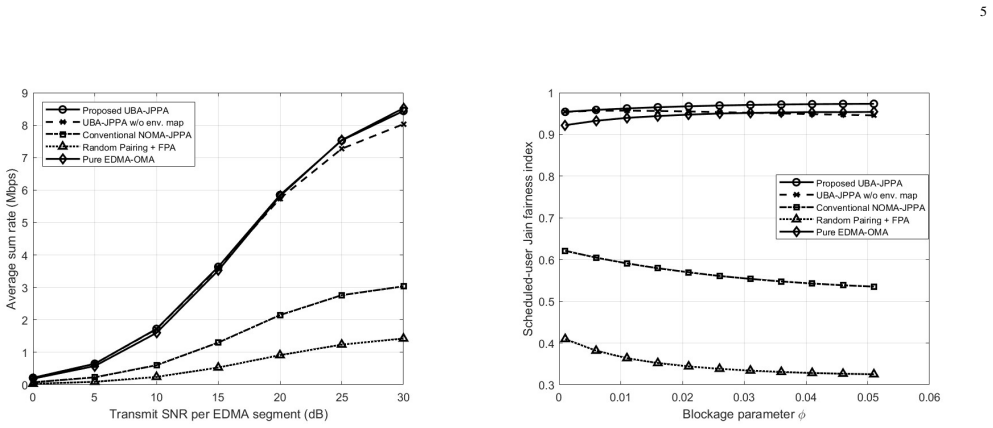
By constructing an average effective large-scale channel gain from path loss and the exponential LoS blockage model, the environment map affects both service links and interference links, allowing the utility-based joint user-pairing and power-allocation algorithm to jointly optimize sum rate and scheduled-user fairness under NOMA constraints and SIC-consistent rates.
What carries the argument
The utility-based joint user-pairing and power-allocation (UBA-JPPA) algorithm driven by the environment-map-aware average channel gains.
If this is right
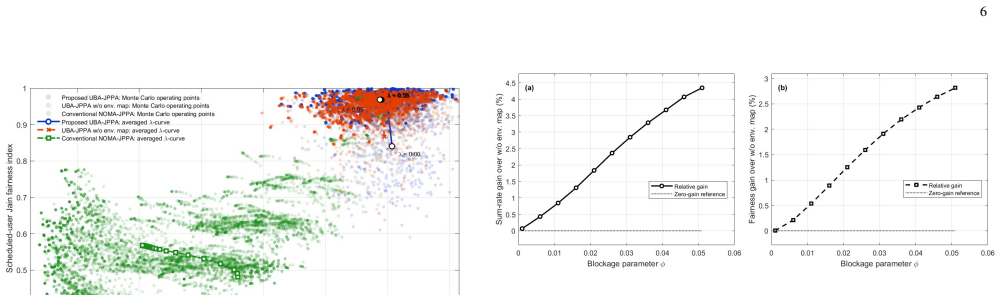
- The map-aware scheme raises sum rate relative to the no-map baseline.
- It raises the Jain fairness index among scheduled users.
- It enlarges the achievable throughput-fairness operating region.
- A strong EDMA-OMA benchmark remains competitive in certain high-SNR regimes.
Where Pith is reading between the lines
- Similar environment-map modeling could be tested in other multiple-access schemes that rely on spatial isolation.
- Accurate real-time environment maps would be needed for mobile users whose blockage conditions change.
- Dynamic updates to the map could further improve performance if blockage statistics vary over time.
Load-bearing premise
The exponential LoS blockage model combined with large-scale path loss produces an average effective channel gain that correctly captures environment effects on both desired service links and inter-region interference links.
What would settle it
Running the same simulations with and without the heterogeneous environment map and finding no consistent gains in sum rate or fairness would refute the claimed benefit of map awareness.
Figures

read the original abstract
Environment division multiple access (EDMA) exploits line-of-sight (LoS) availability, blockage diversity, and spatial isolation in the propagation environment to regulate inter-region interference, while non-orthogonal multiple access (NOMA) improves intra-region access efficiency through power-domain multiplexing and successive interference cancellation (SIC). This paper investigates heterogeneous environment-map-aware user matching and power allocation for pinching-antenna-assisted EDMA-NOMA systems. Based on large-scale path loss and an exponential LoS blockage model, an average LoS/NLoS effective large-scale channel gain is constructed, allowing the environment map to affect both desired service links and inter-region interference links. This avoids the overly optimistic assumption that environmental blockage only suppresses interference. A utility-based joint user-pairing and power-allocation algorithm (UBA-JPPA) is then proposed to jointly account for system throughput and the scheduled-user Jain fairness index under NOMA power constraints and an SIC-consistent rate definition. Simulation results show that, compared with the ablation baseline without a heterogeneous environment map, the proposed scheme provides consistent gains in sum rate, fairness, and the throughput--fairness operating region. Meanwhile, a strong EDMA-OMA benchmark remains competitive in some high-SNR regimes, indicating that the focus of this work is to verify the benefit of heterogeneous environment information for EDMA-NOMA resource allocation rather than to claim that NOMA universally outperforms OMA.
Editorial analysis
A structured set of objections, weighed in public.
Referee Report
Summary. The paper proposes an environment-map-aware joint user-pairing and power-allocation scheme for pinching-antenna-assisted EDMA-NOMA systems. It constructs an average LoS/NLoS effective large-scale channel gain from large-scale path loss and an exponential blockage model, applying this gain symmetrically to desired service links and inter-region interference links. A utility-based algorithm (UBA-JPPA) optimizes sum rate and Jain fairness under explicit NOMA power constraints and SIC-consistent rates. Simulations report consistent gains versus an ablation baseline that omits the heterogeneous environment map, while noting that a strong EDMA-OMA benchmark remains competitive at high SNR.
Significance. If the modeling and simulation results hold, the work provides concrete evidence that heterogeneous environment information improves EDMA-NOMA resource allocation in throughput, fairness, and the throughput-fairness trade-off. The symmetric treatment of blockage on both service and interference links avoids the common optimistic assumption that environment only suppresses interference. The explicit incorporation of NOMA power constraints and SIC rate definitions is a strength. The comparison to an EDMA-OMA benchmark usefully bounds the scope of the NOMA focus.
major comments (1)
- [Abstract (channel gain construction paragraph)] Abstract (channel gain construction paragraph): the exponential LoS blockage model combined with large-scale path loss is asserted to produce an average effective channel gain that correctly captures environment effects on both desired service links and inter-region interference links. This assumption is load-bearing for the ablation comparison and the claim of consistent gains; however, no explicit derivation or validation (e.g., against ray-tracing) is referenced to confirm that the averaging does not introduce differential bias between service and interference terms.
minor comments (2)
- The expansion of UBA-JPPA is given only once; subsequent references would benefit from consistent use of the full name or a clear acronym table.
- Simulation parameter settings (e.g., number of Monte Carlo realizations, exact path-loss exponents, blockage parameters) are referenced in the abstract but should be tabulated with explicit values for reproducibility.
Simulated Author's Rebuttal
We thank the referee for the constructive review and positive assessment of the work's significance. We address the major comment below.
read point-by-point responses
-
Referee: Abstract (channel gain construction paragraph): the exponential LoS blockage model combined with large-scale path loss is asserted to produce an average effective channel gain that correctly captures environment effects on both desired service links and inter-region interference links. This assumption is load-bearing for the ablation comparison and the claim of consistent gains; however, no explicit derivation or validation (e.g., against ray-tracing) is referenced to confirm that the averaging does not introduce differential bias between service and interference terms.
Authors: We agree that an explicit derivation of the average effective channel gain is not provided in the current manuscript. The model applies the identical large-scale path-loss expression and exponential blockage probability to every link, with the blockage parameter drawn from the environment map specific to that link; this construction is symmetric by definition and therefore applies the same averaging operation to both desired service links and inter-region interference links without introducing differential bias. In the revised manuscript we will insert a concise derivation (including the closed-form averaging step) into Section II-B and add a short remark confirming the symmetry. While a ray-tracing validation would further strengthen the modeling claim, it lies outside the scope of the present algorithmic contribution; the exponential blockage model is a standard approximation already employed in the environment-aware communications literature. revision: yes
Circularity Check
No significant circularity identified
full rationale
The paper's core modeling step constructs an average LoS/NLoS effective large-scale channel gain from large-scale path loss plus an exponential blockage model, then applies this gain symmetrically to desired links and inter-region interference links. This construction is presented as an explicit modeling choice that avoids an optimistic assumption about blockage effects. Performance claims rest on simulation comparisons between the full environment-map-aware scheme and an ablation baseline that removes the heterogeneous map; these comparisons do not reduce by the paper's own equations to quantities fitted from the same data or to self-citations. No load-bearing step matches any of the enumerated circularity patterns, and the derivation remains self-contained against external simulation benchmarks.
Axiom & Free-Parameter Ledger
free parameters (1)
- NOMA power allocation constraints
axioms (1)
- domain assumption Exponential LoS blockage model and large-scale path loss produce accurate average effective channel gains for both desired and interference links
Reference graph
Works this paper leans on
-
[1]
Non-orthogonal multiple access (NOMA) for cellular future radio access,
Y . Saito, Y . Kishiyama, A. Benjebbour, T. Nakamura, A. Li, and K. Higuchi, “Non-orthogonal multiple access (NOMA) for cellular future radio access,” inProc. IEEE 77th V ehicular Technology Con- ference (VTC Spring), Dresden, Germany, Jun. 2013, pp. 1–5, doi: 10.1109/VTCSpring.2013.6692652
-
[2]
A. Benjebbour, Y . Saito, Y . Kishiyama, A. Li, A. Harada, and T. Nakamura, “Concept and practical considerations of non-orthogonal multiple access (NOMA) for future radio access,” inProc. International Symposium on Intelligent Signal Processing and Communication Sys- tems (ISPACS), Naha, Japan, Nov. 2013, pp. 770–774, doi: 10.1109/IS- PACS.2013.6704653
work page doi:10.1109/is- 2013
-
[3]
On the performance of non-orthogonal multiple access in 5G systems with randomly deployed users,
Z. Ding, Z. Yang, P. Fan, and H. V . Poor, “On the performance of non-orthogonal multiple access in 5G systems with randomly deployed users,”IEEE Signal Processing Letters, vol. 21, no. 12, pp. 1501–1505, Dec. 2014, doi: 10.1109/LSP.2014.2343971
-
[4]
Nonorthogonal multiple access for 5G and beyond,
Y . Liu, Z. Qin, M. Elkashlan, Z. Ding, A. Nallanathan, and L. Hanzo, “Nonorthogonal multiple access for 5G and beyond,”Proceed- ings of the IEEE, vol. 105, no. 12, pp. 2347–2381, Dec. 2017, doi: 10.1109/JPROC.2017.2768666
-
[5]
Power-domain non-orthogonal multiple access (NOMA) in 5G sys- tems: Potentials and challenges,
S. M. R. Islam, N. Avazov, O. A. Dobre, and K. S. Kwak, “Power-domain non-orthogonal multiple access (NOMA) in 5G sys- tems: Potentials and challenges,”IEEE Communications Surveys & Tutorials, vol. 19, no. 2, pp. 721–742, Secondquarter 2017, doi: 10.1109/COMST.2016.2621116
-
[6]
Fairness for non-orthogonal multiple access in 5G systems,
S. Timotheou and I. Krikidis, “Fairness for non-orthogonal multiple access in 5G systems,”IEEE Signal Processing Letters, vol. 22, no. 10, pp. 1647–1651, Oct. 2015, doi: 10.1109/LSP.2015.2417119
-
[7]
A primer on near-field communications for next-generation multiple access,
C. Ouyang, Z. Wang, Y . Chen, X. Mu, and P. Zhu, “A primer on near-field communications for next-generation multiple access,”Pro- ceedings of the IEEE, vol. 112, no. 9, pp. 1527–1565, Sept. 2024, doi: 10.1109/JPROC.2024.3436513
-
[8]
Flexible-antenna systems: A pinching-antenna perspective,
Z. Ding, R. Schober, and H. V . Poor, “Flexible-antenna systems: A pinching-antenna perspective,”arXiv preprint arXiv:2412.02376, 2024. [Online]. Available: https://arxiv.org/abs/2412.02376
arXiv 2024
-
[9]
Antenna activation for NOMA assisted pinching-antenna systems,
K. Wang, Z. Ding, and R. Schober, “Antenna activation for NOMA assisted pinching-antenna systems,”IEEE Wireless Commu- nications Letters, vol. 14, no. 5, pp. 1526–1530, May 2025, doi: 10.1109/LWC.2025.3548280
-
[10]
Waveguide division multiple access for pinching-antenna systems (PASS),
J. Zhao, X. Mu, K. Cai, Y . Zhu, and Y . Liu, “Waveguide division multiple access for pinching-antenna systems (PASS),” arXiv preprint arXiv:2502.17781, 2025. [Online]. Available: https://arxiv.org/abs/2502.17781
arXiv 2025
-
[11]
Environment division multiple access (EDMA): A feasibility study via pinching anten- nas,
Z. Ding, R. Schober, and H. V . Poor, “Environment division multiple access (EDMA): A feasibility study via pinching anten- nas,”arXiv preprint arXiv:2511.03820, 2025. [Online]. Available: https://arxiv.org/abs/2511.03820
arXiv 2025
-
[12]
T. S. Rappaport,Wireless Communications: Principles and Practice, 2nd ed. Upper Saddle River, NJ, USA: Prentice Hall, 2002
2002
-
[13]
Study on channel model for frequencies from 0.5 to 100 GHz,
3GPP, “Study on channel model for frequencies from 0.5 to 100 GHz,” 3GPP TR 38.901, version 16.1.0, Release 16, Dec. 2019
2019
-
[14]
Coverage and rate analysis for millimeter-wave cellular networks,
T. Bai and R. W. Heath, Jr., “Coverage and rate analysis for millimeter-wave cellular networks,”IEEE Transactions on Wireless Communications, vol. 14, no. 2, pp. 1100–1114, Feb. 2015, doi: 10.1109/TWC.2014.2364267
-
[15]
C. E. Shannon, “A mathematical theory of communication,”Bell Sys- tem Technical Journal, vol. 27, no. 3, pp. 379–423, Jul. 1948, doi: 10.1002/j.1538-7305.1948.tb01338.x
-
[16]
T. M. Cover and J. A. Thomas,Elements of Information Theory, 2nd ed. Hoboken, NJ, USA: Wiley, 2006
2006
-
[17]
A quantitative measure of fairness and discrimination for resource allocation in shared computer systems,
R. Jain, D.-M. Chiu, and W. R. Hawe, “A quantitative measure of fairness and discrimination for resource allocation in shared computer systems,” DEC Research Report TR-301, Eastern Research Laboratory, Digital Equipment Corporation, Hudson, MA, USA, Sept. 1984
1984
-
[18]
Boyd and L
S. Boyd and L. Vandenberghe,Convex Optimization. Cambridge, U.K.: Cambridge University Press, 2004
2004
discussion (0)
Sign in with ORCID, Apple, or X to comment. Anyone can read and Pith papers without signing in.