RODS: Reward-Driven Online Data Synthesis for Multi-Turn Tool-Use Agents
Pith reviewed 2026-06-26 20:53 UTC · model grok-4.3
The pith
RODS detects shifting capability boundaries via rollout reward variance and synthesizes matching multi-turn variants to train tool-use agents from a small dynamic pool.
A machine-rendered reading of the paper's core claim, the machinery that carries it, and where it could break.
Core claim
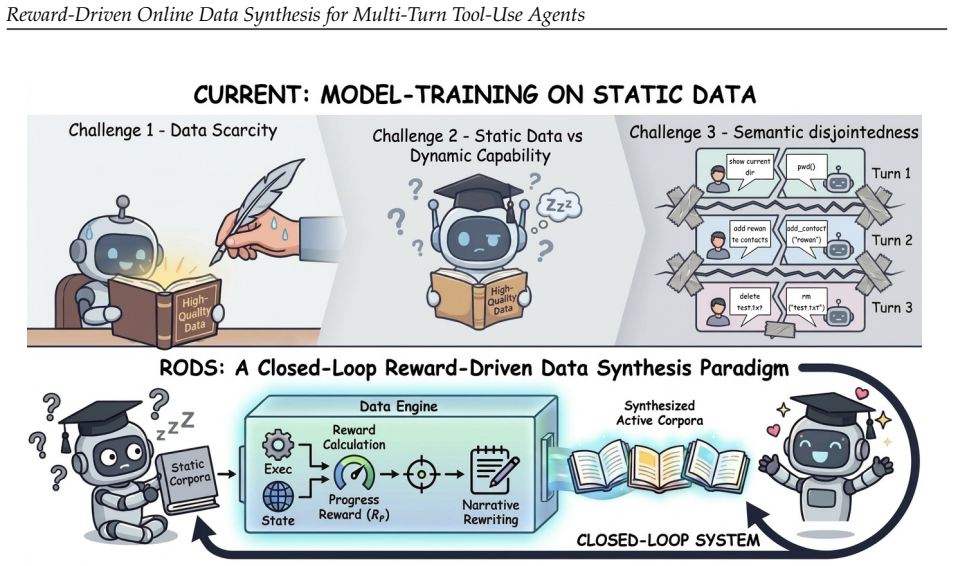
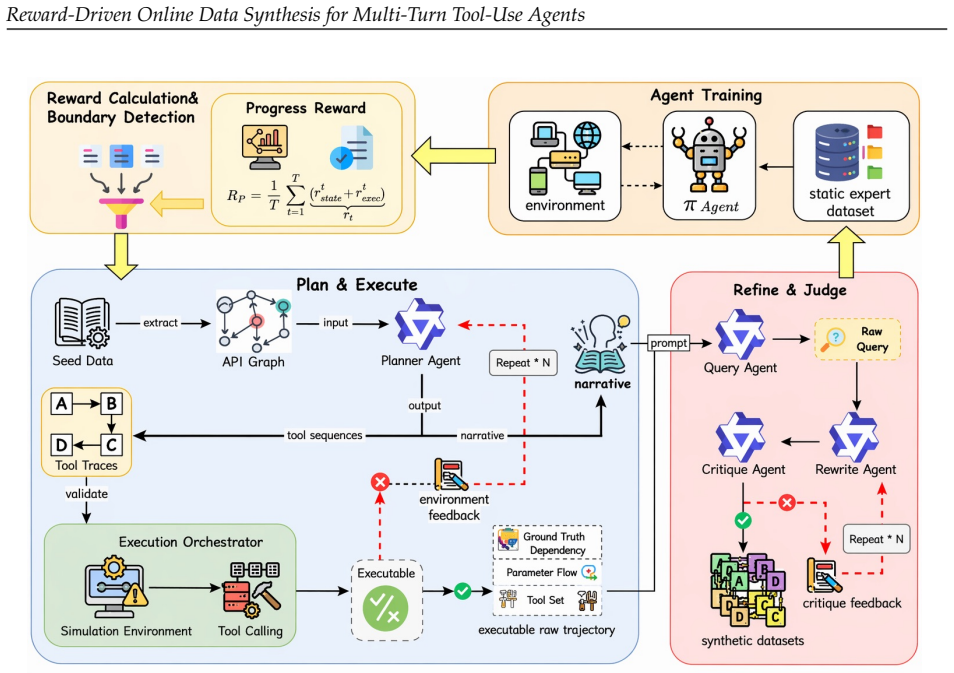
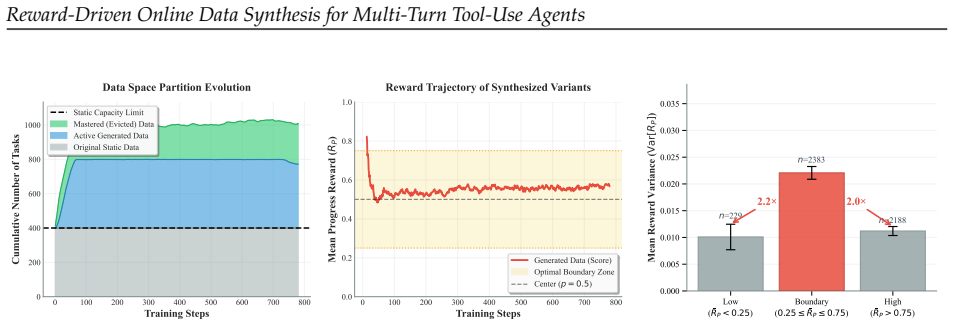
RODS closes the loop between RL training and data generation by repurposing the progress reward variance as a zero-cost boundary detector that requires no extra inference beyond the rollouts already computed for training. It continuously identifies samples near the agent's capability boundary, synthesizes new multi-turn variants matching their structural complexity via a skill-aligned resampling pipeline, and manages a dynamic replay buffer that co-evolves with the policy. Starting from 400 human seeds and maintaining an active training pool of approximately 800 samples, RODS achieves comparable performance to a 17K-sample offline pipeline while requiring roughly 20x fewer trajectories.
What carries the argument
The reward-driven online data synthesis loop that uses observed reward variance from training rollouts to select boundary samples and then applies skill-aligned resampling to produce new multi-turn tasks of matching API topology and dependency depth.
If this is right
- A small initial set of human demonstrations can seed a training process that expands the data pool in step with the policy's progress.
- The total number of trajectories needed for training drops by a factor of roughly twenty compared with a large static dataset while reaching similar final performance.
- The method outperforms both purely fixed-data reinforcement learning and non-adaptive environment augmentation under the same controlled conditions.
- The active pool size stays near 800 samples even as the policy improves, because new boundary tasks replace those that have become too easy or too hard.
Where Pith is reading between the lines
- The same variance-driven selection could be applied to other reinforcement-learning settings where task difficulty shifts, such as multi-step planning or interactive environments.
- If the resampling preserves complexity distributions accurately, the approach could lower the human annotation burden for training agents that use external tools.
- Integration with algorithms other than GRPO that also emphasize high-variance samples might further reduce the data required for policy improvement.
Load-bearing premise
Reward variance observed in training rollouts reliably marks the moving capability boundary, and the resampling step can produce new tasks whose structural complexity matches the originals without adding bias or extra inference cost.
What would settle it
An experiment that replaces the variance-based selection with random selection of the same number of tasks and shows no performance difference, or that measures structural complexity metrics and finds the synthesized tasks deviate systematically from the human seeds.
Figures

read the original abstract
Multi-turn tool-use RL is bottlenecked by the rapid depletion of informative samples in static datasets. We observe that the gradient signal in GRPO concentrates on tasks with the highest rollout reward variance, a consequence of the Popoviciu upper bound. Consequently, samples near the agent's capability boundary -- where successes and failures are roughly balanced -- contribute disproportionately large policy gradients. As training progresses, this boundary continuously shifts, which gradually depletes the pool of informative samples in a static dataset. We propose RODS (Reward-driven Online Data Synthesis) to resolve this depletion. RODS closes the loop between RL training and data generation by repurposing the progress reward variance as a practical, zero-cost boundary detector that requires no extra inference beyond the rollouts already computed for training. It continuously identifies such boundary samples, synthesizes new multi-turn variants matching their structural complexity (e.g., API topology and dependency depth) via a skill-aligned resampling pipeline, and manages a dynamic replay buffer that co-evolves with the policy. Starting from 400 human seeds and maintaining an active training pool of ~800 samples, RODS achieves comparable performance to a 17K-sample offline pipeline while requiring roughly 20x fewer trajectories, and improves over fixed-data RL and environment augmentation in our controlled setting.
Editorial analysis
A structured set of objections, weighed in public.
Referee Report
Summary. The paper proposes RODS (Reward-Driven Online Data Synthesis) for multi-turn tool-use RL agents. It observes that GRPO gradients concentrate on high reward-variance tasks near the capability boundary (via the Popoviciu upper bound), which depletes in static datasets as the boundary shifts. RODS repurposes rollout variance as a zero-cost detector to identify boundary samples, synthesizes new multi-turn variants via skill-aligned resampling that matches structural complexity (API topology, dependency depth), and maintains a dynamic replay buffer. Starting from 400 human seeds and an active pool of ~800 samples, it claims performance parity with a 17K-sample offline pipeline using ~20x fewer trajectories while outperforming fixed-data RL and environment augmentation.
Significance. If the central empirical claims are substantiated, the work offers a practical mechanism to mitigate data depletion in multi-turn tool-use RL by dynamically targeting informative samples without additional inference cost. The reuse of existing variance statistics for boundary detection is a low-overhead contribution. The approach could reduce reliance on large curated datasets, but its validity rests on unverified properties of the synthesis step.
major comments (2)
- [Abstract] Abstract: The headline claim of comparable performance to a 17K-sample offline pipeline with ~20x fewer trajectories (while maintaining an active pool of ~800 samples) is presented without any experimental details, ablation results, error bars, baseline definitions, or controls for confounders such as task difficulty or data distribution shifts. This renders the quantitative result impossible to evaluate.
- [Abstract] Abstract: The skill-aligned resampling pipeline is stated to produce new multi-turn variants whose structural complexity (API topology and dependency depth) matches the human seeds, yet no quantitative comparison, statistics, or validation measurements are supplied. This assumption is load-bearing for the claim that gains arise from accurate boundary targeting rather than from changes in the data distribution induced by synthesis.
Simulated Author's Rebuttal
We thank the referee for the detailed and constructive feedback. We address each major comment below. We agree that the abstract would benefit from greater self-containment and will revise it to reference key experimental details and validation results from the main text.
read point-by-point responses
-
Referee: [Abstract] Abstract: The headline claim of comparable performance to a 17K-sample offline pipeline with ~20x fewer trajectories (while maintaining an active pool of ~800 samples) is presented without any experimental details, ablation results, error bars, baseline definitions, or controls for confounders such as task difficulty or data distribution shifts. This renders the quantitative result impossible to evaluate.
Authors: We agree that the abstract presents the headline claim without sufficient experimental context. The main manuscript details the experimental setup, including baseline definitions (fixed-data RL, environment augmentation, and the 17K offline pipeline), ablation studies, error bars from multiple random seeds, and controls for task difficulty and distribution shifts (Sections 4–5). To address the concern, we will revise the abstract to briefly note that the result holds under controlled experiments with reported error bars and ablations, directing readers to the main text for full specifications. revision: yes
-
Referee: [Abstract] Abstract: The skill-aligned resampling pipeline is stated to produce new multi-turn variants whose structural complexity (API topology and dependency depth) matches the human seeds, yet no quantitative comparison, statistics, or validation measurements are supplied. This assumption is load-bearing for the claim that gains arise from accurate boundary targeting rather than from changes in the data distribution induced by synthesis.
Authors: We acknowledge that the abstract does not supply quantitative validation for the structural matching. The full manuscript provides these measurements, including distributional comparisons of API topology and dependency depth between human seeds and synthesized samples (Section 3.2, with accompanying tables and figures showing close alignment). We will revise the abstract to include a concise reference to this validation (e.g., noting that complexity metrics were matched within reported tolerances), thereby clarifying that the performance gains are not attributable to unintended distribution shifts. revision: yes
Circularity Check
No significant circularity; variance detector reuses existing rollout statistics without self-referential fitting or definition
full rationale
The paper's chain begins with an observation about GRPO gradients concentrating on high-variance tasks (via Popoviciu bound), then directly repurposes the same per-sample variance computed during training rollouts as a boundary detector. This reuse is zero-cost and non-fitted; no parameter is optimized against the target performance metric. The subsequent skill-aligned resampling pipeline is presented as an independent generation step whose structural-matching claim is external to the variance equations. No self-citation chain, ansatz smuggling, or renaming of known results is load-bearing. The headline efficiency result is therefore an empirical outcome, not a definitional tautology.
Axiom & Free-Parameter Ledger
axioms (1)
- domain assumption The gradient signal in GRPO concentrates on tasks with the highest rollout reward variance, a consequence of the Popoviciu upper bound.
Reference graph
Works this paper leans on
-
[1]
Loading the latesttracker.jsonto recover PromptTracker historical windows
-
[2]
Replaying allexpanded_*.jsonlfiles to rebuild the list of generated data
-
[3]
This guarantees zero data loss across restart boundaries and lets the curriculum resume where it was interrupted
Deterministically recomputing the data retirement logic from stored metrics. This guarantees zero data loss across restart boundaries and lets the curriculum resume where it was interrupted. B.5 Motivating Analysis: Gradient Variance at the Capability Boundary We present the analysis motivating our boundary-targeting design heuristic. Specifically, we est...
-
[4]
Select functions that test similar skills to the seed task (e.g., if the seed requires multi-step parameter passing, your plan should also require it)
-
[5]
HIGH-LEVEL functions are preferred when available – they produce richer, multi-step call sequences after decomposition
-
[6]
Each turn should have 1-3 functions from the SAME class
-
[7]
For multi-class seeds, alternate classes across turns (e.g., Turn 1: ClassA, Turn 2: ClassB, Turn 3: ClassA)
-
[8]
Output 2-5 turns total
-
[9]
Closed”→“Open
Ensure the sequence is logically coherent (e.g., authenticate before posting, fill fuel before driving) 14 Reward-Driven Online Data Synthesis for Multi-Turn Tool-Use Agents # Output Format First, analyze the seed task and plan your approach inside <reason></reason> tags. Then output a brief narrative scenario (2-3 sentences) inside<narrative>tags. Finall...
-
[10]
Accurately describes what the GT function calls do (without mentioning function names)
-
[11]
Sounds like a real user talking to an AI assistant
-
[12]
Is semantically coherent with the narrative scenario
-
[13]
Does NOT contain special characters that could cause parsing issues
-
[14]
IMPORTANT: Output exactly{num_turns}queries, one for each turn
For turns with multiple function calls, the query should naturally imply all of them # Output Format Output each query inside<query>tags, one per turn: <query>Turn 1 user query here</query> <query>Turn 2 user query here</query> . . . IMPORTANT: Output exactly{num_turns}queries, one for each turn. C.4 Quality Judge Agent The Quality Judge validates synthes...
-
[15]
Query-GT Alignment: Does each user query accurately describe what the GT function calls do?
-
[16]
State Consistency: Do parameter values reflect the actual environment config?
-
[17]
Cross-Turn Coherence: Is there logical state progression across turns?
-
[18]
Query Naturalness: Do queries sound like real user requests?
-
[19]
Thought Process
Structural Correctness: Are deliberate ambiguities (e.g., missing parameters) properly reflected? 17 Reward-Driven Online Data Synthesis for Multi-Turn Tool-Use Agents # Automatic Rejection Patterns If the query contains any of these patterns, REJECT immediately: • “Thought Process”, “Construct Query”, “Step 1:”, “Step 2:” • Function names or parameter na...
-
[20]
It naturally and accurately describes what the GT function calls actually do
-
[21]
It sounds like a real user talking to an AI assistant
-
[22]
It does NOT mention function names, parameter names, or technical details
-
[23]
It does NOT contain special characters that could cause parsing issues
-
[24]
The pipeline processes each turn sequentially through the following stages:
It fixes the specific issue described above # Output Format Output ONLY the rewritten query inside<answer>tags: <answer>your rewritten query here</answer> D Deterministic Execution Pipeline Internals The Stage II execution pipeline instantiates the abstract plan within a Python-based sandbox environment that faithfully replicates the training environment’...
-
[25]
HIGH-LEVEL functions are automatically decomposed into sequences of BOTTOM-LEVEL API calls
Function Sampling:Given the Planner’s output specifying which functions to call per turn, the pipeline samples concrete function instances from the available catalog. HIGH-LEVEL functions are automatically decomposed into sequences of BOTTOM-LEVEL API calls
-
[26]
Parameter Generation:For each selected function, an LLM generates concrete parameter values condi- tioned on the function schema, the current environment state Ct, and any dependencies from previous turns
-
[27]
The VM maintains a complete environment state (file systems, account balances, database entries, etc.) and returns execution results or error messages
VM Execution:The parameterized function call is executed against the sandbox VM. The VM maintains a complete environment state (file systems, account balances, database entries, etc.) and returns execution results or error messages
-
[28]
Query Generation:A per-class LLM prompt generates a natural user query that describes the function call’s intent without exposing function names or parameters
-
[29]
Use BOTTOM-LEVEL functions only
Query Verification:A verification LLM checks whether the generated query’s semantics align with the GT function calls, rejecting queries that are misaligned or contain data generation artifacts. If any stage fails, a structured error is recorded with the error type, failing function, turn number, and diagnostic detail. This structured error feeds directly...
-
[30]
Patches are accumulated across retries via recursive deep-merge, where later patches override earlier ones for the same field but coexist for different fields
Environment Config Patching:If the error type is patchable (param_gen_failed,vm_exec_failed,func_- sample_failed, or decompose_failed), the Config Patch Agent (Appendix C.2) analyzes the initial envi- ronment configuration and outputs structured XML patches to update the state. Patches are accumulated across retries via recursive deep-merge, where later p...
-
[31]
Use BOTTOM-LEVEL functions only
Action Space Pruning:Simultaneously, the names of all functions involved in failures are extracted and added to a cumulative blocklist. On re-invocation, the Planner Agent receives: (a) the full failure history with structured error descriptions, (b) a list of specifically blocked function names, and (c) error- type-specific guidance (e.g., “Use BOTTOM-LE...
2025
discussion (0)
Sign in with ORCID, Apple, or X to comment. Anyone can read and Pith papers without signing in.