Spin Identification of Dark Sector Mediators through Angular Distributions
Pith reviewed 2026-06-26 19:56 UTC · model grok-4.3
The pith
An angular observable from decay four-momenta distinguishes vector from scalar dark mediators.
A machine-rendered reading of the paper's core claim, the machinery that carries it, and where it could break.
Core claim
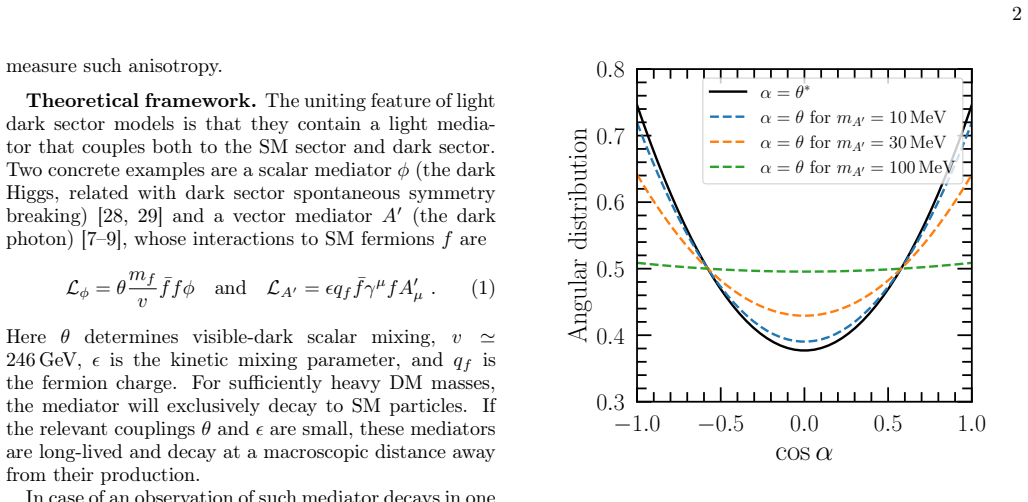
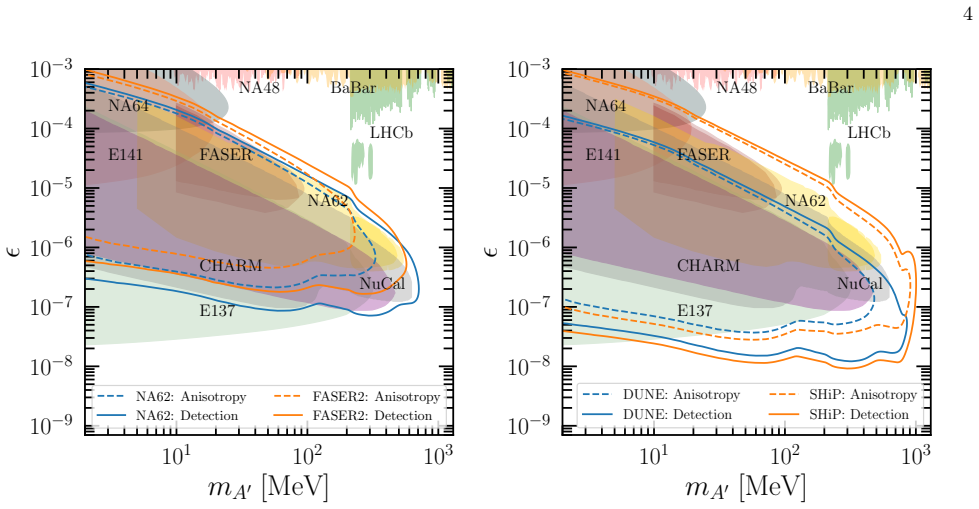
We identify an angular observable, reconstructible solely from the decay products' four-momenta, that exhibits an anisotropic distribution for vector bosons from light meson decays and an isotropic distribution for scalars. Searches at DUNE, SHiP and FASER2 will be able to identify the mediator spin in sizable regions of yet unconstrained parameter space.
What carries the argument
The angular observable constructed solely from the four-momenta of the decay products, which is anisotropic for vectors and isotropic for scalars when the mediator arises from two-body light-meson decays.
If this is right
- Spin identification becomes possible in displaced-decay searches without additional model-dependent corrections beyond the production channel.
- The same observable applies across sizable portions of the currently unconstrained parameter space for light long-lived particles.
- Experiments can move from discovery to quantum-number determination using only the visible decay kinematics already recorded in the search.
Where Pith is reading between the lines
- The approach could be tested first on existing or near-term data sets from fixed-target runs that already target similar meson-decay channels.
- If the observable remains robust under modest changes in production mechanism, it might extend to other long-lived particle searches at colliders.
- Similar four-momentum-only constructions could be explored for parity or other discrete quantum numbers once spin is fixed.
Load-bearing premise
The mediator is produced dominantly via two-body decays of light mesons with couplings that let the angular distribution be computed directly from the visible four-momenta.
What would settle it
Data from DUNE, SHiP or FASER2 showing an isotropic angular distribution for a vector-mediator hypothesis (or anisotropic for a scalar) in the mass and lifetime range where the two-body meson-decay channel dominates would falsify the claimed distinction.
Figures
read the original abstract
A variety of experiments are operating or planned to search for displaced decays of light long-lived dark sector particles. In case such a state is discovered, the next step is determining its quantum numbers. We identify an angular observable, reconstructible solely from the decay products' four-momenta, that exhibits an anisotropic distribution for vector bosons from light meson decays and an isotropic distribution for scalars. We demonstrate that searches at DUNE, SHiP and FASER2 will be able to identify the mediator spin in sizable regions of yet unconstrained parameter space.
Editorial analysis
A structured set of objections, weighed in public.
Referee Report
Summary. The manuscript proposes an angular observable, constructed solely from the four-momenta of decay products, that is claimed to be anisotropic for vector dark-sector mediators produced in two-body decays of light mesons and isotropic for scalars. It argues that displaced-decay searches at DUNE, SHiP and FASER2 possess sufficient statistics and kinematic reach to determine the mediator spin over sizable regions of currently unconstrained parameter space.
Significance. If the central kinematic construction and experimental projections hold, the result supplies a concrete, four-momentum-only handle on the spin of a newly discovered long-lived state. This would be a useful addition to the dark-sector phenomenology toolkit, complementing rate-based and lifetime-based measurements. The approach is attractive because it avoids explicit model-dependent matrix-element fitting once the production channel is fixed.
major comments (2)
- [Abstract and production section] The spin-discriminating power rests on the premise that production occurs dominantly via two-body decays of light mesons (π, K) under couplings that fix the polarization and permit reconstruction of the angular distribution from four-momenta alone. The manuscript must quantify the dilution or distortion introduced by multi-body production channels, feed-down, or alternative coupling structures; without this, the claimed discrimination at DUNE/SHiP/FASER2 does not follow.
- [Abstract] No explicit definition of the angular observable, no derivation of its distribution for vector versus scalar cases, and no Monte-Carlo or analytic treatment of detector acceptance or backgrounds appear in the provided abstract. The full text must supply the functional form (e.g., the cosine variable and its expected density) together with the statistical criterion used to claim spin identification, as these are load-bearing for the experimental reach statements.
minor comments (1)
- Clarify the precise definition of the observable (e.g., which combination of four-momenta) and state any assumptions on the mediator mass relative to the parent meson.
Simulated Author's Rebuttal
We thank the referee for the careful review and constructive feedback. We address each major comment below and will revise the manuscript accordingly to strengthen the presentation and robustness of the results.
read point-by-point responses
-
Referee: [Abstract and production section] The spin-discriminating power rests on the premise that production occurs dominantly via two-body decays of light mesons (π, K) under couplings that fix the polarization and permit reconstruction of the angular distribution from four-momenta alone. The manuscript must quantify the dilution or distortion introduced by multi-body production channels, feed-down, or alternative coupling structures; without this, the claimed discrimination at DUNE/SHiP/FASER2 does not follow.
Authors: The manuscript focuses on two-body meson decays as the dominant production channel under the couplings considered, which fix the mediator polarization. We will add quantitative estimates of the relative rates and resulting dilution from multi-body channels and feed-down in the revised version, demonstrating that the angular observable retains sufficient discriminating power over the relevant unconstrained parameter space at the cited experiments. revision: yes
-
Referee: [Abstract] No explicit definition of the angular observable, no derivation of its distribution for vector versus scalar cases, and no Monte-Carlo or analytic treatment of detector acceptance or backgrounds appear in the provided abstract. The full text must supply the functional form (e.g., the cosine variable and its expected density) together with the statistical criterion used to claim spin identification, as these are load-bearing for the experimental reach statements.
Authors: The full manuscript derives the angular observable (reconstructed from four-momenta) and presents its distributions (anisotropic for vectors, isotropic for scalars) along with the statistical criterion for identification. We will revise the abstract to explicitly state the functional form, the expected distributions, and the identification method. Any additional Monte Carlo details on acceptance will be highlighted or expanded in the main text as needed. revision: yes
Circularity Check
No circularity: kinematic observable derived independently from four-momenta
full rationale
The paper identifies an angular observable constructed solely from the four-momenta of decay products, yielding anisotropic distributions for vectors and isotropic ones for scalars based on standard spin-dependent decay kinematics. This is a direct kinematic construction, not defined in terms of itself or fitted to the target discrimination. Production via two-body light-meson decays is stated as an explicit model premise required for the observable's applicability, rather than derived from the observable. No equations reduce the claimed discrimination at DUNE/SHiP/FASER2 to a self-citation chain, fitted input, or ansatz smuggled via prior work; the derivation remains self-contained against external benchmarks of particle kinematics.
Axiom & Free-Parameter Ledger
Reference graph
Works this paper leans on
-
[1]
M. Pospelov, A. Ritz, and M. B. Voloshin, “Secluded WIMP Dark Matter,”Phys. Lett. B662(2008) 53–61, arXiv:0711.4866 [hep-ph]
Pith/arXiv arXiv 2008
-
[2]
The Low-Energy Frontier of Particle Physics,
J. Jaeckel and A. Ringwald, “The Low-Energy Frontier of Particle Physics,”Ann. Rev. Nucl. Part. Sci.60 (2010) 405–437,arXiv:1002.0329 [hep-ph]
Pith/arXiv arXiv 2010
-
[3]
CP Conservation in the Presence of Instantons,
R. D. Peccei and H. R. Quinn, “CP Conservation in the Presence of Instantons,”Phys. Rev. Lett.38(1977) 1440–1443
1977
-
[4]
A New Light Boson?,
S. Weinberg, “A New Light Boson?,”Phys. Rev. Lett. 40(1978) 223–226
1978
-
[5]
Problem of StrongPandTInvariance in the Presence of Instantons,
F. Wilczek, “Problem of StrongPandTInvariance in the Presence of Instantons,”Phys. Rev. Lett.40(1978) 279–282
1978
-
[6]
Axions and Family Symmetry Breaking,
F. Wilczek, “Axions and Family Symmetry Breaking,” Phys. Rev. Lett.49(1982) 1549–1552
1982
-
[7]
Limits of Electrodynamics: Paraphotons?,
L. B. Okun, “Limits of Electrodynamics: Paraphotons?,”Sov. Phys. JETP56(1982) 502
1982
-
[8]
Two U(1)’s and Epsilon Charge Shifts,
B. Holdom, “Two U(1)’s and Epsilon Charge Shifts,” Phys. Lett. B166(1986) 196–198
1986
-
[9]
Gauge Coupling Renormalization With Several U(1) Factors,
F. del Aguila, G. D. Coughlan, and M. Quiros, “Gauge Coupling Renormalization With Several U(1) Factors,” Nucl. Phys. B307(1988) 633. [Erratum: Nucl.Phys.B 312, 751 (1989)]
1988
-
[10]
Exploring Portals to a Hidden Sector Through Fixed Targets,
B. Batell, M. Pospelov, and A. Ritz, “Exploring Portals to a Hidden Sector Through Fixed Targets,”Phys. Rev. D80(2009) 095024,arXiv:0906.5614 [hep-ph]
Pith/arXiv arXiv 2009
-
[11]
A facility to Search for Hidden Particles at the CERN SPS: the SHiP physics case,
S. Alekhinet al., “A facility to Search for Hidden Particles at the CERN SPS: the SHiP physics case,” Rept. Prog. Phys.79no. 12, (2016) 124201, arXiv:1504.04855 [hep-ph]. [12]NA62Collaboration, E. Cortina Gilet al., “The Beam and detector of the NA62 experiment at CERN,” JINST12no. 05, (2017) P05025,arXiv:1703.08501 [physics.ins-det]. [13]COHERENTCollabor...
Pith/arXiv arXiv 2016
-
[12]
ForwArd Search ExpeRiment at the LHC,
J. L. Feng, I. Galon, F. Kling, and S. Trojanowski, “ForwArd Search ExpeRiment at the LHC,”Phys. Rev. D97no. 3, (2018) 035001,arXiv:1708.09389 [hep-ph]. [18]FASERCollaboration, A. Arigaet al., “FASER’s physics reach for long-lived particles,”Phys. Rev. D99 no. 9, (2019) 095011,arXiv:1811.12522 [hep-ph]. [19]FASERCollaboration, H. Abreuet al., “The FASER d...
Pith/arXiv arXiv 2018
-
[14]
Scientific program for the Forward Physics Facility,
J. Adhikaryet al., “Scientific program for the Forward Physics Facility,”Eur. Phys. J. C85no. 4, (2025) 430, arXiv:2411.04175 [hep-ex]. [23]FPF Working GroupsCollaboration, L. A. Anchordoquiet al., “The Forward Physics Facility at the Large Hadron Collider,” 3, 2025.arXiv:2503.19010 [hep-ex]. [24]CODEX-bCollaboration, G. Aielliet al., “Expression of inter...
arXiv 2025
-
[15]
Sensitivity to sub-GeV dark matter in forthcoming spallation-source neutrino experiments,
D. Aristizabal Sierra, V. De Romeri, D. K. Papoulias, and G. Sanchez Garcia, “Sensitivity to sub-GeV dark matter in forthcoming spallation-source neutrino experiments,”arXiv:2603.02132 [hep-ph]
-
[16]
Spin Correlations in Dark Photon Searches,
J. L. Feng, M. Toman, and E. Welch, “Spin Correlations in Dark Photon Searches,”arXiv:2508.18352 [hep-ph]
-
[17]
Secluded U(1) below the weak scale,
M. Pospelov, “Secluded U(1) below the weak scale,” Phys. Rev. D80(2009) 095002,arXiv:0811.1030 [hep-ph]
Pith/arXiv arXiv 2009
-
[18]
Higgs-field portal into hidden sectors,
B. Patt and F. Wilczek, “Higgs-field portal into hidden sectors,”arXiv:hep-ph/0605188
-
[19]
EPOS LHC: Test of collective hadronization with data measured at the CERN Large Hadron Collider,
T. Pierog, I. Karpenko, J. M. Katzy, E. Yatsenko, and K. Werner, “EPOS LHC: Test of collective hadronization with data measured at the CERN Large Hadron Collider,”Phys. Rev. C92no. 3, (2015) 034906, arXiv:1306.0121 [hep-ph]
Pith/arXiv arXiv 2015
-
[20]
Forward experiment sensitivity estimator for the LHC and future hadron colliders,
F. Kling and S. Trojanowski, “Forward experiment sensitivity estimator for the LHC and future hadron colliders,”Phys. Rev. D104no. 3, (2021) 035012, arXiv:2105.07077 [hep-ph]
arXiv 2021
-
[21]
Searches for Decays of New Particles in the DUNE Multi-Purpose Near Detector,
J. M. Berryman, A. de Gouvea, P. J. Fox, B. J. Kayser, K. J. Kelly, and J. L. Raaf, “Searches for Decays of New Particles in the DUNE Multi-Purpose Near Detector,” JHEP02(2020) 174,arXiv:1912.07622 [hep-ph]
arXiv 2020
-
[22]
Bdf/ship annual report 2025,
H.-E. P. T. SHiP Collaboration, “Bdf/ship annual report 2025,” 2025.https://cds.cern.ch/record/ 2948477/files/SPSC-SR-370.pdf
2025
-
[23]
Faser2: Detector, design and performance,
O. Salin, A. Barr, J. McFayden,et al., “Faser2: Detector, design and performance,” 2025. https://cds.cern.ch/record/2927003/files/FASER2% 20Dectector%20Perfomance%20Note.pdf. [35]NA62Collaboration, E. Cortina Gilet al., “Search for Leptonic Decays of Dark Photons at NA62,”Phys. Rev. Lett.133no. 11, (2024) 111802,arXiv:2312.12055 [hep-ex]. [36]NA64Collabor...
arXiv 2025
-
[24]
Probing millicharged particles with NA64 experiment at CERN,
S. N. Gninenko, D. V. Kirpichnikov, and N. V. Krasnikov, “Probing millicharged particles with NA64 experiment at CERN,”Phys. Rev. D100no. 3, (2019) 035003,arXiv:1810.06856 [hep-ph]
arXiv 2019
-
[25]
Limits on neutral light scalar and pseudoscalar particles in a proton beam dump experiment,
J. Blumlein, F. Brunner, E. M. Drobyshevski,et al., “Limits on neutral light scalar and pseudoscalar particles in a proton beam dump experiment,”Z. Phys. C51(1991) 341–350
1991
-
[26]
New exclusion limits for dark gauge forces from beam-dump data,
J. Blumlein and J. Brunner, “New exclusion limits for dark gauge forces from beam-dump data,”Phys. Lett. B 701(2011) 155–159,arXiv:1104.2747 [hep-ex]. [42]CHARMCollaboration, F. Bergsmaet al., “Search for axion like particle production in 400 gev proton-copper interactions,”Phys. Lett. B157(1985) 458–462
Pith/arXiv arXiv 2011
-
[27]
Search for neutral metastable penetrating particles produced in the slac beam dump,
J. D. Bjorkenet al., “Search for neutral metastable penetrating particles produced in the slac beam dump,” Phys. Rev. D38(1988) 3375
1988
-
[28]
Strong constraints on sub-gev dark sectors from slac beam dump e137,
B. Batell, R. Essig, and Z. Surujon, “Strong constraints on sub-gev dark sectors from slac beam dump e137,” Phys. Rev. Lett.113(2014) 171802,arXiv:1406.2698 [hep-ph]. [45]FASERCollaboration, H. Abreuet al., “Search for dark photons with the FASER detector at the LHC,” Phys. Lett. B848(2024) 138378,arXiv:2308.05587 [hep-ex]. [46]FASERCollaboration, R. Mamm...
Pith/arXiv arXiv 2014
-
[29]
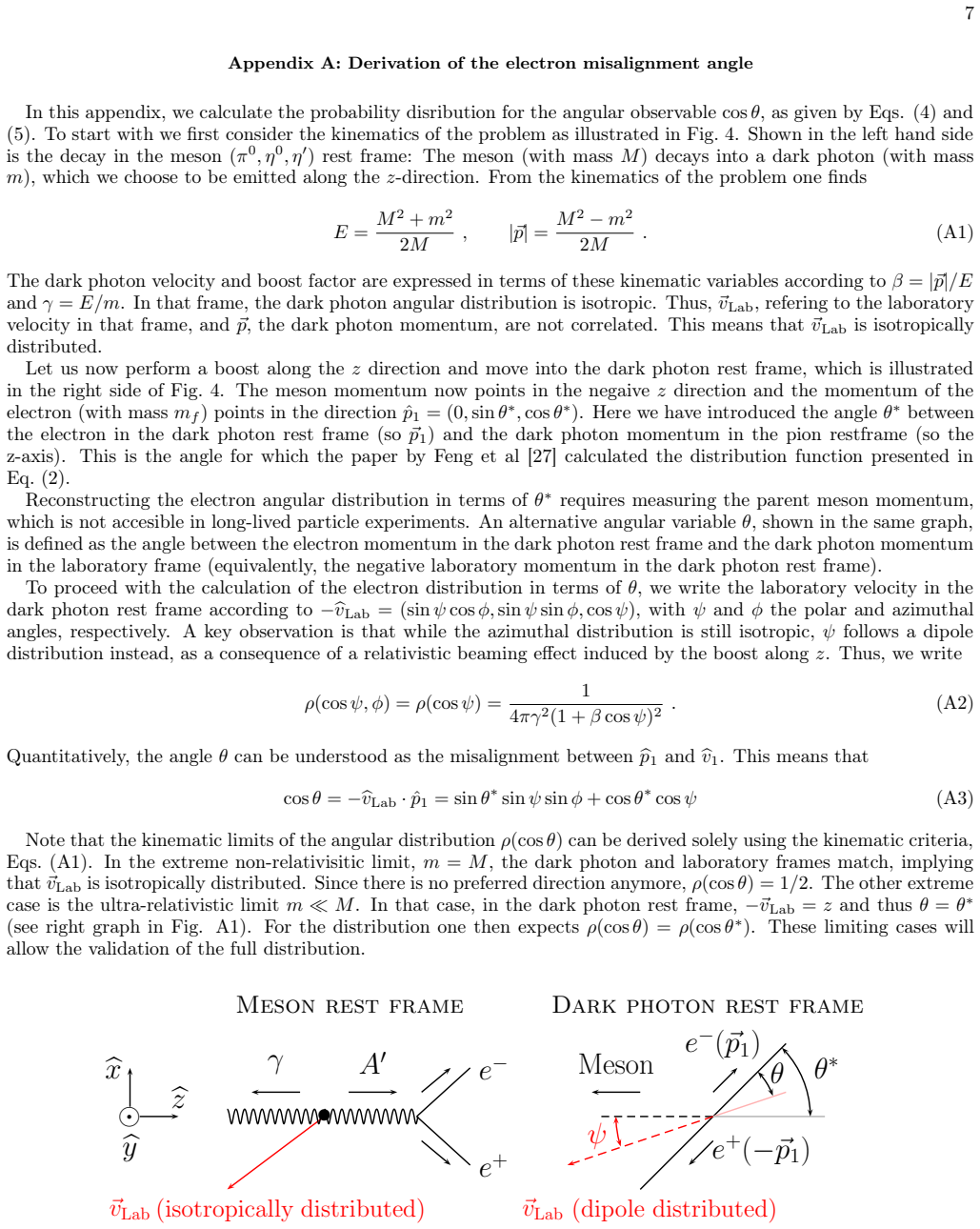
In that limit, the distribution in (A2) reduces to1/4π
Special CaseM=m Let us, for a moment, consider the special case in whichm=M(soβ= 0andγ= 1). In that limit, the distribution in (A2) reduces to1/4π. In this case we find ρ(v) = Z ρ(u)du 2π Z 1 −1 Θ[(1−u 2)(1−v 2)−(t−uv) 2]p (1−u 2)(1−v 2)−(t−uv) 2 dt= Z ρ(u)du 2π Z s(t=1) s(t=−1) Θ[1−s 2]√ 1−s 2 ds .(A8) Here we introduceds= (t−uv)/ p (1−u 2)(1−v 2). One c...
-
[30]
tan−1 s √ A2 −B 2 A+Bs !#1 −1 . (A14) Using the relationtan−1(x)−tan −1(y) = tan−1((x−y)/(1 +xy)), the term in brackets turns out to be
General Case Let us go back to the general case dictated by Eq. (A2) without further assumptions. We can write ρ(v) = Z ρ(u)du 2πγ 2 Z 1 −1 1 (1 +βt) 2 Θ[(1−u 2)(1−v 2)−(t−uv) 2]p (1−u 2)(1−v 2)−(t−uv) 2 dt .(A11) In terms of the variablesused in the Sec. A1 and the argument on the integration boundaries, we obtain ρ(v) = Z ρ(u)du 2πγ 2 Z 1 −1 1 (A+Bs) 2 ...
discussion (0)
Sign in with ORCID, Apple, or X to comment. Anyone can read and Pith papers without signing in.