Multi-Equalization in Conceptual Density Functional Theory: Beyond Electronegativity Equalization
Pith reviewed 2026-06-26 18:35 UTC · model grok-4.3
The pith
Multi-equalization extends electronegativity equalization to higher-order descriptors by treating molecules as flexible density partitions that satisfy simultaneous equalization of hardness and Fukui indices.
A machine-rendered reading of the paper's core claim, the machinery that carries it, and where it could break.
Core claim
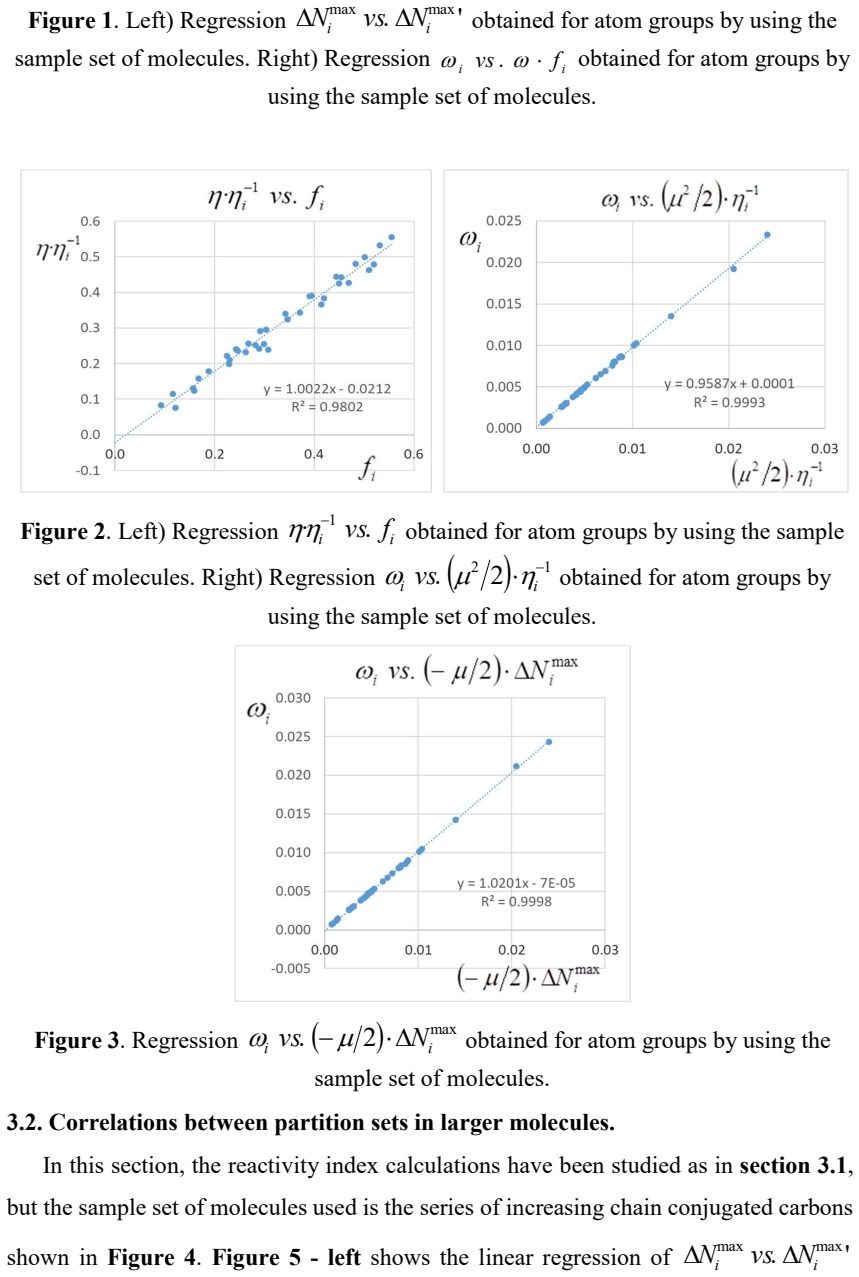
Correlations between energy and density derivatives with respect to the number of electrons produce simultaneous equalization of chemical hardness and Fukui indices that can be satisfied by a single set of density partitions; the inclusion of density response functions further enables local hardness equalization, so that local reactivity descriptors become constrained functionals of the global electron density.
What carries the argument
Multi-equalization, the framework that uses flexible electron density partitions to enforce simultaneous equalization of multiple reactivity descriptors via correlations in their energy and density derivatives.
If this is right
- Local reactivity descriptors become constrained functionals of the global electron density.
- A constructive algorithm locates the optimal density partitions that meet all multi-equalization conditions.
- Density response functions produce local hardness equalization and therefore spatial resolution in reactivity.
- The scheme supplies a consistent description of both global charge transfer and local reactivity.
Where Pith is reading between the lines
- The same partition-search procedure could be applied to larger systems to test whether multi-equalization improves site-selectivity predictions over standard electronegativity equalization.
- Because the equalizations rest on derivative correlations, the framework might be combined with existing linear-response DFT codes to generate the required higher-order kernels automatically.
- If the partitions prove transferable across related molecules, multi-equalization could serve as a parameter-free route to reactivity indices for entire chemical series.
Load-bearing premise
Correlations between energy and density derivatives with respect to electron number necessarily produce simultaneous equalization of multiple descriptors that a single set of density partitions can satisfy.
What would settle it
A numerical search over density partitions for a test molecule that finds no solution simultaneously equalizing both chemical hardness and Fukui indices.
Figures
read the original abstract
The electronegativity equalization principle provides a simple framework to describe charge redistribution, yet its conventional formulation is limited to a first-order description based on chemical potential equalization. In this work, we introduce 'multi-equalization,' a generalized framework that extends this concept by incorporating higher-order responses within Conceptual Density Functional Theory. This approach represents molecules as sets of flexible electron density partitions, allowing different electronic descriptions (e.g., atomic densities or localized orbitals) to be treated within a unified formalism. We demonstrate that correlations between energy and density derivatives with respect to the number of electrons lead to the simultaneous equalization of multiple descriptors, including chemical hardness and Fukui indices. A constructive algorithm is introduced to determine the optimal density partitions satisfying these multi-equalization conditions. This scheme provides a consistent description of both global charge transfer and local reactivity, overcoming the intrinsic limitations of traditional electronegativity equalization models. Notably, the inclusion of density response functions enables local hardness equalization, introducing spatial resolution into reactivity descriptions. Under multi-equalization, local reactivity descriptors become constrained functionals of the global electron density. This framework establishes a deeper connection between charge equalization models and formal density functional theory, offering a theoretically grounded route toward improved predictions of molecular reactivity.
Editorial analysis
A structured set of objections, weighed in public.
Referee Report
Summary. The manuscript introduces a 'multi-equalization' framework in Conceptual Density Functional Theory that generalizes the electronegativity equalization principle by incorporating higher-order responses. Molecules are represented as sets of flexible electron density partitions; the central claim is that correlations between energy and density derivatives with respect to electron number produce simultaneous equalization of multiple descriptors (chemical hardness and Fukui indices), which a constructive algorithm can satisfy, rendering local reactivity descriptors constrained functionals of the global electron density and providing spatial resolution via local hardness equalization.
Significance. If the claimed correlations and algorithm are rigorously derived and shown to be consistent, the framework could strengthen the link between phenomenological charge-equalization models and formal CDFT, offering a route to unified global-local reactivity descriptions. The use of flexible partitions to unify atomic densities and localized orbitals is a potentially useful conceptual step, though its practical advantage over existing CDFT response-function approaches remains to be demonstrated.
major comments (3)
- [Abstract] Abstract: the assertion that 'correlations between energy and density derivatives with respect to the number of electrons lead to the simultaneous equalization of multiple descriptors, including chemical hardness and Fukui indices' is presented without any explicit correlation functions, response kernels, or derivation showing why the second-order hardness kernel and first-order Fukui function are guaranteed to equalize under the same partition parameters.
- [Abstract] Abstract: the constructive algorithm is stated to 'determine the optimal density partitions satisfying these multi-equalization conditions,' yet no equations, convergence criteria, or proof of existence/uniqueness are supplied; this step is load-bearing for the claim that a single set of partitions can simultaneously satisfy the distinct orders of response without additional constraints or loss of consistency.
- [Abstract] Abstract: the statement that 'under multi-equalization, local reactivity descriptors become constrained functionals of the global electron density' follows directly from the unshown multi-equalization conditions; without the explicit functional dependence or the partition optimization equations, the assertion cannot be evaluated.
Simulated Author's Rebuttal
We thank the referee for their careful reading and constructive comments. We address each major comment below. The abstract is a high-level summary, and we agree it can be improved by adding brief references to the detailed derivations in the main text; we will make partial revisions to the abstract accordingly.
read point-by-point responses
-
Referee: [Abstract] Abstract: the assertion that 'correlations between energy and density derivatives with respect to the number of electrons lead to the simultaneous equalization of multiple descriptors, including chemical hardness and Fukui indices' is presented without any explicit correlation functions, response kernels, or derivation showing why the second-order hardness kernel and first-order Fukui function are guaranteed to equalize under the same partition parameters.
Authors: The abstract summarizes the central result; the explicit correlation functions, response kernels, and derivations establishing simultaneous equalization of the hardness kernel and Fukui function under shared partition parameters are given in Sections 3 and 4 of the main text. We will revise the abstract to include a short clause directing readers to these sections for the supporting analysis. revision: partial
-
Referee: [Abstract] Abstract: the constructive algorithm is stated to 'determine the optimal density partitions satisfying these multi-equalization conditions,' yet no equations, convergence criteria, or proof of existence/uniqueness are supplied; this step is load-bearing for the claim that a single set of partitions can simultaneously satisfy the distinct orders of response without additional constraints or loss of consistency.
Authors: The constructive algorithm, including its defining equations, convergence criteria, and discussion of existence and uniqueness, is fully specified in Section 5. We will revise the abstract to note that the algorithm and its properties are derived and demonstrated in the manuscript body. revision: partial
-
Referee: [Abstract] Abstract: the statement that 'under multi-equalization, local reactivity descriptors become constrained functionals of the global electron density' follows directly from the unshown multi-equalization conditions; without the explicit functional dependence or the partition optimization equations, the assertion cannot be evaluated.
Authors: The functional dependence follows from the multi-equalization conditions and partition optimization derived in Sections 3–5. We will revise the abstract to indicate that this consequence is established by the explicit equations and optimization procedure presented in the main text. revision: partial
Circularity Check
No circularity: new multi-equalization framework presented without reduction to self-definition or fitted inputs
full rationale
The provided abstract introduces multi-equalization as an extension of electronegativity equalization incorporating higher-order CDFT responses. It asserts that correlations between energy/density derivatives w.r.t. N lead to simultaneous equalization of hardness and Fukui indices, solved via a constructive algorithm for density partitions. No equations, self-citations, or prior-author uniqueness theorems are quoted that would make the central claim (local descriptors as constrained functionals of global density) equivalent to its inputs by construction. The algorithm is presented as determining partitions that satisfy the conditions rather than presupposing them. This is a standard case of a self-contained proposal with no load-bearing circular steps visible; the existence claim is an assertion to be tested externally rather than a definitional tautology.
Axiom & Free-Parameter Ledger
Reference graph
Works this paper leans on
-
[1]
R. T. Sanderson, An Interpretation of Bond Lengths and a Classification of Bonds. SCIENCE 1951 vol 114 670-672
1951
-
[2]
G. Van Hooydonk and Z. Eeckhaut, On the Principle of Electronegativity Equalization and its Usein the Theory of the Chemical Bond. Berichte der Bunsengesellschaft für physikalische Chemie Vol 74, 4, 1970, 323-326 https://doi.org/10.1002/bbpc.19700740405
-
[3]
Calculation of bond energies in diatomic molecules
Van Hooydonk, G. Calculation of bond energies in diatomic molecules. Theoret. Chim. Acta 22, 157–166 (1971). https://doi.org/10.1007/BF00537624
-
[4]
R. T. Sanderson, Principles of Electronegativity, Journal of Chemical Education, 1988, Volume 65, Number 2, 112-118
1988
-
[5]
R. T. Sanderson. J. Chem. Educ. 1952, 29,539544,1954.31,2-7,238-245. 30
1952
-
[6]
R. G. Parr, L. J. Bartalotti, J. Am. Chem. Soc. 1982, 104, 3801-3803
1982
-
[7]
R. G. Parr, R. A. Donnelly, M. Levy, W. E. Palke, J. Chem. Phys. 1978, 68, 38013807
1978
-
[8]
R. G. Parr, In Electron Distributions and the Chemical Bond; P. Cappens,: Hall. M
-
[9]
Mullay, J. J. Am. Chem. Soc. 1984,106, 5842-5847. B.. Eds.; Pienun: NewYork, 1982; pp95-1W
1984
-
[10]
Oxford University Press
Parr R, Yang W (1989) Density-Functional Theory of Atoms and Molecules. Oxford University Press
1989
-
[12]
Phys Rev Lett 84:5172-5175
Yang WT, Zhang YK, Ayers PW (2000) Degenerate ground states and fractional number of electrons in density and reduced density matrix functional theory. Phys Rev Lett 84:5172-5175
2000
-
[13]
J Math Chem 43:285-303
Ayers PW (2008) The continuity of the energy and other molecular properties with respect to the number of electrons. J Math Chem 43:285-303
2008
-
[14]
Mulliken RS (1934) A New Electroaffinity Scale; Together with Data on Valence States and on Valence Ionization Potentials and Electron Affinities J. Chem. Phys. 2 :782
1934
-
[15]
Iczkowski RP, Margrave JL (1961) Electronegativity J. Am. Chem. Soc. 83:3547- 3551
1961
-
[16]
Sen KD, Jørgensen CK (1987) Electronegativity, Structure and Bonding (Springer, Berlin,
1987
-
[17]
Wiley-VCH, Weinheim,
Pearson RG (1997) Chemical Hardness: Applications from Molecules to Solids. Wiley-VCH, Weinheim,
1997
-
[18]
Geerlings P, De Proft F, Langenaeker W (2003) Conceptual Density Functional Theory. Chem. Rev. 103:1793-1874
2003
-
[19]
(1982) Density-functional theory for fractional particle number: derivative discontinuities of the energy
Perdew JP, Parr RG, Levy M, Balduz JL, Jr. (1982) Density-functional theory for fractional particle number: derivative discontinuities of the energy. Phys Rev Lett 49:1691-1694
1982
-
[20]
Phys Rev Lett 84:5172-5175 31
Yang WT, Zhang YK, Ayers PW (2000) Degenerate ground states and fractional number of electrons in density and reduced density matrix functional theory. Phys Rev Lett 84:5172-5175 31
2000
-
[21]
Parr RG, Szentpaly LV, Liu SB (1999) Electrophilicity Index. J. Am. Chem. Soc. 121:1922-1924
1999
-
[22]
In: Chattaraj PK (ed) Chemical reactivity theory: A density functional view
Liu SB (2009) Electrophilicity. In: Chattaraj PK (ed) Chemical reactivity theory: A density functional view. Taylor and Francis, Boca Raton, p 179
2009
-
[23]
Annual Reports of Progress in Chemistry C 105:13-39
Chattaraj PK, Giri S (2009) Electrophilicity index within a conceptual DFT framework. Annual Reports of Progress in Chemistry C 105:13-39
2009
-
[24]
Chem Rev 106:2065-2091
Chattaraj PK, Sarkar U, Roy DR (2006) Electrophilicity index. Chem Rev 106:2065-2091
2006
-
[25]
J Phys Chem A 107:4973-4975
Chattaraj PK, Maiti B, Sarkar U (2003) Philicity: A unified treatment of chemical reactivity and selectivity. J Phys Chem A 107:4973-4975
2003
-
[26]
Shubin Liu (2009) Chemical Reactivity Theory a Density Functional View, CRC Press, Chapter 13
2009
-
[27]
Sánchez-Márquez, V
J. Sánchez-Márquez, V. García, D. Zorrilla, M. Fernández. New insights in conceptual DFT: New model for the calculation of local reactivity indices based on the Sanderson's principle. Int J Quantum Chem. 2018; e25844
2018
-
[28]
New advances in conceptual-DFT: an alternative way to calculate the fukui function
Sánchez-Márquez, J. New advances in conceptual-DFT: an alternative way to calculate the fukui function. J. Mol. Mod. 2019, 25, 123
2019
-
[29]
Bond reactivity indices
J. Sánchez-Márquez. Introducing new reactivity descriptors: “Bond reactivity indices.” Comparison of the new definitions and atomic reactivity indices. J. Chem. Phys. 145, 194105 (2016)
2016
-
[30]
Draper Norman, H
R. Draper Norman, H. Smith, Applied Regression Analysis (third edition) Wiley series in Probability and Stadistics, John Wiley & Sons; ISBN: 0-471-17082-8
-
[31]
Sánchez-Márquez
J. Sánchez-Márquez. Correlations between Fukui Indices and Reactivity Descriptors. Based on Sanderson’s Principle. J. Phys. Chem. A 2019, 123, 8571−8582
2019
-
[32]
Jesús Sánchez-Márquez, David Zorrilla Cuenca, Manuel Fernández Núñez, Víctor García Hernández. Introducing a new model based on electronegativity equalization principle for the analysis of the natural bond orbital reactivity in the c-DFT background. Int J Quantum Chem. 2022; e26993. https://doi.org/10.1002/qua.26993 32
-
[33]
Density-functional thermochemistry
Becke, A.D. Density-functional thermochemistry. III The role of exact exchange. J. Chem. Phys. 1993, 98, 5648-52
1993
-
[34]
J., Pople, J
Frisch, M. J., Pople, J. A. and Binkley, J. S. Self-consistent molecular orbital methods. 25. Supplementary functions for gaussian basis sets. J. Chem. Phys. 1984, 80, 3265-3269
1984
-
[35]
Gaussian 16, Revision B.01, M. J. Frisch, G. W. Trucks, H. B. Schlegel, G. E. Scuseria, M. A. Robb, J. R. Cheeseman, G. Scalmani, V. Barone, G. A. Petersson, H. Nakatsuji, X. Li, M. Caricato, A. V. Marenich, J. Bloino, B. G. Janesko, R. Gomperts, B. Mennucci, H. P. Hratchian, J. V. Ortiz, A. F. Izmaylov, J. L. Sonnenberg, D. Williams-Young, F. Ding, F. Li...
2016
-
[36]
https://wiki.crc.nd.edu/w/images/d/d7/Gaussview-5-ref.pdf
Gauss View 5.0. https://wiki.crc.nd.edu/w/images/d/d7/Gaussview-5-ref.pdf
-
[37]
Zhurko G. A. Chemcraft - graphical program for visualization of quantum chemistry computations. Ivanovo, Russia, 2005. https://chemcraftprog.com
2005
-
[38]
and Martín-Calleja, J
Sánchez-Márquez, J., Zorrilla, D., Sánchez-Coronilla, A.M., de los Santos, D., Navas J., Fernández-Lorenzo, C., Alcántara, R. and Martín-Calleja, J. Introducing UCA-FUKUI software: reactivity-index calculations. J. Mol. Model. 2014, 20, 2492
2014
-
[39]
Cymerman-Craig, M
J. Cymerman-Craig, M. Moyle. Organic Syntheses Collective 4, 205 (1963)
1963
-
[40]
S. A. Heininger. Organic Syntheses Collective 4, 146 (1963)
1963
-
[41]
T. E. Snider, D. L. Morris, K. C. Srivastava, K. D. Berlin. Organic Syntheses Collective 6, 932 (1988)
1988
-
[42]
E. C. Horning, A. F. Finelli. Organic Syntheses Collective 4, 776 (1963)
1963
-
[43]
(2000), Calculation of atomic integration data
Biegler-König, F. (2000), Calculation of atomic integration data. J. Comput. Chem., 21: 1040-1048. 33 https://doi.org/10.1002/1096-987X(200009)21:12<1040::AID-JCC2>3.0.CO;2-8
-
[44]
Paul L. A. Popelier Fully Analytical Integration Over the 3D Volume Bounded by the β Sphere in Topological Atoms J. Phys. Chem. A, 115, 45, 13169–13179 (2011)
2011
-
[45]
Tian Lu, Feiwu Chen, Multiwfn: A Multifunctional Wavefunction Analyzer, J. Comput. Chem. 33, 580-592 (2012)
2012
-
[46]
Jesús Sánchez-Márquez, Himangshu Mondal, Shanti Gopal Patra, Alejandro Morales-Bayuelo, Pratim Kumar Chattaraj. Local reactivity descriptors of the important atoms in chelotropic reactions provide insight into their global variants along the reaction path. Int J Quantum Chem. e27129 (2023). https://doi.org/10.1002/qua.27129 34 Multi-Equalization in Concep...
-
[47]
i”. A.1.2. Local energy derivatives with regards to the total number of electrons. To calculate the energy derivatives i and i of the “i
Lagrange’s multipliers[27] were used to normalize the indices of Eq. (A1) and we obtained: MINIMUMfrdrfrf MINIMUMfrdrfrf orbitalsall i NBO i orbitalsall i NBO i NBO i orbitalsall i NBO i orbitalsall i NBO i NBO i 1 2 1 2 1 2 1 2 1 1 ...
-
[48]
Maximum local charge variations (obtained with a cubic expansion of the local energy) versus the maximum local charge variations (achieved with a quadratic expansion of the local charge variation): A) B) C) Figure S5. A) Linear regression of the maximum local charge variations (obtained with a cubic expansion of the local energy) versus the maximum local ...
-
[51]
Local i -1 values versus the maximum local charge variations: Figure S32. Lineal regression for local values i -1 versus the maximum local charge variations for the NHOs of the CH2CHCl molecule. Figure S33. Lineal regression for local values i -1 versus the maximum local charge variations for the NHOs of the CH2CHNH2 molecule. y = 7.4024x + 0.0006R² = ...
-
[52]
Maximum local charge variations (obtained with a cubic expansion of the local energy) versus the maximum local charge variations (achieved with a quadratic expansion of the local charge variation) for CMOs: A) B) C) Figure S41. Linear regression of the maximum local charge variations (obtained with a cubic expansion of the local energy) versus the maximum...
-
[53]
Local electrophilicities against local Fukui indices: Figure S50. Linear regression of local electrophilicities against local Fukui indices for the CMOs of the CH2CHCl molecule. Two outliers corresponding to CMOs 16 and 17 have been removed. Figure S51. Linear regression of local electrophilicities against local Fukui indices for the CMOs of the CH2CHNH2 ...
-
[54]
Lineal regression for local i -1 values versus the local Fukui indices for the CMOs of the CH2CHCl molecule
Local i -1 values versus the local Fukui indices: Figure S59. Lineal regression for local i -1 values versus the local Fukui indices for the CMOs of the CH2CHCl molecule. Two outliers corresponding to NBOs 16 and 17 have been removed. Figure S60. Lineal regression for local i -1 values versus the local Fukui indices for the CMOs of the CH2CHNH2 molecul...
-
[55]
Lineal regression for local values i -1 versus the maximum local charge variations for the CMOs of the CH2CHCl molecule
Local i -1 values versus the maximum local charge variations: Figure S68. Lineal regression for local values i -1 versus the maximum local charge variations for the CMOs of the CH2CHCl molecule. Two outliers corresponding to NBOs 16 and 17 have been removed. Figure S69. Lineal regression for local values i -1 versus the maximum local charge variations ...
discussion (0)
Sign in with ORCID, Apple, or X to comment. Anyone can read and Pith papers without signing in.