Enhancing the Detection Sensitivity of Primordial Parity Violation using Galaxy Spins
Pith reviewed 2026-06-26 16:37 UTC · model grok-4.3
The pith
Optimized selection of halos by mass and density raises detection sensitivity for primordial parity violation in spins.
A machine-rendered reading of the paper's core claim, the machinery that carries it, and where it could break.
Core claim
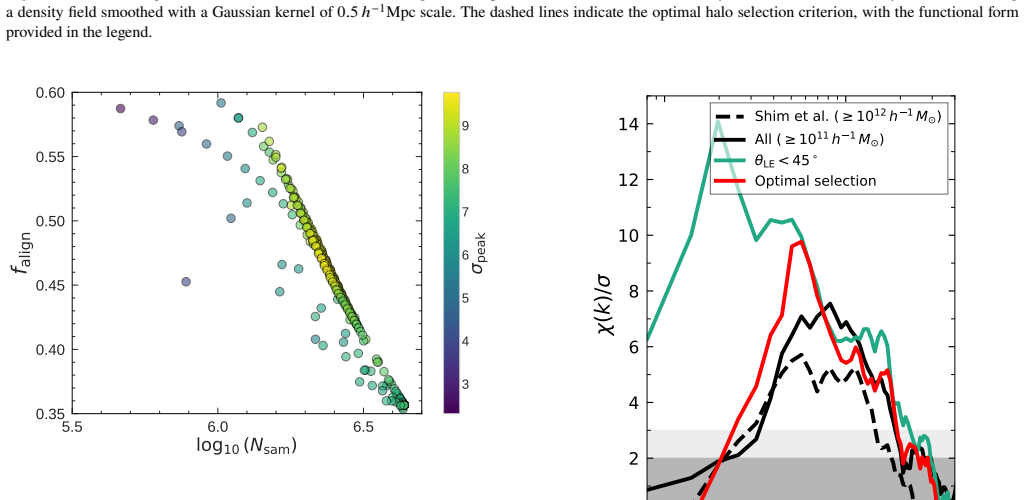
An optimized halo sample selected by mass and local density yields higher detection sensitivity for the primordial parity violation signal imprinted in halo spins than the full halo sample, despite its reduced size.
What carries the argument
The optimized halo selection strategy based on mass and local density, which filters the catalog to isolate the parity-violation imprint while discarding lower-signal objects.
If this is right
- The optimized halo sample produces a higher detection significance than the full sample despite containing fewer objects.
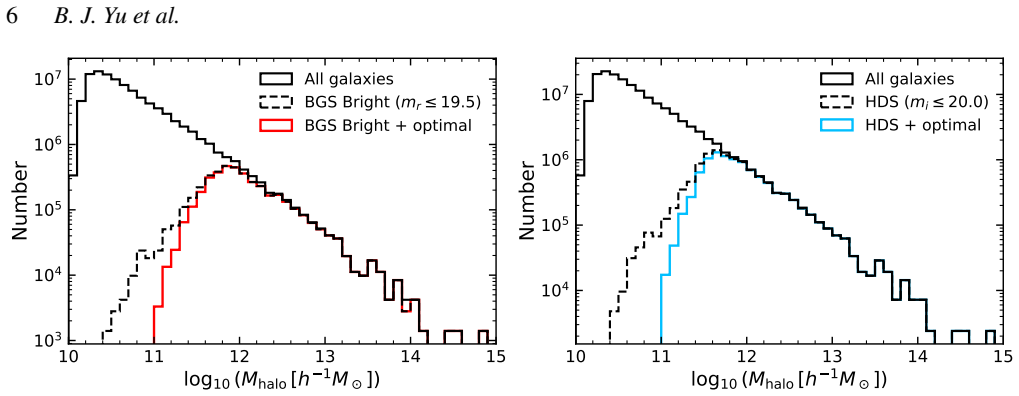
- Future spectroscopic surveys will contain enough galaxies for the enhanced selection to be applied in practice.
- Halo mass and local density cuts can be used to isolate the parity-violation signature more effectively than volume-limited or mass-limited catalogs alone.
Where Pith is reading between the lines
- If the enhanced signal is detected, it would offer a new route to constrain the amplitude of early-universe parity violation using existing and planned large-scale structure data.
- The same selection cuts might be tested on other spin-related observables, such as alignments with filaments, to cross-check the parity signal.
- Varying the parity-violation strength across multiple simulation suites could reveal how the optimal mass and density thresholds shift with the underlying model.
Load-bearing premise
The signature of primordial parity violation is imprinted in halo spins as previously demonstrated, and N-body simulations with parity-asymmetric initial conditions accurately capture this imprint without major contamination from other effects.
What would settle it
A measurement in real galaxy survey data showing that the optimized mass-and-density selection does not produce higher statistical significance for the parity-violation signal than the full sample would falsify the enhancement claim.
Figures
read the original abstract
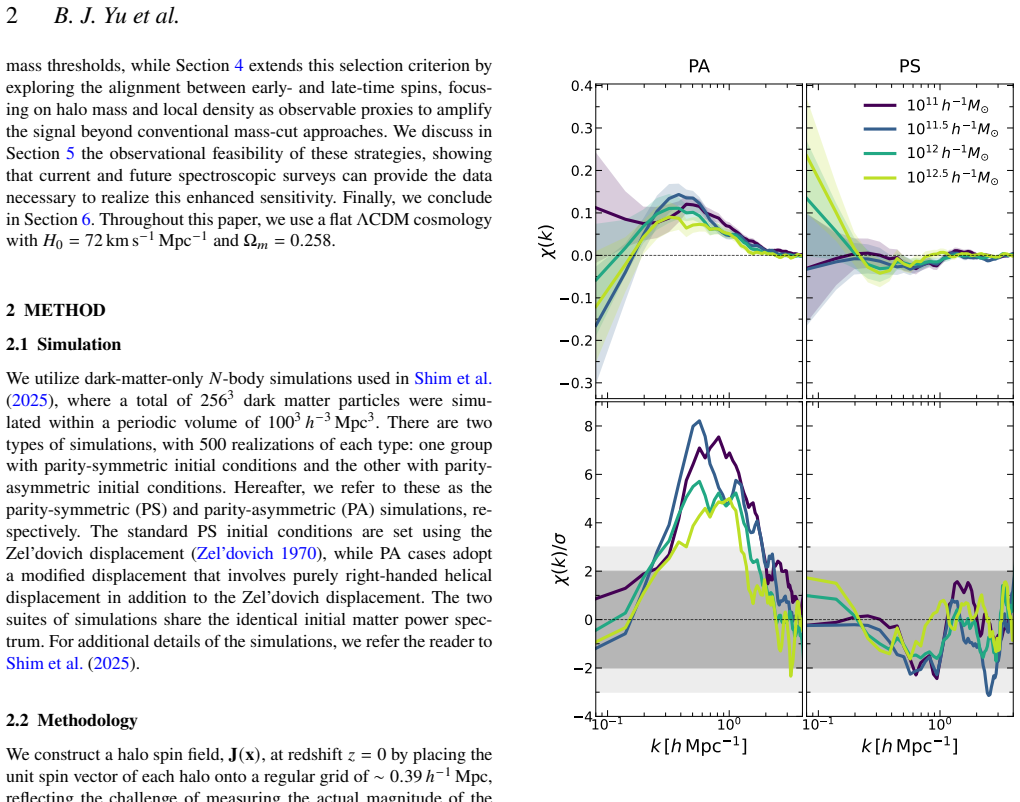
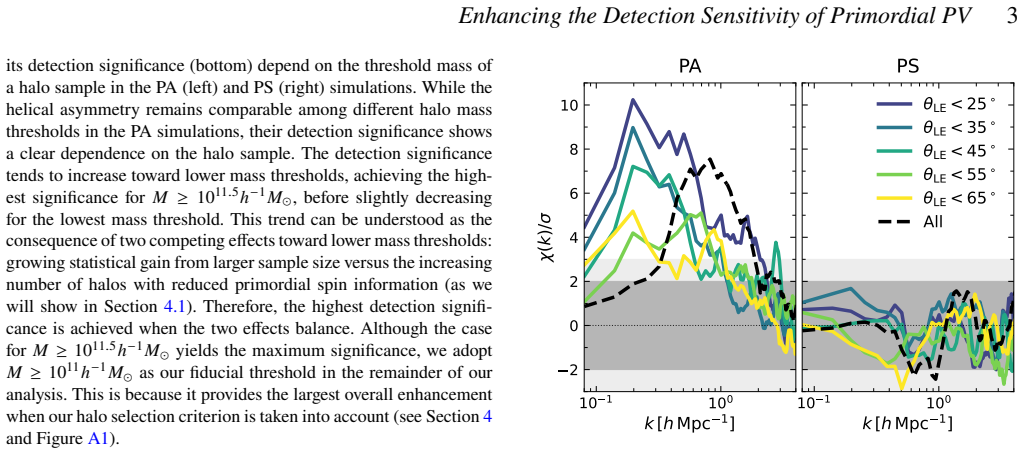
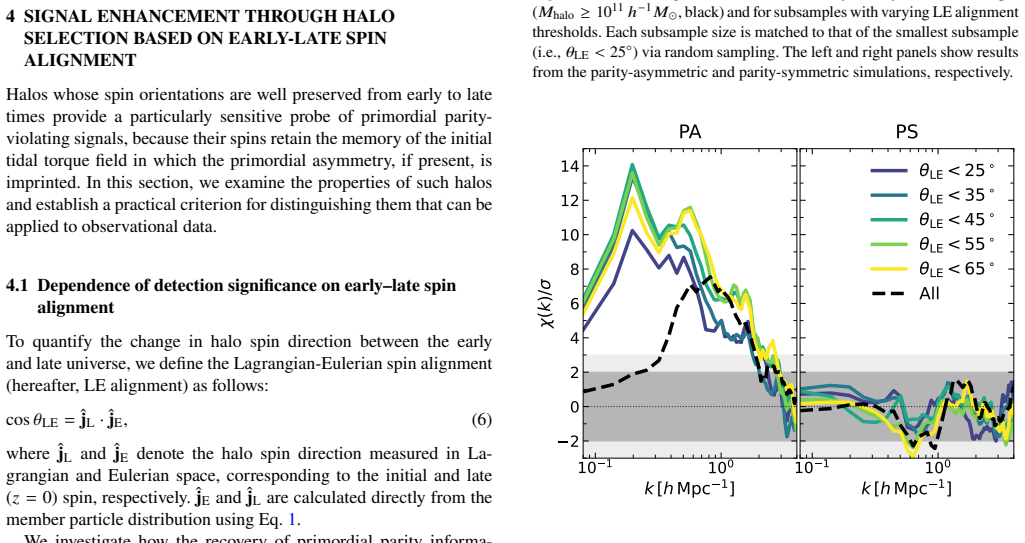
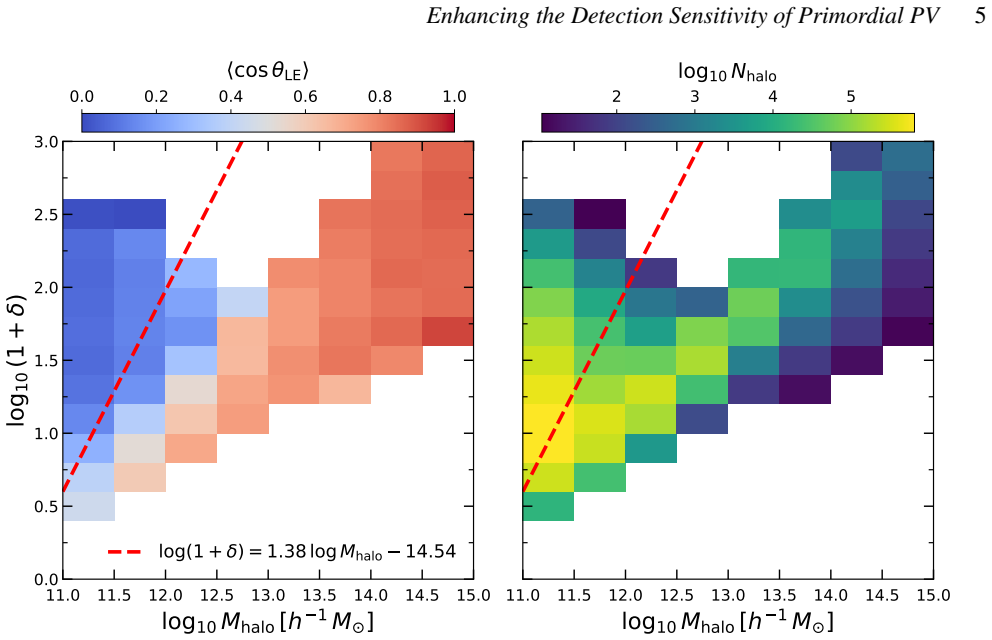
It has been recently demonstrated that the signature of primordial parity violation could be imprinted in halo spins, indicating its potential detectability through the late-time galaxy spin field (Shim et al. 2025). In this study, we develop an optimized halo selection strategy to enhance the detection significance of such a signal, focusing on halo mass and local density. Using N-body simulations with parity-asymmetric initial conditions, we show that the optimized halo sample allows for a higher detection sensitivity than the full halo sample, despite its reduced sample size. Finally, we assess the observational feasibility of our strategy and show that future spectroscopic surveys can provide sufficient data to realize this enhanced sensitivity.
Editorial analysis
A structured set of objections, weighed in public.
Referee Report
Summary. The manuscript claims that an optimized selection of halos based on mass and local density, derived from N-body simulations with parity-asymmetric initial conditions, yields higher detection sensitivity for the primordial parity-violation signal in halo spins than the full sample, despite the reduced sample size. It builds on the base signal identified in Shim et al. 2025 and concludes that future spectroscopic surveys can realize this enhanced sensitivity.
Significance. If the optimization result holds after proper validation, the work would provide a concrete, observationally feasible path to improve sensitivity to a potentially detectable primordial signal, which is a useful incremental contribution to the field of late-time probes of parity violation.
major comments (2)
- [Abstract and results summary] The central claim that the optimized sample yields higher detection sensitivity is presented without any quantitative results, error analysis, or simulation details in the abstract or summary sections; this prevents evaluation of whether the gain is statistically significant or physically meaningful and is load-bearing for the main result.
- [Optimization and simulation sections] The optimization procedure for mass and local-density thresholds appears to use the same N-body realizations both for tuning the selection and for computing the detection significance, with no mention of held-out test simulations, cross-validation across independent initial-condition seeds, or separate validation runs; this directly undermines the robustness of the reported sensitivity improvement.
minor comments (2)
- [Introduction] The reference to Shim et al. 2025 should be expanded with full bibliographic details and a brief recap of the base signal to make the manuscript self-contained.
- [Methods] Clarify the precise definition of 'local density' used for selection and how it is computed from the simulation outputs.
Simulated Author's Rebuttal
We thank the referee for their constructive comments, which help clarify the presentation and strengthen the robustness of our results. We address each major point below.
read point-by-point responses
-
Referee: [Abstract and results summary] The central claim that the optimized sample yields higher detection sensitivity is presented without any quantitative results, error analysis, or simulation details in the abstract or summary sections; this prevents evaluation of whether the gain is statistically significant or physically meaningful and is load-bearing for the main result.
Authors: We agree that the abstract lacks specific quantitative details on the detection significance. In the revised manuscript we will update the abstract to report the measured detection significances (with uncertainties) for both the optimized and full samples, along with a brief mention of the simulation volume and number of realizations used. revision: yes
-
Referee: [Optimization and simulation sections] The optimization procedure for mass and local-density thresholds appears to use the same N-body realizations both for tuning the selection and for computing the detection significance, with no mention of held-out test simulations, cross-validation across independent initial-condition seeds, or separate validation runs; this directly undermines the robustness of the reported sensitivity improvement.
Authors: The referee correctly identifies that the manuscript does not describe any held-out validation or cross-validation procedure. While the threshold selection was motivated by the expected physical dependence of the parity-violating spin signal on mass and density, the absence of explicit validation on independent realizations is a limitation. We will add a dedicated subsection describing cross-validation across independent initial-condition seeds and report the stability of the sensitivity gain on held-out data. revision: yes
Circularity Check
No significant circularity; derivation self-contained against external benchmarks
full rationale
The abstract and available text present the base signal existence via citation to Shim et al. 2025 and then describe a new optimized selection on mass and local density, with the gain demonstrated on N-body simulations. No equations, method descriptions, or claims in the provided material reduce the reported sensitivity gain to a fit, self-definition, or unverified self-citation chain. The optimization step is presented as an independent development rather than a renaming or construction from the input signal. Per rules, absent explicit quotes showing reduction by construction, no circular steps are identified.
Axiom & Free-Parameter Ledger
axioms (1)
- domain assumption The imprint of primordial parity violation on halo spins as demonstrated in Shim et al. 2025
Reference graph
Works this paper leans on
-
[1]
The Astrophysical Journal , author =
Bardeen, J. M., Bond, J. R., Kaiser, N., & Szalay, A. S. 1986, ApJ, 304, 15, doi:10.1086/164143 Bennett,C.L.,Larson,D.,Weiland,J.L.,etal.2013,ApJS,208,20,doi:10. 1088/0067-0049/208/2/20 Bond,J.R.,&Efstathiou,G.1987,MNRAS,226,655,doi:10.1093/mnras/ 226.3.655
-
[2]
Bridle, S. L., Lewis, A. M., Weller, J., & Efstathiou, G. 2003, MNRAS, 342, L72, doi:10.1046/j.1365-8711.2003.06807.x Cabass,G.,Ivanov,M.M.,Philcox,O.H.E.,Simonović,M.,&Zaldarriaga, M. 2022, Phys. Rev. D, 106, 043506, doi:10.1103/PhysRevD.106. 043506
-
[3]
Chudaykin, A., Ivanov, M. M., & Philcox, O. H. E. 2026, Phys. Rev. D, 113, 063552, doi:10.1103/fhj3-6q4x
-
[4]
Coulton, W. R., Philcox, O. H. E., & Villaescusa-Navarro, F. 2024, Phys. Rev. D, 109, 023531, doi:10.1103/PhysRevD.109.023531
-
[5]
Dalal, N., Doré, O., Huterer, D., & Shirokov, A. 2008, Phys. Rev. D, 77, 123514, doi:10.1103/PhysRevD.77.123514
-
[6]
Higgs-electroweak chiral Lagrangian: One-loop renormalization group equations
Desjacques, V. 2008, Phys. Rev. D, 78, 103503, doi:10.1103/PhysRevD. 78.103503 Doroshkevich,A.G.1970,Astrophysics,6,320,doi:10.1007/BF01001625
-
[7]
J., Hu, W., & Tegmark, M
Eisenstein, D. J., Hu, W., & Tegmark, M. 1999, ApJ, 518, 2, doi:10.1086/ 307261
1999
-
[8]
Fakhouri, O., & Ma, C.-P. 2009, MNRAS, 394, 1825, doi:10.1111/j. 1365-2966.2009.14480.x
work page doi:10.1111/j 2009
-
[9]
Feldbrugge, J., Yan, Y., & van de Weygaert, R. 2023, MNRAS, 526, 5031, doi:10.1093/mnras/stad2777
-
[10]
2022, MNRAS, 511, 1439, doi:10.1093/mnras/ stac019
Gabrielpillai, A., Somerville, R. S., Genel, S., et al. 2022, Monthly Notices of the Royal Astronomical Society, 517, 6091, doi:10.1093/mnras/ stac2297 Gao,Z.,MoradinezhadDizgah,A.,&Vlah,Z.2026,J.CosmologyAstropart. Phys., 2026, 027, doi:10.1088/1475-7516/2026/03/027
-
[11]
2025, arXiv e-prints, arXiv:2505.15789, doi:10.48550/arXiv.2505.15789
Greco, A., Slepian, Z., Hou, J., & Krolewski, A. 2025, arXiv e-prints, arXiv:2505.15789, doi:10.48550/arXiv.2505.15789
-
[12]
Hahn, C., Wilson, M. J., Ruiz-Macias, O., et al. 2023, The Astronomical Journal, 165, 253, doi:10.3847/1538-3881/accff8 MNRAS000, 000–000 (0000) Enhancing the Detection Sensitivity of Primordial PV7
-
[13]
2013, ApJS, 208, 19, doi:10
Hinshaw, G., Larson, D., Komatsu, E., et al. 2013, ApJS, 208, 19, doi:10. 1088/0067-0049/208/2/19
2013
-
[14]
Hou, J., Slepian, Z., & Cahn, R. N. 2023, Monthly Notices of the Royal Astronomical Society, 522, 5701, doi:10.1093/mnras/stad1062 Hou,J.,Cahn,R.N.,Aguilar,J.,etal.2025,Parity-oddFour-PointCorrelation Function from DESI Data Release 1 Luminous Red Galaxy Sample. https://arxiv.org/abs/2512.20132
work page internal anchor Pith review Pith/arXiv arXiv doi:10.1093/mnras/stad1062 2023
-
[15]
2024, MN- RAS, 533, 2582, doi:10.1093/mnras/stae1924
Jamieson, D., Caravano, A., Hou, J., Slepian, Z., & Komatsu, E. 2024, MN- RAS, 533, 2582, doi:10.1093/mnras/stae1924
-
[16]
2023, ApJ, 943, 32, doi:10.3847/ 1538-4357/aca8aa
Jia, H., Zhu, H.-M., & Pen, U.-L. 2023, ApJ, 943, 32, doi:10.3847/ 1538-4357/aca8aa
2023
-
[17]
Komatsu, E., & Spergel, D. N. 2001, Phys. Rev. D, 63, 063002, doi:10. 1103/PhysRevD.63.063002
2001
-
[18]
Koyama, K., Umeh, O., Maartens, R., & Bertacca, D. 2018, J. Cosmology Astropart. Phys., 2018, 050, doi:10.1088/1475-7516/2018/07/050 Kurita,T.,Jamieson,D.,Komatsu,E.,&Schmidt,F.2025.https://arxiv. org/abs/2509.08787
work page internal anchor Pith review Pith/arXiv arXiv doi:10.1088/1475-7516/2018/07/050 2018
-
[19]
2003, Journal of High Energy Physics, 2003, 013, doi:10
Maldacena, J. 2003, Journal of High Energy Physics, 2003, 013, doi:10. 1088/1126-6708/2003/05/013
2003
-
[20]
Matarrese, S., & Verde, L. 2008, ApJ, 677, L77, doi:10.1086/587840
-
[21]
2025, arXiv e-prints, arXiv:2507.23302, doi:10.48550/arXiv.2507.23302
Mikura, Y., Okumura, T., & Sasaki, M. 2025, arXiv e-prints, arXiv:2507.23302, doi:10.48550/arXiv.2507.23302
-
[22]
2024, The Astrophysical Journal.https://arxiv
Moon, J.-S., & Lee, J. 2024, The Astrophysical Journal.https://arxiv. org/abs/2401.11707
arXiv 2024
-
[23]
Motloch, P., Pen, U.-L., & Yu, H.-R. 2022, Phys. Rev. D, 105, 083512, doi:10.1103/PhysRevD.105.083512
-
[24]
Okumura, T., & Sasaki, M. 2024, J. Cosmology Astropart. Phys., 2024, 060, doi:10.1088/1475-7516/2024/10/060 Philcox,O.H.E.2022,Phys.Rev.D,106,063501,doi:10.1103/PhysRevD. 106.063501
-
[25]
Philcox, O. H. E. 2023, Phys. Rev. Lett., 131, 181001, doi:10.1103/ PhysRevLett.131.181001
2023
-
[26]
Philcox, O. H. E., & Ereza, J. 2025, Philosophical Transactions of the Royal SocietyofLondonSeriesA,383,20240034,doi:10.1098/rsta.2024. 0034
-
[27]
Philcox, O. H. E., König, M. J., Alexander, S., & Spergel, D. N. 2024, Phys. Rev. D, 109, 063541, doi:10.1103/PhysRevD.109.063541 Planck Collaboration, Akrami, Y., Arroja, F., et al. 2020, A&A, 641, A9, doi:10.1051/0004-6361/201935891
-
[28]
2020, Astrophysics and Space Science, 365, doi:10.1007/ s10509-020-03850-1 —
Shamir, L. 2020, Astrophysics and Space Science, 365, doi:10.1007/ s10509-020-03850-1 —. 2022, Monthly Notices of the Royal Astronomical Society, 516, 2281, doi:10.1093/mnras/stac2372
-
[29]
2021, MNRAS, 502, 3885, doi:10.1093/mnras/stab263
Shim, J., Codis, S., Pichon, C., Pogosyan, D., & Cadiou, C. 2021, MNRAS, 502, 3885, doi:10.1093/mnras/stab263
-
[30]
Shim, J., Pen, U.-L., Yu, H.-R., & Okumura, T. 2025, Phys. Rev. Lett., 135, 141002, doi:10.1103/ym2n-lzts
-
[31]
Slepian, Z., Krolewski, A., Greco, A., et al. 2025, Measurement of Parity- Violating Modes of the Dark Energy Spectroscopic Instrument (DESI) Year 1 Luminous Red Galaxies’ 4-Point Correlation Function.https: //arxiv.org/abs/2508.09133 Somerville,R.S.,Popping,G.,&Trager,S.C.2015,MonthlyNoticesofthe RoyalAstronomicalSociety,453,4337,doi:10.1093/mnras/stv1877
-
[32]
Vieira, J. P. P., Byrnes, C. T., & Lewis, A. 2018, J. Cosmology Astropart. Phys., 2018, 019, doi:10.1088/1475-7516/2018/01/019
-
[33]
White, S. D. M. 1984, ApJ, 286, 38, doi:10.1086/162573
-
[34]
Wu, Q., Yu, H.-R., Liao, S., & Du, M. 2021, Phys. Rev. D, 103, 063522, doi:10.1103/PhysRevD.103.063522 Yu,H.-R.,Motloch,P.,Pen,U.-L.,etal.2020,Phys.Rev.Lett.,124,101302, doi:10.1103/PhysRevLett.124.101302 Yung,L.Y.A.,Somerville,R.S.,Finkelstein,S.L.,Popping,G.,&Davé,R. 2019a, MNRAS, 483, 2983, doi:10.1093/mnras/sty3241
-
[35]
Yung, L. Y. A., Somerville, R. S., Popping, G., et al. 2019b, MNRAS, 490, 2855, doi:10.1093/mnras/stz2755
-
[36]
Yung, L. Y. A., Somerville, R. S., Finkelstein, S. L., et al. 2023, Monthly Notices of the Royal Astronomical Society, 519, 1578, doi:10.1093/ mnras/stac3595 Zel’dovich, Y. B. 1970, A&A, 5, 84 Zhu,H.-M.,&Pen,U.-L.2025,Phys.Rev.Lett.,135,111003,doi:10.1103/ 8s52-x3r2 APPENDIX A: ALIGNMENT EFFECT AT DIFFERENT MASS THRESHOLD Figure A1 extends the LE alignmen...
2023
discussion (0)
Sign in with ORCID, Apple, or X to comment. Anyone can read and Pith papers without signing in.