Generalized Pinching-Antenna Systems: A Radio-Stripe-Based Realization
Pith reviewed 2026-06-26 16:23 UTC · model grok-4.3
The pith
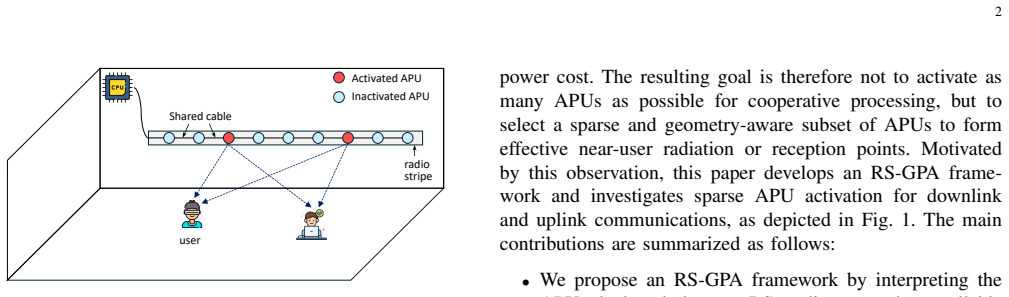
Radio stripes with active units along a cable enable selective activation that lowers total power consumption in wireless access.
A machine-rendered reading of the paper's core claim, the machinery that carries it, and where it could break.
Core claim
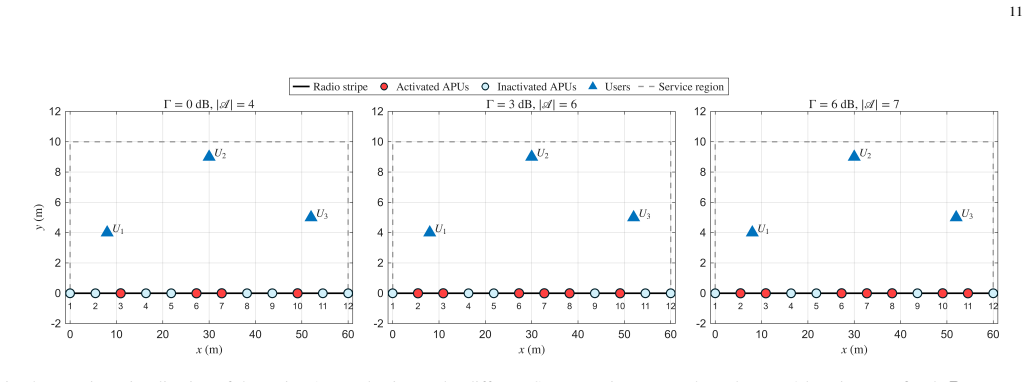
The RS-GPA framework accounts for distance-dependent APU-user channels and circuit power to pose a circuit-power-aware sparse activation and beamforming problem whose solution, obtained via reweighted group-sparse beamforming, yields substantially lower total consumed power; single-user analysis reveals that an extra APU is activated only when its transmit-power reduction exceeds its circuit cost, and this principle is used to derive geometry-guided algorithms that achieve comparable power savings for multiuser downlink and uplink at reduced complexity.
What carries the argument
The radio-stripe generalized pinching-antenna (RS-GPA) framework, in which active antenna processing units deployed along a cable act as discrete, controllable radiation points whose activation is decided by balancing transmit-power savings against circuit-power costs.
If this is right
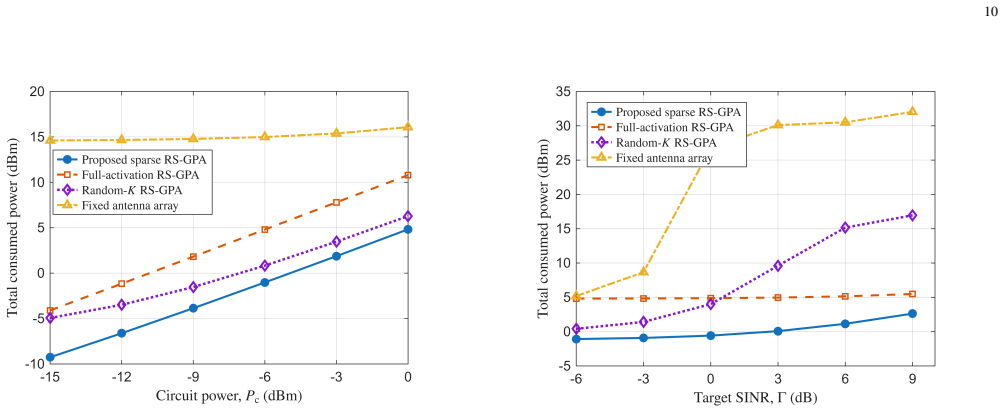
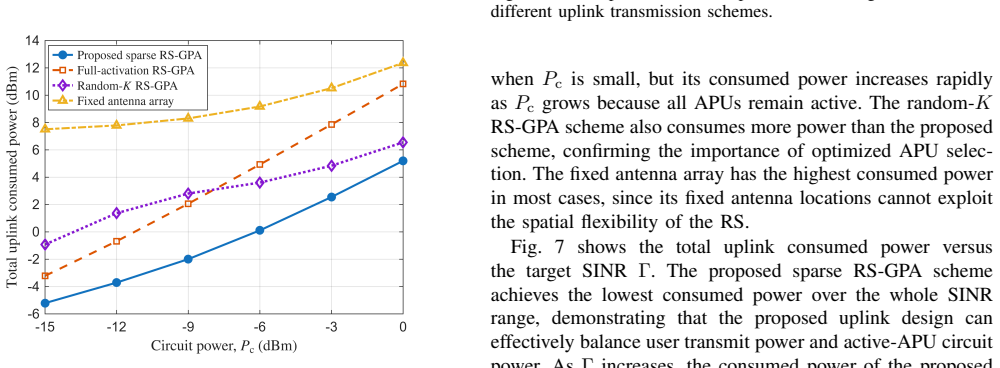
- The RS-GPA framework reduces total consumed power compared with benchmark schemes that do not exploit sparse activation.
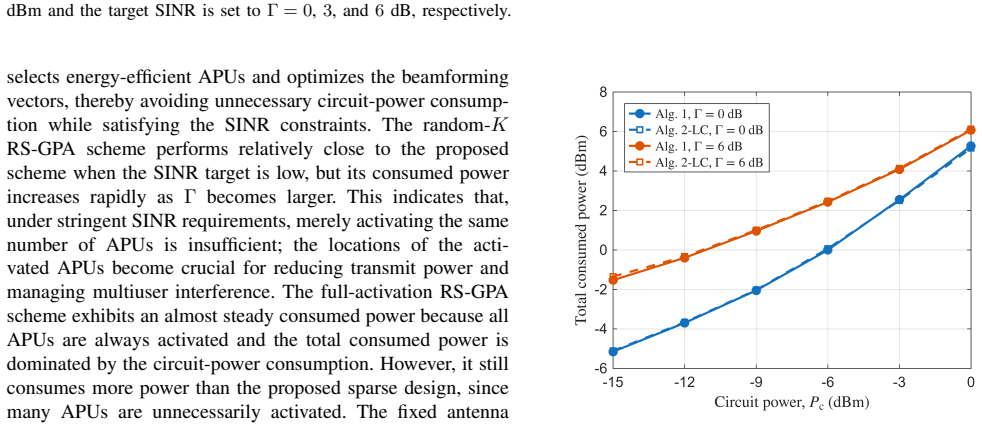
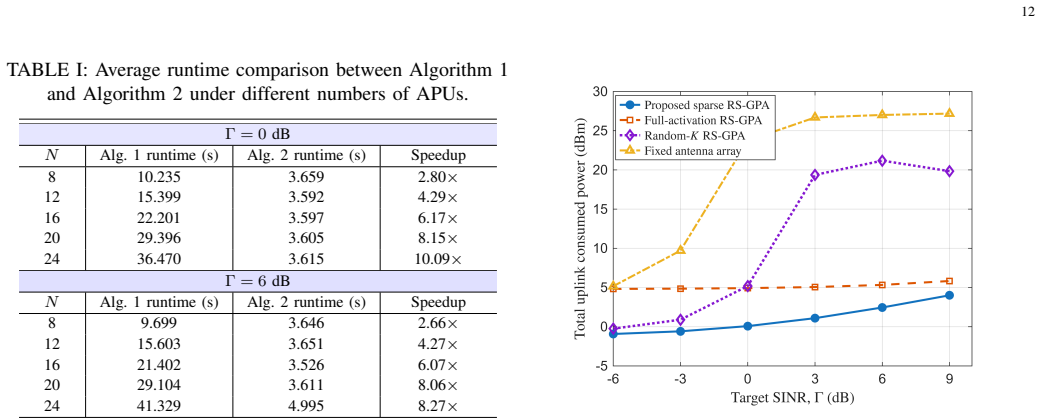
- The geometry-guided multiuser algorithm achieves near-identical consumed-power performance to the group-sparse design while requiring significantly lower runtime.
- In the single-user downlink case an additional APU is activated only when the transmit-power saving exceeds the added circuit-power cost.
- For uplink the geometry-guided sparse activation jointly selects APUs and controls user powers to minimize total consumption.
Where Pith is reading between the lines
- The shared-cable layout could simplify deployment along walls, ceilings, or vehicle interiors where waveguide runs are cumbersome.
- The activation rule derived for static users suggests a natural extension to slowly moving users by periodic re-optimization based on updated distances.
- Because activation decisions rest on geometry, the same principle may apply to other linear or curved cable installations without requiring full channel-state information.
- Integration with existing base-station hardware could be tested by attaching a radio-stripe segment and measuring end-to-end power under realistic traffic loads.
Load-bearing premise
Circuit power costs are treated as known fixed constants and distance-dependent APU-user channels are assumed known accurately enough to drive the optimization.
What would settle it
Build a physical radio-stripe prototype, apply the geometry-guided activation patterns to a set of users, measure the actual total DC power drawn by the system, and compare the measured savings against the values predicted by the algorithms and benchmarks.
Figures
read the original abstract
This paper investigates radio stripes (RSs) as a practical realization of generalized pinching antennas and proposes an RS-based generalized pinching-antenna (RS-GPA) framework. Unlike dielectric-waveguide-based passive pinching antennas that rely on passive coupling from a guided wave into free space, RSs employ active antenna processing units (APUs) deployed along a shared cable for local transmission, reception, and signal processing. This cable-like active architecture offers flexible installation and broad frequency applicability, while allowing selected APUs to act as discrete and controllable radiation or reception points for location-flexible wireless access. Based on the proposed RS-GPA framework, we establish the system and channel models by accounting for the distance-dependent APU-user channels. For downlink transmission, we formulate a circuit-power-aware sparse APU activation and beamforming problem and develop a reweighted group-sparse beamforming algorithm. To reveal the activation principle, we analyze the single-user downlink case and characterize when an additional APU should be activated by balancing transmit-power saving and circuit-power cost. Inspired by this insight, a geometry-guided low-complexity multiuser algorithm is proposed. For uplink transmission, we formulate a joint APU activation and user power control problem and develop a geometry-guided sparse activation design. Numerical results show that the proposed RS-GPA framework substantially reduces the total consumed power compared with benchmark schemes, while the geometry-guided algorithm achieves near-identical consumed-power performance to the group-sparse design with significantly lower runtime.
Editorial analysis
A structured set of objections, weighed in public.
Referee Report
Summary. The paper proposes the RS-GPA framework realizing generalized pinching antennas via radio stripes with active APUs along a shared cable. It establishes distance-dependent channel models, formulates a circuit-power-aware sparse APU activation and beamforming problem for downlink solved via reweighted group-sparse beamforming, derives activation principles from single-user analysis to motivate a geometry-guided multiuser algorithm, and develops a geometry-guided sparse activation design for uplink joint activation and power control. Numerical results claim that the RS-GPA framework substantially reduces total consumed power versus benchmarks while the geometry-guided algorithm matches the group-sparse design's power performance at much lower runtime.
Significance. If the numerical results hold, the work provides a practical, cable-based active architecture for location-flexible access that explicitly trades transmit power against circuit power costs. The single-user activation analysis leading to the geometry-guided multiuser design and the uplink formulation are constructive elements. Reproducible numerical validation of power savings under the stated assumptions would strengthen the contribution to energy-efficient wireless systems.
major comments (1)
- [Abstract] Abstract: the central claim that the RS-GPA framework 'substantially reduces the total consumed power' and that the geometry-guided algorithm achieves 'near-identical consumed-power performance' rests entirely on numerical results, yet the abstract supplies neither the simulation parameters, the exact benchmark schemes, the number of APUs/users, nor the channel model realizations used; without these the comparisons cannot be assessed for fairness or robustness.
minor comments (1)
- [Abstract] The abstract mentions 'distance-dependent APU-user channels' but does not indicate whether the model includes shadowing, small-scale fading, or specific path-loss exponents; adding this detail would clarify the scope of the claimed gains.
Simulated Author's Rebuttal
We thank the referee for the constructive feedback. We address the single major comment below.
read point-by-point responses
-
Referee: [Abstract] Abstract: the central claim that the RS-GPA framework 'substantially reduces the total consumed power' and that the geometry-guided algorithm achieves 'near-identical consumed-power performance' rests entirely on numerical results, yet the abstract supplies neither the simulation parameters, the exact benchmark schemes, the number of APUs/users, nor the channel model realizations used; without these the comparisons cannot be assessed for fairness or robustness.
Authors: We agree that the abstract would be strengthened by including key simulation parameters to make the numerical claims more self-contained. In the revised manuscript we will update the abstract to specify the number of APUs and users employed, the primary benchmark schemes (full activation and random activation), and a brief reference to the distance-dependent channel model. These parameters are already detailed in Sections IV and V; adding them to the abstract addresses the concern without altering the paper's technical content. revision: yes
Circularity Check
No significant circularity; derivation is self-contained
full rationale
The paper introduces the RS-GPA framework, defines system/channel models from first principles (distance-dependent APU-user channels), formulates standard sparse activation and beamforming optimization problems, derives a single-user activation condition by balancing transmit vs. circuit power, and uses that insight to motivate a geometry-guided multiuser algorithm. Uplink follows analogous joint optimization. All steps are constructive derivations or algorithm designs with explicitly stated assumptions; numerical results serve only as validation. No equations reduce to inputs by construction, no fitted parameters are relabeled as predictions, and no load-bearing self-citations or uniqueness theorems are invoked in the provided text.
Axiom & Free-Parameter Ledger
Reference graph
Works this paper leans on
-
[1]
Towards 6G wireless communication networks: Vision, enabling technologies, and new paradigm shifts,
X. You, C.-X. Wang, J. Huang, X. Gao, Z. Zhang, M. Wang, Y . Huang, C. Zhang, Y . Jiang, J. Wanget al., “Towards 6G wireless communication networks: Vision, enabling technologies, and new paradigm shifts,”Sci. China Inf. Sci., vol. 64, no. 1, p. 110301, 2021
2021
-
[2]
Distributed signal processing for extremely large-scale antenna array systems: State-of-the-art and future directions,
Y . Xu, E. G. Larsson, E. A. Jorswieck, X. Li, S. Jin, and T.-H. Chang, “Distributed signal processing for extremely large-scale antenna array systems: State-of-the-art and future directions,”IEEE J. Sel. Top. Signal Process., vol. 19, no. 2, pp. 304–330, 2025
2025
-
[3]
Intelligent reflecting surface enhanced wireless network via joint active and passive beamforming,
Q. Wu and R. Zhang, “Intelligent reflecting surface enhanced wireless network via joint active and passive beamforming,”IEEE Trans. Wireless Commun., vol. 18, no. 11, pp. 5394–5409, 2019
2019
-
[4]
6D movable antenna based on user distribution: Modeling and optimization,
X. Shao, Q. Jiang, and R. Zhang, “6D movable antenna based on user distribution: Modeling and optimization,”IEEE Trans. Wireless Commun., vol. 24, no. 1, pp. 355–370, 2024
2024
-
[5]
6D movable antenna en- hanced wireless network via discrete position and rotation optimization,
X. Shao, R. Zhang, Q. Jiang, and R. Schober, “6D movable antenna en- hanced wireless network via discrete position and rotation optimization,” IEEE J. Sel. Areas Commun., vol. 43, no. 3, pp. 674–687, 2025
2025
-
[6]
Modeling and performance analysis for movable antenna enabled wireless communications,
L. Zhu, W. Ma, and R. Zhang, “Modeling and performance analysis for movable antenna enabled wireless communications,”IEEE Trans. Wireless Commun., vol. 23, no. 6, pp. 6234–6250, 2023
2023
-
[7]
Fluid antenna systems,
K.-K. Wong, A. Shojaeifard, K.-F. Tong, and Y . Zhang, “Fluid antenna systems,”IEEE Trans. Wireless Commun., vol. 20, no. 3, pp. 1950–1962, 2020
1950
-
[8]
Pinching antenna: Using a dielectric waveguide as an antenna,
A. Fukuda, H. Yamamoto, H. Okazaki, Y . Suzuki, and K. Kawai, “Pinching antenna: Using a dielectric waveguide as an antenna,”NTT DOCOMO Technical J., vol. 23, no. 3, pp. 5–12, Jan. 2022
2022
-
[9]
Flexible-antenna systems: A pinching-antenna perspective,
Z. Ding, R. Schober, and H. V . Poor, “Flexible-antenna systems: A pinching-antenna perspective,”IEEE Trans. Commun., vol. 73, no. 10, pp. 9236–9253, Oct. 2025
2025
-
[10]
Rate maximization for downlink pinching-antenna systems,
Y . Xu, Z. Ding, and G. K. Karagiannidis, “Rate maximization for downlink pinching-antenna systems,”IEEE Wireless Commun. Lett., vol. 14, no. 5, pp. 1431–1435, May 2025
2025
-
[11]
Pinching-antenna-based communications: Spectral efficiency analysis and deployment strate- gies,
M. Qian, X. Mu, L. You, and M. Matthaiou, “Pinching-antenna-based communications: Spectral efficiency analysis and deployment strate- gies,”IEEE Trans. Commun., vol. 74, pp. 4758–4771, 2026
2026
-
[12]
Power minimization in pinching- antenna systems under probabilistic LoS blockage,
L. Li, Y . Xu, T. Cai, and T.-H. Chang, “Power minimization in pinching- antenna systems under probabilistic LoS blockage,”IEEE Wireless Commun. Lett., vol. 15, pp. 3139–3143, 2026
2026
-
[13]
Spectral and energy efficiency tradeoff for pinching-antenna systems,
Z. Zhou, Z. Wang, and Y . Liu, “Spectral and energy efficiency tradeoff for pinching-antenna systems,”IEEE Trans. Commun., vol. 74, pp. 8283–8299, 2026
2026
-
[14]
Y . Xu, Z. Ding, X. Y . Zhang, T. Q. Duong, and T.-H. Chang, “Environment-aware network-level design of generalized pinching-antenna systems–part I: Traffic-aware case,”arXiv preprint arXiv:2602.17023, 2026
arXiv 2026
-
[15]
——, “Environment-aware network-level design of generalized pinching-antenna systems–part II: Geometry-aware case,”arXiv preprint arXiv:2602.17032, 2026
arXiv 2026
-
[16]
Performance analysis of pinching- antenna systems,
D. Tyrovolas, S. A. Tegos, P. D. Diamantoulakis, S. Ioannidis, C. K. Liaskos, and G. K. Karagiannidis, “Performance analysis of pinching- antenna systems,”IEEE Trans. Cognit. Commun. Networking, vol. 12, pp. 590–601, 2026
2026
-
[17]
Multi- waveguide pinching antennas for ISAC,
W. Mao, Y . Lu, Y . Xu, B. Ai, O. A. Dobre, and D. Niyato, “Multi- waveguide pinching antennas for ISAC,”IEEE Trans. Wireless Com- mun., vol. 25, pp. 5846–5858, 2026
2026
-
[18]
Rate region of ISAC for pinching-antenna systems,
C. Ouyang, Z. Wang, Y . Liu, and Z. Ding, “Rate region of ISAC for pinching-antenna systems,”IEEE Trans. Commun., vol. 74, pp. 5849– 5866, 2026
2026
-
[19]
QoS-aware NOMA design for downlink pinching-antenna systems,
Y . Xu, Z. Ding, D. Cai, and V . W. Wong, “QoS-aware NOMA design for downlink pinching-antenna systems,”IEEE Trans. Commun., vol. 73, no. 12, pp. 13 611–13 625, 2025
2025
-
[20]
Joint beamforming for NOMA assisted pinching antenna systems (PASS),
D. Gan, X. Xu, J. Zuo, X. Ge, and Y . Liu, “Joint beamforming for NOMA assisted pinching antenna systems (PASS),”IEEE Trans. Commun., vol. 74, pp. 2450–2465, 2025
2025
-
[21]
Resolving the double near- far problem via wireless powered pinching-antenna networks,
V . K. Papanikolaou, G. Zhou, B. Kaziu, A. Khalili, P. D. Diamantoulakis, G. K. Karagiannidis, and R. Schober, “Resolving the double near- far problem via wireless powered pinching-antenna networks,”IEEE Wireless Commun. Lett., vol. 14, no. 11, pp. 3425–3429, 2025
2025
-
[22]
Average aoi in pinching antenna-assisted wpcns with probabilistic los blockage,
H. Hu, R. Jiang, Y . Xu, J. Ma, and F. Fang, “Average aoi in pinching antenna-assisted wpcns with probabilistic los blockage,”IEEE Commun. Lett., vol. 30, pp. 1786–1790, 2026
2026
-
[23]
Physical layer security for pinching-antenna systems via index and directional modulation,
Y . Zhong, J. Chen, Y . Xiao, S. Yang, X. Lei, Y . Gao, and M. Xiao, “Physical layer security for pinching-antenna systems via index and directional modulation,”IEEE Wireless Commun. Lett., vol. 15, pp. 230– 234, 2026
2026
-
[24]
Pinching- antenna systems (PASS)-enabled secure wireless communications,
G. Zhu, X. Mu, L. Guo, S. Xu, Y . Liu, and N. Al-Dhahir, “Pinching- antenna systems (PASS)-enabled secure wireless communications,” IEEE Trans. Commun., vol. 74, pp. 490–505, 2026
2026
-
[25]
Generalized pinching-antenna systems: A tutorial on principles, design strategies, and future directions,
Y . Xu, J. Cui, Y . Zhu, Z. Ding, T.-H. Chang, R. Schober, V . W. Wong, O. A. Dobre, G. K. Karagiannidis, H. V . Poor, and X. You, “Generalized pinching-antenna systems: A tutorial on principles, design strategies, and future directions,”IEEE Commun. Surv. Tutorials, vol. 28, pp. 5872– 5908, 2026
2026
-
[26]
Generalized pinching-antenna systems: A leaky-coaxial-cable perspective,
K. Wang, Z. Ding, and L. Hanzo, “Generalized pinching-antenna systems: A leaky-coaxial-cable perspective,”arXiv preprint arXiv:2512.04979, 2025
arXiv 2025
-
[27]
Leaky coaxial cable based general- ized pinching-antenna systems with dual-port feeding,
K. Wang, Z. Ding, and D. K. So, “Leaky coaxial cable based general- ized pinching-antenna systems with dual-port feeding,”arXiv preprint arXiv:2602.21856, 2026
arXiv 2026
-
[28]
Leaky-coaxial pinching-antenna system with adjustable slot apertures,
K. Wang, D. K. So, Z. Ding, and G. K. Karagiannidis, “Leaky-coaxial pinching-antenna system with adjustable slot apertures,”arXiv preprint arXiv:2604.23246, 2026
Pith/arXiv arXiv 2026
-
[29]
Ubiquitous cell-free massive MIMO communications,
G. Interdonato, E. Bj ¨ornson, H. Quoc Ngo, P. Frenger, and E. G. Larsson, “Ubiquitous cell-free massive MIMO communications,”EURASIP J. Wireless Commun. Networking, vol. 2019, no. 1, pp. 1–13, 2019
2019
-
[30]
MMSE-optimal sequential processing for cell-free massive MIMO with radio stripes,
Z. H. Shaik, E. Bj ¨ornson, and E. G. Larsson, “MMSE-optimal sequential processing for cell-free massive MIMO with radio stripes,”IEEE Trans. Commun., vol. 69, no. 11, pp. 7775–7789, 2021
2021
-
[31]
Massive MIMO with radio stripes for indoor wireless energy transfer,
O. L. L ´opez, D. Kumar, R. D. Souza, P. Popovski, A. T ¨olli, and M. Latva-Aho, “Massive MIMO with radio stripes for indoor wireless energy transfer,”IEEE Trans. Wireless Commun., vol. 21, no. 9, pp. 7088–7104, 2022
2022
-
[32]
Uplink performance optimization of limited-capacity radio stripes,
I. Chiotis and A. L. Moustakas, “Uplink performance optimization of limited-capacity radio stripes,”IEEE Trans. Wireless Commun., vol. 23, no. 9, pp. 12 382–12 395, 2024
2024
-
[33]
Access point selection for spectral efficiency and load balancing optimization in radio stripes,
F. Conceic ¸˜ao, L. Martins, M. Gomes, V . Silva, and R. Dinis, “Access point selection for spectral efficiency and load balancing optimization in radio stripes,”IEEE Commun. Lett., vol. 27, no. 9, pp. 2383–2387, 2023
2023
-
[34]
Radio stripe selection for improved UE position estimation in CF-mMIMO systems,
P. Eberechukwu and D. Yoon, “Radio stripe selection for improved UE position estimation in CF-mMIMO systems,”IEEE Trans. Veh. Technol., pp. 1–6, 2025
2025
-
[35]
Pinching-antenna systems with in-waveguide attenuation: Performance analysis and algorithm design,
Y . Xu, Z. Ding, R. Schober, and T.-H. Chang, “Pinching-antenna systems with in-waveguide attenuation: Performance analysis and algorithm design,”IEEE Trans. Wireless Commun., vol. 25, pp. 14 564–14 580, 2026
2026
-
[36]
Massive MIMO antenna selection: Switching architectures, capacity bounds, and optimal antenna selection algorithms,
Y . Gao, H. Vinck, and T. Kaiser, “Massive MIMO antenna selection: Switching architectures, capacity bounds, and optimal antenna selection algorithms,”IEEE Trans. Signal Process., vol. 66, no. 5, pp. 1346–1360, 2017
2017
-
[37]
Massive MIMO with antenna selection: Fundamental limits and applications,
S. Asaad, A. M. Rabiei, and R. R. M ¨uller, “Massive MIMO with antenna selection: Fundamental limits and applications,”IEEE Trans. Wireless Commun., vol. 17, no. 12, pp. 8502–8516, 2018
2018
-
[38]
Sparse beamforming and user-centric clustering for downlink cloud radio access network,
B. Dai and W. Yu, “Sparse beamforming and user-centric clustering for downlink cloud radio access network,”IEEE Access, vol. 2, pp. 1326– 1339, 2014
2014
-
[39]
Enhancing sparsity by reweightedℓ 1 minimization,
E. J. Candes, M. B. Wakin, and S. P. Boyd, “Enhancing sparsity by reweightedℓ 1 minimization,”J.Fourier Anal. Appl., vol. 14, no. 5, pp. 877–905, 2008
2008
discussion (0)
Sign in with ORCID, Apple, or X to comment. Anyone can read and Pith papers without signing in.