Cosmological Constraints on Minimal Cubic Galileon Models in Teleparallel Gravity
Pith reviewed 2026-06-26 16:53 UTC · model grok-4.3
The pith
Teleparallel cubic Galileon models accommodate late-time cosmic expansion comparably to ΛCDM in some cases.
A machine-rendered reading of the paper's core claim, the machinery that carries it, and where it could break.
Core claim
The considered teleparallel cubic Galileon models can accommodate the late-time expansion history, although the statistical preference depends on the choice of potential and on whether b1 is fixed or varied. In particular, the fixed-b1 model with a quadratic potential provides the most competitive fit among the Galileon scenarios when BAO data are included, showing a lower χ²_min than ΛCDM and comparable support according to the AIC criterion. However, the BIC criterion continues to favor the minimal ΛCDM model because of the larger parameter space of the extended models.
What carries the argument
The parameter b1 that encodes deviations from the teleparallel equivalent of general relativity inside the cubic Galileon action, together with quadratic or exponential scalar-field potentials.
If this is right
- The models remain phenomenologically viable for describing late-time acceleration.
- Statistical preference among the scenarios varies with the potential form and with whether b1 is fixed or free.
- BIC continues to select ΛCDM over the Galileon extensions due to the penalty for extra parameters.
- Any stronger claim that these models resolve the Hubble tension requires additional consistency tests beyond the current data combinations.
Where Pith is reading between the lines
- The competitiveness of the fixed-b1 quadratic case suggests that a discrete choice of b1 may be theoretically preferred and worth testing in other teleparallel extensions.
- Dependence of the fit quality on the inclusion of BAO indicates that future large-scale-structure surveys could tighten or rule out these scenarios more decisively.
- If the models continue to fit well, they motivate checking whether the same b1 value also works for early-universe observables such as the CMB power spectrum.
Load-bearing premise
The data sets (Pantheon+, cosmic chronometers, SH0ES, BAO) are assumed to be mutually compatible and free of significant unaccounted systematics that would change the relative chi-squared and information-criterion rankings.
What would settle it
A reanalysis or new data set that drives the minimum chi-squared of every Galileon variant significantly above that of ΛCDM even after BAO are added, or that produces mutually inconsistent best-fit values of b1 across different data combinations.
Figures
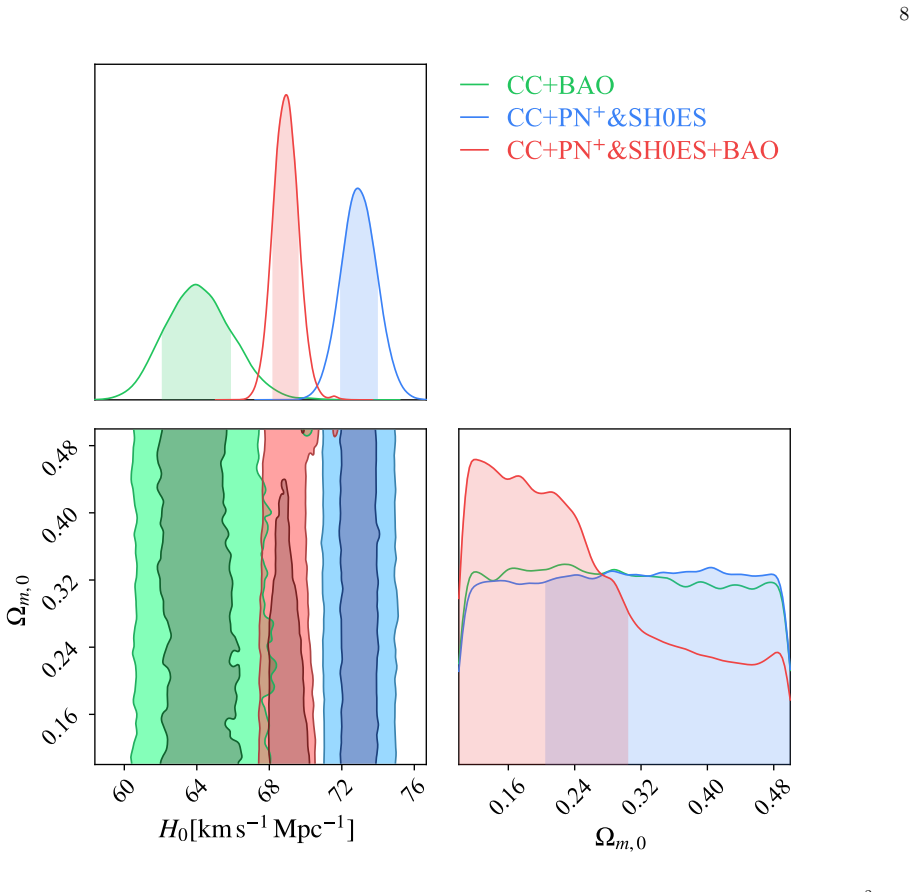
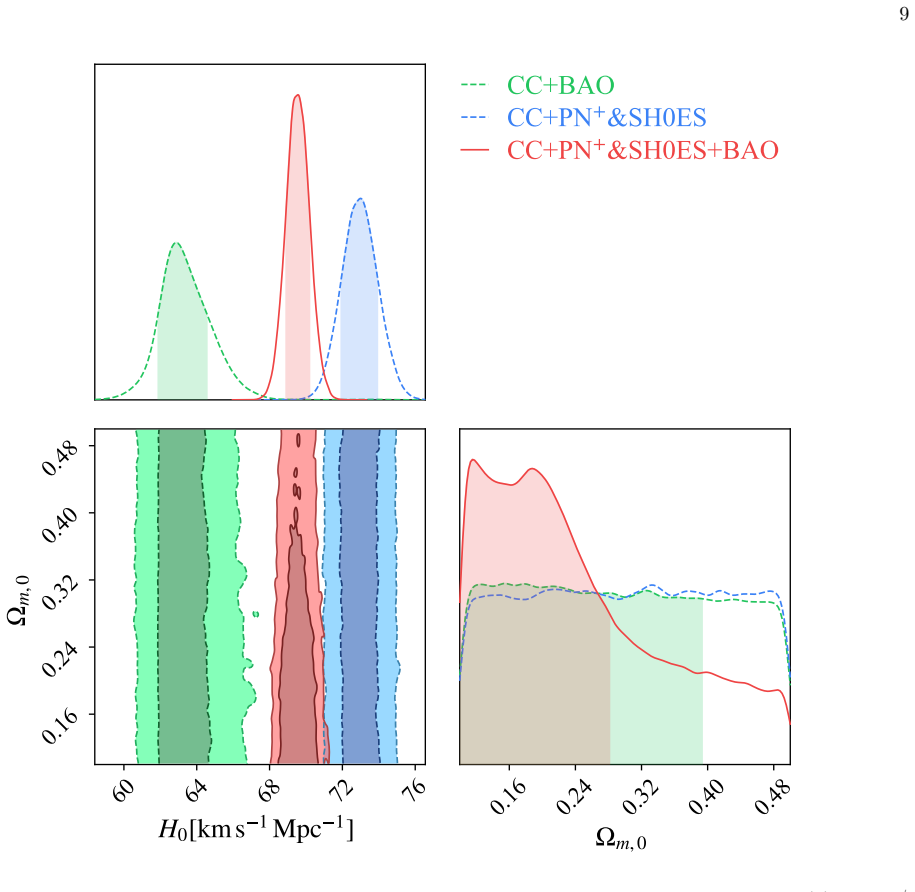
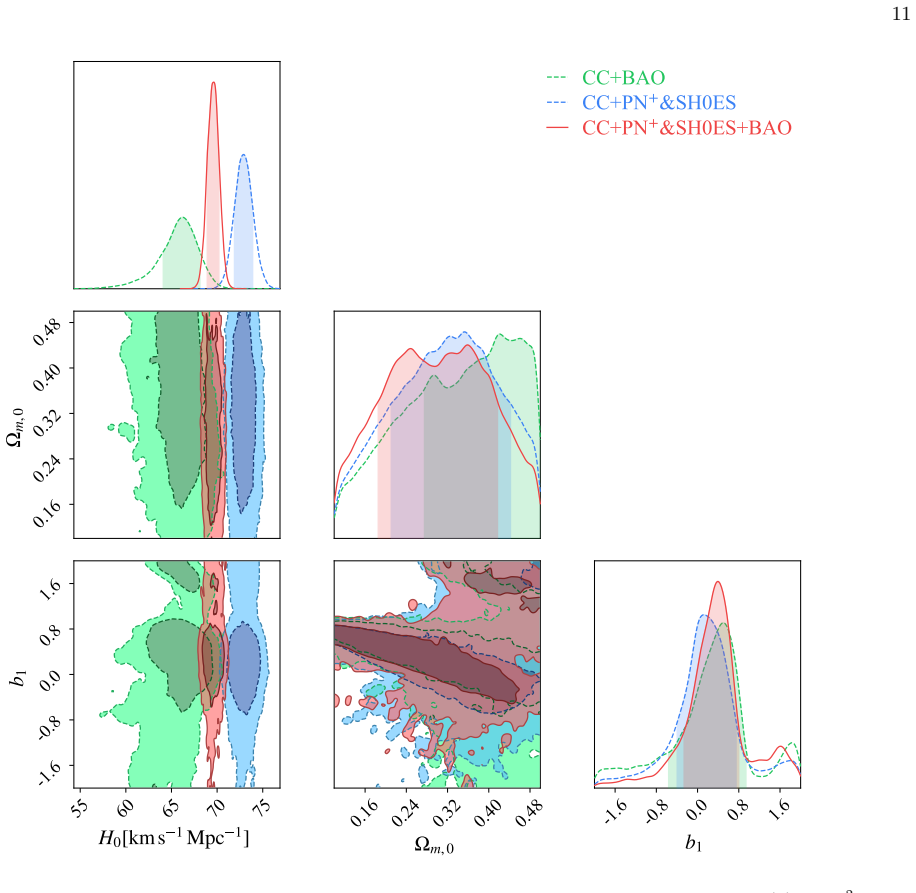
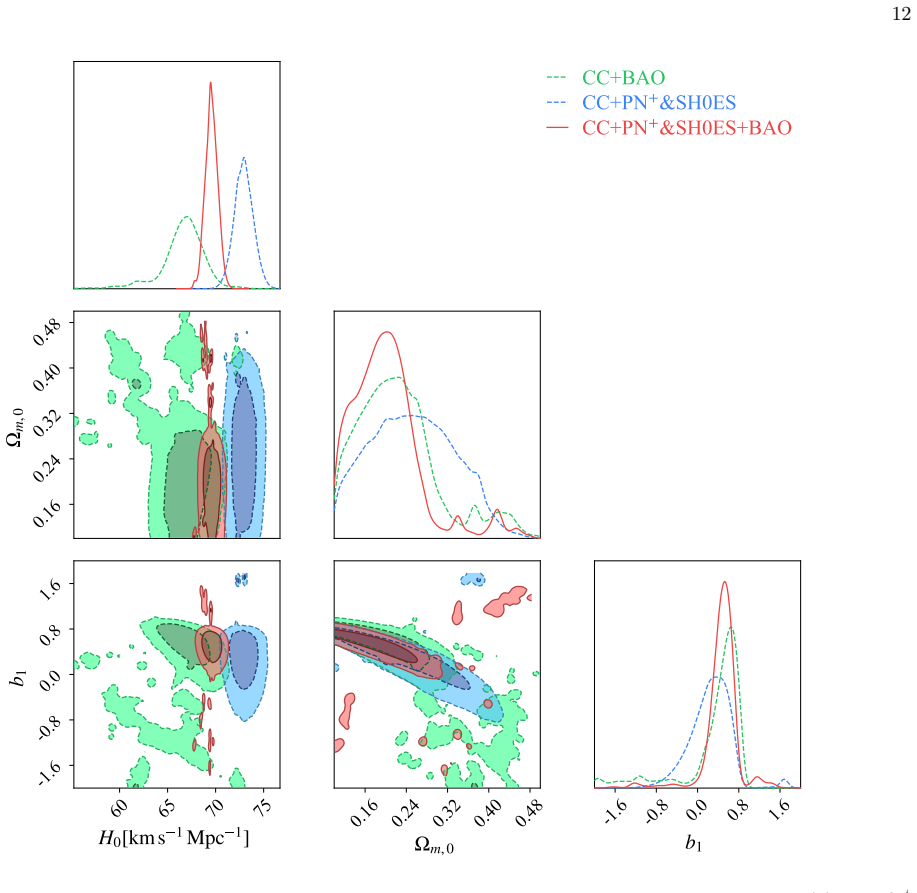
read the original abstract
Cubic Galileon cosmological models provide a well-motivated framework for investigating late-time cosmic acceleration beyond the standard $\Lambda$CDM paradigm. In this work, we study observational constraints on cubic Galileon models within the teleparallel gravity framework, where deviations from the standard teleparallel equivalent of general relativity are encoded through the model parameter $b_1$. We consider two scalar-field potentials, namely quadratic and exponential potentials, and analyze four representative scenarios: quadratic and exponential potentials with $b_1$ treated as a free parameter, together with the corresponding cases in which $b_1=2$ is fixed. Using the $\text{Pantheon}^+$ Type Ia supernova sample, cosmic chronometer measurements, SH0ES information, and baryon acoustic oscillation data, we constrain the cosmological and model parameters and compare the observational viability of the different scenarios. We find that the considered teleparallel cubic Galileon models can accommodate the late-time expansion history, although the statistical preference depends on the choice of potential and on whether $b_1$ is fixed or varied. In particular, the fixed-$b_1$ model with a quadratic potential provides the most competitive fit among the Galileon scenarios when BAO data are included, showing a lower $\chi^2_{\min}$ than $\Lambda$CDM and comparable support according to the AIC criterion. However, the BIC criterion continues to favor the minimal $\Lambda$CDM model because of the larger parameter space of the extended models. These results suggest that teleparallel cubic Galileon cosmologies remain phenomenologically viable, while a stronger claim regarding the Hubble tension requires further consistency tests.
Editorial analysis
A structured set of objections, weighed in public.
Referee Report
Summary. The manuscript examines cosmological constraints on minimal cubic Galileon models in teleparallel gravity, where deviations are parameterized by b1. It considers quadratic and exponential potentials in four scenarios (b1 free or fixed to 2), fitting to Pantheon+ supernovae, cosmic chronometers, SH0ES, and BAO data. The central claim is that these models accommodate the late-time expansion history, with the fixed-b1 quadratic potential yielding the most competitive fit among Galileon cases (lower χ²_min than ΛCDM with BAO included, comparable AIC but BIC favoring ΛCDM due to extra parameters), indicating phenomenological viability while noting that stronger claims on the Hubble tension require further tests.
Significance. If the statistical comparisons hold after addressing data compatibility, the work demonstrates that teleparallel cubic Galileon models remain viable extensions capable of competitive fits to expansion history data, with explicit AIC/BIC rankings highlighting the parameter-count penalty relative to ΛCDM. This adds concrete numerical evidence to the literature on teleparallel modifications without introducing new entities or ad-hoc axioms beyond standard parameter fitting.
major comments (1)
- The joint likelihood analysis of Pantheon+, cosmic chronometers, SH0ES, and BAO implicitly assumes statistical compatibility without reported tension statistics, separate fits, or covariance re-estimation. This assumption underpins the claim that the fixed-b1 quadratic model provides the most competitive fit (lower χ²_min than ΛCDM with BAO), as unmodeled systematics could shift relative χ² values and alter AIC/BIC rankings.
Simulated Author's Rebuttal
We thank the referee for their careful reading of the manuscript and for the constructive comment. We respond to the major comment below.
read point-by-point responses
-
Referee: The joint likelihood analysis of Pantheon+, cosmic chronometers, SH0ES, and BAO implicitly assumes statistical compatibility without reported tension statistics, separate fits, or covariance re-estimation. This assumption underpins the claim that the fixed-b1 quadratic model provides the most competitive fit (lower χ²_min than ΛCDM with BAO), as unmodeled systematics could shift relative χ² values and alter AIC/BIC rankings.
Authors: We acknowledge that explicit checks for inter-dataset compatibility would strengthen the presentation. Our analysis follows the standard practice in the field of performing joint fits to these commonly combined datasets without additional covariance adjustments. To address the concern, the revised manuscript will include the individual χ² contributions from each dataset for the best-fit models of the fixed-b1 quadratic case and ΛCDM, together with a short discussion of dataset compatibility based on the separate constraints already obtained during the MCMC runs. This addition will allow readers to evaluate whether systematics could affect the reported χ²_min differences and information criteria rankings, while preserving the core result that the model remains viable under the joint likelihood. revision: partial
Circularity Check
No significant circularity; standard observational constraints on fitted models
full rationale
The paper performs standard Bayesian parameter estimation and model comparison (χ², AIC, BIC) on teleparallel cubic Galileon cosmologies against external datasets (Pantheon+, cosmic chronometers, SH0ES, BAO). The claim that models 'can accommodate the late-time expansion history' is the direct numerical outcome of these fits, not a derivation presented as first-principles or independent of the input data. No self-definitional steps, fitted inputs renamed as predictions, load-bearing self-citations, uniqueness theorems, or ansatz smuggling appear in the provided text. The analysis is self-contained against the cited external benchmarks, which is the expected non-circular outcome for a constraints paper.
Axiom & Free-Parameter Ledger
free parameters (3)
- b1
- scalar field potential parameters
- cosmological parameters (e.g. matter density, Hubble constant)
axioms (2)
- domain assumption The background cosmology follows the Friedmann-Lemaître-Robertson-Walker metric in teleparallel gravity
- domain assumption The cubic Galileon action is appropriately formulated in the teleparallel framework
Reference graph
Works this paper leans on
-
[1]
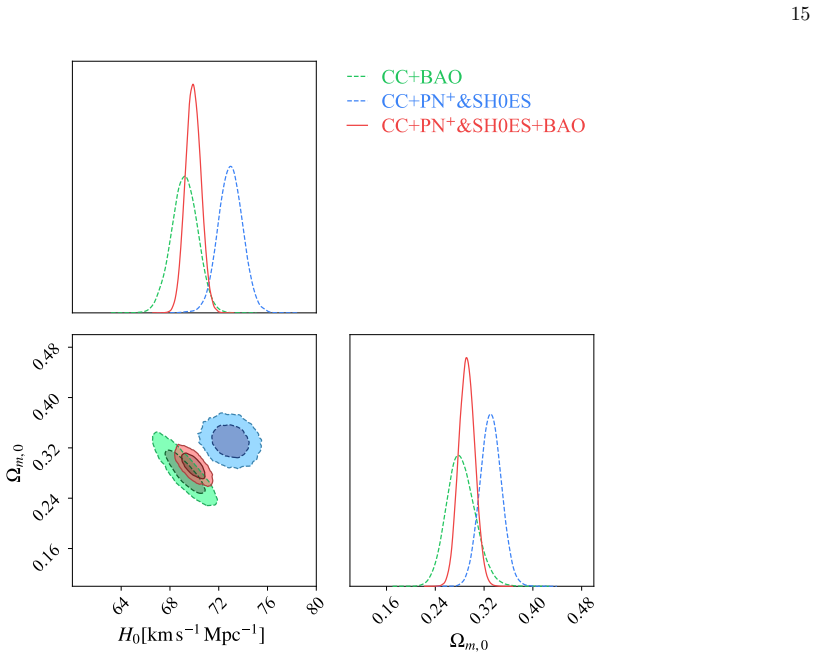
C. W. Misner, K. S. Thorne, and J. A. Wheeler,Gravitation(W. H. Freeman, San Francisco, 1973). 15 CC+BAO CC+PN+&SH0ES CC+PN+&SH0ES+BAO 64 68 72 76 80 H0[kms 1 Mpc 1] 0.16 0.24 0.32 0.40 0.48 m, 0 0.16 0.24 0.32 0.40 0.48 m, 0 FIG. 5: MCMC corner plot for the standard ΛCDM cosmology, adopted as the reference model for the model comparison analysis. The two...
1973
-
[2]
T. Clifton, P. G. Ferreira, A. Padilla, and C. Skordis, Phys. Rept.513, 1 (2012), arXiv:1106.2476 [astro-ph.CO]
Pith/arXiv arXiv 2012
-
[3]
Baudis, Journal of Physics G: Nuclear and Particle Physics43, 044001 (2016)
L. Baudis, Journal of Physics G: Nuclear and Particle Physics43, 044001 (2016)
2016
-
[4]
G. Bertone, D. Hooper, and J. Silk, physrep405, 279 (2005), arXiv:hep-ph/0404175 [hep-ph]
Pith/arXiv arXiv 2005
-
[5]
P. J. E. Peebles and B. Ratra, Rev. Mod. Phys.75, 559 (2003)
2003
-
[6]
E. J. Copeland, M. Sami, and S. Tsujikawa, Int. J. Mod. Phys. D15, 1753 (2006), arXiv:hep-th/0603057
Pith/arXiv arXiv 2006
-
[7]
S. Weinberg, in4th International Symposium on Sources and Detection of Dark Matter in the Universe (DM 2000)(2000) pp. 18–26, arXiv:astro-ph/0005265
Pith/arXiv arXiv 2000
-
[8]
R. J. Gaitskell, Annual Review of Nuclear and Particle Science54, 315 (2004)
2004
-
[9]
E. Di Valentinoet al., Astropart. Phys.131, 102605 (2021), arXiv:2008.11284 [astro-ph.CO]
arXiv 2021
-
[10]
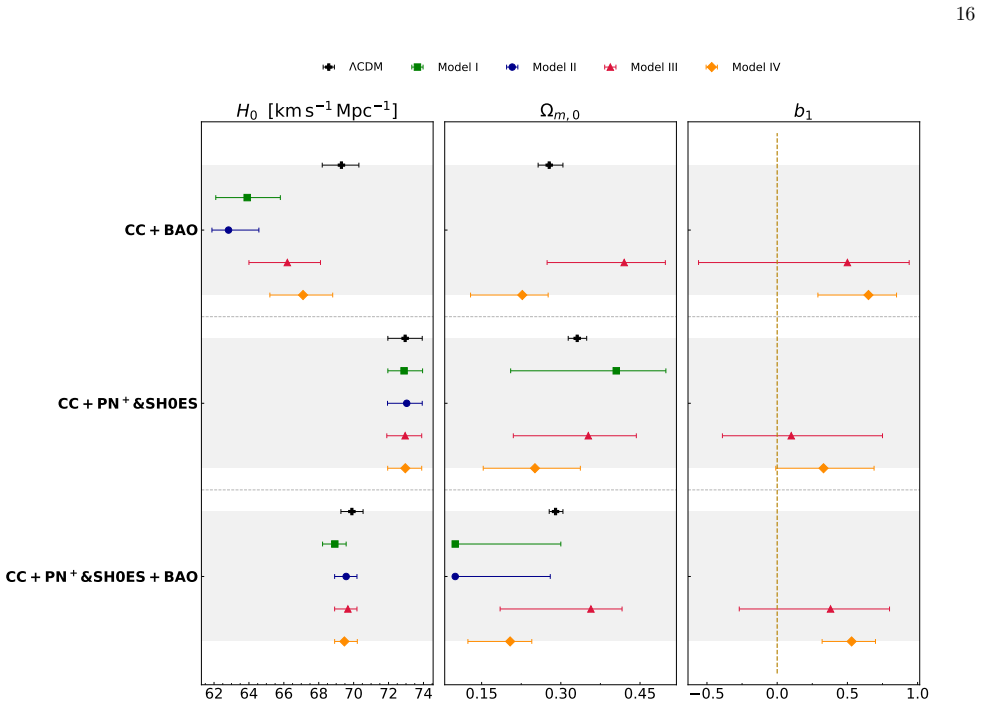
A. G. Riess, S. Casertano, W. Yuan, L. M. Macri, and D. Scolnic, Astrophys. J.876, 85 (2019), arXiv:1903.07603 16 62 64 66 68 70 72 74 CC + BAO CC + PN+ &SH0ES CC + PN+ &SH0ES + BAO H0 [km s 1 Mpc 1] 0.15 0.30 0.45 m, 0 0.5 0.0 0.5 1.0 b1 CDM Model I Model II Model III Model IV FIG. 6: Whisker plot ofH 0, Ω m,0, andb 1, showing the best-fit values and 1σu...
Pith/arXiv arXiv 2019
-
[11]
K. C. Wonget al.(H0LiCOW), Mon. Not. Roy. Astron. Soc.498, 1420 (2020), arXiv:1907.04869 [astro-ph.CO]
arXiv 2020
-
[12]
P. A. R. Adeet al.(Planck), Astron. Astrophys.594, A13 (2016), arXiv:1502.01589 [astro-ph.CO]
Pith/arXiv arXiv 2016
-
[14]
A. G. Riess, Nature Rev. Phys.2, 10 (2019), arXiv:2001.03624 [astro-ph.CO]
arXiv 2019
-
[15]
D. W. Pesceet al., Astrophys. J. Lett.891, L1 (2020), arXiv:2001.09213 [astro-ph.CO]
arXiv 2020
-
[16]
T. de Jaeger, B. E. Stahl, W. Zheng, A. V. Filippenko, A. G. Riess, and L. Galbany, mnras496, 3402 (2020), arXiv:2006.03412 [astro-ph.CO]
arXiv 2020
-
[17]
J. I. Thorpe, J. Ziemer, and at al., inBulletin of the American Astronomical Society, Vol. 51 (2019) p. 77, arXiv:1907.06482 [astro-ph.IM]
Pith/arXiv arXiv 2019
-
[18]
P. Amaro-Seoane, H. Audley, and at al., arXiv e-prints , arXiv:1702.00786 (2017), arXiv:1702.00786 [astro-ph.IM]
Pith/arXiv arXiv 2017
-
[19]
L. Barack, V. Cardoso, and at al., Classical and Quantum Gravity36, 143001 (2019), arXiv:1806.05195 [gr-qc]
Pith/arXiv arXiv 2019
-
[20]
J. L. Bernal, L. Verde, and A. G. Riess, JCAP10, 019, arXiv:1607.05617 [astro-ph.CO]
-
[21]
E. Di Valentino, O. Mena, S. Pan, L. Visinelli, W. Yang, A. Melchiorri, D. F. Mota, A. G. Riess, and J. Silk, Class. Quant. Grav.38, 153001 (2021), arXiv:2103.01183 [astro-ph.CO]
Pith/arXiv arXiv 2021
-
[22]
T. P. Sotiriou and V. Faraoni, Rev. Mod. Phys.82, 451 (2010), arXiv:0805.1726 [gr-qc]
Pith/arXiv arXiv 2010
-
[23]
Akramiet al.(CANTATA),Modified Gravity and Cosmology
Y. Akramiet al.(CANTATA),Modified Gravity and Cosmology. An Update by the CANTATA Network, edited by E. N. Saridakis, R. Lazkoz, V. Salzano, P. Vargas Moniz, S. Capozziello, J. Beltr´ an Jim´ enez, M. De Laurentis, and G. J. Olmo (Springer, 2021) arXiv:2105.12582 [gr-qc]
arXiv 2021
-
[24]
Nakahara,Geometry, topology and physics(2003)
M. Nakahara,Geometry, topology and physics(2003)
2003
-
[25]
S. Bahamonde, K. F. Dialektopoulos, C. Escamilla-Rivera, G. Farrugia, V. Gakis, M. Hendry, M. Hohmann, J. Levi Said, J. Mifsud, and E. Di Valentino, Rept. Prog. Phys.86, 026901 (2023), arXiv:2106.13793 [gr-qc]
arXiv 2023
-
[26]
Aldrovandi and J
R. Aldrovandi and J. G. Pereira,Teleparallel Gravity: An Introduction(Springer, 2013)
2013
-
[27]
Y.-F. Cai, S. Capozziello, M. De Laurentis, and E. N. Saridakis, Rept. Prog. Phys.79, 106901 (2016), arXiv:1511.07586 17 [gr-qc]
Pith/arXiv arXiv 2016
- [28]
- [29]
-
[30]
A. Nicolis, R. Rattazzi, and E. Trincherini, Phys. Rev. D79, 064036 (2009), arXiv:0811.2197 [hep-th]
Pith/arXiv arXiv 2009
-
[31]
C. Deffayet, G. Esposito-Farese, and A. Vikman, Phys. Rev. D79, 084003 (2009), arXiv:0901.1314 [hep-th]
Pith/arXiv arXiv 2009
-
[32]
G. R. Dvali, G. Gabadadze, and M. Porrati, Phys. Lett. B485, 208 (2000), arXiv:hep-th/0005016 [hep-th]
Pith/arXiv arXiv 2000
-
[33]
A. De Felice and S. Tsujikawa, Phys. Rev. Lett.105, 111301 (2010), arXiv:1007.2700 [astro-ph.CO]
Pith/arXiv arXiv 2010
-
[34]
C. Germani, Phys. Rev. D86, 104032 (2012), arXiv:1207.6414 [hep-th]
Pith/arXiv arXiv 2012
-
[35]
R. Kimura and K. Yamamoto, JCAP04, 025, arXiv:1011.2006 [astro-ph.CO]
Pith/arXiv arXiv 2006
-
[36]
N. Frusciante, S. Peirone, L. Atayde, and A. De Felice, Phys. Rev. D101, 064001 (2020), arXiv:1912.07586 [astro-ph.CO]
arXiv 2020
-
[37]
M. Zumalac´ arregui, Phys. Rev. D102, 023523 (2020), arXiv:2003.06396 [astro-ph.CO]
arXiv 2020
-
[38]
S. Brahma and M. W. Hossain, Universe7, 167 (2021), arXiv:2007.07073 [astro-ph.CO]
arXiv 2021
-
[39]
A. Ali, R. Gannouji, M. Sami, and I. Ziaeepour, Phys. Rev. D104, 083543 (2021), arXiv:2107.09919 [gr-qc]
arXiv 2021
-
[40]
W. L. Freedmanet al., Astrophys. J.882, 34 (2019), arXiv:1907.05922 [astro-ph.CO]
arXiv 2019
- [41]
-
[42]
D. M. Scolnicet al.(Pan-STARRS1), Astrophys. J.859, 101 (2018), arXiv:1710.00845 [astro-ph.CO]
Pith/arXiv arXiv 2018
-
[43]
D. Broutet al., Astrophys. J.938, 111 (2022), arXiv:2112.03864 [astro-ph.CO]
arXiv 2022
-
[45]
D. Scolnicet al., Astrophys. J.938, 113 (2022), arXiv:2112.03863 [astro-ph.CO]
Pith/arXiv arXiv 2022
-
[46]
Weitzenb¨ ock,Invariantentheorie(P
R. Weitzenb¨ ock,Invariantentheorie(P. Noordhoff, Groningen, 1923)
1923
-
[47]
Ortin,Gravity and strings, Cambridge Monographs on Mathematical Physics (Cambridge Univ
T. Ortin,Gravity and strings, Cambridge Monographs on Mathematical Physics (Cambridge Univ. Press, 2004)
2004
-
[48]
M. Krˇ sˇ s´ ak and E. N. Saridakis, Class. Quant. Grav.33, 115009 (2016), arXiv:1510.08432 [gr-qc]
Pith/arXiv arXiv 2016
-
[49]
Hayashi and T
K. Hayashi and T. Shirafuji, Phys. Rev. D19, 3524 (1979), [Addendum: Phys.Rev.D 24, 3312–3314 (1982)]
1979
-
[50]
S. Bahamonde, C. G. B¨ ohmer, and M. Krˇ sˇ s´ ak, Phys. Lett. B775, 37 (2017), arXiv:1706.04920 [gr-qc]
Pith/arXiv arXiv 2017
-
[51]
S. Bahamonde, A. Hell, D. Blixt, and K. F. Dialektopoulos, Phys. Rev. D111, 064080 (2025), arXiv:2404.02972 [gr-qc]
arXiv 2025
-
[52]
S. Bahamonde, C. G. B¨ ohmer, and M. Wright, Phys. Rev. D92, 104042 (2015), arXiv:1508.05120 [gr-qc]
Pith/arXiv arXiv 2015
-
[53]
F. W. Hehl, J. D. McCrea, E. W. Mielke, and Y. Ne’eman, Phys. Rept.258, 1 (1995), arXiv:gr-qc/9402012
Pith/arXiv arXiv 1995
-
[54]
R. Ferraro and F. Fiorini, Phys. Rev. D75, 084031 (2007), arXiv:gr-qc/0610067
Pith/arXiv arXiv 2007
-
[55]
R. Ferraro and F. Fiorini, Phys. Rev. D78, 124019 (2008), arXiv:0812.1981 [gr-qc]
Pith/arXiv arXiv 2008
-
[56]
G. R. Bengochea and R. Ferraro, Phys. Rev. D79, 124019 (2009), arXiv:0812.1205 [astro-ph]
Pith/arXiv arXiv 2009
-
[57]
A. Paliathanasis, J. Levi Said, and J. D. Barrow, Phys. Rev. D97, 044008 (2018), arXiv:1709.03432 [gr-qc]
Pith/arXiv arXiv 2018
-
[58]
E. V. Linder, Phys. Rev. D81, 127301 (2010), [Erratum: Phys.Rev.D 82, 109902 (2010)], arXiv:1005.3039 [astro-ph.CO]
Pith/arXiv arXiv 2010
-
[59]
S.-H. Chen, J. B. Dent, S. Dutta, and E. N. Saridakis, Phys. Rev. D83, 023508 (2011), arXiv:1008.1250 [astro-ph.CO]
Pith/arXiv arXiv 2011
-
[60]
S. Bahamonde, K. Flathmann, and C. Pfeifer, Phys. Rev. D100, 084064 (2019), arXiv:1907.10858 [gr-qc]
arXiv 2019
-
[61]
G. Farrugia and J. Levi Said, Phys. Rev. D94, 124054 (2016), arXiv:1701.00134 [gr-qc]
Pith/arXiv arXiv 2016
-
[62]
L. Iorio and E. N. Saridakis, Mon. Not. Roy. Astron. Soc.427, 1555 (2012), arXiv:1203.5781 [gr-qc]
Pith/arXiv arXiv 2012
-
[63]
Deng, Class
X.-M. Deng, Class. Quant. Grav.35, 175013 (2018)
2018
-
[64]
C. Zhang, H. Zhang, S. Yuan, T.-J. Zhang, and Y.-C. Sun, Res. Astron. Astrophys.14, 1221 (2014), arXiv:1207.4541 [astro-ph.CO]
Pith/arXiv arXiv 2014
-
[65]
R. Jimenez, L. Verde, T. Treu, and D. Stern, Astrophys. J.593, 622 (2003), arXiv:astro-ph/0302560
Pith/arXiv arXiv 2003
-
[66]
M. Moresco, L. Pozzetti, A. Cimatti, R. Jimenez, C. Maraston, L. Verde, D. Thomas, A. Citro, R. Tojeiro, and D. Wilkin- son, jcap2016, 014 (2016), arXiv:1601.01701 [astro-ph.CO]
Pith/arXiv arXiv 2016
-
[67]
J. Simon, L. Verde, and R. Jimenez, Phys. Rev. D71, 123001 (2005), arXiv:astro-ph/0412269
Pith/arXiv arXiv 2005
-
[68]
Morescoet al., JCAP08, 006, arXiv:1201.3609 [astro-ph.CO]
M. Morescoet al., JCAP08, 006, arXiv:1201.3609 [astro-ph.CO]
-
[69]
D. Stern, R. Jimenez, L. Verde, M. Kamionkowski, and S. A. Stanford, JCAP02, 008, arXiv:0907.3149 [astro-ph.CO]
-
[70]
Moresco, mnras450, L16 (2015), arXiv:1503.01116 [astro-ph.CO]
M. Moresco, mnras450, L16 (2015), arXiv:1503.01116 [astro-ph.CO]
Pith/arXiv arXiv 2015
-
[71]
R. Jimenez and A. Loeb, Astrophys. J.573, 37 (2002), arXiv:astro-ph/0106145
Pith/arXiv arXiv 2002
-
[72]
A. Conleyet al.(SNLS), Astrophys. J. Suppl.192, 1 (2011), arXiv:1104.1443 [astro-ph.CO]
Pith/arXiv arXiv 2011
-
[73]
A. G. Riess, W. Yuan, L. M. Macri, D. Scolnic, D. Brout, S. Casertano, D. O. Jones, Y. Murakami, G. S. Anand, L. Breuval, T. G. Brink, A. V. Filippenko, S. Hoffmann, S. W. Jha, W. D’arcy Kenworthy, J. Mackenty, B. E. Stahl, and W. Zheng, apjl934, L7 (2022), arXiv:2112.04510 [astro-ph.CO]
Pith/arXiv arXiv 2022
-
[74]
A. J. Ross, L. Samushia, C. Howlett, W. J. Percival, A. Burden, and M. Manera, Mon. Not. Roy. Astron. Soc.449, 835 (2015), arXiv:1409.3242 [astro-ph.CO]
Pith/arXiv arXiv 2015
-
[75]
F. Beutler, C. Blake, M. Colless, D. H. Jones, L. Staveley-Smith, L. Campbell, Q. Parker, W. Saunders, and F. Watson, mnras416, 3017 (2011), arXiv:1106.3366 [astro-ph.CO]
Pith/arXiv arXiv 2011
-
[76]
du Mas des Bourbouxet al.(BOSS), Astron
H. du Mas des Bourbouxet al.(BOSS), Astron. Astrophys.608, A130 (2017), arXiv:1708.02225 [astro-ph.CO]
Pith/arXiv arXiv 2017
-
[77]
G.-B. Zhaoet al.(eBOSS), Mon. Not. Roy. Astron. Soc.482, 3497 (2019), arXiv:1801.03043 [astro-ph.CO]
Pith/arXiv arXiv 2019
-
[78]
S. Alam, M. Ata, and at al., mnras470, 2617 (2017), arXiv:1607.03155 [astro-ph.CO]
Pith/arXiv arXiv 2017
-
[79]
Planck Collaboration and at al., aap641, A6 (2020), arXiv:1807.06209 [astro-ph.CO]
Pith/arXiv arXiv 2020
-
[80]
D. J. Fixsen, Astrophys. J.707, 916 (2009), arXiv:0911.1955 [astro-ph.CO]
Pith/arXiv arXiv 2009
-
[81]
I. Zlatev, L.-M. Wang, and P. J. Steinhardt, Phys. Rev. Lett.82, 896 (1999), arXiv:astro-ph/9807002 . 18
Pith/arXiv arXiv 1999
-
[82]
A. De Felice and S. Tsujikawa, Phys. Rev. D84, 124029 (2011), arXiv:1008.4236 [hep-th]
Pith/arXiv arXiv 2011
discussion (0)
Sign in with ORCID, Apple, or X to comment. Anyone can read and Pith papers without signing in.