Shear-Induced Electrophoretic Migration Perpendicular to the Electric Field
Pith reviewed 2026-06-26 15:44 UTC · model grok-4.3
The pith
Shear flow breaks the symmetry of ionic concentration around dielectric particles with surface conductance, driving lateral migration perpendicular to the electric field.
A machine-rendered reading of the paper's core claim, the machinery that carries it, and where it could break.
Core claim
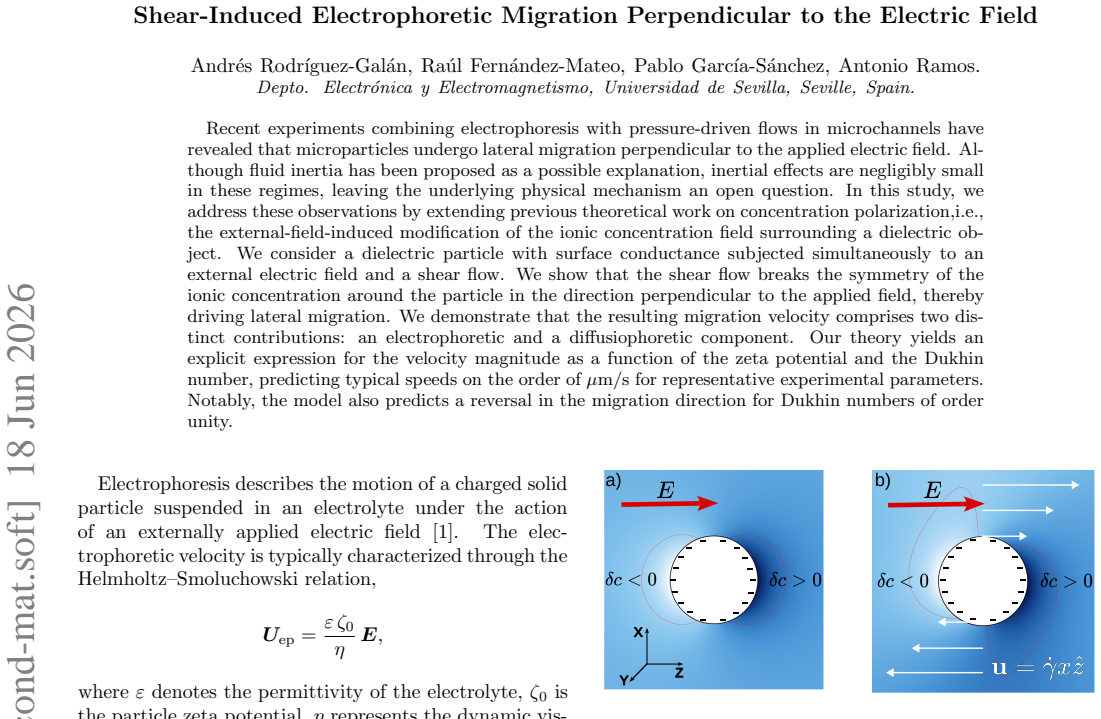
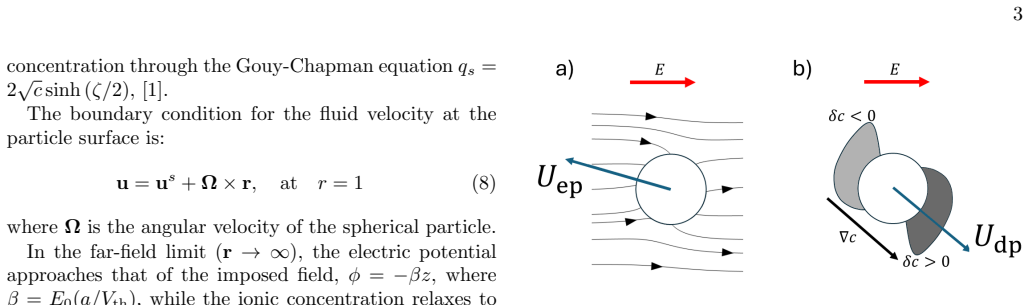
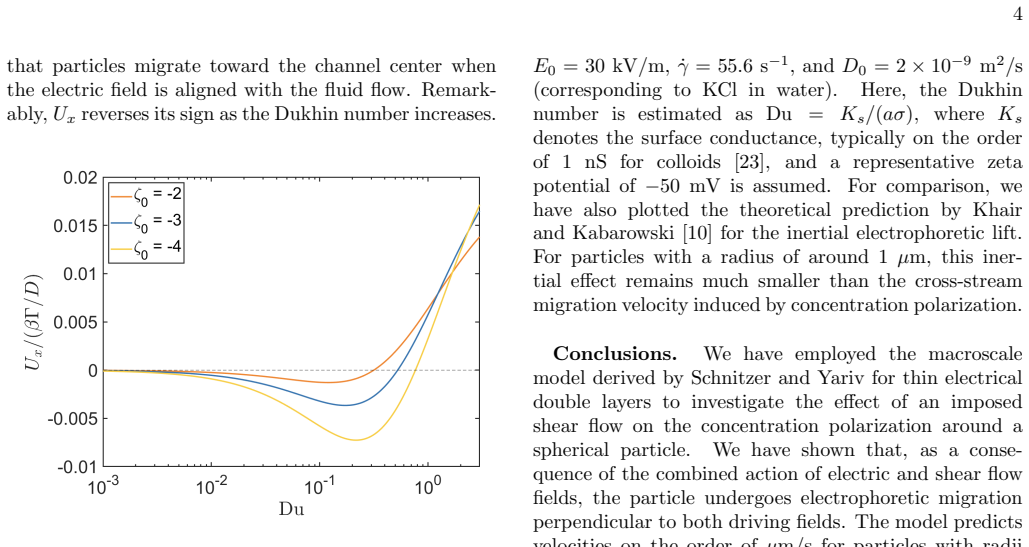
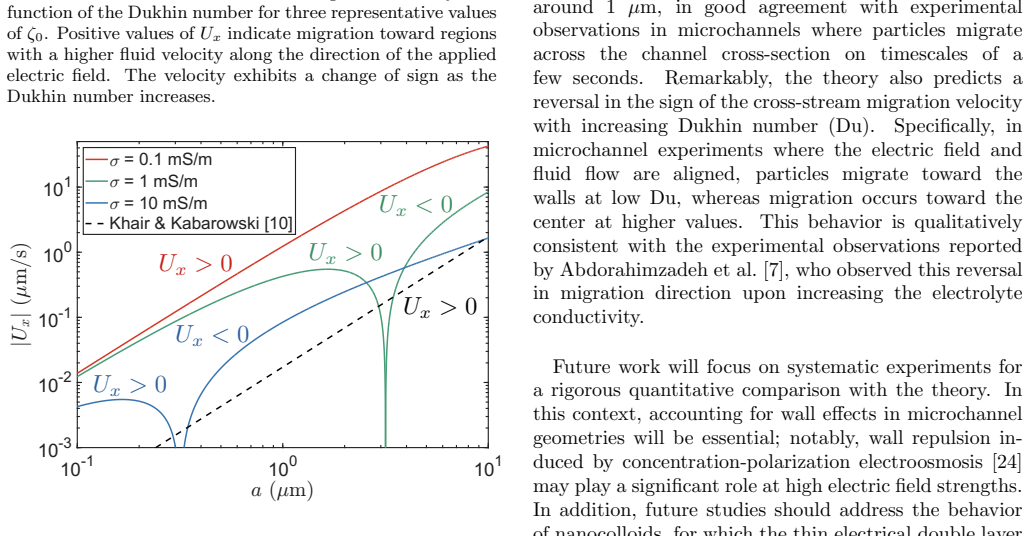
We show that the shear flow breaks the symmetry of the ionic concentration around the particle in the direction perpendicular to the applied field, thereby driving lateral migration. We demonstrate that the resulting migration velocity comprises two distinct contributions: an electrophoretic and a diffusiophoretic component. Our theory yields an explicit expression for the velocity magnitude as a function of the zeta potential and the Dukhin number, predicting typical speeds on the order of μm/s for representative experimental parameters. Notably, the model also predicts a reversal in the migration direction for Dukhin numbers of order unity.
What carries the argument
The shear-induced breaking of symmetry in the ionic concentration polarization around the particle, which generates a net lateral electrophoretic velocity and a diffusiophoretic velocity.
If this is right
- Lateral migration speeds reach order micrometers per second under representative experimental parameters.
- The migration direction reverses when the Dukhin number is of order unity.
- The velocity magnitude is given by an explicit function of zeta potential and Dukhin number.
- The total lateral velocity separates into distinct electrophoretic and diffusiophoretic contributions.
Where Pith is reading between the lines
- The mechanism suggests a route to separate particles by surface conductance in combined flow and field microfluidic setups.
- Analogous lateral drifts may arise in other systems where shear and electric fields act together, such as in porous media or biological suspensions.
- Varying shear rate independently of field strength would allow direct checks of the predicted velocity scaling.
Load-bearing premise
The prior concentration-polarization theory for particles with surface conductance extends to the case of simultaneous electric field and shear flow without other mechanisms dominating the lateral velocity.
What would settle it
Measuring the lateral migration velocity for particles across a range of Dukhin numbers and observing whether the direction reverses near Dukhin number of order unity would test the central prediction.
Figures
read the original abstract
Recent experiments combining electrophoresis with pressure-driven flows in microchannels have revealed that microparticles undergo lateral migration perpendicular to the applied electric field. Although fluid inertia has been proposed as a possible explanation, inertial effects are negligibly small in these regimes, leaving the underlying physical mechanism an open question. In this study, we address these observations by extending previous theoretical work on concentration polarization,i.e., the external-field-induced modification of the ionic concentration field surrounding a dielectric object. We consider a dielectric particle with surface conductance subjected simultaneously to an external electric field and a shear flow. We show that the shear flow breaks the symmetry of the ionic concentration around the particle in the direction perpendicular to the applied field, thereby driving lateral migration. We demonstrate that the resulting migration velocity comprises two distinct contributions: an electrophoretic and a diffusiophoretic component. Our theory yields an explicit expression for the velocity magnitude as a function of the zeta potential and the Dukhin number, predicting typical speeds on the order of $\mathrm{\mu}$m/s for representative experimental parameters. Notably, the model also predicts a reversal in the migration direction for Dukhin numbers of order unity.
Editorial analysis
A structured set of objections, weighed in public.
Referee Report
Summary. The manuscript extends concentration-polarization theory to a dielectric particle with surface conductance under simultaneous external electric field and shear flow. It claims that shear advection breaks the fore-aft symmetry of the ionic concentration field in the direction perpendicular to the applied field, producing a net lateral migration velocity that decomposes into electrophoretic and diffusiophoretic contributions. An explicit closed-form expression for this velocity is derived as a function of zeta potential and Dukhin number, predicting speeds of order μm/s and a reversal in migration direction for Dukhin numbers of order unity.
Significance. If the derivation holds, the work supplies a non-inertial mechanism for recently observed lateral particle migration in combined electrokinetic and pressure-driven microchannel flows. The explicit dependence on zeta and Du, together with the direction-reversal prediction, constitutes a clear, falsifiable claim that can be tested experimentally; this would be a useful contribution to electrokinetic theory.
major comments (2)
- [Derivation of the lateral velocity (concentration-polarization analysis)] The central result (explicit velocity expression and direction reversal at Du ~ O(1)) rests on the assumption that the linearized Nernst-Planck problem with Dukhin-number-dependent surface-flux boundary condition remains uniformly valid when both the electric field and shear flow are present at leading order. No estimate is given for the regime in which convective distortion of the EDL or O(Du) corrections to the tangential velocity boundary condition remain negligible; such corrections would directly alter both the electrophoretic and diffusiophoretic contributions to the perpendicular velocity.
- [Governing equations and boundary conditions] The perturbation scheme (thin-EDL, small-Pe, small-field) is invoked to obtain the perpendicular concentration asymmetry at linear order, yet the manuscript does not demonstrate that the shear-induced advection term, when coupled through the Du-dependent boundary condition, produces a nonzero perpendicular flux at the retained order without higher-order back-coupling. A concrete check (e.g., order-of-magnitude estimate of the neglected terms for the parameter values used to predict reversal) is required to support the load-bearing claim.
minor comments (2)
- [Abstract] The abstract states that typical speeds are “on the order of μm/s for representative experimental parameters” but does not list the specific values of zeta, Du, or shear rate employed; adding these values would allow immediate assessment of the quantitative prediction.
- [Notation and definitions] Notation for the Dukhin number and the decomposition into electrophoretic versus diffusiophoretic velocity components should be introduced once and used consistently in all subsequent equations.
Simulated Author's Rebuttal
We thank the referee for the careful reading and for recognizing the potential significance of the work. The two major comments both concern the need for explicit estimates confirming that the retained linear-order terms dominate under the stated assumptions (thin EDL, small Pe, small field). We agree that such estimates would strengthen the manuscript and will add them in the revision. We respond to each comment below.
read point-by-point responses
-
Referee: [Derivation of the lateral velocity (concentration-polarization analysis)] The central result (explicit velocity expression and direction reversal at Du ~ O(1)) rests on the assumption that the linearized Nernst-Planck problem with Dukhin-number-dependent surface-flux boundary condition remains uniformly valid when both the electric field and shear flow are present at leading order. No estimate is given for the regime in which convective distortion of the EDL or O(Du) corrections to the tangential velocity boundary condition remain negligible; such corrections would directly alter both the electrophoretic and diffusiophoretic contributions to the perpendicular velocity.
Authors: The analysis is performed under the standard thin-EDL, small-Pe, small-field ordering already stated in the manuscript. Within this ordering the shear advection enters the bulk Nernst-Planck equation at the same perturbative order as the electrophoretic driving, while the Dukhin-number surface-flux condition is retained at leading order. Convective distortion of the EDL itself appears only at O(Pe) and is therefore dropped consistently with the small-Pe assumption. O(Du) corrections to the tangential slip velocity are already incorporated through the surface-conductance model; higher-order corrections would require a matched asymptotic treatment of the inner EDL that lies outside the present scope but is standard in the thin-EDL literature. In the revised manuscript we will insert an order-of-magnitude estimate using the representative parameter values that produce the Du ~ O(1) reversal (Pe ≲ 0.1, Du ~ 1, κa ≫ 1), showing that the neglected terms remain smaller than the retained terms by at least an order of magnitude. revision: yes
-
Referee: [Governing equations and boundary conditions] The perturbation scheme (thin-EDL, small-Pe, small-field) is invoked to obtain the perpendicular concentration asymmetry at linear order, yet the manuscript does not demonstrate that the shear-induced advection term, when coupled through the Du-dependent boundary condition, produces a nonzero perpendicular flux at the retained order without higher-order back-coupling. A concrete check (e.g., order-of-magnitude estimate of the neglected terms for the parameter values used to predict reversal) is required to support the load-bearing claim.
Authors: The nonzero perpendicular flux is generated at linear order because the shear advection operator, acting on the fore-aft symmetric concentration perturbation induced by the electric field, produces a source term that is antisymmetric in the transverse coordinate; this source is then integrated against the Du-dependent boundary condition to yield a net transverse electrophoretic and diffusiophoretic velocity. No back-coupling to the leading-order tangential velocity appears at this order because the O(Pe) correction to the slip velocity multiplies an already O(Pe) concentration perturbation. We will add the requested concrete check in the revision, evaluating the magnitude of the neglected O(Pe) and O(1/κa) terms for the same parameter set used to illustrate the Du ~ O(1) reversal, thereby confirming that they do not alter the sign or the leading scaling of the predicted velocity. revision: yes
Circularity Check
No significant circularity; derivation self-contained from standard electrokinetic model
full rationale
The paper extends the standard thin-EDL concentration-polarization framework (Nernst-Planck advection-diffusion with Dukhin-number surface-flux boundary condition) to simultaneous shear and electric field, then solves the resulting linear perturbation problem for the induced concentration asymmetry and the resulting electrophoretic plus diffusiophoretic velocity. The explicit velocity expression is obtained directly from this first-principles expansion; no fitted parameter is renamed as a prediction, no load-bearing step collapses to a self-citation, and the central result is not equivalent to its inputs by construction. The reader's assessment of score 2.0 is consistent with at most a minor non-load-bearing citation to prior concentration-polarization literature.
Axiom & Free-Parameter Ledger
axioms (1)
- domain assumption Standard thin-double-layer and quasi-electroneutrality approximations of electrokinetics remain valid when shear flow is added.
Reference graph
Works this paper leans on
-
[1]
Hunter ,\ @noop title Introduction to Modern Colloid Science \ ( publisher Oxford University Press ,\ year 1993 ) NoStop
author author R. Hunter ,\ @noop title Introduction to Modern Colloid Science \ ( publisher Oxford University Press ,\ year 1993 ) NoStop
1993
-
[2]
von Smoluchowski ,\ title title Contribution \`a la th \'e orie de l'endosmose \'e lectrique et de quelques ph \'e nom \`e nes corr \'e latifs ,\ @noop journal journal Bull
author author M. von Smoluchowski ,\ title title Contribution \`a la th \'e orie de l'endosmose \'e lectrique et de quelques ph \'e nom \`e nes corr \'e latifs ,\ @noop journal journal Bull. Akad. Sci. Cracovie. \ volume 8 ,\ pages 182 ( year 1903 ) NoStop
1903
-
[3]
Zhu , author J
author author Z. Zhu , author J. J. \ Lu ,\ and\ author S. Liu ,\ title title Protein separation by capillary gel electrophoresis: a review ,\ @noop journal journal Analytica chimica acta \ volume 709 ,\ pages 21 ( year 2012 ) NoStop
2012
-
[4]
Stone , author A
author author H. Stone , author A. Stroock ,\ and\ author A. Ajdari ,\ title title Engineering flows in small devices: Microfluidics toward a lab-on-a-chip ,\ @noop journal journal Annu. Rev. Fluid Mech. \ volume 36 ,\ pages 381411 ( year 2004 ) NoStop
2004
-
[5]
Vishwanathan \ and\ author G
author author G. Vishwanathan \ and\ author G. Juarez ,\ title title Synchronous oscillatory electro-inertial focusing of microparticles ,\ @noop journal journal Biomicrofluidics \ volume 17 ( year 2023 ) NoStop
2023
-
[6]
Abdorahimzadeh , author F
author author S. Abdorahimzadeh , author F. W. \ Pratiwi , author S. J. \ Vainio , author H. Liimatainen ,\ and\ author C. Elbuken ,\ title title Interplay of electric field and pressure-driven flow inducing microfluidic particle migration ,\ @noop journal journal Chemical Engineering Science \ volume 276 ( year 2023 ) NoStop
2023
-
[7]
Abdorahimzadeh , author Z
author author S. Abdorahimzadeh , author Z. Bölükkaya , author S. J. \ Vainio , author H. Liimatainen ,\ and\ author C. Elbuken ,\ title title Anomalous electrohydrodynamic cross-stream particle migration ,\ @noop journal journal Physics of Fluids \ volume 36 ( year 2024 ) NoStop
2024
-
[8]
Li \ and\ author X
author author D. Li \ and\ author X. Xuan ,\ title title Electrophoretic slip-tuned particle migration in microchannel viscoelastic fluid flows ,\ @noop journal journal Physical Review Fluids \ volume 3 ,\ pages 074202 ( year 2018 ) NoStop
2018
-
[9]
Di Carlo , author D
author author D. Di Carlo , author D. Irimia , author R. G. \ Tompkins ,\ and\ author M. Toner ,\ title title Continuous inertial focusing, ordering, and separation of particles in microchannels ,\ @noop journal journal Proceedings of the National Academy of Sciences (PNAS) \ volume 104 ,\ pages 18892 ( year 2007 ) NoStop
2007
-
[10]
author author A. S. \ Khair \ and\ author J. K. \ Kabarowski ,\ title title Migration of an electrophoretic particle in a weakly inertial or viscoelastic shear flow ,\ @noop journal journal Physical Review Fluids \ volume 5 ( year 2020 ) NoStop
2020
-
[11]
author author A. Choudhary , author T. Renganathan ,\ and\ author S. Pushpavanam ,\ title title Inertial migration of an electrophoretic rigid sphere in a two-dimensional poiseuille flow ,\ https://doi.org/10.1017/jfm.2019.479 journal journal Journal of Fluid Mechanics \ volume 874 ,\ pages 856–890 ( year 2019 ) NoStop
-
[12]
Dukhin \ and\ author V
author author S. Dukhin \ and\ author V. N. \ Shilov ,\ @noop title Dielectric phenomena and the double layer in disperse systems and polyelectrolytes \ ( publisher John Wiley and Sons ,\ year 1974 ) NoStop
1974
-
[13]
Schnitzer \ and\ author E
author author O. Schnitzer \ and\ author E. Yariv ,\ title title Macroscale description of electrokinetic flows at large zeta potentials: nonlinear surface conduction ,\ @noop journal journal Physical Review E \ volume 86 ,\ pages 021503 ( year 2012 ) NoStop
2012
-
[14]
Schnitzer , author R
author author O. Schnitzer , author R. Zeyde , author I. Yavneh ,\ and\ author E. Yariv ,\ title title Weakly nonlinear electrophoresis of a highly charged colloidal particle ,\ @noop journal journal Physics of Fluids \ volume 25 ,\ pages 052004 ( year 2013 ) NoStop
2013
-
[15]
Schnitzer \ and\ author E
author author O. Schnitzer \ and\ author E. Yariv ,\ title title Nonlinear electrophoresis at arbitrary field strengths: small-dukhin-number analysis ,\ @noop journal journal Physics of Fluids \ volume 26 ,\ pages 122002 ( year 2014 ) NoStop
2014
-
[16]
Calero , author R
author author V. Calero , author R. Fern \'a ndez-Mateo , author H. Morgan , author P. Garc \' a-S \'a nchez ,\ and\ author A. Ramos ,\ title title Stationary electro-osmotic flow driven by ac fields around insulators ,\ @noop journal journal Physical Review Applied \ volume 15 ,\ pages 014047 ( year 2021 ) NoStop
2021
-
[17]
Fern \'a ndez-Mateo , author P
author author R. Fern \'a ndez-Mateo , author P. Garc \' a-S \'a nchez , author V. Calero , author H. Morgan ,\ and\ author A. Ramos ,\ title title Stationary electro-osmotic flow driven by ac fields around charged dielectric spheres ,\ @noop journal journal Journal of Fluid Mechanics \ volume 924 ,\ pages R2 ( year 2021 ) NoStop
2021
-
[18]
author author A. V. \ Delgado , author F. Gonzalez-Caballero , author R. Hunter , author L. Koopal ,\ and\ author J. Lyklema ,\ title title Measurement and interpretation of electrokinetic phenomena (iupac technical report) ,\ @noop journal journal Pure and Applied Chemistry \ volume 77 ,\ pages 1753 ( year 2005 ) NoStop
2005
-
[19]
Prieve , author J
author author D. Prieve , author J. Anderson , author J. Ebel ,\ and\ author M. Lowell ,\ title title Motion of a particle generated by chemical gradients. part 2. electrolytes ,\ @noop journal journal Journal of Fluid Mechanics \ volume 148 ,\ pages 247 ( year 1984 ) NoStop
1984
-
[20]
Yariv , author O
author author E. Yariv , author O. Schnitzer ,\ and\ author I. Frankel ,\ title title Streaming-potential phenomena in the thin-debye-layer limit. part 1. general theory ,\ @noop journal journal Journal of fluid mechanics \ volume 685 ,\ pages 306 ( year 2011 ) NoStop
2011
-
[21]
author author L. G. \ Leal ,\ @noop title Advanced transport phenomena: fluid mechanics and convective transport processes ,\ Vol. volume 7 \ ( publisher Cambridge university press ,\ year 2007 ) NoStop
2007
-
[22]
Masoud \ and\ author H
author author H. Masoud \ and\ author H. A. \ Stone ,\ title title The reciprocal theorem in fluid dynamics and transport phenomena ,\ @noop journal journal Journal of Fluid Mechanics \ volume 879 ,\ pages P1 ( year 2019 ) NoStop
2019
-
[23]
Ermolina \ and\ author H
author author I. Ermolina \ and\ author H. Morgan ,\ title title The electrokinetic properties of latex particles: comparison of electrophoresis and dielectrophoresis ,\ @noop journal journal Journal of colloid and interface science \ volume 285 ,\ pages 419 ( year 2005 ) NoStop
2005
-
[24]
Fern \'a ndez-Mateo , author V
author author R. Fern \'a ndez-Mateo , author V. Calero , author H. Morgan , author P. Garc \' a-S \'a nchez ,\ and\ author A. Ramos ,\ title title Wall repulsion of charged colloidal particles during electrophoresis in microfluidic channels ,\ @noop journal journal Physical Review letters \ volume 128 ,\ pages 074501 ( year 2022 ) NoStop
2022
discussion (0)
Sign in with ORCID, Apple, or X to comment. Anyone can read and Pith papers without signing in.