Effects of interaction range on the mean-field dynamics of Bose polarons
Pith reviewed 2026-06-26 15:21 UTC · model grok-4.3
The pith
The range of impurity-bath forces controls how quickly a Bose polaron relaxes through damped velocity oscillations.
A machine-rendered reading of the paper's core claim, the machinery that carries it, and where it could break.
Core claim
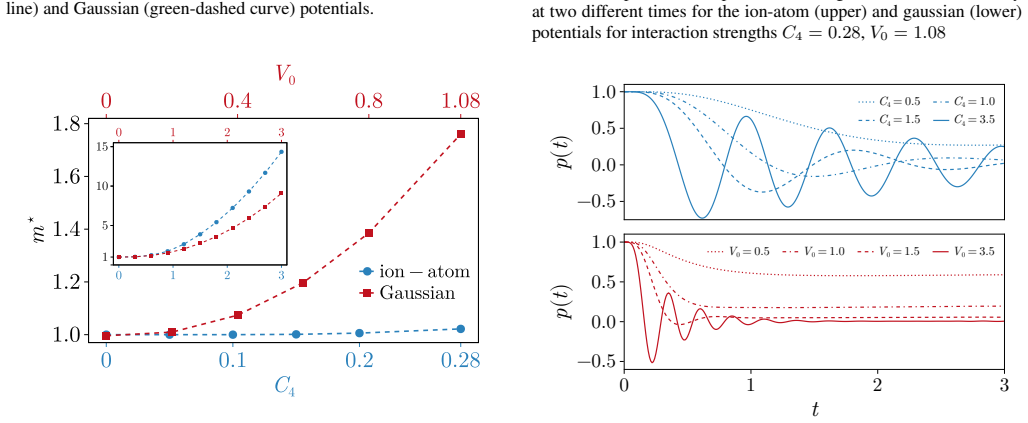
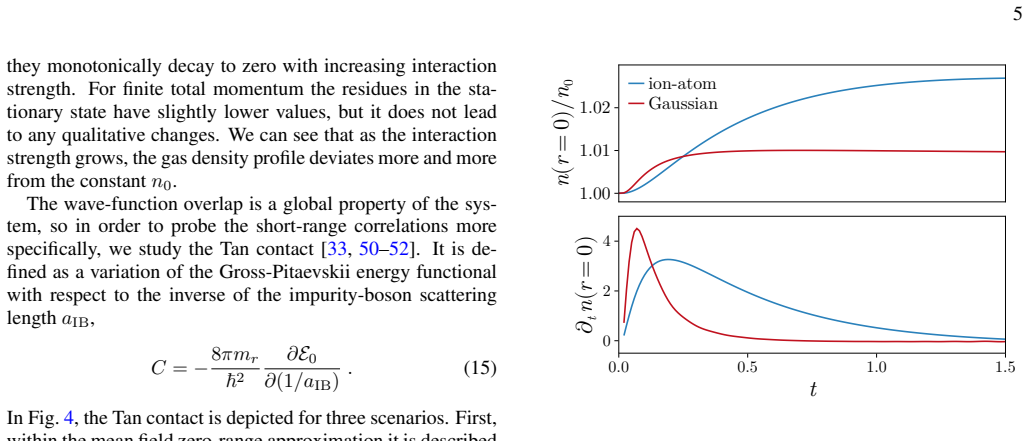
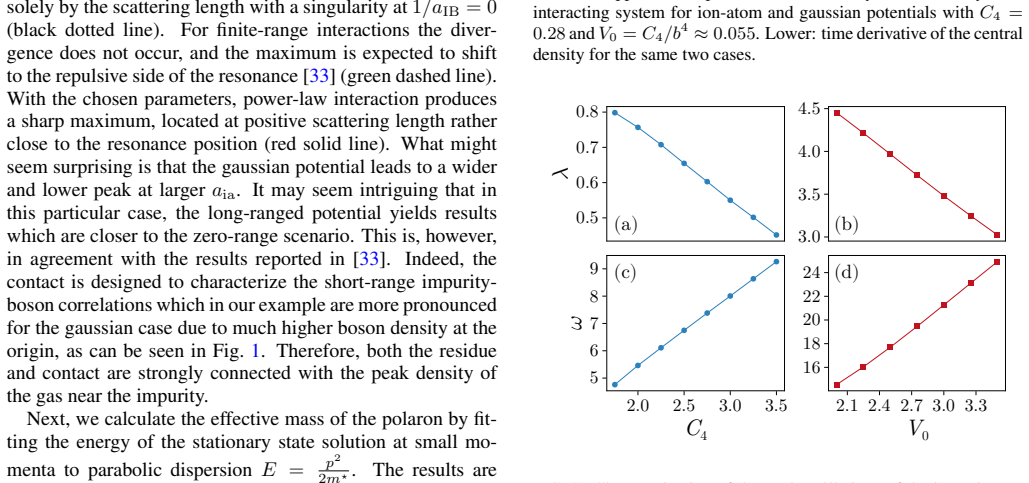
Relaxation dynamics can occur via damped oscillations of the impurity velocity with simple dependence on the interaction strength. The equilibration process is sensitive to the type of the impurity-bath interaction. Specifically, interatomic forces describing ion-atom systems lead to much longer timescales and more pronounced oscillations in the strong coupling regime with respect to local interaction potentials. Effective masses can differ by a large amount between the two scenarios, even if the number of atoms in the polaron cloud remains similar for both cases.
What carries the argument
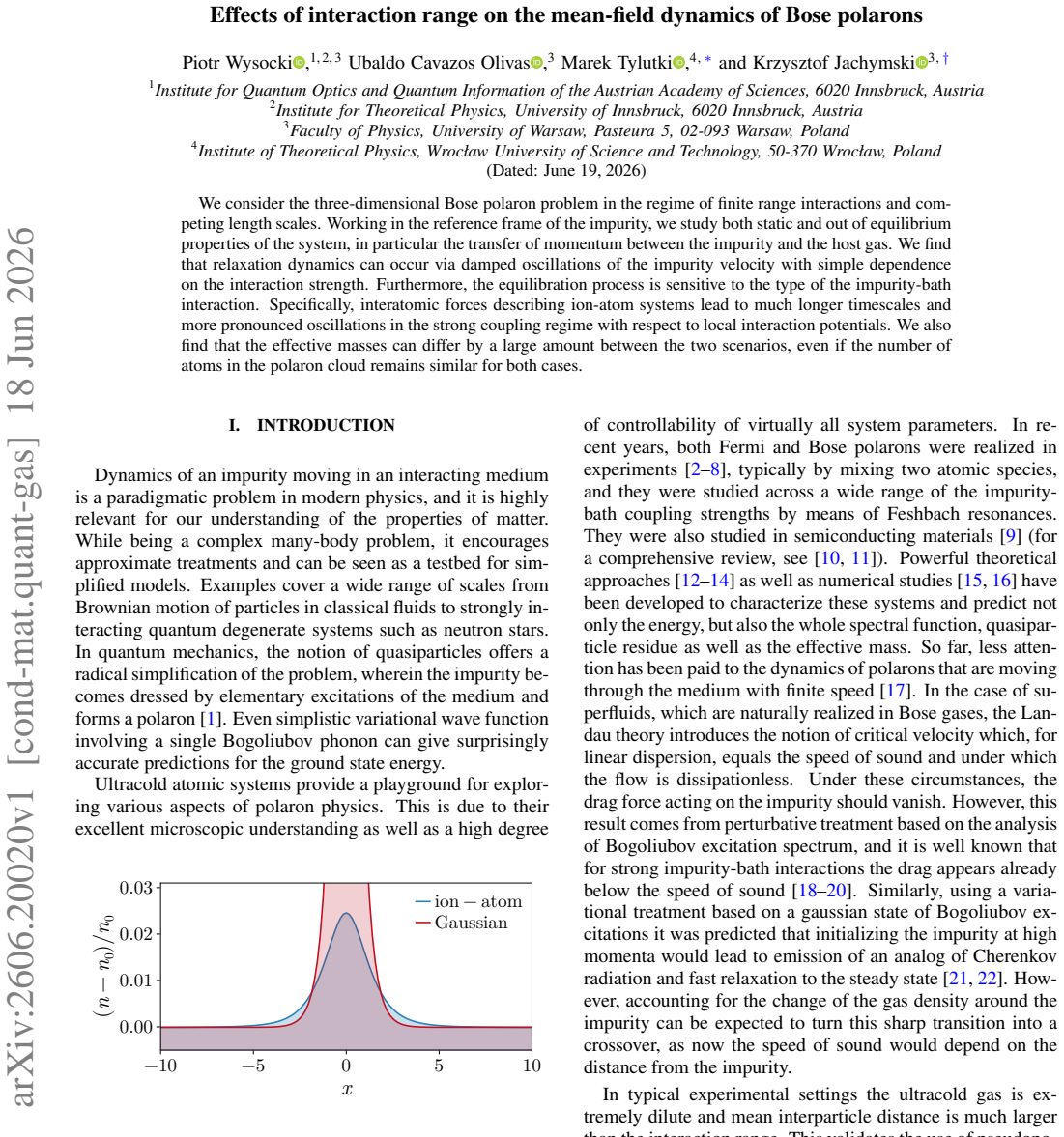
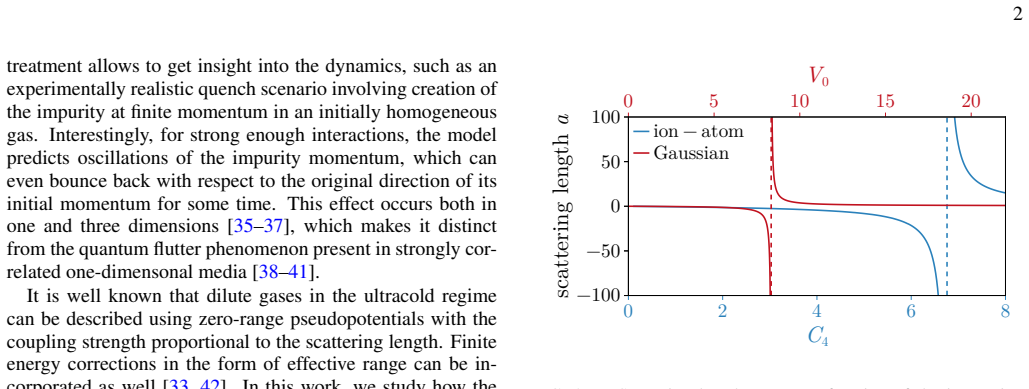
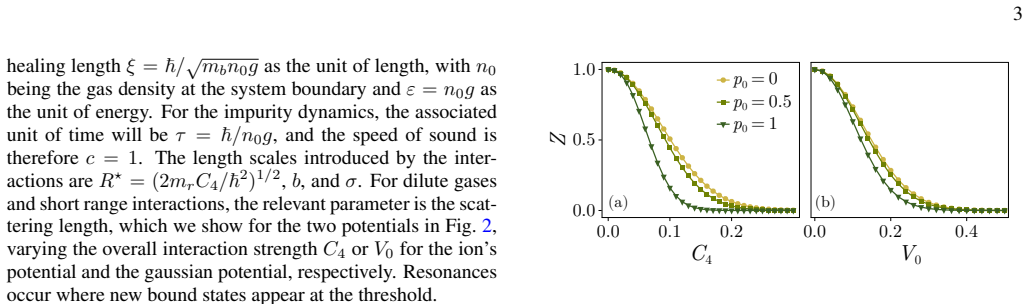
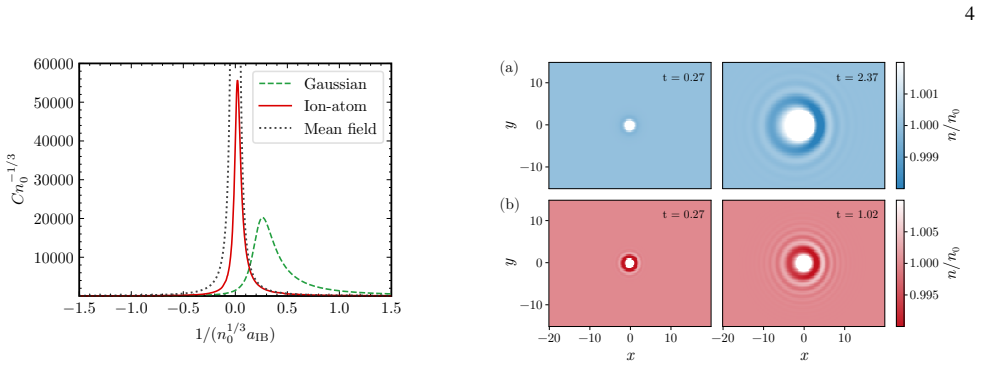
Mean-field evolution of impurity velocity and momentum transfer in the impurity rest frame for finite-range versus contact interactions.
If this is right
- Damped oscillations of impurity velocity provide the relaxation channel, with a form that depends simply on interaction strength.
- Ion-atom type interactions produce longer equilibration times and larger oscillation amplitudes than local potentials in strong coupling.
- Effective masses of the polaron can differ substantially between the two interaction classes even when cloud atom numbers are comparable.
Where Pith is reading between the lines
- Oscillation periods observed in momentum-relaxation experiments could serve as a direct probe of the spatial range of the impurity-bath potential.
- The large effective-mass contrast implies that transport coefficients such as mobility will also differ markedly between neutral and charged impurities despite similar cloud sizes.
- The sensitivity to interaction range suggests that mean-field predictions for out-of-equilibrium dynamics in mixed atomic-ion systems require explicit inclusion of the potential shape rather than a single scattering-length parameter.
Load-bearing premise
The mean-field approximation remains quantitatively accurate for the out-of-equilibrium momentum transfer and relaxation dynamics across the interaction strengths and ranges considered.
What would settle it
An experiment that measures impurity velocity after sudden momentum kick in a Bose gas and finds either no damped oscillations or relaxation timescales that do not differ between ion-atom and contact interactions in the strong-coupling regime.
Figures
read the original abstract
We consider the three-dimensional Bose polaron problem in the regime of finite range interactions and competing length scales. Working in the reference frame of the impurity, we study both static and out of equilibrium properties of the system, in particular the transfer of momentum between the impurity and the host gas. We find that relaxation dynamics can occur via damped oscillations of the impurity velocity with simple dependence on the interaction strength. Furthermore, the equilibration process is sensitive to the type of the impurity-bath interaction. Specifically, interatomic forces describing ion-atom systems lead to much longer timescales and more pronounced oscillations in the strong coupling regime with respect to local interaction potentials. We also find that the effective masses can differ by a large amount between the two scenarios, even if the number of atoms in the polaron cloud remains similar for both cases.
Editorial analysis
A structured set of objections, weighed in public.
Referee Report
Summary. The manuscript examines the three-dimensional Bose polaron problem with finite-range interactions and competing length scales. Working in the impurity reference frame, it analyzes both static properties and out-of-equilibrium momentum transfer between the impurity and the host gas. The central claims are that relaxation proceeds via damped oscillations of the impurity velocity with simple dependence on interaction strength; that ion-atom (long-range) interactions produce substantially longer equilibration timescales and more pronounced oscillations than local potentials in the strong-coupling regime; and that effective masses differ markedly between the two interaction types even when the number of atoms in the polaron cloud is comparable.
Significance. If the mean-field results are quantitatively reliable, the work shows that interaction range is a controlling factor in polaron relaxation dynamics and effective-mass renormalization, offering a concrete distinction between local and ion-atom potentials that could inform experiments in ultracold ion-atom mixtures.
major comments (1)
- [Abstract] Abstract (and the mean-field treatment throughout): the reported damped-oscillation relaxation, interaction-type-dependent timescales, and effective-mass differences are obtained exclusively within a mean-field description. No benchmark against a controlled beyond-mean-field method, fluctuation correction, or expansion parameter is supplied to justify the approximation in the strong-coupling regime highlighted for ion-atom potentials, where correlations are known to renormalize momentum relaxation rates.
Simulated Author's Rebuttal
We thank the referee for the careful reading and the detailed comment on our manuscript. We respond to the major comment below.
read point-by-point responses
-
Referee: [Abstract] Abstract (and the mean-field treatment throughout): the reported damped-oscillation relaxation, interaction-type-dependent timescales, and effective-mass differences are obtained exclusively within a mean-field description. No benchmark against a controlled beyond-mean-field method, fluctuation correction, or expansion parameter is supplied to justify the approximation in the strong-coupling regime highlighted for ion-atom potentials, where correlations are known to renormalize momentum relaxation rates.
Authors: We agree that all quantitative results on the damped-oscillatory relaxation, the interaction-type dependence of the timescales, and the effective-mass differences are obtained strictly within the mean-field treatment. The manuscript is framed as a mean-field study whose purpose is to isolate the role of interaction range and competing length scales. No controlled benchmark against beyond-mean-field methods is provided. In the revised manuscript we will insert an explicit discussion of this limitation, noting that correlations are expected to renormalize relaxation rates in the strong-coupling regime and that the reported numbers should be viewed as qualitative indicators rather than quantitative predictions. revision: yes
Circularity Check
No circularity; direct mean-field evolution of dynamics
full rationale
The paper computes static and dynamical properties via direct numerical integration of the mean-field equations for the impurity-bath system in the impurity rest frame, for two classes of interaction potentials. Reported features (damped velocity oscillations, interaction-range-dependent timescales, effective-mass differences) are outputs of that evolution rather than inputs. No parameter is fitted to a target observable and then relabeled as a prediction, no self-citation supplies a load-bearing uniqueness theorem or ansatz, and the derivation chain does not reduce any claimed result to a tautological re-expression of its own definitions. The work is therefore self-contained against external benchmarks.
Axiom & Free-Parameter Ledger
free parameters (2)
- interaction strength
- interaction range
axioms (1)
- domain assumption Mean-field theory suffices to describe the impurity velocity relaxation and effective mass in the presence of finite-range interactions
Reference graph
Works this paper leans on
-
[1]
Landau and S
L. Landau and S. Pekar, Effective mass of a polaron, Zh. Eksp. Teor. Fiz18, 419 (1948)
1948
-
[2]
Schirotzek, C.-H
A. Schirotzek, C.-H. Wu, A. Sommer, and M. W. Zwierlein, Observation of fermi polarons in a tunable fermi liquid of ultra- cold atoms, Phys. Rev. Lett.102, 230402 (2009)
2009
-
[3]
Cetina, M
M. Cetina, M. Jag, R. S. Lous, I. Fritsche, J. T. Walraven, R. Grimm, J. Levinsen, M. M. Parish, R. Schmidt, M. Knap, et al., Ultrafast many-body interferometry of impurities cou- pled to a fermi sea, Science354, 96 (2016)
2016
-
[4]
G. Ness, C. Shkedrov, Y . Florshaim, O. K. Diessel, J. von Mil- czewski, R. Schmidt, and Y . Sagi, Observation of a smooth polaron-molecule transition in a degenerate fermi gas, Phys. Rev. X10, 041019 (2020)
2020
-
[5]
M.-G. Hu, M. J. Van de Graaff, D. Kedar, J. P. Corson, E. A. Cornell, and D. S. Jin, Bose polarons in the strongly interacting regime, Phys. Rev. Lett.117, 055301 (2016)
2016
-
[6]
Z. Z. Yan, Y . Ni, C. Robens, and M. W. Zwierlein, Bose po- larons near quantum criticality, Science368, 190 (2020)
2020
-
[7]
Z. Z. Yan, Y . Ni, A. Chuang, P. E. Dolgirev, K. Seetharam, E. Demler, C. Robens, and M. Zwierlein, Collective flow of fermionic impurities immersed in a bose–einstein condensate, Nature Physics20, 1395 (2024)
2024
-
[8]
J. c. v. Etrych, G. Martirosyan, A. Cao, C. J. Ho, Z. Hadzibabic, and C. Eigen, Universal quantum dynamics of bose polarons, Phys. Rev. X15, 021070 (2025)
2025
-
[9]
L. B. Tan, O. K. Diessel, A. Popert, R. Schmidt, A. Imamoglu, and M. Kroner, Bose polaron interactions in a cavity-coupled monolayer semiconductor, Phys. Rev. X13, 031036 (2023)
2023
-
[10]
Grusdt, N
F. Grusdt, N. Mostaan, E. Demler, and L. A. P. Ardila, Impuri- ties and polarons in bosonic quantum gases: a review on recent 7 progress (2024)
2024
-
[11]
Massignan, R
P. Massignan, R. Schmidt, G. E. Astrakharchik, A. ˙Imamoglu, M. Zwierlein, J. J. Arlt, and G. M. Bruun, Polarons in atomic gases and two-dimensional semiconductors (2025)
2025
-
[12]
R. S. Christensen, J. Levinsen, and G. M. Bruun, Quasiparticle properties of a mobile impurity in a bose-einstein condensate, Phys. Rev. Lett.115, 160401 (2015)
2015
-
[13]
Y . E. Shchadilova, R. Schmidt, F. Grusdt, and E. Demler, Quan- tum dynamics of ultracold bose polarons, Phys. Rev. Lett.117, 113002 (2016)
2016
-
[14]
Christianen, J
A. Christianen, J. I. Cirac, and R. Schmidt, Phase diagram for strong-coupling bose polarons, SciPost Physics16, 067 (2024)
2024
-
[15]
L. A. P. Ardila and S. Giorgini, Impurity in a bose-einstein condensate: Study of the attractive and repulsive branch using quantum monte carlo methods, Phys. Rev. A92, 033612 (2015)
2015
-
[16]
S. I. Mistakidis, F. Grusdt, G. M. Koutentakis, and P. Schmelcher, Dissipative correlated dynamics of a moving im- purity immersed in a bose–einstein condensate, New Journal of Physics21, 103026 (2019)
2019
-
[17]
M. G. Skou, T. G. Skov, N. B. Jørgensen, K. K. Nielsen, A. Camacho-Guardian, T. Pohl, G. M. Bruun, and J. J. Arlt, Non-equilibrium quantum dynamics and formation of the bose polaron, Nature Physics17, 731 (2021)
2021
-
[18]
Pavloff, Breakdown of superfluidity of an atom laser past an obstacle, Phys
N. Pavloff, Breakdown of superfluidity of an atom laser past an obstacle, Phys. Rev. A66, 013610 (2002)
2002
-
[19]
Ianeselli, C
S. Ianeselli, C. Menotti, and A. Smerzi, Beyond the landau cri- terion for superfluidity, Journal of Physics B: Atomic, Molecu- lar and Optical Physics39, S135 (2006)
2006
-
[20]
Carusotto, S
I. Carusotto, S. X. Hu, L. A. Collins, and A. Smerzi, Bogoliubov- ˇCerenkov radiation in a bose-einstein condensate flowing against an obstacle, Phys. Rev. Lett.97, 260403 (2006)
2006
-
[21]
Seetharam, Y
K. Seetharam, Y . Shchadilova, F. Grusdt, M. B. Zvonarev, and E. Demler, Dynamical quantum cherenkov transition of fast impurities in quantum liquids, Phys. Rev. Lett.127, 185302 (2021)
2021
-
[22]
Seetharam, Y
K. Seetharam, Y . Shchadilova, F. Grusdt, M. Zvonarev, and E. Demler, Quantum cherenkov transition of finite-momentum bose polarons, Phys. Rev. A110, 063306 (2024)
2024
-
[23]
Tomza, K
M. Tomza, K. Jachymski, R. Gerritsma, A. Negretti, T. Calarco, Z. Idziaszek, and P. S. Julienne, Cold hybrid ion-atom systems, Rev. Mod. Phys.91, 035001 (2019)
2019
-
[24]
R. S. Lous and R. Gerritsma, Ultracold ion-atom experiments: cooling, chemistry, and quantum effects, Advances in Atomic, Molecular, and Optical Physics71, 65 (2022)
2022
-
[25]
Massignan, C
P. Massignan, C. J. Pethick, and H. Smith, Static properties of positive ions in atomic bose-einstein condensates, Phys. Rev. A 71, 023606 (2005)
2005
-
[26]
E. R. Christensen, A. Camacho-Guardian, and G. M. Bruun, Charged polarons and molecules in a bose-einstein condensate, Phys. Rev. Lett.126, 243001 (2021)
2021
-
[27]
G. E. Astrakharchik, L. A. P. Ardila, R. Schmidt, K. Jachymski, and A. Negretti, Ionic polaron in a bose-einstein condensate, Communications Physics4, 94 (2021)
2021
-
[28]
Cavazos Olivas, L
U. Cavazos Olivas, L. A. Peña Ardila, and K. Jachymski, Mod- ified mean-field ansatz for charged polarons in a bose-einstein condensate, Phys. Rev. A110, L011301 (2024)
2024
-
[29]
T. A. Yo ˘gurt and M. T. Eiles, Quasiparticle properties of long- range impurities in a bose condensate, Phys. Rev. A112, 063313 (2025)
2025
-
[30]
G. A. Sánchez and A. C. Guardian, Charged bose polarons at finite momentum, arXiv preprint arXiv:2605.31255 (2026)
Pith/arXiv arXiv 2026
-
[31]
Gross, Motion of foreign bodies in boson systems, Annals of Physics19, 234 (1962)
E. Gross, Motion of foreign bodies in boson systems, Annals of Physics19, 234 (1962)
1962
-
[32]
Drescher, M
M. Drescher, M. Salmhofer, and T. Enss, Theory of a resonantly interacting impurity in a bose-einstein condensate, Phys. Rev. Res.2, 032011 (2020)
2020
-
[33]
Schmidt and T
R. Schmidt and T. Enss, Self-stabilized bose polarons, SciPost Physics13, 054 (2022)
2022
-
[34]
Yegovtsev, G
N. Yegovtsev, G. E. Astrakharchik, P. Massignan, and V . Gu- rarie, Exact results for heavy unitary bose polarons, Phys. Rev. A110, 023310 (2024)
2024
-
[35]
Majumdar and A
S. Majumdar and A. Petkovi´c, Relaxation dynamics of a mobile impurity injected into a one-dimensional bose gas, Phys. Rev. A112, 053326 (2025)
2025
-
[36]
S. Majumdar and A. Petkovi ´c, Dynamically entangled oscillat- ing state in a bose gas with an attractive polaron, arXiv preprint arXiv:2602.08443 (2026)
Pith/arXiv arXiv 2026
-
[37]
Wysocki, M
P. Wysocki, M. Tylutki, and K. Jachymski, Dynamics of a mo- bile ion in a bose–einstein condensate, New Journal of Physics 28, 013201 (2026)
2026
-
[38]
C. J. M. Mathy, M. B. Zvonarev, and E. Demler, Quantum flut- ter of supersonic particles in one-dimensional quantum liquids, Nature Physics8, 881 (2012)
2012
-
[39]
M. Knap, C. J. M. Mathy, M. Ganahl, M. B. Zvonarev, and E. Demler, Quantum flutter: Signatures and robustness, Phys. Rev. Lett.112, 015302 (2014)
2014
-
[40]
Burovski, V
E. Burovski, V . Cheianov, O. Gamayun, and O. Lychkovskiy, Momentum relaxation of a mobile impurity in a one- dimensional quantum gas, Phys. Rev. A89, 041601 (2014)
2014
-
[41]
Zhang, Y
Z.-H. Zhang, Y . Jiang, H.-Q. Lin, and X.-W. Guan, Microscopic origin of the quantum supersonic phenomenon in one dimen- sion, Phys. Rev. A110, 023329 (2024)
2024
-
[42]
Collin, P
A. Collin, P. Massignan, and C. J. Pethick, Energy-dependent effective interactions for dilute many-body systems, Phys. Rev. A75, 013615 (2007)
2007
-
[43]
Krych and Z
M. Krych and Z. Idziaszek, Description of ion motion in a paul trap immersed in a cold atomic gas, Phys. Rev. A91, 023430 (2015)
2015
-
[44]
T. D. Lee, F. E. Low, and D. Pines, The motion of slow electrons in a polar crystal, Phys. Rev.90, 297 (1953)
1953
-
[45]
Girardeau, Motion of an impurity particle in a boson super- fluid, The Physics of Fluids4, 279 (1961)
M. Girardeau, Motion of an impurity particle in a boson super- fluid, The Physics of Fluids4, 279 (1961)
1961
-
[46]
Jager, R
J. Jager, R. Barnett, M. Will, and M. Fleischhauer, Strong- coupling bose polarons in one dimension: Condensate defor- mation and modified bogoliubov phonons, Phys. Rev. Res.2, 033142 (2020)
2020
-
[47]
D. Breu, E. Vidal Marcos, M. Will, and M. Fleischhauer, Impu- rities in a trapped one-dimensional bose gas of arbitrary inter- action strength: Localization-delocalization transition and ab- sence of self-localization, Phys. Rev. A111, 023326 (2025)
2025
-
[48]
R. Kubo, M. Toda, and N. Hashitsume,Statistical physics II: nonequilibrium statistical mechanics, V ol. 31 (Springer Science & Business Media, 2012)
2012
-
[49]
A. O. Caldeira and A. J. Leggett, Influence of dissipation on quantum tunneling in macroscopic systems, Phys. Rev. Lett.46, 211 (1981)
1981
-
[50]
Tan, Energetics of a strongly correlated fermi gas, Annals of Physics323, 2952 (2008)
S. Tan, Energetics of a strongly correlated fermi gas, Annals of Physics323, 2952 (2008)
2008
-
[51]
Tan, Large momentum part of a strongly correlated fermi gas, Annals of Physics323, 2971 (2008)
S. Tan, Large momentum part of a strongly correlated fermi gas, Annals of Physics323, 2971 (2008)
2008
-
[52]
Guenther, R
N.-E. Guenther, R. Schmidt, G. M. Bruun, V . Gurarie, and P. Massignan, Mobile impurity in a bose-einstein condensate and the orthogonality catastrophe, Phys. Rev. A103, 013317 (2021)
2021
-
[53]
Dieterle, M
T. Dieterle, M. Berngruber, C. Hölzl, R. Löw, K. Jachymski, T. Pfau, and F. Meinert, Transport of a single cold ion immersed in a bose-einstein condensate, Phys. Rev. Lett.126, 033401 8 (2021). [54] R. Grimm, (2025), conference presentation
2021
discussion (0)
Sign in with ORCID, Apple, or X to comment. Anyone can read and Pith papers without signing in.