Quantitative prediction of excitons in lattice-mismatched van der Waals heterostructures
Pith reviewed 2026-06-26 16:34 UTC · model grok-4.3
The pith
The mQEH-BSE framework predicts absorption spectra and exciton energies in lattice-mismatched van der Waals heterostructures in agreement with experiment.
A machine-rendered reading of the paper's core claim, the machinery that carries it, and where it could break.
Core claim
The mQEH method employs a hierarchical and systematically improvable basis set to describe potentials and induced densities, eliminating the need for arbitrary geometric cutoffs. Combined with a layer projected Bethe-Salpeter Equation, it enables accurate calculations of optical spectra for lattice-mismatched vdW heterostructures, achieving excellent agreement with experiment for TMD heterobilayers.
What carries the argument
The microscopic Quantum Electrostatic Heterostructure (mQEH) method, which uses a hierarchical basis set to accurately capture induced densities and potentials at all length scales.
If this is right
- Absorption spectra of lattice-mismatched vdW heterostructures can be computed efficiently.
- Momentum-indirect exciton energies are obtained in excellent agreement with experiment.
- The method provides a computationally efficient route to predictive modeling of vdW heterostructures.
- Arbitrary geometric cutoffs are no longer needed for accurate screening descriptions.
Where Pith is reading between the lines
- The framework may enable rapid screening of many possible heterostructure combinations for desired optical responses.
- Extensions to other material classes beyond TMDs could follow from the same basis set approach.
- Quantitative predictions could guide experimental fabrication of devices with tailored photonic properties.
Load-bearing premise
The hierarchical and systematically improvable basis set employed by mQEH accurately captures induced densities and potentials at all length scales without requiring arbitrary geometric cutoffs.
What would settle it
Experimental measurement of absorption spectra or exciton energies in a TMD heterobilayer that deviates substantially from the mQEH-BSE prediction.
Figures
read the original abstract
Accurate modeling of dielectric screening in van der Waals (vdW) heterostructures is essential for predicting photonic and optoelectronic properties - yet conventional first-principles methods are often hindered by incommensurate lattices and prohibitive computational costs. In this work, we introduce the microscopic Quantum Electrostatic Heterostructure (mQEH) method. mQEH employs a hierarchical and systematically improvable basis set to describe potentials and induced densities, eliminating the need for arbitrary geometric cutoffs and ensuring accurate screening descriptions at all length scales. The mQEH method is combined with a layer projected Bethe-Salpeter Equation (BSE) to enable calculations of optical spectra of experimentally relevant lattice-mismatched vdW heterostructures. Applying the mQEH-BSE framework to a series of transition-metal dichalcogenide (TMD) heterobilayers, we obtain absorption spectra and momentum-indirect exciton energies in excellent agreement with experiment. The framework provides a computationally efficient route to predictive modeling and design of vdW heterostructures with tailored optical properties.
Editorial analysis
A structured set of objections, weighed in public.
Referee Report
Summary. The manuscript introduces the microscopic Quantum Electrostatic Heterostructure (mQEH) method, which employs a hierarchical and systematically improvable basis set to describe induced densities and potentials in van der Waals heterostructures without arbitrary geometric cutoffs. This is combined with a layer-projected Bethe-Salpeter equation (BSE) to compute optical absorption spectra and momentum-indirect exciton energies for lattice-mismatched transition-metal dichalcogenide heterobilayers, with the central claim being quantitative agreement with experimental data.
Significance. If the quantitative agreement holds under scrutiny, the framework offers a computationally efficient and systematically improvable route to predictive modeling of excitonic and optical properties in incommensurate vdW systems, which is a significant advance for materials design in this area. The absence of ad-hoc parameters and the focus on all length scales are strengths.
minor comments (2)
- [Abstract] Abstract: the statement of 'excellent agreement with experiment' lacks accompanying quantitative validation statistics (e.g., mean absolute deviation, R², or error bars on computed vs. measured exciton energies). Adding these would strengthen the central claim.
- The manuscript should include a dedicated validation section or table comparing mQEH-BSE results to experiment across the full series of TMD heterobilayers, with explicit discussion of any outliers or system-specific deviations.
Simulated Author's Rebuttal
We thank the referee for their positive assessment of the manuscript, recognition of the strengths of the mQEH approach (systematically improvable basis without ad-hoc cutoffs), and recommendation for minor revision. We are pleased that the significance for predictive modeling of incommensurate vdW heterostructures is acknowledged.
Circularity Check
No significant circularity
full rationale
The paper introduces mQEH as a new method employing a hierarchical, systematically improvable basis for induced densities and potentials (eliminating geometric cutoffs), then combines it with layer-projected BSE to compute spectra and exciton energies for lattice-mismatched TMD heterobilayers. These quantities are compared directly to external experimental absorption spectra and energies rather than to any internally fitted or self-defined quantities. No equations or claims reduce by construction to prior inputs, self-citations, or ansatzes; the central results rest on the method's construction plus independent experimental benchmarks, rendering the derivation self-contained.
Axiom & Free-Parameter Ledger
axioms (1)
- domain assumption A hierarchical and systematically improvable basis set can describe potentials and induced densities at all length scales without arbitrary geometric cutoffs.
invented entities (1)
-
microscopic Quantum Electrostatic Heterostructure (mQEH) method
no independent evidence
Reference graph
Works this paper leans on
-
[1]
The measured position of the two low- est, optically active excitons (often referred to as the A and B excitons) are indicated by the second and third downward-pointing arrows
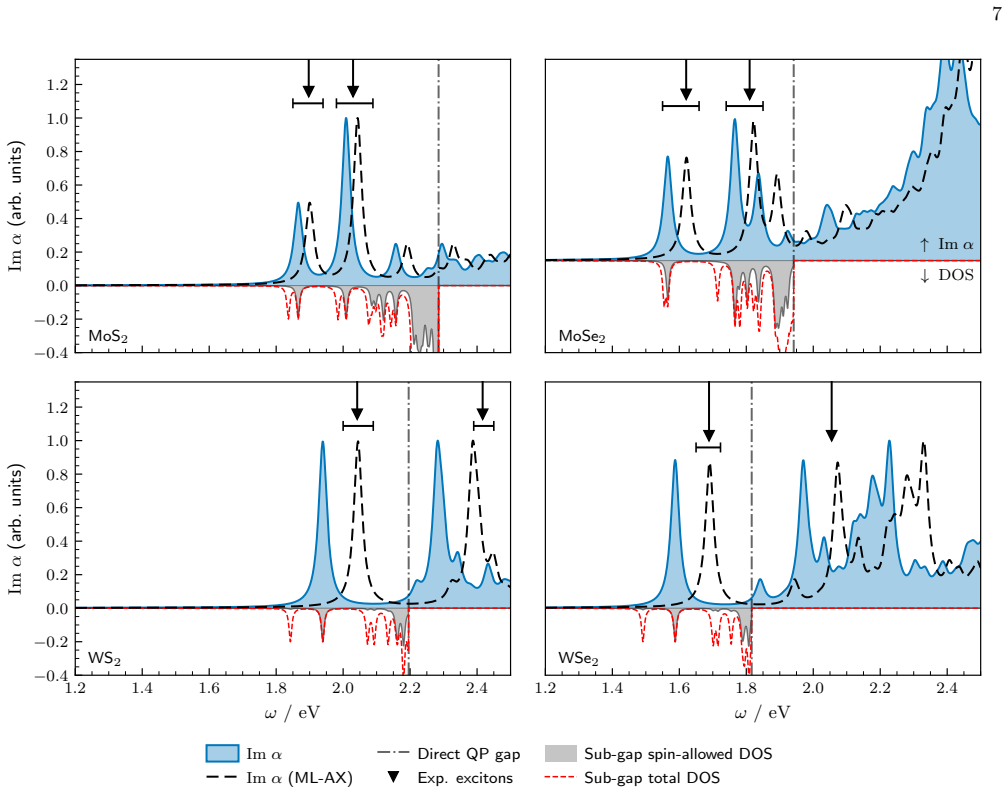
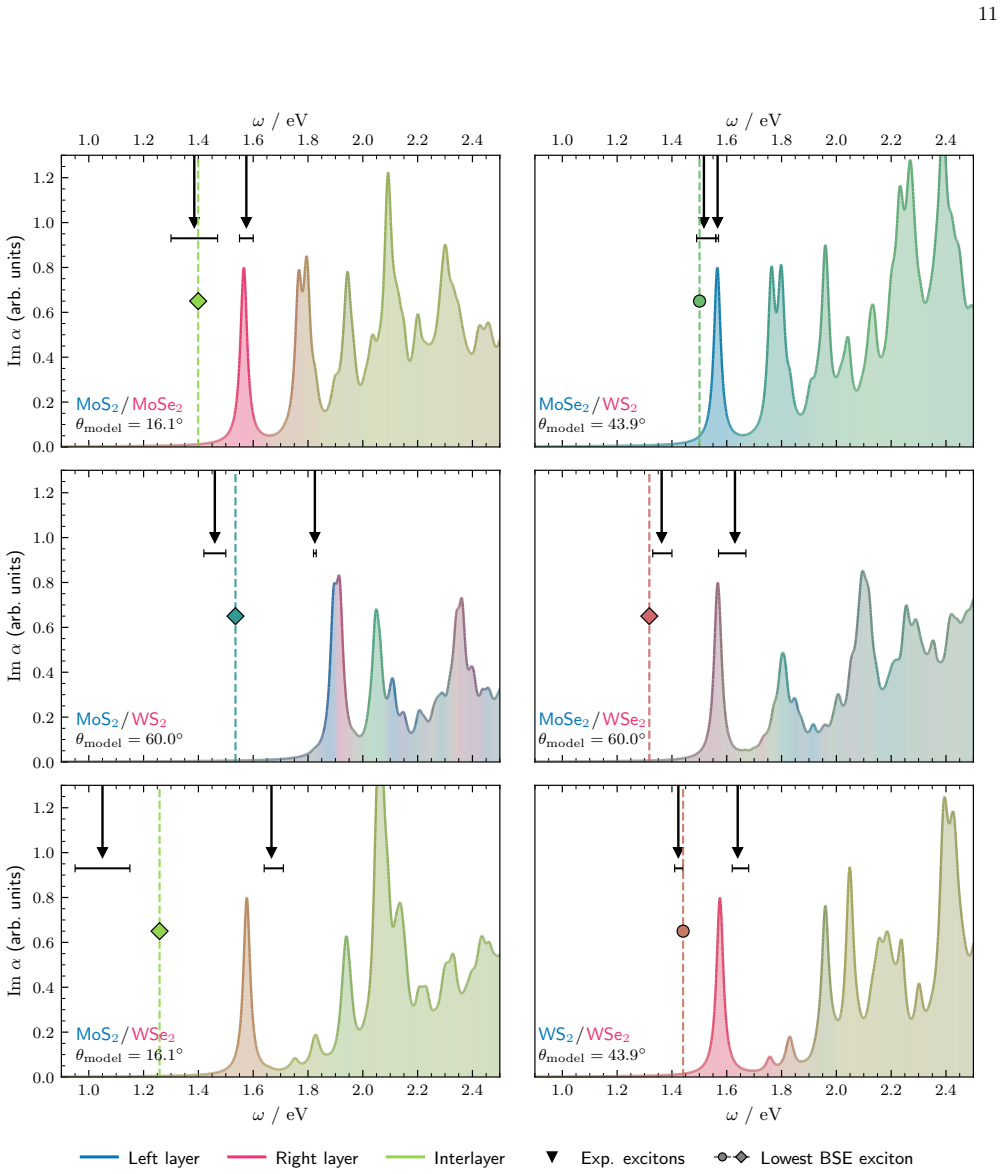
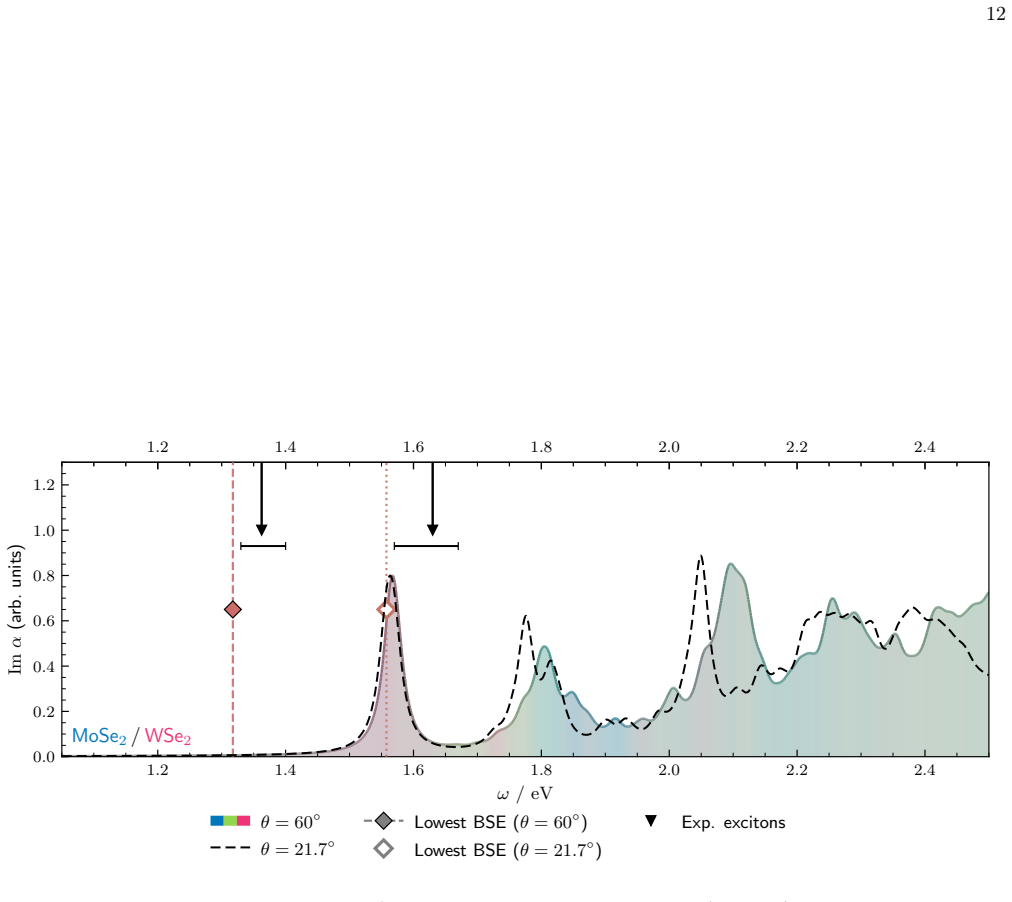
Its experimentally measured position is indicated by the first downward- pointing arrow. The measured position of the two low- est, optically active excitons (often referred to as the A and B excitons) are indicated by the second and third downward-pointing arrows. The experimental data are provided in Table IV. Both the fullyab initio and the ML-AX corre...
-
[2]
In addition, we solve the mQEH-BSE at a finite center-of- mass momentum, Q, corresponding to the indirect band gap in the band structure
To identify the lowest-lying, possibly dark, exciton,X d 0, we now consider the exciton energies, independently of their oscillator strengths. In addition, we solve the mQEH-BSE at a finite center-of- mass momentum, Q, corresponding to the indirect band gap in the band structure. The energy of the lowest singlet exciton is indicated by the dashed vertical...
-
[3]
6 from the good agreement between the vertical dashed lines and the first downward-pointing arrow
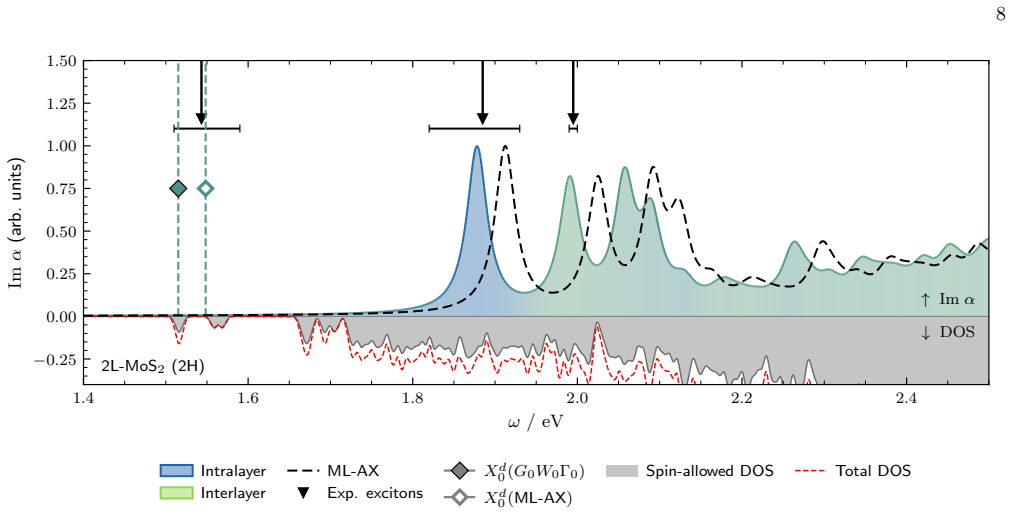
This is evident in Fig. 6 from the good agreement between the vertical dashed lines and the first downward-pointing arrow. Indeed, with the exception of MoS2/WSe2, all calculated exciton energies lie within 0.1 eV of the average experimental value, represented by the arrow. For MoS2/WSe2, the agreement is less satisfac- tory, which we attribute to the pro...
2022
-
[4]
The density induced by an exter- nal potential Vext(q, ω, z) is then ρind(q, ω, z) = X ij h ρi(q, z) χij(q, ω) Z ρ∗ j(q, z′) Vext(q, ω, z′)dz′ i
Operator representation and the matrix Dyson equation We write the density response functionχ (and similarly eχ) in the operator representation χ(q, ω) = X ij |ρi(q)⟩ χij(q, ω) ⟨ρj(q)| , (A1) where i = (ℓ, α) and j = (ℓ′, β) are combined layer and basis function indices. The density induced by an exter- nal potential Vext(q, ω, z) is then ρind(q, ω, z) = ...
-
[5]
The color of the circles indicate the projection of the band onto each of the two layers
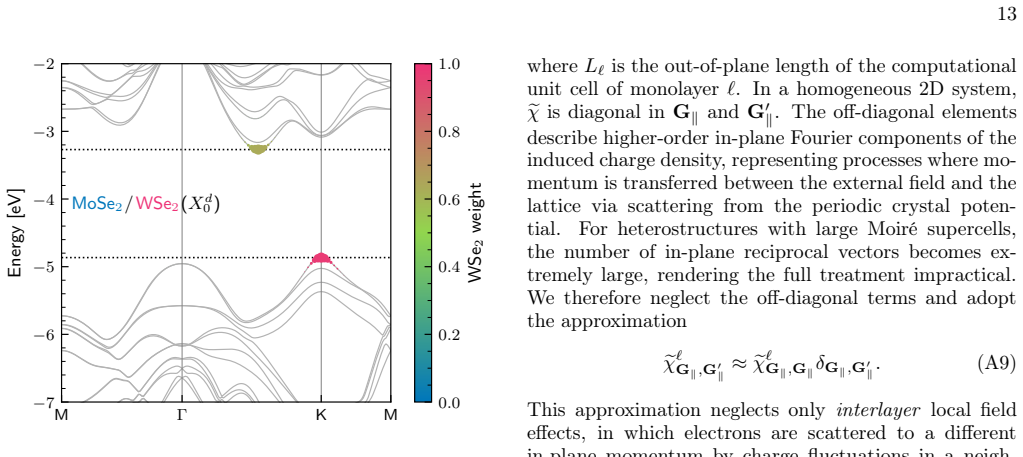
in lattice-matched MoSe2/WSe2 (θ = 60◦). The color of the circles indicate the projection of the band onto each of the two layers. The hole is localized in the WSe2 layer, while the electron is hybridized with significant weight on both layers. matrix V I, on the other hand, couples different layers, so thesolution χofEq.(A5)isnotblock-diagonal, reflectin...
-
[6]
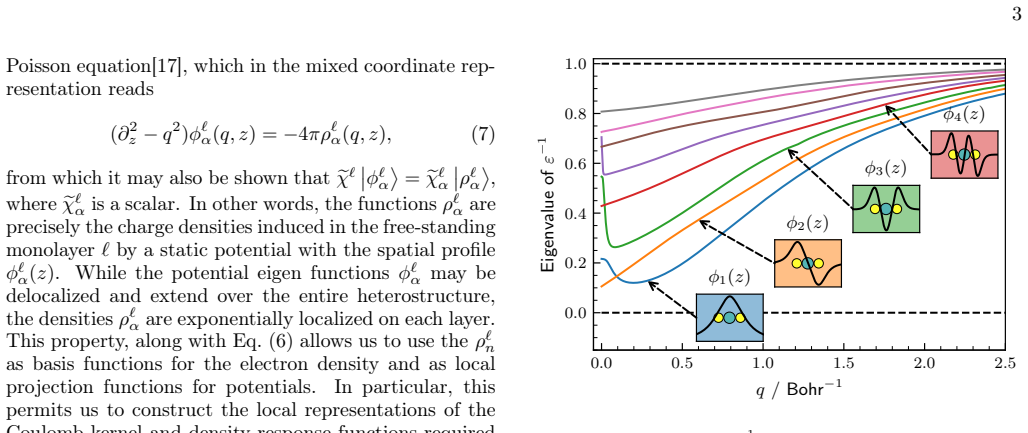
Mixed-space representation and in-plane diagonal approximation In practice,eχℓ is computed in a plane-wave basis using the GPAW [27] code. This plane-wave basis is related to the real-space representation by eχℓ(q, r, r′) = 1 Ωℓ X GG′ ei(G+q)·reχℓ GG′(q)e−i(G′+q)·r′ , (A6) where Ωℓ is the volume of the computational unit cell of monolayer ℓ, and eχℓ(r, r′...
-
[7]
Representation of eχℓ at finite frequency and long wavelengths The shape of the eigenfunctions ϕℓ α(q, z) and ρℓ α(q, z) changes only weakly with frequencyω. To avoid storing nearly identical basis functions at every frequency point, we diagonalize V (q)eχℓ(q, ω = 0) only at ω = 0 and use the resulting eigenfunctions as the density and potential basis at ...
-
[8]
A. K. Geim and I. V. Grigorieva, Van der waals het- erostructures, Nature499, 419 (2013)
2013
-
[9]
W. Ren, P. Bøggild, J. Redwing, K. S. Novoselov, L. Sun, Y. Qi, K. Jia, Z. Liu, O. Burton, J. Alexander-Webber, et al. , The 2d materials roadmap, 2D Materials 13, 021501 (2026)
2026
-
[10]
F. J. G. de Abajo, D. N. Basov, F. H. Koppens, L. Orsini, M. Ceccanti, S. Castilla, L. Cavicchi, M. Polini, P. A. D. Gonçalves, A. T. Costa, et al., Roadmap for photonics with 2d materials, ACS Photonics12, 3961 (2025)
2025
-
[11]
Withers, O
F. Withers, O. Del Pozo-Zamudio, A. Mishchenko, A. P. Rooney, A. Gholinia, K. Watanabe, T. Taniguchi, S. J. Haigh, A. Geim, A. Tartakovskii,et al., Light-emitting diodes by band-structure engineering in van der waals heterostructures, Nature materials14, 301 (2015)
2015
-
[12]
M. Long, P. Wang, H. Fang, and W. Hu, Progress, chal- lenges, and opportunities for 2d material based pho- todetectors, Advanced Functional Materials29, 1803807 (2019)
2019
-
[13]
Ciarrocchi, F
A. Ciarrocchi, F. Tagarelli, A. Avsar, and A. Kis, Exci- tonic devices with van der waals heterostructures: val- leytronics meets twistronics, Nature Reviews Materials 7, 449 (2022)
2022
-
[14]
Y. Cao, V. Fatemi, S. Fang, K. Watanabe, T. Taniguchi, E.Kaxiras,andP.Jarillo-Herrero,Unconventionalsuper- conductivity in magic-angle graphene superlattices, Na- ture 556, 43 (2018)
2018
-
[15]
Wang, E.-M
L. Wang, E.-M. Shih, A. Ghiotto, L. Xian, D. A. Rhodes, C. Tan, M. Claassen, D. M. Kennes, Y. Bai, B. Kim, et al. , Correlated electronic phases in twisted bilayer transition metal dichalcogenides, Nature Materials 19, 861 (2020)
2020
-
[16]
Bistritzer and A
R. Bistritzer and A. H. MacDonald, Moiré bands in twisted double-layer graphene, Proceedings of the Na- tional Academy of Sciences108, 12233 (2011)
2011
-
[17]
Cudazzo, I
P. Cudazzo, I. V. Tokatly, and A. Rubio, Dielectric screening in two-dimensional insulators: Implications for excitonic and impurity states in graphane, Physical Re- view B—Condensed Matter and Materials Physics84, 085406 (2011)
2011
-
[18]
K. S. Thygesen, Calculating excitons, plasmons, and quasiparticles in 2d materials and van der waals het- erostructures, 2D Materials4, 022004 (2017)
2017
-
[19]
Andersen, S
K. Andersen, S. Latini, and K. S. Thygesen, Dielectric genome of van der waals heterostructures, Nano letters 15, 4616 (2015)
2015
-
[20]
M. O. Sauer and T. G. Pedersen, Exciton absorption, band structure, and optical emission in biased bilayer graphene, Physical Review B105, 115416 (2022)
2022
-
[21]
D. A. Leon, M. Kuisma, M. O. Sauer, J. K. Svaneborg, M.K.Svendsen, S.Americo, K.Berland, J.J.Mortensen, and K. S. Thygesen, Self-consistent layer-projected scis- sors operator for band structures of two-dimensional van der waals materials with large unit cells, Phys. Rev. B 112, 115128 (2025)
2025
-
[22]
M. Gjerding, L.Cavalcante, A.Chaves,andK.Thygesen, Efficient ab initio modeling of dielectric screening in 2d van der waals materials: Including phonons, substrates, and doping, The Journal of Physical Chemistry C124, 11609 (2020)
2020
-
[23]
Macheda, F
F. Macheda, F. Mauri, and T. Sohier, Ab initio van der waals electrodynamics: Polaritons and electron scatter- ing from plasmons and phonons in bn-capped graphene, Physical Review B110, 115407 (2024)
2024
-
[24]
Andersen, K
K. Andersen, K. W. Jacobsen, and K. S. Thygesen, Spatially resolved quantum plasmon modes in metal- lic nano-films from first-principles, Physical Review B—Condensed Matter and Materials Physics86, 245129 (2012)
2012
-
[25]
P. S. Schmidt, C. E. Patrick, and K. S. Thygesen, Simple vertex correction improves gw band energies of bulk and two-dimensional crystals, Physical Review B96, 205206 (2017)
2017
-
[26]
K. T. Winther and K. S. Thygesen, Band structure en- gineering in van der waals heterostructures via dielec- tric screening: the gδw method, 2D Materials4, 025059 (2017)
2017
-
[27]
Shishkin and G
M. Shishkin and G. Kresse, Self-consistent gw calcula- tions for semiconductors and insulators, Physical Review B—Condensed Matter and Materials Physics75, 235102 (2007)
2007
-
[28]
Hüser, T
F. Hüser, T. Olsen, and K. S. Thygesen, Quasiparticle gw calculations for solids, molecules, and two-dimensional materials, Physical Review B—Condensed Matter and Materials Physics87, 235132 (2013)
2013
-
[29]
Deilmann and K
T. Deilmann and K. S. Thygesen, Dark excitations in monolayer transition metal dichalcogenides, Physical Re- view B96, 201113 (2017)
2017
-
[30]
Pakdel, A
S. Pakdel, A. Rasmussen, A. Taghizadeh, M. Kruse, T. Olsen, and K. S. Thygesen, High-throughput compu- tational stacking reveals emergent properties in natural van der waals bilayers, Nature Communications15, 932 16 System EA EB Substrate Temperature Technique MoS2[35] 1.85 1.98 SiO 2 Room temp. Refl./PL MoS2[36] 1.93–1.95 – hBN 4 K PL MoS2[37] 1.86 2.02 ...
2024
-
[31]
Taniguchi, K
N.Peimyoo, T.Deilmann, F.Withers, J.Escolar, D.Nut- ting, T. Taniguchi, K. Watanabe, A. Taghizadeh, M. F. Craciun, K. S. Thygesen,et al., Electrical tuning of op- tically active interlayer excitons in bilayer mos2, Nature Nanotechnology 16, 888 (2021)
2021
-
[32]
Deilmann and K
T. Deilmann and K. S. Thygesen, Finite-momentum ex- citon landscape in mono-and bilayer transition metal dichalcogenides, 2D Materials6, 035003 (2019)
2019
-
[33]
P. K. Nayak, Y. Horbatenko, S. Ahn, G. Kim, J.-U. Lee, K. Y. Ma, A.-R. Jang, H. Lim, D. Kim, S. Ryu, et al., Probing evolution of twist-angle-dependent inter- layer excitons in mose2/wse2 van der waals heterostruc- tures, ACS nano11, 4041 (2017)
2017
-
[34]
J. J. Mortensen, A. H. Larsen, M. Kuisma, A. V. Ivanov, A. Taghizadeh, A. Peterson, A. Haldar, A. O. Dohn, C. Schäfer, E. Ö. Jónsson,et al., Gpaw: An open python package for electronic structure calculations, The Journal of Chemical Physics160 (2024)
2024
-
[35]
Ismail-Beigi, Truncation of periodic image interactions for confined systems, Phys
S. Ismail-Beigi, Truncation of periodic image interactions for confined systems, Phys. Rev. B73, 233103 (2006)
2006
-
[36]
F. A. Rasmussen, P. S. Schmidt, K. T. Winther, and K.S.Thygesen,Efficientmany-bodycalculationsfortwo- dimensional materials using exact limits for the screened potential: Band gaps of mos 2, h-bn, and phosphorene, Physical Review B94, 155406 (2016)
2016
-
[37]
A. M. Alvertis, A. Champagne, M. Del Ben, F. H. da Jor- nada, D. Y. Qiu, M. R. Filip, and J. B. Neaton, Impor- tance of nonuniform brillouin zone sampling for ab ini- tio bethe-salpeter equation calculations of exciton bind- ing energies in crystalline solids, Physical Review B108, 235117 (2023)
2023
-
[38]
J. P. Perdew, K. Burke, and M. Ernzerhof, Generalized gradientapproximationmadesimple,Physicalreviewlet- ters 77, 3865 (1996)
1996
-
[39]
Grimme, J
S. Grimme, J. Antony, S. Ehrlich, and H. Krieg, A con- sistent and accurate ab initio parametrization of density functional dispersion correction (dft-d) for the 94 ele- ments h-pu, The Journal of chemical physics132 (2010)
2010
-
[40]
Enkovaara, C
J. Enkovaara, C. Rostgaard, J. J. Mortensen, J. Chen, M. Dułak, L. Ferrighi, J. Gavnholt, C. Glinsvad, V. Haikola, H. Hansen, et al., Electronic structure cal- culations with gpaw: a real-space implementation of the projector augmented-wave method, Journal of physics: Condensed matter22, 253202 (2010)
2010
-
[41]
A. H. Larsen, M. Vanin, J. J. Mortensen, K. S. Thyge- sen, and K. W. Jacobsen, Localized atomic basis set in the projector augmented wave method, Physical Review B—Condensed Matter and Materials Physics80, 195112 (2009)
2009
-
[42]
K. F. Mak, C. Lee, J. Hone, J. Shan, and T. F. Heinz, Atomically thin mos 2: a new direct-gap semiconductor, Physical review letters105, 136805 (2010)
2010
-
[43]
Cadiz, E
F. Cadiz, E. Courtade, C. Robert, G. Wang, Y. Shen, H. Cai, T. Taniguchi, K. Watanabe, H. Carrere, D. La- garde, et al., Excitonic linewidth approaching the homo- geneous limit in mos 2-based van der waals heterostruc- tures, Physical Review X7, 021026 (2017)
2017
-
[44]
Y. Li, A. Chernikov, X. Zhang, A. Rigosi, H. M. Hill, A. M. van der Zande, D. A. Chenet, E.-M. Shih, J. Hone, and T. F. Heinz, Measurement of the optical dielectric function of monolayer transition-metal dichalcogenides: Mos 2, mo s e 2, ws 2, and ws e 2, Physical Review B90, 205422 (2014)
2014
-
[45]
Courtade, S
M.Goryca, J.Li, A.V.Stier, T.Taniguchi, K.Watanabe, E. Courtade, S. Shree, C. Robert, B. Urbaszek, X. Marie, et al., Revealing exciton masses and dielectric properties of monolayer semiconductors with high magnetic fields, Nature communications10, 4172 (2019)
2019
-
[46]
W. Zhao, Z. Ghorannevis, L. Chu, M. Toh, C. Kloc, P.- H. Tan, and G. Eda, Evolution of electronic structure in atomically thin sheets of ws2 and wse2, ACS nano7, 791 (2013)
2013
-
[47]
Chernikov, T
A. Chernikov, T. C. Berkelbach, H. M. Hill, A. Rigosi, Y. Li, B. Aslan, D. R. Reichman, M. S. Hybertsen, and T. F. Heinz, Exciton binding energy and nonhydrogenic rydberg series in monolayer ws 2, Physical review letters 113, 076802 (2014)
2014
-
[48]
J. S. Ross, S. Wu, H. Yu, N. J. Ghimire, A. M. Jones, G. Aivazian, J. Yan, D. G. Mandrus, D. Xiao, W. Yao, et al., Electrical control of neutral and charged excitons in a monolayer semiconductor, Nature communications 4, 1474 (2013)
2013
-
[49]
A. V. Stier, N. P. Wilson, K. A. Velizhanin, J. Kono, X. Xu, and S. A. Crooker, Magnetooptics of exciton ry- dberg states in a monolayer semiconductor, Physical re- view letters120, 057405 (2018)
2018
-
[50]
E. Liu, J. van Baren, T. Taniguchi, K. Watanabe, Y.-C. Chang, and C. H. Lui, Magnetophotoluminescence of ex- citonrydbergstatesinmonolayerwse2,PhysicalReview B 99, 205420 (2019)
2019
-
[51]
H. J. Conley, B. Wang, J. I. Ziegler, R. F. Haglund Jr, S. T. Pantelides, and K. I. Bolotin, Bandgap engineering of strained monolayer and bilayer mos2, Nano letters13, 3626 (2013)
2013
-
[52]
Grzeszczyk, J
M. Grzeszczyk, J. Szpakowski, A. Slobodeniuk, T. Kaz- imierczuk, M. Bhatnagar, T. Taniguchi, K. Watanabe, P. Kossacki, M. Potemski, A. Babiński,et al., The optical response of artificially twisted mos 2 bilayers, Scientific Reports 11, 17037 (2021)
2021
-
[53]
E. M. Alexeev, C. M. Purser, C. M. Gilardoni, J. Ker- foot, H. Chen, A. R. Cadore, B. L. Rosa, M. S. Feuer, E. Javary, P. Hays,et al., Nature of long-lived moiré in- terlayer excitons in electrically tunable mos2/mose2 het- erobilayers, Nano Letters24, 11232 (2024)
2024
-
[54]
Mouri, W
S. Mouri, W. Zhang, D. Kozawa, Y. Miyauchi, G. Eda, and K. Matsuda, Thermal dissociation of inter-layer ex- citons in mos2/mose2 hetero-bilayers, Nanoscale9, 6674 (2017)
2017
-
[55]
Y. Gong, J. Lin, X. Wang, G. Shi, S. Lei, Z. Lin, X. Zou, G. Ye, R. Vajtai, B. I. Yakobson, et al. , Vertical and in-plane heterostructures from ws 2/mos 2 monolayers, Nature materials13, 1135 (2014)
2014
-
[56]
H. Heo, J. H. Sung, G. Jin, J.-H. Ahn, K. Kim, M.-J. Lee, S. Cha, H. Choi, and M.-H. Jo, Rotation-misfit-free het- eroepitaxial stacking and stitching growth of hexagonal transition-metaldichalcogenidemonolayersbynucleation kinetics controls, Advanced Materials27, 3803 (2015)
2015
-
[57]
Karni, E
O. Karni, E. Barré, S. C. Lau, R. Gillen, E. Y. Ma, B. Kim, K. Watanabe, T. Taniguchi, J. Maultzsch, K. Barmak, et al. , Infrared interlayer exciton emission in mos 2/wse 2 heterostructures, Physical Review Let- ters 123, 247402 (2019)
2019
-
[58]
Q. Lin, H. Fang, A. Kalaboukhov, Y. Liu, Y. Zhang, M. Fischer, J. Li, J. Hagel, S. Brem, E. Malic, et al. , Moiré-engineered light-matter interactions in mos2/wse2 heterobilayers at room temperature, Nature Communi- cations 15, 8762 (2024). 18 System Ed 0 Eb 0 Twist angle Substrate Temperature MoS2/MoSe2[46] 1.30 1.55 1◦ BN Room temp. MoS2/MoSe2[47] 1.47 ...
2024
-
[59]
E. M. Alexeev, D. A. Ruiz-Tijerina, M. Danovich, M. J. Hamer, D. J. Terry, P. K. Nayak, S. Ahn, S. Pak, J. Lee, J. I. Sohn,et al., Resonantly hybridized excitons in moiré superlattices in van der waals heterostructures, Nature 567, 81 (2019)
2019
-
[60]
E. M. Alexeev, A. Catanzaro, O. V. Skrypka, P. K. Nayak, S.Ahn, S.Pak, J.Lee, J.I.Sohn, K.S.Novoselov, H. S. Shin, et al., Imaging of interlayer coupling in van der waals heterostructures using a bright-field optical mi- croscope, Nano letters17, 5342 (2017)
2017
-
[61]
Ciarrocchi, D
A. Ciarrocchi, D. Unuchek, A. Avsar, K. Watanabe, T. Taniguchi, and A. Kis, Polarization switching and electricalcontrolofinterlayerexcitonsintwo-dimensional van der waals heterostructures, Nature photonics13, 131 (2019)
2019
-
[62]
Jiang, W
C. Jiang, W. Xu, A. Rasmita, Z. Huang, K. Li, Q. Xiong, and W.-b. Gao, Microsecond dark-exciton valley polar- ization memory in two-dimensional heterostructures, Na- ture communications9, 753 (2018)
2018
-
[63]
Miller, A
B. Miller, A. Steinhoff, B. Pano, J. Klein, F. Jahnke, A. Holleitner, and U. Wurstbauer, Long-lived direct and indirect interlayer excitons in van der waals heterostruc- tures, Nano letters17, 5229 (2017)
2017
-
[64]
N. R. Wilson, P. V. Nguyen, K. Seyler, P. Rivera, A. J. Marsden, Z. P. Laker, G. C. Constantinescu, V. Kandyba, A. Barinov, N. D. Hine,et al., Determina- tion of band offsets, hybridization, and exciton binding in 2d semiconductor heterostructures, Science advances 3, e1601832 (2017)
2017
-
[65]
C. Jin, E. C. Regan, A. Yan, M. Iqbal Bakti Utama, D. Wang, S. Zhao, Y. Qin, S. Yang, Z. Zheng, S. Shi, et al. , Observation of moiré excitons in wse2/ws2 het- erostructure superlattices, Nature567, 76 (2019)
2019
-
[66]
Rossi, J
A. Rossi, J. Zipfel, I. Maity, M. Lorenzon, M. Dandu, E. Barré, L. Francaviglia, E. C. Regan, Z. Zhang, J. H. Nie, et al. , Anomalous interlayer exciton diffusion in ws2/wse2 moiré heterostructure, ACS nano 18, 18202 (2024)
2024
discussion (0)
Sign in with ORCID, Apple, or X to comment. Anyone can read and Pith papers without signing in.