SysML Modeling of Digital Twins for Renewable Energy Communities
Pith reviewed 2026-06-26 16:19 UTC · model grok-4.3
The pith
SysML re-expression of a renewable energy community house yields two block diagrams and identifies gaps for SAREF4ENER to close in digital twin models.
A machine-rendered reading of the paper's core claim, the machinery that carries it, and where it could break.
Core claim
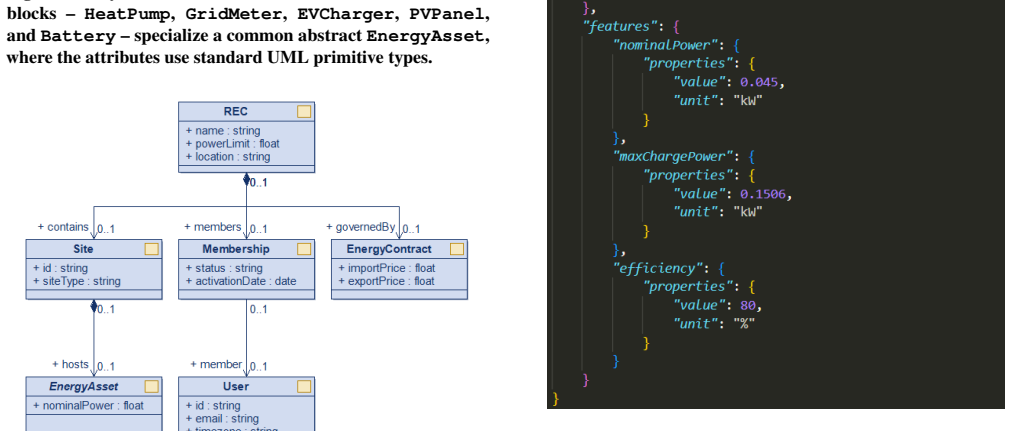
Starting from an industrially-validated REC domain model, we re-express a representative house subset in SysML using the open-source Modelio tool, yielding two Block Definition Diagrams - a device taxonomy and a community organizational view. We then discuss four semantic gaps that plain SysML leaves open and sketch how the SAREF4ENER ontology could be imported as a reference package to close them. Combining SysML with SAREF-based semantics for smart-energy Digital Twins remains largely unexplored, and we position this paper as a first step along that line.
What carries the argument
Two SysML Block Definition Diagrams (device taxonomy and community organizational view) created from the REC domain model, together with the proposed import of SAREF4ENER as a reference package to address semantic gaps.
If this is right
- An MBSE workflow for REC digital twins becomes feasible by re-expressing domain models in SysML.
- Four semantic gaps in plain SysML for smart-energy contexts can be addressed by importing SAREF4ENER.
- The approach supports handling heterogeneity of devices, contracts, and runtime data in REC digital twins.
- SysML combined with SAREF semantics provides a foundation for engineering digital twins of energy sharing systems.
Where Pith is reading between the lines
- The diagrams could be extended as templates for modeling additional REC elements such as shared storage or grid connections.
- SAREF4ENER integration might enable automated consistency checks across contracts and device data in the twin.
- Applying the method to a full multi-house REC instance would test scalability beyond the single-house subset.
- The modeling could connect to other energy system standards to improve interoperability in digital twin platforms.
Load-bearing premise
The industrially-validated REC domain model is complete and accurate enough to serve as a starting point for SysML re-expression, and importing SAREF4ENER will close the semantic gaps without introducing new inconsistencies.
What would settle it
If the created SysML diagrams fail to represent the actual devices and organizational structure of a working renewable energy community, or if importing SAREF4ENER produces modeling conflicts when applied to the digital twin.
Figures


read the original abstract
Renewable Energy Communities (RECs) are emerging as a key organizational model for local and global sharing of renewable generation, storage, and flexible loads. Engineering Digital Twins of RECs is made difficult by the heterogeneity of devices, contracts, and runtime data involved. In this paper, we take a first step toward a Model-Based Systems Engineering (MBSE) workflow for REC's Digital Twins. Starting from an industrially-validated REC domain model, we re-express a representative house subset in SysML using the open-source Modelio tool, yielding two Block Definition Diagrams - a device taxonomy and a community organizational view. We then discuss four semantic gaps that plain SysML leaves open and sketch how the SAREF4ENER ontology could be imported as a reference package to close them. Combining SysML with SAREF-based semantics for smart-energy Digital Twins remains largely unexplored, and we position this paper as a first step along that line.
Editorial analysis
A structured set of objections, weighed in public.
Referee Report
Summary. The paper claims to take a first step toward a Model-Based Systems Engineering (MBSE) workflow for Digital Twins of Renewable Energy Communities (RECs) by starting from an industrially-validated REC domain model, re-expressing a representative house subset in SysML via the Modelio tool to produce two Block Definition Diagrams (a device taxonomy and a community organizational view), identifying four semantic gaps left open by plain SysML, and sketching how importing the SAREF4ENER ontology as a reference package could close those gaps.
Significance. If the re-expression accurately captures the domain model and the sketched gaps are correctly diagnosed, the work provides an initial exploration of combining SysML with SAREF-based semantics for smart-energy digital twins—an area noted as largely unexplored. This could lay groundwork for more systematic handling of device heterogeneity, contracts, and runtime data in REC digital twins, though the contribution remains descriptive rather than validated.
minor comments (2)
- The abstract and description indicate that concrete examples of the four semantic gaps and the resulting diagrams are central to the contribution, but without explicit section references or excerpts showing how the gaps are enumerated (e.g., in a dedicated discussion section), it is difficult to evaluate their technical specificity.
- The reliance on an 'industrially-validated REC domain model' as the unexamined starting point should be supported by at least a brief citation or summary of its validation process to strengthen reproducibility of the SysML re-expression.
Simulated Author's Rebuttal
We thank the referee for their review and for recommending minor revision. The referee's summary accurately describes the manuscript's scope and contributions as an initial exploration of SysML combined with SAREF4ENER for REC digital twins.
Circularity Check
No significant circularity detected
full rationale
The paper is a descriptive modeling exercise that re-expresses an existing industrially-validated REC domain model into two SysML Block Definition Diagrams using Modelio and sketches four semantic gaps plus a possible SAREF4ENER import; it contains no equations, derivations, fitted parameters, predictions, or uniqueness claims. The central contribution is explicitly framed as a first step without any reduction of outputs to inputs by construction, self-citation load-bearing premises, or ansatz smuggling. All load-bearing elements (domain model completeness, ontology integration) are presented as assumptions or discussion points rather than derived results, making the work self-contained against external benchmarks.
Axiom & Free-Parameter Ledger
axioms (1)
- domain assumption The industrially-validated REC domain model accurately captures the heterogeneity of devices, contracts, and runtime data in renewable energy communities.
Reference graph
Works this paper leans on
-
[1]
Digital twin technology for renewable energy, smart grids, energy storage and vehicle-to-grid integration,
A. Q. Al-Shetwi, I. E. Atawi, M. A. El-Hameed, and A. Abuelrub, “Digital twin technology for renewable energy, smart grids, energy storage and vehicle-to-grid integration,”IET Smart Grid, 2025
2025
-
[2]
What is a digital twin any- way? deriving the definition for the built environment from over 15,000 scientific publications,
M. Abdelrahman, E. Macatulad, B. Lei, M. Quintana, C. Miller, and F. Biljecki, “What is a digital twin any- way? deriving the definition for the built environment from over 15,000 scientific publications,”Building and Environment, vol. 274, p. 112748, 2025
2025
-
[3]
Us- ing model-based systems engineering to design system- based digital twins,
M. V . P. Pessoa, A. P. L. Schuch, and J. M. Bezerra, “Us- ing model-based systems engineering to design system- based digital twins,” inProceedings of the INCOSE International Symposium, vol. 33, pp. 1299–1315, Wi- ley, 2023. 8-step MBSE approach, Eclipse Papyrus, Python parser for SysML to simulation
2023
-
[4]
Model- driven engineering for digital twins: a systematic map- ping study,
D. Lehner, J. Zhang, J. Pfeiffer, S. Sint, A.-K. Splettstößer, M. Wimmer, and A. Wortmann, “Model- driven engineering for digital twins: a systematic map- ping study,”Software and Systems Modeling, 2025
2025
-
[5]
Modelio: Open-source modeling environ- ment
Modeliosoft, “Modelio: Open-source modeling environ- ment.” https://www.modelio.org/. Accessed 2026-04-24
2026
-
[6]
SysML 4 digital twins – utilization of system mod- els for the design and operation of digital twins,
F. Wilking, C. Sauer, B. Schleich, and S. Wartzack, “SysML 4 digital twins – utilization of system mod- els for the design and operation of digital twins,” in Proceedings of the Design Society (DESIGN 2022), vol. 2, pp. 1815–1824, Cambridge University Press,
2022
-
[7]
SysML diagrams → executable DT behavior code derivation
-
[8]
From engineering models to digital twins: Generating AAS from SysML v2 models,
E. Ferko, L. Berardinelli, A. Bucaioni, M. Behnam, and M. Wimmer, “From engineering models to digital twins: Generating AAS from SysML v2 models,”The Journal of Systems and Software, vol. 233, p. 112688,
-
[9]
QVT-based transformation SysML v2 → AAS, EMF-compliant, 24 validated examples
-
[10]
Interoperability for smart appliances in the IoT world,
L. Daniele, M. Solanki, F. den Hartog, and J. Roes, “Interoperability for smart appliances in the IoT world,” inThe Semantic Web – ISWC 2016, vol. 9982 ofLecture Notes in Computer Science, pp. 21–29, Springer, 2016. Original SAREF ontology paper, SAREF4EE extension for EEBus/Energy
2016
-
[11]
Digital twin network for the IIoT using Eclipse Ditto and Hono,
M. Kherbache, M. Maimour, and E. Rondeau, “Digital twin network for the IIoT using Eclipse Ditto and Hono,” IFAC-PapersOnLine, vol. 55, no. 8, pp. 37–42, 2022
2022
-
[12]
Design of an ontology-driven constraint tester (ODCT) and ap- plication to SAREF and smart energy appliances,
T. M. R. H. Chy, H. Lamboro, O. Genest, A. Kung, C. Rabrait, D. Sebilleau, and A. Gyrard, “Design of an ontology-driven constraint tester (ODCT) and ap- plication to SAREF and smart energy appliances,” in International Knowledge Graph and Semantic Web Con- ference, pp. 183–198, Springer, 2024
2024
-
[13]
Leverag- ing SysML v2 to enhance system architecture decision- making based on process information,
C.-P. Grunenwald, A. Dybov, and R. Stark, “Leverag- ing SysML v2 to enhance system architecture decision- making based on process information,” in2025 IEEE International systems Conference (SysCon), pp. 1–8, IEEE, 2025
2025
-
[14]
Ten years of asset administration shell: Developments, research opportunities, and adoption challenges,
L. Sakurada, F. De La Prieta, and P. Leitao, “Ten years of asset administration shell: Developments, research opportunities, and adoption challenges,”IEEE Access, 2025
2025
-
[15]
Increasing interoperability between digital twin stan- dards and specifications: Transformation of DTDL to AAS,
C. Schmidt, F. V olz, L. Stojanovic, and G. Sutschet, “Increasing interoperability between digital twin stan- dards and specifications: Transformation of DTDL to AAS,”Sensors, vol. 23, no. 18, p. 7742, 2023. HIGH: DTDL (Azure) to AAS (IEC 63278) transformation; interoperability between DT standards
2023
-
[16]
Industry 4.0 renewable energy power plant ar- chitecture using next generation service interface linked data connectors,
I.-A. Gal, L. Vl ˘ad˘areanu, V . Vl˘ad˘areanu, and D.-O. Melinte, “Industry 4.0 renewable energy power plant ar- chitecture using next generation service interface linked data connectors,” in2023 8th International Conference on Mathematics and Computers in Sciences and Indus- try (MCSI), pp. 155–160, IEEE, 2023
2023
-
[17]
Extending the SAREF4ENER ontology with flexibility based on FlexOffers,
F. Lilliu, A. Laadhar, C. Thomsen, and D. R. Recupero, “Extending the SAREF4ENER ontology with flexibility based on FlexOffers,” 2025
2025
-
[18]
SARGON – SmArt eneRGy dOmain oNtology,
M. Haghgoo, I. Sychev, A. Monti, and F. H. Fitzek, “SARGON – SmArt eneRGy dOmain oNtology,”IET Smart Cities, vol. 2, no. 4, pp. 191–198, 2020
2020
-
[19]
Uni- fied, ontology-based information model for smart energy management systems,
T. Ivanova, P. Kesova, Y . Belev, and I. Batchkova, “Uni- fied, ontology-based information model for smart energy management systems,” inProceedings of the IEEE In- ternational Conference on Automation and Informatics (ICAI), IEEE, 2025. M . S a m a d i , L . M . P i n h o, A . S a d o v y k h , G . L u c a s7
2025
-
[20]
Multi-partner project: A model-driven engineering framework for federated digital twins of industrial systems (MATISSE),
A. Bucaioni, R. Eramo, L. Berardinelli, H. Brune- liere, B. Combemale, D. E. Khelladi, V . Muttillo, A. Sadovykh, and M. Wimmer, “Multi-partner project: A model-driven engineering framework for federated digital twins of industrial systems (MATISSE),” inPro- ceedings of the Design, Automation and Test in Europe Conference (DATE), (Lyon, France), pp. 1–6, ...
2025
-
[21]
A review of SHACL: from data validation to schema reasoning for RDF graphs,
P. Pareti and G. Konstantinidis, “A review of SHACL: from data validation to schema reasoning for RDF graphs,”Reasoning Web International Summer School, pp. 115–144, 2021
2021
-
[22]
Featherweight OCL: A proposal for a machine-checked formal seman- tics for OCL 2.5,
A. D. Brucker, F. Tuong, and B. Wolff, “Featherweight OCL: A proposal for a machine-checked formal seman- tics for OCL 2.5,” 2015
2015
-
[23]
Utilization of SysML system models for smart assembly using digital twins,
F. Wilking, S. Kaup, M. Fett, S. Goetz, E. Kirchner, and S. Wartzack, “Utilization of SysML system models for smart assembly using digital twins,” inProceedings of NordDesign 2024, (Reykjavik, Iceland), pp. 61–70, Aug
2024
-
[24]
SysML to discrete event simulation for assembly DT, manufacturing structure integration
-
[25]
Architect- ing a BIM-based digital twin platform for airport asset management: a model-based system engineering with SysML approach,
B. Keskin, B. Salman, and O. Koseoglu, “Architect- ing a BIM-based digital twin platform for airport asset management: a model-based system engineering with SysML approach,”Journal of Construction Engineering and Management, vol. 148, no. 5, p. 04022018, 2022
2022
-
[26]
Using SysML mod- els as digital twins for early validation of modular sys- tems and systems of systems,
H. Wagner, L. Portenlänger,et al., “Using SysML mod- els as digital twins for early validation of modular sys- tems and systems of systems,” inProceedings of the IEEE International Systems Conference (SysCon), pp. 1– 8, IEEE, 2023
2023
-
[27]
Semantic interoperability on IoT: Aligning IFC and Smart Application Reference (SAREF) sensor data models,
E. D. Okonta, F. Rahimian, V . Vukovi ´c, and S. Ro- driguez, “Semantic interoperability on IoT: Aligning IFC and Smart Application Reference (SAREF) sensor data models,”Automation in Construction, vol. 177, p. 106328, 2025. IADOM approach for aligning saref:Sensor and IfcSensor, RDF/Protege modeling
2025
-
[28]
Ontology-driven smart building semantics: An EnergyPlus-SAREF approach,
U. Kırnapcı, M. B. Hekimo˘glu, S. Baghaee, and I. Ulu- soy, “Ontology-driven smart building semantics: An EnergyPlus-SAREF approach,” inProceedings of the IEEE Signal Processing and Communications Applica- tions Conference (SIU), IEEE, 2025
2025
-
[29]
A survey on semantic modeling for building energy management,
M. Aniakor, V . V . Cogo, and P. M. Ferreira, “A survey on semantic modeling for building energy management,” 2024
2024
-
[30]
Empowering the Eclipse Arrowhead framework with a digital twin as a proxy service,
A. Aziz, O. Schelén, U. Bodin, L. Römer, S. E. Jeroschewski, and J. Kristan, “Empowering the Eclipse Arrowhead framework with a digital twin as a proxy service,” inProceedings of the 22nd International Con- ference on Control, Automation and Systems (ICCAS), pp. 1716–1721, IEEE, 2022
2022
-
[31]
OpenTwins: An open-source framework for the development of next- gen compositional digital twins,
J. Robles, C. Martín, and M. Díaz, “OpenTwins: An open-source framework for the development of next- gen compositional digital twins,”Computers in Industry, vol. 152, p. 104007, 2023
2023
-
[32]
Digital twin technology for renewable energy microgrids,
K. E. Bassey, J. Opoku-Boateng, B. O. Antwi, A. Nti- akoh, and A. R. Juliet, “Digital twin technology for renewable energy microgrids,”Engineering Science & Technology Journal, vol. 5, no. 7, pp. 2248–2272, 2024
2024
-
[33]
SysML as a common integration platform for co-simulations,
A. Sadovykh, A. Bagnato, I. Quadri, A. E.-D. Mady, L. D. Couto, S. Basagiannis, and M. Hasanagic, “SysML as a common integration platform for co-simulations,” inProceedings of the 12th Central and Eastern Euro- pean Software Engineering Conference in Russia (CEE- SECR), pp. 1–5, ACM, 2016
2016
discussion (0)
Sign in with ORCID, Apple, or X to comment. Anyone can read and Pith papers without signing in.