Constrained hybrid modelling to predict microbial dynamics and organic matter turnover in soil systems
Pith reviewed 2026-06-26 17:42 UTC · model grok-4.3
The pith
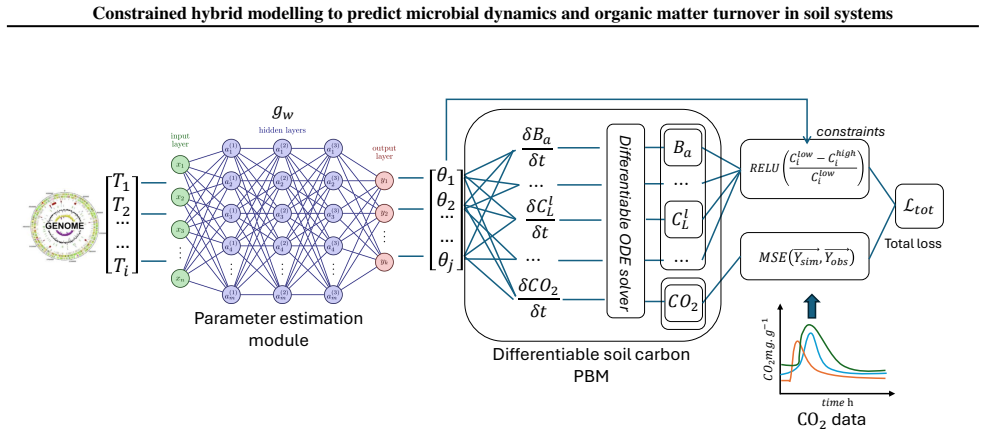
A neural network maps metagenomic traits to biokinetic parameters in a soil organic matter model while ecological constraints keep unmeasurable states realistic.
A machine-rendered reading of the paper's core claim, the machinery that carries it, and where it could break.
Core claim
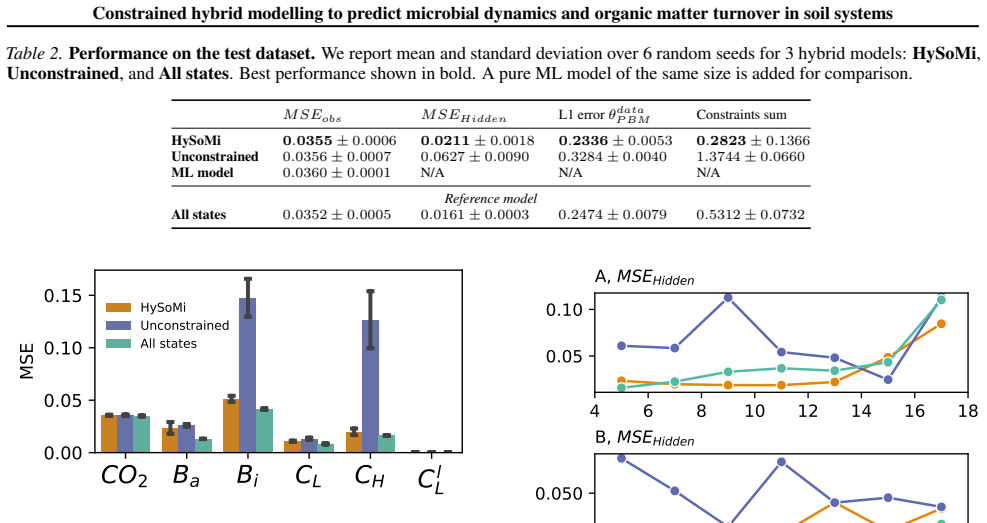
The central claim is that a neural network can derive realistic biokinetic parameter values for a process-based soil organic matter turnover model from metagenome-inferred functional traits, with ecological constraints ensuring plausible behavior of non-observed state variables, and that this yields better performance than baselines even on small training datasets.
What carries the argument
The constrained hybrid modeling framework in which a neural network predicts biokinetic parameters from genomic trait data and ecological constraints regularize the mapping to keep non-observed dynamics realistic.
If this is right
- Improved accuracy for unmeasurable state variables in the process-based model.
- Outperformance over multiple baselines on both synthetic and real genomic trait data.
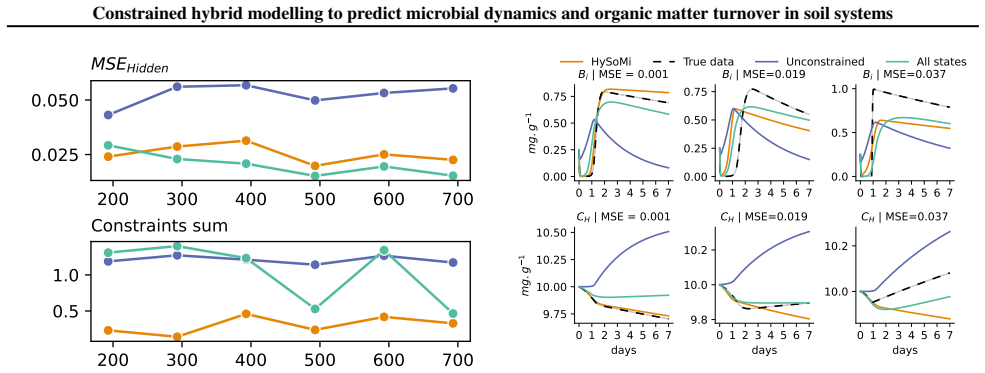
- Effective learning of dynamics even when training datasets are small.
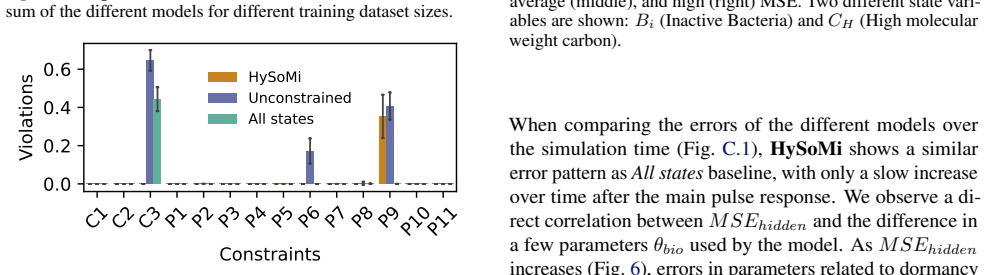
- Realistic outputs maintained by the ecological constraints for all state variables.
Where Pith is reading between the lines
- The same mapping could be tested on additional omics layers such as metatranscriptomics to check whether trait-to-parameter translation improves further.
- Field-scale application might allow the model to forecast how different land-management choices alter carbon storage trajectories.
- Cross-validation across soil types from contrasting climates would show how far the learned trait-to-parameter relationships transfer beyond the original training conditions.
Load-bearing premise
A neural network can learn a generalizable mapping from metagenome-inferred functional traits to biokinetic parameters of the process-based model when regularized by ecological constraints.
What would settle it
Predictions that deviate substantially from measured microbial dynamics or organic matter turnover rates on independent real soil datasets withheld from training.
Figures
read the original abstract
Soil microorganisms control organic matter cycling and largely determine how soil systems can cope with and mitigate climate change and environmental threats. Representing microbial dynamics in process-based soil models is therefore critical to predict carbon cycling in soils, albeit highly challenging to inform from data. One promising approach to improve their parametrisation is the integration of genomic data, yet modelling the complex and unknown relationship between genomes and the processes the microbes are driving is an unsolved problem. In this work, we present the first hybrid modeling framework for deriving biokinetic parameter values of a process-based soil organic matter turnover model from metagenome-inferred functional traits based on DNA sequencing data. Our model predicts biokinetic parameters of the process-based model from genomic trait data with a neural network and integrates constraints from ecological theory and literature to ensure realistic behavior, even of non-observed state variables. We evaluate our method on synthetic genomic trait datasets of varying complexity and on real data, showing that our approach improves performance over multiple baselines and learns the dynamics of unmeasurable components of the process-based model effectively, even for small training datasets.
Editorial analysis
A structured set of objections, weighed in public.
Referee Report
Summary. The paper presents the first hybrid modeling framework that uses a neural network to predict biokinetic parameters of a process-based soil organic matter turnover model from metagenome-inferred functional traits derived from DNA sequencing data. Ecological constraints from theory and literature are incorporated to regularize behavior of unobserved state variables. Evaluation is performed on synthetic genomic trait datasets of varying complexity and on real soil data, with claims of improved performance over multiple baselines and effective learning of unmeasurable component dynamics even for small training datasets.
Significance. If the central mapping generalizes, the approach could meaningfully advance data-informed parametrization of microbial dynamics in soil carbon models, addressing a key challenge in predicting responses to climate and environmental change. The explicit use of ecological constraints to regularize non-observed states is a constructive strength that distinguishes the method from purely data-driven alternatives.
major comments (2)
- [Real data evaluation] Real-data evaluation (as described in the abstract and methods): the reported improvements on real soil datasets lack an independent hold-out set drawn from a different soil type, location, or environmental regime. Without such a test or proxy measurements for the hidden states, it is not possible to confirm that the NN mapping from functional traits to biokinetic parameters transfers outside the training distribution rather than overfitting to the observed variables under the ecological regularizers.
- [Synthetic experiments] Synthetic-to-real transfer (evaluation sections): while synthetic experiments can demonstrate recovery by construction, the manuscript does not report quantitative metrics (e.g., parameter recovery error or trajectory error on held-out synthetic regimes) that would establish the conditions under which the constrained NN mapping remains accurate when the underlying trait-to-parameter relationship deviates from the training distribution.
minor comments (2)
- [Abstract] The abstract lists 'multiple baselines' without naming them or indicating whether they include both purely process-based and unconstrained neural hybrids; this should be clarified for reproducibility.
- [Methods] Notation for the ecological constraints and the precise form of the regularization term in the loss function should be defined explicitly (e.g., as an equation) rather than described at a high level.
Simulated Author's Rebuttal
We appreciate the referee's detailed and constructive feedback on our manuscript. We address the major comments below and outline the revisions we plan to make.
read point-by-point responses
-
Referee: [Real data evaluation] Real-data evaluation (as described in the abstract and methods): the reported improvements on real soil datasets lack an independent hold-out set drawn from a different soil type, location, or environmental regime. Without such a test or proxy measurements for the hidden states, it is not possible to confirm that the NN mapping from functional traits to biokinetic parameters transfers outside the training distribution rather than overfitting to the observed variables under the ecological regularizers.
Authors: We agree that an independent hold-out set from a different soil type or environmental regime would strengthen the evidence for transferability of the NN mapping. Our evaluation on real data relies on cross-validation within the available dataset, which demonstrates improved performance over baselines but does not fully address out-of-distribution generalization. We will revise the manuscript to include a more explicit discussion of this limitation and explore the possibility of incorporating additional real-world datasets for validation if feasible. revision: partial
-
Referee: [Synthetic experiments] Synthetic-to-real transfer (evaluation sections): while synthetic experiments can demonstrate recovery by construction, the manuscript does not report quantitative metrics (e.g., parameter recovery error or trajectory error on held-out synthetic regimes) that would establish the conditions under which the constrained NN mapping remains accurate when the underlying trait-to-parameter relationship deviates from the training distribution.
Authors: We acknowledge the value of reporting additional quantitative metrics on held-out synthetic regimes to assess performance under deviations from the training distribution. We will update the evaluation section to include parameter recovery errors and trajectory errors for such cases, thereby better characterizing the robustness of the constrained hybrid model. revision: yes
Circularity Check
No significant circularity; empirical claims rest on independent evaluation
full rationale
The paper describes a hybrid framework in which a neural network maps metagenomic traits to biokinetic parameters of a process-based model, with regularization drawn from external ecological theory and literature. Performance is assessed by direct comparison to baselines on both synthetic and real datasets, including the ability to track unmeasurable states. No equations, parameter-fitting steps, or citations are presented that reduce the central mapping or predictions to the training data by construction. The load-bearing elements (NN architecture, ecological constraints, generalization) are stated as external inputs rather than self-derived, making the reported improvements falsifiable against held-out data and independent benchmarks.
Axiom & Free-Parameter Ledger
Reference graph
Works this paper leans on
-
[1]
Nature Climate Change , author =
Global soil carbon projections are improved by modelling microbial processes , volume =. Nature Climate Change , author =. 2013 , note =. doi:10.1038/nclimate1951 , abstract =
-
[2]
A differentiable, physics-informed ecosystem modeling and learning framework for large-scale inverse problems: demonstration with photosynthesis simulations , volume =. Biogeosciences , author =. 2023 , note =. doi:10.5194/bg-20-2671-2023 , abstract =
-
[3]
Nature Communications , author =
From calibration to parameter learning:. Nature Communications , author =. 2021 , note =. doi:10.1038/s41467-021-26107-z , abstract =
-
[4]
Nature Microbiology , author =
Microbial ecology:. Nature Microbiology , author =. 2016 , note =. doi:10.1038/nmicrobiol.2015.28 , abstract =
-
[5]
7553, 436–444, https://doi.org/10.1038/nature14539
Deep learning , volume =. Nature , author =. 2015 , note =. doi:10.1038/nature14539 , abstract =
-
[6]
A Differentiable Programming System to Bridge Machine Learning and Scientific Computing
Innes, Mike and Edelman, Alan and Fischer, Keno and Rackauckas, Chris and Saba, Elliot and Shah, Viral B. and Tebbutt, Will , month = jul, year =. A. doi:10.48550/arXiv.1907.07587 , abstract =
work page internal anchor Pith review Pith/arXiv arXiv doi:10.48550/arxiv.1907.07587 1907
-
[7]
NatureReviewsEarth&Environment 4, 552–567
Differentiable modelling to unify machine learning and physical models for geosciences , volume =. Nature Reviews Earth & Environment , author =. 2023 , note =. doi:10.1038/s43017-023-00450-9 , abstract =
-
[8]
Advances in
Paszke, Adam and Gross, Sam and Massa, Francisco and Lerer, Adam and Bradbury, James and Chanan, Gregory and Killeen, Trevor and Lin, Zeming and Gimelshein, Natalia and Antiga, Luca and Desmaison, Alban and Kopf, Andreas and Yang, Edward and DeVito, Zachary and Raison, Martin and Tejani, Alykhan and Chilamkurthy, Sasank and Steiner, Benoit and Fang, Lu an...
-
[9]
He, Kaiming and Zhang, Xiangyu and Ren, Shaoqing and Sun, Jian , month = jun, year =. Deep. 2016. doi:10.1109/CVPR.2016.90 , abstract =
-
[10]
Approximate
Narasimhan, Harikrishna and Cotter, Andrew and Zhou, Yichen and Wang, Serena and Guo, Wenshuo , year =. Approximate. Advances in
-
[12]
Feed-forward neural networks , volume =. IEEE Potentials , author =. 1994 , keywords =. doi:10.1109/45.329294 , abstract =
-
[13]
Agarap, Abien Fred , month = feb, year =. Deep. doi:10.48550/arXiv.1803.08375 , abstract =
work page internal anchor Pith review Pith/arXiv arXiv doi:10.48550/arxiv.1803.08375
-
[14]
Physics-informed neural networks:. Journal of Computational Physics , author =. 2019 , keywords =. doi:10.1016/j.jcp.2018.10.045 , abstract =
-
[15]
Physics-informed machine learning
Physics-informed machine learning , volume =. Nature Reviews Physics , author =. 2021 , note =. doi:10.1038/s42254-021-00314-5 , abstract =
-
[18]
He, Kaiming and Zhang, Xiangyu and Ren, Shaoqing and Sun, Jian , year =. Delving. International Conference on Computer Vision , url =
-
[19]
International Conference on Machine Learning , pages =
Batch Normalization: Accelerating Deep Network Training by Reducing Internal Covariate Shift , author =. International Conference on Machine Learning , pages =. 2015 , editor =
2015
-
[20]
and Jung, M
Kraft, B. and Jung, M. and K\"orner, M. and Koirala, S. and Reichstein, M. , TITLE =. Hydrology and Earth System Sciences , VOLUME =. 2022 , NUMBER =
2022
-
[21]
Water Resources Research , volume =
Schmidt, Lennart and Heße, Falk and Attinger, Sabine and Kumar, Rohini , title =. Water Resources Research , volume =. doi:https://doi.org/10.1029/2019WR025924 , url =. https://agupubs.onlinelibrary.wiley.com/doi/pdf/10.1029/2019WR025924 , note =
-
[22]
Environmental Research Letters , abstract =
ElGhawi, Reda and Kraft, Basil and Reimers, Christian and Reichstein, Markus and Körner, Marco and Gentine, Pierre and Winkler, Alexander J , title =. Environmental Research Letters , abstract =. 2023 , month =. doi:10.1088/1748-9326/acbbe0 , url =
-
[23]
Chen, Ricky T. Q. , title=. 2018 , url=
2018
-
[24]
2017 , eprint=
Adam: A Method for Stochastic Optimization , author=. 2017 , eprint=
2017
-
[25]
Soil carbon and nitrogen mineralization: Theory and models across scales , journal =
Stefano Manzoni and Amilcare Porporato , keywords =. Soil carbon and nitrogen mineralization: Theory and models across scales , journal =. 2009 , issn =. doi:https://doi.org/10.1016/j.soilbio.2009.02.031 , url =
-
[26]
Ecological Modelling , author =
Incorporating dormancy in dynamic microbial community models , volume =. Ecological Modelling , author =. 2011 , keywords =. doi:10.1016/j.ecolmodel.2011.07.006 , abstract =
-
[27]
Frontiers in Environmental Science , author =
Spatial. Frontiers in Environmental Science , author =. 2020 , file =
2020
-
[28]
Wieder, W. R. and Grandy, A. S. and Kallenbach, C. M. and Taylor, P. G. and Bonan, G. B. , TITLE =. Geoscientific Model Development , VOLUME =. 2015 , NUMBER =
2015
-
[29]
Proceedings of the Asian Conference on Computer Vision (ACCV) , month =
Sargeant, James and Teng, Shyh Wei and Murshed, Manzur and Paul, Manoranjan and Brennan, David , title =. Proceedings of the Asian Conference on Computer Vision (ACCV) , month =. 2024 , pages =
2024
-
[30]
Acta Mechanica Sinica , author =
Physics-informed neural networks (. Acta Mechanica Sinica , author =. 2021 , pages =. doi:10.1007/s10409-021-01148-1 , abstract =
-
[31]
Journal of Geophysical Research: Biogeosciences , volume =
Chandel, Aneesh Kumar and Jiang, Lifen and Luo, Yiqi , title =. Journal of Geophysical Research: Biogeosciences , volume =. doi:https://doi.org/10.1029/2023JG007436 , url =. https://agupubs.onlinelibrary.wiley.com/doi/pdf/10.1029/2023JG007436 , note =
-
[32]
Nature Communications , author =
Gene-informed decomposition model predicts lower soil carbon loss due to persistent microbial adaptation to warming , volume =. Nature Communications , author =. 2020 , note =. doi:10.1038/s41467-020-18706-z , abstract =
-
[33]
Journal of Geophysical Research: Biogeosciences , volume =
Aboelyazeed, Doaa and Xu, Chonggang and Gu, Lianhong and Luo, Xiangzhong and Liu, Jiangtao and Lawson, Kathryn and Shen, Chaopeng , title =. Journal of Geophysical Research: Biogeosciences , volume =. doi:https://doi.org/10.1029/2024JG008552 , url =. https://agupubs.onlinelibrary.wiley.com/doi/pdf/10.1029/2024JG008552 , note =
-
[34]
Proceedings of the IEEE Conference on Computer Vision and Pattern Recognition (CVPR) , month =
Kendall, Alex and Gal, Yarin and Cipolla, Roberto , title =. Proceedings of the IEEE Conference on Computer Vision and Pattern Recognition (CVPR) , month =
-
[35]
Xuebin Xu and Xianting Wang and Ping Zhou and Zhenke Zhu and Liang Wei and Shuang Wang and Periyasamy Rathinapriya and Qicheng Bei and Jinfei Feng and Fuping Fang and Jianping Chen and Tida Ge , keywords =. Coupling of microbial-explicit model and machine learning improves the prediction and turnover process simulation of soil organic carbon , journal =. ...
-
[36]
and Pagel, Holger and Kügler, Philipp and Streck, Thilo , title =
Marschmann, Gianna L. and Pagel, Holger and Kügler, Philipp and Streck, Thilo , title =. 2019 , journal =. doi:10.1016/j.envsoft.2019.104518 , url =
-
[37]
Karaoz, Ulas and Brodie, Eoin L. , TITLE=. Frontiers in Bioinformatics , VOLUME=. 2022 , URL=. doi:10.3389/fbinf.2022.918853 , ISSN=
-
[38]
ISME Communications , volume =
Dragone, Nicholas B and Hoffert, Michael and Strickland, Michael S and Fierer, Noah , title =. ISME Communications , volume =. 2024 , month =. doi:10.1093/ismeco/ycae081 , url =
-
[39]
Humberto Blanco-Canqui and Charles A. Shapiro and Charles S. Wortmann and Rhae A. Drijber and Martha Mamo and Tim M. Shaver and Richard B. Ferguson , title =. Journal of Soil and Water Conservation , volume =. 2013 , publisher =. doi:10.2489/jswc.68.5.129A , URL =
-
[40]
The variation of soil microbial respiration with depth in relation to soil carbon composition , volume =. Plant and Soil , author =. 2005 , keywords =. doi:10.1007/s11104-004-0278-4 , abstract =
-
[41]
Martin-Georg Endress and Fatemeh Dehghani and Sergey Blagodatsky and Thomas Reitz and Steffen Schlüter and Evgenia Blagodatskaya , keywords =. Spatial substrate heterogeneity limits microbial growth as revealed by the joint experimental quantification and modeling of carbon and heat fluxes , journal =. 2024 , issn =. doi:https://doi.org/10.1016/j.soilbio....
-
[42]
Hobbie, John E. and Hobbie, Erik A. , TITLE=. Frontiers in Microbiology , VOLUME=. 2013 , URL=. doi:10.3389/fmicb.2013.00324 , ISSN=
-
[43]
The effects of glucose loading rates on bacterial and fungal growth in soil , journal =
Stephanie Reischke and Johannes Rousk and Erland Bååth , keywords =. The effects of glucose loading rates on bacterial and fungal growth in soil , journal =. 2014 , issn =. doi:https://doi.org/10.1016/j.soilbio.2013.12.011 , url =
-
[44]
Biology Bulletin Reviews , author =
Metabarcoding and. Biology Bulletin Reviews , author =. 2021 , pages =. doi:10.1134/S2079086421010084 , abstract =
-
[45]
Manzoni, Stefano and Taylor, Philip and Richter, Andreas and Porporato, Amilcare and Ågren, Göran I. , title =. New Phytologist , volume =. doi:https://doi.org/10.1111/j.1469-8137.2012.04225.x , url =. https://nph.onlinelibrary.wiley.com/doi/pdf/10.1111/j.1469-8137.2012.04225.x , abstract =
-
[46]
Holger Pagel and Christian Poll and Joachim Ingwersen and Ellen Kandeler and Thilo Streck , keywords =. Modeling coupled pesticide degradation and organic matter turnover: From gene abundance to process rates , journal =. 2016 , issn =. doi:https://doi.org/10.1016/j.soilbio.2016.09.014 , url =
-
[47]
Trait-based modeling of microbial interactions and carbon turnover in the rhizosphere , journal =
Ahmet Kürşad Sırcan and Thilo Streck and Andrea Schnepf and Mona Giraud and Adrian Lattacher and Ellen Kandeler and Christian Poll and Holger Pagel , keywords =. Trait-based modeling of microbial interactions and carbon turnover in the rhizosphere , journal =. 2025 , issn =. doi:https://doi.org/10.1016/j.soilbio.2024.109698 , url =
-
[48]
FEMS Microbiology Ecology , volume =
Stolpovsky, Konstantin and Fetzer, Ingo and Van Cappellen, Philippe and Thullner, Martin , title =. FEMS Microbiology Ecology , volume =. 2016 , month =. doi:10.1093/femsec/fiw071 , url =
-
[49]
Modeling ecosystem-scale carbon dynamics in soil: The microbial dimension , journal =
Joshua Schimel , keywords =. Modeling ecosystem-scale carbon dynamics in soil: The microbial dimension , journal =. 2023 , issn =. doi:https://doi.org/10.1016/j.soilbio.2023.108948 , url =
-
[50]
Vereecken, H. and Schnepf, A. and Hopmans, J.W. and Javaux, M. and Or, D. and Roose, T. and Vanderborght, J. and Young, M.H. and Amelung, W. and Aitkenhead, M. and Allison, S.D. and Assouline, S. and Baveye, P. and Berli, M. and Brüggemann, N. and Finke, P. and Flury, M. and Gaiser, T. and Govers, G. and Ghezzehei, T. and Hallett, P. and Hendricks Fransse...
-
[51]
Nature Microbiology , author =
Predictions of rhizosphere microbiome dynamics with a genome-informed and trait-based energy budget model , volume =. Nature Microbiology , author =. 2024 , note =. doi:10.1038/s41564-023-01582-w , abstract =
-
[52]
Kothawala, D. N. and Moore, T. R. and Hendershot, W. H. , title =. Soil Science Society of America Journal , volume =. doi:https://doi.org/10.2136/sssaj2008.0254 , url =. https://acsess.onlinelibrary.wiley.com/doi/pdf/10.2136/sssaj2008.0254 , abstract =
-
[53]
2018 , eprint=
Auxiliary Tasks in Multi-task Learning , author=. 2018 , eprint=
2018
-
[54]
Bradford, Mark A. and Wieder, William R. and Bonan, Gordon B. and Fierer, Noah and Raymond, Peter A. and Crowther, Thomas W. , month = aug, year =. Managing uncertainty in soil carbon feedbacks to climate change , volume =. Nature Climate Change , publisher =. doi:10.1038/nclimate3071 , abstract =
-
[55]
2018 , eprint=
Multi-Task Learning Using Uncertainty to Weigh Losses for Scene Geometry and Semantics , author=. 2018 , eprint=
2018
-
[56]
Orgiazzi, A. and Ballabio, C. and Panagos, P. and Jones, A. and Fernández-Ugalde, O. , title =. European Journal of Soil Science , volume =. doi:https://doi.org/10.1111/ejss.12499 , url =. https://bsssjournals.onlinelibrary.wiley.com/doi/pdf/10.1111/ejss.12499 , abstract =
-
[57]
Alejandro Salazar and Benjamin N. Sulman and Jeffrey S. Dukes , keywords =. Microbial dormancy promotes microbial biomass and respiration across pulses of drying-wetting stress , journal =. 2018 , issn =. doi:https://doi.org/10.1016/j.soilbio.2017.10.017 , url =
-
[58]
International Conference on Learning Representations , year=
Adam: A method for stochastic optimization , author=. International Conference on Learning Representations , year=
-
[59]
and Dacal, Marina and Hartley, Iain P
García-Palacios, Pablo and Crowther, Thomas W. and Dacal, Marina and Hartley, Iain P. and Reinsch, Sabine and Rinnan, Riikka and Rousk, Johannes and van den Hoogen, Johan and Ye, Jian-Sheng and Bradford, Mark A. , month = jul, year =. Evidence for large microbial-mediated losses of soil carbon under anthropogenic warming , volume =. Nature Reviews Earth &...
-
[60]
Langley , title =
P. Langley , title =. Proceedings of the 17th International Conference on Machine Learning (ICML 2000) , address =. 2000 , pages =
2000
-
[61]
T. M. Mitchell. The Need for Biases in Learning Generalizations. 1980
1980
-
[62]
M. J. Kearns , title =
-
[63]
Machine Learning: An Artificial Intelligence Approach, Vol. I. 1983
1983
-
[64]
R. O. Duda and P. E. Hart and D. G. Stork. Pattern Classification. 2000
2000
-
[65]
Suppressed for Anonymity , author=
-
[66]
Newell and P
A. Newell and P. S. Rosenbloom. Mechanisms of Skill Acquisition and the Law of Practice. Cognitive Skills and Their Acquisition. 1981
1981
-
[67]
A. L. Samuel. Some Studies in Machine Learning Using the Game of Checkers. IBM Journal of Research and Development. 1959
1959
discussion (0)
Sign in with ORCID, Apple, or X to comment. Anyone can read and Pith papers without signing in.