Role-Based Agentic AI for Intent-Driven Network and Service Orchestration
Pith reviewed 2026-06-30 23:38 UTC · model grok-4.3
The pith
A role-based multi-agent system with four hierarchical layers bridges the BSS-OSS divide for intent-driven telecom orchestration.
A machine-rendered reading of the paper's core claim, the machinery that carries it, and where it could break.
Core claim
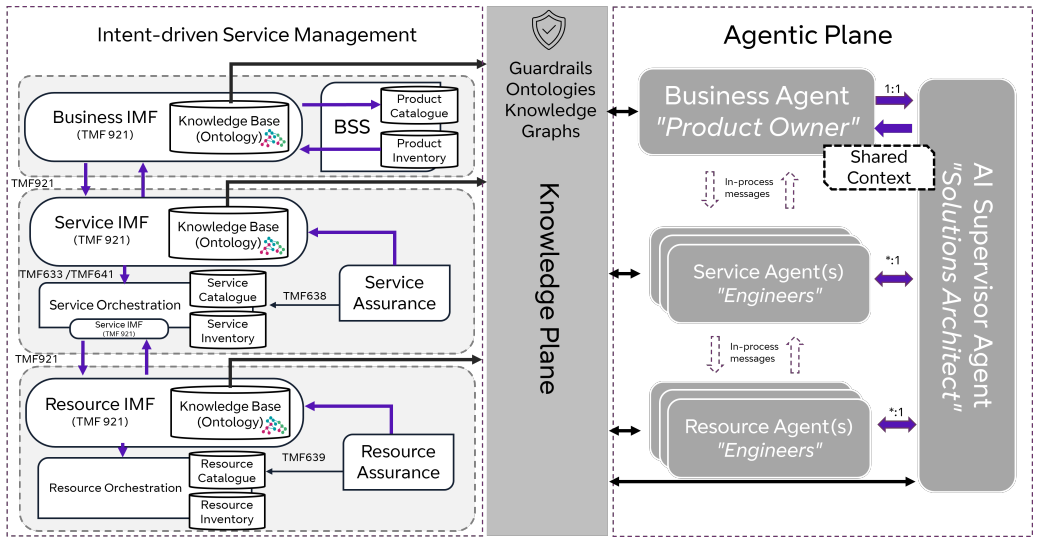
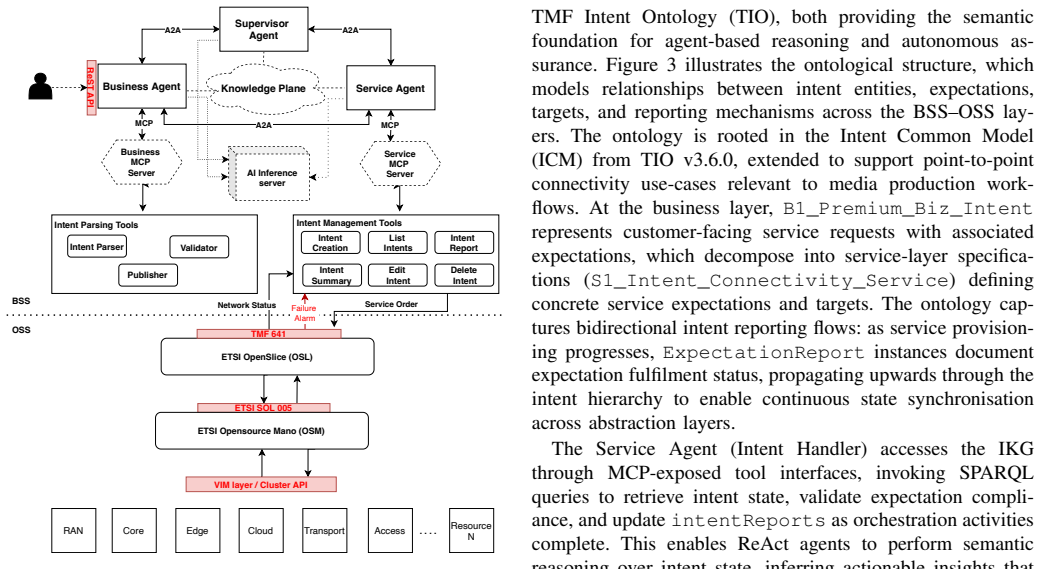
The paper introduces a role-based multi-agent system that mirrors Communication Service Provider organisational structures through a hierarchical four-layer architecture. Leadership agents coordinate planning while service and resource agents are dynamically instantiated according to intent requirements, applying functional decomposition, explicit task ownership, privacy-preserving domain separation, and domain-specific expertise. A proof-of-concept implementation shows this approach can bridge Business Support Systems and Operations Support Systems to deliver accountable, scalable intent-driven service orchestration.
What carries the argument
A hierarchical four-layer role-based multi-agent system that uses functional decomposition and explicit task ownership to assign agents to customer engagement, strategic planning, service delivery, and infrastructure provisioning layers.
If this is right
- Intent handling becomes end-to-end, linking customer requests directly to infrastructure changes through structured agent handoffs.
- Accountability improves because each agent layer owns explicit tasks and maintains domain separation.
- Scalability increases as specialised agents are instantiated only when required by a given intent.
- The same role structure can be reused across different network technologies and service types.
Where Pith is reading between the lines
- The same layered role assignment could be tested in non-telecom domains that also separate business goals from operational execution, such as cloud service platforms.
- Dynamic agent instantiation may reduce idle compute compared with static orchestration systems, though this remains unmeasured in the presented work.
- Privacy-preserving domain separation might allow competing service providers to share parts of the agent framework without exposing internal plans.
Load-bearing premise
That mirroring Communication Service Provider organisational structures with a hierarchical four-layer agent system using functional decomposition and explicit task ownership will produce effective, accountable coordination across layers.
What would settle it
A controlled test in which the agent system receives a complex multi-domain intent and fails to produce a single accountable plan that crosses from customer requirements through strategic, service, and resource layers without manual intervention or untracked decisions.
Figures
read the original abstract
Telecommunication networks are increasingly complex due to heterogeneous technologies, diverse service requirements, and growing demands for resource efficiency and business agility. Intent-Based Networking (IBN) and, more recently, agentic AI have emerged as promising paradigms to address this complexity through autonomous network management. However, existing approaches primarily focus on operational orchestration within Operations Support Systems (OSS) and lack an integrated framework that spans Business Support Systems (BSS) and OSS, limiting the realisation of true intent-to-business-to-network coordination. This paper presents a role-based multi-agent architecture (MAS) for end-to-end intent orchestration that mirrors Communication Service Provider (CSP) organisational structures. The proposed framework applies principles of functional decomposition, explicit task ownership, privacy-preserving domain separation, and domain-specific expertise within a hierarchical four-layer agent system spanning customer engagement, strategic planning, service delivery, and infrastructure provisioning. Leadership agents coordinate planning activities, whilst specialised service and resource agents are dynamically instantiated according to intent requirements. A proof-of-concept implementation demonstrates the feasibility of bridging the BSS-OSS divide through structured agent coordination, illustrating how agentic MAS can support accountable and scalable intent-driven service orchestration.
Editorial analysis
A structured set of objections, weighed in public.
Referee Report
Summary. The paper proposes a role-based multi-agent system (MAS) for end-to-end intent orchestration in telecommunication networks. It mirrors CSP organizational structures via a hierarchical four-layer agent architecture (customer engagement, strategic planning, service delivery, infrastructure provisioning) that applies functional decomposition, explicit task ownership, privacy-preserving domain separation, and domain-specific expertise. Leadership agents coordinate planning while specialised service and resource agents are instantiated dynamically. A proof-of-concept implementation is presented as demonstrating the feasibility of bridging the BSS-OSS divide to support accountable and scalable intent-driven service orchestration.
Significance. If the PoC evaluation were supplied with quantitative results, this could represent a structured contribution to agentic AI for IBN by explicitly linking business and operational domains through organisational mirroring. The explicit separation of leadership, service, and resource agents offers a concrete design pattern for accountability that is not common in existing OSS-focused IBN work.
major comments (2)
- [Abstract] Abstract: the central claim that the PoC 'demonstrates the feasibility of bridging the BSS-OSS divide' and supports 'accountable and scalable' orchestration is unsupported because no quantitative metrics, test cases, error analysis, baseline comparisons, or description of what the PoC actually measured (e.g., coordination latency, success rate under intent load, or accountability audit trails) are supplied.
- [Abstract / PoC description] The manuscript's feasibility argument rests on the assumption that mirroring CSP structures with a four-layer hierarchy will produce effective coordination, yet the provided description supplies no evaluation exercising cross-layer coordination under realistic intent loads, leaving the scalability and accountability assertions without empirical grounding.
Simulated Author's Rebuttal
Thank you for the detailed review. The referee correctly identifies that our proof-of-concept lacks quantitative evaluation, which means the claims in the abstract regarding demonstration of feasibility for accountable and scalable orchestration are not empirically supported. We will address this by revising the abstract and PoC description to provide a more accurate portrayal of the implementation's scope and by adding explicit statements about limitations and future evaluation needs.
read point-by-point responses
-
Referee: [Abstract] Abstract: the central claim that the PoC 'demonstrates the feasibility of bridging the BSS-OSS divide' and supports 'accountable and scalable' orchestration is unsupported because no quantitative metrics, test cases, error analysis, baseline comparisons, or description of what the PoC actually measured (e.g., coordination latency, success rate under intent load, or accountability audit trails) are supplied.
Authors: We agree that the abstract's claims exceed what the PoC provides. The PoC is a conceptual demonstration showing that the four-layer agent hierarchy can be implemented and that agents can interact to process intents from business to infrastructure layers. However, it does not include the metrics or analyses listed. In revision, we will update the abstract to state that the PoC illustrates the architecture's structure and coordination mechanisms without claiming empirical proof of scalability or accountability. We will also include a new subsection detailing the PoC's implementation scope and limitations. revision: yes
-
Referee: [Abstract / PoC description] The manuscript's feasibility argument rests on the assumption that mirroring CSP structures with a four-layer hierarchy will produce effective coordination, yet the provided description supplies no evaluation exercising cross-layer coordination under realistic intent loads, leaving the scalability and accountability assertions without empirical grounding.
Authors: This point is valid. The design is motivated by mirroring real CSP organizations to achieve better accountability through role separation, but the PoC does not simulate high-load scenarios or measure coordination effectiveness quantitatively. We will revise the relevant sections to present the mirroring as a design choice based on organizational theory rather than an empirically validated one in this work. The abstract will be adjusted accordingly, and we will add text in the discussion section acknowledging the need for future experiments on intent load and audit trails. revision: yes
Circularity Check
No circularity: architecture proposal is self-contained design choice
full rationale
The paper advances a role-based hierarchical MAS architecture for intent-driven orchestration by mirroring CSP structures with functional decomposition and domain separation. No equations, fitted parameters, predictions, or uniqueness theorems appear in the provided text. The central claim rests on a PoC implementation whose feasibility is asserted directly from the described design rather than reducing to any self-citation chain, ansatz, or renamed prior result. The derivation chain is therefore a straightforward engineering proposal without the enumerated circular patterns.
Axiom & Free-Parameter Ledger
axioms (1)
- domain assumption Functional decomposition, explicit task ownership, privacy-preserving domain separation, and domain-specific expertise enable effective coordination in a hierarchical multi-agent system for network orchestration.
invented entities (1)
-
Leadership agents, specialised service agents, and resource agents
no independent evidence
Reference graph
Works this paper leans on
-
[1]
IEEE Communications Surveys & Tutorials , year=
A survey on large language models for communication, network, and service management: Application insights, challenges, and future directions , author=. IEEE Communications Surveys & Tutorials , year=
-
[2]
International Conference on Learning Representations , year=
ReAct: Synergizing Reasoning and Acting in Language Models , author=. International Conference on Learning Representations , year=
-
[3]
, author=
Report addresses the main challenges faced by CSPs achieving next-level network autonomy provides recommendations to help overcome them. , author=. Achieving next-level network autonomy , year=
-
[4]
Authorea Preprints , year=
GenAI-powered Intent-Based Autonomous Networks: Standardisation Landscape and Emerging Industry Trends , author=. Authorea Preprints , year=
-
[5]
Brodimas and A
D. Brodimas and A. Birbas and D. Kapolos , title =. IEEE Open Journal of the Communications Society , year =
-
[6]
Proceedings of the ACM SIGCOMM 2025 Conference , pages =
Wang, Zhaodong and Lin, Samuel and Yan, Guanqing and Ghorbani, Soudeh and Yu, Minlan and Zhou, Jiawei and Hu, Nathan and Baruah, Lopa and Peters, Sam and Kamath, Srikanth and Yang, Jerry and Zhang, Ying , title =. Proceedings of the ACM SIGCOMM 2025 Conference , pages =. 2025 , isbn =. doi:10.1145/3718958.3750537 , abstract =
-
[7]
Intent-Based Autonomous Network Framework Guided by Large Language Model , year=
Guo, Lingqi and Zhang, Lei and Wang, Jingyu and Wu, Jianyu and Yan, Yuhang and Sun, Haifeng and He, Bo and Qi, Qi and Liao, Jianxin , journal=. Intent-Based Autonomous Network Framework Guided by Large Language Model , year=
-
[8]
Maestro: LLM-Driven Collaborative Automation of Intent-Based 6G Networks , year=
Chatzistefanidis, Ilias and Leone, Andrea and Nikaein, Navid , journal=. Maestro: LLM-Driven Collaborative Automation of Intent-Based 6G Networks , year=
-
[9]
Generative Intent Prediction Agentic AI empowered Edge Service Function Chain Orchestration
Y. Sun and S. Guo and S. Huang and Z. Feng and F. Qi and X. Qiu , title =. arXiv preprint arXiv:2601.13694 , year =
work page internal anchor Pith review Pith/arXiv arXiv
-
[10]
Applied Ontology , volume=
From human-to LLM-centered collaborative ontology engineering , author=. Applied Ontology , volume=. 2024 , publisher=
2024
-
[11]
European Semantic Web Conference , pages=
Ontology generation using large language models , author=. European Semantic Web Conference , pages=. 2025 , organization=
2025
-
[12]
AI-Driven Zero Touch Network and Service Management in 5G and Beyond: Challenges and Research Directions , year=
Benzaid, Chafika and Taleb, Tarik , journal=. AI-Driven Zero Touch Network and Service Management in 5G and Beyond: Challenges and Research Directions , year=
-
[13]
tmforum.org , year =
-
[14]
Knowledge-Enabled Intent-Driven Network Configuration Generation for 5G Core Networks , year=
Li, Qiuying and Cai, Jiajun and Xu, Ji’ang and Liu, Ruosi and Yuan, Caixia and Gao, Hui , booktitle=. Knowledge-Enabled Intent-Driven Network Configuration Generation for 5G Core Networks , year=
-
[15]
Using Knowledge Graphs to Automate Network Compliance of Containerized Services , year=
Simić, Aleksandra and Palma, David , booktitle=. Using Knowledge Graphs to Automate Network Compliance of Containerized Services , year=
-
[16]
Single and Multi-Agent Deep Reinforcement Learning for AI-Enabled Wireless Networks: A Tutorial , year=
Feriani, Amal and Hossain, Ekram , journal=. Single and Multi-Agent Deep Reinforcement Learning for AI-Enabled Wireless Networks: A Tutorial , year=
-
[17]
and Fettweis, Gerhard P
Chen, Kwang-Cheng and Lin, Shih-Chun and Hsiao, Jen-Hao and Liu, Chun-Hung and Molisch, Andreas F. and Fettweis, Gerhard P. , journal=. Wireless Networked Multirobot Systems in Smart Factories , year=
-
[18]
2025 , eprint=
Establishing Best Practices for Building Rigorous Agentic Benchmarks , author=. 2025 , eprint=
2025
-
[19]
The Dynamic Reasoning Trace: Achieving Verifiable Faithfulness through Agentic Self-Correction , journal=
Pandey, Kamal , year =. The Dynamic Reasoning Trace: Achieving Verifiable Faithfulness through Agentic Self-Correction , journal=
-
[20]
2024 , eprint=
Navigating the Risks: A Survey of Security, Privacy, and Ethics Threats in LLM-Based Agents , author=. 2024 , eprint=
2024
-
[21]
Physical Safety and Cyber Security Analysis of Multi-Agent Systems: A Survey of Recent Advances , year=
Zhang, Dan and Feng, Gang and Shi, Yang and Srinivasan, Dipti , journal=. Physical Safety and Cyber Security Analysis of Multi-Agent Systems: A Survey of Recent Advances , year=
-
[22]
2025 , eprint=
Uncertainty-Aware, Risk-Adaptive Access Control for Agentic Systems using an LLM-Judged TBAC Model , author=. 2025 , eprint=
2025
-
[23]
Arif and Iftikhar, Mohsin and Imran, Muhammad and Emad Ul Haq, Qazi , journal=
Kaur, Jasneet and Khan, M. Arif and Iftikhar, Mohsin and Imran, Muhammad and Emad Ul Haq, Qazi , journal=. Machine Learning Techniques for 5G and Beyond , year=
discussion (0)
Sign in with ORCID, Apple, or X to comment. Anyone can read and Pith papers without signing in.