Mechanically Exfoliated Metallic Delafossite PdCoO2 Nanomembranes: Quantum Transport and Electrical Evaluation Toward Interconnect Applications
Reviewed by Pith2026-06-26 13:41 UTCgrok-4.3pith:JW2N6O3Qopen to challenge →
The pith
Mechanically exfoliated PdCoO2 nanomembranes preserve bulk crystalline quality in the quasi-2D limit down to 40 nm thickness.
A machine-rendered reading of the paper's core claim, the machinery that carries it, and where it could break.
Core claim
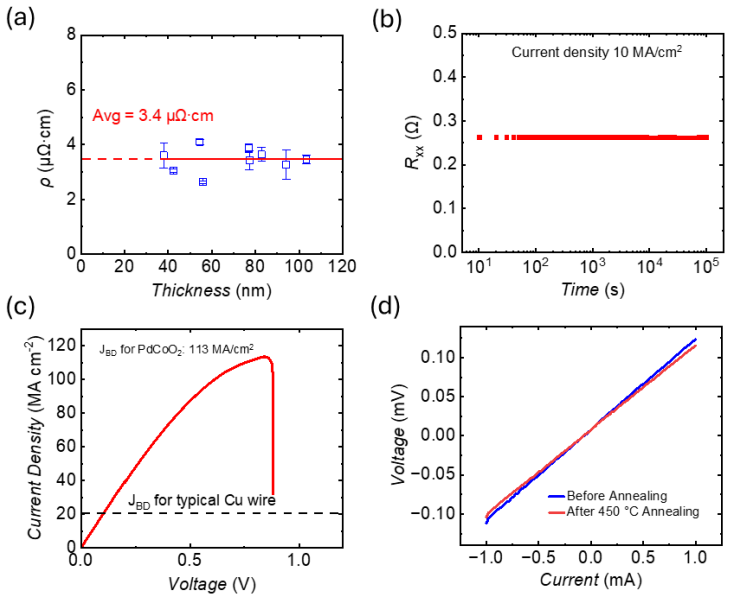
Mechanically exfoliated PdCoO2 nanomembranes preserve the high crystalline and electronic quality of bulk crystals in the quasi-2D limit. Shubnikov-de Haas and Aharonov-Bohm oscillations are observed under different magnetic field orientations, yielding the electron effective mass and phase coherence length. Room-temperature resistivity remains nearly thickness-independent down to 40 nm, and breakdown current density reaches 113 MA cm^{-2} with excellent thermal stability and electromigration resistance.
What carries the argument
Mechanical exfoliation of PdCoO2 single crystals into nanomembranes that support quantum oscillations and thickness-independent resistivity.
If this is right
- Quantum transport studies become feasible in quasi-2D PdCoO2 devices fabricated by simple exfoliation.
- The material meets key metrics for interconnect use through stable resistivity and high breakdown current density.
- Nanomembranes exhibit thermal stability and electromigration resistance suitable for high-current nanoscale circuits.
- The platform enables mesoscopic physics experiments without requiring specialized thin-film growth methods.
Where Pith is reading between the lines
- Other delafossite oxides might be exfoliated by the same route to produce additional quasi-2D metallic systems for comparison.
- The observed thickness independence could guide tests of even thinner flakes to determine the ultimate limit before surface effects appear.
- Integration with existing semiconductor processes might be explored to assess compatibility for on-chip interconnect scaling.
Load-bearing premise
The mechanical exfoliation process does not introduce defects or alter the electronic band structure enough to change the observed transport properties.
What would settle it
If resistivity rises sharply or quantum oscillations disappear in flakes thinner than 40 nm, the claim that exfoliation preserves bulk quality would be contradicted.
Figures
read the original abstract
Metallic delafossite oxides have drawn attention for their ultralow resistivity and coherent electronic transport. However, mesoscopic transport studies are hindered by the limited access to high quality nanoscale devices. Here, we report single crystalline PdCoO2 nanomembranes, enabling exploration of quasi two dimensional (2D) transport. Shubnikov de Haas and Aharonov Bohm oscillations under different magnetic field orientations are observed at low temperatures, from which the electron effective mass and electron phase coherence length are extracted. Beyond quantum transport, the electrical performance of PdCoO2 toward interconnect applications is evaluated. A nearly thickness independent room temperature resistivity is observed for flakes down to 40 nm thickness. The nanomembranes exhibit a breakdown current density up to 113 MA cm-2, with excellent thermal stability and electromigration resistance. These results demonstrate that mechanically exfoliated PdCoO2 flakes preserve the high crystalline and electronic quality of bulk crystals in the quasi-2D limit, providing a useful platform for mesoscopic transport studies and interconnect applications.
Editorial analysis
A structured set of objections, weighed in public.
Referee Report
Summary. The paper reports the mechanical exfoliation of single-crystalline PdCoO2 nanomembranes and their use for mesoscopic transport studies. It claims observation of Shubnikov-de Haas and Aharonov-Bohm oscillations at low temperatures, from which electron effective mass and phase coherence length are extracted. It further reports nearly thickness-independent room-temperature resistivity down to 40 nm thickness and breakdown current densities up to 113 MA cm^{-2}, concluding that the flakes preserve the high crystalline and electronic quality of bulk crystals for both quantum transport and interconnect applications.
Significance. If the central claims hold with the required quantitative support, the work would provide a useful experimental platform for exploring quasi-2D transport in metallic delafossites and identify PdCoO2 nanomembranes as a candidate material for interconnects due to their high current-carrying capacity, thermal stability, and electromigration resistance. The ability to access quantum oscillations in exfoliated flakes would be a notable advance for the field.
major comments (2)
- [Abstract] Abstract: the claim that the nanomembranes 'preserve the high crystalline and electronic quality of bulk crystals' is load-bearing for the central conclusion but is not supported by any numerical comparison of the extracted effective mass or room-temperature resistivity to established bulk PdCoO2 single-crystal literature values; without such comparison the assumption that exfoliation leaves band structure and scattering rates unaltered remains untested.
- [Abstract] Abstract: the reported breakdown current density of 113 MA cm^{-2} and the assertion of 'excellent thermal stability and electromigration resistance' are presented without error bars, fitting procedures, measurement protocols, or controls for Joule heating, which are required to substantiate the interconnect-application claims.
Simulated Author's Rebuttal
We thank the referee for the careful review and for recognizing the potential significance of our work on PdCoO2 nanomembranes. We address each major comment below with point-by-point responses.
read point-by-point responses
-
Referee: [Abstract] Abstract: the claim that the nanomembranes 'preserve the high crystalline and electronic quality of bulk crystals' is load-bearing for the central conclusion but is not supported by any numerical comparison of the extracted effective mass or room-temperature resistivity to established bulk PdCoO2 single-crystal literature values; without such comparison the assumption that exfoliation leaves band structure and scattering rates unaltered remains untested.
Authors: We agree that explicit numerical comparisons would better support the claim in the abstract. While the main text extracts the effective mass from SdH oscillations and reports the resistivity, we will revise the abstract to include direct comparisons to established bulk PdCoO2 values (e.g., effective mass and room-temperature resistivity) to demonstrate consistency with bulk crystals. This will be incorporated in the revised manuscript. revision: yes
-
Referee: [Abstract] Abstract: the reported breakdown current density of 113 MA cm^{-2} and the assertion of 'excellent thermal stability and electromigration resistance' are presented without error bars, fitting procedures, measurement protocols, or controls for Joule heating, which are required to substantiate the interconnect-application claims.
Authors: We acknowledge that additional documentation is needed for the breakdown current density results. In the revised manuscript we will add error bars to the reported value, describe the measurement protocols and any fitting procedures used, and include discussion of controls for Joule heating to substantiate the claims of thermal stability and electromigration resistance. revision: yes
Circularity Check
No circularity: purely experimental measurements with no derivations or self-referential predictions
full rationale
The paper reports mechanical exfoliation followed by direct transport measurements (SdH and AB oscillations, resistivity vs thickness, breakdown current density). No equations, predictions, or derivations are presented that reduce to fitted inputs or self-citations by construction. Extracted quantities (m*, coherence length) are standard data reductions from observed oscillations, not claimed as first-principles results. The central claim of preserved quality rests on comparison to bulk behavior via observables, not on any definitional loop. This matches the default case of a self-contained experimental study.
Axiom & Free-Parameter Ledger
axioms (2)
- standard math Shubnikov-de Haas oscillations can be used to extract electron effective mass via standard Lifshitz-Kosevich analysis
- domain assumption Aharonov-Bohm oscillations directly measure electron phase coherence length
Reference graph
Works this paper leans on
-
[1]
(a) Room-temperature resistivity as a function of thickness
PdCoO2 Flake Interconnect Evaluation. (a) Room-temperature resistivity as a function of thickness. The error bars represent the variation in resistance measured from different longitudinal electrode pairs of the same Hall bar device. (b) Resistance as a function of time under a current density of 10 MA cm -2 of a 44-nm-thick PdCoO2 flake. (c) Current dens...
2020
-
[2]
From basic properties to the Mott design of correlated delafossites
(4) Lechermann, F. From basic properties to the Mott design of correlated delafossites. Npj Comput. Mater. 2021, 7 (1),
2021
-
[3]
(5) Kushwaha, P.; Sunko, V .; Moll, P. J. W.; Bawden, L.; Riley, J. M.; Nandi, N.; Rosner, H.; Schmidt, M. P.; Arnold, F.; Hassinger, E.; Kim, T. K.; Hoesch, M.; Mackenzie, A. P.; King, P. D. C. Nearly free electrons in a 5d delafossite oxide metal. Sci. Adv. 2015, 1 (9), e1500692. (6) Hicks, C. W.; Gibbs, A. S.; Mackenzie, A. P.; Takatsu, H.; Maeno, Y .;...
2015
-
[4]
H.; Chang, C
(11) Sunko, V .; McGuinness, P. H.; Chang, C. S.; Zhakina, E.; Khim, S.; Dreyer, C. E.; Konczykowski, M.; Borrmann, H.; Moll, P. J. W.; König, M.; Muller, D. A.; Mackenzie, A. P. Controlled Introduction of Defects to Delafossite Metals by Electron Irradiation. Phys. Rev. X 2020, 10 (2), 021018. (12) Bachmann, M. D.; Sharpe, A. L.; Baker, G.; Barnard, A. W...
2020
-
[5]
Highly conductive PdCoO2 ultrathin films for transparent electrodes
(19) Harada, T.; Fujiwara, K.; Tsukazaki, A. Highly conductive PdCoO2 ultrathin films for transparent electrodes. APL Mater. 2018, 6 (4), 046107. (20) Wei, R.; Gong, P.; Zhao, M.; Tong, H.; Tang, X.; Hu, L.; Yang, J.; Song, W.; Zhu, X.; Sun, Y . Solution-Processable Epitaxial Metallic Delafossite Oxide Films. Adv. Funct. Mater. 2020, 30 (24), 2002375 (21)...
2018
-
[6]
Recent progress on the mechanical exfoliation of 2D transition metal dichalcogenides
(25) Li, Y .; Kuang, G.; Jiao, Z.; Yao, L.; Duan, R. Recent progress on the mechanical exfoliation of 2D transition metal dichalcogenides. Mater. Res. Express 2022, 9 (12), 122001. (26) Islam, M. A.; Serles, P.; Kumral, B.; Demingos, P. G.; Qureshi, T.; Meiyazhagan, A.; Puthirath, A. B.; Abdullah, M. S. B.; Faysal, S. R.; Ajayan, P. M.; Panesar, D.; Singh...
-
[7]
Origin of the metallic conductivity in PdCoO2 with delafossite structure
(35) Tanaka, M.; Hasegawa, M.; Higuchi, T.; Tsukamoto, T.; Tezuka, Y .; Shin, S.; Takei, H. Origin of the metallic conductivity in PdCoO2 with delafossite structure. Phys. B Condens. Matter 1998, 245 (2), 157–163. (36) Washburn, S.; Webb, R. A. Aharonov -Bohm effect in normal metal quantum coherence and transport. Adv. Phys. 1986, 35 (4), 375–422. (37) Al...
1998
-
[8]
Ultralow electron- surface scattering in nanoscale metals leveraging Fermi-surface anisotropy
(38) Kumar, S.; Multunas, C.; Defay, B.; Gall, D.; Sundararaman, R. Ultralow electron- surface scattering in nanoscale metals leveraging Fermi-surface anisotropy. Phys. Rev. Mater. 2022, 6 (8), 085002. (39) Son, M.; Jang, J.; Lee, Y .; Nam, J.; Hwang, J. Y .; Kim, I. S.; Lee, B. H.; Ham, M.- H.; Chee, S.-S. Copper-graphene heterostructure for back-end-of-...
2022
-
[9]
Explaining an unusual electromigration behavior —A comprehensive experimental and theoretical analysis using finite element method
(40) Wang, Z.; Alajlouni, S.; Bermel, P.; Shakouri, A. Explaining an unusual electromigration behavior —A comprehensive experimental and theoretical analysis using finite element method. J. Appl. Phys. 2021, 129 (21), 214502. 20 (41) Kuo, C.-Y .; Zhu, J.-H.; Chiu, Y .-P.; Ni, I.-C.; Chen, M.-H.; Wu, Y .-R.; Wu, C.-I. Graphene-All-Around Cobalt Interconnec...
2021
discussion (0)
Sign in with ORCID, Apple, or X to comment. Anyone can read and Pith papers without signing in.