Constant-Time Certificate Selection for Local Broadcast Repair in Dense Gaussian and Eisenstein--Jacobi Networks
Pith reviewed 2026-06-26 13:36 UTC · model grok-4.3
The pith
Constant-time certificate selectors repair one- and two-fault sets in dense Gaussian and Eisenstein-Jacobi networks by classifying relative fault geometry from coordinates alone.
A machine-rendered reading of the paper's core claim, the machinery that carries it, and where it could break.
Core claim
For dense Gaussian networks G_k, every source-free fault set with |F|≤2 is repaired with depth at most k+2 and with exactly c-1 external component-crossing edges for the selected fault-pruned orientation. For dense EJ networks H_t, every one-fault placement is repaired within depth t+1, and every two-fault placement is repaired within depth t+2, again with exactly c-1 external repair edges. The selectors achieve this by fixed orientation rules on relative fault geometry, without further search.
What carries the argument
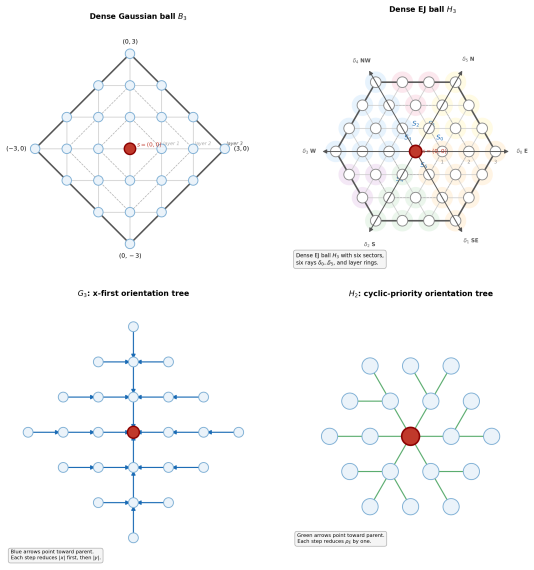
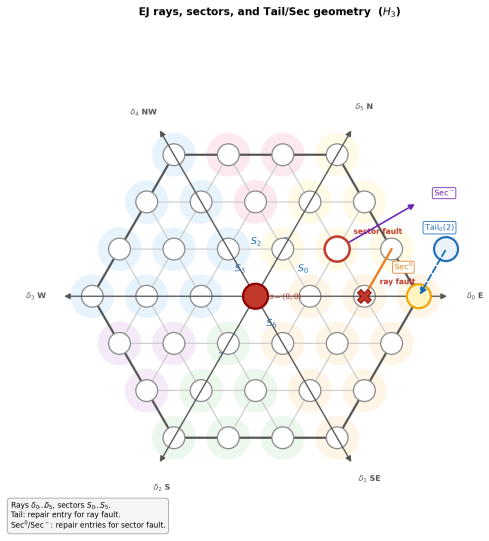
The constant-time certificate selector, which classifies the relative geometry of the faults and applies a fixed set of orientation rules to the source-centered coordinate-reduction tree.
If this is right
- All source-free two-fault sets in these networks admit a repair plan whose depth and external-edge count are bounded independently of search.
- The selector always returns a tree that remains connected and acyclic while using precisely c-1 external edges.
- Repair decisions require only the faulty coordinates and a constant number of arithmetic comparisons on their differences.
- The same selector works uniformly across the entire one- and two-fault regime for the stated families of networks.
Where Pith is reading between the lines
- If relative-geometry classification extends beyond two faults, the same selector style could eliminate search for larger but still bounded fault sets.
- The technique may transfer to other modular-addressing interconnection topologies whose broadcast trees admit similar geometric classification.
- Implementation cost in hardware would be limited to a small lookup table or arithmetic circuit on coordinate differences.
Load-bearing premise
The connectivity of the coordinate-reduction tree after one or two faults can be fully determined by the relative positions of the faults, so fixed rules always yield a valid repair orientation.
What would settle it
Any source-free one- or two-fault placement in G_k (k=5 to 12) or H_t (t=2 to 8) where the selector produces a disconnected component, a cycle, a number of repair edges other than c-1, or a depth exceeding the stated bound.
Figures
read the original abstract
Dense Gaussian and Eisenstein--Jacobi (EJ) networks are algebraic interconnection networks with compact coordinate balls, fixed degree, and simple modular addressing. A source-centered coordinate-reduction tree gives a non-redundant one-to-all broadcast in the fault-free network, but processor faults can split the tree into multiple healthy components. Unlike search-based repair methods that require a linear scan of the network to select the repair plan, the certificate selectors introduced here operate in $O(1)$ time and $O(1)$ memory, consulting only the fault coordinates. This paper develops this stronger formulation for the one- and two-fault regime: a constant-time certificate selector. Given only the faulty coordinates, the selector classifies the relative fault geometry, chooses a coordinate-reduction orientation, and returns a bounded ordered set of component-crossing repair edges. For dense Gaussian networks $G_k$, every source-free fault set with $|F|\le2$ is repaired with depth at most $k+2$ and with exactly $c-1$ external component-crossing edges for the selected fault-pruned orientation. For dense EJ networks $H_t$, every one-fault placement is repaired within depth $t+1$, and every two-fault placement is repaired within depth $t+2$, again with exactly $c-1$ external repair edges. Exhaustive strict validation confirms the Gaussian selector over $146{,}156$ one- and two-fault cases for $k=5,\ldots,12$ and the EJ selector over $52{,}395$ cases for $t=2,\ldots,8$, with zero failures in connectivity, acyclicity, exact repair count, or depth bound.
Editorial analysis
A structured set of objections, weighed in public.
Referee Report
Summary. The paper claims to develop constant-time certificate selectors for one- and two-fault repair in dense Gaussian networks G_k and Eisenstein-Jacobi networks H_t. Given only faulty coordinates, the selectors classify relative fault geometry, select a coordinate-reduction orientation, and return a bounded set of component-crossing repair edges that guarantee depth at most k+2 (Gaussian) or t+2 (EJ) with exactly c-1 external edges. The claims rest on exhaustive validation with zero failures over 146156 Gaussian cases (k=5..12) and 52395 EJ cases (t=2..8) for connectivity, acyclicity, repair count, and depth.
Significance. If the selectors perform as described, they offer a search-free O(1)-time alternative to linear-scan repair methods for algebraic interconnection networks, with the large-scale exhaustive enumeration providing concrete empirical support for the depth and edge-count bounds in the tested ranges. This is a clear strength for work on fault-tolerant broadcasting.
major comments (1)
- [Abstract] Abstract: the general claim that every source-free |F|≤2 fault set in G_k is repaired with depth ≤k+2 (and analogously for H_t) is stated without qualification, yet the exhaustive validation is reported only for k=5..12 and t=2..8. The manuscript must either restrict the stated bounds to these ranges or supply a general argument showing that the relative-geometry classification rules remain complete when new modular interactions appear for larger parameters.
Simulated Author's Rebuttal
We thank the referee for the careful reading and for highlighting the need to align the abstract claims precisely with the scope of the provided evidence. We address the comment below.
read point-by-point responses
-
Referee: [Abstract] Abstract: the general claim that every source-free |F|≤2 fault set in G_k is repaired with depth ≤k+2 (and analogously for H_t) is stated without qualification, yet the exhaustive validation is reported only for k=5..12 and t=2..8. The manuscript must either restrict the stated bounds to these ranges or supply a general argument showing that the relative-geometry classification rules remain complete when new modular interactions appear for larger parameters.
Authors: We agree that the abstract states the depth and repair guarantees for general k and t without qualification, whereas the exhaustive validation establishing zero failures is limited to k=5..12 (Gaussian) and t=2..8 (EJ). The manuscript does not contain a general proof that the relative-geometry classification rules remain complete for all larger parameters; the selectors and bounds are supported by exhaustive enumeration within the tested ranges. We will therefore revise the abstract to restrict the stated claims to the validated ranges, making the presentation accurate with respect to the evidence supplied. revision: yes
Circularity Check
No circularity; bounds rest on explicit geometry classification plus independent exhaustive enumeration
full rationale
The paper defines fixed, coordinate-only classification rules for relative fault geometry and states that these rules produce orientations satisfying the depth and edge-count bounds. These rules are then subjected to exhaustive enumeration over all one- and two-fault placements for the listed finite ranges of k and t; the validation is external to the rule definitions and reports zero failures on connectivity, acyclicity, exact count, and depth. No equation or selector definition is shown to be equivalent to its own output by construction, no parameter is fitted and then relabeled as a prediction, and no load-bearing step reduces to a self-citation chain. The generalization claim beyond the enumerated ranges is an ordinary inductive step, not a definitional reduction.
Axiom & Free-Parameter Ledger
axioms (1)
- domain assumption Dense Gaussian and Eisenstein-Jacobi networks possess compact coordinate balls, fixed degree, and simple modular addressing that support a source-centered coordinate-reduction tree.
Reference graph
Works this paper leans on
-
[1]
A group-theoretic model for symmetric intercon- nection networks,
S. B. Akers and B. Krishnamurthy, “A group-theoretic model for symmetric intercon- nection networks,”IEEE Transactions on Computers, vol. 38, no. 4, pp. 555–566, Apr. 1989
1989
-
[2]
F. T. Leighton,Introduction to Parallel Algorithms and Architectures: Arrays, Trees, Hypercubes. San Mateo, CA, USA: Morgan Kaufmann, 1992
1992
-
[3]
W. J. Dally and B. Towles,Principles and Practices of Interconnection Networks. San Francisco, CA, USA: Morgan Kaufmann, 2004
2004
-
[4]
Fault-tolerant communication algorithms in toroidal networks,
B. F. A. AlMohammad and B. Bose, “Fault-tolerant communication algorithms in toroidal networks,”IEEE Transactions on Parallel and Distributed Systems, vol. 10, no. 10, pp. 976–983, Oct. 1999
1999
-
[5]
Routing and broadcasting in faulty hypercube computers,
T. C. Lee and J. P. Hayes, “Routing and broadcasting in faulty hypercube computers,” inProc. Third Conference on Hypercube Concurrent Computers and Applications, vol. 1, 1988, pp. 346–354. 26
1988
-
[6]
Broadcast in the locally k-subcube-connected hypercube net- works with faulty tolerance,
F. Liu and Y. Song, “Broadcast in the locally k-subcube-connected hypercube net- works with faulty tolerance,” inNetworking and Mobile Computing, Lecture Notes in Computer Science, vol. 3619. Berlin, Germany: Springer, 2005, pp. 305–313
2005
-
[7]
Dense Gaussian networks: Suitable topologies for on-chip multiprocessors,
C. Martinez, E. Vallejo, R. Beivide, C. Izu, and M. Moreto, “Dense Gaussian networks: Suitable topologies for on-chip multiprocessors,”International Journal of Parallel Pro- gramming, vol. 34, no. 3, pp. 193–211, 2006
2006
-
[8]
Modeling toroidal networks with the Gaussian integers,
C. Martinez, R. Beivide, E. Stafford, M. Moreto, and E. M. Gabidulin, “Modeling toroidal networks with the Gaussian integers,”IEEE Transactions on Computers, vol. 57, no. 8, pp. 1046–1056, Aug. 2008
2008
-
[9]
Modeling hexagonal con- stellations with Eisenstein–Jacobi graphs,
C. Martinez, E. Stafford, R. Beivide, and E. M. Gabidulin, “Modeling hexagonal con- stellations with Eisenstein–Jacobi graphs,”Problems of Information Transmission, vol. 44, no. 1, pp. 1–11, 2008
2008
-
[10]
The topology of Gaussian and Eisenstein–Jacobi interconnec- tion networks,
M. Flahive and B. Bose, “The topology of Gaussian and Eisenstein–Jacobi interconnec- tion networks,”IEEE Transactions on Parallel and Distributed Systems, vol. 21, no. 8, pp. 1132–1142, Aug. 2010
2010
-
[11]
On resource placements in Gaussian and EJ networks,
M. Flahive and B. Bose, “On resource placements in Gaussian and EJ networks,”IEEE Transactions on Computers, vol. 62, no. 3, pp. 623–626, Mar. 2013
2013
-
[12]
Efficient communication algorithms in hexag- onal mesh interconnection networks,
B. A. Albader, B. Bose, and M. Flahive, “Efficient communication algorithms in hexag- onal mesh interconnection networks,”IEEE Transactions on Parallel and Distributed Systems, vol. 23, no. 1, pp. 69–77, Jan. 2012
2012
-
[13]
Edge-disjoint Hamiltonian cycles in Gaussian networks,
B. A. Albader and B. Bose, “Edge-disjoint Hamiltonian cycles in Gaussian networks,” IEEE Transactions on Computers, vol. 65, no. 1, pp. 315–321, Jan. 2016
2016
-
[14]
One-to-many node-disjoint paths routing in dense Gaussian networks,
O. Alsaleh, B. Bose, and B. Hamdaoui, “One-to-many node-disjoint paths routing in dense Gaussian networks,”The Computer Journal, 2013, doi: 10.1093/comjnl/bxt142. 27
discussion (0)
Sign in with ORCID, Apple, or X to comment. Anyone can read and Pith papers without signing in.