Communication Heterogeneity and Collective Consensus in Neural Cellular Automata
Pith reviewed 2026-06-26 12:51 UTC · model grok-4.3
The pith
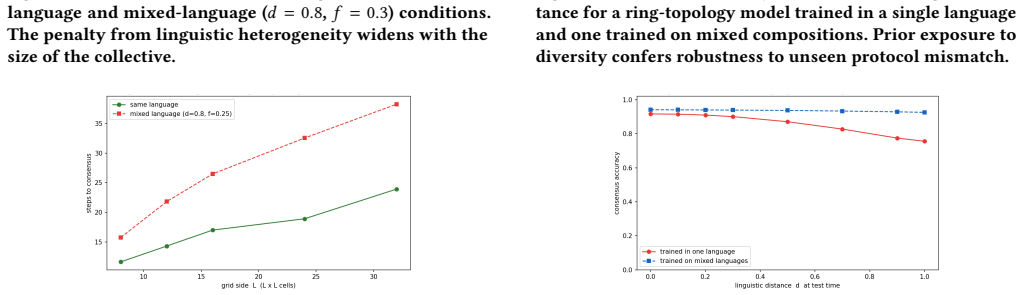
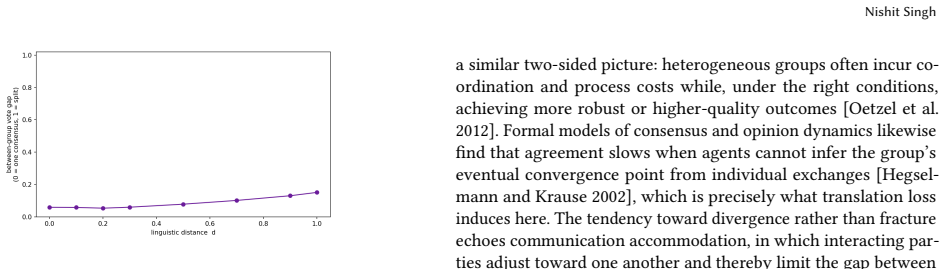
A neural cellular automaton trained under diverse communication protocols reaches consensus despite language mismatches that derail uniformly trained ones.
A machine-rendered reading of the paper's core claim, the machinery that carries it, and where it could break.
Core claim
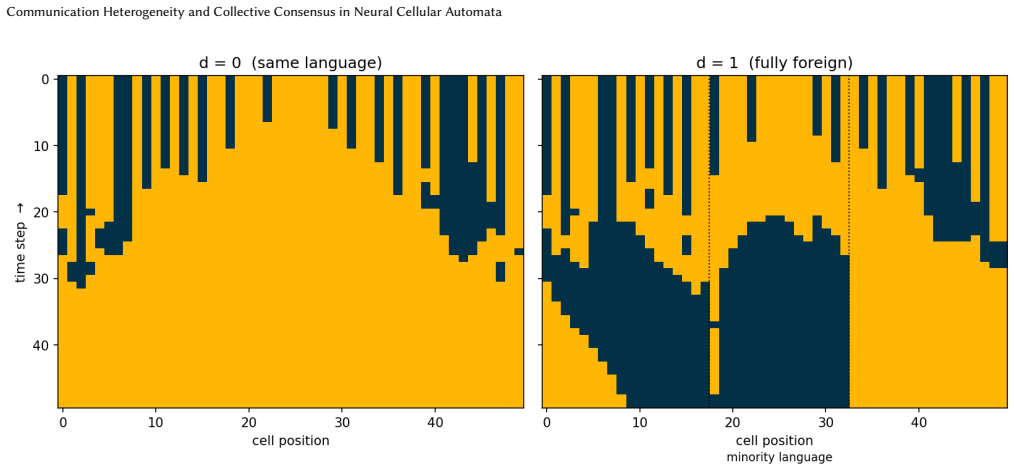
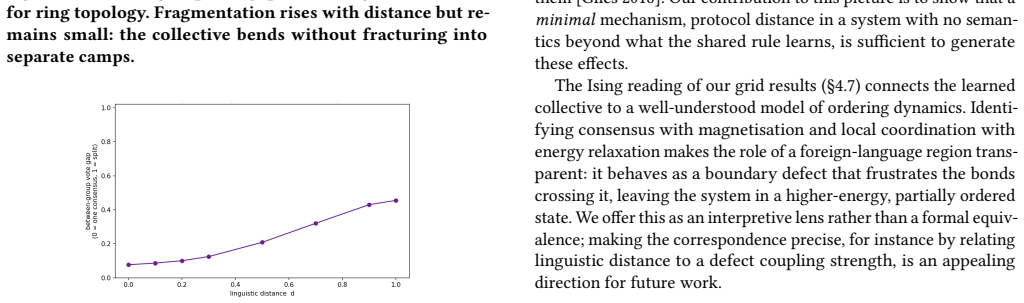
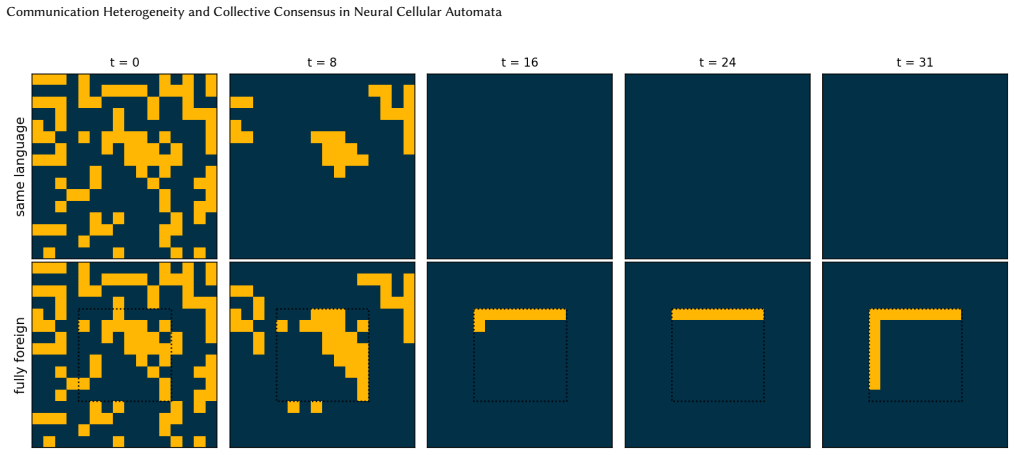
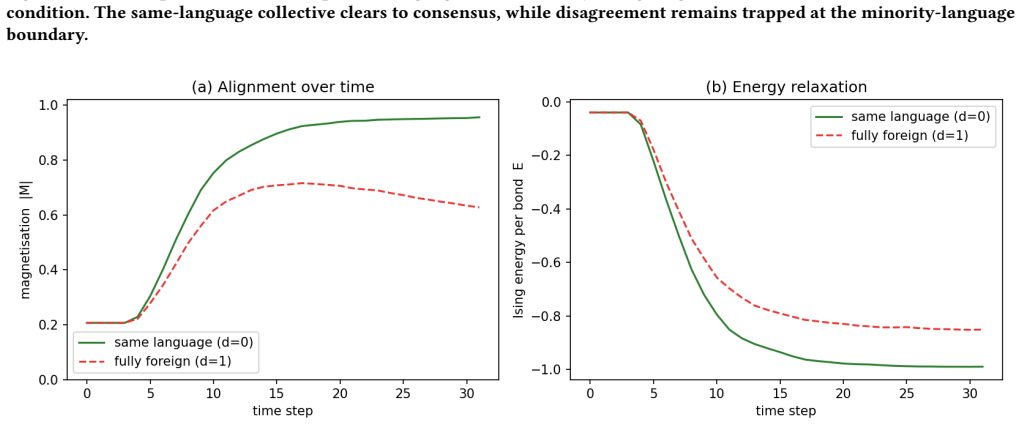
In a neural cellular automaton solving the density classification task, sub-populations separated by tunable linguistic distance slow consensus, produce partial rather than complete fragmentation, and leave a collective whose rule was trained on diverse protocols robust to mismatch while a homogeneously trained collective is not. The effect persists on both ring and two-dimensional grid topologies and admits a direct reading as Ising relaxation in which a foreign-language region functions as a boundary defect that holds the system in a higher-energy, partially ordered state.
What carries the argument
Neural cellular automaton with sub-populations that read one another's messages through tunable translation mismatch, used to model communication heterogeneity during consensus formation.
If this is right
- Linguistic distance slows consensus but produces only mild divergence between groups rather than full fragmentation.
- Robustness to mismatch appears on both ring and two-dimensional grid topologies.
- The mismatched region functions as a boundary defect that leaves the system in a higher-energy partially ordered state under an Ising reading.
- The observed patterns match effects reported in human group studies without requiring language-specific mechanisms.
Where Pith is reading between the lines
- Training protocols that deliberately vary communication rules during learning may help engineered collectives tolerate real-world diversity.
- The minimal mechanism could be tested by applying similar mismatch manipulations to other collective tasks such as flocking or resource allocation.
- The Ising analogy suggests experiments that measure energy-like quantities in human or robotic groups exposed to protocol differences.
Load-bearing premise
The density classification task in a neural cellular automaton with tunable translation mismatch between sub-populations serves as a faithful minimal model of communication heterogeneity in collective consensus.
What would settle it
Train one neural cellular automaton rule under uniform protocols and another under diverse protocols, then introduce a fixed linguistic distance between sub-populations and check whether the uniform rule fails to reach global majority while the diverse rule succeeds.
Figures
read the original abstract
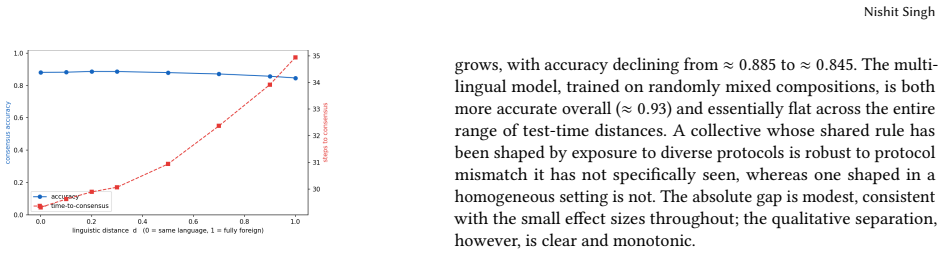
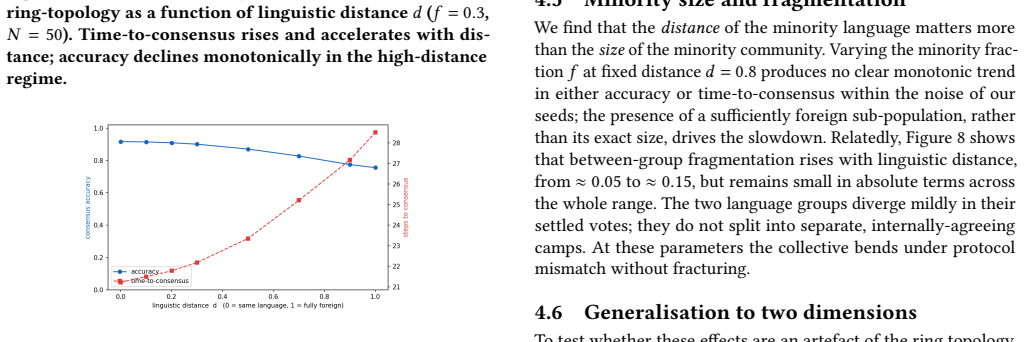
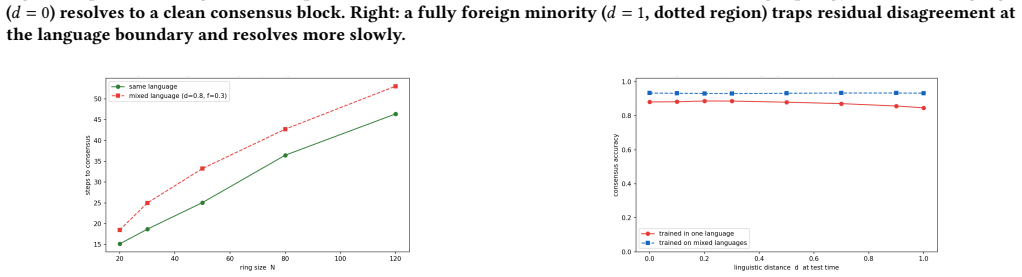
Reaching global agreement from purely local interactions is a defining problem of collective intelligence, and most models of it assume that all agents share a single communication protocol. We ask what happens when they do not. Using a Neural Cellular Automaton in which a population of cells must solve the density classification task, agreeing on a global majority that no individual can observe, we introduce ``languages'' as sub-populations that read one another's messages through a translation with a tunable ``linguistic distance''. We find that linguistic distance slows consensus, that it produces mild divergence between groups rather than full fragmentation, and that a collective whose shared rule was trained under diverse protocols is robust to mismatch; a homogeneously trained one is not. The findings hold on both a ring and a two-dimensional grid, and admit a natural reading as Ising relaxation, in which a foreign-language region acts as a boundary defect that leaves the system in a higher-energy, partially ordered state. These patterns are qualitatively consistent with effects reported in human group studies, suggesting that distance between communication protocols is a minimal mechanism sufficient to produce them, without anything language-specific.
Editorial analysis
A structured set of objections, weighed in public.
Referee Report
Summary. The manuscript uses neural cellular automata (NCA) to model collective consensus on the density classification task under communication heterogeneity. Sub-populations ('languages') interact via a tunable translation mismatch ('linguistic distance'). The central empirical claims are that linguistic distance slows consensus and produces mild divergence rather than fragmentation; that rules trained under diverse protocols remain functional under test-time mismatch while homogeneously trained rules do not; and that the patterns hold on both ring and grid topologies and admit a qualitative Ising-defect interpretation. The work suggests this mechanism is sufficient to reproduce patterns seen in human groups without language-specific ingredients.
Significance. If the simulation results are reproducible and the training protocols are fully specified, the paper supplies a controlled, minimal computational model linking protocol mismatch to consensus dynamics. The explicit comparison of diverse versus homogeneous training regimes is a clear strength, as is the consistency across topologies. The Ising reading, while qualitative, offers a concrete way to interpret the partial-ordering effect of foreign-language regions.
major comments (2)
- [Abstract] Abstract (paragraph on linguistic distance and Ising reading): The claim that the NCA density-classification setup with tunable translation mismatch constitutes a 'minimal mechanism sufficient to produce' the reported patterns rests on the untested assumption that the translation operation is a faithful proxy for communication heterogeneity; an ablation replacing the structured translation with unstructured noise or a different mismatch type would be required to establish specificity.
- [Methods] Methods (training protocol description): The central robustness result (diverse vs. homogeneous training) is load-bearing for the main claim, yet the abstract and visible text supply no information on the number of independent training runs, the precise schedule of protocol diversity during optimization, the loss function, or any statistical controls; without these the magnitude and reliability of the reported difference cannot be assessed.
minor comments (2)
- [Abstract] The abstract states the findings 'admit a natural reading as Ising relaxation' but provides no equation or figure that maps the NCA state to an energy or magnetization variable, making the analogy difficult to evaluate quantitatively.
- Notation for the translation operator and the linguistic-distance parameter is introduced without an explicit functional form or pseudocode, which would aid reproducibility even if the full implementation appears later.
Simulated Author's Rebuttal
We thank the referee for the constructive feedback. We address the two major comments point by point below, indicating where revisions will be made to improve clarity and reproducibility.
read point-by-point responses
-
Referee: [Abstract] Abstract (paragraph on linguistic distance and Ising reading): The claim that the NCA density-classification setup with tunable translation mismatch constitutes a 'minimal mechanism sufficient to produce' the reported patterns rests on the untested assumption that the translation operation is a faithful proxy for communication heterogeneity; an ablation replacing the structured translation with unstructured noise or a different mismatch type would be required to establish specificity.
Authors: The translation operation is introduced as an explicit, tunable model of structured communication mismatch between sub-populations (i.e., 'languages'), so it functions as the defined proxy for the heterogeneity under study. The manuscript's central claim is sufficiency: this mechanism produces the observed effects (slower consensus, mild divergence, and training-dependent robustness). We do not assert uniqueness or that unstructured noise would fail to produce similar outcomes; such an ablation would be a valuable extension but is not required to substantiate the sufficiency result as stated. We will revise the abstract to replace 'minimal mechanism sufficient' with 'controlled mechanism that produces' to avoid any implication of exclusivity. revision: partial
-
Referee: [Methods] Methods (training protocol description): The central robustness result (diverse vs. homogeneous training) is load-bearing for the main claim, yet the abstract and visible text supply no information on the number of independent training runs, the precise schedule of protocol diversity during optimization, the loss function, or any statistical controls; without these the magnitude and reliability of the reported difference cannot be assessed.
Authors: We agree that these implementation details are essential for evaluating the robustness comparison. The revised manuscript will move the following information from the supplement into the main Methods section: 10 independent training runs per condition, uniform random sampling of linguistic distances [0,1] at each optimization step for the diverse regime, mean-squared error loss on the final configuration versus the target majority, and statistical reporting (mean ± SEM across seeds with paired t-tests for the diverse vs. homogeneous difference). revision: yes
Circularity Check
No significant circularity; claims are direct simulation outputs
full rationale
The paper presents empirical results from training and testing Neural Cellular Automata on the density classification task under homogeneous vs. diverse protocols, with tunable translation mismatch. All reported findings (slower consensus, mild divergence, robustness differences, Ising-like interpretation) are stated as direct observations from the described simulations on ring and grid topologies. No load-bearing mathematical derivation, fitted parameter renamed as prediction, self-definitional loop, or self-citation chain appears in the provided text; the central claim does not reduce to its own inputs by construction.
Axiom & Free-Parameter Ledger
free parameters (1)
- linguistic distance
axioms (1)
- domain assumption Neural cellular automata with local update rules can solve the density classification task
invented entities (1)
-
languages as sub-populations with translation
no independent evidence
Reference graph
Works this paper leans on
-
[1]
A Path to Universal Neural Cellular Automata. InProceedings of the Genetic and Evolutionary Computation Conference Companion(NH Malaga Hotel, Malaga, Spain)(GECCO ’25 Companion). Association for Computing Machinery, New York, NY, USA, 2099–2107. doi:10.1145/3712255.3734310 Eric Bonabeau, Marco Dorigo, and Guy Theraulaz
-
[2]
Bonabeau, M
Swarm Intelligence : From Natural to Artificial Systems / E. Bonabeau, M. Dorigo, G. Theraulaz. (01 2001). Annajirao Challa, Duxiao Hao, Jordan C Rozum, and Luis M Rocha
2001
-
[3]
Alife2024 (July 2024)
The Effect of Noise on the Density Classification Task for Various Cellular Automata Rules. Alife2024 (July 2024). Guillaume Deffuant, David B. Neau, Frédéric Amblard, and Gérard Weisbuch
2024
-
[4]
Complex Syst.3 (2000), 87–98
Mixing beliefs among interacting agents.Adv. Complex Syst.3 (2000), 87–98. https://api.semanticscholar.org/CorpusID:15604530 P. Gach, G. L. Kurdyumov, and L. A. Levin
2000
-
[5]
English translation inProblems of Information Transmission, 14(3):223–226,
One-Dimensional Uniform Arrays That Wash Out Finite Islands.Problemy Peredachi Informatsii14, 3 (1978), 92–96. English translation inProblems of Information Transmission, 14(3):223–226,
1978
-
[6]
2016.Communication Accommodation Theory
http://mi.mathnet.ru/ppi1551 Howard Giles. 2016.Communication Accommodation Theory. doi:10.1002/ 9781118766804.wbiect056 Benedikt Hartl, Michael Levin, and Léo Pio-Lopez
2016
-
[7]
2025), 94–108
Neural cellular automata: Applications to biology and beyond classical AI.Phys Life Rev56 (Nov. 2025), 94–108. Nishit Singh Rainer Hegselmann and Ulrich Krause
2025
-
[8]
Lu Hong and Scott E
Opinion Dynamics and Bounded Confi- dence Models, Analysis and Simulation.Journal of Artificial Societies and Social Simulation5 (07 2002). Lu Hong and Scott E. Page
2002
-
[9]
Groups of diverse problem solvers can outperform groups of high-ability problem solvers.Proceed- ings of the National Academy of Sciences101, 46 (2004), 16385– 16389. arXiv:https://www.pnas.org/doi/pdf/10.1073/pnas.0403723101 doi:10.1073/pnas.0403723101 Mark Land and Richard K. Belew
-
[10]
No Perfect Two-State Cellular Automata for Density Classification Exists.Phys. Rev. Lett.74 (Jun 1995), 5148–5150. Issue
1995
-
[11]
doi:10.1103/PhysRevLett.74.5148 Yanjiang Li and Chong Tan
-
[12]
arXiv:https://doi.org/10.1080/21642583.2019.1695689 doi:10.1080/21642583.2019
A survey of the consensus for multi- agent systems.Systems Science & Control Engineering7, 1 (2019), 468–482. arXiv:https://doi.org/10.1080/21642583.2019.1695689 doi:10.1080/21642583.2019. 1695689 Alexander Mordvintsev, Ettore Randazzo, and Craig Fouts
-
[13]
arXiv:2205.01681 [cs.NE] https://arxiv.org/abs/2205
Growing Isotropic Neural Cellular Automata. arXiv:2205.01681 [cs.NE] https://arxiv.org/abs/2205. 01681 Eyvind Niklasson, Alexander Mordvintsev, Ettore Randazzo, and Michael Levin
-
[14]
https://distill.pub/selforg/2021/textures
Self-Organising Textures.Distill(2021). https://distill.pub/selforg/2021/textures. doi:10.23915/distill.00027.003 John Oetzel, Virginia Mcdermott, Annette Torres, and Christina Sanchez
-
[15]
The Impact of Individual Differences and Group Diversity on Group Interaction Climate and Satisfaction: A Test of the Effective Intercultural Workgroup Communication Theory.Journal of International and Intercultural Communication5 (05 2012), 144–167. doi:10.1080/17513057.2011.640754 Ettore Randazzo, Alexander Mordvintsev, Eyvind Niklasson, Michael Levin, ...
-
[16]
https://distill.pub/2020/selforg/mnist
Self-classifying MNIST Digits.Distill(2020). https://distill.pub/2020/selforg/mnist. doi:10.23915/distill.00027.002 Craig W. Reynolds
-
[17]
Flocks, herds and schools: A distributed behavioral model. InProceedings of the 14th Annual Conference on Computer Graphics and Interactive Techniques (SIGGRAPH ’87). Association for Computing Machinery, New York, NY, USA, 25–34. doi:10.1145/37401.37406 James Stovold
-
[18]
InALIFE 2025: Ciphers of Life: Proceedings of the Artificial Life Conference 2025 (isal2025, Vol
Identity Increases Stability of Neural Cellular Automata. InALIFE 2025: Ciphers of Life: Proceedings of the Artificial Life Conference 2025 (isal2025, Vol. 37). MIT Press. doi:10.1162/isal.a.848 J. Tsitsiklis, D. Bertsekas, and M. Athans
-
[19]
Distributed asynchronous deterministic and stochastic gradient optimization algorithms.IEEE Trans. Automat. Control31, 9 (Sept. 1986), 803–812. doi:10.1109/TAC.1986.1104412 Tamás Vicsek, András Czirók, Eshel Ben-Jacob, Inon Cohen, and Ofer Shochet
-
[20]
Novel Type of Phase Transition in a System of Self-Driven Particles.Phys. Rev. Lett. 75 (Aug 1995), 1226–1229. Issue
1995
-
[21]
doi:10.1103/PhysRevLett.75.1226 Kevin Xu and Risto Miikkulainen
-
[22]
arXiv:2506.15746 doi:10.48550/ARXIV.2506.15746
Neural Cellular Automata for ARC-AGI.CoRR abs/2506.15746 (2025). arXiv:2506.15746 doi:10.48550/ARXIV.2506.15746
discussion (0)
Sign in with ORCID, Apple, or X to comment. Anyone can read and Pith papers without signing in.